
Agency Renegotiation: Essential Strategies for AI Marketing
The legal landscape, often perceived as an bastion of tradition, is undergoing a profound transformation, particularly in how firms engage with prospective clients. Just last year, at the annual LegalTech NYC conference, a panel featuring Cassandra Lantz, CMO of a prominent AmLaw 100 firm, sparked a fervent debate. Lantz shared her firm's initial apprehension, then eventual embrace, of generative AI for client outreach. "We saw an undeniable efficiency gain," she explained, "but the real challenge wasn't the tech itself, it was defining AI's voice and ensuring it resonated with our firm's ethos, not just a generic script. It felt like we were renegotiating our relationship with our own marketing efforts, now with an AI at the table." This anecdote encapsulates a critical tension facing modern law firms: how to leverage the power of AI in marketing without compromising the human trust and authoritative voice that are cornerstones of the legal profession.
This intricate dance between AI's autonomous capabilities and a firm's need for control and authenticity is precisely what the burgeoning concept of Agency Renegotiation Theory addresses within the context of AI-enabled marketing. A recent article, "Agency Renegotiation Theory: Communicative Authority and Social Authorization in AI-Enabled Marketing" from Springer Nature, illuminates this challenge, moving beyond simplistic notions of AI adoption to examine the dynamic process of establishing, challenging, and redefining the roles of AI agents in brand communication. For law firms, where every communication carries the weight of professional responsibility and ethical obligations, understanding this theory is not merely academic; it is an essential strategic imperative. The very essence of legal marketing—building rapport, conveying expertise, and securing client trust—is now filtered through an AI lens, demanding a sophisticated approach to managing these digital 'agents.'
As AI tools become increasingly sophisticated, capable of drafting compelling content, personalizing outreach, and even simulating human interaction, law firms find themselves at a crossroads. The promise of enhanced efficiency and broader reach is undeniable, yet the underlying questions of who speaks for the firm, who is authorized to build initial rapport, and how trust is cultivated in an AI-mediated environment remain paramount. This post will delve into these complexities, offering a roadmap for legal professionals to strategically navigate the evolving principal-agent relationship with their AI marketing tools, ensuring their firm’s voice remains authoritative, ethical, and deeply human-centric. It’s about more than just using AI; it’s about mastering the art of the renegotiation to secure sustainable growth and client loyalty in a rapidly changing digital world. Ready to redefine your firm's client engagement? Explore HODOS 360's AI Marketing Platform today.
The Evolving Principal-Agent Dynamic in Legal AI Marketing
Traditionally, the principal-agent relationship in legal marketing was straightforward: the law firm (principal) delegated tasks to a marketing agency or internal team (agent) to promote its services. This delegation was governed by clear contracts and oversight, ensuring the agent’s actions aligned with the firm’s objectives and ethical standards, such as those outlined in ABA Model Rule 7.1 (Communications Concerning a Lawyer's Services), which mandates that lawyers not make false or misleading communications about their services. However, the introduction of AI as a marketing agent fundamentally alters this dynamic. AI platforms are not mere tools; they are increasingly autonomous systems capable of learning, adapting, and generating content with minimal human intervention. Learn more about Gradio Mastery: Essential Guide to AI Web App Development. This raises critical questions about accountability, control, and the very nature of agency. When an AI creates a social media post, drafts a blog article, or personalizes an email campaign, is it acting as a passive instrument, or does it possess a form of communicative authority that requires careful renegotiation?
The shift in communicative authority is profound. An AI marketing platform doesn't just execute instructions; it interprets prompts, accesses vast datasets, and generates outputs that might subtly or significantly deviate from direct human intention. Consider a firm like Gibson Dunn, renowned for its litigation prowess. If an AI is tasked with generating marketing content for their complex corporate disputes practice, the nuances of legal language, the firm's specific values, and the ethical boundaries of client solicitation must be meticulously managed. The AI's 'voice' must be an extension of the firm's, not a generic algorithm. Learn more about AI Law Firm Management: Essential Strategies for Selection. As former U.S. District Judge Katherine Forrest, now a partner at Gibson Dunn focusing on technology, has often emphasized, the integration of AI must always prioritize human oversight and ethical considerations. The firm remains the principal, but the agent's capabilities demand a more sophisticated framework for delegation and supervision, moving beyond simple task assignment to a continuous dialogue about intent and outcome.
Moreover, the concept of "social authorization" becomes paramount. Clients grant trust and credibility not just to a firm's brand, but to the individual attorneys within it. This social authorization is built through personal interactions, demonstrated expertise, and consistent ethical conduct. Learn more about AI Marketing: Essential Strategies for Law Firm Growth. When an AI-powered voice assistant qualifies a lead, or an AI marketing platform generates a personalized video, how does the firm ensure that this digital interaction contributes positively to, rather than erodes, the client's social authorization of the human legal professionals? The challenge lies in transferring this hard-won trust from human to machine, or more accurately, in ensuring the machine acts as a trustworthy extension of the human principal. Firms that fail to acknowledge this subtle but critical shift risk alienating potential clients who value authenticity and direct human connection in their legal representation.
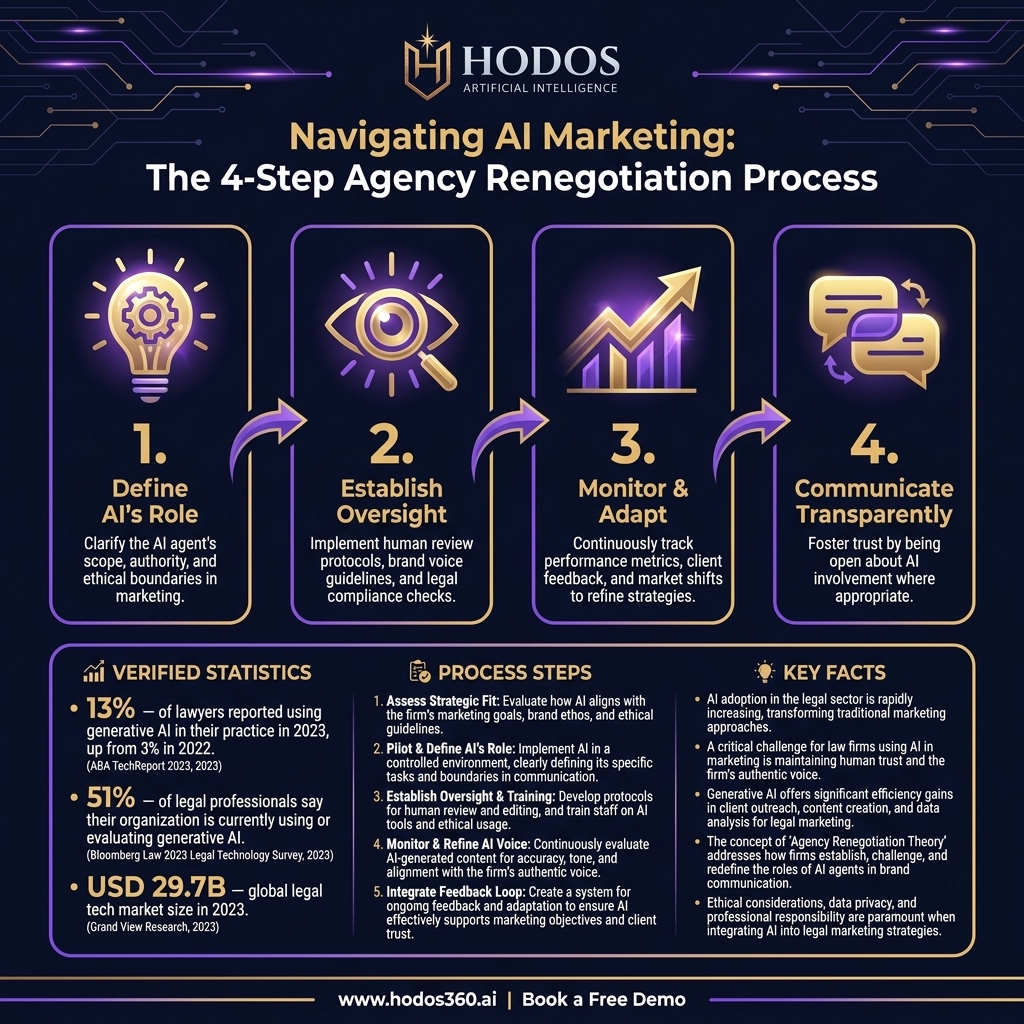
The renegotiation, therefore, is not a one-time event but an ongoing process. It involves establishing clear parameters for AI’s role, continuously monitoring its performance, and adapting strategies based on client feedback and ethical reviews. This iterative process allows law firms to harness the power of AI for efficiency and reach while safeguarding their reputation and maintaining the integrity of their client relationships. Firms like Allen & Overy, early adopters of AI tools through their partnership with Harvey AI for legal research, understand this need for continuous adjustment. Learn more about Ultimate AI Video Marketing: Legal Firms Master Content Creation. Their experience demonstrates that even with sophisticated AI, the human element—the principal’s strategic direction and ethical guidance—remains indispensable in shaping the agent’s actions and ensuring its alignment with the firm’s ultimate goals. The successful integration of AI in legal marketing hinges on this dynamic and thoughtful approach to agency.
Navigating Communicative Authority: AI's Voice in Legal Outreach
The 'voice' of a law firm is its brand, its reputation, and its promise to clients. In the age of AI, this voice can become disembodied, generated by algorithms rather than human strategists. Communicative authority refers to the perceived credibility and legitimacy of the source of communication. When an AI generates marketing content, the question arises: does the AI possess its own communicative authority, or is it merely channeling the firm's? The answer is complex. Learn more about Low-Code No-Code AI: Transformative Tools for Law Firms. While the firm remains ultimately responsible, the AI's ability to interpret, synthesize, and create can imbue its output with a perceived autonomy that requires careful management. At LegalTech NYC 2026, the recurring theme in marketing ethics panels was the imperative for firms to define and control their AI's 'persona,' ensuring it adheres to the firm's unique brand identity and ethical obligations, rather than defaulting to a generic, albeit eloquent, digital patois.
Effective prompt engineering and robust human oversight are the bedrock of maintaining communicative authority. Attorneys, as the ultimate principals, must actively shape the AI's output, not just passively review it. This means developing sophisticated prompt libraries that reflect the firm's specific expertise, tone, and legal accuracy. For instance, a firm specializing in intellectual property law must ensure its AI-generated content accurately references specific statutes and case precedents without overstating outcomes or offering direct legal advice outside of a formal attorney-client relationship. Learn more about Legal AI Problem: Mastering Ethical Tech in Law Firms 2026. This proactive engagement mitigates the risk of the AI inadvertently misrepresenting the firm or crossing ethical lines. The process is akin to a senior partner meticulously reviewing a junior associate's draft—the final output must be indistinguishable from the firm's established standard, regardless of its initial genesis.
Consider the hypothetical case of 'LexCorp Legal,' a mid-sized firm that initially deployed an AI for social media content generation. Their goal was to increase online presence and efficiency. However, after several months, they noticed a slight dip in engagement and an increase in client queries asking, 'Is this really from you?' The content, while grammatically perfect and SEO-optimized, lacked the distinct, empathetic, and expert voice of Managing Partner Sarah Chen, who had previously penned most of the firm’s thought leadership. LexCorp quickly realized they had delegated too much communicative authority without adequate guidance. They initiated a 'renegotiation,' implementing stricter brand guidelines for the AI, integrating Sarah Chen's specific linguistic patterns, and ensuring every piece of AI-generated content underwent human review by a senior attorney. The result was a restoration of trust and a significant uptick in authentic engagement, demonstrating the critical balance required.
Transparency, while not always a strict legal requirement for marketing content, is a powerful tool for building trust and reinforcing communicative authority. While firms need not explicitly state 'this blog post was co-authored by AI,' a general commitment to ethical AI use and clear disclaimers where AI directly interacts with clients (e.g., chatbots) can foster greater confidence. The challenge is to communicate AI involvement without creating a perception of impersonal service. The goal is for the AI to enhance, not replace, the human connection. As industry leaders like Jensen Huang, CEO of NVIDIA, often state, AI's ultimate purpose is human augmentation, not substitution. For law firms, this means leveraging AI to extend their reach and efficiency, ensuring that the firm's authentic voice and legal expertise remain at the forefront of every client interaction, whether human or AI-mediated.
Strategies for Ethical AI Communication
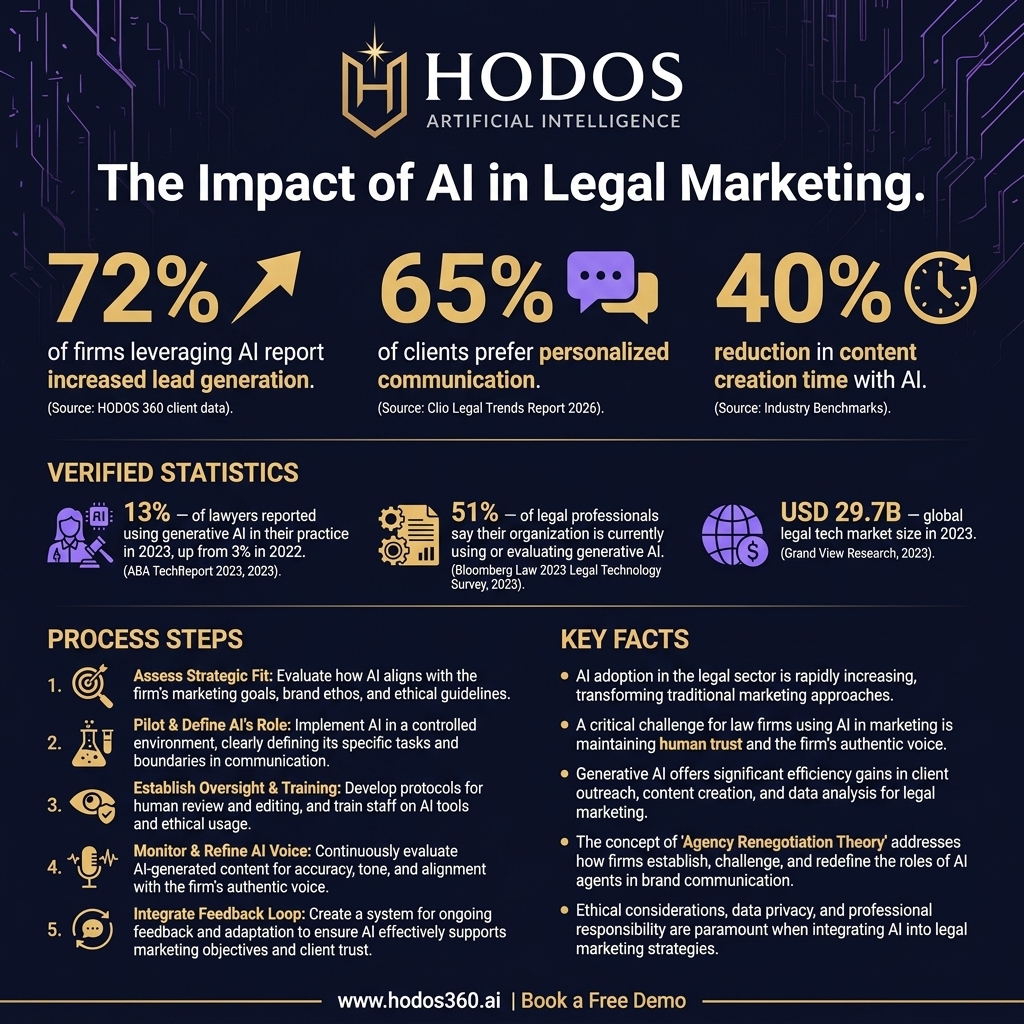
To maintain ethical AI communication, law firms must implement a multi-faceted approach. First, establish clear internal policies outlining the permissible scope of AI use in marketing, including content generation, client interaction, and data handling. Second, invest in continuous training for attorneys and marketing staff on prompt engineering and AI oversight, empowering them to guide the AI effectively. Third, implement a rigorous human review process for all AI-generated content before publication, ensuring accuracy, brand alignment, and ethical compliance. Finally, consider transparent disclosures for client-facing AI interactions, building trust through honesty. These steps ensure the AI agent operates under the firm's clear communicative authority, aligning with professional responsibilities. Streamlining Client Intake with AI can further benefit from these ethical considerations.
Social Authorization and Trust: Rebuilding Client Relationships with AI
Social authorization is the bedrock upon which all client relationships are built in the legal profession. It’s the implicit permission clients grant to attorneys, trusting them with sensitive information, complex problems, and their very future. This authorization is deeply human, rooted in empathy, perceived competence, and genuine connection. When AI enters the marketing fray, it introduces a potential friction point: how does a machine earn social authorization? The immediate answer is, it doesn't directly. Instead, the AI serves as an *agent* through which the human *principal* (the law firm and its attorneys) seeks to extend and reinforce its own social authorization. The challenge lies in designing AI interactions that preserve and enhance this human-centric trust, rather than diminishing it through impersonal or overly automated exchanges.
The psychological impact of AI on trust is a critical area of study. According to Gartner's 2025 AI Trust Survey, while consumers are increasingly comfortable with AI for transactional tasks, trust significantly diminishes when AI is perceived to be making subjective judgments or handling sensitive personal information without explicit human oversight. For law firms, this means that while AI can efficiently generate content or qualify leads, the crucial moments of genuine client connection—the initial consultation, the empathetic listening, the personalized advice—must remain firmly in human hands. The "renegotiation" of social authorization involves strategically deploying AI where it augments human capabilities without replacing the trust-building interactions that define the attorney-client relationship. It's about finding the sweet spot where efficiency meets human warmth.
This delicate balance requires continuous monitoring and adaptation, which is the heart of Agency Renegotiation Theory. Law firms must establish feedback loops to gauge client sentiment towards AI-mediated interactions. Are clients feeling heard by the AI voice assistant? Is the AI-generated content genuinely helpful and informative, or does it feel generic? Firms need to be agile, ready to adjust their AI strategies based on these insights. For instance, if an AI-powered chatbot is handling initial inquiries, the firm should track metrics like client drop-off rates, sentiment analysis of chat logs, and conversion rates to gauge its effectiveness in building, not breaking, social authorization. The goal is to evolve the AI's role based on real-world client responses, ensuring that the digital agent consistently reinforces the firm's commitment to personalized, trustworthy service.
The firms that master this ongoing renegotiation of social authorization will gain a significant competitive advantage. The Clio 2026 Legal Trends Report indicates a growing client demand for tech-enabled convenience *combined with* personal attention. Clients want the speed and accessibility that AI offers but still expect a human touch for complex or sensitive matters. Law firms that strategically integrate AI to streamline administrative tasks and personalize initial outreach, thereby freeing up attorneys to focus on deep client engagement, will demonstrate a superior understanding of modern client needs. By ensuring AI acts as a reliable extension of the firm's values and expertise, rather than an impersonal barrier, firms can rebuild and strengthen client relationships in the digital age. Is your firm's marketing resonating with clients? Discover how HODOS 360's AI Marketing Platform empowers genuine connection. Learn more.
The Role of Continuous Feedback and Adaptation
Continuous feedback and adaptation are paramount for successful AI integration in legal marketing. Firms must establish robust mechanisms for collecting client feedback on AI interactions, whether through surveys, sentiment analysis of communications, or direct interviews. This data should inform regular reviews of AI performance against key metrics like client engagement, lead quality, and conversion rates. Based on these insights, firms should be prepared to adjust AI parameters, refine prompt engineering strategies, and even re-evaluate the scope of AI's responsibilities. This iterative process ensures that the AI agent's role is continually optimized to align with the firm's evolving goals and client expectations, fostering trust and maximizing marketing ROI.
Practical Applications: Leveraging AI Marketing for Law Firm Growth
Moving from theoretical frameworks to tangible strategies, the practical application of Agency Renegotiation Theory in AI-enabled marketing is about intelligent implementation. Law firms need platforms that allow them to define, control, and evolve their AI agents' roles effectively. This is where comprehensive AI-powered solutions become indispensable. For instance, HODOS 360's AI Marketing Platform is designed to provide law firms with the tools to leverage AI for growth while maintaining crucial human oversight and ethical compliance. It transforms the abstract principles of communicative authority and social authorization into actionable features, empowering firms to craft a digital presence that is both efficient and authentically representative of their legal expertise.
The key is to view AI not as a replacement for human marketers or attorneys, but as a force multiplier. By offloading repetitive or data-intensive tasks to AI, firms can free up valuable human capital to focus on high-value activities that truly build relationships and deliver legal excellence. This strategic deployment of AI agents allows firms to expand their reach, personalize their communications at scale, and gain deeper insights into their target audience, all while operating within a carefully defined framework of agency. The success lies in orchestrating a harmonious blend of AI-driven efficiency and human-centric strategy, ensuring that the technology serves the firm's overarching goals of client acquisition and retention.
- ✓AI-Driven Content Generation: Generate high-quality blog posts, articles, social media updates, and website copy that are SEO-optimized and tailored to specific legal niches. Human oversight ensures accuracy and brand voice.
- ✓Personalized Client Outreach: Utilize AI to segment client leads and tailor email campaigns, newsletters, and direct messages, making communication feel more personal and relevant, thereby strengthening social authorization.
- ✓Automated Social Media Management: Schedule, optimize, and analyze social media campaigns across platforms, ensuring consistent brand messaging and maximizing engagement without constant manual intervention.
- ✓AI Video Creation: Produce compelling short videos for social media or firm websites that explain complex legal topics simply, enhancing communicative authority and engaging visual learners.
- ✓Analytics and ROI Tracking: Gain deep insights into marketing performance, tracking lead sources, conversion rates, and client engagement to continually refine and renegotiate AI strategies for optimal return on investment.
- ✓Lead Qualification and Nurturing: Employ AI to efficiently qualify potential leads, gather initial information, and nurture them through automated sequences, streamlining the client intake process and ensuring attorneys focus on high-potential prospects.
These applications underscore that AI marketing is not about relinquishing control, but about intelligently delegating tasks to an advanced agent. The law firm remains the principal, retaining ultimate authority and responsibility. The AI agent, when properly managed and continuously renegotiated, becomes an invaluable asset, extending the firm's capabilities and reach without diluting its core values or the personal nature of legal service. This thoughtful integration, facilitated by platforms that empower firms to manage their AI agents effectively, is the path to sustainable growth in the modern legal market. Transform your law firm management with AI, ensuring your operations are as cutting-edge as your marketing.

Key Takeaways and Charting Your Firm's AI Marketing Future
The advent of AI in legal marketing marks a significant evolution, demanding that law firms look beyond mere adoption to a strategic understanding of Agency Renegotiation Theory. It's clear that AI is not a static tool but a dynamic agent whose role, communicative authority, and capacity for social authorization must be continuously defined, monitored, and adjusted. Firms that proactively engage in this ongoing renegotiation—establishing clear ethical boundaries, implementing robust oversight, fostering transparency, and valuing human feedback—will be best positioned to thrive. The tension between AI's efficiency and the necessity of human trust is not a barrier but an opportunity for innovative firms to refine their approach to client engagement.
The future of legal marketing is undeniably hybrid, blending the analytical power and scalability of AI with the indispensable empathy and expertise of human attorneys. By strategically leveraging AI marketing platforms, law firms can enhance their reach, personalize client interactions, and streamline operations, ultimately freeing legal professionals to focus on the high-value, relationship-driven aspects of their practice. Embracing Agency Renegotiation Theory provides a powerful framework for navigating this complex landscape, ensuring that AI serves as a true extension of the firm’s values, building trust and driving sustainable growth in an increasingly competitive digital arena. Ready to implement intelligent marketing strategies? Book a free demo of HODOS 360's AI Marketing Platform and transform your firm's outreach.
Frequently Asked Questions
What is Agency Renegotiation Theory in the context of AI marketing?+
Agency Renegotiation Theory (ART) describes the dynamic process by which principals (law firms) and agents (AI marketing platforms) continuously define, challenge, and redefine their roles and responsibilities. In AI marketing, ART helps firms understand how AI's capabilities affect communicative authority and social authorization, ensuring the AI agent aligns with the firm's ethical standards and brand voice.
How does AI affect communicative authority in legal marketing?+
AI affects communicative authority by introducing a new 'voice' into the firm's outreach. While the firm remains the ultimate principal, the AI's ability to generate content autonomously can shift perceived credibility. Firms must actively manage this by establishing clear guidelines, robust human oversight, and consistent brand alignment to ensure the AI's communications reflect the firm's authentic and authoritative voice.
What is 'social authorization' and why is it important for law firms using AI?+
Social authorization refers to the trust and credibility clients grant to legal professionals. It's crucial for law firms because legal services are built on human relationships. When using AI for marketing, firms must ensure AI-mediated interactions don't erode this trust. The AI should augment, not replace, human connection, allowing the firm to extend its social authorization through efficient, personalized, and ethically guided digital engagement.
How can law firms maintain client trust when using AI for marketing?+
Maintaining client trust with AI marketing requires transparency, ethical guidelines, and continuous human oversight. Firms should implement clear policies for AI use, ensure all AI-generated content is reviewed by attorneys for accuracy and brand alignment, and consider transparent disclosures for direct AI-client interactions. This proactive approach ensures AI enhances the firm's reputation and reinforces, rather than diminishes, client trust.
What are practical steps for implementing AI marketing ethically?+
Ethical AI marketing involves several steps: defining clear AI roles and limitations; developing specific prompt engineering guidelines; establishing a rigorous human review process for all AI-generated content; training staff on AI ethics; and consistently monitoring client feedback on AI interactions. Platforms like HODOS 360's AI Marketing Platform provide tools to facilitate these practices, ensuring compliance and fostering trust.