
AI Legal Efficiency: Proven Strategies to Avoid Busywork
The promise of artificial intelligence in the legal sector has been nothing short of revolutionary: a future where tedious tasks vanish, research is instantaneous, and lawyers are freed to focus on high-value strategic work. Yet, for many law firms, the reality has proven more complex. A recent Law.com article, "AI Promises to Save Lawyers Time; But Is It Actually Creating More ‘Busywork’?", illuminated a growing concern: despite significant investment, some AI implementations are inadvertently generating new forms of administrative burden, from validating AI-generated drafts to correcting erroneous research. This paradox challenges firms to look beyond the hype and strategically integrate AI to truly enhance AI legal efficiency.
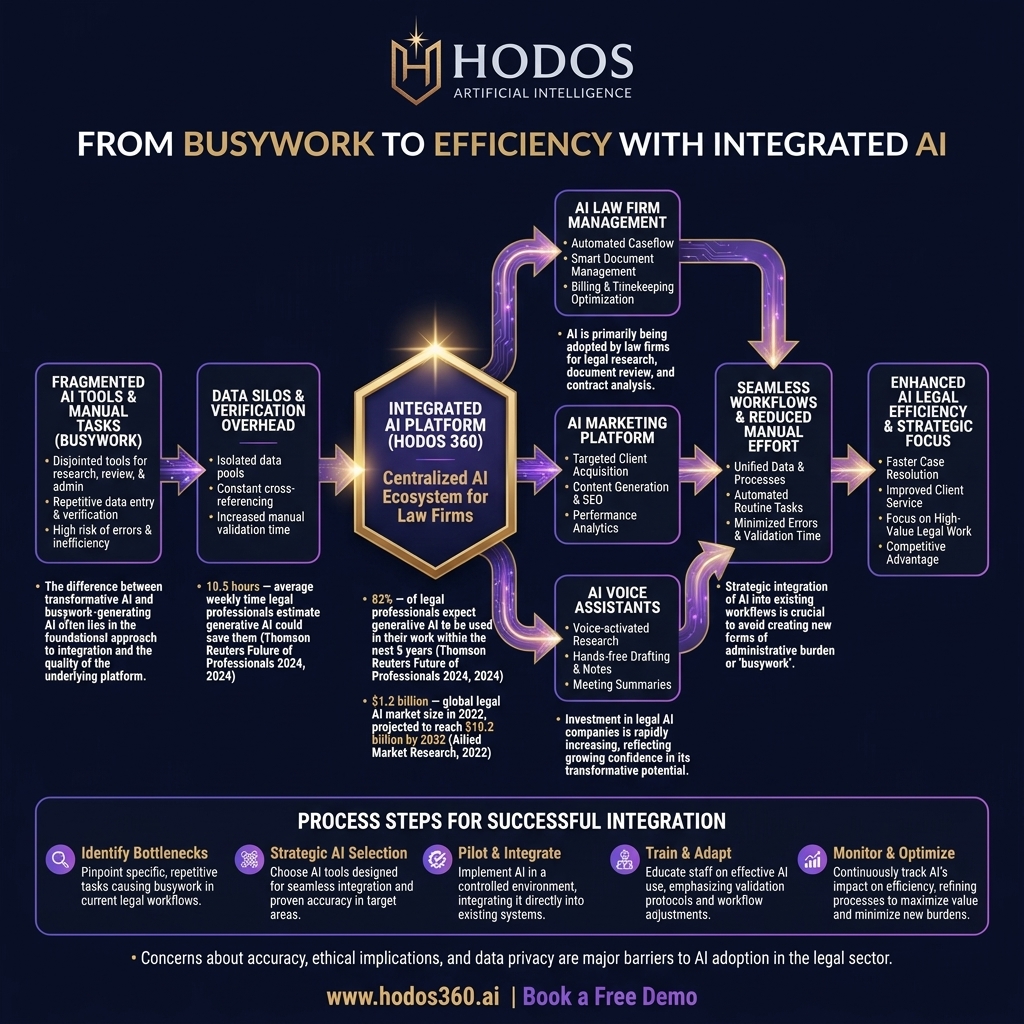
This isn't a critique of AI itself, but rather a crucial examination of its deployment. The legal industry has witnessed substantial investments in AI, with companies like Harvey AI securing significant funding and forming partnerships with global giants like Allen & Overy to develop bespoke legal large language models (LLMs). These collaborations, lauded at events like LegalTech NYC 2026, demonstrate the immense potential. However, the difference between transformative AI and busywork-generating AI often lies in the foundational approach to integration and the quality of the underlying platform. Without a coherent strategy, firms risk merely digitizing inefficiencies rather than eradicating them.
The core challenge lies in shifting from a reactive adoption of AI tools to a proactive, integrated strategy. The goal is not just to use AI, but to embed it within existing workflows to create seamless, intelligent processes. This requires understanding where AI truly adds value, how to mitigate its inherent risks, and selecting platforms that are designed for comprehensive legal firm management, not just isolated task automation. The path to achieving genuine AI legal efficiency demands a holistic view, ensuring that technology serves the lawyer, not the other way around. Firms must critically assess whether their current AI tools are truly reducing workload or simply shifting it.
The initial wave of AI adoption often focused on discrete tasks: document review, contract analysis, or basic legal research. While these applications offer undeniable benefits, a fragmented approach can lead to a 'Frankenstein's monster' of disparate tools that don't communicate effectively. "The real value of AI isn't just in automating a single task, but in orchestrating a symphony of interconnected processes," notes Brad Blickstein of the Blickstein Group, a leading legal tech consultant. He often highlights that without proper integration, lawyers spend more time context-switching and verifying outputs from multiple systems, negating any potential time savings. This scenario is particularly prevalent in firms that hastily adopted several point solutions without a unifying platform strategy, leading to a new kind of digital busywork.
Consider the experience of a partner at a mid-sized firm in Chicago, who, after investing in several standalone AI tools for research and drafting, found himself spending nearly an extra hour each day reconciling information. Learn more about AI Marketing Workflows: The Proven Advantage for Law Firms. "The AI was fast, but it didn't 'know' our internal case history or client preferences, so every output required heavy manual customization and cross-referencing against our existing knowledge base," he lamented during a recent industry roundtable. This anecdote underscores a critical point: generic AI, while powerful, often lacks the contextual intelligence needed for specialized legal work. The promise of AI legal efficiency remains elusive when tools operate in silos, disconnected from the firm's unique operational DNA.
- ✓Streamlined Client Intake: Automate data collection, conflict checks, and initial document generation, reducing administrative overhead.
- ✓Intelligent Document Automation: Generate complex legal documents, contracts, and pleadings with AI assistance, ensuring consistency and accuracy.
- ✓Enhanced Case Management: Utilize AI to prioritize tasks, predict case outcomes, and manage deadlines more effectively.
- ✓Automated Billing & Expense Tracking: AI-powered systems can learn billing patterns, flag inconsistencies, and streamline invoice generation.
- ✓Proactive Workflow Suggestions: AI-powered legal workflows can guide attorneys through complex processes, ensuring compliance and best practices.
- ✓Personalized Marketing Campaigns: AI marketing platform tools generate targeted content and manage social media, freeing up internal resources.
- ✓24/7 Client Communication: AI voice assistants handle routine inquiries, qualify leads, and schedule appointments, improving client service without consuming attorney time.
Strategic AI Implementation: Beyond Isolated Task Automation
To genuinely enhance AI legal efficiency, firms must move beyond a piecemeal approach to AI adoption. This involves a strategic shift towards integrated platforms that can manage multiple aspects of a law firm's operations. The goal is to create a symbiotic relationship between human expertise and artificial intelligence, where AI handles the repetitive, data-intensive, and predictive elements, allowing lawyers to focus on judgment, strategy, and client relationships. According to a 2024 report by McKinsey & Company, firms that implement AI across integrated workflows achieve 20-30% higher productivity gains compared to those using isolated tools, primarily by reducing the 'handoff' and 'verification' overhead. This data highlights the critical importance of a unified strategy.
The integration of AI into core legal firm management systems is paramount. Learn more about AI Marketing: The Ultimate Shift for Law Firms. Instead of relying on separate tools for case management, billing, client intake, and document automation, a comprehensive AI-powered platform unifies these functions. For instance, when a new client is onboarded via an AI-driven intake system, that data should seamlessly flow into case management, trigger document generation, and inform initial billing setup. This eliminates redundant data entry and minimizes errors, which are common sources of 'busywork.' Firms like Clifford Chance have invested heavily in internal AI development, not just for external client work, but for optimizing their own operational backbones, demonstrating a commitment to holistic integration.
The Role of AI-Powered Legal Workflows in Reducing Busywork
One of the most powerful applications of AI in reducing busywork is through intelligent legal workflows. These aren't just automated checklists; they are dynamic systems that learn from past cases, flag potential issues, suggest next steps, and even draft initial communications based on context. For example, in litigation, an AI-powered workflow might automatically identify relevant precedents, highlight discovery obligations based on jurisdiction, and generate initial draft motions, all while ensuring compliance with Federal Rules of Civil Procedure. This proactive assistance significantly cuts down on manual review and ensures consistency across cases, a major boost to AI legal efficiency. The EU AI Act, expected to be fully enforced by 2027, will also place new emphasis on transparent and accountable AI systems, further driving the need for well-defined, auditable AI workflows.
Furthermore, generative AI, when properly trained on a firm's proprietary data and ethical guidelines, can move beyond generic content creation to produce highly specific, contextually relevant legal documents. Learn more about AI Voice Assistant: Essential Lead Qualification for Law Firms. This requires significant investment in data governance and model training, as demonstrated by firms like Allen & Overy with Harvey AI. Their approach involves feeding the AI with thousands of internal legal documents, ensuring its outputs reflect the firm's specific style, precedents, and risk tolerance. This level of customization is what transforms AI from a general tool into a bespoke legal assistant, capable of drafting nuanced legal arguments or complex contracts, substantially reducing the need for extensive human editing and verification – the very definition of eliminating busywork.
Navigating Data, Ethics, and Competence in AI Adoption
The pursuit of AI legal efficiency is inextricably linked with the ethical and professional obligations of lawyers. As firms increasingly rely on AI, questions of data privacy, client confidentiality (ABA Model Rule 1.6), and lawyer competence (ABA Model Rule 1.1) become paramount. The recent openai news regarding data breaches and privacy concerns underscores the importance of choosing AI platforms with robust security protocols and transparent data handling policies. Firms must ensure that any client data processed by AI remains confidential and is not inadvertently exposed or used to train public models. This often means opting for private, secure cloud environments and AI models specifically designed for legal applications, rather than general-purpose tools.
Moreover, the duty of technological competence requires lawyers to understand not only how AI works but also its limitations. Learn more about WordPress AI Unlocked: Legal Websites Mastered 2026. This includes recognizing the potential for 'hallucinations' in generative AI—where the model produces plausible but factually incorrect information. A lawyer cannot simply delegate their ethical duties to an algorithm. As demonstrated in a high-profile case involving a lawyer who cited fictitious cases generated by ChatGPT, the ultimate responsibility for accuracy and truthfulness lies with the human attorney. Therefore, effective AI integration must include rigorous validation processes and ongoing training for legal professionals on how to effectively review and leverage AI outputs, transforming potential busywork into targeted, efficient review.
Training and Change Management for Successful AI Integration
Implementing AI is as much about people and processes as it is about technology. Resistance to change, lack of understanding, and insufficient training can quickly turn a promising AI investment into another source of frustration and busywork. Law firms must invest in comprehensive training programs that educate attorneys and staff on how to effectively use new AI tools, understand their capabilities and limitations, and integrate them into daily routines. This isn't a one-time workshop; it's an ongoing commitment to digital literacy and adaptation. Firms that prioritize change management, fostering a culture of innovation and continuous learning, are far more likely to realize the full potential of AI legal efficiency.
Successful change management also involves clear communication about the 'why' behind AI adoption. Learn more about ActiveCampaign 2026: AI Marketing Unleashes Law Firm Growth. It's crucial to articulate how AI will empower legal professionals, reduce their most tedious tasks, and allow them to deliver better client outcomes, rather than simply presenting it as a cost-cutting measure or a threat to job security. Leaders like Jensen Huang of NVIDIA often speak about the importance of human-AI collaboration, emphasizing that AI is a co-pilot, not a replacement. By framing AI as a tool for augmentation and professional growth, firms can build buy-in and transform potential resistance into enthusiastic adoption, ensuring that AI truly saves time rather than creating more busywork.
HODOS 360: A Blueprint for Integrated AI Legal Efficiency
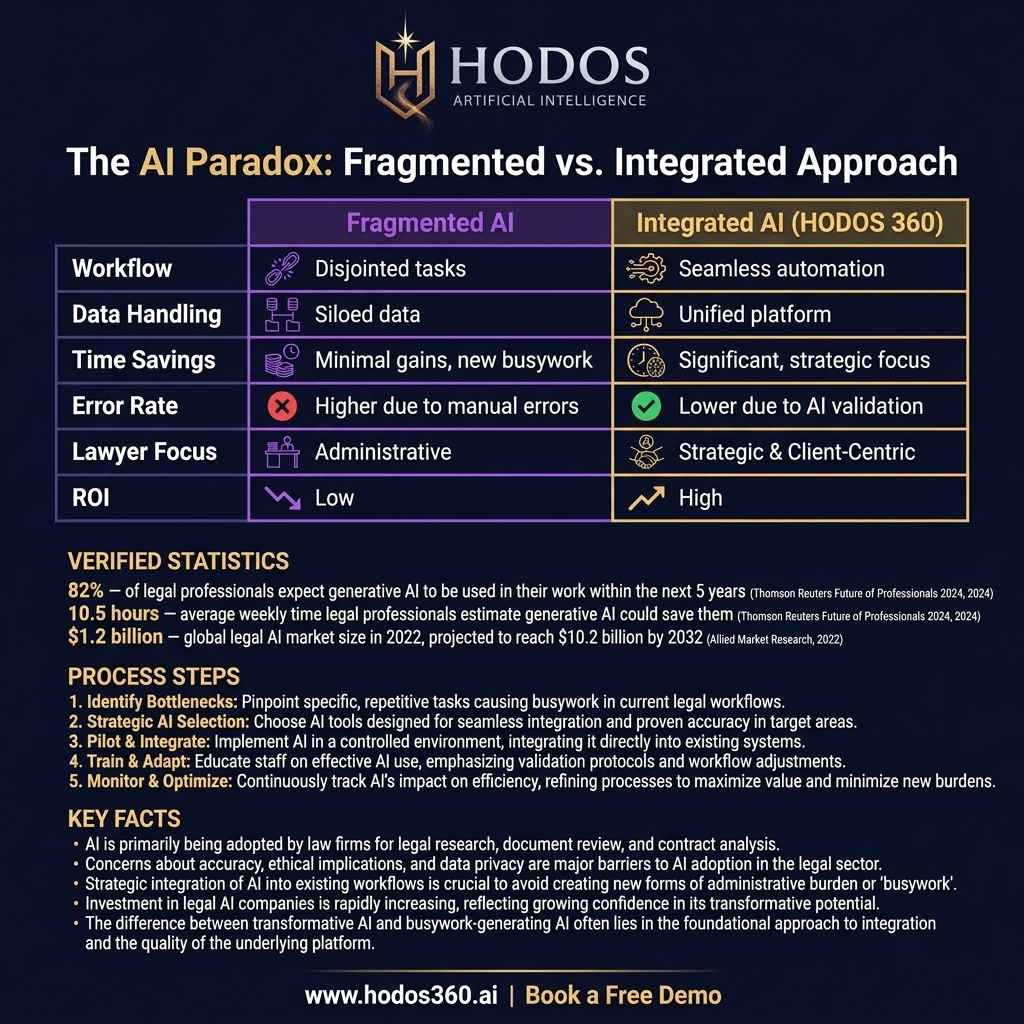
The path to unlocking true AI legal efficiency and avoiding the 'busywork paradox' lies in adopting a comprehensive, integrated platform. HODOS 360 offers a holistic solution designed specifically for modern law firms, addressing the very challenges highlighted by the Law.com article. Its AI Law Firm Management System unifies case management, billing, client intake, and document automation, ensuring seamless data flow and intelligent workflows that genuinely reduce manual tasks. By providing a single source of truth for all firm operations, HODOS 360 eliminates the need for lawyers to navigate fragmented systems, thereby minimizing context-switching and verification overhead, which are prime contributors to busywork. This integrated approach ensures that AI enhances, rather than complicates, legal practice.
Beyond internal operations, HODOS 360 extends its AI capabilities to client acquisition and communication. Learn more about AI Website Builders: Ultimate Growth for Law Firms. The AI Marketing Platform automates content generation, social media management, and ROI tracking, while AI Voice Assistants provide 24/7 phone answering, lead qualification, and appointment booking. These services free up valuable attorney and paralegal time, allowing them to focus on legal work instead of administrative and marketing overhead. By integrating these external-facing AI tools with internal management, HODOS 360 creates a cohesive ecosystem where every aspect of the firm benefits from intelligent automation, delivering a tangible return on investment and demonstrating a clear path to achieving unparalleled AI legal efficiency.

Key Takeaways and Next Steps for Your Firm
The debate around AI creating more busywork for lawyers is a vital one, prompting law firms to critically re-evaluate their technology strategies. The key takeaway is clear: generic, fragmented AI solutions often fall short of their promises, sometimes exacerbating administrative burdens. True AI legal efficiency emerges from strategic, integrated implementation, where AI tools are deeply embedded into core workflows, trained on proprietary data, and supported by robust ethical frameworks and comprehensive human training. Firms that embrace this holistic approach will not only avoid the busywork trap but will also unlock unprecedented levels of productivity, client satisfaction, and competitive advantage.
To move forward, assess your firm's current AI landscape. Are your tools integrated, or are they silos? Are your lawyers adequately trained to leverage AI effectively and ethically? Consider platforms that offer comprehensive, AI-powered solutions across management, marketing, and client communication. The future of legal practice isn't just about adopting AI; it's about adopting AI intelligently. The firms that do so will redefine what AI legal efficiency truly means, ensuring that innovation truly serves the pursuit of justice and superior client service, rather than adding to the daily grind.
Frequently Asked Questions
How can law firms avoid AI creating more 'busywork'?+
To avoid AI-induced busywork, law firms must adopt integrated AI platforms rather than fragmented point solutions. Focus on AI that automates entire workflows, not just isolated tasks, and ensure seamless data flow between systems. Invest in training your team to use AI effectively and validate outputs efficiently. Prioritize platforms that can be customized with your firm's specific data and ethical guidelines, minimizing generic or erroneous outputs that require extensive manual correction.
What are the core components of genuine AI legal efficiency?+
Genuine AI legal efficiency stems from a holistic approach. Key components include an integrated AI Law Firm Management System for case management, billing, and document automation; an AI Marketing Platform for lead generation and brand building; and AI Voice Assistants for 24/7 client communication. These systems should work in concert, reducing manual handoffs, eliminating redundant data entry, and providing intelligent support across all firm operations, freeing lawyers for strategic work.
How does AI-powered document automation reduce busywork?+
AI-powered document automation reduces busywork by generating accurate, compliant, and customized legal documents much faster than manual processes. Instead of drafting from scratch or heavily editing generic templates, AI can pull relevant data from case files, apply specific clauses, and ensure consistency. This minimizes the time spent on repetitive drafting, formatting, and proofreading, allowing legal professionals to focus on the nuanced legal strategy and client-specific details, rather than administrative tasks.
What ethical considerations should firms keep in mind when using AI?+
Ethical considerations for AI in law include maintaining client confidentiality (ABA Model Rule 1.6), ensuring technological competence (ABA Model Rule 1.1), and preventing 'hallucinations' or biased outputs. Firms must choose AI platforms with robust data security, understand how their data is used, and educate lawyers on AI's limitations. Lawyers remain ultimately responsible for the accuracy and ethical implications of AI-generated content, requiring diligent review and oversight.
Can AI help with both internal operations and client acquisition?+
Absolutely. Modern AI platforms offer comprehensive solutions. Internally, AI streamlines case management, billing, and document automation. Externally, AI Marketing Platforms can generate targeted content and manage social media, while AI Voice Assistants handle client inquiries, qualify leads, and book appointments 24/7. This dual capability ensures that AI enhances efficiency across the entire firm ecosystem, from operational backbone to client-facing services, driving growth and improving client experience.