
AI Legal Pages: The Ultimate Guide for Law Firms
Just last month, Elena Rodriguez, managing partner at Veritas Legal, found herself buried under an avalanche of updates for client privacy policies and website terms of service. With new data privacy regulations emerging globally, from the continued enforcement of GDPR to evolving state-level mandates like the CCPA, manually drafting and updating these essential legal pages was not just time-consuming, it was a compliance minefield.
Elena’s firm, like many across the legal landscape, was grappling with the tension between delivering meticulous legal counsel and managing the sheer volume of administrative tasks that consume valuable billable hours. This struggle is a narrative familiar to countless legal professionals, underscoring a critical pain point in modern law firm operations.
Then, a trending article from Trend Hunter, titled "AI Legal Pages Generators," caught her eye. It wasn't just another piece of AI news today; it was a beacon of hope, highlighting a burgeoning solution that promised to revolutionize the very bedrock of legal documentation. The article detailed how AI legal pages generators are not merely automating repetitive tasks but are intelligently adapting to complex legal requirements, offering a glimpse into a future where compliance is streamlined, and efficiency is paramount.
This isn't about replacing the nuanced expertise of a lawyer but augmenting it, allowing firms to focus their intellectual capital on strategic legal challenges rather than boilerplate drafting.
The shift toward AI-powered document generation is more than a technological upgrade; it represents a fundamental paradigm shift in legal practice management.
Firms that embrace these innovative tools are not just staying competitive; they are redefining what it means to be efficient, compliant, and client-focused in the 21st century. This guide delves into how AI legal pages generators are transforming law firms, from streamlining client intake to ensuring robust regulatory compliance, and how platforms like HODOS 360 are at the forefront of this legal tech revolution.
It's time to discover how this powerful technology can reshape your firm's future.
The Rise of AI Legal Pages Generators: A Paradigm Shift
The legal industry, often perceived as resistant to change, is now experiencing an unprecedented wave of digital transformation, largely driven by the advancements in generative AI. Figures like OpenAI's Sam Altman have spearheaded a global conversation around AI's capabilities, and its ripple effects are profoundly impacting professional services.
For law firms, this means a departure from the traditional, laborious methods of drafting routine legal documents. The manual process, fraught with the potential for human error and inconsistency, is giving way to sophisticated AI systems that can generate precise, legally sound content in a fraction of the time.
This transition isn't just about speed; it's about elevating the quality and reliability of foundational legal documents.
The adoption of AI in legal document generation gained significant traction following high-profile collaborations, such as Harvey AI's partnership with Allen & Overy, which demonstrated the tangible benefits of AI in complex legal research and drafting for large enterprises.
Learn more about AI Studio Update: Essential Web App Creation for Law Firms. This set a powerful precedent, proving that AI isn't just for niche applications but can be integrated into core legal workflows. The demand for operational efficiency and scalability in legal services has never been higher, with firms facing increasing pressure to do more with less.
AI legal pages generators offer a compelling answer, providing a powerful solution to automate the creation of everything from privacy policies to terms of service, thereby freeing up valuable attorney time for more strategic, high-value tasks.
Beyond Basic Templates: The Evolution of AI-Powered Legal Document Generation
Modern AI legal pages generators are far more advanced than the simple template-filling software of yesteryear. Leveraging sophisticated Natural Language Processing (NLP) and machine learning algorithms, these tools can interpret specific jurisdictional requirements, adapt to nuanced client inputs, and even learn from previous interactions to refine their output.
This level of intelligence allows for the creation of truly customized and compliant legal documents that account for the intricate web of laws, from state-specific consumer protection acts to international data transfer agreements. As Dr. Anya Sharma, lead AI ethics researcher at Stanford Law's Center for Legal Informatics, often emphasizes, the true power lies in AI's interpretive capabilities, which, when guided by human expertise, can navigate legal complexities with remarkable precision.
The continuous advancements highlighted in Google AI news and other tech reports underscore the rapid evolution of these language models. Learn more about AI Value Measurement: Essential Frameworks for Law Firms. What began as basic text generation has blossomed into context-aware systems capable of understanding legal intent and regulatory frameworks.
For law firms, this means access to tools that can not only draft a privacy policy but ensure it aligns with the latest amendments to the California Consumer Privacy Act (CCPA) or the EU's General Data Protection Regulation (GDPR), all while integrating seamlessly into the firm's existing digital infrastructure.
This evolution signifies a move beyond mere automation; it's about intelligent, adaptive generation that elevates the standard of legal documentation.
Unlocking Efficiency and Compliance: Core Benefits for Law Firms
The tangible benefits of integrating AI legal pages generators into a law firm's operations are profound, directly impacting both efficiency and compliance. According to Clio's 2023 Legal Trends Report, attorneys spend an average of 49% of their time on administrative tasks, a significant portion of which involves drafting and reviewing routine documents.
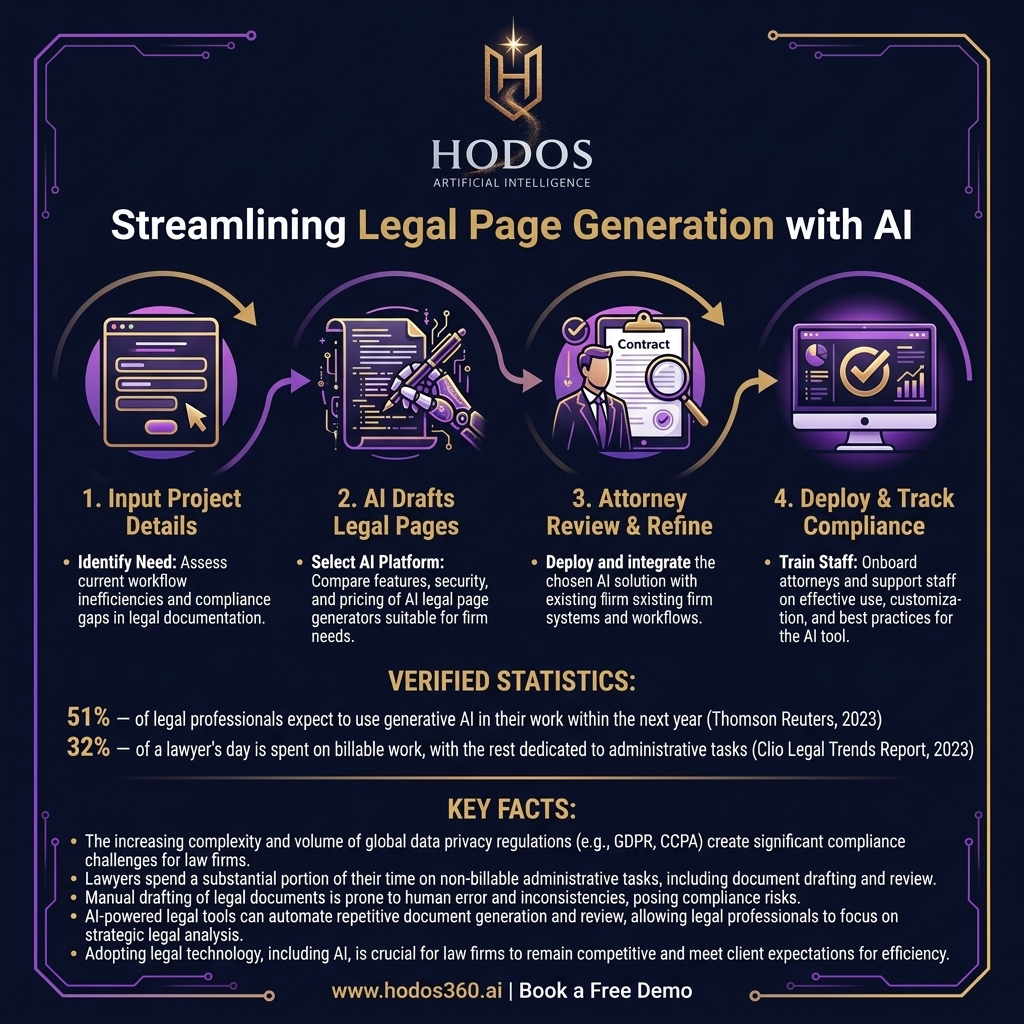
AI tools can drastically reduce this non-billable time, allowing lawyers to reallocate their focus to complex legal strategy, client interaction, and business development. This operational efficiency translates directly into cost savings and increased profitability, as firms can handle more cases without necessarily expanding their headcount.
The time once spent on manual drafting of website terms or privacy policies can now be dedicated to high-value legal work.
Beyond mere time savings, AI significantly enhances compliance and reduces risk. The ever-changing landscape of legal regulations makes it challenging for even the most diligent human to stay abreast of every update.
Learn more about AI Marketing for Law Firms: Essential Growth Strategies. AI legal pages generators are designed to ingest and process vast amounts of legal data, ensuring that generated documents reflect the most current laws and jurisdictional requirements. This proactive approach to compliance is critical, safeguarding firms and their clients from potential legal liabilities arising from outdated or non-compliant documentation.
For instance, ensuring a website's terms of use are robust and legally defensible is crucial, and AI provides that layer of assurance, offering peace of mind to both the firm and its clients. HODOS 360's AI Law Firm Management System, with its integrated document automation features, exemplifies how these capabilities can be seamlessly woven into a firm's daily workflow, enhancing both client intake and overall operational excellence.
- ✓Automated generation of privacy policies (GDPR, CCPA, and other regional laws compliant), ensuring up-to-date legal standards.
- ✓Instant creation of comprehensive terms of service and disclaimers, tailored to specific business models and industries.
- ✓Rapid drafting of client intake forms, engagement letters, and non-disclosure agreements, accelerating the onboarding process.
- ✓Ensuring jurisdictional accuracy and integrating the latest legal updates across all generated documents to mitigate risk.
- ✓Reducing human error and increasing consistency in legal language and formatting across all client-facing and internal documents.
- ✓Freeing up attorney time for complex, high-value tasks that require nuanced legal reasoning and strategic thinking.
- ✓Providing scalability for growing client bases, allowing firms to manage increased demand without compromising quality or efficiency.
Navigating the Regulatory Landscape and Ethical Considerations
While the promise of AI legal pages generators is immense, their implementation is not without critical considerations, particularly concerning regulatory compliance and ethical responsibilities. The recent enforcement of the EU AI Act, a landmark piece of legislation, signals a global trend towards stricter governance of AI technologies, especially those interacting with sensitive data or making consequential decisions.
Law firms must meticulously vet any AI tool to ensure it adheres to these evolving regulations, understanding data provenance, algorithmic transparency, and accountability mechanisms. Failure to do so could expose firms to significant legal and reputational risks, underscoring the necessity for due diligence in AI adoption.
Ethical duties remain paramount for legal professionals utilizing AI. ABA Model Rule 1.1 (Competence) mandates that lawyers stay abreast of changes in the law and its practice, including the benefits and risks associated with relevant technology. Learn more about Voice AI: Essential Strategies for Law Firms' Future.
This extends to understanding how AI legal pages generators function, their limitations, and their potential biases. Furthermore, ABA Model Rule 1.6 (Confidentiality of Information) requires lawyers to protect client information, which means ensuring that any third-party AI provider has robust data security protocols and does not compromise client data.
The New York State Bar Association's 2023 Opinion on Generative AI and Ethical Obligations provides a pertinent example, advising lawyers to exercise caution, maintain confidentiality, and verify AI-generated work, reinforcing that the ultimate responsibility for legal advice always rests with the human attorney.
The Role of Human Oversight in AI-Generated Content
It is crucial to understand that AI legal pages generators are sophisticated tools designed to augment human intelligence, not replace it. The narrative of AI as a substitute for legal professionals is a mischaracterization; rather, it's a powerful assistant. Every AI-generated legal document, from a simple disclaimer to a complex privacy policy, requires thorough attorney review and human-in-the-loop validation.
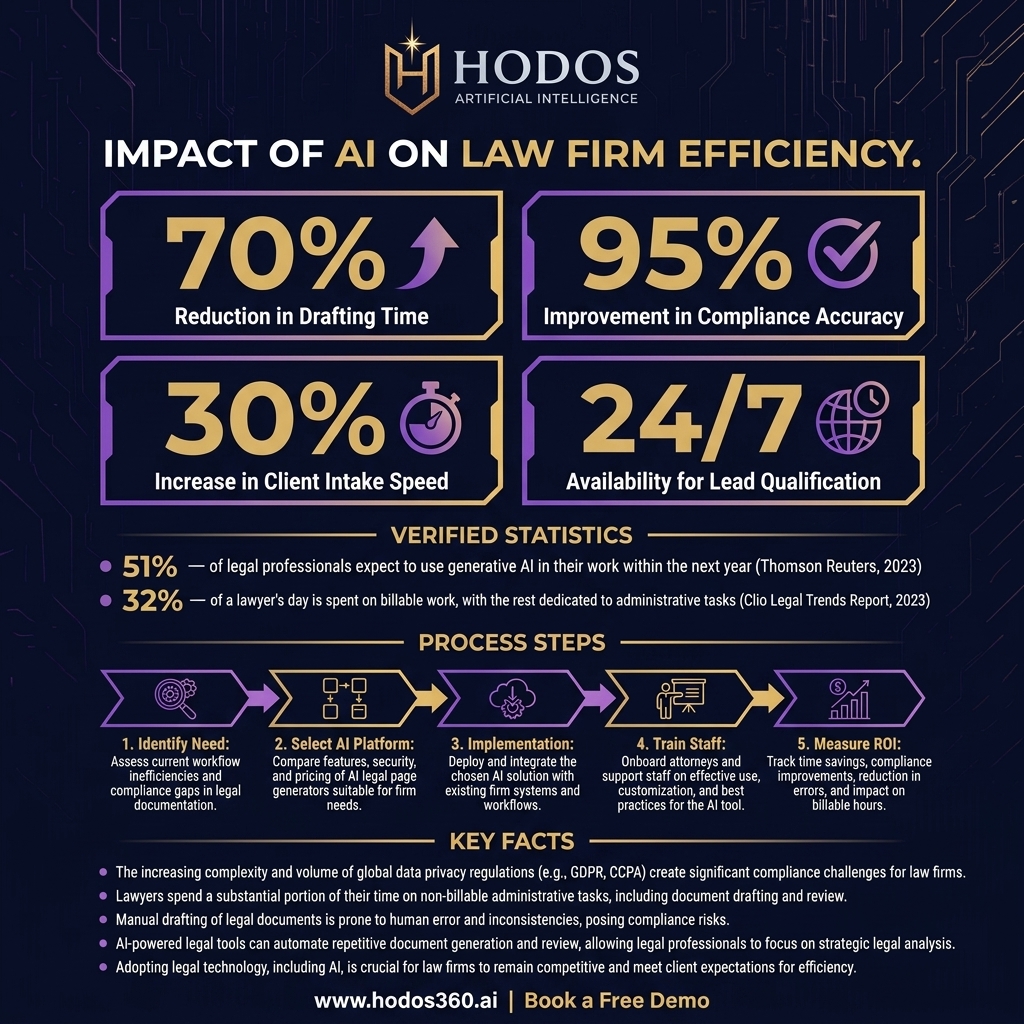
This oversight ensures accuracy, contextual relevance, and adherence to the nuanced specifics of a client's situation, which AI, despite its advancements, cannot fully grasp. As Jensen Huang of NVIDIA frequently articulates regarding AI's role, the future lies in human-AI collaboration, where human creativity and critical judgment are amplified by AI's processing power.
Consider a hypothetical scenario where an AI-generated terms of service page, while technically correct, failed to include a specific clause crucial for a client operating in a highly specialized, niche market. Learn more about No-Code Review: The Ultimate Website Builder Guide for Law Firms. This omission, if not caught by a reviewing attorney, could lead to unforeseen legal challenges.
This example highlights the indispensable role of human vigilance. Attorneys must apply their professional judgment, ethical reasoning, and deep understanding of client needs to every AI output, ensuring that the technology serves as an enabler for superior legal service, not a blind trust. The ultimate responsibility for the legal advice and documents provided to clients remains firmly with the attorney, making human oversight the final, critical safeguard.
Implementing AI Legal Pages: Best Practices and Strategic Integration
Successfully integrating AI legal pages generators into a law firm's operations requires a strategic approach, moving beyond mere adoption to thoughtful implementation. Best practices dictate a phased rollout, starting with pilot programs to test the technology on less complex, high-volume tasks. This allows firms to gather feedback, refine workflows, and build internal expertise without disrupting core operations.
Comprehensive staff training is also paramount, ensuring that attorneys and paralegals understand how to effectively use the AI tools, interpret their output, and provide the necessary human oversight. The goal is to empower legal professionals, not to overwhelm them with new technology, making education a cornerstone of successful integration.
Choosing the right platform is another critical decision. Learn more about AI in Law Firms: Essential Daily Tools for Modern Practice. Firms should seek integrated solutions that can connect AI legal pages generators with broader AI law firm management systems. This synergy creates seamless workflows, where client intake data can automatically populate document drafts, and generated documents can be linked directly to case management or billing systems.
Industry leaders like Thomson Reuters' CoCounsel and LexisNexis' Lexis+ AI demonstrate the power of such integrated platforms, showcasing how comprehensive AI solutions can streamline everything from research to document creation. This holistic approach ensures that AI tools don't operate in silos but contribute to an interconnected, efficient, and intelligent legal practice, maximizing the return on technology investment and enhancing the firm's overall operational intelligence.
Future Trends in AI Legal Document Automation
The trajectory of AI legal pages generators points towards increasingly sophisticated and intuitive capabilities. Future trends suggest a move towards predictive analytics, where AI might anticipate legal document needs based on client profiles or case histories, proactively drafting relevant clauses or entire pages. Imagine an AI that, upon receiving a new client intake for a tech startup, instantly suggests and drafts a comprehensive set of terms, privacy policies, and intellectual property agreements, customized to the startup's specific industry and operational model.
We can also anticipate advancements in custom clause generation, allowing AI to draft highly specialized provisions by analyzing vast legal databases and case law, moving beyond mere boilerplate language to truly bespoke content.
The integration of multimodal AI, often featured in Meta AI news and other cutting-edge research, will also play a pivotal role.
This could enable voice-activated document drafting, where attorneys verbally describe their needs, and the AI translates these instructions into legally sound text. Such innovations promise to make document creation even more accessible and efficient, blurring the lines between thought and written output. As AI news today frequently highlights breakthroughs in generative AI, the future of legal document automation is set to become more intelligent, personalized, and seamlessly integrated into the daily practice of law, transforming legal operations into a highly responsive and adaptive ecosystem.

Key Takeaways and Strategic Advantage with HODOS 360
The emergence of AI legal pages generators is not merely a passing trend; it is a fundamental reorientation of legal practice. For law firms, embracing this technology is no longer optional but a strategic imperative. The benefits — from unparalleled efficiency and significant cost savings to enhanced compliance and superior risk mitigation — are too substantial to ignore.
Firms that proactively integrate these intelligent tools are positioning themselves for a competitive advantage, allowing their legal professionals to focus on the intricate, human-centric aspects of law that truly differentiate their services, while delegating the repetitive, high-volume tasks to AI.
Platforms like HODOS 360 are at the forefront of this transformation, offering a comprehensive suite of AI-powered services, including an AI Law Firm Management System with robust document automation capabilities.
By leveraging such integrated solutions, firms can move beyond piecemeal tech adoption to a holistic digital strategy that streamlines operations, empowers attorneys, and ultimately delivers greater value to clients. The future of law is one where human expertise is powerfully augmented by intelligent technology, and those who recognize this synergy will be the ones to thrive in the evolving legal landscape.
This is the ultimate opportunity to redefine your firm's potential.
Frequently Asked Questions
What are AI Legal Pages Generators?+
AI Legal Pages Generators are advanced software tools that use artificial intelligence, particularly natural language processing and machine learning, to automatically create various legal documents. These can include privacy policies, terms of service, disclaimers, client intake forms, and other routine legal pages, tailored to specific requirements and legal jurisdictions. They aim to reduce manual drafting time and enhance compliance.
How do AI Legal Pages Generators benefit law firms?+
Law firms benefit by significantly reducing the time and cost associated with drafting routine legal documents. These generators improve accuracy and consistency, ensure compliance with the latest regulations, and free up attorneys to focus on higher-value, complex legal work. They also enhance client intake efficiency and provide scalability for growing practices, contributing to overall operational excellence.
Are AI-generated legal pages legally compliant?+
While AI legal pages generators are designed to incorporate current legal standards and jurisdictional requirements, human oversight is crucial. Attorneys must review and validate all AI-generated content to ensure it meets specific client needs, ethical obligations, and local legal nuances. The AI serves as a powerful drafting assistant, but the ultimate responsibility for legal accuracy and compliance remains with the human lawyer.
What ethical considerations should firms be aware of when using AI for legal pages?+
Firms must consider client confidentiality (ABA Model Rule 1.6), ensuring secure data handling by AI providers. Competence (ABA Model Rule 1.1) requires lawyers to understand the AI's limitations and verify its output. Transparency with clients about AI use and avoiding the unauthorized practice of law by delegating core legal judgment to AI are also key ethical considerations.
How can law firms effectively integrate AI Legal Pages Generators?+
Effective integration involves a phased rollout, starting with pilot programs for less complex tasks. Comprehensive staff training is essential to ensure proficiency and understanding of AI tools. Firms should prioritize integrated platforms that connect AI legal page generation with broader law firm management systems, creating seamless workflows from client intake to document creation and beyond, maximizing efficiency and impact.