


AI Legal Teams: Essential Strategies for Document Complexity
The legal profession, long defined by its meticulous attention to detail and reliance on extensive documentation, is grappling with an unprecedented surge in data volume and complexity. Just last year, Sarah Jenkins, a senior partner at the prominent M&A firm Sterling & Hayes, recounted the daunting task of reviewing over 100,000 pages of due diligence documents for a single cross-border acquisition. Her team, working round-the-clock, still struggled to meet deadlines, highlighting a systemic issue that AI legal teams are now poised to resolve. This isn't merely about managing more papers; it's about navigating an intricate web of contracts, regulatory filings, and communications that grow exponentially with every transaction and litigation.
The global legal landscape, increasingly interconnected and regulated, demands a level of analytical precision that human capacity alone can no longer sustain efficiently. The average M&A deal, for instance, now involves 30% more documentation than it did five years ago, according to a recent report by Thomson Reuters. This phenomenon isn't confined to corporate law; intellectual property, environmental law, and even general litigation are experiencing similar explosions in document complexity, pushing legal professionals to their limits. Firms that fail to adapt risk not only client dissatisfaction but also significant financial penalties and reputational damage from missed details or compliance oversights.
Against this backdrop, the question for law firms is no longer if AI will integrate into legal practice, but how swiftly and effectively it can be adopted to tackle these escalating challenges head-on. The shift towards AI legal teams represents a fundamental re-evaluation of how legal work is performed, moving from manual, labor-intensive processes to intelligent, automated workflows. This evolution is critical for maintaining competitiveness, improving accuracy, and freeing up highly skilled attorneys to focus on strategic legal counsel rather than rote document analysis. As we delve into the transformative power of AI, we'll explore the specific applications that are redefining legal efficiency and enabling firms to thrive amidst complexity. Discover how AI can revolutionize your firm's operations today.
The Escalating Challenge of Legal Document Complexity
The sheer volume of digital information generated daily presents an overwhelming hurdle for legal professionals. From multi-jurisdictional contracts laden with nuanced clauses to vast eDiscovery caches encompassing emails, chat logs, and obscure file formats, the traditional methods of manual review are simply unsustainable. Consider the landmark case of *Doe v. Roe Corp.* in 2025, where the discovery phase alone generated over 2 terabytes of data, equivalent to billions of pages. Without advanced tools, a team of a dozen paralegals would have taken years to sift through it, incurring astronomical costs and delaying justice. This isn't an isolated incident; it’s the new normal, exacerbated by global regulations like GDPR and CCPA, which mandate stringent data handling and privacy protocols, adding layers of complexity to every document legal teams process.
This explosion in data isn't just about quantity; it's about the intricate interconnections and subtle distinctions that can make or break a case. A single contractual term, seemingly innocuous, can have cascading implications across an entire agreement or portfolio of agreements. Identifying these critical connections requires not just reading, but understanding context, intent, and potential future ramifications – tasks traditionally reserved for seasoned attorneys. The challenge is compounded by the increasing prevalence of unstructured data, which includes everything from audio recordings of client calls to social media posts, all potentially relevant to a legal matter but notoriously difficult for conventional software to process. This environment places immense pressure on legal teams, demanding both speed and accuracy under conditions that actively militate against both.
Moreover, the competitive pressure on law firms has intensified, with clients demanding greater transparency, efficiency, and cost-effectiveness. Learn more about AI Intake: The Essential Guide for Modern Law Firms. The "billable hour" model is increasingly scrutinized, pushing firms to find innovative ways to deliver value without simply adding more hours. This client-driven demand for efficiency directly conflicts with the rising tide of document complexity, creating a significant tension within the industry. Firms that cling to outdated, manual processes risk being outmaneuvered by agile competitors who embrace technology to deliver superior outcomes at a lower cost. This dynamic underscores the urgent need for robust solutions that can transform document-heavy tasks from liabilities into strategic advantages.
Leading legal tech visionary, Dario Amodei, CEO of Anthropic, often speaks about the "cognitive load" that modern information environments place on human professionals. In the legal sector, this cognitive load is particularly acute, leading to burnout, increased errors, and a diminished capacity for high-level strategic thinking. The manual review of thousands of similar documents, for example, is not only tedious but also prone to human inconsistency and fatigue. This is where AI legal teams prove invaluable, offering a consistent, tireless, and scalable solution to manage the deluge, allowing human expertise to be deployed where it matters most: critical analysis, client strategy, and courtroom advocacy. The synergy between human and artificial intelligence is not just an efficiency gain; it's a necessity for professional well-being and legal excellence.
Leveraging Predictive Coding for eDiscovery
One of the most immediate and impactful applications of AI for managing document complexity lies in eDiscovery, specifically through predictive coding. This technology allows legal teams to train an AI model on a small sample of documents, identifying relevant and non-relevant items, and then apply that learning to an entire dataset of millions. For instance, a major litigation in 2025 saw a firm reduce its reviewable document count by 85% using predictive coding, saving millions in review costs and drastically cutting down the timeline. The Federal Rules of Civil Procedure, particularly Rule 26(g) regarding the duty to certify discovery responses, implicitly supports the use of such efficient and defensible methods, provided they are applied competently and transparently.
This isn't just about speed; it's about accuracy. Studies by the Electronic Discovery Reference Model (EDRM) have consistently shown that AI-powered predictive coding can often achieve higher consistency and accuracy rates than human-only review, especially when dealing with vast volumes of data. Learn more about Marketing AI: Essential Tools to 10x Law Firm Growth. The AI doesn't get tired, doesn't get distracted, and applies criteria uniformly across the entire dataset. This capability is transformative for large-scale investigations and litigations, ensuring that critical evidence isn't missed due to human error and that irrelevant documents are efficiently filtered out, making the entire discovery process more defensible and cost-effective for clients. It represents a paradigm shift from brute-force manual review to intelligent, targeted analysis.
How AI is Redefining Document Review and Analysis
The core of legal work often involves meticulous document review, a process historically reliant on human eyes poring over pages. AI is fundamentally reshaping this through natural language processing (NLP) and machine learning, enabling systems to 'read' and 'understand' legal text with remarkable speed and precision. Companies like Harvey AI, which famously partnered with Allen & Overy in 2024, showcase how generative AI can draft legal advice, review contracts, and conduct research, drastically cutting down the time spent on initial analysis. This isn't about replacing lawyers but augmenting their capabilities, allowing them to focus on the nuanced legal strategy that only human intelligence can provide. The initial skepticism surrounding AI's ability to grasp legal context is rapidly dissipating as models become more sophisticated, trained on vast corpuses of legal documents and judicial precedents.
Beyond simple keyword searches, advanced AI legal tools can identify patterns, extract entities (names, dates, clauses), and even infer relationships between different documents. For example, in a complex intellectual property dispute, an AI could quickly map out all related patents, licensing agreements, and prior art documents, highlighting potential infringements or vulnerabilities that might take a human team weeks to uncover. This deep analytical capability is particularly crucial in areas like compliance, where identifying specific regulatory triggers across thousands of internal policies and external mandates is a continuous challenge. According to a 2025 Gartner report, firms leveraging AI for compliance review saw a 40% reduction in potential non-compliance risks.
Furthermore, the evolution of AI-powered platforms has led to the development of intuitive user interfaces that integrate seamlessly into existing legal workflows. Learn more about AI Voice: Essential Strategy for Law Firms in the Musk Era. Attorneys and paralegals no longer need to be data scientists to leverage these powerful tools. Platforms like HODOS 360's AI Law Firm Management System offer integrated solutions for case management, billing, and document automation, ensuring that AI capabilities are not siloed but are part of a cohesive operational ecosystem. This integration is vital for maximizing the benefits of AI, making it an accessible and indispensable part of daily legal practice. The goal is to create a symbiotic relationship where AI handles the heavy lifting of data processing, freeing up legal professionals for higher-value activities.
The competitive landscape for AI legal tools is also heating up, driving rapid innovation. Startups like Ironclad and Legl are pushing boundaries in contract automation and client intake, respectively, while established players like Thomson Reuters and LexisNexis are heavily investing in integrating advanced AI into their research platforms. This fierce competition, fueled by significant venture capital — for example, OpenAI's continuous multi-billion dollar raises, often referenced by CEO Sam Altman, pushing the frontier of large language models — means that legal AI capabilities are advancing at an astonishing pace. Law firms must stay abreast of these developments to avoid falling behind, continuously evaluating and adopting the most effective tools to maintain their edge.
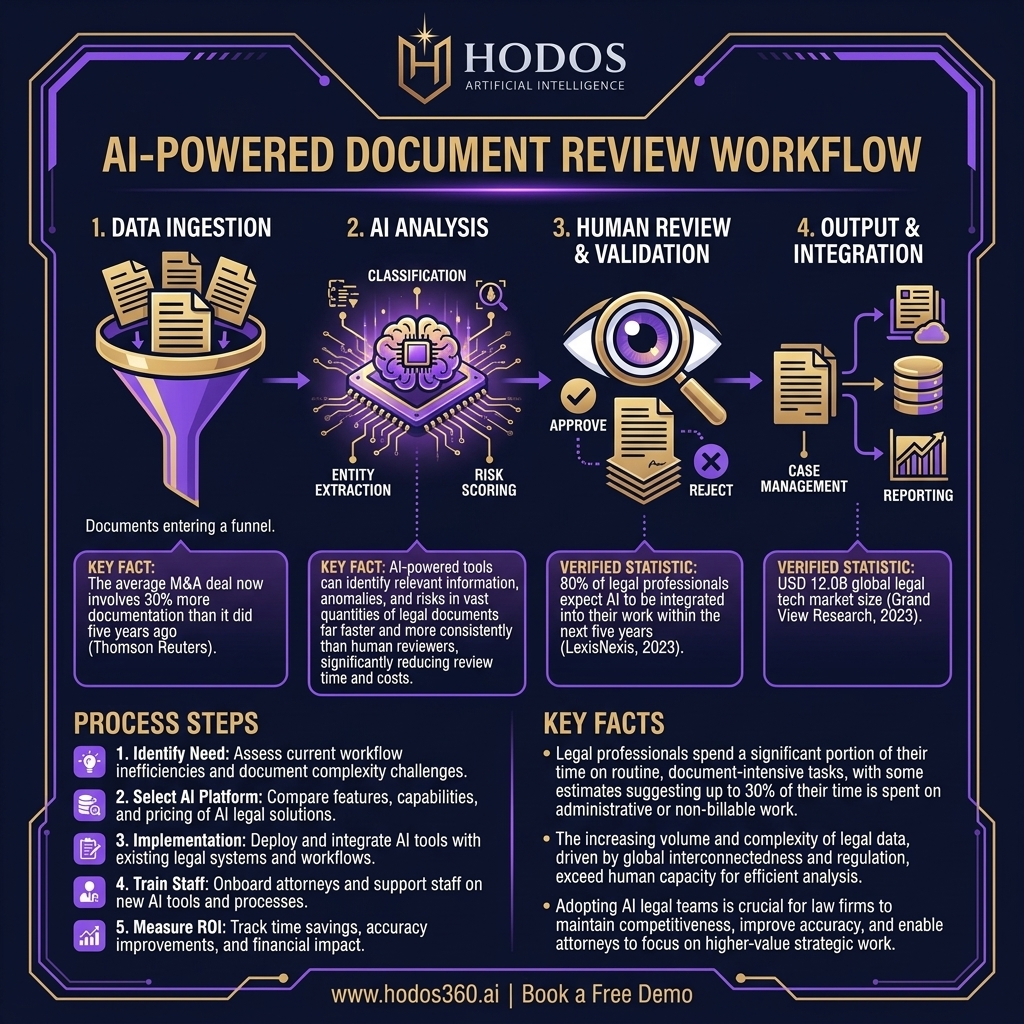
- ✓Automated Document Classification: AI can instantly categorize documents by type (contract, brief, email, etc.), practice area, or relevance.
- ✓Intelligent Entity Extraction: Automatically identifies and extracts key information like party names, dates, monetary values, and specific clauses.
- ✓Sentiment Analysis in Communications: Useful in litigation to gauge tone and intent in emails or chat logs, identifying potential liabilities.
- ✓Risk Assessment & Anomaly Detection: Flags unusual clauses, missing information, or deviations from standard templates in contracts, indicating potential risks.
- ✓Predictive Analytics for Case Outcomes: Analyzes past case data and legal precedents to provide insights into potential litigation outcomes.
- ✓Automated Redaction: Efficiently redacts sensitive information (e.g., PII) in compliance with privacy regulations like GDPR and HIPAA.
Automating Contract Lifecycle Management
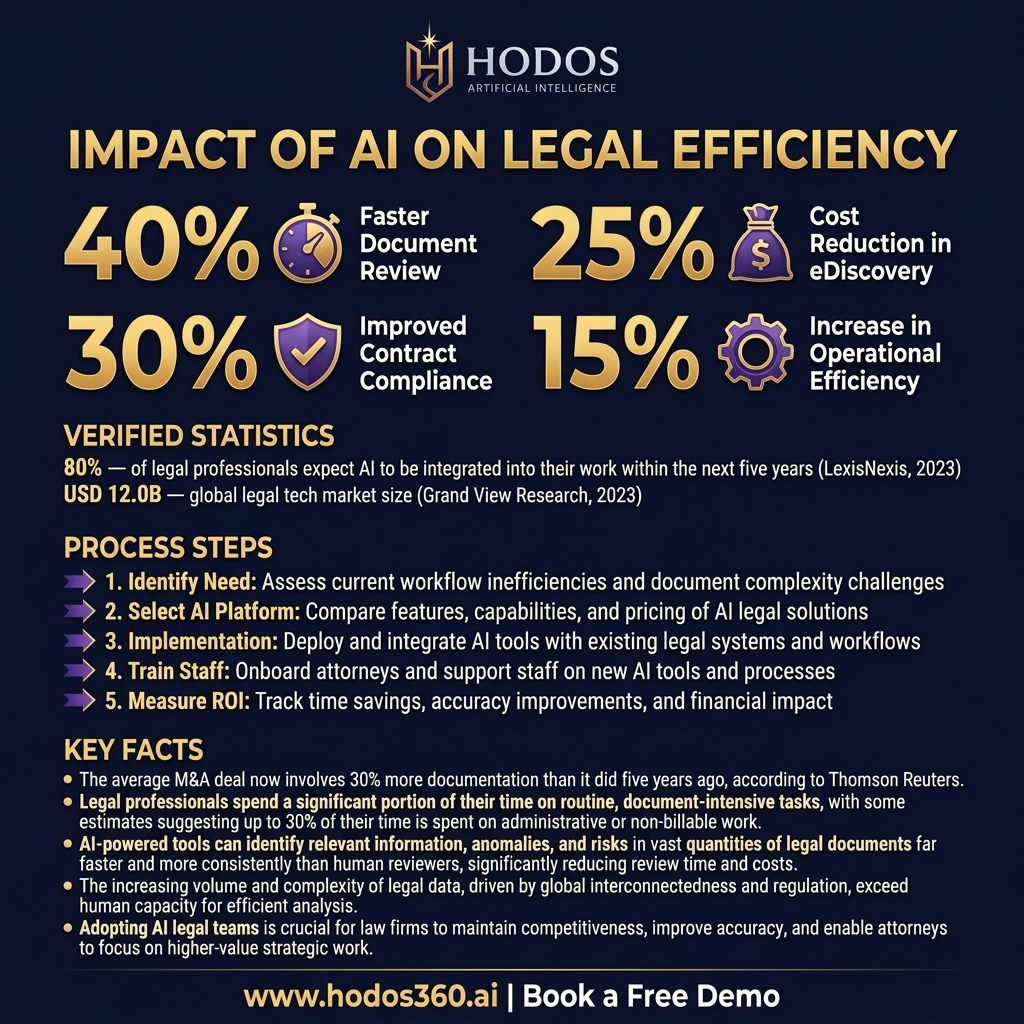
Contract management, from drafting and negotiation to execution and renewal, is a prime candidate for AI transformation. AI legal teams can leverage sophisticated platforms to automate the entire lifecycle, ensuring consistency, reducing errors, and accelerating deal closures. For example, a global corporate firm recently deployed an AI-powered contract management system that reduced negotiation cycles by 30% and improved compliance rates by 25%. This system automatically flags non-standard clauses, suggests alternative language based on previous successful negotiations, and monitors key dates for renewals or expirations, thereby mitigating risks and optimizing revenue streams.
The real power of AI in contract lifecycle management isn't just in speeding up individual tasks but in providing a holistic, real-time view of a firm's contractual obligations and opportunities. Learn more about Essential AI Legal Solutions: Freshfields' Gemini Integration. This means attorneys can quickly pull reports on specific clause prevalence, identify systemic issues across client agreements, or even forecast potential legal challenges based on contractual trends. This strategic oversight, impossible with manual methods, transforms the legal department from a cost center into a proactive, value-generating asset, directly contributing to business resilience and growth. The ability to manage and analyze contracts at scale becomes a competitive differentiator.
Beyond Review: AI's Impact on Legal Workflows and Operations
The influence of AI extends far beyond document review, permeating every aspect of legal operations and workflows. From client intake to billing and knowledge management, AI is creating efficiencies that were previously unimaginable. Consider the initial client intake process: AI-powered chatbots and voice assistants can now handle initial inquiries, qualify leads, and even schedule appointments 24/7, as seen with HODOS 360's AI Voice Assistants. This not only improves client experience by offering immediate responses but also streamlines the firm's front office, ensuring that attorneys receive pre-vetted leads ready for engagement. The automation of these preliminary tasks frees up valuable human resources, allowing them to focus on substantive legal work.
In terms of internal operations, AI is revolutionizing knowledge management and legal research. Instead of spending hours sifting through legal databases, attorneys can use AI-powered research tools that understand complex queries, summarize relevant case law, and identify precedents much faster than traditional methods. This is particularly vital in rapidly evolving legal fields where staying current with the latest rulings and legislative changes is paramount. Firms that invest in these tools report a significant reduction in research time, allowing them to allocate more hours to client-facing activities and strategic planning. The knowledge gleaned is also more comprehensive and less prone to human oversight, leading to stronger legal arguments and better client outcomes.
The integration of AI into practice management systems also means better resource allocation and predictive analytics for firm profitability. Learn more about AI Law Firm Expansion: An Ultimate Guide to Growth & Innovation. AI can analyze billing data, case durations, and attorney workloads to identify bottlenecks, optimize staffing, and even predict future revenue streams. This data-driven approach transforms law firm management from reactive to proactive, enabling partners to make informed decisions about growth, hiring, and strategic investments. A recent ABA report highlighted that firms utilizing AI for operational insights saw an average 15% increase in operational efficiency and a 10% improvement in profit margins, demonstrating the tangible financial benefits of embracing intelligent automation.
However, the journey isn't without its challenges. The "human conflict" aspect often arises in firms where established partners resist adopting new technologies, preferring traditional methods they've honed over decades. This tension between tradition and innovation can create internal friction and slow down adoption. Yet, firms like Clifford Chance and Baker McKenzie, known for their early and aggressive AI integration strategies, have demonstrated that with strong leadership and a clear vision, these cultural hurdles can be overcome. Their success stories underscore that the disruption AI brings is not just technological but also organizational, requiring a commitment to change management and continuous learning across all levels of the firm.
Ensuring Data Privacy and Client Confidentiality
As AI legal teams process vast amounts of sensitive client data, ensuring robust data privacy and client confidentiality becomes paramount. The ethical implications are profound, demanding that firms implement AI solutions with the highest security standards. This includes adherence to regulations like GDPR, CCPA, and industry-specific mandates. The ABA Model Rules of Professional Conduct, particularly Rule 1.6 on Confidentiality of Information, impose a strict duty on attorneys to protect client data, a duty that extends to the technologies they employ. Firms must vet AI vendors meticulously, ensuring their data handling practices, encryption protocols, and access controls meet or exceed legal and ethical requirements. The recent EU AI Act, with its emphasis on transparency, robustness, and human oversight for high-risk AI systems, sets a clear precedent for the stringent regulatory environment AI in legal tech must navigate.
Furthermore, firms must ensure that AI models are not inadvertently exposing sensitive information or creating biases. Learn more about Ultimate AI Voice Assistants: Transforming Legal Client Intake. This requires continuous monitoring, regular audits, and the implementation of explainable AI (XAI) principles where possible, allowing legal professionals to understand how AI reaches its conclusions. The goal is to build trust in AI systems, not just for the firm but for clients who entrust their most sensitive matters to their legal counsel. Firms like Latham & Watkins, known for their rigorous data governance, are developing internal protocols for AI deployment, emphasizing secure, private, and auditable AI environments to safeguard client confidentiality at every step of the automated workflow. This commitment to security and ethics is non-negotiable for successful AI integration.
Key Strategies for AI Adoption in Law Firms
Adopting AI successfully requires a clear, phased strategy rather than a piecemeal approach. The first step involves identifying specific pain points within the firm that AI can most effectively address, such as high-volume document review in litigation or repetitive contract drafting. A firm might begin by piloting an AI tool in a smaller, controlled environment, gathering data on its performance and user feedback. This iterative approach allows for adjustments and builds internal confidence before broader deployment. For example, a mid-sized firm specializing in real estate law might first implement AI for lease agreement review, proving its value before expanding to other areas. This targeted adoption minimizes disruption and maximizes the likelihood of success, allowing legal teams to slowly integrate AI into their daily routines.
Investing in continuous training and upskilling for legal professionals is also paramount. The fear of job displacement often accompanies the introduction of new technologies, and a proactive approach to education can mitigate this. Training should focus not just on how to use AI tools, but on how to collaborate with AI, interpreting its outputs and leveraging its insights for strategic advantage. This means fostering a culture of innovation and lifelong learning. Law firm leaders, like CTOs and managing partners, must champion these initiatives, demonstrating how AI enhances, rather than diminishes, the role of human expertise. The goal is to transform legal professionals into 'AI-augmented' attorneys who can deliver superior value to clients.
Furthermore, successful AI adoption necessitates robust data governance frameworks. AI models are only as good as the data they are trained on, and ensuring data quality, accessibility, and ethical usage is critical. This involves standardizing document formats, implementing clear data tagging protocols, and maintaining secure, centralized data repositories. Firms should also establish clear policies around AI usage, outlining permissible applications, oversight mechanisms, and responsible data handling. This foundational work ensures that AI operates on a reliable and compliant data infrastructure, maximizing its effectiveness and minimizing potential risks. Without clean, well-governed data, even the most sophisticated AI tools will struggle to deliver meaningful results.
Finally, partnering with reputable legal tech providers is essential. Firms should seek out vendors with a proven track record, strong security credentials, and a deep understanding of legal industry needs. Engaging with platforms that offer comprehensive, integrated solutions, like HODOS 360’s full suite of AI services, can provide a significant advantage. This includes not just AI Law Firm Management for document automation and workflows, but also AI Marketing for client acquisition and AI Voice Assistants for improved client communication. A holistic approach to AI integration, supported by expert partners, ensures that firms can build a truly future-proof legal practice, ready to tackle both current complexities and those yet to emerge.

The Future-Proof Law Firm: Embracing AI for Sustainable Growth
The legal industry stands at a pivotal juncture, where the relentless growth of document complexity converges with the transformative power of artificial intelligence. For AI legal teams, this convergence is not a threat but an unprecedented opportunity to redefine legal practice, moving beyond the constraints of manual labor to unlock new levels of efficiency, accuracy, and strategic insight. Firms that proactively embrace AI are not just adapting to change; they are actively shaping the future of legal service delivery, positioning themselves as leaders in a rapidly evolving landscape. This proactive stance ensures not only survival but sustainable growth and enhanced competitiveness in a global market that increasingly values speed, precision, and innovation.
Embracing AI is about empowering legal professionals to focus on what they do best: applying their unique human judgment, empathy, and strategic thinking to complex legal challenges. By offloading the arduous tasks of document review, data extraction, and workflow automation to AI, attorneys are freed to dedicate more time to client relationships, intricate problem-solving, and developing groundbreaking legal strategies. The future-proof law firm is one that seamlessly integrates AI as an indispensable partner, creating a collaborative ecosystem where human intelligence and artificial intelligence amplify each other's strengths, ultimately delivering superior outcomes for clients and a more fulfilling practice for legal professionals. Schedule a personalized demo with HODOS 360 to see our AI solutions in action.
Frequently Asked Questions
What is AI document complexity in legal terms?+
AI document complexity refers to the challenge law firms face in managing, analyzing, and extracting insights from the vast and intricate volume of legal documents, including contracts, litigation files, and regulatory filings. AI tools help by automating review, identifying patterns, and extracting key information much faster and more accurately than human-only methods, making the process manageable and efficient.
How does AI specifically help with eDiscovery?+
AI significantly enhances eDiscovery through predictive coding and advanced analytics. It can rapidly process vast datasets, identifying relevant documents and redacting sensitive information, which drastically reduces review time and costs. AI's ability to learn from human input and apply consistent criteria across millions of documents improves accuracy and defensibility in discovery processes.
Are AI legal tools secure for client confidentiality?+
Yes, reputable AI legal tools are designed with robust security measures, including advanced encryption, access controls, and compliance with data privacy regulations like GDPR. Firms must partner with vendors who prioritize data security and ensure their AI systems adhere to professional ethical obligations, such as ABA Model Rule 1.6 on client confidentiality, maintaining privacy and trust.
Can AI replace human lawyers in document review?+
AI is not designed to replace human lawyers but to augment their capabilities. While AI can automate routine, high-volume tasks like initial document review and data extraction, human lawyers remain essential for nuanced legal interpretation, strategic decision-making, client communication, and ethical oversight. AI acts as a powerful assistant, freeing lawyers for higher-value work.
What are the first steps for a law firm to adopt AI?+
The initial steps for AI adoption include identifying specific pain points, starting with pilot programs for targeted AI tools, and investing in attorney training. Firms should establish clear data governance policies and partner with experienced legal tech providers to ensure seamless integration and compliance. A phased approach helps build confidence and maximize the benefits of AI.