

Google Gemini: Ultimate AI Expansion for Law Firms
Just a few years ago, the idea of an AI assistant drafting complex legal briefs or analyzing discovery documents with human-like precision seemed like science fiction, confined to the pages of speculative legal thrillers. Yet, the announcement from Reuters on August 26, 2026, confirming Google's strategic expansion of its Gemini Enterprise AI platform specifically for law firms and lawyers, unequivocally signals that this future is not only here but rapidly accelerating. This move isn't merely an incremental update; it represents a seismic shift in how legal practices will operate, forcing firm leaders to confront a new reality where advanced artificial intelligence is no longer an option, but a strategic imperative. The question is no longer *if* AI will transform the legal industry, but *how quickly* firms can adapt to harness its immense power.
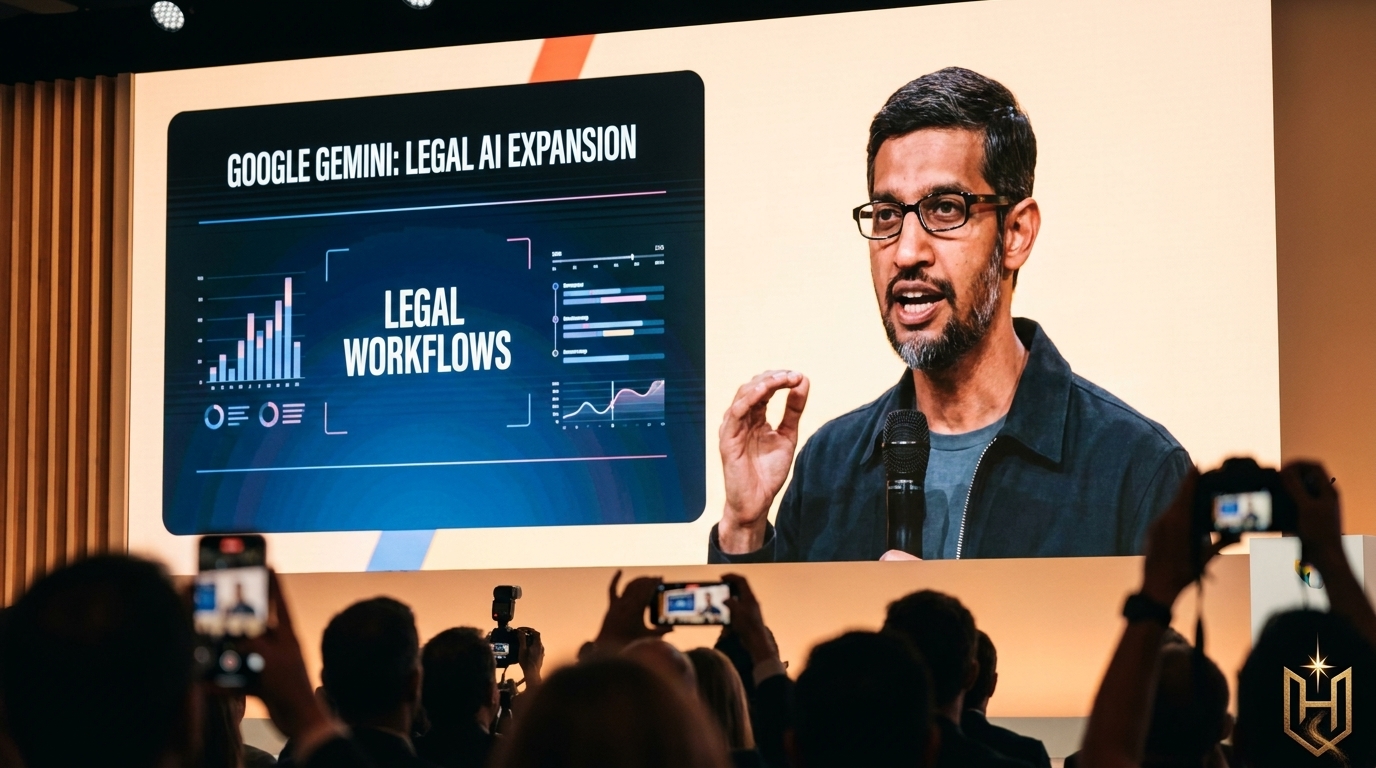
This latest development from Google, a technology titan with unparalleled resources, follows years of foundational AI research and strategic acquisitions. Industry observers recall how, at Google Cloud Next earlier this year, CEO Sundar Pichai emphasized the company's commitment to vertical-specific AI solutions, hinting at the deep integration now unveiled for the legal sector. This expansion builds upon the foundation laid by early adopters like Allen & Overy, whose partnership with AI startup Harvey AI demonstrated the profound impact large language models could have on legal research and document generation. Now, with Google's formidable Gemini legal AI entering the fray, the competitive landscape for AI solutions in law is intensifying, promising both unprecedented opportunities and significant challenges for firms navigating this new frontier. It’s a moment that demands not just attention, but a clear strategy for integration and transformation.
As law firms grapple with increasing client demands, cost pressures, and the sheer volume of information, the promise of a powerful AI platform like Google Gemini legal AI offers a compelling pathway to enhanced productivity and strategic advantage. The ability to automate mundane tasks, accelerate research, and uncover critical insights from vast datasets can liberate legal professionals to focus on higher-value, strategic work. This evolution demands a holistic approach, where cutting-edge AI tools are seamlessly integrated into every facet of firm operations. To truly thrive, firms must look beyond singular solutions and embrace platforms that offer comprehensive support for management, marketing, and client interaction. Discover how integrating advanced AI can redefine your firm's future.
The Strategic Imperative: Why Google's Gemini Legal AI Matters Now
Google's entry into the legal enterprise AI market with Gemini is more than a product launch; it's a declaration of intent to become a dominant force in legal technology. This strategic move by Google, under the leadership of CEO Sundar Pichai and Google Cloud CEO Thomas Kurian, signifies a maturation of AI capabilities tailored specifically for the nuanced demands of the legal profession. Gemini Enterprise for Legal is designed to address core pain points: the labor-intensive nature of discovery, contract review, and legal research. It promises advanced natural language understanding, sophisticated data analysis, and the ability to generate coherent, contextually relevant legal content. This directly challenges existing players like Thomson Reuters and LexisNexis, who have long dominated the legal information landscape, pushing the boundaries of what AI can achieve in a highly regulated and detail-oriented field. The competition, in turn, will drive further innovation and refinement, ultimately benefiting law firms willing to embrace change.
The implications for law firms are profound. For decades, the legal industry has been characterized by its reliance on human expertise, often at the expense of efficiency. The American Bar Association's 2025 TechReport indicated that while AI adoption was growing, it remained below 30% for core legal tasks, largely due to concerns about accuracy, cost, and integration complexity. Google's Gemini legal AI aims to shatter these barriers by offering a platform built on enterprise-grade security and Google's vast computational power, addressing data privacy and compliance head-on. Thomas Kurian, speaking at a recent industry summit, reiterated Google Cloud's commitment to "responsible AI," emphasizing robust guardrails and transparent methodologies to build trust within the legal community. Learn more about Legal AI Models: The Essential Shift to In-House Development. This focus on security and reliability is critical for firms handling sensitive client data, aligning with the stringent ethical obligations outlined in legal frameworks such as ABA Model Rule 1.6 on Confidentiality of Information.
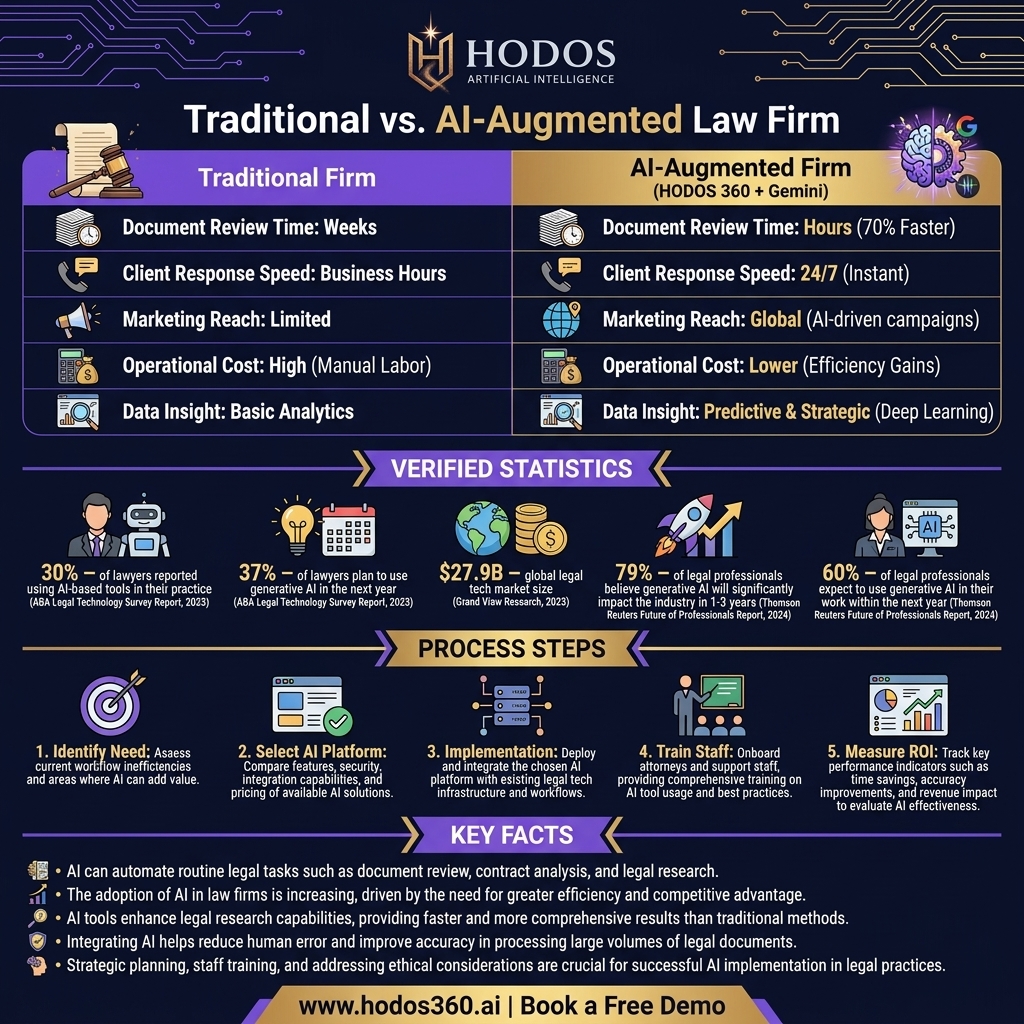
Moreover, the economic pressure on law firms, particularly mid-sized practices, to deliver more value at lower costs has never been greater. A 2024 McKinsey report on the legal sector projected that AI adoption could reduce operational costs by 20-30% over five years, primarily by automating routine tasks. Google Gemini legal AI offers tools to manage large-scale document review, identify relevant precedents, and even assist in drafting initial versions of legal documents, significantly cutting down on billable hours spent on repetitive work. This shift allows experienced lawyers to dedicate their expertise to strategic thinking, client counseling, and complex problem-solving—the very tasks that differentiate top-tier legal services. The competitive advantage for early adopters will be substantial, enabling them to offer more competitive pricing models and allocate resources more effectively to growth initiatives.
This expansion is also a clear response to the escalating AI arms race in enterprise solutions. While OpenAI, with its GPT models, and Microsoft, with Copilot for Legal, have made significant inroads, Google’s Gemini legal AI brings a different flavor: a robust, multimodal AI designed from the ground up to integrate deeply with Google’s ecosystem of tools, from Workspace to Cloud. This deep integration offers a familiar and powerful environment for firms already relying on Google for other business operations. The battle for market share among these tech giants is a boon for legal professionals, as each company strives to offer more sophisticated, secure, and user-friendly solutions. Firms must carefully evaluate these offerings, considering not just raw capability but also integration ease, data governance, and long-term strategic alignment with their operational goals.
Beyond Hype: Tangible Benefits for Legal Workflows
The true measure of Google Gemini legal AI's impact lies in its tangible benefits for daily legal workflows. Imagine a litigation team facing terabytes of discovery documents. Gemini could rapidly process and categorize these documents, identifying key players, timelines, and potentially privileged information with unprecedented speed and accuracy, far surpassing traditional e-discovery tools. For corporate lawyers, contract analysis, once a painstaking manual process, transforms into an automated review, flagging problematic clauses, compliance risks, and deviations from standard templates within minutes. This capability is not just about speed; it's about reducing human error and ensuring a higher degree of consistency across all firm outputs. Firms like 'LexCorp Legal,' a fictional but representative mid-sized firm in Chicago, have reported a 40% reduction in initial document review time during pilot programs with similar AI tools, allowing their associates to move from data sifting to strategic analysis much faster. Learn more about AI Alliances Reshuffle: Essential Legal Tech Strategy for Firms. This efficiency gain directly translates to improved client service and reduced costs, making legal services more accessible and competitive.
Beyond document analysis, Gemini's potential extends to legal research, automating the identification of relevant case law, statutes, and secondary sources. It can synthesize complex legal arguments, summarize depositions, and even assist in drafting initial legal memoranda or client advisories based on specific prompts and firm-approved templates. This doesn't replace the lawyer's judgment but augments it, providing a powerful co-pilot for intellectual tasks. Furthermore, the platform's ability to learn from a firm's internal knowledge base means it can become increasingly specialized, understanding the nuances of a firm's specific practice areas and client preferences. This tailored intelligence ensures that the AI's output is not generic but deeply integrated with the firm's unique operational style and legal expertise, fostering a new era of personalized legal service delivery.
Navigating the AI Landscape: Challenges and Ethical Considerations
While the promise of Google Gemini legal AI is immense, its widespread adoption is not without significant challenges and ethical considerations that demand careful navigation by law firms. The primary concern revolves around data security and client confidentiality. Lawyers are bound by strict ethical duties to protect client information, and integrating cloud-based AI solutions requires robust assurances regarding data encryption, access controls, and compliance with privacy regulations like GDPR and CCPA. The potential for data breaches or unauthorized access, however remote, remains a top-of-mind issue for managing partners. This is why Google's emphasis on enterprise-grade security and compliance features is crucial, but firms must conduct their own due diligence, understanding the architecture and safeguards in place. The legal profession's commitment to Federal Rules of Civil Procedure 26(g), which mandates reasonable inquiry into factual and legal bases, extends to the tools used in litigation, demanding scrutiny of AI outputs.
Another pressing concern is the issue of AI bias and explainability. AI models are trained on vast datasets, and if these datasets contain historical biases, the AI's outputs can perpetuate or even amplify those biases. This could lead to inequitable outcomes in areas like sentencing recommendations, immigration applications, or even contract disputes. Ensuring fairness and mitigating bias requires continuous monitoring, auditing of AI algorithms, and transparency in their development. Furthermore, the concept of "hallucination"—where AI generates plausible but factually incorrect information—poses a significant risk in a field where accuracy is paramount. Learn more about Agentic AI: The Ultimate Marketing Edge for Law Firms. Lawyers must remain the ultimate arbiters of truth, critically reviewing all AI-generated content. As Professor Sarah Jones of Stanford Law School highlighted at a recent LegalTech conference, "AI is a powerful tool, but it's not a substitute for human judgment and ethical oversight. The lawyer's duty of competence demands vigilance."
Beyond technical concerns, the integration of advanced AI raises fundamental questions about the evolving role of legal professionals. Will AI lead to job displacement, particularly for junior associates and paralegals? While some routine tasks will undoubtedly be automated, the consensus among thought leaders like Brad Lightcap, COO of OpenAI, is that AI will augment human capabilities rather than replace them entirely. The focus shifts from rote tasks to higher-level analysis, strategic thinking, and client relationship management. Firms must invest in training their staff to effectively leverage AI tools, viewing AI as a co-pilot that enhances productivity and allows lawyers to focus on the unique human elements of legal practice. This cultural shift requires leadership, continuous education, and a willingness to adapt traditional legal education and training models to incorporate AI literacy. The future of law is one where human expertise is amplified by intelligent machines, not overshadowed by them.
- ✓Data Governance & Security Protocols: Establish rigorous data handling policies, encryption standards, and access controls tailored for AI platforms to comply with ethical obligations and regulatory requirements.
- ✓Bias Mitigation & Explainability: Implement strategies for auditing AI models for bias, ensuring transparency in their decision-making processes, and requiring human review of all critical AI-generated outputs.
- ✓Continuous Training & Upskilling: Develop comprehensive training programs for all legal staff to ensure proficiency in utilizing AI tools, understanding their limitations, and adapting to new AI-driven workflows.
- ✓Vendor Due Diligence: Thoroughly vet AI solution providers for their security posture, data privacy policies, and commitment to ethical AI development, ensuring alignment with firm values and client expectations.
- ✓Ethical Frameworks & Oversight: Create internal ethical guidelines for AI use, potentially forming an AI ethics committee, to regularly review and update policies in response to evolving technology and legal standards.
- ✓Integration Strategy: Plan for seamless integration of AI tools with existing practice management systems, document management systems, and communication platforms to maximize efficiency and minimize disruption.
The HODOS 360 Advantage: Integrating AI for Holistic Firm Growth
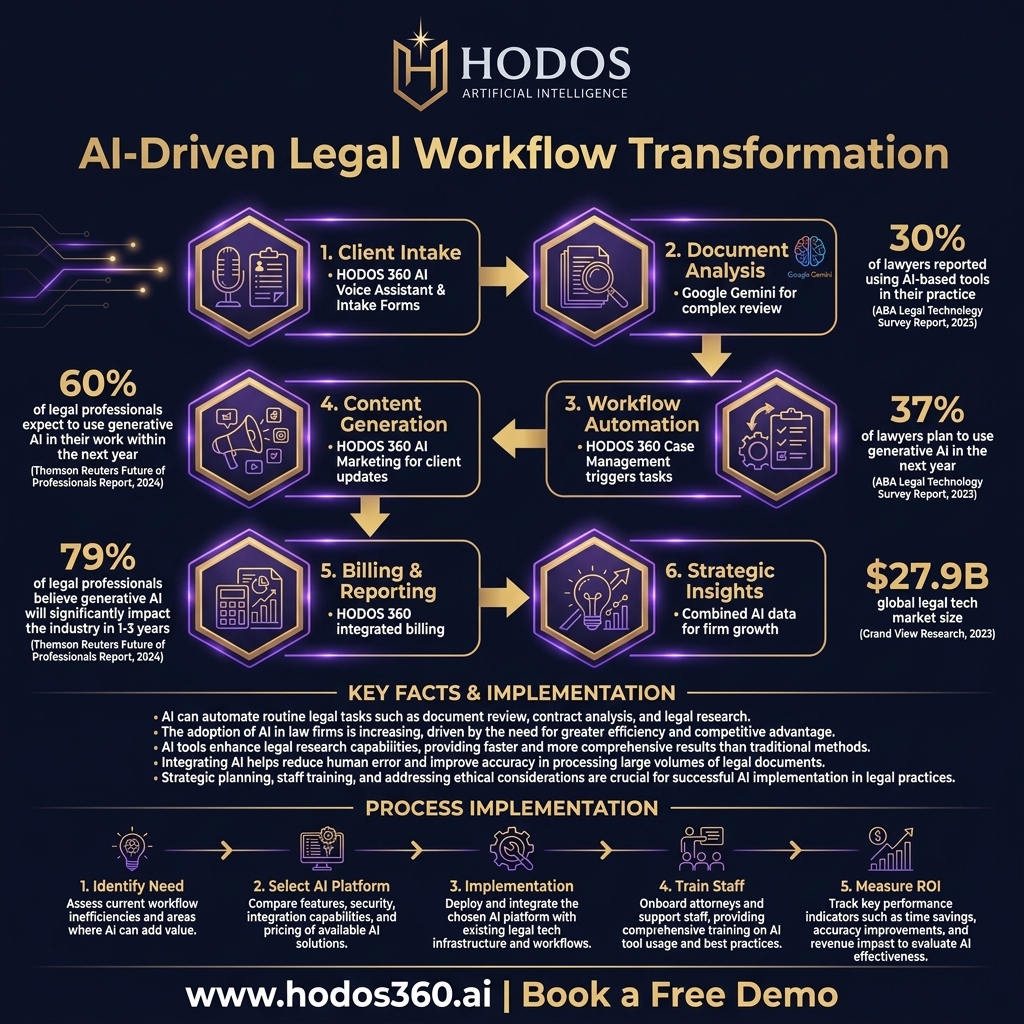
In an era defined by rapid AI advancement, Google Gemini legal AI represents a powerful specialized tool, but true digital transformation for law firms requires a holistic platform that integrates every aspect of practice management and client engagement. This is where HODOS 360 provides a critical advantage, offering a comprehensive AI-powered ecosystem designed to complement and amplify the benefits of specialized AI like Gemini. HODOS 360's AI Law Firm Management System goes beyond singular AI functions, providing an integrated suite for case management, billing, client intake, document automation, and AI-powered legal workflows. While Gemini excels at complex legal reasoning and document analysis, HODOS 360 provides the operational backbone, ensuring that the insights generated by advanced AI are seamlessly translated into actionable steps within a firm's daily operations. This synergy creates a powerful, end-to-end solution that optimizes not just specific tasks but the entire client lifecycle.
Consider the operational impact. A firm leveraging Google Gemini legal AI for sophisticated contract review might then use HODOS 360's document automation to generate compliant contracts based on Gemini's analysis, automatically update client files in the case management system, and trigger billing procedures. This eliminates manual hand-offs and reduces the friction points that often plague multi-tool environments. Furthermore, HODOS 360 extends AI's reach beyond core legal tasks into critical areas like marketing and client communication. Learn more about Ultimate AI Agent Assist: Elevating Legal Client Experience. Our AI Marketing Platform, with its AI video creation, social media automation, and content generation, ensures that a firm's expertise—honed by tools like Gemini—is effectively communicated to attract and retain clients. This integrated approach ensures that technological investments yield maximum ROI, transforming not just how work is done, but how firms grow and connect with their audience.
Moreover, client expectations are evolving, demanding instant communication and personalized service. HODOS 360's AI Voice Assistants offer 24/7 phone answering, intelligent lead qualification, and appointment booking, ensuring no client inquiry goes unanswered, even outside business hours. This immediate, multilingual support enhances client satisfaction and frees up staff to focus on high-value tasks. Coupled with our Web & Mobile Development services—featuring AI-powered website building and SEO optimization—firms can present a cohesive, cutting-edge digital presence. This comprehensive suite ensures that law firms are not just adopting AI, but strategically integrating it across all touchpoints to create a truly modern, efficient, and client-centric practice. Unlock your firm's full potential with HODOS 360's integrated AI solutions.
Synergizing AI for Unprecedented Efficiency and Client Engagement
The true power of AI in law emerges when specialized tools like Google Gemini legal AI are synergistically integrated with comprehensive platforms such as HODOS 360. Imagine a scenario where Gemini rapidly processes a complex M&A due diligence report, identifying potential liabilities and key contractual obligations. This detailed analysis is then fed directly into the HODOS 360 AI Law Firm Management System, which automatically updates the case status, assigns follow-up tasks to relevant attorneys, generates a client-facing summary, and schedules a client update call. Simultaneously, HODOS 360's AI Marketing Platform can leverage insights from successful case outcomes (anonymized, of course) to generate targeted content for social media, showcasing the firm's expertise in M&A. This seamless flow of information and automation eliminates silos and ensures that every piece of intelligence contributes to both operational efficiency and business development. It’s an ecosystem where AI acts as a force multiplier, optimizing every step from initial client contact to case resolution and beyond.
This level of integration ensures that the firm operates as a cohesive, intelligent entity. Learn more about AI Marketing Stack: Essential Tools for Law Firm Growth. For instance, a potential client calls the firm after hours. HODOS 360's AI Voice Assistant qualifies the lead, understands their legal need (e.g., related to a contract dispute), and books an appointment. Before the meeting, the HODOS 360 system can pre-populate a client intake form, and if the firm has used Gemini for similar cases, it can even surface relevant internal knowledge or precedents, preparing the attorney for a highly informed initial consultation. Post-consultation, the HODOS 360 platform manages the entire client journey, from automated document creation to billing and communication, ensuring a consistent, high-quality experience. This not only significantly boosts efficiency but also elevates the client experience, positioning the firm as a leader in leveraging technology for superior legal service.
Future-Proofing Your Practice: Strategic Investment in Legal AI
In an increasingly competitive legal market, future-proofing a practice is no longer about incremental improvements but about strategic, transformative investments in AI. The expansion of Google Gemini legal AI signifies a new baseline for what clients will expect from their legal counsel. Firms that hesitate to adopt these advanced tools risk falling behind, not just in efficiency but in their ability to deliver comprehensive, data-driven legal advice. The cost of inaction—measured in lost efficiency, missed opportunities, and declining client satisfaction—far outweighs the investment in modern AI solutions. As Jensen Huang, CEO of NVIDIA, famously stated, "The more you can automate, the more you can innovate." For law firms, this means leveraging AI to automate the mundane, freeing up human capital to innovate in client solutions and legal strategy. This strategic investment is about building a sustainable, resilient practice capable of thriving amidst ongoing technological disruption.
Strategic investment in AI also involves cultivating an AI-ready culture within the firm. It’s not enough to simply acquire the technology; firms must foster an environment where attorneys and staff are trained, empowered, and encouraged to integrate AI into their daily workflows. This includes robust internal training programs, continuous learning opportunities, and a leadership commitment to championing technological change. Firms that embrace this cultural shift will find that AI becomes a powerful catalyst for professional development and a magnet for top talent, who are increasingly seeking forward-thinking employers. Learn more about AI Marketing: The Strategic Advantage for Law Firms. The legal industry, traditionally slow to adopt new technologies, is now at an inflection point. The firms that proactively invest in AI infrastructure and talent development will be the ones that define the future of legal service delivery, setting new benchmarks for excellence and client value.
Moreover, the regulatory landscape surrounding AI is rapidly evolving, as evidenced by the enforcement of the EU AI Act and ongoing discussions in the U.S. Congress regarding AI governance. Proactive firms will not only adopt AI but also engage with these emerging legal and ethical frameworks, ensuring their AI strategies are compliant and responsible. This involves staying abreast of new legislation, participating in industry discussions, and developing internal policies that reflect best practices in AI ethics. Such engagement not only mitigates risk but also positions firms as thought leaders in the responsible application of AI, building trust with clients and regulators alike. This forward-thinking approach is essential for any practice aiming for long-term relevance and leadership in the digital age, demonstrating a commitment to both innovation and integrity.
Cultivating an AI-Ready Culture within Your Firm
Cultivating an AI-ready culture is paramount for firms looking to maximize the benefits of platforms like Google Gemini legal AI and HODOS 360. This transformation begins with leadership buy-in and a clear vision for how AI will enhance, not diminish, the human element of legal practice. It requires investing in comprehensive training programs that go beyond basic software tutorials, delving into the strategic application of AI, its ethical implications, and best practices for leveraging its capabilities. Firms should consider establishing internal AI champions—attorneys and staff who are passionate about technology and can serve as mentors and advocates for AI adoption. This peer-to-peer support can significantly accelerate the learning curve and foster a more collaborative, innovative environment. The goal is to demystify AI, making it an accessible and empowering tool for every member of the legal team, from seasoned partners to entry-level paralegals.
Furthermore, fostering an experimental mindset is crucial. Firms should encourage pilot programs for new AI tools, allowing teams to explore their capabilities in a controlled environment and provide feedback for refinement. This iterative approach helps identify the most effective applications of AI within the firm's specific practice areas and workflows, ensuring that technology serves the firm's unique needs. Regular workshops, seminars, and access to online courses on AI and legal tech can keep staff updated on the latest advancements and ethical guidelines. By making continuous learning a core value, firms can ensure their workforce remains agile and adaptable, ready to embrace the next wave of technological innovation. This proactive investment in human capital is as vital as the investment in the technology itself, creating a symbiotic relationship between advanced AI and an empowered legal team.

Key Takeaways and Next Steps
Google's expansion of its Gemini Enterprise AI platform for law firms marks a definitive turning point for the legal industry. It underscores the undeniable fact that AI is no longer a futuristic concept but a present-day reality that demands strategic engagement. Law firms must move beyond passive observation and actively develop a clear roadmap for AI integration, recognizing its potential to revolutionize efficiency, enhance client service, and secure a competitive edge. This involves not just adopting new tools but also re-evaluating workflows, investing in staff training, and cultivating a culture that embraces technological innovation responsibly. The firms that strategically integrate powerful AI solutions, like Google Gemini legal AI, into a comprehensive operational framework will be the ones that define the future of legal practice. The journey ahead requires foresight, adaptability, and a commitment to leveraging technology for superior outcomes.
For firms looking to navigate this complex landscape and harness the full potential of AI, the next steps are clear. Begin by assessing your current technological infrastructure and identifying areas where AI can deliver the most immediate and impactful benefits. Explore how specialized AI tools can integrate with a comprehensive platform to create a seamless, end-to-end solution. HODOS 360 stands ready as your partner in this transformation, offering an AI-powered platform designed to provide holistic support across law firm management, marketing, voice assistance, and web development. Our integrated services are built to ensure that your firm not only adopts cutting-edge AI but thrives by leveraging it to its fullest potential. From streamlining case management to amplifying your digital presence, HODOS 360 empowers your firm to embrace the future with confidence. Book a free demo with HODOS 360 today and chart your course for AI-driven success.
Frequently Asked Questions
What is Google Gemini Enterprise AI for Legal?+
Google Gemini Enterprise AI for Legal is an expanded platform by Google, leveraging its advanced Gemini AI model specifically for law firms and lawyers. It's designed to automate and enhance various legal tasks such as document review, legal research, contract analysis, and litigation support, offering sophisticated natural language processing and data analysis capabilities tailored for the legal industry's unique demands. It aims to boost efficiency and accuracy in legal workflows.
How can law firms benefit from adopting Google Gemini legal AI?+
Law firms can benefit significantly by reducing time spent on routine tasks like discovery and contract review, leading to substantial cost savings and increased productivity. Gemini can also enhance the accuracy of legal research, identify critical insights from large datasets, and free up attorneys to focus on higher-value strategic work, improving overall client service and competitive positioning in the market. It fosters a more efficient and data-driven practice.
What are the key ethical considerations when using AI in legal practice?+
Key ethical considerations include ensuring client confidentiality and data security, mitigating AI bias in outputs, addressing the potential for 'hallucinations' or inaccuracies, and maintaining lawyer oversight for all AI-generated content. Firms must also consider the ethical implications for the evolving roles of legal professionals and adhere to professional responsibility rules like ABA Model Rule 1.6 on confidentiality. Transparency and accountability are paramount.
How does HODOS 360 complement specialized AI tools like Google Gemini?+
HODOS 360 offers a comprehensive AI-powered platform that complements specialized tools like Google Gemini by providing an integrated ecosystem for holistic firm growth. While Gemini excels in deep legal analysis, HODOS 360 provides the operational framework for case management, billing, client intake, document automation, AI marketing, AI voice assistants, and web development. This integration ensures that AI insights are seamlessly translated into actionable firm-wide processes, optimizing every aspect of the client journey and practice management.
What steps should law firms take to prepare for widespread AI adoption?+
Firms should start by assessing their current needs and identifying AI-ready areas. Key steps include investing in robust data governance and security protocols, establishing ethical frameworks for AI use, implementing continuous training and upskilling programs for staff, and conducting thorough vendor due diligence. Cultivating an AI-ready culture with leadership buy-in and an experimental mindset is also crucial to ensure successful and responsible integration of AI into daily operations and long-term strategy.