
No-Code AI Agents: Essential for Law Firm Web Development
In a legal landscape increasingly defined by digital agility, the launch of platforms like Creatio 10x with its groundbreaking no-code AI agents marks a pivotal moment for law firms. Gone are the days when sophisticated web and mobile development required extensive coding expertise and prohibitive budgets. Today, the power to craft dynamic, high-converting digital presences is being democratized, enabling legal practices of all sizes to innovate at an unprecedented pace. This shift is not merely about convenience; it's about competitive survival and client engagement in an era where digital presence is paramount.
Consider the challenges faced by firms like "LexCorp Legal," a mid-sized practice in Chicago, which, just a few years ago, grappled with outdated client portals and static websites. Their efforts to update their digital infrastructure were met with long development cycles, escalating costs, and a constant struggle to integrate new features swiftly. The promise of no-code AI agents directly addresses these pain points, offering a future where legal professionals, not just developers, can directly shape their firm's online identity. This technology introduces a new paradigm, allowing firms to build tailored client intake forms, secure communication channels, and responsive informational sites that truly reflect their brand and service offerings. The era of the 'citizen developer' in legal tech is here, empowered by intelligent automation that understands and executes complex design and functionality requests, fundamentally altering how law firms approach their digital strategy and client interactions.
Ready to revolutionize your firm's digital presence? Explore how HODOS 360's AI-powered Web & Mobile Development can transform your practice today.
The Dawn of No-Code AI Agents in Legal Tech
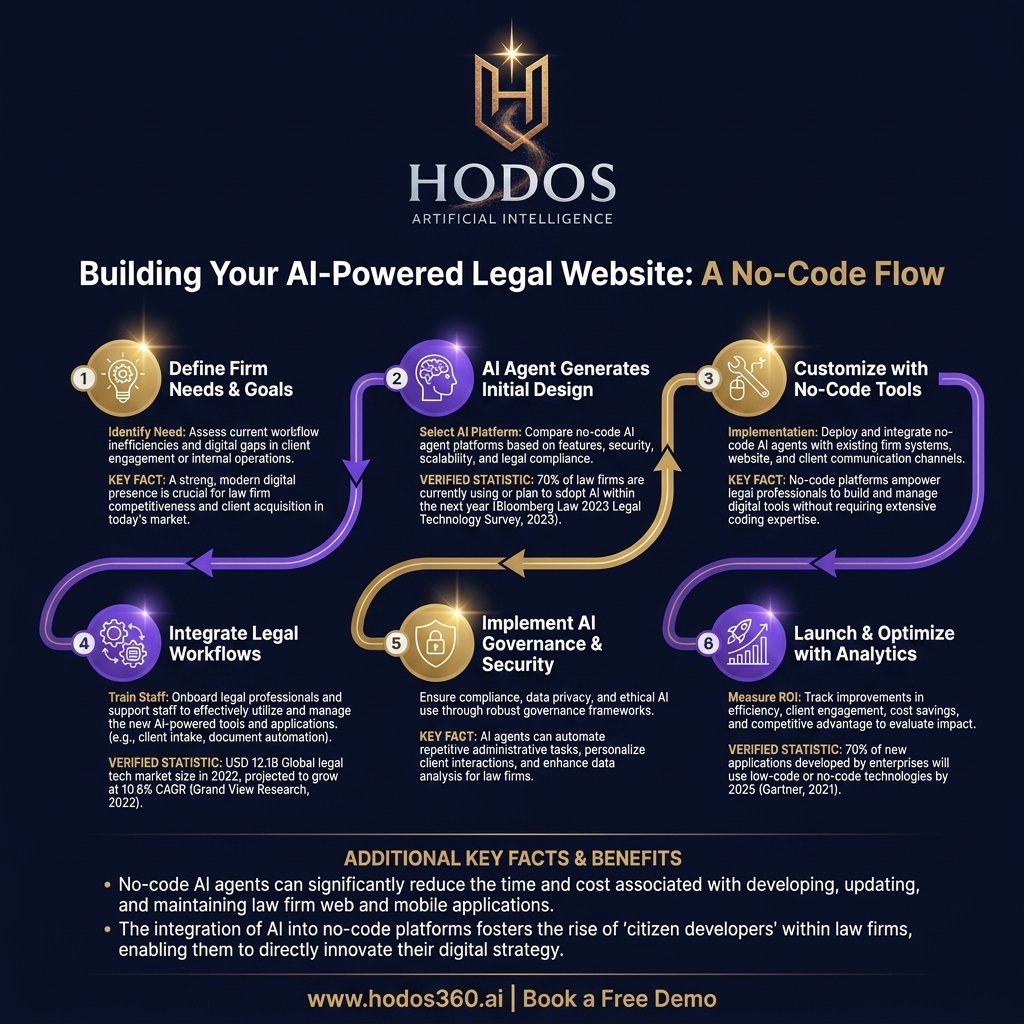
The evolution of no-code platforms has been a quiet revolution, but the integration of advanced AI capabilities, particularly in the form of no-code AI agents, has amplified its impact exponentially. Companies like Creatio, with their "AI Twin" concept, are leading this charge, demonstrating how these intelligent agents can understand natural language commands and translate them into functional code or design elements. This democratizes the development process, allowing legal professionals to describe desired website features or client portal functionalities, and have the AI agent generate them, reducing reliance on specialized IT teams. This isn't about replacing human creativity but augmenting it, enabling faster iteration and deployment of digital solutions crucial for staying competitive.
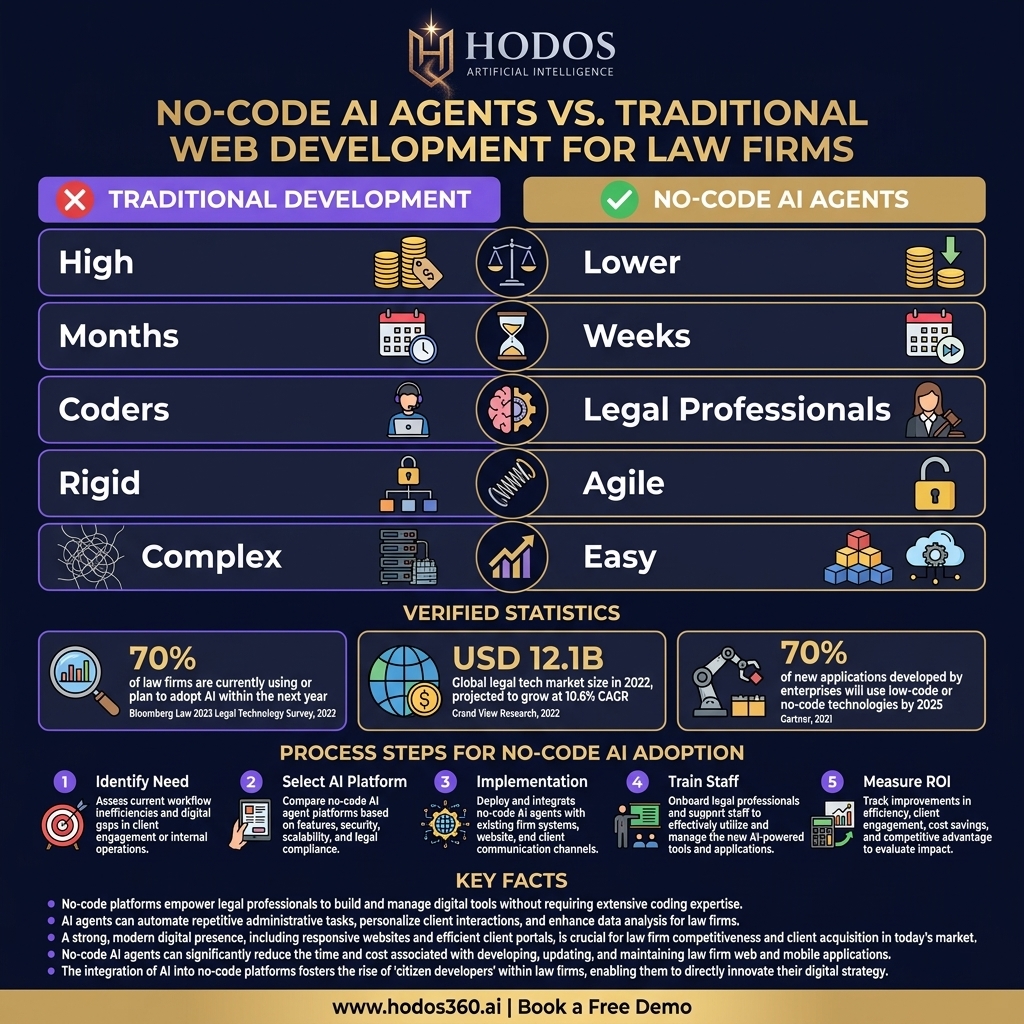
The market signals are clear: Gartner predicts that by 2025, 70% of new enterprise applications will be developed using low-code or no-code technologies. For law firms, this means a significant shift in resource allocation and strategic planning. Learn more about AI Voice Assistants: The Ultimate Evolution for Law Firms. Instead of outsourcing every digital project, firms can empower their internal marketing or administrative teams to build and maintain sophisticated online tools. This agility is vital in a fast-moving legal market where client expectations for digital engagement are constantly rising. The ability to rapidly deploy new features, update content, and respond to market trends without lengthy development cycles provides a distinct competitive advantage, fostering innovation from within the firm. The ethical duty for attorneys to stay abreast of technology, as outlined in ABA Model Rule 1.1 (Competence), makes understanding and leveraging these tools not just an option, but a professional imperative.
Bridging the Digital Divide: From Concept to Client Portal
For law firms, the practical applications of no-code AI agents are transformative. Imagine a firm needing a custom client intake form that integrates directly with their case management system. Traditionally, this would involve a lengthy process of requirements gathering, design mock-ups, coding, and testing. With AI agents, a legal operations manager could describe the desired fields, conditional logic, and integration points, and the agent would generate a functional prototype in hours, not weeks. This capability extends to building secure client portals where clients can upload documents, track case progress, and communicate securely with their legal team. Learn more about Strategic AI Tools Adoption: Essential Guide for Law Firms. Firms can also rapidly deploy dynamic informational sites for specific practice areas, populated with AI-generated content that is then reviewed and refined by human experts. This dramatically shortens the time from concept to deployment, allowing firms to be more responsive to client needs and market opportunities. It enables legal teams to focus on legal work, while AI handles the technical heavy lifting of digital interface creation, ensuring that the firm's digital presence remains cutting-edge and highly functional.
Elevating Law Firm Web Development with AI Governance
While the speed and flexibility of no-code AI agents are undeniable, the concept of "enterprise governance" highlighted by Creatio 10x is particularly critical for the legal sector. Law firms handle highly sensitive client data, making data security, privacy, and regulatory compliance non-negotiable. The EU AI Act, for instance, introduces stringent requirements for AI systems deemed 'high-risk,' which could include certain legal tech applications. Therefore, any adoption of AI-powered development tools must be accompanied by robust governance frameworks. This means centralized control over access, data handling protocols, audit trails for AI-generated content or code, and adherence to privacy regulations like GDPR and CCPA. Learn more about Essential AI Website Builders for Law Firms: A Deep Dive. Firms must ensure that while development is democratized, oversight remains centralized and stringent, preventing potential ethical breaches or data vulnerabilities.
Legal tech experts like Sarah Glassmeyer, a prominent voice on legal innovation, have consistently emphasized that technology adoption in law must always prioritize ethical considerations and data integrity. Implementing no-code AI agents requires not just technical integration but also a comprehensive policy framework that dictates how these agents are trained, what data they can access, and how their outputs are validated. This dual focus on innovation and governance ensures that law firms can harness the power of AI without compromising their professional obligations or client trust. A recent Thomson Reuters Legal Executive Institute report on AI adoption underscored that firms prioritizing robust governance frameworks are not only mitigating risks but also building a stronger foundation for long-term technological success and client confidence.
Scaling Digital Capabilities: AI-Powered Websites for Enterprise Law Firms
For large, enterprise-level law firms, the ability of no-code AI agents to scale digital offerings is a game-changer. These firms often have diverse practice areas, multiple office locations, and a global client base, each requiring tailored digital experiences. Traditional development approaches often struggle to keep pace with such complex and rapidly evolving needs. AI-powered website building, however, allows for the rapid deployment of personalized client experiences, multilingual support, and highly responsive designs across various devices. For example, a firm might need a dedicated microsite for a complex M&A transaction with secure data rooms and real-time updates for specific clients. No-code AI agents can facilitate the rapid creation and customization of such platforms, integrating seamlessly with existing enterprise systems.
Firms that embrace this level of AI integration are setting a new standard. Learn more about Legora's Strategic Leap: Essential AI Law Firm Management. Consider Allen & Overy's widely publicized partnership with Harvey AI, demonstrating how even the largest law firms are integrating advanced AI into their core operations. This extends beyond legal research to client-facing platforms, where AI can personalize content delivery, offer 24/7 basic query responses (synergizing with HODOS 360's AI Voice Assistants), and optimize user journeys based on behavioral analytics. This strategic adoption allows enterprise law firms to maintain a cutting-edge digital presence, offering an unparalleled client experience that is both efficient and highly personalized, ultimately solidifying their position as industry leaders. The ability to manage and update vast amounts of digital content and complex web structures with the assistance of AI agents means an unlimited potential for digital growth and client service innovation.
Is your firm equipped for the future of legal web development? Book a personalized demo with HODOS 360 to see our AI-powered solutions in action.
Beyond Websites: Mobile Development and Client Engagement
The utility of no-code AI agents extends far beyond static websites to encompass sophisticated mobile development and client engagement strategies. Law firms can leverage these tools to build custom mobile applications that offer secure client communication, provide real-time case updates, and deliver personalized legal content. Imagine a client receiving a push notification about a new development in their case, or easily uploading required documents through a secure mobile portal—all powered by an app developed rapidly and efficiently using AI agents. AI can also analyze user behavior within these platforms to optimize content delivery and user experience, ensuring that clients receive the most relevant information at the right time. Learn more about AI Design Tools: Ultimate Guide to Web & Mobile Transformation. This level of mobile-first engagement is becoming a differentiator, allowing firms to deepen client relationships and streamline operational efficiencies by making information accessible and interactive on the go. This is a crucial step towards a truly integrated digital client experience.
The Competitive Edge: Faster Development, Enhanced ROI
The business case for adopting no-code AI agents in legal web development is compelling, primarily driven by significantly reduced time-to-market and substantial cost savings. By empowering legal teams to build and iterate digital assets faster, firms can respond to market demands and client feedback with unprecedented agility. McKinsey & Company's research consistently highlights that organizations leveraging AI for process automation and digital product development often see a 10-15% increase in operational efficiency and a faster return on investment. For law firms, this translates into quicker deployment of new practice area pages, more efficient client intake systems, and the ability to test and refine marketing campaigns with greater speed, directly impacting lead generation and client acquisition costs. The traditional bottlenecks of complex coding and lengthy development cycles are effectively bypassed, freeing up resources that can be reallocated to core legal services.
Furthermore, enhanced client satisfaction stemming from a superior digital experience directly contributes to the firm's bottom line. A user-friendly, responsive website and intuitive client portal can significantly improve client retention and attract new business through positive word-of-mouth and online reviews. Learn more about Agentic Marketing: Essential Data Foundation for Law Firms. The ability to track ROI for digital initiatives through integrated analytics, a feature often built into AI-powered development tools, allows firms to make data-driven decisions about their online strategy. This strategic advantage is not merely about having a modern website; it's about building a scalable, adaptable digital infrastructure that consistently delivers value. Firms that are early adopters of these advanced technologies, integrating them thoughtfully into their operations, are already demonstrating superior market performance and client engagement compared to those adhering to traditional, slower development paradigms. Federal Rules of Civil Procedure Rule 26(f) (Discovery Planning) also implicitly encourages efficiency and technological competence, as robust digital infrastructure can aid in managing increasingly complex e-discovery demands.
Customization and Personalization with AI Agents
One of the most powerful aspects of no-code AI agents is their capacity for deep customization and personalization. For law firms, this means the ability to create highly tailored digital experiences for individual clients or specific client segments. A personal AI agent can learn a client's preferences, the specific legal services they require, and even their communication style, then adapt the firm's digital interface to match. From tailored intake questions that pre-populate based on previous interactions to personalized dashboards showing relevant case documents and updates, the client experience becomes seamless and highly efficient. This level of bespoke service, once the exclusive domain of high-cost, custom-coded solutions, is now accessible to a broader range of firms. It allows firms to reinforce their brand as client-centric and technologically forward-thinking, fostering stronger client relationships and enhancing overall service delivery without the need for extensive manual coding.

Key Takeaways and Next Steps
The rapid advancement of no-code AI agents, as exemplified by recent release events like Creatio 10x, signals a new era for law firm web and mobile development. This technology offers an unlimited potential to transform how legal practices establish and maintain their digital presence, moving beyond static websites to dynamic, client-centric platforms. Firms must recognize that adopting these tools is not just about keeping up with trends but about strategically positioning themselves for future growth and enhanced client satisfaction. The ability to build, govern, and scale digital solutions with unprecedented speed and efficiency is now within reach for enterprises of all sizes in the legal sector. Embracing this paradigm shift requires a proactive approach, focusing on understanding the capabilities of AI agents, establishing robust governance protocols, and investing in internal training to empower legal professionals as 'citizen developers'.
The future of legal digital presence is agile, AI-driven, and accessible. Law firms that proactively evaluate their current digital infrastructure and explore the strategic integration of no-code AI agents will be better equipped to meet evolving client expectations and maintain a competitive edge. HODOS 360 stands at the forefront of this transformation, offering comprehensive AI-powered web & mobile development services designed specifically for the nuanced needs of the legal industry. Our platform empowers law firms to build responsive, SEO-optimized, and high-converting websites and mobile applications, ensuring a robust and future-proof digital strategy. This strategic development is essential for any firm looking to leverage cutting-edge technology to enhance client engagement and operational efficiency.
Future-proof your firm's digital strategy. Contact HODOS 360 today to learn how our Web & Mobile Development services can empower your practice.
Frequently Asked Questions
What exactly are no-code AI agents in the context of web development?+
No-code AI agents are intelligent software programs that can understand natural language instructions or visual inputs to generate and modify web and mobile applications without requiring traditional coding. They automate complex development tasks, allowing non-technical users, such as legal professionals, to design and deploy sophisticated digital platforms efficiently. These agents leverage AI to interpret user intent and translate it into functional digital elements.
How do no-code AI agents specifically benefit law firms?+
For law firms, no-code AI agents offer several benefits: rapid development of client portals, custom intake forms, and practice-specific websites; reduced costs and time associated with traditional coding; enhanced client experience through personalized digital interactions; and improved operational efficiency. They enable firms to quickly adapt their digital presence to market changes and client needs, fostering greater agility and innovation across the practice.
Is using no-code AI agents secure for sensitive legal data?+
Yes, when implemented with robust enterprise governance. Reputable no-code platforms integrating AI agents prioritize security, offering features like data encryption, access controls, and compliance with industry standards. Law firms must ensure their chosen platform adheres to legal data privacy regulations (e.g., GDPR, CCPA) and establish internal protocols for data handling and AI agent training, ensuring sensitive information remains protected and confidential.
What are the customization limitations of no-code AI agents for legal websites?+
While no-code AI agents offer extensive customization, some highly niche or extremely complex functionalities requiring deep integration with legacy systems might still benefit from traditional coding. However, modern no-code platforms are increasingly sophisticated, allowing for a high degree of personalization in design, workflow automation, and third-party integrations, often meeting 90% or more of a law firm's unique requirements without writing a single line of code.
How does the rise of no-code AI agents impact traditional web developers in the legal tech space?+
The rise of no-code AI agents shifts the role of traditional web developers. Instead of hands-on coding for every project, developers can focus on more complex, bespoke integrations, creating custom components for no-code platforms, and managing the overall architectural governance. They become enablers and architects of the no-code ecosystem, ensuring security, scalability, and performance, while empowering legal professionals to handle day-to-day digital content creation and maintenance.