


AI Marketing: The Essential KPI for Law Firm Growth
The legal industry, often perceived as a bastion of tradition, is currently navigating an unprecedented digital transformation, particularly in client acquisition. For years, law firms relied on word-of-mouth referrals, networking events, and perhaps a modest local advertisement. However, the ground beneath this conventional approach has shifted dramatically. A recent InfotechLead report highlights a seismic change: 69% of B2B buying information now moves online, making AI marketing relevance a critical Key Performance Indicator (KPI) for any business, including law firms. This isn't just a trend; it's the new operating reality, demanding immediate adaptation from legal professionals who wish to remain competitive and ensure sustained growth.
Consider Sarah Chen, Managing Partner at LexLink Partners, a hypothetical mid-sized firm with a commendable track record but a stubbornly traditional marketing strategy. For years, LexLink thrived on its reputation and established network. Yet, by early 2026, Sarah observed a concerning plateau in new client inquiries, even as younger, digitally-savvy competitor firms seemed to be capturing an increasing share of high-value clients in their niche areas. Her growing unease crystallized during LegalTech NYC 2026, where she listened to industry luminaries like Dario Amodei, CEO of Anthropic, discuss AI's pervasive impact, not just on internal operations but crucially on client engagement and acquisition. Amodei's vision underscored that the future of business, including legal, would be inextricably linked to how effectively organizations leverage artificial intelligence to understand and connect with their target audience. This pivotal insight ignited Sarah's realization that LexLink's future hinged on embracing the new frontier of AI marketing relevance.
This dramatic shift isn't merely about having a website; it's about intelligent, data-driven engagement. The digital consumer, whether an individual seeking legal counsel or a corporation requiring complex litigation support, begins their journey online. They research, compare, and form initial impressions long before making contact. For law firms, this means that their digital presence is no longer a supplementary tool but the primary conduit for lead generation and client intake. The firms that recognize and strategically address this transformation, integrating AI into their marketing efforts, are not just surviving—they are thriving, redefining what it means to achieve commercial growth in the modern legal landscape. This new chapter in legal marketing requires an urgent upgrade to our understanding of what constitutes effective client outreach, pushing AI from a nascent technology to a critical equalizer in the race for market share.
The Digital Transformation of Legal Client Acquisition
The transition from traditional, relationship-based client acquisition to a digitally-driven model has been swift and profound for law firms. Historically, a lawyer's network, participation in community events, and referrals from existing clients formed the bedrock of their marketing strategy. While these elements retain value, their efficacy as standalone drivers of growth has significantly diminished. Data from the ABA TechReport 2025 indicates that over 70% of law firms now acknowledge the internet as their primary source of new client leads, a stark contrast to a decade ago. This statistic underscores a fundamental shift in client behavior: potential clients, both individual and corporate, are increasingly sophisticated researchers. They expect immediate access to information, transparent service offerings, and demonstrable expertise, all discoverable online. Firms that fail to meet these expectations risk becoming invisible in an increasingly crowded digital marketplace.
This transformation introduces unique challenges for the legal sector, particularly concerning ethical advertising and client trust. Unlike consumer goods, legal services are intangible, often sought during periods of vulnerability, and are bound by strict professional conduct rules. The ABA Model Rules of Professional Conduct, specifically Rule 7.1 (Communications Concerning a Lawyer's Services) and Rule 7.3 (Solicitation of Clients), govern how attorneys can market their services. These rules, while essential for maintaining professionalism and preventing misleading claims, can sometimes be misinterpreted as barriers to aggressive digital marketing. Learn more about Ultimate AI in MarTech: Predictive Power for Law Firms. However, the most successful firms have demonstrated that ethical digital engagement is not only possible but imperative. They leverage platforms to educate, demonstrate thought leadership, and build trust long before a formal engagement, thereby transforming the digital space into an extension of their professional reputation. This approach ensures that their digital presence is not just compliant but also compelling, driving genuine client interest rather than mere clicks.
Moreover, the competitive landscape has intensified. Legal tech startups, often backed by significant funding rounds—such as OpenAI's $6.6 billion raise (though not directly legal marketing, it signifies the scale of AI investment) or Clio's strategic acquisitions in practice management—are not just offering tools; they are setting new benchmarks for efficiency and client experience. Law firms are no longer just competing against other firms but against a rapidly evolving ecosystem that prioritizes digital fluency. For example, firms like Gunderson Dettmer, known for its work with startups, have long understood the importance of a strong digital brand and actively engage with their target audience through content and online presence. This proactive stance ensures they remain relevant to a tech-savvy client base, demonstrating how a forward-thinking approach to digital outreach can secure a firm's position at the forefront of the industry. The firms that are winning are those that are actively leveraging digital channels to cultivate relationships, educate potential clients, and ultimately, convert interest into loyal business.
Beyond Billboards: The New KPI Landscape
The shift to digital client acquisition necessitates a re-evaluation of what constitutes a successful marketing metric. The era of measuring success purely by billboard impressions or Yellow Pages ads is long gone. Today, AI marketing relevance defines a new chapter in performance measurement, focusing on metrics that directly correlate with client engagement, conversion, and ultimately, commercial growth. It moves beyond vanity metrics like website traffic to encompass deeper indicators such as qualified lead generation, client acquisition cost (CAC), client lifetime value (CLTV), and return on marketing investment (ROI). For instance, a firm might track how many prospects downloaded a whitepaper on a specific legal topic, how many then booked a consultation through an online scheduler, and the conversion rate from consultation to retained client. These are quantifiable, actionable insights that traditional marketing simply couldn't provide with such precision.
This new KPI landscape is driven by data analytics and artificial intelligence, transforming raw data into strategic intelligence. Learn more about AI Content Operations: Essential for Law Firm Marketing Success. Instead of merely knowing that a client visited a website, AI-powered analytics can reveal *which* pages they visited, *how long* they stayed, *what content* they engaged with, and even predict their likelihood of conversion based on their digital footprint. This level of insight allows law firms to optimize their marketing spend, personalize outreach, and allocate resources to the channels and content that yield the highest returns. As Professor Richard Susskind, a leading authority on legal tech, has consistently argued, the legal profession must embrace data-driven decision-making to remain viable. Firms that are proactively tracking these advanced KPIs, rather than relying on outdated measures, are better positioned to understand their market, respond to trends, and adapt their strategies to achieve sustainable growth. This analytical rigor is a cornerstone of modern legal business strategy, distinguishing the leaders from those content to merely follow.
AI's Strategic Imperative in Legal Marketing
The deployment of artificial intelligence in legal marketing is no longer a luxury but a strategic imperative for firms seeking to optimize their client acquisition funnels and enhance their market presence. AI's capabilities extend far beyond simple automation; it enables hyper-personalization, predictive analytics, and content generation at scale, providing a distinct competitive edge. Consider how AI can analyze vast datasets of past client interactions, case outcomes, and market trends to identify ideal client profiles with unprecedented accuracy. This allows firms to target their marketing efforts with surgical precision, reaching potential clients who are most likely to require their specific services, thereby improving conversion rates and reducing wasteful spending. For instance, an AI system might identify a surge in corporate bankruptcies in a specific industry sector and automatically tailor ad campaigns and content to reach businesses within that sector proactively, offering relevant legal solutions.
One of the most compelling applications of AI is in content generation and distribution. Creating high-quality, relevant content—blog posts, articles, legal explainers, social media updates—is time-consuming but essential for demonstrating expertise and building authority online. AI-powered platforms can assist in drafting initial content, optimizing it for search engines, and even generating custom video content at scale. Take the example of HODOS 360's AI Marketing Platform. It empowers law firms to create engaging AI videos, automate social media posting across multiple platforms, and generate targeted content effortlessly. Learn more about AI Website Builders: The Ultimate Guide to Legal SEO Automation. This allows legal professionals to focus on their core practice while the platform ensures a consistent, high-impact digital footprint. Firms like Wilson Sonsini Goodrich & Rosati (known for its tech focus) are already leveraging advanced analytics to inform their content strategy, ensuring their insights reach the right audience at the right time, demonstrating a clear understanding of AI's critical role in modern legal outreach.
Furthermore, AI excels in managing the complex ecosystem of digital advertising and social media. From optimizing ad bids on Google and LinkedIn to identifying optimal posting times for social media engagement, AI algorithms can process and react to market dynamics faster and more effectively than human marketers alone. This leads to more efficient ad spend and increased visibility. For example, AI can analyze user behavior on a firm’s website and dynamically adjust the content or calls to action presented to that user, creating a more personalized and effective journey. This level of adaptive intelligence is transforming how law firms approach their marketing efforts, moving from a reactive to a proactive stance. The result is a more dynamic, responsive, and ultimately more effective marketing strategy that drives consistent growth and strengthens client relationships. The shift is not just about adopting new tools but fundamentally reimagining the client engagement process, with AI at its core, ensuring the firm's message resonates deeply and widely across the digital sphere.
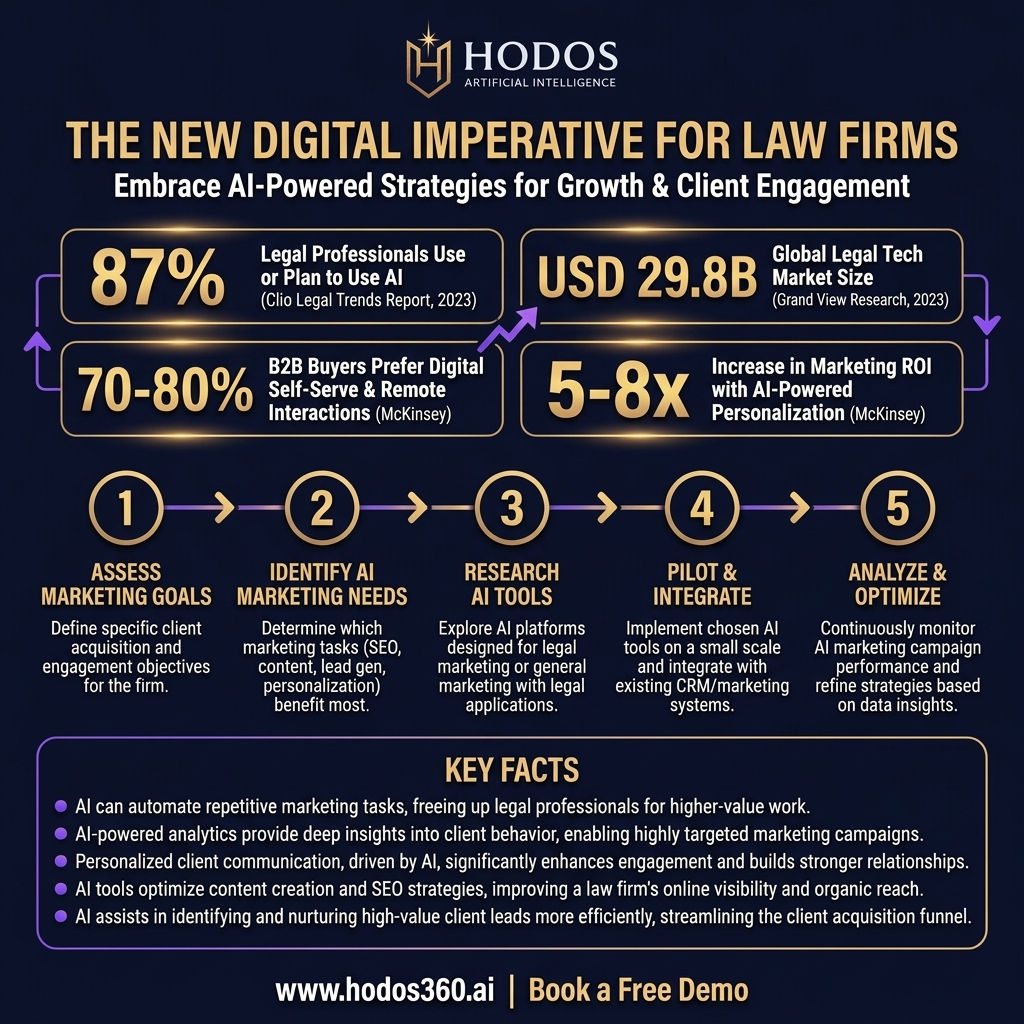
- ✓Hyper-Personalization: AI analyzes client data to deliver highly relevant content and service recommendations, making interactions feel tailored and impactful.
- ✓Automated Content Generation: AI tools assist in drafting legal articles, social media posts, and even video scripts, significantly boosting content output and consistency.
- ✓Predictive Analytics: AI forecasts market trends and client needs, allowing firms to proactively develop and market services to emerging demands.
- ✓Optimized Ad Campaigns: AI manages digital ad bids and targeting in real-time, maximizing ROI and ensuring ads reach the most qualified prospects.
- ✓Enhanced SEO: AI identifies high-value keywords and content gaps, improving search engine rankings and organic client acquisition.
- ✓Efficient Lead Qualification: AI-powered chatbots and voice assistants can pre-qualify leads 24/7, ensuring attorneys only engage with serious prospects.
- ✓Comprehensive ROI Tracking: AI platforms provide granular insights into marketing campaign performance, enabling data-driven adjustments for continuous improvement and growth.
Navigating the Ethical and Regulatory Maze of AI Marketing
While the promise of AI in legal marketing is immense, law firms must navigate a complex ethical and regulatory landscape to ensure compliance and maintain public trust. The deployment of artificial intelligence inherently involves data collection, processing, and analysis, which raises significant concerns regarding data privacy, algorithmic bias, and transparency. Regulations such as the General Data Protection Regulation (GDPR) in Europe and the California Consumer Privacy Act (CCPA) in the United States impose strict requirements on how personal data is handled. Firms utilizing AI for client segmentation, personalized outreach, or lead generation must ensure their practices align with these stringent data protection laws. Failure to do so can result in hefty fines and severe reputational damage, eroding the very trust that legal professionals are sworn to uphold. The legal profession, more than most, operates on a foundation of confidentiality and ethical conduct, making diligence in AI implementation not just good practice, but a critical professional obligation.
Algorithmic bias is another paramount concern. If the data used to train AI models is biased—reflecting historical inequities or skewed demographics—the AI's outputs can perpetuate or even amplify those biases. In legal marketing, this could manifest as discriminatory targeting, inadvertently excluding certain demographics from receiving information about legal services, or creating profiles that misrepresent potential clients. For example, if an AI model is trained predominantly on data from a specific socioeconomic group, its marketing recommendations might inadvertently overlook or undervalue other groups, leading to inequitable access to justice. Legal professionals, guided by principles of fairness and equal access, have a unique responsibility to scrutinize their AI tools for such biases. Firms like Harvey AI, though focused on legal research, have emphasized the importance of ethical AI development, highlighting that even seemingly neutral algorithms can have profound societal impacts if not carefully managed. Learn more about Proven Legal AI ROI: Essential Strategies for Law Firms. Their discussions, often featured at conferences like ABA TechShow, underscore the ongoing debate and the need for robust ethical frameworks.
Furthermore, the transparency of AI-driven marketing practices is crucial for maintaining client trust and adhering to legal ethics. Potential clients should understand when they are interacting with an AI (e.g., a chatbot) and how their data is being used. Misleading or deceptive practices, even if unintentional, can undermine a firm's credibility. The ABA Model Rules of Professional Conduct, particularly Rule 7.1, requires that communications about a lawyer's services not be false or misleading. This extends to AI-generated content and automated outreach. Firms must ensure that AI-created content accurately reflects their expertise and services, and that automated interactions do not create false expectations. As Associate Justice Elena Kagan once noted in a different context, transparency is key to public confidence in legal processes. This principle applies equally to the adoption of advanced technologies in legal business. Law firms must establish clear guidelines for AI usage, conduct regular audits of their AI marketing campaigns, and prioritize ethical considerations at every stage of their digital strategy, ensuring that innovation does not come at the expense of integrity.
Building Trust in an AI-Driven World
In an era where artificial intelligence is increasingly intertwined with client interactions, building and maintaining trust becomes even more paramount for law firms. Transparency is the bedrock of this trust. Firms must be open about their use of AI in marketing, clearly indicating when a client is interacting with an AI-powered chatbot or receiving AI-generated content. This can be as simple as a disclosure on a website or a clear statement at the beginning of a chat interaction. Beyond transparency, active human oversight of AI systems is critical. While AI can automate tasks and provide insights, human attorneys must remain in control, reviewing AI-generated content, monitoring campaign performance, and making final decisions. This ensures that the firm's values, ethical standards, and legal expertise are consistently reflected in all client-facing communications. Learn more about Legal Tech Strategy: Essential Build vs. Buy Insights. It's about leveraging AI as an assistant, not a replacement for human judgment and empathy, particularly in a profession built on personal relationships.
Developing internal policies and training programs around ethical AI use is another essential step. Law firms should establish clear guidelines for data privacy, algorithmic fairness, and content accuracy for their AI marketing relevance strategies. This includes regular audits of AI systems to detect and correct any biases, ensuring that marketing efforts are inclusive and non-discriminatory. For instance, a firm might implement a policy requiring human review of all AI-generated content before publication or establish a diverse internal committee to review AI analytics for potential biases. This proactive approach not only mitigates risks but also reinforces the firm's commitment to ethical practice in a technologically advanced world. By embedding ethical considerations into their AI strategy, law firms can harness the power of AI to drive growth while upholding the highest standards of the legal profession, demonstrating that innovation and integrity are not mutually exclusive but rather complementary forces in the digital age.
Future-Proofing Your Law Firm: The HODOS 360 Advantage
For law firms looking to not just survive but thrive in this digitally transformed legal landscape, proactively embracing AI-powered marketing is key to future-proofing their practice. The firms that are investing in sophisticated, integrated AI platforms today are the ones poised for sustained growth and leadership tomorrow. This isn't about adopting a piecemeal approach; it's about integrating AI across the entire client acquisition lifecycle, from initial awareness to conversion and beyond. Platforms that offer a holistic suite of AI-driven marketing tools provide a significant advantage, streamlining operations, enhancing client engagement, and delivering measurable ROI. The strategic imperative is clear: firms must evolve their marketing capabilities to match the digital behaviors of their target audience, ensuring their relevance in a competitive, AI-driven market.
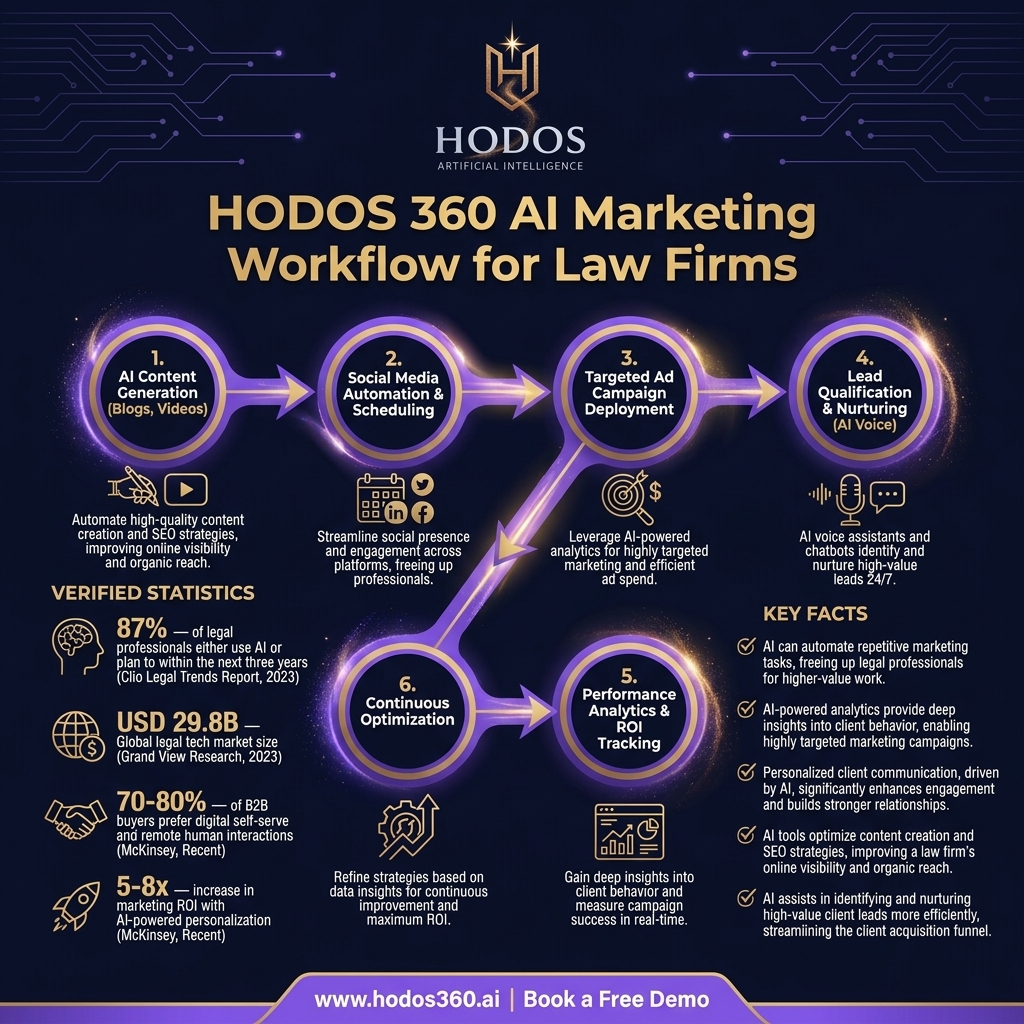
This is where comprehensive solutions like HODOS 360's AI Marketing Platform become indispensable. HODOS 360 offers a powerful suite of services designed specifically for law firms, addressing the core challenges of digital client acquisition. Imagine being able to leverage AI for rapid, high-quality video creation, transforming complex legal concepts into engaging visual content for social media and websites. Or automating your social media campaigns, ensuring a consistent, professional presence across all relevant platforms without consuming valuable attorney time. The platform's content generation capabilities mean your firm can produce expert articles and blog posts at scale, boosting your SEO and demonstrating thought leadership. Learn more about Marketing Attention: The Ultimate Shift for Law Firms. Furthermore, its advanced analytics and ROI tracking provide clear insights into what’s working, allowing for continuous optimization and ensuring every marketing dollar is spent effectively. This integrated approach ensures that AI marketing relevance is not just a buzzword but a tangible, measurable driver of your firm's commercial growth.
The competitive landscape for law firms is constantly evolving, with new trends and technologies emerging at an accelerating pace. Firms that cling to outdated marketing methodologies will inevitably fall behind. In contrast, those that strategically adopt AI, leveraging platforms that understand the unique needs of the legal industry, will gain a considerable edge. This proactive stance allows firms to not only attract more qualified leads but also to build stronger, more enduring client relationships through personalized and consistent engagement. As Jensen Huang, CEO of NVIDIA, frequently articulates regarding AI's impact across industries, the winners will be those who harness this technology to fundamentally rethink and improve their core functions. For law firms, this means embracing AI to redefine their marketing strategy, making it more intelligent, efficient, and ultimately, more successful. The path to future-proof your law firm lies in intelligent adoption of artificial intelligence that aligns with the digital expectations of today's clients.
Measuring ROI and Sustained Growth with AI
The true power of AI in legal marketing lies in its ability to provide granular, actionable data that enables precise measurement of ROI and supports sustained growth. Unlike traditional marketing, where attributing a new client to a specific campaign could be speculative, AI platforms offer sophisticated analytics dashboards that track every touchpoint. Firms can monitor lead sources, conversion rates at each stage of the funnel, client acquisition costs, and ultimately, the lifetime value of clients acquired through specific AI-driven campaigns. This level of transparency allows managing partners to make informed decisions, reallocate budgets to high-performing strategies, and continually refine their marketing efforts for optimal results. For example, a firm might discover that AI-generated video content on LinkedIn yields a significantly higher conversion rate for corporate clients than traditional blog posts, prompting a strategic shift in their content investment. This data-first approach transforms marketing from an art into a science.
Furthermore, AI facilitates continuous optimization, which is critical for sustained growth. AI models learn and adapt over time, constantly refining their targeting, content recommendations, and campaign adjustments based on real-time performance data. This iterative process ensures that marketing strategies remain relevant and effective, even as market conditions or client behaviors evolve. For a law firm, this means their AI marketing relevance is perpetually being fine-tuned, ensuring they maintain a competitive edge. This dynamic capability is a stark contrast to static marketing plans that quickly become outdated. By embracing AI for comprehensive ROI tracking and continuous improvement, law firms can move beyond guesswork, confidently investing in marketing strategies that deliver consistent, measurable commercial growth and secure their position as leaders in the digital age. It's about creating a virtuous cycle where data informs strategy, strategy drives performance, and performance fuels further investment and innovation, ensuring the firm's long-term prosperity.

Key Takeaways and Next Steps
The transformation of B2B buying behavior, with nearly 70% of information consumption now online, unequivocally establishes AI marketing relevance as a critical KPI for law firms. The era of passive client acquisition is over; proactive, intelligent digital engagement is the new standard. Firms must recognize that artificial intelligence is not just a tool for internal efficiency but a powerful engine for external growth and client acquisition. From hyper-personalization and automated content creation to predictive analytics and precise ROI tracking, AI offers unprecedented opportunities to streamline marketing efforts, enhance client engagement, and secure a competitive advantage.
Navigating this new landscape requires a strategic approach that balances innovation with ethical responsibility. Law firms must prioritize transparency, ensure data privacy, and actively combat algorithmic bias to build and maintain trust in an AI-driven world. The future belongs to those who embrace these trends and integrate sophisticated AI solutions into their core business strategy. For law firms ready to harness the power of AI marketing relevance and ensure their sustained commercial growth, exploring a comprehensive platform is the logical next step. Discover how HODOS 360's AI Marketing Platform can empower your firm to attract more clients, optimize your digital presence, and achieve measurable success. Book a Free Demo with HODOS 360 today and transform your client acquisition strategy.
Frequently Asked Questions
What does 'AI marketing relevance' mean for law firms?+
AI marketing relevance for law firms means leveraging artificial intelligence to ensure that all marketing efforts—content, ads, social media—are precisely targeted, highly personalized, and genuinely valuable to potential clients. It focuses on metrics that measure true engagement and conversion, rather than just superficial visibility, making marketing more effective and ROI-driven.
How does AI marketing help law firms acquire clients?+
AI marketing assists law firms in client acquisition by automating content creation, optimizing digital ad campaigns for specific audiences, personalizing client outreach, and providing advanced analytics. This leads to more qualified leads, lower client acquisition costs, and a more efficient use of marketing resources, ultimately driving more client engagements.
Are there ethical concerns with using AI in legal marketing?+
Yes, ethical concerns include data privacy (compliance with GDPR/CCPA), algorithmic bias (ensuring fairness in targeting), and transparency (disclosing AI use to clients). Law firms must ensure their AI marketing practices adhere to the ABA Model Rules of Professional Conduct and other relevant regulations, prioritizing trust and integrity.
What specific AI tools are best for law firm marketing?+
For law firms, the best AI tools integrate multiple functions, such as AI-powered content generation (e.g., for blog posts, social media updates), AI video creation, social media automation, and robust analytics with ROI tracking. Platforms like HODOS 360's AI Marketing Platform offer these comprehensive capabilities tailored to legal needs.
How can a small law firm implement AI marketing effectively?+
Small law firms can implement AI marketing effectively by starting with an integrated platform that offers a suite of tools without requiring extensive technical expertise. Focus on automating repetitive tasks like social media posting and content repurposing, using AI for targeted local SEO, and leveraging analytics to understand client behavior. Prioritize solutions that offer clear ROI tracking.