

AI Marketing Workflows: The Proven Advantage for Law Firms
Imagine two law firms, both established and reputable, navigating the fierce competition for clients in mid-2026. "Sterling & Associates" had recently invested in overhauling its marketing operations with advanced AI, transforming its client outreach from a fragmented, labor-intensive process into a highly efficient, data-driven engine. Their social media engagement surged, lead conversion rates doubled, and their brand presence dominated niche legal searches. Meanwhile, "Blackstone Chambers," a peer firm, remained anchored to traditional methods – manual content creation, sporadic social media updates, and reactive client engagement. This stark contrast underscores a pivotal truth: the legal sector, traditionally cautious, is undergoing a rapid, AI-driven evolution, and marketing departments are at its vanguard. The core of this transformation, as highlighted by a recent Social Samosa article, isn't just about using AI tools, but about fundamentally reimagining and optimizing marketing workflows.
The legal industry's journey with artificial intelligence has accelerated dramatically since the widespread adoption of large language models. What was once the domain of esoteric legal research tools has now expanded into every facet of firm operations, from intricate case management to sophisticated client intake. Visionaries like Sam Altman, CEO of OpenAI, have consistently articulated AI's potential to augment human capabilities across all professional domains, and legal marketing is proving to be a prime example. Firms are no longer asking *if* they should adopt AI, but *how* to integrate it strategically to gain a tangible competitive edge. The answer lies in orchestrating AI to create seamless, intelligent workflows that deliver consistent, high-impact results.
For law firms, this means moving beyond rudimentary automation to embrace intelligent systems that can learn, adapt, and execute complex marketing strategies with minimal human intervention. The firms that are successfully leveraging AI are seeing not just incremental improvements, but exponential growth in client acquisition, brand visibility, and operational efficiency. This shift is not merely about technological adoption; it's about a strategic imperative to future-proof a legal practice. By integrating AI into the very fabric of their marketing operations, law firms can unlock unprecedented levels of personalization, scale, and measurable ROI, ensuring they remain competitive and relevant in an evolving legal landscape. Ready to revolutionize your law firm's marketing? Discover how HODOS 360's AI Marketing Platform can transform your outreach and drive unprecedented growth.
The Workflow Revolution: From Manual Drudgery to Agentic Efficiency
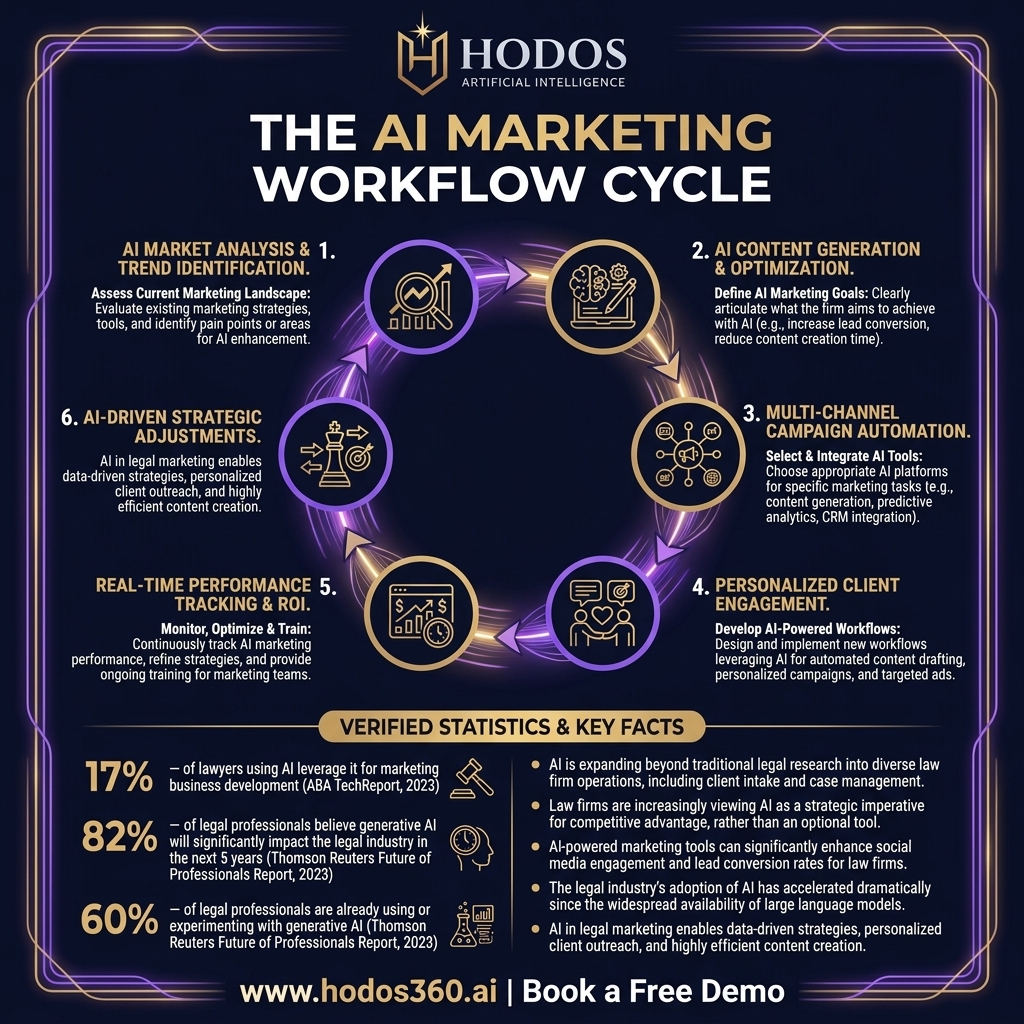
The pre-AI marketing landscape in many law firms was often characterized by disconnected, manual tasks. Attorneys or their marketing teams spent countless hours drafting blog posts, curating social media content, and tracking campaign performance—a process that was time-consuming, inconsistent, and lacked analytical depth. A 2023 Thomson Reuters report on the State of the Legal Market underscored how many firms struggled to effectively measure marketing ROI, often due to fragmented data and anecdotal evidence. This operational inefficiency hampered growth and diverted valuable attorney time, limiting the firm's ability to respond dynamically to market changes.
Enter the era of agentic AI, a paradigm shift beyond simple automation. Unlike traditional tools that merely execute predefined scripts, agentic AI systems can autonomously plan, adapt, and execute multi-step tasks to achieve a high-level goal, learning from their environment. Inspired by research at companies like Anthropic, led by Dario Amodei, these sophisticated agents manage complex marketing workflows. Learn more about AI SEO Lead Generation: Essential Strategies for Law Firms. For law firms, an AI can not only schedule a social media post but also analyze trending legal topics, draft a relevant post, optimize it for platforms, and even engage with comments, all while maintaining brand voice and ethical guidelines. This autonomy frees up human marketers at firms like "LexCorp Legal" to focus on high-level strategy and client relationship building, rather than execution.
Specific examples abound: AI agents can continuously monitor legislative changes, such as new data privacy laws, and automatically trigger the creation of informative articles or social media updates. This proactive approach ensures firms like Allen & Overy, known for its innovative approach, can leverage AI-driven insights to maintain thought leadership, much like their partnership with Harvey AI transformed legal research. This deep integration allows marketing efforts to be not just automated, but intelligently orchestrated and continuously optimized, ensuring maximum impact with minimal human oversight for routine tasks.
Streamlining Content Creation for Legal Expertise
One of the most significant advantages AI marketing workflows offer is streamlining content creation without compromising legal accuracy. Traditionally, producing high-quality, legally sound content for blogs and websites required extensive attorney time. Now, AI-powered content generation tools, leveraging advanced large language models, can draft initial versions of articles, case summaries, and client-facing FAQs on complex legal topics. These tools, trained on vast legal datasets, produce coherent and informative content, requiring only final review and refinement from an attorney.
This collaborative approach significantly reduces the time and cost associated with content production. Learn more about AI Legal Startup Sandstone: Unlocking 2026's Legal Tech Future. For instance, an IP firm can use AI to generate articles explaining new patent rulings, then have an IP attorney quickly review and add unique insights. Furthermore, AI ensures consistency in brand voice and messaging across all digital channels, reinforcing the firm's professional image and adhering to search engine optimization (SEO) best practices, including Google's E-E-A-T (Experience, Expertise, Authoritativeness, Trustworthiness) guidelines, crucial for online visibility and credibility in the legal sector.
Hyper-Personalization and Client Acquisition at Scale
The legal profession thrives on trust and personal connection, yet traditional marketing struggles to deliver personalized experiences at scale. Each client's legal needs are unique, making generic outreach ineffective. AI marketing workflows overcome this by analyzing vast amounts of data (always anonymized and with proper consent) to understand individual client profiles, preferences, and potential legal requirements. This allows law firms to deliver hyper-personalized communications, ensuring prospective clients receive information directly relevant to their specific situation, fostering trust from the first interaction.
This granular understanding enables AI-driven campaigns to segment audiences with unprecedented precision. A family law firm, for example, can identify individuals searching for divorce attorneys and deliver tailored content specifically addressing their immediate concerns. Firms like "Justice Digital" leverage AI to craft personalized email sequences and ad copy that resonate deeply with individual pain points, leading to significantly higher engagement and conversion rates. Learn more about Essential AI Website Builders for Law Firms: A Deep Dive. A McKinsey report from 2022 highlighted that personalization can drive 5-15% revenue growth for companies, a principle equally impactful for legal clients.
Furthermore, AI significantly enhances the lead qualification and nurturing process. When a potential client interacts with a firm, AI analyzes their input, assesses legal needs, and estimates conversion likelihood. This intelligence allows the firm to prioritize high-potential leads and guide them through a personalized nurturing journey, providing relevant information, scheduling follow-ups, and booking consultations. This seamless, intelligent hand-off ensures valuable leads are never lost and attorneys' time is spent engaging with genuinely qualified prospects, optimizing the entire client acquisition funnel.
Ready to scale your client acquisition and deliver unparalleled personalization? Learn more about HODOS 360's AI Marketing Platform and see it in action.
- ✓AI-Powered Video Creation: Generate engaging client testimonials, educational explainers, and firm introductions with AI, transforming complex legal concepts into accessible visual content.
- ✓Social Media Automation & Optimization: Schedule posts, analyze engagement, and adapt strategies in real-time across platforms, ensuring consistent brand presence and maximum reach.
- ✓Real-time Content Generation: Quickly produce high-quality blog posts, newsletters, and press releases tailored to current legal trends and client inquiries, maintaining thought leadership.
- ✓Predictive Analytics for Legal Trends: Identify emerging legal needs, regulatory changes, and market shifts before competitors, allowing proactive campaign development.
- ✓A/B Testing & Campaign Optimization: Continuously test different marketing messages, visuals, and calls-to-action to maximize conversion rates and improve ROI.
- ✓Personalized Client Intake Forms: Develop dynamic intake forms that adapt based on client responses, gathering precise information efficiently and enhancing the initial client experience.
Measuring Success: ROI, Analytics, and Ethical Considerations
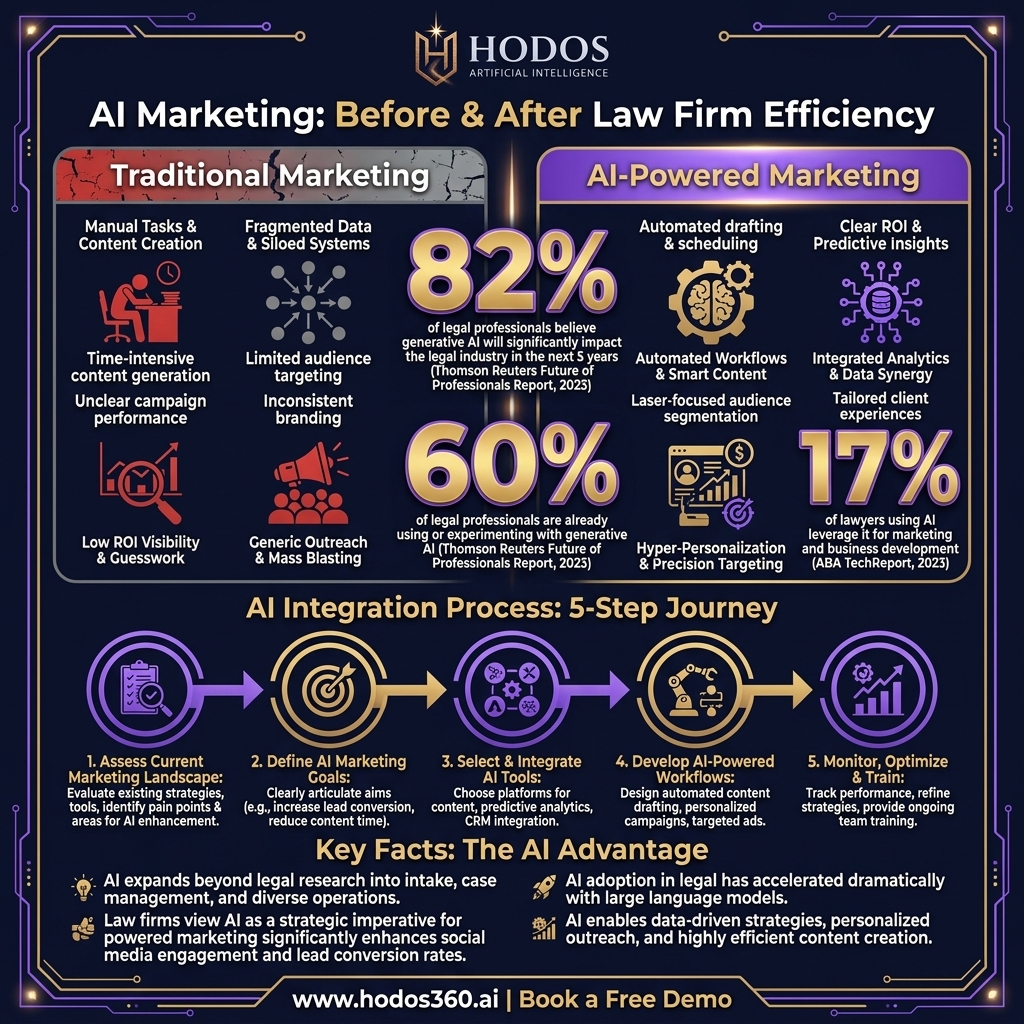
Accurately attributing ROI to marketing campaigns has long been a challenge in legal marketing. AI-powered marketing workflows fundamentally change this by providing granular, real-time analytics. These platforms track every touchpoint, from initial ad impression to signed retainer, allowing law firms to understand precisely which channels, campaigns, and content pieces are driving the most value. This transparency empowers firms to make data-driven decisions, optimizing their marketing budget for maximum impact and demonstrating a clear return on investment to partners.
AI's ability to track campaign performance extends beyond simple attribution; it includes sophisticated analysis that identifies underperforming assets and suggests immediate optimizations. Learn more about Conversational AI: Ultimate Guide for Legal Teams. If an AI detects that an ad copy generates high clicks but low conversions, it can automatically suggest alternative headlines or reallocate budget to better-performing campaigns. This dynamic optimization ensures marketing resources are always deployed effectively, minimizing waste and maximizing efficiency. Firms no longer wait for end-of-quarter reports to adjust strategy; insights are available instantly, enabling agile responses to market shifts.
Data-Driven Decision Making for Strategic Growth
However, the power of AI in legal marketing comes with significant ethical responsibilities. The legal profession is bound by strict rules regarding attorney advertising and client solicitation, such as ABA Model Rule 7.1 (Communications Concerning a Lawyer's Services), which mandates that communications must not be false, misleading, or deceptive. AI systems must be designed and deployed with these ethical constraints in mind, ensuring transparency, avoiding algorithmic bias, and protecting client data privacy. The ongoing development of legislation like the EU AI Act, imposing stringent requirements on high-risk AI systems, underscores the global imperative for responsible AI use. Ultimately, while AI automates, strategic direction, ethical oversight, and final review remain the unequivocal responsibility of legal professionals. Learn more about Essential AI Voice Assistant Strategies for Modern Law Firms. As Jensen Huang, CEO of NVIDIA, often emphasizes, AI is a powerful co-pilot, but human expertise and ethical judgment are non-negotiable.
Beyond optimizing individual campaigns, AI marketing workflows provide law firms with unparalleled capabilities for data-driven strategic planning. By analyzing aggregated data on client behavior, market demand, competitor activities, and legal trends, AI can identify patterns and insights impossible for human analysts to discern manually. This deep understanding allows firm leaders to make informed decisions about niche specialization, geographic expansion, and service line development. For instance, AI might reveal an unmet demand for specific regulatory compliance services in an industry, prompting the firm to proactively develop targeted marketing campaigns and expertise.

Future-Proofing Your Firm's Marketing in a Dynamic Legal Landscape
The journey into AI-powered marketing workflows is no longer a futuristic concept but a present-day necessity for law firms aiming for sustainable growth and competitive advantage. The firms that embrace this transformation are not just automating tasks; they are fundamentally reshaping their client acquisition strategies, enhancing personalization, and gaining unprecedented clarity into their marketing ROI. The narrative of "Sterling & Associates" outperforming "Blackstone Chambers" is becoming an increasingly common reality, demonstrating that early adoption and strategic implementation of AI are critical differentiators in the modern legal landscape.
For law firm owners and managing partners, the immediate takeaway is clear: inaction carries a significant opportunity cost. The legal tech sector continues to innovate at a breakneck pace, with new solutions emerging constantly. Integrating AI marketing with other cutting-edge legal tech, such as an AI Law Firm Management System that provides end-to-end solutions from client intake to billing, creates a holistic, hyper-efficient ecosystem. Learn more about AI Officer: The Essential Role for Modern Law Firms. This integrated approach ensures that every touchpoint with a client, from their first interaction with your marketing materials to the final resolution of their case, is optimized for efficiency, transparency, and satisfaction.
The evolving role of the legal marketer, augmented by AI, shifts from tactical execution to strategic oversight, ethical stewardship, and creative problem-solving. This human-AI collaboration ensures that while repetitive tasks are handled with machine precision, the nuanced art of client relationship building and brand storytelling remains firmly in human hands. Embracing AI marketing workflows is not just about adopting new tools; it's about investing in the long-term viability and prosperity of your firm, ensuring you can attract and retain clients effectively in an increasingly competitive and technologically advanced world.
Empower your law firm with cutting-edge AI marketing workflows and gain a decisive competitive edge. Book a free demo with HODOS 360 today to see how our AI Marketing Platform can transform your practice.
Frequently Asked Questions
How can AI marketing workflows specifically benefit small to mid-sized law firms?+
AI marketing workflows democratize sophisticated strategies, enabling smaller firms to compete with larger ones without extensive in-house teams. They automate time-consuming tasks like content creation and social media management, freeing up limited resources. This allows small to mid-sized firms to achieve hyper-personalization, broader reach, and precise ROI tracking, which were previously only accessible to firms with substantial marketing budgets.
What kind of ROI can law firms expect from implementing AI marketing?+
Law firms can expect significant ROI through improved lead quality, increased client conversion rates, and reduced marketing operational costs. AI optimizes ad spend, identifies high-potential leads, and automates repetitive tasks, leading to higher efficiency. While specific figures vary, firms often report 15-30% increases in qualified leads and substantial savings in marketing hours, directly translating to higher revenue and profitability.
How does AI ensure ethical compliance in legal marketing?+
Ethical compliance in AI marketing is paramount. AI systems should be designed with built-in parameters to adhere to legal advertising rules, such as ABA Model Rule 7.1, by avoiding misleading claims and ensuring transparency. Human oversight remains crucial for final content review and strategic decision-making. Reputable AI platforms prioritize data privacy, consent, and bias mitigation, providing tools for firms to maintain ethical standards.
Is extensive technical expertise required to implement AI marketing solutions?+
No, most modern AI marketing platforms, including HODOS 360, are designed for user-friendliness, requiring minimal technical expertise. They offer intuitive interfaces and often provide robust training and support. While a basic understanding of marketing principles is beneficial, the AI handles the complex technical execution, allowing legal professionals to focus on strategy and client engagement rather than intricate technical configurations.
How do AI marketing platforms integrate with existing law firm systems?+
Leading AI marketing platforms are built with integration in mind. They typically offer APIs or pre-built connectors to seamlessly integrate with existing CRM systems, case management software, and other legal tech solutions. This ensures a unified view of client data and marketing efforts, from initial lead generation to case resolution, avoiding data silos and enhancing overall operational efficiency for the firm.
What are the first steps a law firm should take to adopt AI marketing workflows?+
The first step is to assess your current marketing challenges and identify areas where automation and intelligence can have the greatest impact. Next, research reputable AI marketing platforms specifically designed for the legal industry. Start with a pilot program on a specific campaign or service area, gather data, and iterate. Partnering with a comprehensive platform like HODOS 360 can provide guided implementation and support, ensuring a smooth transition.