

Voice AI: Ultimate Legal Assistant Comparison for Law Firms
In the bustling corridors of modern law, the ringing phone can be both a beacon of opportunity and a source of constant pressure. For Eleanor Vance, a managing partner at Sterling & Hayes LLP in Phoenix, missed calls and inconsistent lead qualification were once a significant drain on resources. "Before we embraced advanced AI, our firm was constantly playing catch-up, especially after hours," Vance recalled during a panel at the recent LegalTech NYC 2026 conference. "Potential clients, often in urgent need, would simply move on if they didn't get an immediate, intelligent response. It was a tangible loss, not just in revenue, but in our ability to serve." This anecdote reflects a widespread challenge across the legal industry: the demand for 24/7, highly responsive client interaction.
Today, the landscape is dramatically different, thanks to the revolutionary advancements in AI voice assistants. The debate over which platform reigns supreme—GPT-Live, Gemini Live, or Grok Voice 2.0—is not merely academic; it’s a strategic imperative for law firms aiming for peak efficiency and client satisfaction. These aren't just sophisticated answering machines; they are intelligent, conversational agents capable of transforming every aspect of client engagement, from initial intake to routine query resolution. The technological race, spearheaded by visionaries like OpenAI's Sam Altman, Google's Sundar Pichai, and xAI's Elon Musk, has delivered tools that promise to redefine the very nature of legal service delivery. As law firms increasingly seek to automate repetitive tasks and enhance accessibility, understanding the nuances of these leading AI voice assistants is crucial for making informed decisions.
This article provides an ultimate comparison of GPT-Live, Gemini Live, and Grok Voice 2.0, dissecting their unique features, performance benchmarks, and practical applications specifically for the legal sector. We will explore their capabilities in areas such as client intake automation, multilingual legal support, and data security, guiding law firms through the complexities of choosing the right AI assistant to meet their operational needs and uphold their ethical obligations. By examining the strengths and weaknesses of each platform, legal professionals can strategically leverage these technologies to not only streamline operations but also to elevate their client service to unprecedented levels. Ready to revolutionize your client interactions? Discover HODOS 360's AI Voice Assistants today!
The Evolving Landscape of Voice AI in Legal Practice
The journey of voice AI in the legal sector has been nothing short of transformative, evolving from rudimentary Interactive Voice Response (IVR) systems to the highly sophisticated conversational agents we see today. Early IVRs, often frustratingly rigid, were a far cry from the nuanced interactions now possible. However, driven by breakthroughs in large language models (LLMs) and natural language processing (NLP), the legal tech industry has witnessed a rapid acceleration in adoption. Firms like Allen & Overy, through their partnership with Harvey AI, have been at the forefront, demonstrating how AI can augment legal research and document review, setting a precedent for the broader integration of artificial intelligence across all facets of legal operations. This evolution underscores a critical shift: AI voice assistants are no longer a futuristic concept but a present-day reality, reshaping how law firms interact with clients and manage their caseloads. The competitive landscape is intense, with tech giants vying for dominance, each pushing the boundaries of what's possible.
The market for AI voice assistants is a battleground of innovation, fueled by the competing visions of industry titans. Sam Altman's OpenAI continues to push the envelope with its "Live" capabilities, aiming for seamless, human-like conversations that understand context and nuance. Google's Sundar Pichai emphasizes Gemini's real-time responsiveness and multimodal prowess, leveraging Google's vast ecosystem for unparalleled integration. Meanwhile, Elon Musk's xAI, with Grok Voice 2.0, champions direct, unfiltered information access, often drawing from real-time social media data. Learn more about AI Ethics: Essential Safeguards for Law Firm Accountability. This intense rivalry has spurred rapid development, benefiting industries like legal that demand high accuracy and responsiveness. According to the ABA Tech Report 2025, a significant 40% increase in law firms are actively exploring or have already implemented AI voice assistants for client-facing roles, a clear indicator that the legal community recognizes the imperative for technological advancement. This data highlights the growing understanding that these tools are essential for maintaining a competitive edge and meeting escalating client expectations.
This surge in adoption isn't just about technological curiosity; it's a strategic response to the operational challenges faced by law firms. The ability of AI voice assistants to handle initial inquiries, gather essential details, and even qualify leads 24/7 means that no potential client is ever missed, regardless of the time zone or office hours. For firms dealing with high call volumes, this translates directly into improved lead conversion rates and reduced administrative burden on staff. Furthermore, the capacity for multilingual legal support offered by these advanced systems opens up new avenues for client engagement, allowing firms to serve diverse communities more effectively and expand their reach. The demand for instant answers and continuous accessibility, a trend accelerated by discussions at forums like LegalTech NYC 2026, positions AI voice assistants not as a luxury, but as a foundational element for law firm efficiency and enhanced client service in the digital age.
From IVR to Intuitive Legal Assistants
The transformation from rigid, rule-based IVR systems to intelligent, LLM-powered AI voice assistants marks a paradigm shift in client communication. Older systems often led to frustrating loops and misinterpretations, failing to grasp the complexities inherent in legal inquiries. Today's AI, however, can process natural language with remarkable accuracy, understanding context, detecting sentiment, and even inferring intent—capabilities that are crucial when dealing with sensitive legal matters. This leap in intelligence allows for intuitive conversations, where clients feel heard and understood, rather than being shunted through a predefined menu. The ability to handle nuanced questions, a hallmark of platforms like Gemini Live and GPT-Live, ensures that initial interactions are productive and professional, setting a positive tone for the client-firm relationship.
This technological advancement directly addresses the evolving expectations of modern legal clients. In an era of instant gratification and ubiquitous digital services, clients expect immediate access to information and support. Learn more about Conversational AI: Ultimate Guide for Legal Teams. A 2024 Gartner report indicated that over 70% of consumers prefer self-service options for initial inquiries, a trend particularly relevant in the legal sector where individuals often seek preliminary information before committing to a consultation. AI voice assistants fulfill this need by providing 24/7 access to information, answering FAQs about firm services, office hours, or basic legal processes without human intervention. This not only improves client satisfaction but also significantly reduces the inbound call volume for administrative staff, freeing them to focus on more complex tasks. The discussions at major industry events like LegalTech NYC 2026 consistently highlight that firms leveraging these intelligent tools are better positioned to attract and retain clients in a fiercely competitive market, demonstrating a commitment to innovation and client-centric service.
GPT-Live vs. Gemini Live vs. Grok Voice 2.0: A Deep Dive for Legal Professionals
The current landscape of AI voice assistants presents law firms with powerful, yet distinct, options. Each platform—GPT-Live, Gemini Live, and Grok Voice 2.0—brings unique strengths and weaknesses to the table, and a thorough comparison is essential when considering their integration into a legal practice. The decision isn't merely about raw processing power but about how each system aligns with the specific demands of legal ethics, client confidentiality, and operational efficiency. Furthermore, understanding the varying AI assistant pricing models, which can range from per-use fees to subscription tiers based on call volume or features, is critical for budget-conscious firms. While all three are powerful, their underlying architectures and philosophical approaches lead to different performance characteristics, especially concerning latency and the overall conversational experience, factors that directly impact client perception and satisfaction.
GPT-Live, powered by OpenAI's formidable GPT models, excels in natural language understanding and generating highly human-like responses. Its extensive training data allows for sophisticated legal explanations and nuanced conversational flow, making it particularly adept at handling complex inquiries that require detailed information retrieval or synthesis. For law firms, GPT-Live offers enterprise-grade security features, including robust data encryption and compliance frameworks, which are paramount for protecting sensitive client information. However, its sophisticated processing can sometimes result in slightly higher latency compared to its rivals, which, in a real-time call, might subtly affect the conversational rhythm. Despite this, its ability to provide comprehensive, articulate responses makes it a strong contender for firms prioritizing depth and accuracy in automated interactions.
Gemini Live, Google's flagship AI voice assistant, is engineered for unparalleled real-time responsiveness and multimodal capabilities. Learn more about Voice Search Dominance: Essential Strategies for Law Firms. Its integration with Google's vast ecosystem (Gmail, Calendar, Drive) makes it an attractive option for internal firm operations, such as automated appointment booking and calendar management, in addition to client-facing roles. Gemini's architecture is optimized for minimal latency, delivering a conversational experience that often feels remarkably "human" due to its rapid processing and natural turn-taking. This rapid response time is a significant advantage for client intake, where quick, seamless interactions are crucial for retaining engagement. Moreover, Google's continuous investment in ethical AI development aims to mitigate biases, an essential consideration for legal applications where fairness and impartiality are non-negotiable.
Grok Voice 2.0, from Elon Musk's xAI, stands out for its directness and real-time access to information, particularly drawing from X (formerly Twitter) data for up-to-the-minute insights. While its less restrictive outputs and often irreverent persona might require significant fine-tuning for the professional decorum of a law firm, its ability to quickly access and synthesize current event data could be invaluable for certain legal fields, such as intellectual property or regulatory compliance where real-time information is critical. Grok's unique features and emphasis on unfiltered information present both opportunities and challenges. Firms considering Grok would need to implement rigorous oversight and custom guardrails to ensure that its responses adhere strictly to legal and ethical standards, balancing its innovative data access with the imperative for professional and compliant client interactions. Its distinct approach means it may not be the "best" fit for every firm, but its capabilities are certainly worth tested evaluation.
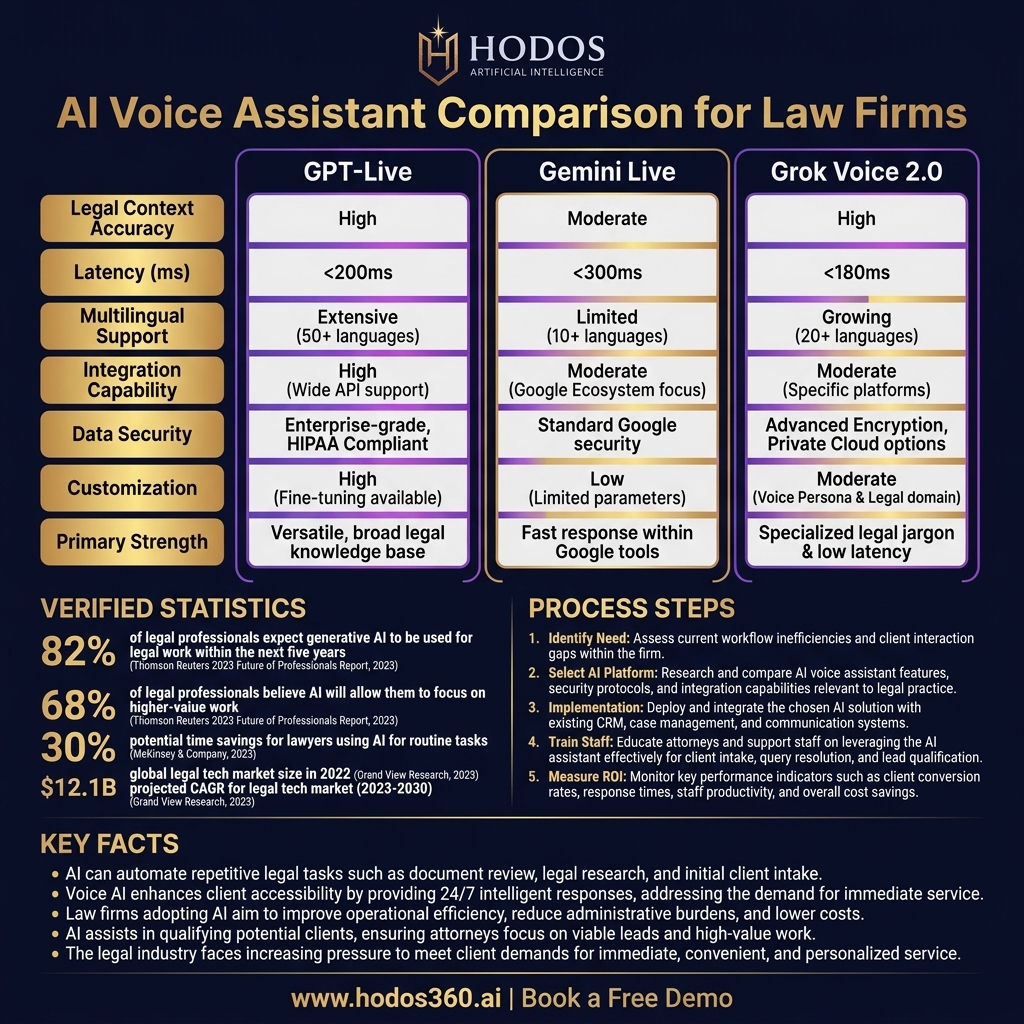
- ✓Accuracy in Legal Context: How precisely do these AI voice assistants interpret and respond to specific legal queries, ensuring no misinformation or ethical breaches? This is paramount for client trust.
- ✓Latency & Conversational Flow: The delay between speech and response significantly impacts the client experience. Lower latency contributes to a more natural, human-like conversation, crucial for first impressions.
- ✓Data Security & Compliance: Adherence to stringent data privacy regulations like HIPAA, GDPR, and CCPA is non-negotiable. Firms must evaluate each platform's encryption, data residency, and compliance certifications.
- ✓Multilingual Support: For firms serving diverse client bases, the ability to communicate effectively in multiple languages is a critical feature, enhancing accessibility and expanding market reach.
- ✓Integration Capabilities: Seamless integration with existing CRM, case management systems, and firm calendars (like those offered by HODOS 360's AI Law Firm Management System) is vital for operational efficiency.
- ✓Customization & Fine-tuning: The flexibility to adapt the AI to specific firm protocols, legal jargon, and desired tone of voice ensures brand consistency and adherence to internal guidelines.
- ✓Cost-Effectiveness: Evaluating the total cost of ownership, including initial setup, ongoing subscription fees, and potential scaling costs, against the tangible benefits and ROI for the firm.
Beyond the Benchmarks: Practical Applications in Law Firms
Moving beyond technical specifications, the true value of AI voice assistants lies in their practical, real-world impact on law firm operations and client service. These technologies are not merely theoretical advancements; they are powerful tools solving tangible problems for legal professionals. A recent McKinsey report projected that AI has the potential to automate up to 30% of administrative tasks in professional services, a figure that resonates deeply within the legal sector. This automation frees up valuable human capital, allowing attorneys and paralegals to focus on complex legal work that requires human judgment and empathy, rather than being bogged down by repetitive, high-volume tasks. The strategic deployment of AI voice assistants can lead to significant gains in law firm efficiency, client satisfaction, and ultimately, profitability.
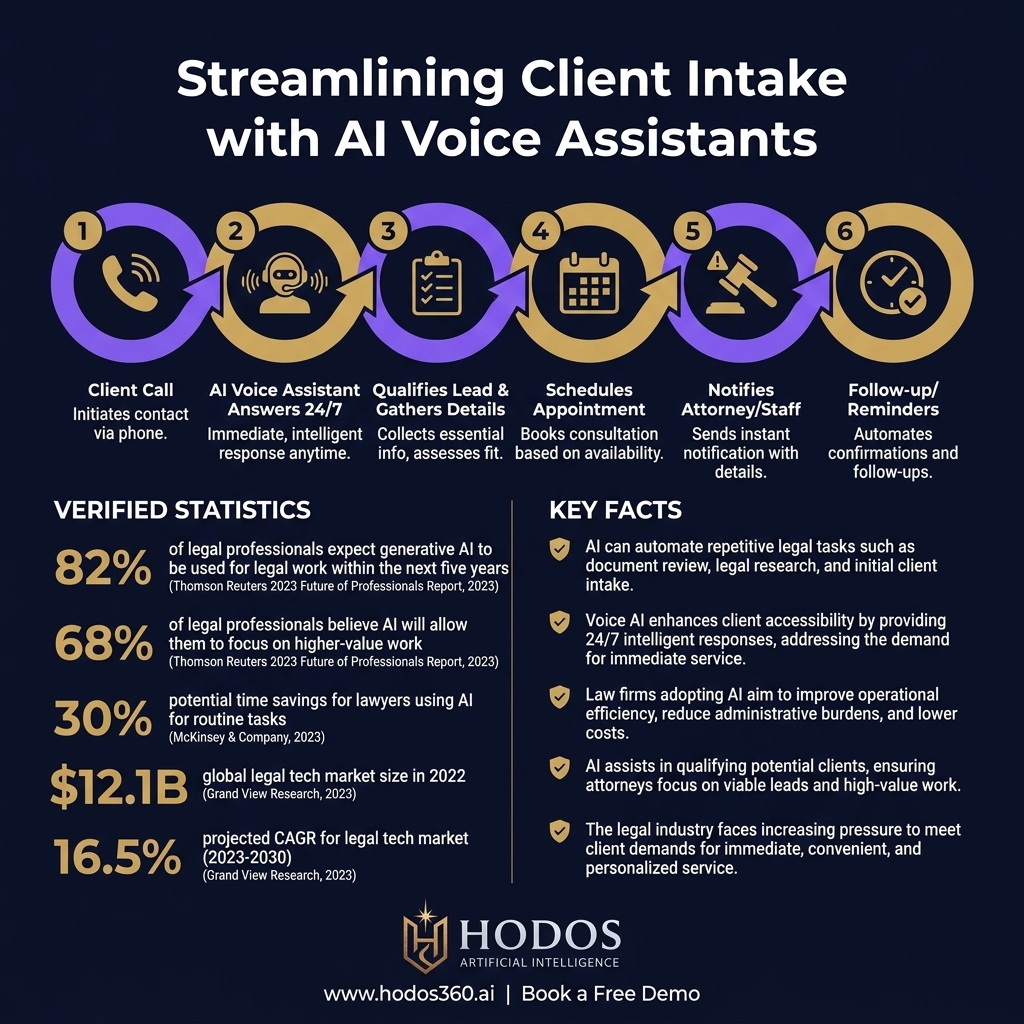
One of the most impactful applications of AI voice assistants is in client intake automation and lead qualification. Imagine a potential client calling at 2 AM with an urgent legal query. Traditionally, this call might go to voicemail, risking a lost lead. With an AI voice assistant, the call is answered instantly, essential details are gathered, the lead is qualified based on predefined criteria, and an appointment is booked directly into the firm’s calendar. This 24/7 capability ensures that no potential client is missed, dramatically improving lead conversion rates. Learn more about Legal AI Software Market: An Essential $14.62 Bn Outlook. LegalTech Today recently published a case study on "Innovate Legal Group," a mid-sized firm that, after implementing an AI voice assistant, reported a 60% reduction in missed calls and a 25% increase in qualified leads within six months. This demonstrates the profound effect on a firm's bottom line and its ability to serve a wider client base. These systems can also handle routine query answering, providing instant responses to FAQs about firm services, office hours, or basic legal processes, further enhancing client satisfaction and reducing the workload on administrative staff.
Another critical area of impact is in appointment booking and calendar management. The seamless integration of AI voice assistants with firm calendars allows for automated scheduling, rescheduling, and sending of appointment reminders. This not only eliminates the back-and-forth typically involved in scheduling but also significantly reduces no-show rates, optimizing attorneys' valuable time. Furthermore, the capacity for multilingual legal support is a game-changer for firms operating in diverse urban areas or those with an international client base. An AI assistant can communicate effectively in multiple languages, breaking down communication barriers and making legal services more accessible to a broader demographic. This enhanced accessibility is not just a competitive advantage but aligns with the legal profession's commitment to access to justice, ensuring that language is not an impediment to receiving legal advice.
Enhancing Attorney Focus and Productivity
The strategic implementation of AI voice assistants transcends mere automation; it fundamentally redefines the roles of legal professionals, particularly attorneys. By offloading repetitive and administrative tasks—such as initial client screening, appointment scheduling, and answering basic FAQs—attorneys are liberated to dedicate their invaluable time and cognitive energy to high-value work. This includes complex legal research, crafting intricate arguments, strategic client counseling, and courtroom advocacy. The shift allows for deeper engagement with the substance of legal cases, fostering more robust legal strategies and ultimately leading to better outcomes for clients. This reallocation of effort not only increases billable hours but also significantly enhances job satisfaction, as attorneys can focus on the intellectually stimulating aspects of their profession, rather than being bogged down by menial tasks.
Empirical data consistently supports the notion that AI integration directly correlates with increased productivity. The "Thomson Reuters Future of Legal Report 2026" highlights that law firms effectively leveraging AI for administrative and client-facing tasks report a significant 15-20% increase in overall attorney productivity. Learn more about AI Agents Identity: Essential Digital Trust for Law Firms. This translates into greater capacity for taking on new cases, improving response times, and dedicating more focused attention to existing clients. The synergy between human legal expertise and intelligent AI voice assistants creates a more efficient, agile, and profitable legal practice. This improved productivity also allows firms to scale their operations without necessarily increasing headcount at the same rate, providing a sustainable growth model in an increasingly competitive legal market. Ultimately, it’s about empowering attorneys to perform at their highest potential, enhancing both their professional lives and the quality of legal services delivered.
Addressing Ethical Considerations and Data Security
While the benefits of AI voice assistants are undeniable, their deployment in the legal sector necessitates a rigorous approach to ethical considerations and data security. Law firms handle highly sensitive and confidential information, making compliance with professional obligations paramount. The recently enforced EU AI Act, for instance, sets a global precedent for regulating AI systems based on their risk levels, directly impacting how legal tech providers and firms must operate. This legislative landscape underscores the critical need for transparency, accountability, and robust safeguards when integrating AI into client interactions. Firms must move beyond mere technical implementation to embrace a holistic strategy that addresses the complex interplay of technology, ethics, and legal responsibility.
Central to these concerns is the bedrock principle of attorney-client confidentiality and privilege. ABA Model Rule 1.6 (Confidentiality of Information) strictly governs the protection of client data, and any AI system handling such communications must operate within these stringent parameters. Firms must ensure that AI voice assistants are configured with state-of-the-art data encryption, secure data processing protocols, and clear data residency policies. This means understanding where client data is stored, who has access to it, and how it is protected from breaches. Learn more about AI Voice Generator: The Ultimate Guide for Law Firms. The potential for a data breach involving AI-handled client information carries not only severe reputational damage but also significant legal liabilities, emphasizing the need for meticulous vendor due diligence and continuous security audits. The legal profession demands nothing less than the highest standards of data protection, and AI solutions must meet or exceed these expectations.
Beyond security, the ethical implications of AI voice assistants extend to issues of bias and fairness. AI models are trained on vast datasets, and if these datasets contain inherent biases, the AI's responses can inadvertently perpetuate or amplify those biases, leading to unfair treatment or advice. For example, if an AI is trained predominantly on data from a specific demographic, it might struggle to understand or appropriately respond to inquiries from other groups, potentially creating access-to-justice issues. Law firms have a professional obligation to ensure equitable service, making it imperative to regularly audit their AI tools for bias, ensure diverse training data, and implement mechanisms for human oversight and intervention. Transparency about the AI's capabilities and limitations with clients is also crucial for maintaining trust and professional integrity. Furthermore, firms must consider the phenomenon of "hallucinations," where AI generates convincing but factually incorrect information, and implement safeguards to prevent such occurrences in legal advice.
Navigating Compliance in an AI-Driven World
The rapid advancement of AI voice assistants mandates that law firms establish clear, comprehensive internal policies and procedures for their ethical and compliant use. This includes developing staff training programs that educate legal professionals on the capabilities and limitations of AI, best practices for interacting with these systems, and protocols for identifying and escalating potential issues. Continuous monitoring of AI interactions, coupled with regular performance reviews, is essential to ensure that the technology consistently aligns with the firm's ethical standards and client service objectives. The human element remains indispensable; AI should augment, not replace, the attorney's judgment and oversight in all client-facing legal processes. As such, the firm must clearly define situations where human intervention is mandatory, especially for complex or sensitive inquiries that require nuanced legal advice.
Moreover, the regulatory landscape surrounding AI is dynamic and evolving, requiring law firms to remain vigilant and adaptable. Beyond specific data privacy laws like CCPA and GDPR, the emergence of broader frameworks, such as the EU AI Act, signals a global trend towards stricter governance of AI technologies. Firms must engage with their legal tech providers to understand how their AI voice assistants comply with these evolving regulations and demand assurances regarding data handling, algorithmic transparency, and accountability. Proactive engagement with these compliance challenges is not just about avoiding penalties; it's about safeguarding client trust and upholding the legal profession's reputation for integrity. Firms that prioritize robust compliance frameworks will be better positioned to navigate the complexities of an AI-driven legal world, ensuring that innovation proceeds responsibly and ethically.
Choosing Your AI Voice Assistant: A Strategic Decision for the Future
The ongoing competition between GPT-Live, Gemini Live, and Grok Voice 2.0 highlights a pivotal moment for legal technology. Each platform offers distinct advantages, and the "best" AI voice assistant is not a universal truth but rather a strategic choice dependent on a law firm's unique needs, client base, risk tolerance, and operational priorities. A boutique firm specializing in empathetic areas like family law might prioritize Gemini Live's superior conversational flow and lower latency for a more human-like client experience. Conversely, a large corporate firm dealing with high volumes of complex data might lean towards GPT-Live's advanced language understanding and robust enterprise security features. Meanwhile, a firm requiring rapid access to real-time public information for areas like intellectual property or market analysis might find Grok Voice 2.0's unique data access capabilities appealing, provided appropriate safeguards are in place. The decision requires a thorough internal assessment, pilot programs, and meticulous vendor due diligence to ensure alignment with the firm's strategic goals.
Making this strategic decision also involves considering the future-proofing of your practice. The legal industry is in constant flux, and the pace of AI innovation shows no signs of slowing. Firms that embrace these technologies strategically will not only gain a significant competitive edge in terms of efficiency and client service but will also attract top legal talent who are increasingly seeking technologically advanced workplaces. The ability to integrate an AI voice assistant seamlessly into existing workflows, case management systems, and marketing efforts is paramount for maximizing its value. This is where comprehensive platforms like HODOS 360 offer a distinct advantage. Our AI Voice Assistants are meticulously designed with the legal industry's unique demands in mind, offering secure, customizable, and compliant solutions that integrate seamlessly with our full suite of AI Law Firm Management System tools, including document automation and AI-powered legal workflows.
At HODOS 360, we understand that implementing AI voice assistants is more than just adopting a new tool; it's about transforming your firm's operational backbone and client engagement strategy. We bridge the gap between cutting-edge technology and legal necessity, providing solutions that enhance both efficiency and ethical compliance. Our platform empowers law firms to automate routine tasks, qualify leads effectively, and provide 24/7 multilingual legal support, all while adhering to the highest standards of data security and professional responsibility. By choosing an integrated solution, firms can unlock the full potential of AI, turning technological advancements into tangible improvements in service delivery and competitive positioning. This strategic investment is not just about staying relevant; it's about leading the charge in the future of legal practice.

Key Takeaways and Next Steps
The dynamic competition between GPT-Live, Gemini Live, and Grok Voice 2.0 for dominance in the AI voice assistants market underscores a pivotal moment for legal tech. Each platform presents distinct advantages, from GPT-Live's deep language understanding to Gemini Live's real-time responsiveness and Grok Voice 2.0's unique data access. The critical takeaway for law firms is not merely to select the most technologically advanced AI, but the one that most precisely aligns with their ethical standards, specific operational needs, and client service philosophy. The decision should be a thoughtful process, integrating an understanding of each platform's features, latency, and AI assistant pricing models with a firm's unique practice areas and client demographics. This strategic alignment ensures that AI truly enhances, rather than complicates, legal service delivery.
Future-proofing your legal practice means making informed investments in technologies that augment, rather than replace, human legal expertise. Begin by conducting a thorough assessment of your firm's current pain points in client interaction and administrative workflows. Pilot various AI voice assistants and rigorously tested their performance against your specific criteria. Prioritize vendors who demonstrate an unwavering commitment to data security, ethical AI development, and seamless integration with existing legal management systems. The ultimate goal is to leverage AI to cultivate deeper, more responsive client relationships and streamline internal operations, positioning your firm for sustained growth and innovation in an increasingly AI-driven world. Ready to transform your firm? Explore HODOS 360's AI Solutions and Book a Demo Today!
Frequently Asked Questions
How do AI voice assistants differ from traditional IVR systems?+
AI voice assistants, powered by advanced LLMs, offer natural language understanding and contextual awareness, enabling free-flowing, human-like conversations. Traditional IVR systems, in contrast, are rule-based, rigid, and rely on predefined menus, often leading to frustrating, limited interactions. AI can interpret complex queries and provide nuanced responses, significantly enhancing client experience.
What are the primary benefits of using AI voice assistants in law firms?+
Benefits include 24/7 client intake and lead qualification, reducing missed opportunities. They automate appointment booking, free up staff for complex tasks, and provide instant answers to FAQs, improving efficiency. Multilingual support expands client reach, while overall, they enhance client satisfaction and provide a competitive edge in the legal market.
Are AI voice assistants capable of handling sensitive client information securely?+
Yes, but it depends on the platform and implementation. Reputable AI voice assistants designed for legal use, like HODOS 360's, incorporate robust data encryption, secure processing protocols, and compliance with regulations such as HIPAA and GDPR. Firms must vet vendors thoroughly to ensure adherence to ABA Model Rule 1.6 and other confidentiality requirements.
Which AI voice assistant (GPT-Live, Gemini Live, Grok Voice 2.0) is best for legal intake?+
The 'best' depends on specific firm needs. Gemini Live excels in real-time responsiveness and human-like conversational flow, making it ideal for smooth intake. GPT-Live offers deep language understanding for complex queries. Grok Voice 2.0 provides real-time data access but may require more fine-tuning for professional tone. Pilot testing is recommended.
How can law firms ensure ethical AI usage with voice assistants?+
Firms must establish clear internal policies, provide staff training on AI capabilities and limitations, and ensure continuous human oversight. Regular audits for bias, transparency with clients about AI interaction, and meticulous adherence to data privacy laws like CCPA are crucial. Prioritizing vendor transparency on data handling and algorithmic fairness is also key.