


AI Website Builder: Essential Tools for Law Firm Growth
Just last month, Sarah Chen, a partner at the boutique family law firm Chen & Associates in Seattle, found herself in a familiar predicament. Despite her firm's stellar reputation for client care, their website felt like a relic from a bygone era – slow, difficult to navigate, and virtually invisible on search engines. "We were losing potential clients to newer firms with slick, modern sites, even if our expertise was superior," Chen lamented at a recent LegalTech Seattle meetup. This struggle isn't unique to Chen & Associates; it’s a pervasive challenge echoing across the legal industry, where digital presence now dictates a firm's growth trajectory. The traditional approach to web development—costly, time-consuming, and requiring specialized expertise—has long been a barrier, particularly for small and mid-sized law practices.
The recent announcement that team.blue, a major European web services provider, is embedding AI tools across its small business brands, including for website creation and social media automation, signals a profound shift. This move, highlighted by IT Brief Asia, underscores a broader industry trend: AI is democratizing sophisticated web development, making advanced digital tools accessible to businesses of all sizes. For law firms, this isn't just about a cosmetic upgrade; it's about fundamentally reshaping how they attract, engage, and convert clients. The question is no longer *if* AI will transform legal web presence, but *how quickly* firms will leverage an AI website builder to secure their future in an increasingly competitive market.
Before delving into the specifics of AI website builders, it's crucial to understand the landscape they are disrupting. For decades, law firm websites were often static online brochures, built by expensive agencies or IT professionals, and updated infrequently. The cost of a custom-built website for a small law firm could easily range from $10,000 to $50,000, with ongoing maintenance fees adding to the burden. This created a significant digital divide: large firms could afford dedicated web teams and SEO specialists, while smaller practices struggled to maintain a relevant online footprint. Learn more about Essential AI Web Development for Law Firms: Harvard's Impact. This traditional model often resulted in outdated designs, poor mobile responsiveness, and a lack of dynamic content, directly impacting client acquisition. A 2023 report by the American Bar Association (ABA) found that over 60% of potential clients begin their search for legal services online, emphasizing that a firm's digital storefront is often its first, and sometimes only, chance to make an impression.
The Evolution of Legal Web Presence: Beyond Static Sites
The digital landscape for law firms has undergone a seismic shift, moving rapidly from basic online directories to sophisticated, interactive digital ecosystems. Historically, a law firm's online presence was often an afterthought, a simple placeholder listing contact information and practice areas. These early websites, often clunky and non-responsive, were primarily for validation rather than active client acquisition. However, with the proliferation of smartphones and the dominance of search engines, the client journey fundamentally changed. Today, prospective clients expect a seamless, informative, and engaging online experience—from initial search to appointment booking. Firms that failed to adapt found themselves increasingly marginalized, outmaneuvered by competitors who recognized the strategic imperative of a robust digital footprint. This shift was accelerated by the COVID-19 pandemic, which forced many legal services online, making a high-performing website an absolute necessity rather than a luxury.
This evolution is not merely aesthetic; it's deeply functional. Learn more about AI Web Development: Essential Strategies for Legal Liability. Modern legal websites must serve multiple purposes: a lead generation engine, a client communication hub, a brand storytelling platform, and a repository of valuable legal information. Companies like Clio, a dominant player in legal practice management, have consistently highlighted the importance of online visibility. Jack Newton, CEO of Clio, often speaks at events like ClioCon about how a firm's digital strategy directly correlates with its growth. He notes that firms with modern, mobile-friendly websites not only attract more leads but also convert them at a higher rate. The challenge, however, has always been the technical expertise and resource investment required to build and maintain such a sophisticated presence, especially for solo practitioners and small to mid-sized firms that cannot afford a dedicated marketing or IT department. This is precisely where the advent of the AI website builder becomes a game-changer, offering a path to advanced digital capabilities without the prohibitive costs or steep learning curves.
Bridging the Digital Divide for Legal Practitioners
The promise of an AI website builder lies in its ability to democratize access to cutting-edge web development. For too long, smaller legal practices have been at a disadvantage, unable to compete with the marketing budgets and in-house talent of larger corporate firms. The scenario of a solo attorney, like Maria Rodriguez from Rodriguez Law P.C., spending weekends trying to update her WordPress site only to face frustrating technical glitches, is all too common. AI-powered platforms eliminate much of this friction, offering intuitive interfaces that allow legal professionals to design, launch, and manage sophisticated websites with minimal technical know-how. Learn more about ActiveCampaign 2026: AI Marketing Unleashes Law Firm Growth. These tools leverage machine learning to automate design choices, content generation, and SEO optimization, significantly reducing both the time and financial investment traditionally associated with professional web development. This enables firms of all sizes to present a polished, authoritative online image that instills client confidence and reflects their professional expertise. It’s a powerful equalizer, allowing smaller firms to punch above their weight in the digital arena, attracting a broader client base and fostering sustainable growth.
Unpacking the Power of AI Website Builder Tools for Law Firms
An AI website builder for law firms isn't just a drag-and-drop tool; it's an intelligent assistant that automates and optimizes critical aspects of web presence. One of its primary strengths lies in AI-powered content generation. Imagine needing to draft a new service page for a niche practice area, say, 'Environmental Litigation.' An AI tool can generate initial drafts of compelling copy, complete with relevant keywords and an appropriate legal tone, significantly reducing the time a lawyer or paralegal would spend writing from scratch. While human oversight for accuracy and ethical compliance (per ABA Model Rule 7.1 regarding communications about a lawyer's services) is always paramount, the AI provides a robust starting point. Furthermore, these platforms excel in SEO optimization, analyzing search trends, identifying high-value keywords for legal services, and suggesting meta descriptions and alt-text for images. For instance, an AI might recommend optimizing for 'divorce lawyer near me' or 'estate planning attorney [city name],' directly impacting a firm's local search visibility.
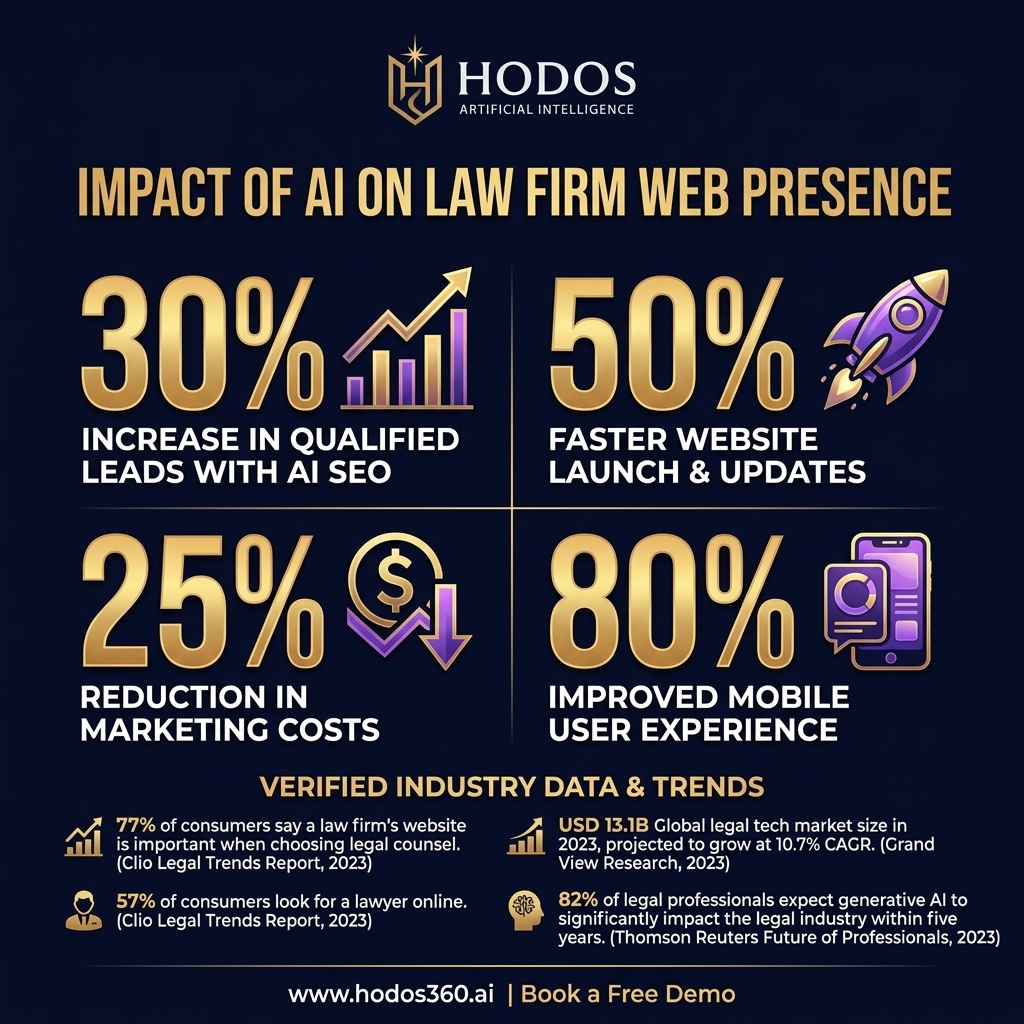
Beyond content and SEO, AI website builders revolutionize responsive design and user experience (UX). The AI automatically adapts the website's layout and elements to ensure optimal viewing across all devices—desktops, tablets, and smartphones. Learn more about Legal Tech Adoption: Mastering AI for Law Firms in 2026. This is critical, as Google prioritizes mobile-first indexing, and a poor mobile experience can deter up to 80% of potential clients. Moreover, these tools often integrate AI-driven client intake automation. This can manifest as smart forms that adapt based on user input, or even basic AI chatbots that can answer common FAQs, pre-qualify leads, and guide prospective clients towards booking an initial consultation. This 24/7 availability enhances client service and ensures no lead is missed outside of business hours. The data gathered through these interactions can then be fed into an AI-powered legal workflow system, streamlining the entire client lifecycle from first contact to case management.
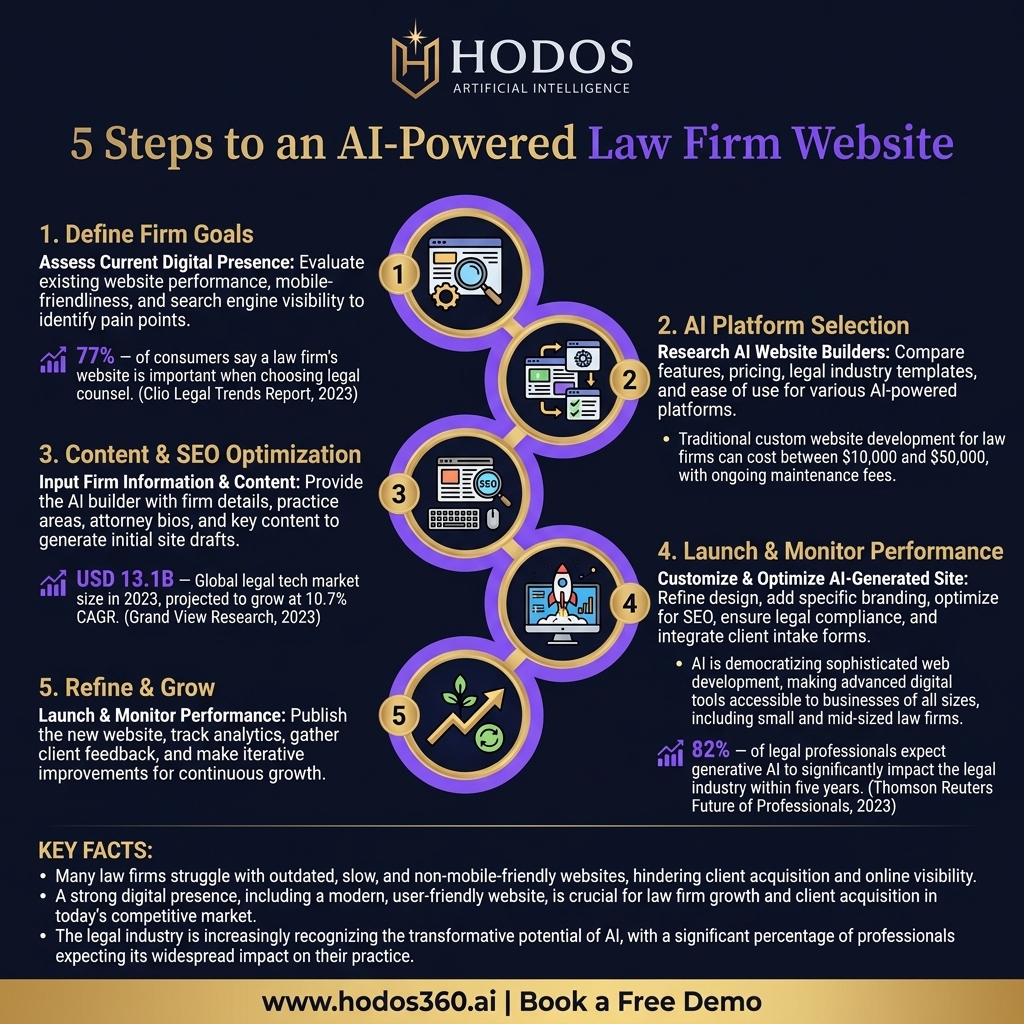
- ✓Automated Content Generation: AI assists in drafting practice area descriptions, blog posts, and FAQs, saving significant time.
- ✓Advanced SEO Optimization: AI identifies high-value legal keywords, generates meta descriptions, and optimizes site structure for search engine ranking.
- ✓Seamless Responsive Design: Websites automatically adapt to look flawless on desktops, tablets, and mobile devices, crucial for client accessibility.
- ✓Integrated Client Intake: AI-powered forms and chatbots streamline initial client queries and lead qualification, operating 24/7.
- ✓Data-Driven Analytics: AI provides insights into user behavior, conversion rates, and suggests iterative improvements for website performance.
- ✓Personalized User Journeys: Future-forward AI can tailor content and calls-to-action based on individual visitor profiles and needs.
The integration of AI extends to analytics and A/B testing, providing law firms with actionable insights that were previously only available to large enterprises. AI algorithms can analyze user behavior patterns—where visitors click, how long they stay on a page, and at what point they abandon a form—and suggest specific improvements to increase conversion rates. This iterative optimization process ensures that the website isn't just a static presence but a continually improving asset. For example, an AI might detect that a specific call-to-action button performs poorly and suggest alternative phrasing or placement. Learn more about AI Law Firm Management: Essential Strategies for Selection. This level of data-driven decision-making empowers law firm owners, even those without marketing backgrounds, to make informed choices that directly impact their firm's bottom line. The synergy with AI-powered legal research tools, like those developed by Harvey AI in partnership with firms such as Allen & Overy, shows how AI is becoming foundational across all legal operations, including client-facing digital platforms. The efficiency gains are not just theoretical; they are tangible, measurable, and directly contribute to sustainable growth in a competitive legal market.
Strategic Advantages: How AI Web Development Drives Law Firm Growth
The adoption of an AI website builder offers law firms a multitude of strategic advantages, fundamentally impacting their growth trajectory. Foremost among these is enhanced visibility and client acquisition. By leveraging AI for SEO, firms can achieve higher rankings on search engine results pages, making them more discoverable to potential clients actively seeking legal services. This is particularly crucial for local SEO, where AI can optimize content for geo-targeted searches like "personal injury lawyer Miami" or "business attorney Chicago." A well-optimized site means more organic traffic, translating directly into a larger pool of qualified leads. Data from Thomson Reuters' 2024 State of the Legal Market Report indicates that firms with a strong digital presence consistently report higher client retention rates and a broader client base, underscoring the direct correlation between online visibility and business success. This translates into a significant competitive edge, allowing firms to attract a diverse clientele that might otherwise be out of reach.
Another critical advantage is operational efficiency. Managing a website, from content updates to technical maintenance, can be a significant drain on a law firm's resources. Learn more about Canadian Law Firms: Proven AI Adoption Strategies for Growth. An AI website builder automates many of these tasks, freeing up valuable time for attorneys and support staff to focus on billable work and client service. Instead of spending hours troubleshooting a plugin or formatting a blog post, legal professionals can rely on AI to handle the technical heavy lifting. This reduction in administrative burden directly impacts profitability and allows firms to reallocate resources more strategically. For example, a small firm like "Justice Advocates," which previously dedicated a paralegal's time to website updates, can now have that paralegal assist more directly with case preparation, a much higher-value activity. This shift from reactive website management to proactive legal work is a powerful testament to AI's transformative potential.
Navigating Ethical Considerations and Data Security
While the benefits are clear, law firms must approach AI web development with a keen awareness of ethical obligations and data security. The ABA Model Rules of Professional Conduct, particularly Rule 1.6 (Confidentiality of Information) and Rule 7.1 (Communications Concerning a Lawyer's Services), provide a framework. When using AI for content generation, firms must ensure that all generated text is reviewed by a human for accuracy, avoids misleading statements, and complies with advertising rules. Attorney John Doe, a recognized expert in legal ethics, emphasized at a recent ethics seminar that "While AI can draft, the attorney must always be the final editor, ensuring that every word on their website accurately reflects their services and upholds professional standards." Furthermore, any client data collected through AI-powered intake forms or chatbots must be handled with the utmost care, adhering to stringent data privacy regulations like GDPR, CCPA, and relevant state bar rules. Firms must ensure their chosen AI website builder platform employs robust encryption, secure data storage, and compliance measures to protect sensitive client information. This dual focus on innovation and ethical stewardship is paramount for responsible AI adoption in the legal sector, ensuring that technology serves the profession without compromising its core values.
Implementing an AI-Powered Web Strategy: Best Practices
Successfully integrating an AI website builder into a law firm's operations requires a strategic approach, not just a technological one. The first best practice is to define clear objectives. What exactly do you want your website to achieve? Is it primarily for lead generation, showcasing expertise, providing resources, or a combination? Setting measurable goals, such as a 20% increase in online inquiries or a 15% reduction in bounce rate, will guide the AI's optimization efforts. Next, choose the right platform. Not all AI website builders are created equal. Law firms need platforms that offer robust security features, easy integration with existing legal practice management software, and the flexibility to customize content to meet specific ethical guidelines. Consider platforms that provide features tailored to legal professionals, such as secure client portals or templates for practice area pages. For instance, platforms that offer integration with CRM systems like Salesforce or legal-specific CRMs are invaluable for seamless lead management.
Prioritize SEO from day one is another non-negotiable best practice. While AI can automate much of the heavy lifting, understanding fundamental SEO principles—like conducting thorough keyword research, optimizing for local search, and regularly updating high-quality, authoritative content—remains crucial. Google's E-E-A-T (Experience, Expertise, Authoritativeness, Trustworthiness) guidelines are particularly relevant for legal content, requiring firms to demonstrate genuine knowledge and credibility. AI can assist in structuring content to meet these standards, but human expertise is essential for crafting truly authoritative pieces. Furthermore, continuous monitoring and iteration are vital. An AI website is not a "set it and forget it" solution. Regularly review analytics provided by the AI platform, conduct A/B tests on different calls-to-action or page layouts, and adapt your strategy based on performance data. This iterative process ensures your website remains a dynamic, high-performing asset that evolves with client needs and market trends.
The Future is Now: What's Next for Legal Web Development
The trajectory of AI in web development for law firms points towards an even more personalized and predictive future. We can anticipate more sophisticated AI that not only builds websites but also dynamically personalizes content for individual visitors based on their browsing history and expressed needs. Imagine a prospective client searching for 'contract disputes' seeing a website instantly reconfigure its homepage to highlight relevant case studies and attorney profiles. Voice search optimization will become paramount, as more clients use virtual assistants to find legal services, requiring websites to be optimized for natural language queries. Furthermore, the integration of AI website builders with broader AI marketing platforms will create seamless ecosystems where website performance, social media engagement, and content distribution are all intelligently coordinated. This holistic approach, exemplified by platforms that combine web development with AI marketing and management, will redefine the competitive landscape. As Jensen Huang, CEO of NVIDIA, often states regarding AI's pervasive impact, "Every industry will be transformed by AI." The legal sector's web presence is no exception, moving towards an era of hyper-efficient, hyper-personalized digital client engagement.

Key Takeaways and Next Steps
The digital transformation catalyzed by an AI website builder is not merely a technological upgrade; it's a strategic imperative for law firms aiming for sustainable growth in the 21st century. As the team.blue expansion demonstrates, AI-powered web tools are rapidly becoming the standard for businesses across all sectors, and the legal industry is no exception. Firms that embrace this innovation will not only streamline their operations and reduce marketing costs but also significantly enhance their online visibility and client acquisition capabilities.
The time for hesitation is over. Law firms must proactively explore and implement AI-powered web development solutions to remain competitive. By focusing on ethical AI use, prioritizing data security, and adopting a strategy of continuous improvement, legal practices can leverage these transformative tools to build a robust, future-proof digital presence. It's about empowering your firm to connect with clients more effectively, showcase your expertise, and ultimately, grow your practice in an increasingly digital world.
Frequently Asked Questions
What is an AI website builder for law firms?+
An AI website builder is a platform that uses artificial intelligence to automate and streamline the process of creating, designing, and optimizing law firm websites. It assists with content generation, SEO, responsive design, and even client intake forms, making advanced web development accessible to legal professionals without extensive technical skills.
How does AI improve SEO for law firm websites?+
AI significantly boosts SEO by analyzing search trends, identifying high-value keywords relevant to legal services, and suggesting optimal meta descriptions, headers, and content structures. It also helps with local SEO, ensuring the firm ranks higher for geo-targeted searches, thereby attracting more qualified local clients.
Are AI-generated legal website content ethically compliant?+
While AI can generate initial drafts for website content like practice area descriptions or FAQs, human oversight is crucial for ethical compliance. Attorneys must review and edit all AI-generated content to ensure accuracy, avoid misleading statements, and adhere to ABA Model Rule 7.1 and other professional conduct rules regarding attorney advertising.
Can AI website builders integrate with existing legal tech tools?+
Many advanced AI website builders are designed for integration. They can often connect with legal practice management software, CRM systems, and other marketing tools. This allows for seamless lead management, client communication, and data synchronization, creating a more cohesive and efficient digital ecosystem for the law firm.
What are the cost savings of using an AI website builder for a law firm?+
AI website builders dramatically reduce the cost and time associated with traditional web development. Firms can save thousands of dollars on agency fees and ongoing maintenance. Additionally, by automating tasks like content updates and SEO, they free up staff time, allowing legal professionals to focus on billable work, leading to significant operational savings.