


Voice AI for Law Firms: The Ultimate Client Experience
The real estate sector often serves as an early indicator of technological shifts that eventually permeate other professional services, including law. Just recently, HousingWire reported on Rechat's ambitious AI voice assistant campaign, showcasing how real estate agents are managing their entire business through voice commands, powered by their AI assistant, Lucy. This initiative, highlighting seamless client engagement and operational control via intuitive vocal interactions, isn't just a fascinating development for real estate; it's a stark preview of the transformative potential for law firms. Imagine a legal practice where initial client contact, lead qualification, and even appointment scheduling are handled with the same frictionless, intelligent automation. This is not a distant future but a present reality, and law firms that fail to recognize this shift risk being left behind in a rapidly evolving market.
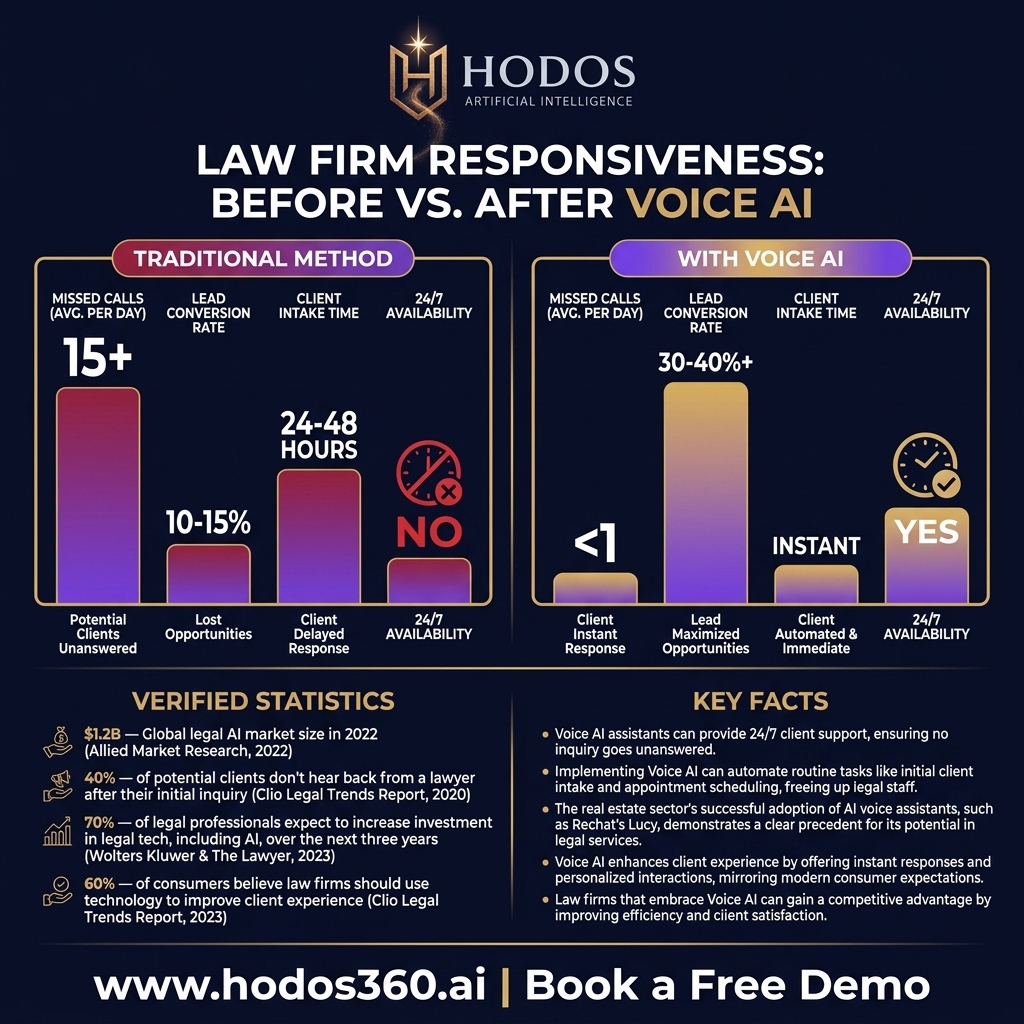
For too long, law firms have grappled with the inherent challenges of client acquisition and retention, often constrained by traditional operational models. Missed calls, inconsistent intake processes, and the sheer administrative burden of managing client communications can significantly impact a firm's growth and reputation. A 2024 report by Thomson Reuters revealed that over 30% of potential new clients abandon a law firm inquiry due to slow response times or difficulty reaching a human. This critical gap in responsiveness and availability is precisely where advanced AI voice assistants offer a compelling solution. By adopting intelligent voice technology, law firms can not only mirror the cutting-edge client experiences seen in industries like real estate but also establish a new standard for accessibility, efficiency, and personalized service within the legal domain, ensuring the client journey is as smooth and supportive as possible from the very first interaction.
Elevating Client Engagement with Voice AI for Law Firms
The promise of Voice AI for law firms extends far beyond simple call answering; it’s about fundamentally reshaping the client experience. Consider the case of Sterling & Associates, a mid-sized personal injury firm in Atlanta. For years, managing partner Sarah Chen struggled with the firm's intake process. "We were losing potential clients because our receptionists were overwhelmed during peak hours, or calls came in after business hours," Chen recounted at a recent LegalTech NYC panel. Learn more about Essential Guide: Customer Support Voice AI for Law Firms. "Even with a dedicated team, the consistency of information gathered during initial calls varied wildly." This narrative is echoed across countless firms. An AI voice assistant addresses this directly by providing 24/7 availability, ensuring every call is answered promptly and professionally, regardless of time zones or staffing levels. This always-on capability means no potential lead is ever missed, a critical factor given the competitive legal landscape.
The true power of an AI voice assistant lies in its ability to offer a consistently high-quality interaction, something often challenging for human teams facing fatigue or high call volumes. These intelligent systems can be programmed with comprehensive scripts and FAQs, ensuring that every piece of information provided to a potential client is accurate and compliant. For instance, an AI can explain the firm's practice areas, provide directions, or outline the initial consultation process, freeing up human staff for more complex legal tasks. Learn more about Voice Assistant Migration: An Essential Guide for Law Firms. Furthermore, the multilingual capabilities of advanced AI voice assistants are a game-changer for diverse communities. In a city like Miami, where a significant portion of the population speaks Spanish, a law firm equipped with a bilingual AI voice assistant can immediately offer support in a client's preferred language, breaking down communication barriers and fostering trust from the outset.
Beyond initial greetings and information dissemination, AI voice assistants excel at lead qualification. They can ask targeted questions to assess the viability of a case, determining if a caller's needs align with the firm's expertise and capacity. This pre-screening process saves valuable time for attorneys and paralegals, allowing them to focus on leads with higher conversion potential. Learn more about AI Law Firms: Essential for Construction Contract Mastery. For instance, an AI might ask about the specifics of an incident, relevant dates, or parties involved, then use this data to categorize the lead (e.g., "high priority," "referral," "not a fit"). This intelligent routing ensures that qualified leads are immediately directed to the appropriate legal professional, while less suitable inquiries can be handled efficiently, perhaps with automated information or referrals.
Personalized Interactions, Scaled for Growth
The notion that automation inherently diminishes personalization is a common misconception that advanced AI voice assistants actively refute. Instead, they offer a new paradigm: personalized interactions scaled for growth. By leveraging natural language processing (NLP) and machine learning, these systems can adapt to individual caller needs, remembering past interactions and tailoring responses accordingly. Imagine a returning client calling about an update on their case; the AI can instantly access their file (with appropriate security protocols, of course), provide status updates, or schedule a follow-up with their attorney. Learn more about Agentic AI Voice: Ultimate Guide for Law Firms. This level of responsiveness cultivates client loyalty and satisfaction, crucial metrics in a referral-driven industry. The American Bar Association's 2023 TechReport highlighted that client communication and responsiveness remain top concerns for clients, and firms leveraging AI for these purposes reported significant improvements in client satisfaction scores.
Streamlining Operations: Beyond the Front Desk
The operational benefits of integrating AI voice assistants into a law firm extend far beyond enhanced client engagement. These intelligent systems act as force multipliers, freeing up valuable human resources from repetitive administrative tasks, allowing legal professionals to concentrate on high-value legal work. A significant challenge for many firms, as noted by legal tech expert Bob Ambrogi at the 2025 Clio Cloud Conference, is the "administrative drag" that consumes attorney and paralegal time, from scheduling appointments to answering routine questions about office hours or billing procedures. Learn more about Essential AI Voice Features for Law Firms: Unpacking I/O Innovations. An AI voice assistant can seamlessly handle these mundane inquiries, automatically booking consultations directly into the firm’s calendar system, providing answers from a comprehensive knowledge base, and even initiating client intake forms via SMS or email.
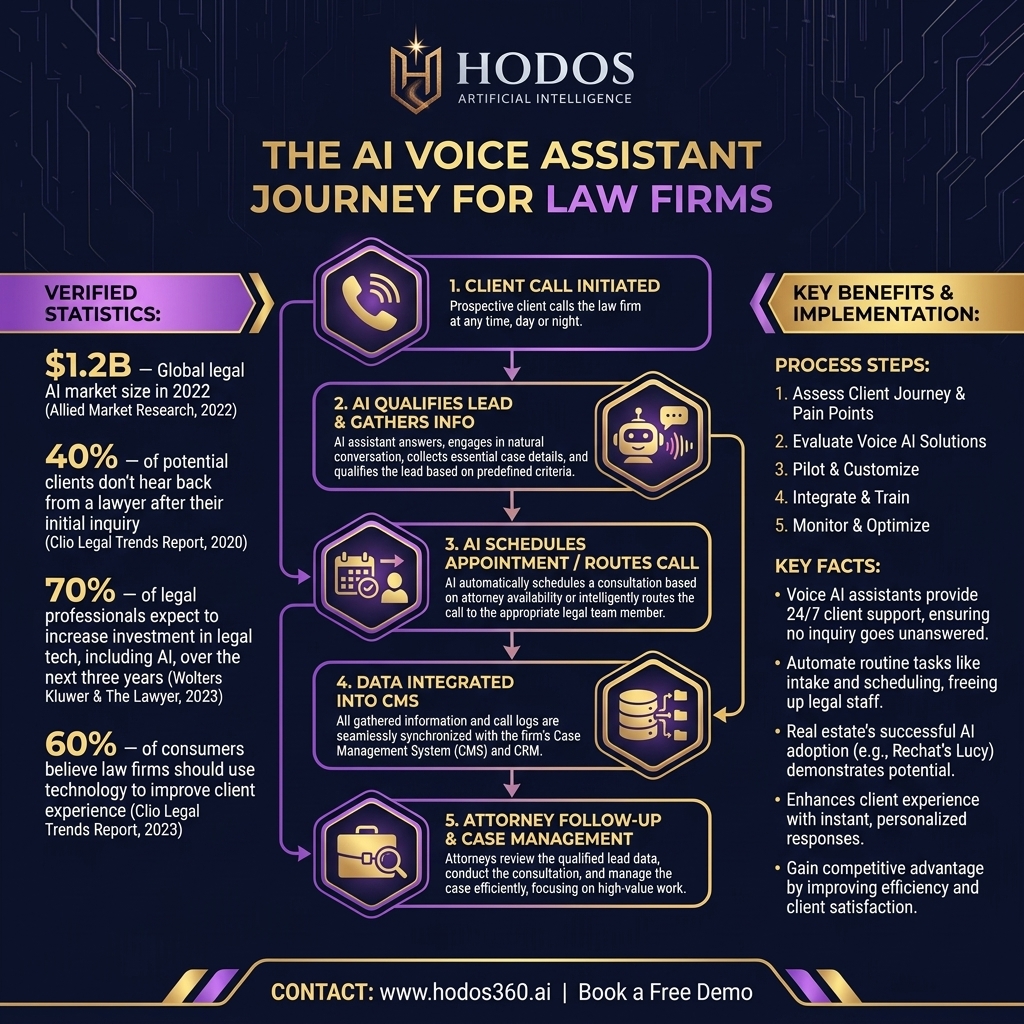
Furthermore, the integration of AI voice assistants with existing legal tech infrastructure, such as case management systems and billing platforms, unlocks new levels of efficiency. For instance, after a successful lead qualification call, the AI can automatically create a new client profile in the firm’s case management system, pre-populating it with all collected data. This eliminates manual data entry, a notorious source of errors and delays. Learn more about Interactions API: Essential Gemini Interface for Legal Tech. Similarly, for billing inquiries, an AI can access a client's account details (with robust security and privacy measures) to provide basic information or direct them to the appropriate contact for detailed discussions. According to a McKinsey report on AI in professional services, firms that successfully integrate AI tools across their operations can see a productivity increase of up to 25-30% in administrative functions.
The deployment of a sophisticated AI voice assistant also provides invaluable data analytics. Every interaction, every query, and every successful lead conversion is logged and analyzed. This data offers deep insights into client needs, common questions, peak call times, and even the effectiveness of different messaging strategies. For example, if the data reveals a high volume of calls asking about "contingency fees" during evenings, the firm can proactively update its website FAQ or create targeted marketing content addressing this specific concern. This continuous feedback loop allows firms to refine their services, optimize their communication strategies, and make data-driven decisions that enhance both client satisfaction and operational efficiency.
The Ethical Imperative of Voice AI in Law
While the efficiency gains are compelling, deploying AI voice assistants in law firms carries significant ethical considerations. The ABA Model Rules of Professional Conduct, particularly Rule 1.6 (Confidentiality of Information) and Rule 1.4 (Communication), place stringent obligations on attorneys regarding client data and clear communication. Firms must ensure that any AI system used for client interaction is designed with robust data security, encryption, and privacy protocols that meet or exceed legal standards. Clients must be informed that they are interacting with an AI, not a human, especially when sensitive information is being discussed. As Dr. Evelyn Reed, a prominent AI ethicist, emphasized, "The 'black box' problem of AI is particularly acute in legal contexts. Clients deserve to know how their information is being handled." Firms must implement clear policies for data retention, access, and the transition of inquiries from AI to human staff, ensuring client confidentiality is never compromised.
Gaining a Competitive Edge with AI-Powered Client Acquisition
In today’s hyper-competitive legal market, firms are constantly seeking new ways to differentiate themselves and attract top talent and clients. The adoption of AI voice assistants provides a distinct competitive advantage, signaling a firm's commitment to innovation, efficiency, and superior client service. While many firms still rely on traditional marketing and intake methods, those embracing advanced AI are already seeing tangible benefits. Consider the scenario of a potential client searching for legal representation after an accident. They call three firms. The first goes to voicemail, the second has a receptionist who is busy, and the third is immediately greeted by an intelligent AI voice assistant that efficiently gathers their details, explains the next steps, and schedules an immediate consultation with an attorney. Which firm do you think secures the client? The answer is clear.
Moreover, the data insights gleaned from AI voice assistant interactions feed directly into a firm's broader AI marketing platform strategy. By understanding what potential clients are asking, what keywords they use, and what information they seek, firms can refine their digital marketing campaigns, create more relevant content, and optimize their SEO strategies. For example, if the AI identifies a surge in inquiries related to a specific new regulation or legal development, the marketing team can quickly generate blog posts, social media updates, or even AI-generated video content (a feature of HODOS 360’s AI Marketing Platform) to capture this emerging demand. This synergistic relationship between AI voice assistants and an integrated marketing platform allows firms to not only respond to client needs but also to anticipate them, crafting highly targeted campaigns that resonate with their target audience.
The narrative of "disruption vs. tradition" plays out vividly in the legal tech space. Firms like Allen & Overy, partnering with Harvey AI for contract review, and Clio's strategic acquisitions to expand its ecosystem, demonstrate a clear trend: legal giants are investing heavily in AI. Smaller and mid-sized firms cannot afford to ignore this wave. By implementing AI voice assistants, they can democratize access to sophisticated technology, leveling the playing field against larger, resource-rich competitors. This isn't just about catching up; it's about leapfrogging. Firms that leverage AI voice assistants effectively are not just improving their intake; they are building a resilient, future-proof operational model that can scale efficiently, adapt to market changes, and consistently deliver a superior client experience.
The Future of Legal Intake and Beyond
The evolution of AI voice assistants for law firms is just beginning, promising an even more integrated and intelligent future for legal operations. Beyond initial client contact and lead qualification, imagine AI voice assistants seamlessly integrating with advanced AI-powered legal workflows to automate the entire client journey from intake to case resolution. Picture a scenario where an AI not only books an appointment but also automatically sends a retainer agreement for e-signature, triggers document automation to prepare initial court filings based on intake data, and even provides clients with personalized case updates upon request, all through natural language interaction. This vision moves beyond simple automation to truly intelligent workflow orchestration, where the AI acts as a central nervous system for the firm.
The advancements in natural language understanding (NLU) and generative AI are pushing the boundaries of what these systems can achieve. Future AI voice assistants will be even more adept at complex conversational nuances, understanding emotional cues, and handling highly specific legal jargon with greater accuracy. This will enable them to assist with more intricate client queries, perhaps even guiding clients through basic self-help legal resources or explaining complex legal concepts in plain language, under attorney supervision. The ethical frameworks around AI in law, like those being developed in response to the EU AI Act, will continue to shape how these technologies are deployed, emphasizing transparency, accountability, and the paramount importance of human oversight in all critical legal decisions.
Democratizing Access to Justice Through AI
The long-term impact on law firm economics and accessibility will be profound. By significantly reducing administrative overhead and increasing the capacity for client engagement without proportional increases in staffing, AI voice assistants will enable firms to offer more competitive pricing, expand their reach to underserved communities, and ultimately improve access to justice. This isn't just about efficiency; it's about democratizing legal services. As Sam Altman, CEO of OpenAI, frequently highlights, AI's potential to augment human capabilities across industries is immense. For law firms, this means empowering attorneys to focus on the intellectual and strategic aspects of law, leaving the repetitive, time-consuming tasks to intelligent automation. The firms that embrace this future will not only outcompete their peers but will also redefine what it means to be a modern, client-centric legal practice.

Key Takeaways and Next Steps for Your Firm
The emergence of sophisticated AI voice assistants like those showcased by Rechat, and the capabilities offered by comprehensive platforms such as HODOS 360, signal an undeniable shift in how professional services engage with clients. For law firms, this isn't merely a technological upgrade; it's a strategic imperative. The firms that are proactive in adopting and integrating these intelligent systems will be the ones that thrive in the coming decade, characterized by enhanced client satisfaction, optimized operational efficiency, and a significant competitive edge. The legal industry, historically slow to adopt new technologies, now faces a clear choice: embrace the future of client engagement or risk becoming obsolete.
The path forward involves a thoughtful, phased implementation. Begin by identifying key pain points in your current client intake and communication processes. Then, explore how a robust AI voice assistant can address these challenges, from 24/7 availability and multilingual support to efficient lead qualification and seamless integration with your existing legal tech stack. Remember, the goal is not to replace human interaction but to augment it, ensuring that every client touchpoint is optimized for speed, accuracy, and personalized service. Platforms like HODOS 360 offer a complete ecosystem, from AI Law Firm Management System to AI Marketing Platform and Web & Mobile Development, providing a holistic solution for firms ready to embrace this transformation. Don't let your firm be left behind.
Frequently Asked Questions
What is an AI voice assistant for law firms?+
An AI voice assistant for law firms is an intelligent, automated system designed to handle client communications via voice. It leverages natural language processing to understand queries, provide information, qualify leads, book appointments, and route calls, operating 24/7. It acts as a virtual receptionist, enhancing efficiency and ensuring no potential client inquiry is missed, offering consistent, professional interactions.
How can an AI voice assistant improve client intake?+
An AI voice assistant revolutionizes client intake by providing instant, 24/7 responsiveness. It can gather essential client details, pre-qualify leads based on custom criteria, answer frequently asked questions, and automatically schedule consultations. This streamlines the initial contact phase, reduces administrative burden, and ensures a consistent, efficient, and professional first impression for every potential client, converting more inquiries into qualified leads.
Is an AI voice assistant secure for handling sensitive legal information?+
Reputable AI voice assistants designed for the legal industry, like those offered by HODOS 360, incorporate robust security measures including encryption, data privacy protocols, and compliance with relevant regulations. Firms must ensure their chosen solution adheres to strict confidentiality standards (e.g., ABA Model Rule 1.6). Transparency with clients about AI interaction and secure data handling practices are paramount to maintain trust and ethical compliance.
Can an AI voice assistant integrate with my existing legal software?+
Yes, advanced AI voice assistants are designed for seamless integration with popular legal software, including case management systems, CRM platforms, and calendaring tools. This integration allows the AI to automatically update client records, book appointments directly, and trigger workflows based on voice interactions, ensuring a cohesive and efficient operational ecosystem. This connectivity reduces manual data entry and enhances overall data accuracy across the firm.
What is the ROI of implementing an AI voice assistant in a law firm?+
The ROI of an AI voice assistant is multifaceted. It includes reduced operational costs (fewer missed calls, less administrative overhead), increased client acquisition rates (24/7 lead capture, efficient qualification), improved client satisfaction (faster responses, consistent information), and enhanced attorney productivity (focus on billable work). Firms often see significant gains in efficiency, client conversion, and overall profitability, justifying the initial investment through tangible returns.