

Legal Intake Outsourcing: The Ultimate AI vs. Human Guide
In the fiercely competitive legal landscape of 2026, the efficiency of client acquisition is no longer a mere operational detail—it's a strategic imperative. Consider the case of 'Sterling & Sterling LLP,' a mid-sized litigation firm in Miami. For years, they grappled with inconsistent lead capture; potential clients calling after hours or during peak court times often encountered voicemail, leading to a significant drop-off rate.
Managing Partner Isabella Sterling herself admitted at a recent Florida Bar conference, "We were leaving money on the table, not because of a lack of legal talent, but because our initial client touchpoints were failing." This common scenario highlights a critical tension: how do law firms ensure every potential client receives a prompt, professional, and effective first interaction?
The answer often lies in legal intake outsourcing, a practice that has evolved dramatically with the advent of artificial intelligence, presenting a stark choice between human-powered and AI-driven solutions.
Traditionally, legal intake outsourcing involved delegating initial client contact to specialized call centers or virtual receptionists.
This model offered a lifeline for firms struggling with staffing or 24/7 coverage, promising to capture leads and qualify potential cases without the overhead of an in-house team. However, as technology surged forward, particularly with breakthroughs in natural language processing and generative AI from powerhouses like OpenAI and Anthropic, a new contender emerged: AI-powered intake systems.
These platforms promise not just efficiency, but a level of consistency, data analysis, and scalability previously unimaginable. This comprehensive guide delves into the nuances of both traditional outsourced legal intake and its AI counterpart, dissecting their costs, speed, quality, and strategic implications for modern law firms.
We will navigate the benefits and pitfalls, offering insights into which approach—or combination—can best serve your firm's unique needs in this rapidly evolving digital era.
Ready to revolutionize your client intake? Discover the HODOS 360 difference today.
What is Legal Intake Outsourcing? Defining the Modern Approach
Legal intake outsourcing, at its core, involves entrusting the initial client contact and qualification process to a third-party service provider. Historically, this meant engaging specialized answering services or virtual receptionist companies that operated much like traditional call centers. Firms like 'Legal Answering Solutions Inc.' have long provided a crucial service, ensuring that calls are answered promptly, basic client information is gathered, and potential conflicts of interest are screened.
This model allowed law firms to extend their operational hours, offer 24/7 coverage, and manage fluctuating call volumes without the significant overhead associated with hiring and training in-house staff. The value proposition was clear: focus on legal work, and let specialists handle the initial client engagement.
However, the quality and depth of these services varied widely, often limited by the human agents' understanding of legal nuances and firm-specific protocols, leading to a mixed bag of client experiences. A 2024 ABA survey revealed that nearly 30% of potential clients abandon a firm after an unsatisfactory initial phone interaction, underscoring the critical importance of this first touchpoint.
While traditional outsourcing offers undeniable benefits in terms of cost reduction and expanded availability, it also comes with inherent limitations. Learn more about Agentic Marketing: The Ultimate Guide for Law Firms. Law firms, particularly those dealing with complex or emotionally charged cases, often struggled with the impersonal nature of some outsourced services.
The human element, while present, could sometimes lack the deep empathy or specific legal knowledge required to truly connect with a prospective client in distress. Furthermore, managing an outsourced team, even a reputable one, still required significant oversight to ensure adherence to firm standards, ethical guidelines, and consistent brand messaging.
The challenge of scaling quality, rather than just quantity, became a recurring theme for firms reliant solely on this model. For instance, a small personal injury firm might find a generic call center unable to adequately pre-qualify intricate medical malpractice cases, missing key details that an experienced intaker would immediately identify.
Traditional Outsourcing: The Human Touch and Its Limitations
The undeniable strength of traditional outsourced legal intake services lies in the human touch. An empathetic voice, the ability to read between the lines, and the flexibility to navigate complex or emotionally charged conversations are qualities that human agents excel at. For a client calling after a traumatic event, a compassionate human can provide immediate reassurance and guide them through the initial steps with sensitivity.
However, this strength also highlights its limitations. Humans are susceptible to fatigue, inconsistencies in performance, and require extensive, ongoing training to stay updated on legal developments or firm-specific intake scripts. Learn more about AI Website Builder: The Ultimate Guide for Law Firms. The scalability of the human touch is inherently limited by the number of agents and their availability.
When a major event triggers a surge in inquiries—say, a class-action lawsuit following a product recall—even the most robust outsourced call centers can be overwhelmed, leading to longer wait times and missed opportunities. Moreover, the cost per interaction in a human-centric model scales directly with volume and agent time, making it potentially expensive for high-volume firms.
The Rise of AI in Legal Intake: A Paradigm Shift for Law Firms
The legal industry is witnessing a profound transformation, largely driven by advancements in artificial intelligence. Major players like OpenAI, with its GPT-4o, and Anthropic, with Claude 3, are pushing the boundaries of what AI can understand and generate, making sophisticated AI-powered intake solutions not just theoretical but practical realities.
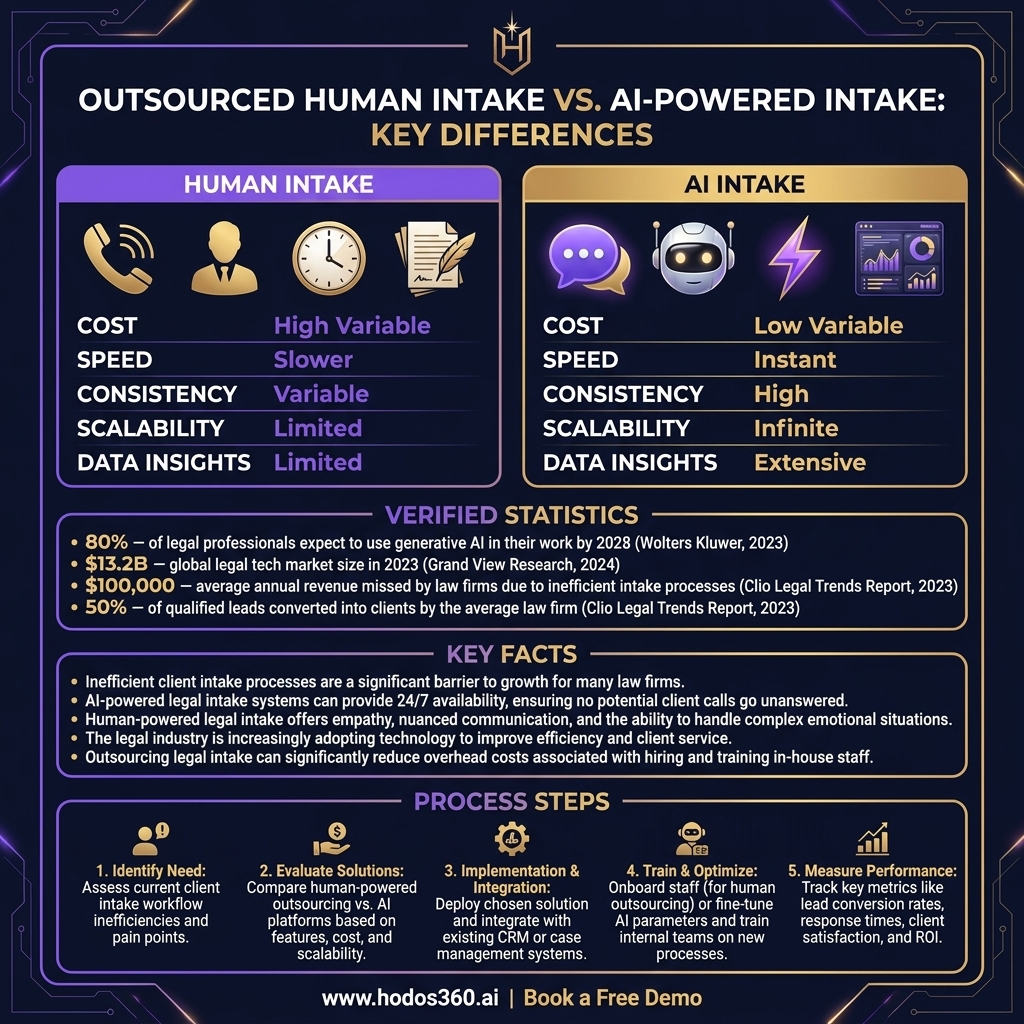
Legal tech startups, exemplified by Harvey AI's partnership with Allen & Overy, have demonstrated AI's capability in complex legal reasoning, paving the way for its application in client intake. Today, AI-powered legal intake systems leverage natural language processing (NLP), machine learning, and sentiment analysis to engage with prospective clients through various channels—phone, chat, web forms—with remarkable efficiency and precision.
These systems can conduct initial lead qualification, perform automated conflict checks, gather essential case details, and even provide preliminary information about the firm's services, all without human intervention. This shift represents a true paradigm shift, moving beyond simple automation to intelligent, adaptive client engagement, as highlighted at LegalTech NYC 2026, where a significant portion of discussions centered on AI's role in client acquisition workflows.
AI-powered intake systems, often integrated within a comprehensive AI Law Firm Management System, are designed to streamline the entire client journey from first contact. Learn more about Legal AI Gap: Bridging the Divide for Law Firms in 2026. For instance, HODOS 360's AI Voice Assistants offer 24/7 phone answering, lead qualification, and appointment booking with multilingual support, ensuring no potential client is ever missed.
These systems utilize advanced algorithms to analyze conversations, identify key legal issues, and route qualified leads to the appropriate attorney or department. They can automate the generation of initial intake forms, populate CRM systems with captured data, and even initiate document automation for retainer agreements.
The precision and consistency of AI are unparalleled; every interaction adheres to predefined scripts and legal guidelines, minimizing the risk of human error or miscommunication. This data-driven approach not only enhances efficiency but also provides invaluable insights into client demographics, common inquiries, and conversion rates, allowing firms to continuously optimize their marketing and intake strategies.
Understanding AI's Algorithmic Edge in Client Acquisition
The algorithmic edge of AI in client acquisition stems from its capacity for instantaneous, scalable, and data-rich interactions. Unlike human agents, an AI system can handle thousands of concurrent inquiries without any degradation in performance, providing immediate responses to every lead. This is particularly crucial in today's digital world where clients expect instant gratification.
As Jack Newton, CEO of Clio, emphasized at a recent industry summit, "The future of legal client experience is immediate, personalized, and seamless, and AI is the key enabler." AI's multilingual capabilities mean a firm can instantly serve a diverse client base without hiring a team of polyglot receptionists, broadening market reach significantly.
Furthermore, AI systems continuously learn and refine their interactions based on vast datasets, leading to ever-improving lead qualification and client satisfaction rates. The analytics generated by AI intake platforms, such as ROI tracking and conversion funnel analysis, offer law firms unprecedented visibility into their client acquisition efforts, allowing for precise adjustments to marketing spend and legal intake outsourcing strategies.
Beyond basic answering, AI delivers sophisticated capabilities like automated conflict checks against existing client databases, a critical ethical safeguard that can be performed in seconds. Learn more about Website Design Cost 2026: Strategic Investment for Law Firms. It can conduct initial case assessments by asking structured questions, identifying key facts, and even flagging potential legal issues based on pre-programmed knowledge bases.
This pre-screening dramatically reduces the administrative burden on attorneys, allowing them to focus on genuinely qualified leads. Seamless integration with existing practice management software, CRM systems, and document automation tools transforms the intake process from a series of disjointed steps into a cohesive, automated workflow.
For example, a fully qualified lead can automatically trigger the creation of a new client file, generate an engagement letter draft, and schedule an initial consultation directly into an attorney's calendar. This level of automation, powered by AI, ensures that the journey from prospective client to retained client is as smooth and efficient as possible, providing a competitive advantage to firms that embrace these innovations.
Cost-Benefit Analysis: Outsourced Call Centers vs. AI-Powered Systems
When evaluating legal intake outsourcing options, a thorough cost-benefit analysis is paramount. Traditional outsourced call centers typically operate on a per-minute or per-call basis, often coupled with setup fees and tiered service plans. While these can appear cost-effective for firms with low call volumes, the expenses can escalate rapidly during peak periods.
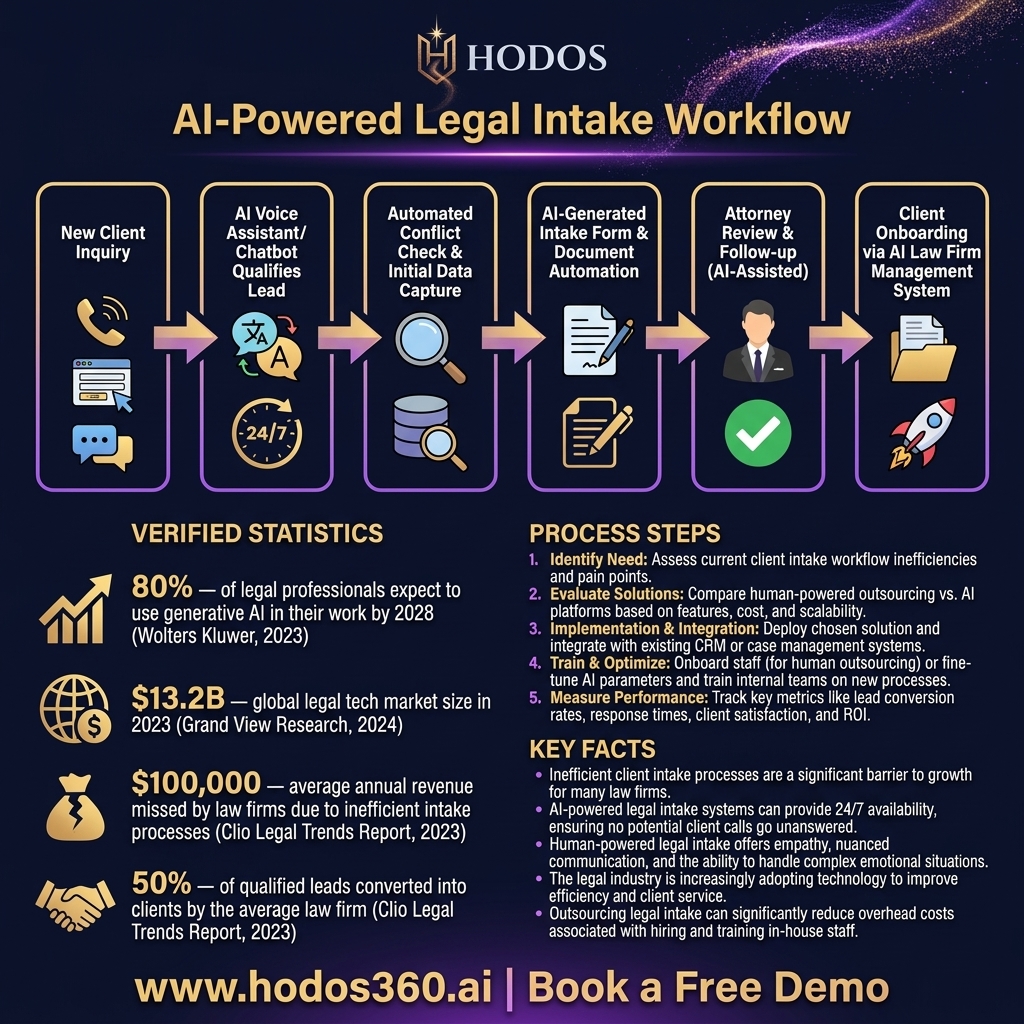
Hidden costs might include fees for after-hours service, specialized training for agents, or charges for detailed reporting. Moreover, the ongoing expense of human labor means that scaling up directly increases costs, creating a linear relationship between growth and expenditure. In contrast, AI-powered systems, while potentially requiring a higher initial investment for implementation and customization, often offer a more predictable and scalable cost model through subscription-based licensing.
McKinsey & Company's 2025 report on AI in professional services projects that firms adopting advanced AI solutions can achieve a 30-40% reduction in operational costs over five years, primarily by automating repetitive tasks and optimizing human resource allocation. This long-term cost efficiency is a significant driver for firms considering the shift to AI-driven intake.
Beyond raw financial outlay, efficiency and speed are critical differentiators. Human-operated call centers, by their nature, are limited by human processing speed and the number of available agents. Wait times can frustrate potential clients, and the quality of information gathered can vary depending on the individual agent's experience and attention.
Learn more about AI App Development: Essential for Law Firms' Digital Future. AI systems, however, operate at machine speed, handling multiple inquiries simultaneously without delay. They ensure consistent data capture, precise lead qualification, and immediate routing, drastically reducing the time from initial contact to attorney engagement.
This speed not only enhances client satisfaction but also significantly increases conversion rates. Thomson Reuters' 2024 'State of the Legal Market' report indicated that firms with faster lead response times convert leads into clients at a rate 2.5 times higher than those with slower responses, a clear advantage for AI's instantaneous capabilities.
The quality of service also sees a transformation; while human empathy is invaluable, AI offers unwavering consistency, ensuring every client receives the same high standard of information and professionalism, free from human biases or off-days.
Ultimately, the choice hinges on balancing immediate needs with long-term strategic goals.
For a small firm with minimal intake volume, a basic outsourced answering service might suffice. However, for growth-oriented firms or those with diverse client bases, the scalability, data insights, and consistent quality offered by AI present a compelling return on investment. The initial investment in an AI system pays dividends not just in cost savings but in competitive advantage, enabling firms to capture more leads, convert them more efficiently, and provide a superior client experience from the very first interaction.
This strategic move ensures that a firm's legal intake process is not merely a cost center but a powerful engine for growth and client satisfaction, solidifying its market position.
- ✓Scalability: AI handles sudden surges in inquiries effortlessly and cost-effectively, unlike human teams that require proportional staffing increases.
- ✓24/7/365 Coverage: Both can offer round-the-clock service, but AI does so without human fatigue, shift changes, or holiday surcharges.
- ✓Data Analytics & Insights: AI platforms provide granular data on lead sources, conversion rates, common queries, and attorney performance, enabling continuous optimization of legal intake and marketing strategies.
- ✓Multilingual Support: AI offers instant and accurate multilingual capabilities, significantly broadening a firm's potential client reach without specialized hires.
- ✓Integration & Workflow Automation: AI systems often integrate more deeply with existing practice management, CRM, and document automation software, creating seamless legal workflows.
- ✓Initial Setup vs. Ongoing Costs: AI may have a higher upfront investment for customization but typically leads to lower variable costs per interaction over time, especially for high-volume firms. Traditional outsourcing has lower setup but higher per-interaction costs.
- ✓Consistency & Compliance: AI ensures every interaction adheres strictly to predefined scripts and ethical guidelines, minimizing human error and ensuring uniform quality, which can be challenging to maintain across large human teams.
Explore how HODOS 360’s AI Law Firm Management System can optimize your firm's intake process and boost ROI. Book a free demo!
Navigating Compliance and Ethical Considerations in Legal Intake
The adoption of any legal intake outsourcing solution, whether human or AI-powered, must be rigorously vetted against the profession's stringent ethical rules and compliance standards. Attorneys have an unwavering ethical duty to ensure client confidentiality (ABA Model Rule 1.6) and to supervise non-lawyer assistants, including third-party intake providers (ABA Model Rule 5.3).
This means firms cannot simply 'set and forget' an outsourced or AI system; they must conduct thorough due diligence, establish clear protocols, and regularly audit the performance and security measures of their chosen provider. The potential for conflicts of interest also looms large; an intake system must be capable of accurately screening for conflicts before any substantive legal advice is given.
Failure to adequately address these ethical considerations can lead to severe repercussions, including disciplinary action, loss of client trust, and even malpractice claims. The emerging EU AI Act, while not directly applicable to U.S. firms, sets a global precedent for AI governance, emphasizing transparency, accountability, and risk management—principles that progressive U.S. Learn more about Proven Strategy: AI-Built Websites Can Convert for Law Firms.
firms are already incorporating into their AI adoption strategies.
Data privacy is another paramount concern, especially when sensitive client information is being collected and processed by third parties or AI systems. Regulations such as GDPR, CCPA, and various state-specific privacy laws impose strict requirements on how personal data is handled, stored, and protected.
Law firms must ensure that their outsourced or AI intake partners comply with these regulations, employing robust encryption, secure data storage, and strict access controls. The potential for data breaches, as evidenced by recent high-profile cyber-attacks on legal service providers, underscores the critical need for vigilance.
Firms must enter into comprehensive service agreements that clearly define data ownership, security protocols, and breach notification procedures. The ethical obligation extends to verifying that AI systems are not inadvertently collecting or using client data in ways that violate privacy expectations or professional rules, maintaining the sanctity of the attorney-client privilege from the very first interaction.
Data Security and Client Confidentiality in the AI Era
In the AI era, safeguarding client data and maintaining confidentiality present unique challenges that demand proactive solutions. The sheer volume of data processed by AI intake systems, from personal details to sensitive case facts, makes them attractive targets for cybercriminals. Firms must demand that their AI providers implement 'privacy by design' principles, ensuring data protection is baked into the system architecture from the outset.
This includes advanced encryption protocols for data in transit and at rest, multi-factor authentication for access, and regular security audits. For instance, the inadvertent disclosure of privileged information, even through an automated system, can have devastating consequences for a case, highlighting the attorney's responsibility under rules like Federal Rule of Civil Procedure 26(b)(5)(B) regarding privilege.
Firms should seek out AI solutions that offer verifiable audit trails, allowing them to track who accessed what information and when, providing an essential layer of accountability.
The attorney's ethical duty to supervise technology and ensure client data protection remains paramount, even when delegating tasks to sophisticated AI or outsourced services.
This means attorneys must understand how their chosen AI system handles data, where it is stored, and what safeguards are in place. They must also ensure that the AI is properly trained and configured to avoid potential biases or misinterpretations that could compromise client interests or violate ethical rules.
Regular reviews of the AI's performance, including mock client interactions and security penetration testing, are not just best practices but ethical imperatives. The ultimate responsibility for protecting client information and maintaining ethical standards always rests with the law firm and its attorneys, making diligent vendor selection and ongoing oversight non-negotiable in the age of AI-powered legal intake outsourcing.
Strategic Implementation: Integrating Advanced Intake Solutions for Growth
For law firms looking to thrive in the modern legal market, the strategic implementation of advanced legal intake outsourcing solutions is not an option but a necessity. The first step involves a comprehensive assessment of the firm's current intake process, identifying bottlenecks, pain points, and missed opportunities.
Firms must evaluate their specific needs based on practice area, client volume, growth objectives, and budget. A personal injury firm with high call volumes might prioritize AI's scalability and 24/7 coverage, while a boutique corporate law firm might seek an AI system with deep integration into complex conflict-checking databases.
The goal is to move beyond mere lead capture to intelligent lead qualification and seamless client onboarding, ensuring that every interaction contributes to the firm's bottom line and enhances its reputation. This strategic foresight ensures that the chosen solution aligns with both operational efficiency and long-term growth aspirations.
Successful integration of AI intake solutions often requires a phased approach and robust training for existing staff. Rather than a disruptive overhaul, firms should consider piloting AI for specific types of inquiries or during off-hours, gradually expanding its role as confidence and proficiency grow. Training is crucial: attorneys and support staff need to understand how to interact with the AI system, interpret its outputs, and leverage its capabilities to enhance their own work.
The most effective implementations see AI not as a replacement for human talent, but as an augmentation—freeing up legal professionals to focus on higher-value tasks that require nuanced legal judgment and human empathy. Firms like 'Innovate Legal,' a leading IP firm, have successfully integrated AI-powered intake, reporting a 40% reduction in administrative time spent on initial client screening, directly translating to more billable hours and improved client satisfaction.
The journey doesn't end with implementation; continuous optimization is key to maximizing the benefits of advanced legal intake solutions. AI platforms provide rich analytics that can be used to refine intake scripts, identify areas for process improvement, and track the ROI of marketing campaigns. By analyzing data on lead sources, conversion rates, and client feedback, firms can make data-driven decisions to continuously enhance their client acquisition strategies.
This iterative process ensures that the intake system evolves with the firm's needs and market dynamics, maintaining its effectiveness as a competitive advantage. The future of client acquisition in law is dynamic, requiring firms to be agile, data-driven, and technologically forward-thinking.
Ultimately, the choice between traditional legal intake outsourcing and AI-powered solutions is a strategic one, reflecting a firm's commitment to efficiency, client experience, and sustainable growth.
While human outsourcing offers a personal touch, AI delivers unparalleled scalability, consistency, and data insights. The most forward-thinking firms are exploring hybrid models, where AI handles initial screening and routine inquiries, while human experts step in for complex or sensitive cases. This balanced approach harnesses the best of both worlds.
HODOS 360 stands at the forefront of this evolution, offering a comprehensive suite of AI-powered services—from an AI Law Firm Management System that automates workflows to AI Voice Assistants that ensure 24/7 lead capture—empowering law firms to optimize their legal intake process, enhance client satisfaction, and achieve unprecedented growth in the digital age.
Frequently Asked Questions
What is legal intake outsourcing?+
Legal intake outsourcing involves delegating the initial client contact and lead qualification process to a third-party service provider. This can include answering calls, gathering basic client information, performing conflict checks, and scheduling initial consultations. It allows law firms to extend their availability, manage call volumes, and reduce overhead by relying on external specialists to handle the crucial first impression with potential clients, ensuring no lead is missed.
How does AI intake differ from traditional outsourcing?+
AI intake differs by leveraging artificial intelligence to automate and enhance the client acquisition process. While traditional outsourcing relies on human agents, AI systems use natural language processing and machine learning for 24/7, instantaneous, and highly consistent interactions. AI can perform advanced lead qualification, automated conflict checks, and data-driven insights, offering superior scalability, data analytics, and integration capabilities compared to human-only services, transforming the entire legal intake workflow.
What are the main cost considerations for each?+
Traditional outsourcing typically involves per-minute or per-call charges, which can fluctuate with volume. While initial setup costs may be lower, ongoing expenses for human labor can be significant. AI intake systems often require a higher upfront investment for implementation and customization, but offer predictable subscription models with lower variable costs per interaction. Over time, AI can lead to substantial operational cost reductions due to its efficiency and scalability, providing a better long-term ROI for high-volume firms.
Can AI intake handle complex legal queries?+
Modern AI intake systems are increasingly sophisticated and can handle a wide range of legal queries. While they excel at routine information gathering, lead qualification, and answering FAQs, their ability to provide nuanced legal advice is still evolving. For truly complex legal queries requiring specific interpretation or empathy, the AI system typically qualifies the lead and seamlessly routes it to a human attorney. AI acts as an intelligent front-line assistant, ensuring attorneys focus on high-value, complex legal work.
How do I ensure data privacy with AI intake?+
Ensuring data privacy with AI intake requires rigorous due diligence. Firms must select providers with robust security measures, including end-to-end encryption, secure cloud infrastructure, and compliance with data privacy regulations like GDPR and CCPA. It's crucial to implement 'privacy by design,' conduct regular security audits, and have clear data ownership and breach notification clauses in service agreements. Attorneys also maintain an ethical duty to supervise the technology, verifying that client data is handled securely and confidentially at all times.
Is AI intake suitable for all law firms?+
AI intake offers significant benefits for most law firms, particularly those seeking to scale, improve efficiency, and enhance client experience. Firms with high call volumes, diverse client bases, or aggressive growth targets will find AI's scalability and data insights invaluable. Smaller firms might start with hybrid models. The key is to assess specific needs, practice areas, and budget. While AI is transforming intake, the best solution often involves a strategic blend of AI automation and human expertise, tailored to the firm's unique operational and ethical requirements.