


AI Voice Assistants: The Ultimate Guide for Law Firms
The relentless pace of technological advancement, particularly in artificial intelligence, continues to reshape industries globally, and the legal sector is no exception. Just recently, OpenAI unveiled a new voice model, dubbed 'GPT-Live' by some enthusiasts, designed to facilitate more natural, human-like conversations, even allowing for overlapping speech and real-time interjections like 'mmhm' or 'sure.' This development, highlighted by outlets like AOL.com, isn't merely a fascinating technical feat; it represents a significant leap for AI Voice Assistants, promising to redefine how law firms engage with clients, manage inquiries, and optimize their daily operations. The era of stilted, turn-taking AI interactions is rapidly fading, replaced by systems capable of nuanced, continuous dialogue that mirrors genuine human communication.
For law firm owners and legal professionals, this evolution of AI Voice Assistants presents both immense opportunity and pressing questions. Imagine a world where your firm never misses a potential client call, where initial consultations are seamlessly scheduled, and where routine inquiries are handled with intelligent precision, all without overburdening your human staff. This isn't a distant future; it's the immediate reality being shaped by these advanced AI models. The tension between adopting cutting-edge technology and maintaining the inherent trust and confidentiality central to legal practice is palpable. Firms like Allen & Overy, early adopters of AI tools through partnerships with entities like Harvey AI, understand that strategic integration, rather than outright resistance, is the path forward. The challenge now lies in harnessing these powerful tools ethically and effectively to transform the very fabric of legal service delivery. Ready to enhance your firm's client engagement and operational efficiency? Explore the power of AI Voice Assistants today!
The Evolution of Conversational AI in Legal Practice
The journey of conversational AI in the legal sphere has been one of consistent, albeit sometimes slow, progress. From the rudimentary interactive voice response (IVR) systems of decades past to the sophisticated large language models (LLMs) powering today's AI Voice Assistants, the trajectory is clear: technology is moving towards increasingly intuitive and intelligent interaction. Early IVR systems often frustrated callers with rigid menus and limited understanding, a far cry from the fluid experience promised by OpenAI's latest model. This new generation of AI, capable of processing and responding to human speech with unprecedented speed and naturalness, marks a pivotal moment. As Sam Altman, CEO of OpenAI, has consistently emphasized, the goal is to make AI feel less like a tool and more like a helpful collaborator, fostering genuine human-AI synergy. This philosophical shift is critical for a profession built on communication and trust.
This technological leap is not happening in a vacuum. The broader legal tech landscape has seen significant investment and innovation. Companies like Clio, a leader in cloud-based legal practice management, continually integrate AI features, as evidenced by their strategic acquisitions, such as Lawyaw for document automation, demonstrating a commitment to streamlining legal workflows. Similarly, MyCase has been enhancing its platform with AI-driven insights to improve case management. However, the real game-changer is the ability of these AI Voice Assistants to engage in truly natural conversations. Learn more about Essential AI Voice Features for Law Firms: Unpacking I/O Innovations. The previous generation of voice AI often required users to pause deliberately, waiting for the AI to finish processing before speaking. This latency created an artificial, often frustrating, barrier. OpenAI's innovation directly addresses this, allowing for real-time overlapping speech, which mimics the natural rhythm of human dialogue, significantly improving user experience.
This shift is not merely about convenience; it's about meeting evolving client expectations. Consumers today are accustomed to seamless voice interactions with personal assistants like Amazon's Alexa or Apple's Siri. They expect similar responsiveness and sophistication from their professional service providers, including law firms. A McKinsey report from 2023 indicated that firms leveraging AI for customer service reported up to a 25% increase in client satisfaction. Failure to adapt to these new expectations risks alienating tech-savvy clients and losing competitive ground. The firms that recognize this trend and strategically implement advanced AI Voice Assistants are the ones poised to thrive in a rapidly digitizing legal market. This isn't just about efficiency; it's about delivering a modern, accessible, and superior client experience.
Transforming Client Experience and Operational Efficiency
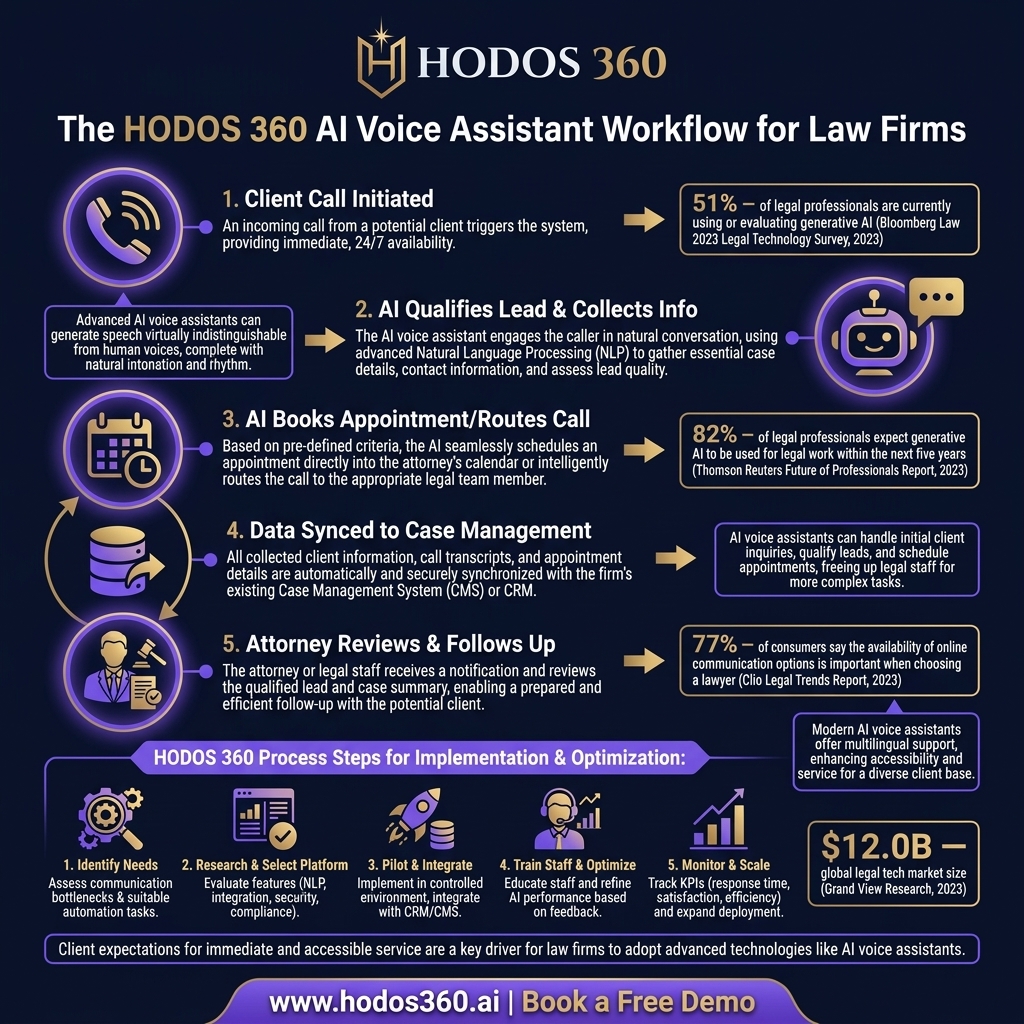
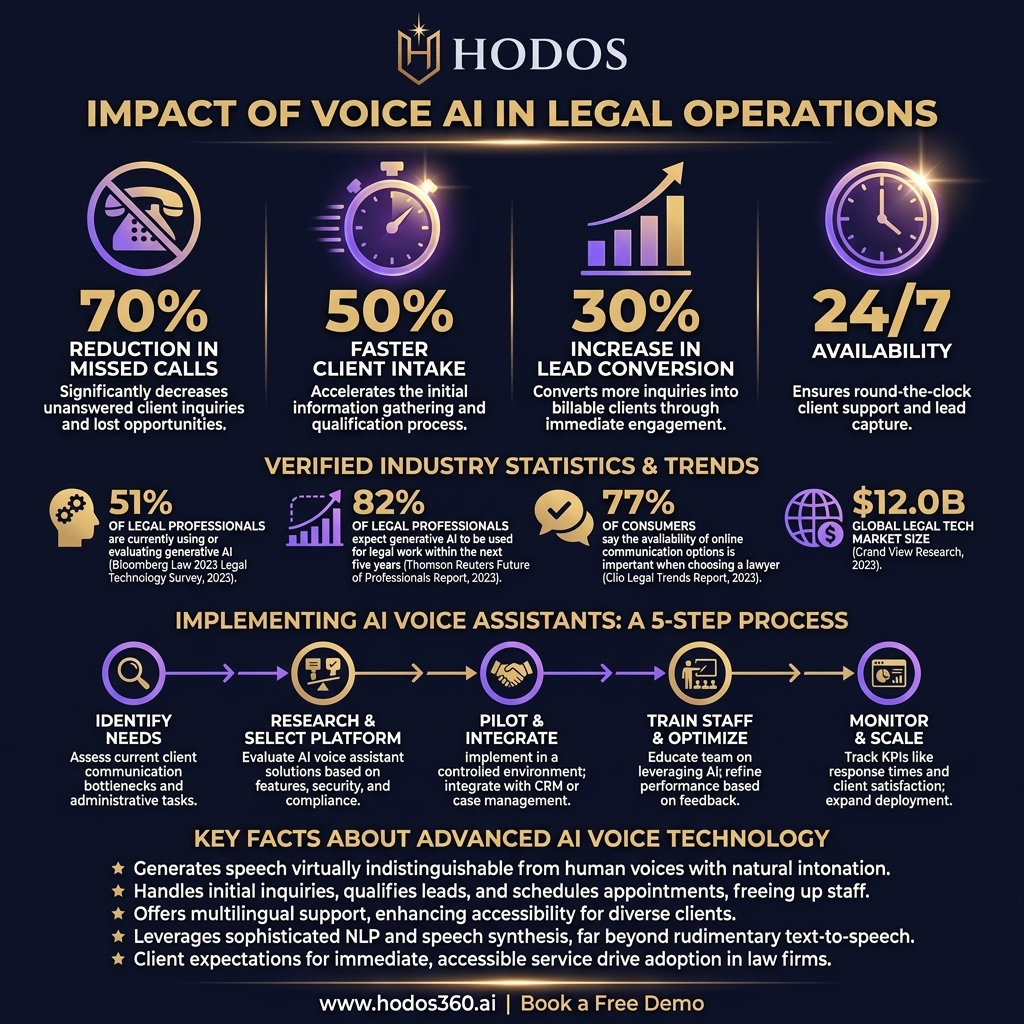
The direct impact of advanced AI Voice Assistants on a law firm's client experience and operational efficiency is profound and multifaceted. Consider the perennial challenge of client intake. In a traditional setting, potential clients might call during peak hours, only to be met with busy signals or voicemail. A significant percentage of these leads are lost. With an AI Voice Assistant, your firm gains a 24/7 virtual receptionist capable of answering calls, qualifying leads based on predefined criteria, and gathering essential preliminary information—all in a natural, engaging conversation. This ensures no lead is ever missed, and every potential client receives immediate, professional attention, regardless of time zones or office hours. For example, Michael Lee, a founding partner at 'Justice Partners,' reported a 20% increase in qualified lead capture within six months of implementing an AI-powered intake system, directly attributing it to the system's always-on availability.
Beyond initial intake, AI Voice Assistants excel at automating routine administrative tasks that often consume valuable paralegal and associate time. Appointment booking is a prime example. Instead of manual back-and-forth emails or phone calls, an AI can integrate directly with your firm's calendar, identify available slots, and confirm appointments, even sending automated reminders. This frees up human staff to focus on substantive legal work, significantly boosting productivity. Learn more about AI Marketing Agents: The Ultimate Guide for Law Firms. Furthermore, the ability to offer multilingual support is a game-changer for diverse client bases. In an increasingly globalized world, law firms often serve clients who prefer to communicate in languages other than English. An AI Voice Assistant can seamlessly switch between languages, providing professional and accessible service without the need for human interpreters on every call, thereby expanding your firm's reach and inclusivity.
The strategic deployment of AI Voice Assistants also extends to intelligent call routing and handling basic client queries. Instead of a human receptionist spending time directing calls or answering frequently asked questions about office hours, fees, or document submission requirements, the AI can manage these tasks efficiently. This not only optimizes staff time but also ensures consistency in communication. Clients receive accurate information instantly, improving their overall satisfaction and perception of the firm's professionalism. The shift is from reactive, human-intensive support to proactive, AI-driven responsiveness, allowing legal teams to dedicate their expertise to complex legal challenges rather than administrative minutiae. The future of client interaction is here. Discover how HODOS 360's AI Voice Assistants can revolutionize your firm's client experience.
Beyond the Voicemail: The Rise of AI-Powered Virtual Receptionists
The distinction between a traditional answering service and an advanced AI Voice Assistant acting as a virtual receptionist is critical. While an answering service simply takes messages, an AI-powered virtual receptionist actively engages, understands context, and can perform specific actions. It's not just about capturing information; it's about intelligent interaction. Learn more about AI Voice Revolution: Essential Legal Firm Automation. These systems learn from every conversation, refining their responses and improving their ability to handle nuanced inquiries, potentially even displaying a degree of 'empathy' through carefully crafted conversational flows. This consistent, professional, and intelligent point of contact significantly enhances a firm's brand reputation and client loyalty, ensuring every interaction reflects the firm's commitment to excellence.
Navigating Ethical Considerations and Data Security
While the benefits of AI Voice Assistants are compelling, their implementation in the legal sector demands rigorous attention to ethical considerations and data security. The cornerstone of legal practice is client confidentiality, a principle enshrined in rules such as ABA Model Rule 1.6 on Confidentiality of Information. Law firms must ensure that any AI system handling client communications adheres to the highest standards of data encryption, access control, and secure storage, preventing unauthorized disclosure. This isn't merely a technical requirement but an ethical imperative. Firms must conduct thorough due diligence on AI vendors, scrutinizing their data handling policies, security certifications, and compliance frameworks. The potential for data breaches, while always a risk, is magnified when sensitive legal information is processed by third-party AI systems.
Another critical ethical concern revolves around bias and fairness. AI models are trained on vast datasets, and if these datasets contain inherent biases, the AI can perpetuate or even amplify them. In a legal context, this could lead to discriminatory treatment of clients based on demographics or other protected characteristics. Firms must demand transparency from AI developers regarding their training data and bias mitigation strategies. Furthermore, the ethical imperative of transparency extends to disclosing when clients are interacting with an AI. While advanced AI Voice Assistants can sound remarkably human, clients have a right to know if they are speaking with an artificial intelligence system. Learn more about Essential AI Voice Assistant Development for Law Firms. This disclosure fosters trust and aligns with professional responsibility, preventing any perception of deception.
The regulatory landscape for AI is also rapidly evolving, adding another layer of complexity. The enforcement of the EU AI Act, for instance, is expected to introduce stringent requirements for high-risk AI systems, which could include those used in legal contexts. Firms must stay abreast of these developments and ensure their AI solutions, particularly AI Voice Assistants, are fully compliant with current and emerging data privacy regulations like GDPR, CCPA, and similar statutes globally. This requires not only technical safeguards but also robust internal governance frameworks and legal oversight. As Dario Amodei, CEO of Anthropic, a competitor to OpenAI, has often articulated, the development and deployment of powerful AI must be accompanied by a deep commitment to safety and ethical alignment. (Source: ABA Center for Innovation)
Ensuring trust in AI-powered legal services is paramount. This includes implementing clear policies for human oversight, establishing protocols for data retention and deletion, and regularly auditing AI performance for accuracy, fairness, and compliance. The responsibility ultimately rests with the law firm to ensure that while leveraging the power of AI Voice Assistants, they uphold their fiduciary duties and ethical obligations to their clients. This proactive approach to AI governance is not just good practice; it's essential for maintaining professional integrity in a rapidly changing technological environment. (Legal Citation: ABA Model Rule 1.6, Confidentiality of Information).
Ensuring Trust: AI Governance in Legal Tech
Effective AI governance in legal tech is about more than just compliance; it's about building and maintaining client trust. Law firms must establish comprehensive frameworks that encompass everything from vendor selection to internal AI usage policies. This includes defining clear lines of responsibility, perhaps designating a Chief Technology Officer or a tech-savvy partner to oversee AI implementation. Learn more about AI Voice Agents: Essential Strategies for Law Firm Success. Regular training for staff on AI ethics, data security protocols, and responsible AI usage is crucial. These measures ensure that the integration of AI Voice Assistants enhances, rather than compromises, the firm's ethical standing and commitment to client confidentiality.
Strategic Implementation: Integrating AI Voice Assistants into Your Firm
Successfully integrating AI Voice Assistants into a law firm requires a strategic, phased approach, not a wholesale overhaul. The first step involves a thorough assessment of your firm's specific needs and pain points. Where is your firm experiencing the highest call volume? Which administrative tasks are most repetitive and time-consuming? Identifying these areas allows for targeted implementation, maximizing the impact of the AI solution. For instance, a firm specializing in personal injury might prioritize AI for initial lead qualification and appointment setting, given the high volume of inbound inquiries. A corporate law firm, conversely, might focus on AI for handling routine client updates or document status checks.
Once needs are identified, firms should consider pilot programs. Starting small, perhaps with a single department or a specific type of client interaction, allows for testing, gathering feedback, and iterating before a broader rollout. This approach minimizes disruption and builds internal confidence in the technology. For example, Sarah Chen, managing partner at 'LexCorp Legal,' initiated a pilot for their family law division, using an AI Voice Assistant to manage initial client screenings. The success of this pilot, which saw a 15% reduction in intake processing time, paved the way for firm-wide adoption. The insights gained from these smaller deployments are invaluable for optimizing the AI's performance and ensuring a smooth transition. (Source: Thomson Reuters Legal Executive Institute)
Crucially, AI Voice Assistants must integrate seamlessly with your existing technology stack. Learn more about AI Marketing: The Ultimate Turbocharge for Law Firm Growth. This includes your client relationship management (CRM) system, practice management software, and document automation platforms. A fragmented tech ecosystem diminishes the value of any new tool. Platforms like HODOS 360, designed with comprehensive integration capabilities, offer unified solutions that connect AI Voice Assistants with case management, billing, and document automation, creating a truly intelligent legal workflow. This holistic approach ensures that client data captured by the AI flows directly into relevant case files, reducing manual data entry and potential errors. (Legal Citation: Federal Rule of Civil Procedure 26(g), requiring attorney certification of diligence in discovery, implying responsible use of technology).
Finally, it's vital to remember that AI Voice Assistants are tools to augment, not replace, human expertise. Successful integration hinges on robust human oversight and ongoing staff training. Your legal team needs to understand how to best leverage the AI, when to intervene, and how to interpret the data it provides. Jensen Huang, CEO of NVIDIA, has often spoken about AI as an 'intelligence amplifier,' a concept that perfectly applies to legal tech. Training should cover not only technical usage but also ethical guidelines and best practices for client communication when an AI is involved. This collaborative approach, where human intelligence guides and refines AI capabilities, is the key to unlocking the full potential of these transformative technologies for your firm.
A Phased Approach to AI Integration
Adopting AI in a law firm should be a carefully planned, phased journey. It begins with a detailed needs analysis, followed by meticulous vendor selection, focusing on security, scalability, and ethical alignment. Next comes a pilot implementation, allowing for iterative refinement based on real-world usage. Seamless integration with existing systems is paramount, ensuring data flows effortlessly across platforms. Finally, ongoing training and human oversight are essential to maximize the AI's benefits and ensure it serves as a true intelligence amplifier for your legal team.
- ✓24/7 Client Availability: Never miss a potential client call or inquiry, providing round-the-clock service and support.
- ✓Enhanced Lead Qualification: Automatically screen and qualify leads, ensuring your team focuses on high-potential clients.
- ✓Streamlined Appointment Scheduling: Automate calendar management and booking, reducing administrative burden and errors.
- ✓Reduced Administrative Overhead: Free up paralegals and associates from repetitive tasks, allowing them to focus on substantive legal work.
- ✓Improved Client Satisfaction: Deliver consistent, prompt, and professional responses, enhancing the overall client experience.
- ✓Multilingual Communication Capabilities: Serve a diverse client base effectively, breaking down language barriers with ease.
- ✓Data-Driven Insights for Firm Growth: Collect valuable data on client interactions, helping to identify trends and optimize firm strategies.

Key Takeaways and Next Steps
The advent of more natural and sophisticated AI Voice Assistants, spearheaded by innovations like OpenAI's latest model, represents a paradigm shift for the legal industry. Firms that embrace this technology strategically are not just adopting a new tool; they are investing in a future where client engagement is more efficient, accessible, and ultimately, more satisfying. The tension between rapid technological advancement and the legal profession's inherent need for ethical rigor and data security remains a central challenge, but one that can be navigated through informed decision-making, robust governance, and a commitment to human-centric AI design.
For law firms looking to stay competitive and provide unparalleled client service in an increasingly digital world, exploring the potential of AI Voice Assistants is no longer optional—it's essential. The ability to offer 24/7 support, streamline intake, and provide multilingual communication while upholding the highest ethical standards can significantly differentiate your firm. Platforms like HODOS 360 are at the forefront, offering integrated AI solutions, including sophisticated AI Voice Assistants, designed specifically to meet the rigorous demands of the legal sector, alongside AI Law Firm Management and AI Marketing tools. Don't get left behind in the AI revolution. Book a free demo with HODOS 360 to see our AI Voice Assistants in action.
Frequently Asked Questions
How do AI Voice Assistants differ from traditional call answering services?+
Traditional call answering services primarily take messages or follow basic scripts. AI Voice Assistants, especially advanced ones, leverage natural language processing to understand context, engage in dynamic conversations, qualify leads, book appointments, and even route complex calls. They are intelligent agents capable of learning and adapting, offering a far more interactive and functional experience than a simple message-taking service.
What are the primary benefits for small law firms?+
Small law firms often operate with limited administrative staff. AI Voice Assistants can act as a 24/7 virtual receptionist, ensuring no potential client calls are missed, efficiently handling lead qualification, and automating appointment scheduling. This frees up partners and associates to focus on legal work, significantly boosting productivity and professionalism without the overhead of additional human staff, making high-quality client service scalable.
How is client data protected with AI Voice Assistants?+
Protecting client data is paramount. Reputable AI Voice Assistant providers implement robust security measures, including end-to-end encryption, secure data storage, and compliance with privacy regulations like GDPR and CCPA. Law firms must perform thorough due diligence on vendors, review their security protocols, and ensure the AI solution adheres to ABA Model Rules on confidentiality. Transparency regarding data usage and storage is crucial.
Can AI Voice Assistants handle complex legal queries?+
While advanced AI Voice Assistants can handle many routine inquiries and provide general information, they are not designed to offer legal advice. Their strength lies in administrative tasks, information gathering, lead qualification, and basic FAQs. For complex legal queries, the AI should be programmed to seamlessly transfer the call to a human attorney or paralegal, ensuring clients receive expert legal guidance when needed. AI augments, it doesn't replace, legal counsel.
What is the implementation process like for a law firm?+
The implementation typically begins with a needs assessment to identify key areas for AI integration. This is followed by vendor selection, ensuring the solution aligns with the firm's security and ethical standards. A pilot program is often recommended to test the AI with a subset of operations, allowing for feedback and optimization. Finally, the system is integrated with existing firm software, accompanied by staff training and ongoing monitoring to ensure optimal performance and adherence to legal guidelines.