
AI for Small Law Firms: The Essential Hub for Growth
Just last year, Sarah Chen, managing partner of Innovate Legal Solutions in Austin, Texas, found herself at a crossroads. Her three-attorney firm, specializing in intellectual property, was struggling under the weight of escalating client demands. Complex patent research consumed countless hours, drafting agreements felt like an endless loop, and billing—a necessary evil—eroded valuable weekends.
Sarah considered expanding her team, but the overhead was daunting. This narrative, far from unique, echoes across thousands of small law firms nationwide, often caught between growth aspirations and the limitations of traditional operational models. The legal industry, historically cautious with technology, is now at a pivotal moment, driven by AI advancements that promise to reshape legal service delivery, especially for lean small law firms.
The recent Stock Titan headline, "Small law firms get AI research, drafting and billing in one hub," isn't just news; it's a beacon of a burgeoning reality.
This shift transcends mere software adoption; it’s about embracing AI as a force multiplier, leveling the playing field for smaller practices against their resource-rich counterparts.
For years, advanced legal tech was perceived as prohibitively expensive and complex, exclusive to AmLaw 100 firms. However, cloud-based AI platforms have democratized access. Today, AI for small law firms is not a luxury but a strategic imperative, offering tools that automate mundane tasks, enhance accuracy, and free attorneys for high-value client work.
The integration of AI into core functions—from client intake to sophisticated legal research, precise document drafting, and efficient billing—is transforming operational efficiency, promising not just cost savings but a significant competitive advantage. Firms like Sarah Chen's are now leveraging these integrated hubs to navigate a complex legal landscape with unprecedented agility.
The Shifting Sands: Why AI for Small Law Firms is No Longer Optional
The legal profession faces immense pressure: clients demand faster, more cost-effective services, while the volume of legal data continues to explode. A 2023 Thomson Reuters report indicated law firms increased tech spending by 12% year-over-year, with AI solutions forming a significant portion. This trend is particularly acute for small law firms, often operating with tighter margins and fewer administrative resources.
The traditional model, heavily reliant on manual processes for legal research, document review, and case management, is increasingly unsustainable. Firms resisting this technological wave risk being outpaced, struggling with inefficiencies that erode profitability and client satisfaction. The tension between traditional practice and technological adoption is real, creating a divide between those proactively integrating tools and those clinging to outdated methods.
The rapid evolution of generative AI, spearheaded by companies like OpenAI with its GPT models and Anthropic's Claude, has accelerated the development of legal-specific applications. Visionaries like Sam Altman and Dario Amodei have pushed AI's capabilities, leading to a new generation of legal AI tools that are both powerful and accessible.
While enterprise-level solutions like Harvey AI's partnership with Allen & Overy demonstrate high-end potential, the benefits are rapidly democratizing. This innovation isn't just about raw processing power; it’s about specialized training on vast legal datasets, making models adept at understanding legal nuances, identifying precedents, and even predicting outcomes.
Learn more about AI Lead Flow: Essential Strategies for Law Firm Growth. Tasks once requiring hours of highly paid human effort can now be augmented or automated, allowing small firm attorneys to reclaim time for strategic counsel.
The Stock Titan article, "Small law firms get AI research, drafting and billing in one hub," perfectly encapsulates this transformative trend.
It signifies a move from disparate, siloed tools to integrated platforms offering a holistic approach to practice management. This consolidation is a game-changer, eliminating the friction of switching between multiple applications and centralizing critical firm data. For small law firms, a single login can unlock capabilities ranging from AI-powered legal workflows and document automation to advanced analytics and streamlined client intake.
The promise is not just efficiency but a complete overhaul of legal operations, ensuring every aspect, from complex legal research to simple billing, is optimized for speed, accuracy, and profitability. This integrated approach enables firms to operate with startup-like agility and deliver seasoned quality.
Ready to see how an integrated AI platform can transform your practice?
Discover the future of legal efficiency. [Learn More about HODOS 360’s AI Law Firm Management System]
Revolutionizing Legal Research with AI
The era of exhaustive manual legal research is drawing to a close. AI-powered platforms, such as Thomson Reuters' CoCounsel and LexisNexis' Lexis+ AI, are fundamentally changing how attorneys find and analyze information. These tools comprehend natural language queries, synthesize vast amounts of case law, statutes, and secondary sources, and identify relevant precedents often missed by traditional methods.
Imagine asking a complex legal question and receiving a concise summary of prevailing arguments, complete with citations, within minutes. Learn more about AI Legal Research: The Ultimate Evolution of Legal Analysis. This capability drastically reduces initial research time, allowing attorneys to focus on strategic analysis rather than exhaustive data collection.
For small law firms, this democratizes access to superior legal intelligence, previously exclusive to larger firms with dedicated research departments.
Beyond the Hype: Practical AI Legal Tools for Daily Practice
Beyond theoretical discussions, AI's profound impact for small law firms lies in its practical, day-to-day applications. The market now offers specialized legal AI tools addressing specific pain points. Consider AI drafting assistants: platforms like Spellbook are revolutionizing contract creation and review, offering real-time clause suggestions, identifying potential risks, and ensuring jurisdictional compliance.
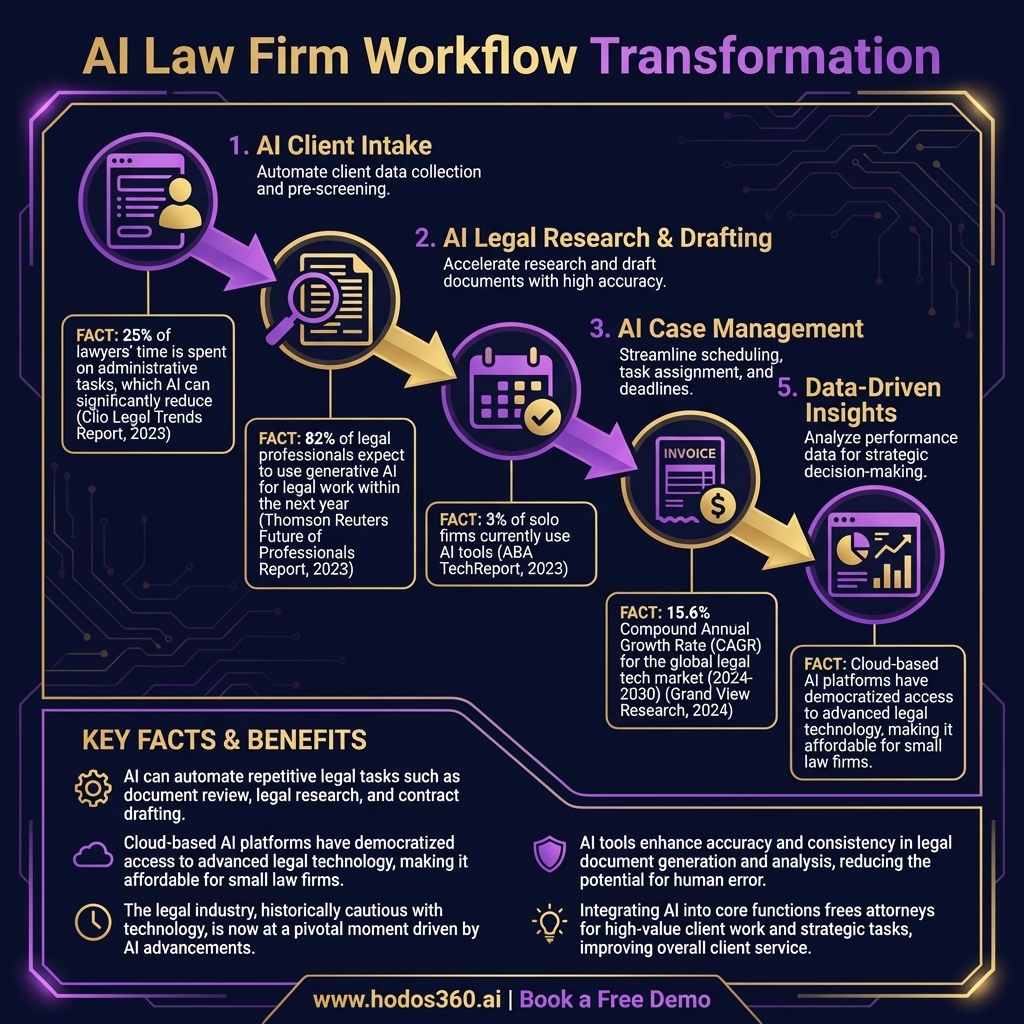
This goes beyond simple grammar checks; these tools understand legal context, aiding attorneys in drafting complex documents—commercial contracts, pleadings, motions—with greater speed and accuracy. The time savings are immense, allowing attorneys to focus on strategic content and client-specific nuances, rather than tedious mechanics. For small firms managing diverse caseloads, this versatility is invaluable, enabling them to confidently undertake previously time-consuming matters.
Document review is another area profoundly transformed. For litigation or due diligence, reviewing thousands of documents is a monumental, costly undertaking. AI tools can rapidly sift through vast datasets, identify relevant information, tag privileged documents, and detect inconsistencies human reviewers might miss. This drastically reduces discovery time and cost, while improving review quality and accuracy.
Furthermore, document automation systems, often integrated into comprehensive AI law firm management platforms, allow firms to generate standardized legal documents—from engagement letters to boilerplate contracts—with a few clicks. By inputting key client and case data, attorneys automatically populate templates, ensuring consistency, reducing errors, and freeing significant administrative time.
This efficiency gain is critical for small firms aiming to scale without proportional headcount increases.
The client journey itself is being reshaped by AI. Learn more about Generative AI Marketing: Law Firms' 2026 Growth Engine. From the initial contact, AI-powered systems streamline client intake, collecting essential information, conducting conflict checks, and even providing preliminary legal information.
This creates a smoother, more professional client experience while ensuring attorneys receive well-organized, pre-qualified leads. Within case management, AI assists in task management, deadline tracking, and even predictive analytics, identifying potential bottlenecks or risks. Imagine an AI assistant flagging a critical filing deadline or suggesting optimal resource allocation based on historical case data.
These capabilities allow small firms to manage a larger volume of cases with greater oversight and precision, ensuring nothing falls through the cracks. The integration of these functions provides unparalleled operational control and insight.
Beyond internal operations, client communication and lead generation are also revolutionized.
AI Voice Assistants, like those offered by HODOS 360, provide 24/7 phone answering, lead qualification, and appointment booking. For a small firm, this means never missing a potential client call, even after hours, and ensuring leads are professionally handled and routed. This significantly enhances client experience and boosts conversion rates, directly impacting the firm's bottom line without additional reception staff overhead.
Multilingual support further broadens a firm's reach, making legal services accessible to diverse clientele. This automation of front-office tasks allows attorneys and paralegals to dedicate their time to substantive legal work, knowing inbound communications are expertly managed around the clock.
Integrated Efficiency: Unifying Document Automation, Research, and Billing
The true power of AI for small law firms emerges when disparate functionalities integrate into a cohesive, centralized hub. The 'one hub' concept is not just convenience; it’s about creating a synergistic ecosystem where data flows seamlessly. For instance, when a new client is onboarded via an AI-powered intake system, that data instantly populates the case management system.
As attorneys conduct legal research AI and draft documents, time spent is automatically logged, and relevant document versions stored, all feeding into intelligent billing software. This eliminates manual data entry, reduces errors, and ensures every billable minute is accurately captured. The efficiency gains are exponential, allowing firms to prioritize legal strategy over administrative overhead, directly addressing historical inefficiencies in small practices.
Perhaps one of the most impactful areas of integration is in billing software and financial management. For many small firms, billing is a time-consuming, dreaded task, leading to delayed invoices and lost revenue. Integrated AI platforms automate time tracking, categorize expenses, and generate detailed invoices based on pre-set rates.
Some advanced systems even analyze billing patterns to identify potential write-offs or areas for improved profitability. Clio, a leader in legal practice management, has consistently shown the significant impact of efficient billing on firm profitability through its Legal Trends Report. Learn more about Legal AI Gap: Bridging the Divide for Law Firms in 2026.
Their continuous innovation in AI-driven features underscores the industry's move towards smarter, more automated legal firm billing software. This automation accelerates cash flow and provides real-time financial insights, enabling more informed business decisions for firms like Sarah Chen's.
The unified approach offered by comprehensive platforms provides a distinct competitive advantage.
Instead of piecing together various point solutions—one for research, another for drafting, a third for billing—firms benefit from a single, intuitive interface. This reduces training time, minimizes compatibility issues, and ensures a consistent user experience. Moreover, a centralized platform allows for comprehensive analytics, giving firm owners a 360-degree view of operations.
From tracking case progress and attorney productivity to analyzing marketing ROI and client acquisition costs, these insights are invaluable for strategic planning and growth. This holistic visibility empowers small firms to make data-driven decisions, optimizing resource allocation and identifying new opportunities for expansion. The era of intelligent, data-backed practice management is here.
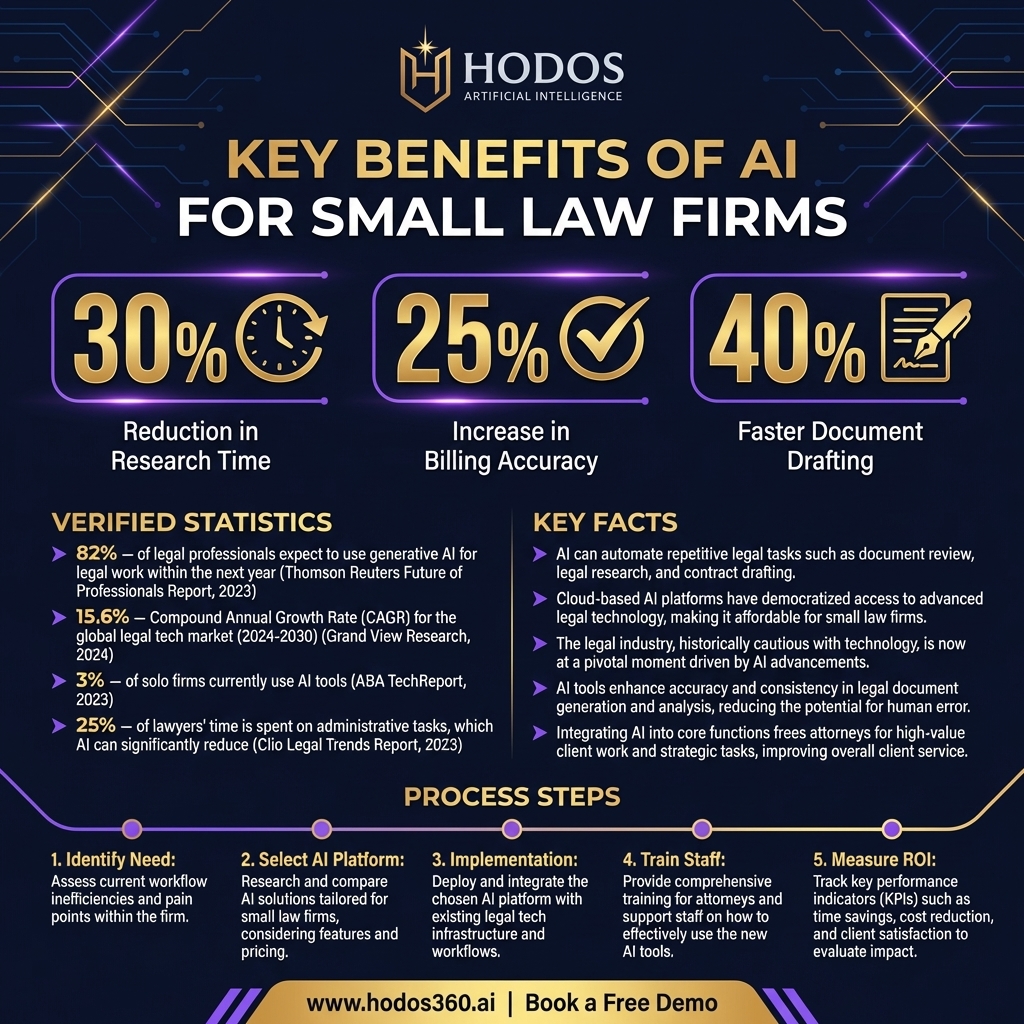
- ✓Enhanced Productivity: Automate repetitive tasks like document generation, time tracking, and initial research, freeing attorneys for higher-value work.
- ✓Superior Accuracy: AI minimizes human error in drafting, document review, and billing, leading to more precise legal work and fewer compliance issues.
- ✓Cost Reduction: Decrease reliance on external services for research and administrative support, and optimize operational overhead.
- ✓Improved Client Experience: Faster response times, 24/7 support via AI voice assistants, and streamlined intake processes enhance client satisfaction.
- ✓Competitive Edge: Access to sophisticated tools previously exclusive to large firms, enabling small practices to offer cutting-edge services.
- ✓Data-Driven Decisions: Centralized analytics provide insights into firm performance, client trends, and profitability, guiding strategic growth.
Ready to transform your law firm with cutting-edge AI? [Explore HODOS 360’s Integrated AI Solutions]
Streamlining Client Intake and Case Management
Effective client intake is the gateway to a successful attorney-client relationship, and AI is transforming this crucial first step. Modern AI systems can guide potential clients through intuitive online questionnaires, collect necessary documents, and perform initial conflict checks against the firm’s existing database. This not only gathers pertinent information systematically but also provides a professional and efficient first impression.
Once onboarded, AI-powered case management tools automate appointment scheduling, generate initial legal documents, and set critical deadlines. Learn more about Law Firm Return on Investment: Maximize AI in 2026. Firms leverage these systems to track case progress in real-time, monitor attorney workloads, and allocate resources more effectively.
This level of organization, often a challenge for smaller teams balancing multiple cases, becomes effortlessly manageable with an intelligent system.
Navigating the Future: Ethical Considerations and the AI-Powered Law Firm
While AI's benefits are undeniable, its integration demands a keen awareness of ethical responsibilities. The American Bar Association (ABA) Model Rules of Professional Conduct, particularly Rule 1.1 (Competence) and Rule 1.6 (Confidentiality), provide crucial frameworks. Attorneys have a duty of technological competence, understanding AI's risks and benefits, including potential "hallucinations" or biases, and maintaining ultimate oversight.
As Sarah Chen noted at a recent LegalTech NYC 2026 panel, "AI is a powerful co-pilot, not an autonomous driver. Our professional judgment remains paramount." Firms must implement robust protocols for verifying AI-generated output, ensuring accuracy and avoiding unauthorized disclosure of client information. The tension between leveraging cutting-edge tools and upholding professional duties is a central theme in legal tech.
A paramount concern for any law firm, especially with cloud-based AI platforms, is data security and client confidentiality. Handling sensitive legal information requires the highest standards of protection. The impending EU AI Act enforcement and various state-level data privacy statutes underscore increasing regulatory scrutiny on how AI systems process personal data.
Firms must ensure their chosen AI solutions comply with stringent security protocols, including robust encryption, secure data storage, and clear data governance policies. This means scrutinizing vendor agreements, understanding data hosting, and verifying compliance certifications. Learn more about Legal AI Adoption: An Essential Roadmap for Law Firms.
The conflict lies between the convenience of cloud-based AI and the absolute necessity of safeguarding client data. Firms must prioritize platforms offering enterprise-grade security and transparent data handling, protecting client trust and avoiding liabilities under ABA Model Rule 1.6.
Another critical ethical consideration is the potential for bias in AI algorithms.
If AI models are trained on biased datasets, they can perpetuate or amplify existing societal biases, leading to unfair or discriminatory legal outcomes. Attorneys using AI must be aware of these risks and exercise critical judgment. The principle of accountability dictates that the attorney, not the AI, bears ultimate responsibility for legal advice.
This necessitates a 'human-in-the-loop' approach, where AI augments human capabilities rather than replacing oversight. Firms must implement internal training on responsible AI use, ensuring technology enhances, rather than compromises, legal practice integrity. This ongoing dialogue and commitment to ethical deployment will define AI integration into the legal ecosystem.
Data Security and Client Confidentiality in the AI Era
In an era of increasing cyber threats and evolving data privacy regulations, safeguarding client information is non-negotiable. For small law firms adopting AI, this means rigorously evaluating a platform's security architecture. A strong AI solution must offer end-to-end encryption, multi-factor authentication, and adhere to industry standards like ISO 27001 or SOC 2. Beyond technical measures, firms must establish clear internal policies for AI use, including guidelines for inputting client data, reviewing AI-generated content for confidentiality risks, and training staff on data hygiene.
The risk of a data breach, even accidental, can have catastrophic consequences. Investing in AI platforms that prioritize privacy by design and offer transparent data handling is not just good practice; it’s an ethical imperative.
Building the Competitive Edge: Choosing the Right Practice Management Solution
For small law firms eager to harness AI, selecting the right practice management solution is paramount. It’s not about the flashiest tool, but a platform aligning with the firm's specific needs, budget, and growth aspirations. Key considerations include the breadth of integrated features—does it seamlessly cover case management, billing, document automation, and client intake?
Is the user interface intuitive, minimizing the learning curve? Scalability is crucial; the system must grow with the firm, accommodating increasing caseloads and expanding service lines without a complete overhaul. Firms should seek vendors with a proven track record, robust customer support, and a commitment to continuous innovation, ensuring the platform remains cutting-edge.
Investing in an integrated AI hub is an investment in the firm’s future viability and competitive positioning.
The 'one hub' philosophy, exemplified by platforms like HODOS 360’s AI Law Firm Management System, is precisely what small firms need to thrive. Such systems offer a comprehensive suite, from AI-powered legal workflows streamlining case handling to sophisticated AI marketing platforms generating leads and tracking ROI.
The value lies in how features work together for a cohesive, efficient practice. Firms should prioritize solutions offering strong customer support and training, ensuring smooth transitions and maximizing user adoption. The legal tech market is dynamic, but the emphasis should always be on integrated systems solving multiple pain points simultaneously, rather than fragmented tools adding complexity.
This strategic choice can be the difference between merely surviving and truly thriving in the modern legal market.
As we look to 2026 and beyond, AI integration into legal practice will only deepen. Firms proactively embracing these technologies will enhance operational efficiency and redefine service quality.
The competitive landscape will favor those leveraging AI to deliver faster, more accurate, and cost-effective legal solutions. From the visionary insights of tech leaders like Jensen Huang, CEO of NVIDIA, pushing AI hardware boundaries, to daily innovations in legal tech startups, the pace of change is relentless.
For small law firms, this means continuous learning and adaptation, viewing AI not as a threat but as an unparalleled opportunity to innovate, grow, and solidify their position as indispensable advisors in a complex world. The future of law is intelligent, and the pathway to success is paved with strategic AI adoption.

Key Takeaways and Next Steps
The integration of AI for small law firms is no longer a futuristic concept but a present-day reality offering profound benefits across research, drafting, billing, and overall practice management. As demonstrated by firms like Innovate Legal Solutions, leveraging an integrated AI hub dramatically enhances efficiency, reduces operational costs, and elevates legal service quality.
The competitive advantage gained by embracing legal AI tools is clear, enabling smaller practices to punch above their weight and meet evolving client expectations. However, this transformation requires a thoughtful approach, balancing innovation with ethical responsibility and a keen focus on data security. Choosing the right AI-powered practice management solution, one that offers comprehensive features and robust support, is the critical next step for any firm ready to embrace this new era.
Propel your practice forward. [Book a Free Demo with HODOS 360 Today!]
Frequently Asked Questions
Q: What is the primary benefit of AI for small law firms?+
A: The primary benefit is unparalleled efficiency. AI automates time-consuming tasks like legal research, document drafting, and billing, freeing attorneys to focus on high-value client work. This not only reduces operational costs but also enhances accuracy and allows small firms to compete more effectively with larger practices by streamlining their entire workflow.
Q: How does AI improve legal research for small firms?+
A: AI revolutionizes legal research by enabling natural language queries, synthesizing vast legal datasets, and identifying relevant precedents far faster than traditional methods. Tools powered by AI can provide concise summaries of legal arguments with citations, significantly cutting down research time and giving small firms access to sophisticated legal intelligence.
Q: Are AI legal tools too expensive for small law firms?+
A: Historically, advanced legal tech was costly, but cloud-based AI platforms have democratized access. Many integrated solutions now offer scalable pricing models, making them affordable for small firms. The efficiency gains and cost reductions from automation often provide a significant return on investment, making AI a financially viable and strategic asset.
Q: What ethical considerations should small firms be aware of when using AI?+
A: Small firms must prioritize ethical competence (ABA Rule 1.1) and client confidentiality (ABA Rule 1.6). This means understanding AI's limitations, verifying AI-generated output, safeguarding client data with robust security measures, and being aware of potential biases in algorithms. Human oversight remains crucial to maintain professional responsibility.
Q: Can AI help with client intake and marketing for small firms?+
A: Absolutely. AI streamlines client intake by automating information collection and conflict checks, providing a professional first impression. For marketing, AI platforms can generate content, automate social media, create AI videos, and track ROI, helping small firms attract and convert leads more efficiently without extensive marketing teams.