


AI Lead Flow: Essential Strategies for Law Firm Growth
On March 20, 2026, Thryv, a leading small business software provider, announced the launch of its AI Lead Flow, a groundbreaking solution designed to unify marketing and sales automation for small businesses. Joe Walsh, CEO and President of Thryv, emphasized the platform's ability to streamline the entire customer journey, from initial contact to conversion, leveraging artificial intelligence to qualify leads, automate outreach, and optimize sales processes.
This move isn't just significant for SMBs; it casts a long shadow over the legal industry, signaling an undeniable shift towards integrated, AI-powered lead management that promises to redefine law firm growth and business development legal strategies.
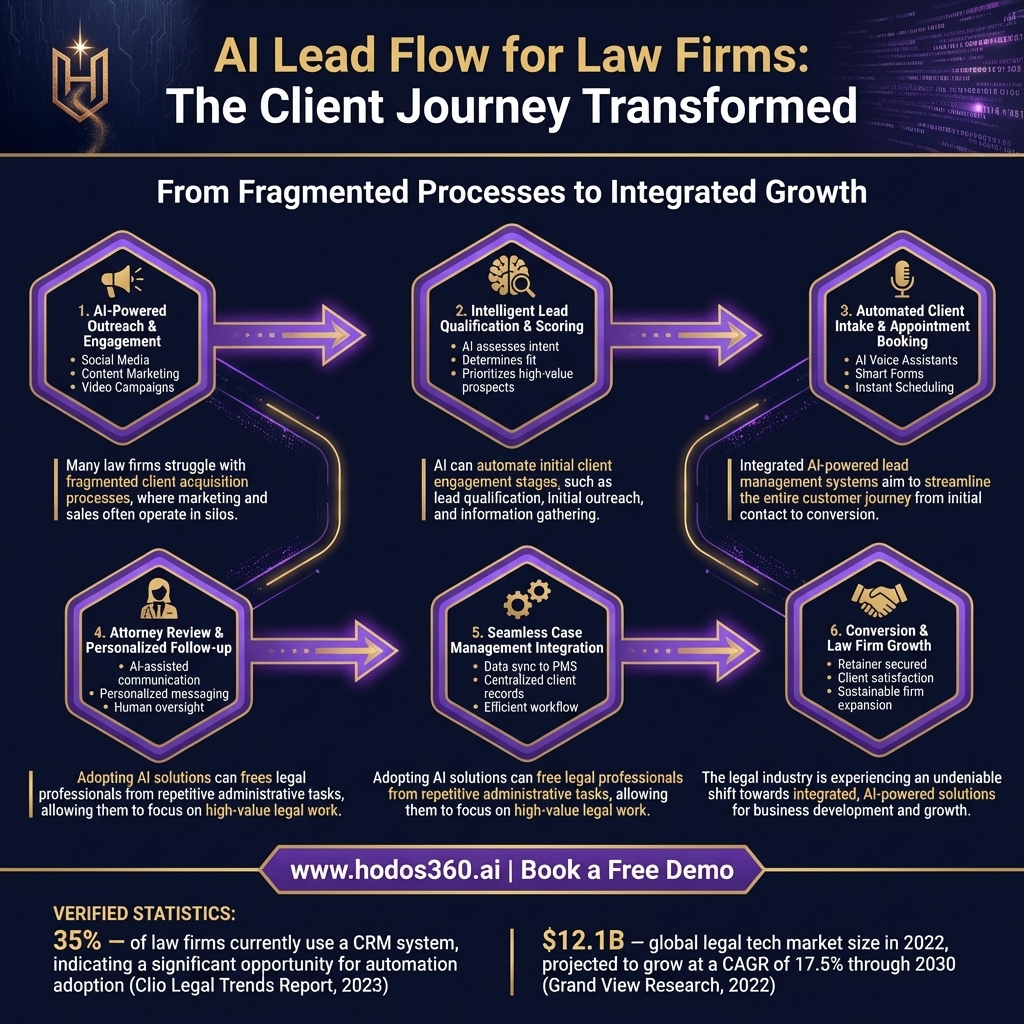
For too long, many law firms have grappled with a fragmented approach to client acquisition.
Marketing efforts often operate in silos from the actual sales and client intake processes, leading to inefficiencies, missed opportunities, and a frustrating experience for potential clients. The traditional methods of lead generation, while foundational, often lack the precision, speed, and scalability demanded by today's competitive legal landscape.
Attorneys and legal professionals find themselves bogged down in administrative tasks, sifting through unqualified inquiries, rather than focusing on high-value legal work.
The advent of AI Lead Flow presents a transformative opportunity for law firms to bridge this divide. By harnessing advanced AI capabilities, legal practices can now automate the initial stages of client engagement, intelligently qualify prospects, and nurture relationships with unprecedented efficiency.
This isn't merely about adopting new tools; it's about embracing a strategic paradigm shift that unifies marketing and sales automation, ensuring every potential client interaction is optimized for conversion and long-term engagement. The firms that proactively integrate these AI-powered solutions will undoubtedly gain a significant competitive advantage, charting a clear path to sustainable expansion.
The Genesis of AI Lead Flow in Legal Practice
Thryv's AI Lead Flow, which integrates AI-powered website building, social media automation, and content generation, is a clear indicator of where the broader market is headed. Its core innovation lies in its ability to centralize and automate the traditionally disparate functions of attracting and converting clients.
For law firms, this means moving beyond generic web forms and manual follow-ups to a system that can understand client intent, route inquiries to the correct practice area, and even pre-qualify leads based on specified criteria. This level of sophistication, once the exclusive domain of large enterprises, is now becoming accessible, setting a new benchmark for lead management in the legal sector.
The implications for legal practice are profound. Learn more about Generative AI Marketing: Law Firms' 2026 Growth Engine. Imagine a prospective client searching for a 'divorce lawyer in New York.' An AI Lead Flow system could not only capture this inquiry but instantly assess its urgency, geographic relevance, and even potential case value.
It could then trigger a personalized, automated response, book an initial consultation, and prepare a summary for the attorney — all before the attorney even sees the lead. This dramatically reduces the time and resources spent on unqualified leads, allowing legal teams to focus their expertise where it matters most: delivering exceptional legal services and driving genuine law firm growth.
The Thryv Precedent: Lessons for Legal
Thryv's success with small businesses, as highlighted by their CEO Joe Walsh, offers valuable insights for the legal industry. The platform's emphasis on unifying marketing and sales automation for SMBs directly addresses a critical pain point for many mid-sized and boutique law firms. These firms often lack the extensive marketing departments of larger counterparts or the dedicated business development teams.
An AI Lead Flow solution designed for legal can provide the leverage needed to compete effectively, turning a trickle of inquiries into a steady stream of qualified clients. The focus on easy-to-use, integrated tools demonstrates that powerful AI-powered solutions don't have to be overly complex or cost-prohibitive.
This shift isn't just about technology; it’s about a change in mindset. Learn more about AI Marketing: Law Firms Slash $225K Tools in 2026. Firms that embrace the lessons from platforms like Thryv recognize that the future of client intake and lead management lies in intelligent automation.
As reported by Gartner, by 2027, generative AI will be a primary component of 70% of marketing initiatives, up from less than 10% in 2023. This projection underscores the urgency for legal professionals to adopt these advancements, not just to keep pace but to proactively shape their competitive landscape.
Navigating the AI Lead Flow Landscape: Challenges & Opportunities
While the opportunities presented by AI Lead Flow are immense, law firms must navigate a unique set of challenges. Paramount among these are ethical considerations and data privacy. The use of AI in client communications and data processing raises questions about confidentiality, attorney-client privilege, and compliance with rules like ABA Model Rule 1.6 on Confidentiality of Information and state-specific data privacy regulations.
Firms must ensure their AI-powered systems are designed with robust security protocols and transparent data handling practices, maintaining client trust at every step. The need for human oversight remains critical, ensuring that AI augments, rather than replaces, the essential human element of legal counsel.
Despite these challenges, the opportunities for digital transformation legal are compelling.
Learn more about AI Marketing Revolution 2026: Autonomous Agents for Law Firms. AI Lead Flow can significantly enhance efficiency by automating repetitive tasks, allowing attorneys to dedicate more time to complex legal analysis and client advocacy. It provides unparalleled insights into client behavior and market trends through sophisticated data analytics law firm capabilities, enabling firms to refine their marketing strategies with precision.
Firms that proactively invest in these solutions, integrating them with their existing AI-powered legal workflows, will not only optimize their client intake but also build a resilient foundation for long-term law firm growth in an increasingly competitive environment.
Implementing AI Lead Flow: A Strategic Blueprint for Law Firms
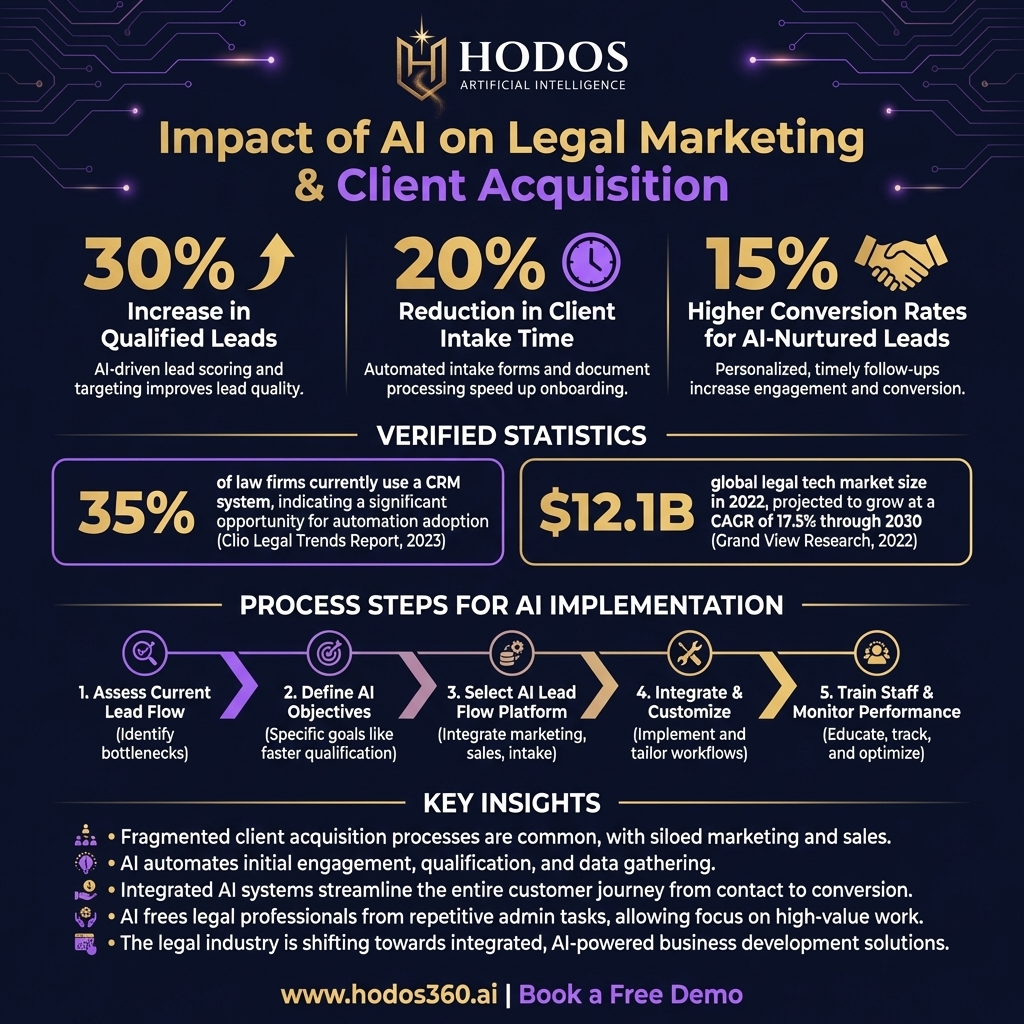
Implementing an effective AI Lead Flow system requires a strategic, phased approach. The first step involves a comprehensive audit of existing marketing and sales processes within the firm. Identify bottlenecks, manual touchpoints, and areas where leads are lost or mishandled. Defining clear objectives—whether it's reducing client intake time, increasing qualified lead volume, or improving conversion rates—is crucial for tailoring the AI solution to the firm's specific needs.
This foundational understanding ensures that the technology serves the firm’s strategic goals, rather than merely being an add-on.
Next, focus on data infrastructure and integration. AI models thrive on clean, structured data. Learn more about AI Voice Assistant: Essential for Modern Law Firm Growth. Law firms must ensure their client data, case information, and marketing analytics are centralized and accessible.
Integrating the AI Lead Flow platform with existing CRM and practice management systems is paramount for a seamless operational flow. This integration ensures that once a lead is qualified and converted, their information flows effortlessly into the firm's case management and billing systems, eliminating redundant data entry and minimizing errors.
The goal is a holistic system that supports the entire client lifecycle, from initial interest to case resolution.
Integrating AI with Existing Legal Workflows
The true power of AI Lead Flow for law firms is realized when it integrates seamlessly with existing legal workflows. Platforms like HODOS 360 are designed to offer this holistic integration, ensuring that AI-powered tools enhance every stage of a firm's operation. From initial client outreach to automated follow-ups and even document generation, AI can streamline processes that traditionally consume significant attorney and staff time.
Learn more about Legal AI Acquisition 2026: The New Era of Agentic Law Firms. This creates a truly connected ecosystem where lead management is not a standalone function but an integral part of the broader law firm management system.
This robust integration fosters a competitive advantage by creating efficiencies that directly impact the bottom line and client satisfaction.
Key capabilities of an integrated AI Lead Flow system for law firms include:
- ✓Automated Client Intake Forms: AI-powered data extraction and smart forms reduce manual entry and accelerate the onboarding process, ensuring accuracy.
- ✓Intelligent Lead Qualification: AI algorithms analyze inquiries against firm criteria, assigning lead scoring and prioritizing high-value prospects for specific practice areas.
- ✓Personalized Outreach & Follow-up: Automated email sequences and communication flows are tailored to prospect needs, keeping the firm top-of-mind without manual effort.
- ✓Automated Appointment Booking: AI voice assistants and smart scheduling tools manage consultations, integrating directly with attorney calendars.
- ✓Real-time Analytics & ROI Tracking: Dashboards provide immediate insights into lead sources, conversion rates, and the effectiveness of marketing campaigns, informing strategic adjustments.
- ✓Seamless Handoff to Case Management: Qualified leads and client data transition effortlessly into existing case management systems upon retainer, minimizing administrative burden.
- ✓Multilingual Support: AI-powered communication tools offer 24/7 support in multiple languages, broadening a firm's reach and client base.
Measuring Success: ROI and Analytics in AI-Powered Lead Management
Quantifying the return on investment (ROI) of AI Lead Flow is essential for demonstrating its value and securing continued commitment. Beyond simple lead volume, firms must track metrics such as lead quality, conversion rates from qualified leads to retained clients, average client acquisition cost, and ultimately, client lifetime value.
Advanced data analytics law firm tools integrated into AI-powered platforms provide granular insights into every stage of the client journey. This allows firms to identify which marketing channels are most effective, which lead types convert best, and where the client journey can be further optimized.
For example, a firm might discover that leads generated through AI video creation convert at a 20% higher rate than traditional content, prompting a reallocation of marketing resources.
Real-world data consistently validates the benefits of AI-powered lead management. Learn more about AI Legal Practice Management: The Ultimate Firm Advantage.
According to the Thomson Reuters Institute's annual Legal Trends Report, firms that leverage technology for client intake and business development consistently outperform their peers in revenue growth and client satisfaction. Consider a hypothetical mid-sized litigation firm that implemented an AI Lead Flow system. Within six months, they reported a 25% increase in qualified leads, a 15% reduction in the time spent on initial client screening, and a significant boost in their overall conversion rate, directly translating to substantial law firm growth.
These tangible results underscore that AI is not a luxury but a strategic imperative for competitive firms seeking measurable success.
Ethical Considerations in AI-Powered Marketing
As law firms delve deeper into AI-powered marketing and lead management, a robust framework for ethical conduct is non-negotiable. Beyond data privacy regulations like GDPR or CCPA, firms must consider the ethical implications of AI algorithms, particularly concerning potential biases in lead scoring or targeting.
ABA Model Rule 7.1, which governs communications concerning a lawyer's services, demands that all marketing be truthful and not misleading. This extends to AI-generated content and automated communications, requiring careful human oversight to prevent any misrepresentation or unintended implications. Transparency with potential clients about the use of AI in the intake process also builds trust and maintains professional integrity.
Moreover, the responsibility for ethical AI use ultimately rests with the legal professionals. Firms should establish internal guidelines for the development and deployment of AI Lead Flow systems, ensuring regular audits for fairness, accuracy, and compliance. This proactive approach not only mitigates risks but also reinforces the firm's commitment to ethical practice in the age of digital transformation legal.
Embracing AI ethically means leveraging its power responsibly, ensuring that technological advancement aligns with the core values of the legal profession.

The Future of Legal Business Development: Beyond AI Lead Flow
The current advancements in AI Lead Flow are merely the beginning of a profound transformation in legal business development. Looking ahead, we can anticipate hyper-personalized client experiences, where AI not only qualifies leads but predicts their specific legal needs and proactively offers tailored solutions. Imagine AI systems analyzing publicly available data and behavioral patterns to identify potential clients facing specific legal challenges, allowing firms to engage them with highly relevant information before they even realize they need a lawyer.
This predictive capability will shift marketing from reactive to truly proactive, creating unprecedented opportunities for law firm growth.
The role of legal professionals in this AI-powered future will evolve from manual lead management to strategic oversight. Attorneys and marketing teams will become architects of AI systems, refining algorithms, ensuring ethical compliance, and interpreting complex data analytics law firm insights to drive strategic decisions.
The focus will shift from operational tasks to high-level strategy, client relationship building, and the continuous innovation of legal service delivery. Firms that embrace this evolution, leveraging sophisticated platforms to unify their marketing and sales automation, will not only thrive but redefine the competitive landscape of the legal industry.
Frequently Asked Questions
What is AI Lead Flow for law firms?+
AI Lead Flow for law firms is an integrated system that uses artificial intelligence to automate and optimize the entire client acquisition process. This includes attracting prospects, qualifying leads, nurturing relationships, and streamlining client intake. It unifies marketing and sales efforts, allowing firms to efficiently identify, engage, and convert potential clients using AI-powered tools for tasks like lead scoring, automated communication, and personalized outreach.
How can AI Lead Flow improve client intake?+
AI Lead Flow significantly improves client intake by automating preliminary screenings, data collection, and initial communications. AI can analyze inquiries to quickly qualify leads, route them to the appropriate attorneys, and even help fill out initial forms. This reduces manual effort, accelerates the onboarding process, and ensures that attorneys spend their valuable time on high-quality, pre-vetted prospects, leading to faster and more efficient client conversions.
What are the ethical considerations of using AI for lead generation in legal?+
Ethical considerations include ensuring data privacy and confidentiality (adhering to ABA Model Rule 1.6), avoiding algorithmic bias in lead scoring, and maintaining transparency with clients about AI's role. All AI-generated marketing content must comply with advertising rules (e.g., ABA Model Rule 7.1) to be truthful and not misleading. Human oversight remains crucial to ensure ethical compliance and preserve the attorney-client relationship.
Can AI Lead Flow integrate with existing law firm software?+
Yes, modern AI Lead Flow platforms are designed for seamless integration with existing law firm software, including CRM systems, practice management platforms, billing software, and document automation tools. This ensures a unified workflow where client data flows smoothly from initial contact through case resolution, eliminating redundancies and enhancing overall operational efficiency. Integration is key to maximizing the benefits of AI in a legal practice.
What kind of ROI can law firms expect from implementing AI Lead Flow?+
Law firms can expect a significant ROI from AI Lead Flow through increased lead quality, higher conversion rates, and reduced client acquisition costs. Benefits also include a decrease in administrative time spent on unqualified leads, improved client experience, and data-driven insights for marketing optimization. Firms often see measurable improvements in key performance indicators such as qualified lead volume and revenue growth within months of implementation.