
AI marketing for law firms — what works under state-bar advertising rules
Most marketing automation platforms are built for SaaS, e-commerce, or coaching. The defaults — testimonials with claims, comparative ads, 'guaranteed' language, urgency-triggered scarcity tactics — work in those industries and quietly violate state-bar advertising rules in legal. Generic AI tools pointed at law-firm marketing produce content that looks reasonable on the surface and creates real ethics-rule exposure. This is what AI marketing for law firms actually has to handle.
What state-bar advertising rules actually restrict
Every state has its own advertising rules, but the core categories of restriction are similar. (1) No false or misleading communications about the lawyer or services — this includes implying outcomes that aren't realistic, claiming 'specialist' status without certification, or mischaracterizing fees. (2) Restrictions on testimonials and endorsements — many states require disclaimers, prohibit claims about results, or restrict the use of past client outcomes. (3) Restrictions on direct solicitation — particularly for personal injury and certain other practices, with state-specific waiting periods after an incident. (4) Comparative advertising restrictions — claims that one lawyer is 'better' than another are heavily regulated.
These rules vary by state and change. NC, FL, CA, NY, TX all differ in significant ways. A multi-state firm has to navigate the strictest rule of any state where it advertises. Generic AI marketing tools have no awareness of any of this; they will happily produce content that violates one or more of these categories in their default voice.
What AI marketing for law firms can do well
AI is genuinely good at several marketing tasks that respect ethics rules: (1) Content drafting — long-form articles on practice areas, FAQ pages, and educational content explaining legal processes. These are fact-based, educational, and easy to keep ethics-compliant if the prompt and review process are tuned. (2) SEO and content distribution — analyzing keyword opportunities, generating page outlines, suggesting internal links, and identifying gaps in topical coverage. (3) Multi-platform social distribution — taking a single piece of content and adapting it for LinkedIn, Instagram, TikTok, YouTube, and Twitter without rewriting from scratch each time. (4) Email and SMS sequence drafting for existing clients (where ethics rules are looser than for prospects). (5) Ad copy generation, with human review against state-bar rules before publication.
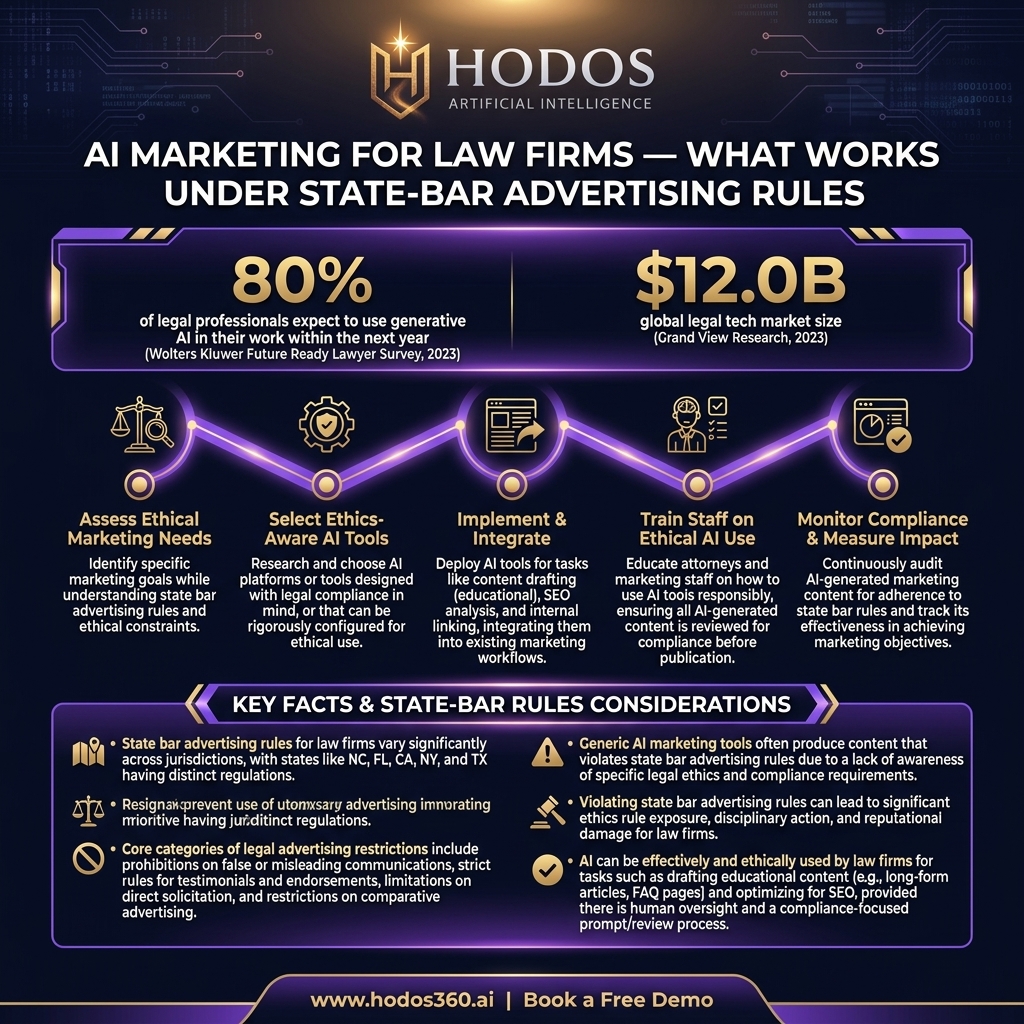
Done well, this stack saves the marketing-content equivalent of one full-time content marketer per firm — articles, social posts, email sequences, and ad copy at a quality and volume that solos and small firms previously couldn't reach.
Where to be careful — the categories that go wrong
Three categories of AI marketing output need explicit guardrails for legal use.
First: outcome claims. AI loves writing 'we'll win your case' or 'guaranteed compensation.' These are direct violations in most states. The fix is a system-prompt-level rule banning result-implying language and a human review step before publication. We use a check that flags a list of words/phrases (won, guaranteed, recovered, recovery, settlement amounts) for human review before any content goes live.
Second: testimonials and case studies. Many states require specific disclaimers ('past results do not guarantee similar outcomes'), prohibit certain framings, or limit how testimonials can be used. AI doesn't know which state's rules apply to your audience. The fix: maintain a state-specific testimonial template library that AI can pull from, with the right disclaimers built in. Don't let AI generate testimonial content from scratch.
Third: 'specialist' / 'expert' / 'top' claims. Many states restrict these to attorneys with formal specialty certification (NC, for example, has a rigorous board certification process). AI freely uses 'specialist' as a synonym for 'experienced.' The fix: ban 'specialist,' 'expert,' 'top,' 'best,' and certain other terms via system prompt unless the lawyer actually holds the certification that justifies the claim.
The right setup for a small firm
Most solos and small firms don't need a sophisticated marketing automation stack. Three layers cover most of what matters.
- ✓Content layer — AI-assisted drafting of practice-area pages, FAQ pages, and 1–2 blog posts per month, with explicit state-bar compliance prompts and human review
- ✓Distribution layer — automation that takes each long-form piece and produces LinkedIn, Instagram, and one short-form video version, scheduled with consistent cadence
- ✓Conversion layer — landing pages tied to ad campaigns and a CRM (GoHighLevel, HubSpot, Clio Grow) that captures leads and delivers them to intake within minutes
Every piece in this stack should be ethics-aware by default. If a vendor tells you their tool 'works for any industry,' assume the legal-specific guardrails are missing and you'll need to add them yourself.
What we built
Hodos360's AI marketing product ships with NC, FL, and a handful of other state-bar advertising rules baked in as system-prompt constraints. The platform refuses to generate banned phrasing, flags borderline content for review, and ships state-specific disclaimers in testimonials and case-study copy automatically. We built it because we ran the off-the-shelf alternatives at Vasquez Law Firm for six months and ended up reviewing every piece of content manually anyway. Better to encode the rules once than catch them on every output.