


Law Firm Return on Investment: Maximize AI in 2026
The legal landscape is undergoing a profound transformation, driven by the relentless march of artificial intelligence. As Legalweek 2026 convenes, a central theme reverberates through its halls: 'Identifying Law Firm Return on Investment in AI.' This isn't merely a discussion about adopting new tools; it's a forensic examination of how technology translates into tangible value, efficiency gains, and ultimately, enhanced profitability for legal practices of all sizes.
The question is no longer *if* AI will impact your firm, but *how* strategically you are leveraging it to secure a competitive edge and demonstrable Law Firm Return on Investment in AI.
For far too long, technology adoption in law firms has been viewed as a necessary expenditure, often without a clear framework for measuring its direct impact on the bottom line.
However, the current generation of AI solutions demands a more rigorous approach. Firms that merely 'dabble' in AI risk falling behind those that meticulously integrate and optimize it, turning innovative tools into strategic assets. The competitive legal market of 2026 demands not just innovation, but quantifiable results.
This comprehensive guide will dissect the multifaceted nature of AI ROI, offering a roadmap for legal professionals to not only understand but actively engineer success from their AI investments. We'll explore how to move beyond anecdotal evidence to concrete metrics, ensuring every AI initiative contributes meaningfully to your firm's growth and operational excellence.
The Imperative of AI ROI in the 2026 Legal Market
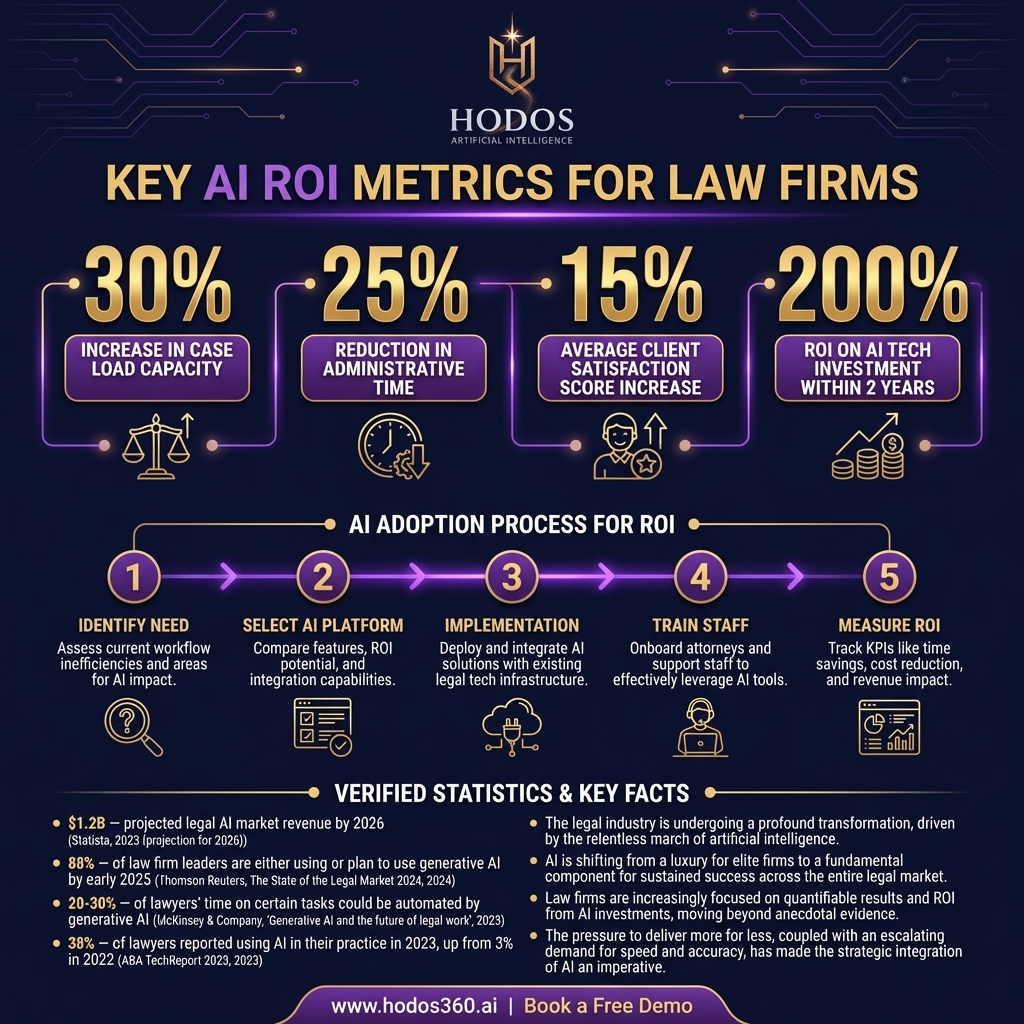
The discussions at Legalweek 2026 have underscored a critical shift: AI is no longer a luxury for elite firms but a fundamental component for sustained success across the entire legal market. The pressure to deliver more for less, coupled with an escalating demand for speed and accuracy, has made the strategic integration of AI an imperative.
However, the initial investment in cutting-edge legal technology can be significant, prompting a natural and necessary query from managing partners: what is the true Law Firm Return on Investment in AI? This question moves beyond simple cost-benefit analyses, delving into the long-term strategic advantages that AI confers, such as enhanced client satisfaction, improved attorney well-being, and the capacity to scale operations without commensurate increases in overhead.
As the legal profession grapples with evolving client expectations and the complexities of modern litigation, AI emerges as a powerful ally. According to a 2025 report by Thomson Reuters, firms that have strategically invested in AI solutions for document review, legal research, and case management have reported an average increase in operational efficiency by 25-30% within 18 months of implementation.
This isn't just about saving hours; it's about reallocating highly skilled legal talent to higher-value tasks, fostering innovation, and enhancing the overall quality of legal services Learn more about Revolutionizing Legal Intake: Multilingual AI Voice Agents for Law Firms. The competitive landscape demands that firms not only embrace AI but also meticulously track its performance, ensuring that every technological advancement contributes directly to measurable business objectives.
Failing to identify and optimize this return on investment risks not just stagnation, but a significant erosion of market share. Strategic legal AI adoption is no longer optional; it's foundational to future growth.
Deconstructing AI's Value: Beyond Cost Savings
While cost savings are an undeniable benefit of AI, particularly in automating repetitive tasks, the true Law Firm Return on Investment in AI extends far beyond simple reductions in operational expenditure. AI's value proposition is multifaceted, impacting revenue generation, risk mitigation, and the overall strategic positioning of a firm.
Consider the power of predictive analytics in litigation, where AI models can analyze vast datasets of past cases to forecast outcomes, inform settlement strategies, and identify potential risks with unprecedented accuracy. This capability transforms legal strategy from reactive to proactive, leading to better client outcomes and a stronger reputation for the firm.
Moreover, AI-powered marketing platforms can identify high-potential leads, optimize client acquisition channels, and personalize outreach, directly contributing to revenue growth rather than merely cutting costs.
Intangible benefits, while harder to quantify immediately, often represent the most profound long-term returns. Enhanced attorney satisfaction, for instance, stems from offloading mundane administrative tasks, allowing legal professionals to focus on complex legal reasoning and client interaction—the very core of their expertise Learn more about FirmPilot AI's $22M Boost: What It Means for Your Legal Marketing Strategy.
This leads to reduced burnout, improved morale, and better talent retention, crucial factors in a competitive industry. Furthermore, AI's ability to ensure consistency and accuracy across legal documents and processes significantly reduces the risk of errors, malpractice claims, and compliance breaches. This risk mitigation, while not directly generating revenue, protects the firm’s financial health and reputation.
The Law.com article from Legalweek 2026 rightly points out that identifying ROI requires looking beyond the ledger and into the strategic advantages AI creates, distinguishing between the immediate financial impact and the enduring value that reshapes a firm’s capabilities and market standing.
Tangible vs. Intangible Benefits
Tangible benefits of AI are often the easiest to measure: reduced hours spent on document review, faster contract drafting, lower administrative overhead, and increased client intake capacity. For example, AI-powered legal research can cut research time by up to 70%, allowing attorneys to complete more cases or dedicate more time to complex strategic analysis.
Similarly, AI-driven billing and case management systems reduce billing errors and accelerate payment cycles, improving cash flow. These direct, quantifiable improvements are crucial for demonstrating immediate Law Firm Return on Investment in AI and securing buy-in for further technological adoption. They provide the bedrock for financial justification, showing how AI directly impacts the firm's profitability and operational efficiency.
However, the intangible benefits often unlock the greatest long-term value. These include improved client satisfaction due to faster service and more accurate advice, enhanced data security through AI-driven anomaly detection, and a stronger firm culture fostered by innovation Learn more about Legal AI Voice Assistants: Transforming Law Firms 2026.
A firm known for its cutting-edge technology and efficient processes attracts higher-caliber talent and more discerning clients. The ability to offer 24/7 client support through AI voice assistants, for instance, significantly elevates the client experience, building loyalty and generating positive referrals. While these benefits don't appear as direct line items on a balance sheet, they contribute immensely to a firm's brand equity, competitive advantage, and sustainable growth, ultimately leading to a more robust and resilient practice.
Understanding this dual nature of AI benefits is key to a holistic assessment of its ROI.
Strategic Pillars for Maximizing AI Investment
Maximizing the Law Firm Return on Investment in AI requires a strategic, systematic approach, not merely a piecemeal adoption of tools. The most successful firms are those that integrate AI into their core operations, aligning technology with overarching business goals. This begins with a clear understanding of current pain points and identifying specific areas where AI can deliver the most significant impact.
Is it client intake bottlenecks? Document review inefficiencies? Or perhaps challenges in identifying profitable marketing channels? Pinpointing these areas allows for targeted AI implementation, ensuring that resources are allocated where they will yield the highest return. Without a well-defined strategy, AI investments can become fragmented, yielding suboptimal results and failing to demonstrate their full potential.
Effective change management is another critical pillar. Introducing AI into a law firm requires not just technological integration but also a cultural shift Learn more about AI Legal Tech: Navigating 2026's AI Adoption Pressure. Attorneys and staff need to be trained, supported, and engaged throughout the process.
Resistance to new technology is natural, but it can be mitigated through transparent communication, demonstrating the benefits to individual roles, and providing comprehensive training. Firms that invest in upskilling their workforce to work alongside AI, rather than viewing AI as a replacement, will unlock greater value.
This collaborative approach fosters an environment where human expertise is augmented by AI, leading to superior outcomes and a more adaptable practice. The goal is to create symbiotic workflows where AI handles the data-intensive, repetitive tasks, freeing human professionals for nuanced judgment, strategic thinking, and client relationship building.
Data-Driven Implementation & Metrics
To truly measure Law Firm Return on Investment in AI, firms must embrace a data-driven approach to implementation and ongoing performance monitoring. This means establishing clear Key Performance Indicators (KPIs) *before* deploying any AI solution. These KPIs should be directly linked to the identified pain points and desired outcomes.

For instance, if the goal is to improve client intake efficiency, metrics might include time from initial contact to retainer, conversion rates of qualified leads, or reduction in manual data entry errors. For document automation, KPIs could be drafting time saved, accuracy rates, or compliance adherence.
Regular monitoring of these metrics allows firms to assess the effectiveness of their AI tools, identify areas for optimization, and quantify the tangible benefits.
Moreover, firms should leverage the analytical capabilities of AI itself to track and report on ROI Learn more about AI Adoption: Transformative Playbook for Law Firms in 2026.
Modern AI-powered legal management systems often include robust analytics dashboards that provide real-time insights into operational performance, financial health, and client engagement. This continuous feedback loop is essential for refining AI strategies and ensuring that investments continue to yield maximum value. Without precise data, firms are essentially operating in the dark, unable to articulate the specific impact of their AI initiatives.
The ABA's Model Rule 1.1 on Competence implicitly suggests that attorneys must keep abreast of changes in the law and its practice, including the benefits and risks associated with relevant technology, reinforcing the need for data-driven adoption and evaluation.
- ✓Increased Case Load Capacity: Measure the percentage increase in cases handled per attorney or paralegal without increasing headcount, directly attributable to AI automation.
- ✓Reduced Administrative Overhead: Quantify the reduction in staff hours spent on non-billable administrative tasks (e.g., scheduling, data entry, document filing) through AI-powered workflows.
- ✓Accelerated Billing & Collections: Track improvements in billing cycle times, reduction in accounts receivable days, and fewer billing disputes due to AI-assisted invoicing and expense tracking.
- ✓Enhanced Client Conversion Rates: Monitor the percentage of leads qualified and converted into clients using AI marketing tools and AI voice assistants for initial engagement.
- ✓Improved Document Accuracy & Compliance: Measure reduction in errors in contracts, briefs, and other legal documents, alongside improved adherence to regulatory requirements, minimizing rework and risk.
- ✓Time Savings in Legal Research & Review: Calculate the hours saved by attorneys on research and document review tasks using AI tools, allowing reallocation to strategic work.
- ✓Client Satisfaction Scores: Monitor improvements in client feedback related to responsiveness, speed of service, and ease of communication, often facilitated by AI-powered client portals and assistants.
Navigating the AI Landscape: Challenges & Solutions
While the promise of Law Firm Return on Investment in AI is compelling, the path to achieving it is not without its challenges. One of the primary concerns for legal professionals is data privacy and security. Handling sensitive client information with AI requires robust encryption, stringent access controls, and adherence to evolving data protection regulations like GDPR and CCPA.
Firms must carefully vet AI vendors to ensure their platforms meet the highest security standards and comply with all relevant legal and ethical guidelines. Furthermore, the ethical implications of AI, particularly concerning bias in algorithms or the potential for AI to 'practice law' without human oversight, demand careful consideration.
The ABA Standing Committee on Ethics and Professional Responsibility consistently issues guidance on these evolving issues, emphasizing the attorney's duty to supervise and ensure ethical use of technology.
Another significant hurdle is the initial cost of implementation and the complexity of integrating new AI systems with existing legacy infrastructure.
Many law firms operate on a patchwork of older software, making seamless integration a daunting task Learn more about AI Voice Assistants: Revolutionizing Law Firm Client Engagement & Growth. This is where strategic planning and choosing comprehensive, integrated platforms become crucial. The 'rip and replace' approach is often impractical; instead, firms should seek AI solutions designed for modular integration and scalability.
Additionally, the rapid pace of AI development means firms must commit to continuous learning and adaptation. What is cutting-edge today may be standard tomorrow, necessitating ongoing investment in training and system upgrades to maintain a competitive edge. Overcoming these challenges requires foresight, a commitment to due diligence, and a willingness to invest in both technology and human capital.
Overcoming Adoption Hurdles
Overcoming adoption hurdles for AI in law firms primarily revolves around addressing skepticism, fear of job displacement, and the learning curve associated with new technologies. A common solution is to involve attorneys and staff early in the selection and implementation process. Pilot programs with engaged teams can demonstrate AI's practical benefits firsthand, turning skeptics into advocates.
Focusing on how AI augments human capabilities rather than replaces them is key. For instance, explaining how AI-powered document automation frees up paralegals from tedious formatting, allowing them to focus on more substantive legal support, can significantly boost buy-in. Training should be ongoing, accessible, and tailored to different roles within the firm, ensuring everyone from administrative staff to senior partners feels comfortable and proficient with the new tools.
Moreover, selecting user-friendly, intuitive AI platforms can drastically reduce the learning curve. Technology that is complex or difficult to navigate will inevitably face resistance. Firms should prioritize solutions that offer clear interfaces, robust support, and seamless integration into existing workflows. The goal is to make AI a natural extension of daily tasks, not an additional burden.
Emphasizing the competitive advantage that comes from early and effective AI adoption – such as increased efficiency, better client service, and enhanced profitability – can also motivate teams. By strategically managing expectations, providing ample support, and showcasing tangible benefits, law firms can successfully navigate and overcome the common adoption hurdles, solidifying their Law Firm Return on Investment in AI.

HODOS 360: Your Partner in Achieving Unprecedented AI ROI
At HODOS 360, we understand that achieving a significant Law Firm Return on Investment in AI isn't just about having advanced technology—it's about strategic implementation and measurable impact. Our comprehensive AI-powered platform is engineered to address the core challenges law firms face in 2026, providing integrated solutions that drive efficiency, enhance client engagement, and accelerate growth.
Our AI Law Firm Management System, for instance, streamlines everything from case management and billing to client intake and document automation. By automating repetitive legal workflows and providing intelligent insights, it dramatically reduces administrative burden, allowing your legal team to focus on high-value, billable work, directly translating into higher profitability and a clear ROI.
Beyond internal operations, HODOS 360 empowers your firm to dominate the digital landscape. Our AI Marketing Platform leverages cutting-edge AI for video creation, social media automation, and content generation, ensuring your firm's message reaches the right audience at the right time. With built-in analytics and ROI tracking, you can precisely measure the effectiveness of your marketing spend, optimizing campaigns for maximum client acquisition.
Imagine the impact of consistent, high-quality content and targeted social engagement, all managed with AI precision. This strategic advantage in marketing is a direct driver of increased lead generation and client conversion, offering a measurable boost to your firm's revenue and securing a strong Law Firm Return on Investment in AI.
Client experience is paramount in today's competitive legal market, and HODOS 360’s AI Voice Assistants are designed to deliver unparalleled service. Providing 24/7 phone answering, intelligent lead qualification, and seamless appointment booking, these assistants ensure no potential client is missed and every inquiry is handled promptly and professionally.
Multilingual support further expands your reach, while smart call routing ensures clients connect with the right department every time. This not only enhances client satisfaction and loyalty but also frees up valuable staff time, allowing them to focus on substantive legal work rather than administrative calls.
The efficiency gained and the improved client perception contribute significantly to your overall firm value and long-term Law Firm Return on Investment in AI.
Finally, HODOS 360's Web & Mobile Development services ensure your firm presents a modern, professional, and highly effective digital storefront. With AI-powered website building, responsive design, and robust SEO optimization, your firm will stand out online, attracting more qualified leads.
Our high-converting templates are designed with the legal client journey in mind, transforming visitors into prospects. By integrating these services with our AI Law Firm Management and Marketing platforms, HODOS 360 offers a truly holistic solution. We equip your firm with the tools to not only measure but actively maximize your Law Firm Return on Investment in AI, propelling you towards unparalleled success in the evolving legal market of 2026. Ready to transform your firm?
Book a free demo with HODOS 360 today!
Frequently Asked Questions
What specifically constitutes 'Law Firm Return on Investment in AI'?+
Law Firm Return on Investment in AI refers to the measurable benefits a firm gains from its AI technology investments. This includes tangible outcomes like increased operational efficiency, reduced costs, and higher revenue, as well as intangible benefits such as improved client satisfaction, enhanced data security, and better attorney work-life balance. It's about quantifying how AI contributes to the firm's strategic objectives and bottom line.
How can HODOS 360 help my firm measure its AI ROI?+
HODOS 360's integrated platform provides robust analytics across all services. Our AI Law Firm Management System tracks efficiency gains in case management, billing, and document automation. The AI Marketing Platform offers detailed ROI tracking for campaigns, while our Web & Mobile Development includes SEO analytics. These tools provide the data needed to quantify the impact of AI on your firm's operations and profitability.
What are the most common challenges in implementing AI for ROI, and how can they be overcome?+
Common challenges include data privacy concerns, integration with legacy systems, high initial costs, and user adoption resistance. Overcoming these involves thorough due diligence in vendor selection, strategic phased implementation, comprehensive staff training, and emphasizing AI as an augmentation tool. HODOS 360 addresses these with secure, integrated solutions and dedicated support to ensure smooth adoption.
Is AI Law Firm Return on Investment relevant for small and mid-sized firms?+
Absolutely. AI ROI is arguably even more critical for small and mid-sized firms, as they often have tighter budgets and need to maximize every investment. AI can level the playing field by providing access to sophisticated capabilities (like advanced analytics or 24/7 client support) previously only available to larger firms, enabling significant efficiency gains and competitive advantages without extensive overhead.
How does AI impact client relationships and satisfaction?+
AI significantly enhances client relationships by improving responsiveness, efficiency, and personalization. AI voice assistants offer 24/7 support and quick lead qualification, ensuring clients feel valued. Document automation speeds up processes, delivering faster service. AI-powered marketing allows for more targeted and relevant communication. These improvements lead to higher client satisfaction, stronger loyalty, and positive referrals, directly contributing to long-term firm growth.