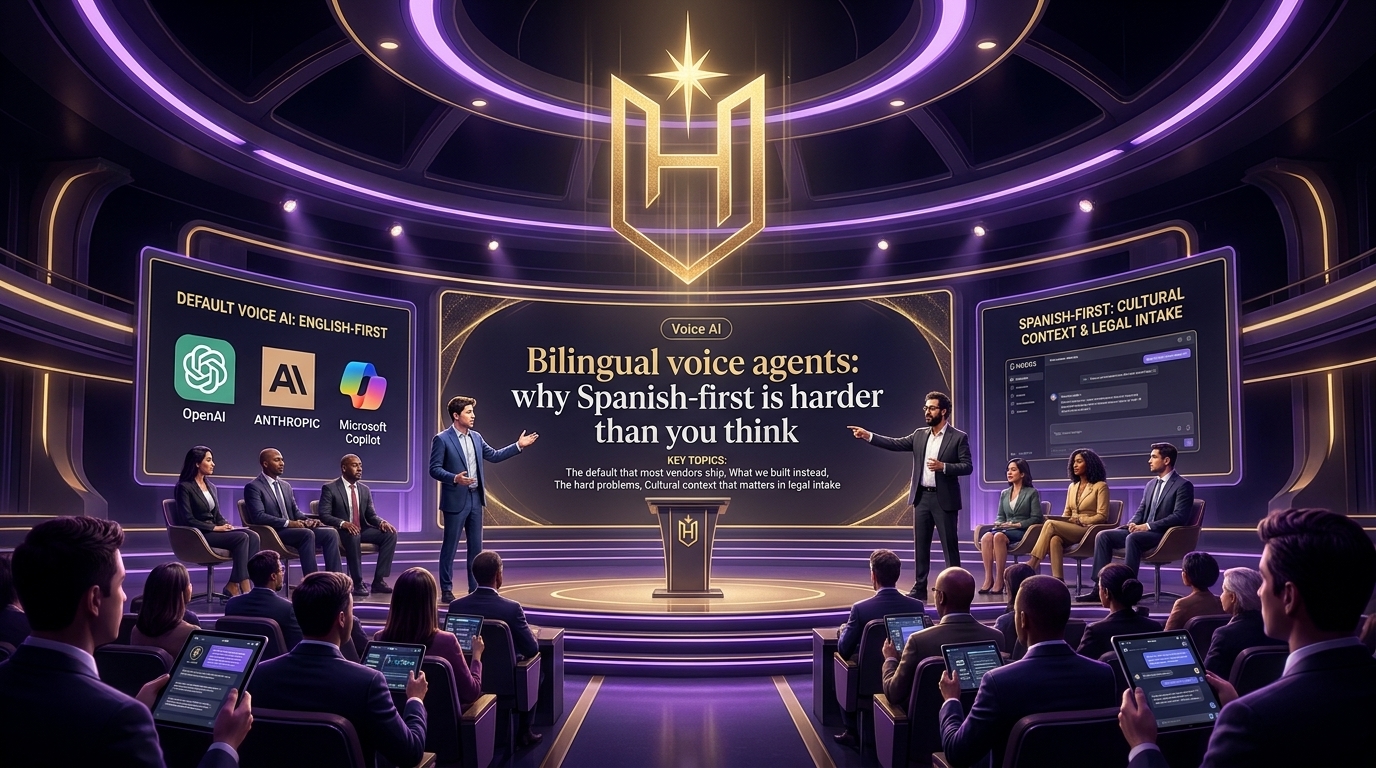


The bilingual law-firm market: where the biggest legal intake gap actually is
I run Vasquez Law Firm in North Carolina and Florida. Roughly half of our inbound calls are in Spanish. When we evaluate AI receptionist products, the gap between vendors' marketing and what actually works for bilingual callers is wider than I expected. This is a market analysis from the inside — what bilingual law-firm intake really requires, why most vendors get it wrong, and where the opportunity is for solos and boutique firms serving Hispanic communities.
The market that gets undercounted
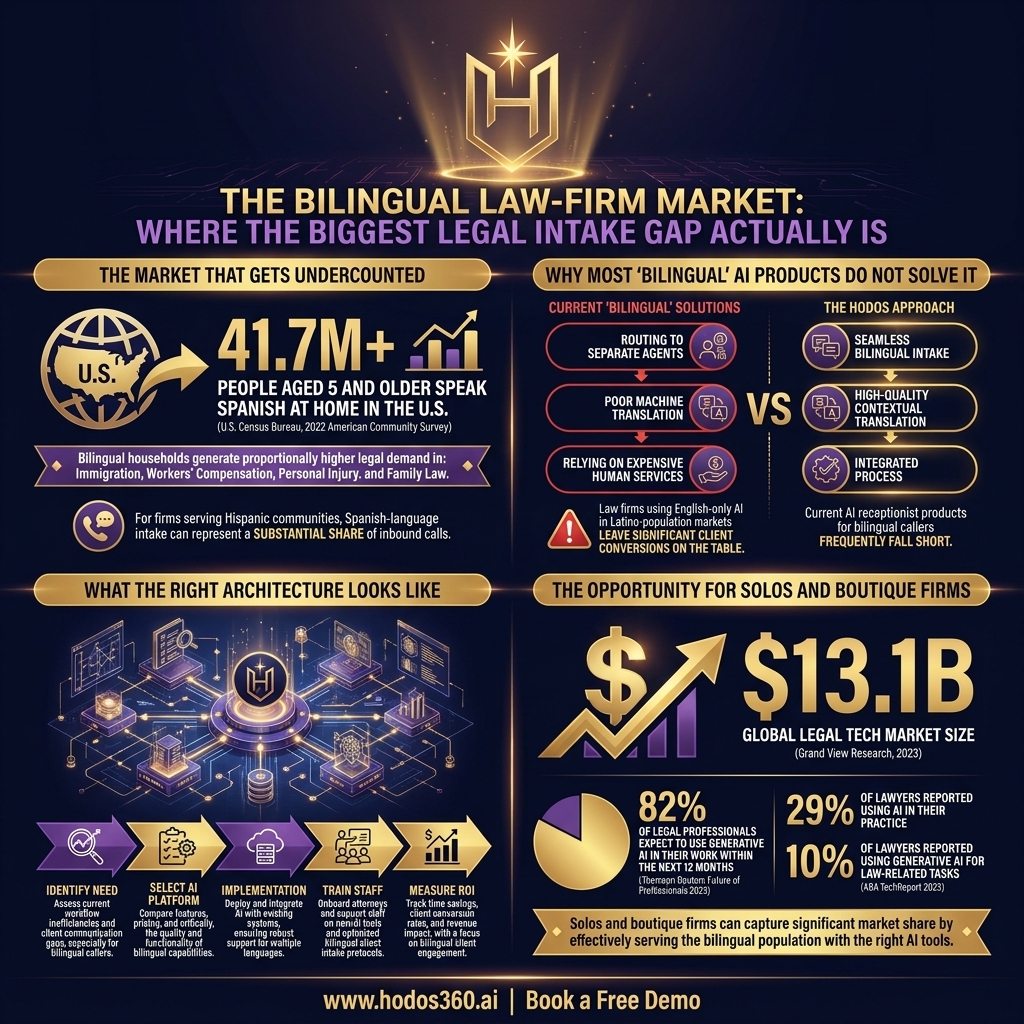
The U.S. Census Bureau pegs the Spanish-speaking-at-home population at over 41 million. That number alone undersells the legal-intake demand. Bilingual households generate proportionally more legal demand in immigration (visa categories, removal defense, naturalization), workers' compensation (blue-collar work disproportionately Hispanic in many states), personal injury (high MVA exposure), and family law. The intake demand is not just 'Spanish-as-an-option' for these firms — it is a substantial share of inbound calls, in some markets the majority.
What this means in practice: a firm in Charlotte, Orlando, Houston, Phoenix, or any Latino-population market that ships English-only AI is leaving conversion on the table. Not at the margins — at scale. The lift from doing bilingual right is in the same ballpark as the lift from any of the other AI investments firms make this year.
Why most 'bilingual' AI products do not solve it
If you evaluate three AI receptionist vendors right now, you'll typically see one of three patterns. (1) English-first product with a Spanish-language option that routes to a separate agent — the caller gets sent to a queue, has to repeat themselves, and conversion drops at the hand-off. (2) Same-agent Spanish that's machine-translated from the English prompt — sounds robotic, sometimes wrong, and Hispanic callers can hear the difference within the first sentence. (3) Bilingual receptionist services with humans, which work but cost a multiple of AI pricing and don't scale to 24/7 without staffing premiums.
None of these are bad products in their respective lanes. But none of them solve the actual problem of bilingual law-firm intake, which is: a Spanish-speaking caller who calls at 9pm with an immigration question wants the same intake quality as the English-speaking caller who calls at 10am. Same agent. Same context. Same depth of qualification. Code-switching handled gracefully when it happens (which is often — many bilingual callers mix languages mid-call).
What the right architecture looks like
We landed on three architectural decisions that mattered. First: language is a property of the matter, not a routing branch. The agent detects the caller's language preference and continues in that language for the entire call, sharing all conversation context. Second: Spanish prompts are written in Spanish, not translated. Idioms, register, and qualification phrasing are native — and reviewed by a Spanish linguist (in our case, the founder). Third: recognition is tuned for the regional Spanish variants in the actual caller base — Caribbean, Mexican, Central American, Andean — with custom vocabulary biasing for Hispanic given names, surnames, and immigration form numbers.
These decisions are not subtle technically, and they don't show up on a marketing page comparison chart. They surface in production: the agent gets names right on the first try, follows code-switching without a hiccup, and converts Spanish callers at rates similar to English callers. Without these decisions, Spanish caller conversion sits visibly below English. We watched it happen in our first version before we tuned for our actual market mix.
The opportunity for solos and boutique firms
Big firms with national marketing budgets typically aren't bilingual-specific. They optimize for volume in English and treat Spanish as a side feature. That leaves the bilingual market structurally underserved by the firms with the biggest marketing reach. Solos and boutiques with bilingual operators are positioned to win disproportionately if they get the AI tooling right.
The economics work. Bilingual humans cost roughly $48,000–$72,000 per year per office for 24/7 coverage; bilingual AI runs at per-minute pricing that's 5–10× cheaper at typical legal-firm volumes. The savings free up capacity for marketing into Hispanic markets, where ad costs are often lower than English-language equivalents and the message-fit is better. Compounding effect over 12–18 months: more Spanish callers reached, better conversion of those callers, more matters retained, more marketing budget available, repeat.
What to evaluate when picking a bilingual AI
- ✓Same-agent Spanish (not a separate routing branch) — verify on a live test call
- ✓Native Spanish prompts (not machine-translated) — ask the vendor who wrote them
- ✓Regional accent handling tuned to your specific market mix
- ✓Custom vocabulary biasing for Hispanic names + immigration form numbers
- ✓Code-switching support — try a test call mixing English and Spanish mid-conversation
- ✓Per-minute pricing, not call-based — bilingual matters tend to be longer; per-call pricing distorts incentives
If a vendor cannot demonstrate any one of these on a live test call, they are not the right fit for a bilingual practice. Marketing copy lies; live calls don't.