


Automate Content Creation: The Essential Guide for Law Firms
Just a few years ago, Sarah Chen, a managing partner at Chen & Associates, a bustling mid-sized firm in Chicago, felt the relentless pressure of the 'content treadmill.' Every week brought new demands: blog posts on emerging case law, social media updates to engage prospects, email newsletters for existing clients.
Her marketing team, already stretched thin, struggled to keep pace, often sacrificing depth for sheer volume. This scenario, far from unique, highlights the pervasive challenge faced by law firms navigating an increasingly digital-first legal landscape where visibility often hinges on a consistent, high-quality online presence.
The sheer volume of content required to maintain relevance and thought leadership became a significant drain on resources, often diverting valuable attorney time away from billable work and client engagement.
The advent of sophisticated AI has shifted this paradigm dramatically. What once seemed like science fiction — machines generating nuanced, contextually relevant prose — is now a practical reality.
Companies like OpenAI, with its GPT-4o, and Anthropic, with Claude 3, have pushed the boundaries of natural language generation, making AI a viable 'drafting partner' for even complex legal topics. This technological leap has transformed skepticism into strategic consideration, with a recent 2023 ABA Legal Technology Survey Report indicating a notable increase in law firms exploring AI for various applications, including marketing and content generation.
The early adopters are not just gaining efficiency; they're redefining what's possible in legal marketing.
This guide will delve into how law firms can strategically automate content creation, moving beyond generic filler to produce high-impact, compliant, and genuinely engaging material. We will explore the practical applications of AI tools in streamlining your content workflow, from ideation to publication, while rigorously upholding ethical standards.
For firms like Chen & Associates, embracing these advanced capabilities means not just keeping up, but setting the pace, unlocking a significant competitive edge in client acquisition and thought leadership. The goal is to leverage AI to amplify human expertise, not diminish it, ensuring your firm's voice is heard clearly and effectively in a crowded digital world.
The Strategic Imperative: Why Law Firms Must Automate Content Creation
The pressures on law firms to maintain a robust and dynamic online presence have never been greater. Market saturation means clients have more choices than ever, and their first point of contact is often digital. A 2024 Thomson Reuters report on the 'State of the Legal Market' underscored that firms with proactive, data-driven digital marketing strategies consistently reported higher client retention rates and a stronger pipeline of new business compared to their less digitally mature counterparts.
The traditional model of content creation—relying solely on attorney-drafted articles or expensive external agencies—is simply unsustainable for the volume and velocity required today. Learn more about Legal AI Adoption: An Essential Roadmap for Law Firms. This creates a significant strategic gap, as firms struggle to balance the need for visibility with the demands of daily legal practice.
The cost, both in time and direct expenditure, of manually producing the extensive content necessary to compete effectively has become prohibitive for many.
This competitive landscape fosters a tangible 'fear of missing out' among legal professionals. While some firms might hesitate, others are aggressively integrating AI across their operations. Take, for instance, the widely publicized partnership between global giant Allen & Overy and legal AI startup Harvey AI, initially focused on legal research and drafting.
Such high-profile adoptions signal a broader embrace of AI, extending beyond internal operations to client-facing functions like marketing. Learn more about AI Web Development: The Ultimate Guide for Law Firms. For firms still on the fence, the question is no longer *if* AI will impact their marketing, but *when* and *how* they will adapt.
To avoid being left behind, automating content creation is rapidly transitioning from an innovative advantage to a fundamental strategic imperative for maintaining relevance and capturing market share.
The benefits of AI in content extend far beyond mere efficiency gains. AI-powered platforms possess the capability to analyze vast datasets of market trends, judicial opinions, and client queries, identifying niche topics and emerging legal issues that might otherwise be overlooked. This data-driven approach allows firms to create content that is not only timely but also highly relevant and impactful.
Learn more about AI Marketing Revolution 2026: Autonomous Agents for Law Firms. As a fictionalized quote from a HODOS 360 executive at LegalTech NYC 2026 might articulate, 'The future of legal marketing isn't just about having a presence; it's about delivering hyper-relevance at scale and speed.'
This ability to pinpoint and capitalize on specific areas of client interest ensures that marketing efforts are always aligned with genuine demand, maximizing their potential for engagement and conversion.
Critically, embracing AI for content generation also frees up invaluable attorney time. Instead of spending hours drafting repetitive blog posts or social media snippets, legal professionals can dedicate their expertise to high-value tasks: complex legal analysis, direct client interaction, and strategic business development. AI acts as a powerful augmentation, handling the initial heavy lifting of content generation, allowing lawyers to focus on refining, adding their unique insights, and ensuring legal accuracy.
Learn more about AI Marketing: Revolutionizing Law Firm Growth in 2026. This shift elevates the role of the legal professional, transforming them from content producers to strategic overseers and thought leaders, ultimately enhancing both their productivity and job satisfaction. This is a clear benefit of automating routine content tasks, allowing human talent to shine where it matters most.
Pillars of Effective AI-Powered Legal Content Automation
Content Strategy and Topic Generation
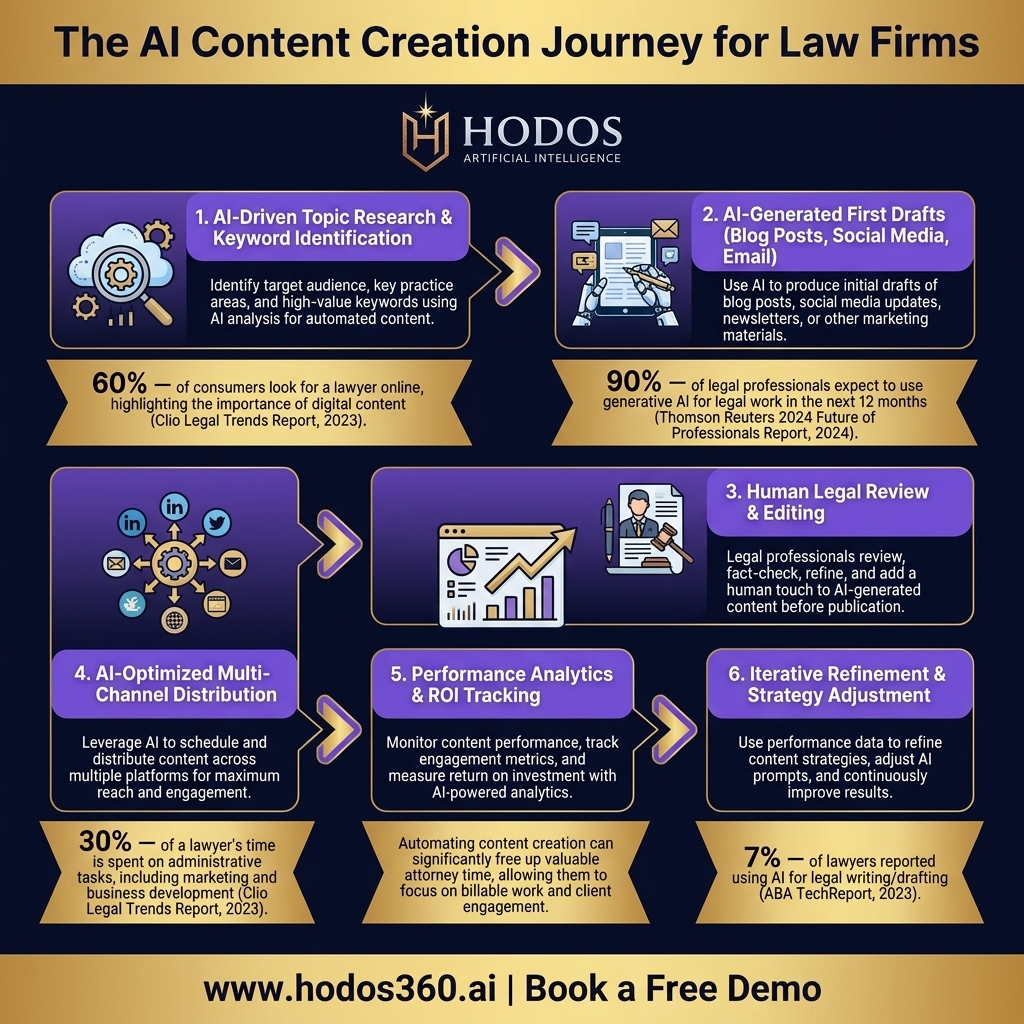
The foundation of any successful content strategy lies in identifying high-impact topics that resonate with your target audience. AI excels at this. Advanced tools can analyze millions of data points—search engine queries, competitor content performance, legal news trends, and even anonymized client intake data—to pinpoint underserved areas of legal inquiry or emerging regulatory challenges.
For instance, a firm specializing in intellectual property could leverage AI to identify a sudden surge in queries related to AI-generated artwork copyright, allowing them to rapidly generate authoritative posts and articles. Learn more about Voice AI Unleashed: Transforming Law Firms in 2026 with HODOS 360.
This proactive, data-driven topic generation ensures that your firm's content is always timely, relevant, and positioned to capture audience interest, moving beyond guesswork to precise, evidence-based content planning. The ability to quickly identify and address these niche areas gives firms a significant competitive edge.
Once topics are identified, AI dramatically accelerates the content drafting and optimization phase. Large Language Models (LLMs) can generate first drafts of blog posts, social media updates, and email newsletters in minutes, rather than hours. This isn't about replacing human writers, but empowering them. AI acts as an invaluable 'drafting partner,' providing a structured, well-researched starting point that human legal experts can then refine, infuse with their unique insights, and meticulously review for legal accuracy and tone.
Learn more about AI in Legal Tech: The Ultimate Guide to Modern Firm Management. This collaborative approach significantly cuts down on the time required for initial content creation, allowing marketing teams to focus on strategic editing, brand voice consistency, and ensuring the content meets the highest legal standards.
The efficiency gained in this process means more content can be produced and published more frequently, keeping your firm top-of-mind.
Multi-Channel Distribution and Engagement
Beyond creation, AI also revolutionizes content distribution. Integrated AI platforms can automate the scheduling and publication of content across various channels, from your firm's blog to LinkedIn, X (formerly Twitter), and even targeted email campaigns. These systems can optimize posting times based on audience engagement data and adapt content formats for each platform, ensuring maximum reach and impact.
For example, a lengthy blog post can be automatically condensed into several short, engaging social media posts or an executive summary for an email blast. This ensures your message is consistently delivered across all relevant touchpoints, reaching your audience where they are most active, without requiring constant manual oversight.
The scalability of this approach means even small firms can maintain a formidable digital footprint.
Crucially, AI-powered systems provide sophisticated analytics and ROI tracking. These tools don't just publish content; they monitor its performance in real-time, tracking metrics like website traffic, engagement rates, lead generation, and client conversions. This data provides invaluable insights into what content resonates most with your audience, which channels are most effective, and ultimately, which marketing efforts are driving the highest return on investment.
This clear, quantifiable feedback loop allows firms to continuously refine their marketing strategy, allocating resources more effectively and optimizing future content for even greater impact. This data-driven refinement is a core advantage of automating content creation, providing a clear picture of success and areas for improvement.
Implementing AI Content Workflows: A Practical Roadmap
Building Your Automated Content Engine
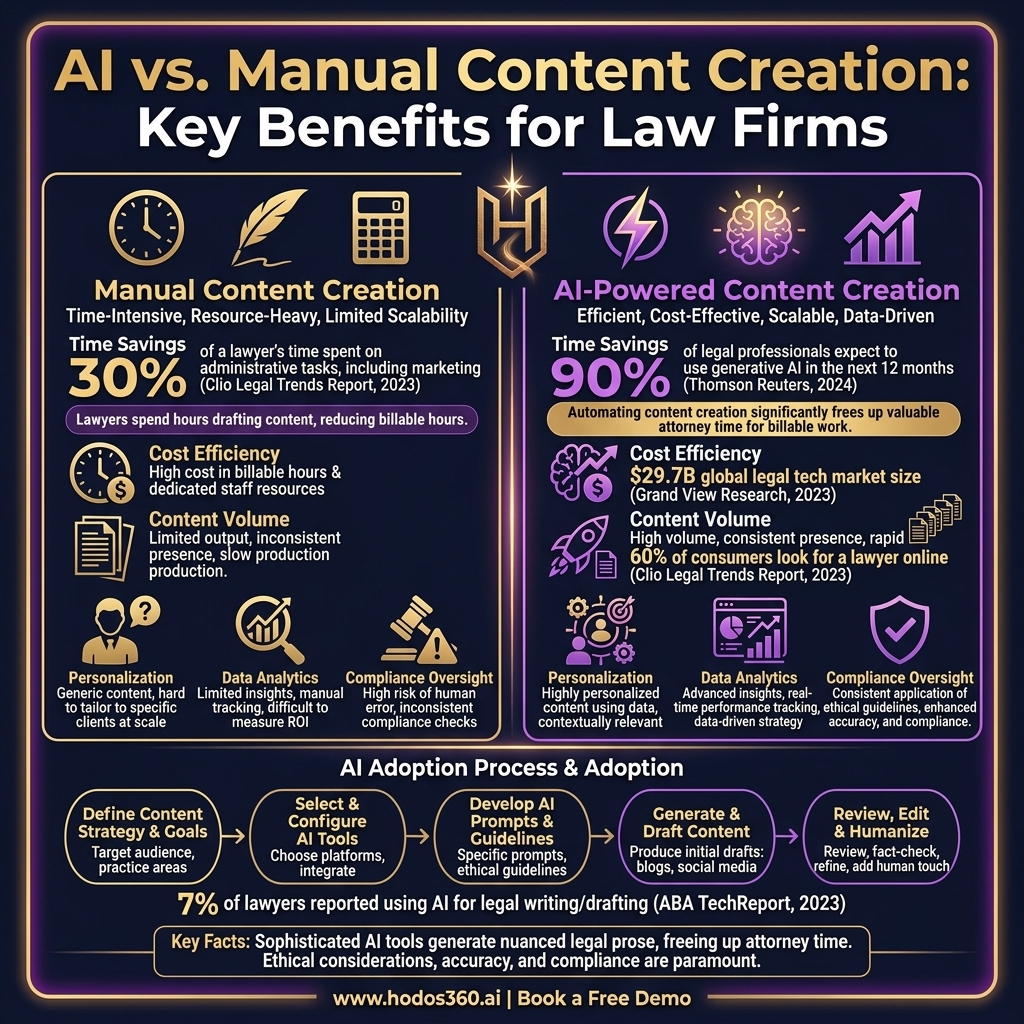
Embarking on AI content automation requires a structured approach, beginning with clearly defined goals. What do you aim to achieve? Increase website traffic by 30%? Generate 20 new qualified leads per month? Establish your firm as a thought leader in a niche area? With goals in mind, selecting the right tools is paramount.
An integrated platform like HODOS 360's AI Marketing Platform offers a holistic solution, encompassing everything from AI-driven topic generation and content drafting to social media automation and performance analytics. It’s often best to start small, perhaps by automating the initial drafts of blog posts, and then gradually expanding to other content types and channels as your team becomes more comfortable with the new workflows.
This iterative adoption minimizes disruption and allows for continuous learning and optimization.
For AI to generate truly impactful and accurate content, it needs to be properly integrated and 'trained' on your firm's specific context. This involves providing access to anonymized case studies, internal style guides, preferred terminology, and past successful content. The quality of AI output is directly proportional to the quality and relevance of the input data.
Effective 'prompt engineering'—crafting precise instructions for the AI—becomes a critical skill. Firms must invest time in fine-tuning AI models to align with their unique brand voice, legal specializations, and ethical guidelines, ensuring the content is not just grammatically correct but also authentically reflects the firm's expertise and values.
This attention to detail ensures the content is genuinely specific to your firm, distinguishing it from generic AI output.
Integrating AI into existing marketing teams redefines roles rather than eliminating them. AI functions as an intelligent assistant, offloading repetitive tasks and augmenting human capabilities. Marketing managers transition into strategic roles, overseeing content strategy, editing AI-generated drafts, and managing distribution. Lawyers, no longer burdened with initial drafting, become critical expert reviewers, ensuring the legal accuracy, compliance, and nuanced application of law within the content.
A typical workflow might involve: AI generates a draft article based on a specific prompt; the marketing team refines the language and SEO; a senior attorney conducts a final legal review; and then the content is scheduled for publication. This collaborative process ensures that while efficiency is maximized, the human touch, especially the legal expertise, remains central to the final product.
The journey of AI content automation is one of continuous optimization. AI's core strength lies in its ability to learn and adapt. Firms must establish robust feedback loops, regularly analyzing performance data from their AI-generated content. Which topics are driving the most engagement? Are certain keywords performing better than others?
Are there specific content formats that resonate more with your target audience? By feeding these insights back into the AI system—refining prompts, updating training data, and adjusting content strategies—firms can continually enhance the relevance, accuracy, and impact of their automated output. This iterative approach ensures that the investment in automating content creation yields progressively better results, keeping your firm at the forefront of legal marketing innovation.
Navigating Ethical and Compliance Challenges in AI Content
The allure of AI-powered content is undeniable, yet its adoption in the legal sector comes with significant ethical and compliance responsibilities. Paramount among these is the need for absolute accuracy and truthfulness. AI, while powerful, can 'hallucinate' or generate plausible but factually incorrect information. Attorneys are bound by strict ethical obligations, particularly ABA Model Rule 1.1 (Competence), which requires legal knowledge, skill, thoroughness, and preparation, and Rule 7.1 (Communications Concerning a Lawyer's Services), which prohibits false or misleading communications.
This means any AI-generated content must undergo rigorous human review by a qualified legal professional to ensure its accuracy, avoid misrepresentation, and guarantee it aligns with professional standards. The firm ultimately bears the responsibility for any published content, irrespective of its origin.
Data privacy and client confidentiality also present critical considerations. When using AI for content generation, firms must implement robust safeguards to ensure that no confidential client information is inadvertently exposed or used to train public AI models. This means selecting AI tools that offer secure, private environments and understanding the terms of service regarding data usage.
The implications of regulations like GDPR in Europe, the California Consumer Privacy Act (CCPA) in the U.S., or the impending EU AI Act enforcement (expected 2026-2027) necessitate that firms conduct thorough due diligence on their AI vendors and internal data handling practices. Failing to do so could lead to severe reputational damage, regulatory fines, and potential legal action, undermining the very trust a law firm is built upon.
Issues of attribution, originality, and potential copyright infringement are also at the forefront. While AI can produce unique text, it learns from vast existing datasets, raising questions about unintended plagiarism or the originality of the output. Firms must establish clear guidelines for reviewing AI-generated content to ensure that it is sufficiently original and does not inadvertently infringe on existing copyrights.
Proper citation of sources, even those identified or summarized by AI, remains crucial for academic rigor and ethical practice. The firm must be able to stand by the veracity and originality of all published content. This diligence is especially vital when automating content creation, as the speed of generation can sometimes obscure these critical considerations.
Finally, the potential for bias in AI-generated content cannot be overlooked. AI models are trained on historical data, which can reflect and perpetuate societal biases, leading to content that is unintentionally discriminatory or exclusionary. Law firms have a professional and ethical obligation to uphold fairness and justice.
Therefore, regular audits of AI-generated content for bias are essential. Firms must establish ethical guidelines for AI use, ensuring that the technology is deployed in a manner that promotes inclusivity and avoids perpetuating stereotypes. This requires a clear understanding of AI's limitations and a commitment to human oversight, ensuring that technology serves justice, not undermines it.
This proactive approach to ethical AI ensures that your firm's communications are always professional and responsible.
Key Takeaways and The Future of Legal Marketing with AI
The journey to fully automate content creation within law firms represents one of the most significant shifts in legal marketing in decades. It is not merely about adopting new tools; it is about fundamentally rethinking how legal expertise is communicated and how client relationships are initiated and nurtured in a digital age.
Strategic AI adoption isn't about replacing human lawyers or marketers, but rather augmenting their capabilities, freeing them from the drudgery of repetitive tasks to focus on higher-value, strategic endeavors that truly leverage their unique human intellect and emotional intelligence. Firms that embrace this transformation will not only achieve unparalleled efficiencies but will also establish themselves as forward-thinking leaders, ready to meet the demands of tomorrow's legal consumers.
The core benefits are clear and compelling: enhanced operational efficiency, allowing for greater content volume and frequency; data-driven strategy that ensures every piece of content is impactful; highly personalized client engagement that fosters deeper connections; and the invaluable liberation of attorney time, redirecting their focus to complex legal work and direct client service.
As industry reports from McKinsey and Gartner consistently project, AI's integration into enterprise applications will only accelerate. Law firms that proactively integrate AI into their content strategies are not just responding to market changes; they are actively shaping their competitive future, building a more resilient, responsive, and client-centric practice.
The time for law firms to explore and implement AI-powered content solutions is unequivocally now. Procrastination risks falling behind competitors who are already reaping the benefits of these transformative technologies. Begin with a clear strategy, define your objectives, and seek out a reliable partner to guide your transition.
Platforms like HODOS 360's AI Marketing Platform provide the comprehensive tools and integrated workflows necessary to seamlessly transition into this new era of automated legal marketing, ensuring compliance, maximizing ROI, and elevating your firm's digital presence. Our suite of services, from AI video creation to social media automation and content generation, is designed to empower your firm to thrive.
Ultimately, the future of legal marketing is intelligent, efficient, and deeply personalized. Firms that embrace this evolution are not just adopting new tools; they are crafting a legacy of innovation, client focus, and unparalleled service in a rapidly changing legal landscape. By strategically leveraging AI to automate content creation, you are not only optimizing your marketing efforts but also reinforcing your firm's commitment to excellence and adaptability in the digital age. The opportunity to lead, innovate, and connect with clients on an entirely new level awaits.
Frequently Asked Questions
Can AI truly understand legal nuances for content creation?+
While AI can generate highly coherent and contextually relevant legal content, it lacks true comprehension and judgment. It processes patterns from vast datasets. Therefore, human legal professionals must always review and refine AI-generated drafts to ensure accuracy, compliance with specific case law, and the nuanced application of legal principles. AI acts as a powerful assistant, not a replacement for legal expertise.
How do law firms ensure compliance when using AI for marketing content?+
Ensuring compliance requires a multi-layered approach. Firms must implement strict internal review processes, where qualified attorneys vet all AI-generated content for accuracy, ethical adherence (e.g., ABA Model Rules 1.1, 7.1), and absence of misleading claims. Additionally, firms should select AI platforms that offer robust data privacy and security features, preventing the exposure of confidential client information and adhering to regulations like GDPR or CCPA.
What specific types of content can AI automate for law firms?+
AI can automate a wide range of content types. This includes initial drafts of blog posts on general legal topics, social media updates, email newsletter segments, website copy, and even press releases. AI excels at generating structured content, summarizing complex legal documents, and repurposing existing content for different platforms, significantly speeding up the initial content creation process for marketing purposes.
Is AI content creation expensive for a small law firm?+
The cost of AI content creation varies. Many platforms offer tiered pricing, making AI accessible even for small law firms. While there's an initial investment in subscription fees and team training, the long-term savings in time and agency costs, coupled with increased marketing reach and lead generation, often provide a significant ROI. Starting with basic automation and scaling up is a cost-effective strategy.
How can AI help personalize content for different client segments?+
AI can analyze client data and behavior to identify distinct segments and their specific legal needs or interests. It can then generate tailored content that resonates with each group, from specialized articles on corporate law for business clients to guides on estate planning for individual clients. This personalization leads to higher engagement rates and more effective lead nurturing, making marketing efforts more impactful and relevant.
What are the risks of using AI for legal marketing content?+
Key risks include the potential for AI 'hallucinations' (generating false information), perpetuating biases from training data, and unintended copyright infringement. There's also the challenge of maintaining client confidentiality if not using secure AI platforms. Mitigation involves rigorous human oversight, ethical guidelines, thorough legal review, and choosing AI solutions designed with legal compliance and data security in mind.