

AI Adoption in Legal: An Essential Guide to Scaling GenAI
The legal profession stands at a critical juncture, navigating the transformative currents of artificial intelligence. Just recently, Legal IT Insider highlighted Mayer Brown's ambitious journey in scaling Generative AI, underscoring the formidable challenges of AI adoption, comprehensive training, and the perennial 'buy-vs-build' conundrum. This isn't merely a technological upgrade; it's a fundamental re-evaluation of legal practice, demanding strategic foresight and meticulous execution. Law firm leaders, from managing partners like Paul Hastings' Frank Lopez to innovative CTOs across the Am Law 100, are no longer asking *if* AI will impact their firms, but *how quickly* they can integrate it effectively and ethically to maintain a competitive edge. The narrative isn't just about acquiring cutting-edge tools; it's about embedding them into the very fabric of daily operations, ensuring every legal professional, from seasoned partners to paralegals, is not only proficient but truly embraces the new paradigm. This deep dive explores the multifaceted approach required for successful AI integration, drawing lessons from pioneering firms and industry experts.
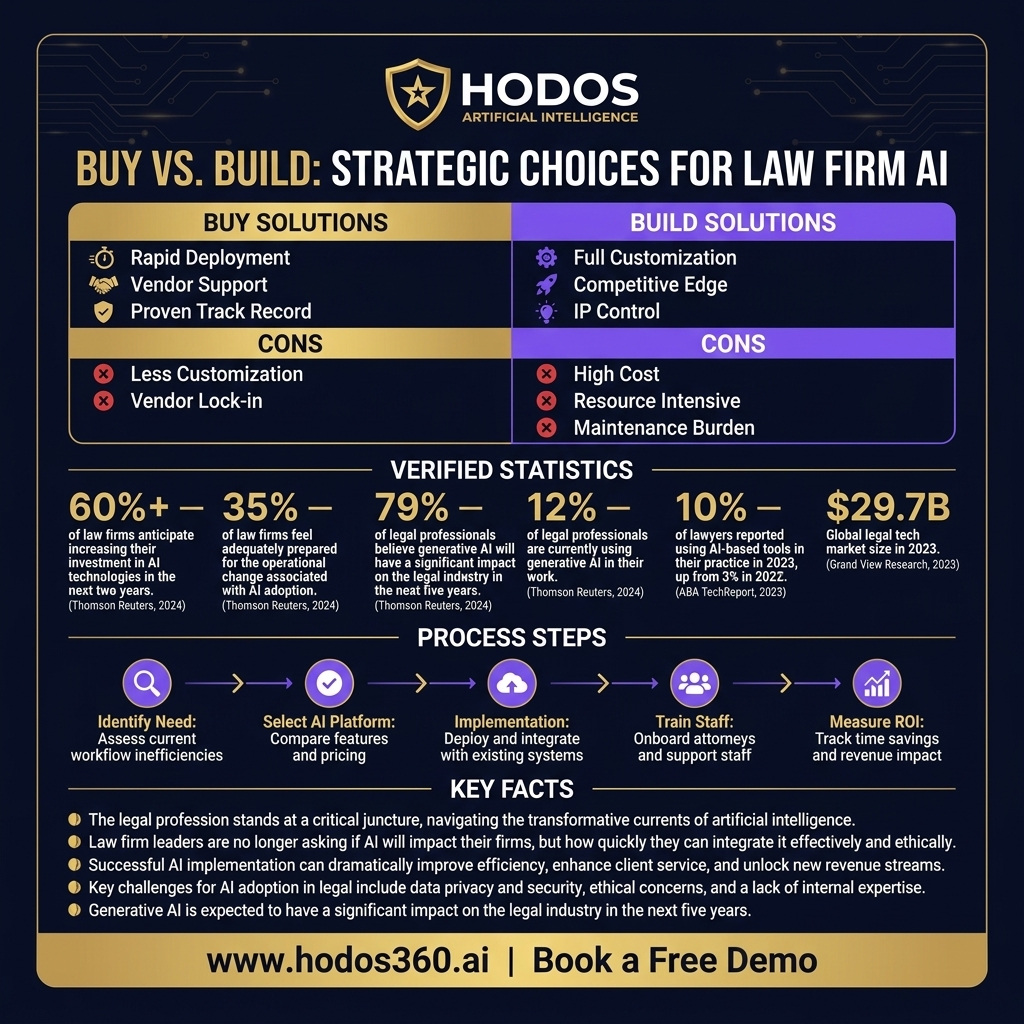
This shift isn't without its tensions. The legal market, traditionally cautious, is now a battleground for innovation, with firms like Allen & Overy making headlines for their partnership with Harvey AI, and others, like Mayer Brown, carefully evaluating how to best leverage existing platforms versus developing bespoke solutions. The stakes are incredibly high, as firms that successfully implement robust AI strategies can dramatically improve efficiency, enhance client service, and unlock new revenue streams, while those that lag risk falling behind. According to a 2024 report by Thomson Reuters, over 60% of law firms anticipate increasing their investment in AI technologies in the next two years, yet only 35% feel adequately prepared for the associated operational change. This disparity highlights a significant gap between aspiration and readiness, emphasizing the urgent need for well-defined strategies around training, user adoption, and the thoughtful selection of AI tools. It is within this dynamic environment that firms must forge a clear path, transforming potential disruption into a powerful catalyst for growth and evolution. Discover how to strategically approach GenAI integration and empower your firm for the future.
Navigating the GenAI Landscape: The Buy-vs-Build Question
The decision to 'buy' an off-the-shelf Generative AI solution or 'build' a custom one is perhaps the most fundamental strategic choice facing law firms today. For firms like Mayer Brown, as highlighted by Legal IT Insider, this isn't a simple procurement decision but a complex strategic undertaking that touches upon data security, integration with existing systems, and long-term scalability. On one hand, purchasing solutions from established legal tech vendors such as Thomson Reuters (with products like CoCounsel) or LexisNexis (with Lexis+ AI) offers immediate access to sophisticated models pre-trained on vast legal datasets. These platforms often come with robust support, regular updates, and a proven track record, significantly reducing the burden of development and maintenance for firms. For instance, the partnership between Allen & Overy and Harvey AI, backed by OpenAI's Sam Altman, exemplifies the 'buy' strategy, allowing a global firm to rapidly deploy advanced legal research and drafting capabilities without incurring the massive R&D costs of developing a proprietary large language model from scratch. This approach is particularly attractive for firms looking for rapid deployment and leveraging specialized legal AI expertise.
However, the 'build' approach, while more resource-intensive, offers unparalleled customization and competitive differentiation. Firms with significant in-house tech talent, like some of the larger Am Law 50, might opt to develop their own AI tools or significantly customize open-source models, tailoring them precisely to their unique practice areas, firm culture, and existing data infrastructure. Learn more about Essential AI Voice Assistant Strategies for Modern Law Firms. This strategy allows for tighter control over data governance, intellectual property, and the specific nuances of their workflows. For example, a firm specializing in complex litigation might build a GenAI tool specifically optimized for parsing obscure case law or predicting judicial outcomes based on proprietary firm data, giving them a distinct advantage. The tension lies in the trade-offs: speed and proven reliability versus bespoke control and unique competitive advantage. A 2023 report by the ABA Journal indicated that while 70% of firms prefer vendor solutions, 15% are actively exploring in-house development, particularly those with over 500 attorneys. The key to successful AI adoption in this context lies in a thorough cost-benefit analysis, considering not just financial outlay but also potential disruption, required internal competency, and alignment with the firm’s long-term strategic vision.
Strategic Partnerships and Hybrid Models
Beyond the binary choice of buy or build, many firms are exploring hybrid models, fostering strategic partnerships with AI startups or integrating multiple vendor solutions to create a comprehensive ecosystem. This approach recognizes that no single AI tool can address all the complex needs of a modern law firm. For instance, a firm might 'buy' a foundational GenAI platform for document review and legal research, while simultaneously 'building' smaller, specialized AI scripts or automation tools to streamline internal administrative tasks or client intake processes. This strategy, often championed by legal tech evangelists like Noah Waisberg, co-founder of Kira Systems (now part of Litera), allows firms to leverage the strengths of external innovation while retaining control over critical internal workflows. These hybrid models require a sophisticated understanding of integration capabilities and a clear roadmap for how different AI components will interact. Learn more about Voice Search Optimization: The Ultimate Guide for Law Firms. The goal is to create a seamless, interconnected system that enhances efficiency across the board, from case management to client communication, without creating siloed technological islands. This nuanced approach to AI adoption requires a dedicated internal team, often led by a Chief Innovation Officer or Head of Legal AI, to manage vendor relationships, oversee custom development, and ensure all components align with the firm’s overarching digital transformation strategy. It's a testament to the idea that successful AI adoption is less about a single solution and more about an evolving ecosystem.
The Cornerstone of Success: Effective AI Training and Competency
Once the 'buy-vs-build' question is addressed, the next, and arguably most critical, hurdle for successful AI adoption is comprehensive training and the cultivation of AI competency among legal professionals. The American Bar Association's Model Rule of Professional Conduct 1.1 on Competence now explicitly includes the duty to keep abreast of changes in the law and its practice, including the benefits and risks associated with relevant technology. This isn't a suggestion; it's a professional obligation. Firms cannot simply deploy AI tools and expect spontaneous mastery. The challenge, as observed by legal tech consultant Brad Blickstein, is less about the technology itself and more about the human element – the willingness and ability of lawyers to integrate these tools into their daily routines. Effective training programs must go beyond mere technical instruction; they need to address the 'why' behind AI, illustrating its potential to enhance legal practice, not replace it. This involves showcasing real-world scenarios where AI has significantly reduced research time, improved document accuracy, or streamlined complex tasks, thereby building enthusiasm and demonstrating tangible benefits.
Leading institutions and firms are investing heavily in structured AI education. Suffolk University Law School, under the guidance of Dean Andrew Perlman, has been a pioneer in integrating legal tech and AI into its curriculum, preparing future lawyers for an AI-driven world. Learn more about Voice AI: An Essential Leap for Law Firms' Client Engagement. For current practitioners, firms like Mayer Brown are likely developing tailored internal programs that blend theoretical understanding with practical, hands-on application. These programs often start with foundational modules on AI principles, data ethics, and responsible use, before moving into specific software training. Crucially, successful training is an ongoing process, not a one-time event. As AI technologies evolve rapidly, continuous learning and refresher courses are required to maintain high levels of competency. This also means creating internal champions – tech-savvy lawyers who can act as peer mentors and troubleshooters, fostering a supportive environment for learning and experimentation. Without a robust and continuous training framework, even the most advanced AI tools will remain underutilized, hindering the firm's overall digital transformation efforts.

Tailoring Training for Diverse Legal Roles
One size does not fit all when it comes to AI training in a law firm. The specific needs of a litigation partner, a corporate associate, a paralegal, and an administrative staff member vary significantly. Effective training programs must be tailored to these diverse roles, focusing on the AI functionalities most relevant to their daily tasks. For instance, a litigation team might require intensive training on AI-powered e-discovery platforms and predictive analytics tools, while a transactional team might benefit more from modules on AI-driven contract drafting, review, and due diligence. Paralegals, often at the forefront of document management and research, would need deep dives into AI tools that automate these processes, enabling them to improve efficiency and accuracy. Learn more about Legal AI Software Market: An Essential $14.62 Bn Outlook. This segmented approach ensures that training is perceived as directly relevant and valuable, increasing engagement and ultimately driving better AI adoption. Furthermore, incorporating feedback mechanisms into training programs allows firms to continuously refine their curriculum, addressing specific pain points and adapting to evolving user experiences and technological advancements. This adaptive learning environment is key to building a truly AI-fluent legal team, ensuring that every member feels empowered by technology rather than overwhelmed by it. The ultimate goal is to create a culture where AI is seen as a powerful assistant, not a competitor, for every role within the firm.
Cultivating User Adoption: Beyond the Initial Rollout
While training establishes competency, true AI adoption transcends initial instruction and delves into the realm of sustained behavioral change. The statistics are sobering: a 2023 McKinsey report revealed that only 30% of digital transformations successfully achieve their desired outcomes, largely due to resistance to change and lack of user buy-in. For law firms, this means that even after investing in cutting-edge GenAI and providing extensive training, the real work of integration begins. Cultivating user adoption requires a multi-pronged strategy that addresses psychological barriers, provides ongoing support, and demonstrates clear value. Leadership plays an indispensable role here; managing partners and practice group leaders must actively champion AI tools, not just endorse them from a distance. When senior attorneys visibly use and advocate for AI in their own practice, it sends a powerful message that this is a critical component of the firm's future, inspiring junior lawyers to learn and engage. This top-down encouragement, combined with bottom-up feedback loops, creates a virtuous cycle of acceptance and integration.
Beyond leadership, creating tangible incentives and showcasing immediate benefits are crucial. Firms can implement internal 'AI success stories' campaigns, highlighting how specific lawyers used AI to save hours on a complex brief or uncover a critical precedent, directly translating to better client outcomes or more billable hours elsewhere. Gamification, where users earn points or recognition for consistent AI tool usage, can also be effective. Learn more about AI Marketing Agency: Ultimate Growth for Law Firms. Moreover, the design of the AI tools themselves plays a significant role. Intuitive interfaces, seamless integration with existing legal workflows, and minimal disruption to established routines are paramount. This is where platforms like HODOS 360, with its AI Law Firm Management System, can make a significant difference by embedding AI capabilities directly into familiar interfaces for case management, document automation, and billing. The aim is to make AI use feel natural and effortless, rather than an added burden. Regular check-ins, user groups, and dedicated IT support teams are also vital to address questions, troubleshoot issues, and gather recommendations for improvement, ensuring that the adoption process is collaborative and responsive to user needs. Don't let your AI investment gather digital dust. Request a personalized demo of HODOS 360 today to see how our AI solutions drive real adoption and efficiency.
Overcoming Resistance and Fostering a Culture of Innovation
Resistance to change in law firms often stems from a combination of factors: fear of the unknown, skepticism about new technology's reliability, concerns about job displacement, and the comfort of established practices. To overcome this, firms must foster a culture of open dialogue and continuous innovation. This involves transparently addressing concerns about AI's impact on job security, emphasizing that AI is a tool for augmentation, not replacement, allowing lawyers to focus on higher-value, strategic work. Firms can organize 'lunch and learn' sessions, invite external AI experts to demystify the technology, and create safe spaces for lawyers to experiment with new tools without fear of failure. Encouraging a growth mindset, where experimentation and learning from mistakes are valued, is essential. Learn more about AI Voice Calls: The Essential Guide for Modern Law Firms. The goal is to transform skepticism into curiosity and apprehension into empowerment. This cultural shift is not merely about adopting technology but about evolving the very mindset of legal professionals, preparing them not just for current AI tools but for future advancements. By actively engaging lawyers in the process of AI integration, from tool selection to feedback on functionality, firms can build a sense of ownership and collective responsibility for the success of their digital transformation, ensuring that AI adoption becomes a shared firm-wide objective.
The HODOS 360 Advantage: Streamlining AI Law Firm Management
The complex journey of AI adoption, from strategic decision-making to sustained user engagement, demands an integrated and intelligent platform. This is precisely where HODOS 360's AI Law Firm Management System proves invaluable. Unlike fragmented solutions that require extensive custom integration and often lead to user frustration, HODOS 360 offers a unified ecosystem designed specifically for the legal industry. It addresses the 'buy' side of the GenAI equation by providing a comprehensive, ready-to-deploy suite of AI-powered services. Imagine a system where your case management, client intake, billing, and document automation are not just digitized but intelligently enhanced by AI. This means AI-powered legal workflows that automatically categorize documents, suggest relevant precedents, draft initial client communications, and even predict case outcomes based on firm data. This level of integration significantly reduces the friction points that often impede AI adoption, making the transition seamless and intuitive for legal professionals. For example, a lawyer using HODOS 360 can leverage AI to automate the generation of first-draft discovery requests, saving hours that can then be dedicated to strategic legal analysis, directly addressing the ABA's call for technological competency and efficient practice.
The real power of HODOS 360 lies in its ability to facilitate not just the initial implementation but also the ongoing user adoption and training required for long-term success. By centralizing critical firm operations within an AI-enhanced framework, it inherently simplifies the learning curve. Attorneys and staff interact with familiar functions like calendar management and client communication, now supercharged with AI capabilities that feel like an organic extension of their existing workflows. The platform's intuitive design reduces the need for extensive retraining, allowing firms to improve efficiency almost immediately. Furthermore, HODOS 360's integrated nature helps firms overcome the challenges of data silos, ensuring that AI tools have access to comprehensive, real-time information to provide the most accurate and relevant insights. This holistic approach ensures that the investment in AI translates into tangible benefits, driving significant improvements in productivity, client satisfaction, and overall firm profitability. It’s a complete solution designed to empower law firms to thrive in the age of AI, making the journey of AI adoption not just manageable, but truly transformative. It provides the necessary support and strategy for sustained growth.
Integrated Workflows for Seamless AI Integration
The seamless integration of AI into daily legal workflows is paramount for maximizing its value and ensuring high user adoption. HODOS 360’s platform excels in this regard, moving beyond mere feature aggregation to create a truly synergistic environment. Consider the process of client intake: traditionally a laborious, manual task. With HODOS 360, AI can automatically parse intake forms, extract key information, conduct initial conflict checks, and even suggest preliminary legal strategy based on historical data, all before a lawyer has dedicated significant time. This not only dramatically accelerates the intake process but also ensures greater accuracy and compliance. Similarly, in document automation, AI can learn from a firm's precedents to generate highly customized contracts, briefs, and motions, drastically reducing drafting time while maintaining consistency and quality. This integration extends to billing and financial management, where AI can analyze time entries for discrepancies, optimize invoicing, and provide predictive analytics on firm revenue, helping managing partners make more informed business decisions. By embedding AI directly into these core operational functions, HODOS 360 makes AI an indispensable part of every legal professional's day, rather than an optional add-on, thereby ensuring a high rate of AI adoption and delivering measurable ROI. This level of integration is what truly defines a modern, AI-powered law firm, ensuring that the technology is not just present, but actively enhancing every aspect of legal service delivery.

Key Takeaways and Next Steps
The successful AI adoption within law firms is not a passive event but an active, strategic imperative. As the legal industry continues its rapid evolution, the lessons from firms like Mayer Brown's journey with GenAI underscore several critical factors for enduring success. First, the 'buy-vs-build' decision must be rooted in a thorough analysis of a firm's unique needs, resources, and long-term strategic goals, often leading to nuanced hybrid approaches. Second, comprehensive and continuous training is non-negotiable; it's the bedrock upon which AI competency is built, ensuring that legal professionals are not just familiar with tools but proficient in leveraging them ethically and effectively, adhering to standards like ABA Model Rule 1.1. Third, cultivating genuine user adoption requires more than just good technology; it demands strong leadership, clear communication, demonstrable value, and an unwavering support system to navigate the inevitable change.
Ultimately, the future-proof law firm will be one that views AI not as a threat, but as an unparalleled opportunity to improve efficiency, elevate client service, and redefine legal excellence. The transformation is less about technology and more about people – empowering them with the right tools and knowledge. Firms must prioritize creating an environment where learning and innovation are celebrated, where AI is seen as an invaluable partner in delivering superior legal outcomes. The journey towards a fully AI-integrated practice is ongoing, required continuous evaluation and adaptation. By embracing a strategic, human-centric approach to AI adoption, law firms can not only survive but thrive in this exciting new era of legal practice, setting new benchmarks for efficiency and innovation. The time to learn and act is now, transforming the challenges of AI into a powerful competitive advantage.
Frequently Asked Questions
What is the primary challenge for law firms adopting GenAI?+
The primary challenge for law firms adopting Generative AI (GenAI) is multifaceted, encompassing strategic decisions like 'buy-vs-build,' ensuring comprehensive training for legal professionals to build AI competency, and cultivating sustained user adoption beyond initial implementation. Overcoming resistance to change and integrating AI seamlessly into existing workflows are also significant hurdles that require careful planning and execution.
How do law firms typically approach the 'buy-vs-build' decision for AI?+
Law firms approach the 'buy-vs-build' decision by weighing factors like customization needs, data security, integration with existing systems, and available in-house technical resources. Many firms opt to 'buy' established vendor solutions for rapid deployment and specialized expertise, while others 'build' custom tools for unique competitive advantages. A growing number are adopting hybrid models, combining off-the-shelf products with bespoke internal developments.
Why is continuous AI training important for legal professionals?+
Continuous AI training is crucial for legal professionals because the technology evolves rapidly, and the ABA Model Rules of Professional Conduct require lawyers to stay competent with relevant technology. Ongoing training ensures lawyers can effectively and ethically leverage new AI tools, maintain proficiency, and adapt to changes, preventing underutilization of expensive solutions and maximizing the benefits of AI in legal practice.
What strategies can law firms use to improve AI user adoption?+
To improve AI user adoption, law firms can implement several strategies: secure strong leadership buy-in and advocacy, demonstrate clear value through success stories, offer ongoing support and feedback mechanisms, and design intuitive tools that integrate seamlessly into existing workflows. Addressing user concerns transparently and fostering a culture of innovation and continuous learning are also vital for sustained adoption.
How can AI law firm management systems like HODOS 360 help with AI adoption?+
AI law firm management systems like HODOS 360 streamline AI adoption by offering integrated, AI-powered solutions for case management, document automation, client intake, and billing within a single platform. This reduces the 'build' complexity, simplifies training by embedding AI into familiar workflows, and provides a cohesive ecosystem that addresses common adoption barriers, ultimately enhancing efficiency and supporting comprehensive digital transformation.