


AI Voice Calls: The Essential Guide for Modern Law Firms
The legal landscape is perpetually reshaped by technological innovation, and few advancements hold as much immediate promise and profound implications as artificial intelligence in voice communication. On April 9, 2026, the wireless carrier REALLY made headlines with its announcement of 'Clone,' an AI designed to make and answer calls from a user's phone number in their own voice.
This launch isn't just a consumer convenience; it's a potent signal of a new era for professional services, particularly for law firms grappling with the demands of 24/7 client accessibility and operational efficiency. Imagine Sarah Chen, a busy litigation partner, missing a critical intake call while deep in court proceedings.
Now, an AI, indistinguishable from her own voice, could intelligently screen that call, gather initial details, and even schedule a follow-up, ensuring no potential client is ever truly unheard.
This isn't merely about basic interactive voice response (IVR) systems of yesteryear. We are talking about highly sophisticated, context-aware AI capable of natural language understanding and generation, powered by advancements from titans like OpenAI and Anthropic.
While the public discourse often veers towards the ethical perils of deepfakes and voice scams—concerns validated by incidents like the rise of 'wangiri' fraud and the FCC's recent moves to outlaw AI-generated voices in robocalls—the legitimate applications for law firms are transformative. The tension between innovation and ethical deployment is real, yet for firms willing to navigate this complexity with diligence, the rewards are substantial.
The legal sector, traditionally cautious, is now positioned at an inflection point where embracing AI voice calls is no longer optional but a strategic imperative for competitive advantage.
For law firm owners and attorneys, understanding and strategically implementing AI voice calls means more than just adopting a new tool; it's about redefining client engagement and operational workflows.
It offers a pathway to significantly enhance client intake, automate routine communications, and free up invaluable human capital for complex legal work. This comprehensive guide will delve into the practical applications, ethical considerations, and future potential of AI voice technology, demonstrating how your firm can leverage these advancements to deliver superior service and achieve unprecedented efficiency in an increasingly demanding legal market.
Ready to transform your firm's communication? Explore HODOS 360's AI Voice Assistants today.
The Transformative Power of AI Voice Calls in Legal Operations
The announcement of REALLY's Clone, an AI capable of mimicking a user's voice to handle phone calls, marks a significant leap from rudimentary voice assistants. This technology promises to answer and screen inbound calls, make outbound calls, and even navigate complex IVR trees—tasks that collectively consume countless hours in a typical law firm.
For legal operations, this translates into a profound shift from a reactive communication model to a proactive, always-on client service paradigm. Firms can now ensure that every incoming call, regardless of the time of day or attorney availability, is met with an intelligent, responsive interaction, capturing crucial information and setting client expectations from the very first touchpoint.
Consider the operational burden of client intake, often a bottleneck for growing firms. An AI voice assistant can act as a 24/7 virtual receptionist, fielding initial inquiries, performing preliminary lead qualification, and even scheduling appointments directly into an attorney's calendar. According to the 2023 Thomson Reuters Legal Trends Report, client demands for immediate communication are at an all-time high, with many potential clients moving on if they don't receive a prompt response.
Firms that implement sophisticated AI voice calls can dramatically improve their responsiveness, ensuring that no lead falls through the cracks due to missed calls or delayed follow-ups.
The efficiency gains extend beyond initial contact. Learn more about AI Web Apps: Ultimate Legal Firms' Guide to Next-Gen Development.
Routine queries about case status, billing, or general firm information can be handled autonomously by an AI, freeing up paralegals, legal assistants, and even attorneys from repetitive administrative tasks. This reallocation of human capital allows legal professionals to focus on high-value, complex legal work that truly requires their expertise and judgment.
Andrew Arruda, co-founder of Ross Intelligence, has often spoken about AI's role in augmenting legal professionals, allowing them to perform at the top of their license rather than getting bogged down in administrative minutiae.
Furthermore, AI voice calls can enhance the client experience by providing consistent, accurate, and rapid responses.
Imagine a client receiving an automated, yet personalized, call confirming their upcoming court date or reminding them of a document deadline. This proactive communication builds trust and demonstrates a firm's commitment to modern, client-centric service. By leveraging AI to manage these communication touchpoints, law firms can cultivate stronger client relationships, improve satisfaction scores, and ultimately, bolster their reputation in a competitive market.
Navigating the Ethical and Security Landscape of Voice AI
The rapid advancement of voice AI, while promising, inevitably raises critical ethical and security questions, especially within the highly regulated legal sector. The tension between leveraging innovative technology and upholding professional duties is a central challenge. The trending news of AI 'clones' capable of mimicking human voices immediately brings to mind concerns about misuse, such as deepfake scams or deceptive robocalls.
Indeed, the U.S. Federal Communications Commission (FCC) recently declared AI-generated voices in robocalls illegal under the Telephone Consumer Protection Act, underscoring the regulatory environment’s response to potential abuses. For law firms, this means a rigorous commitment to ethical deployment and transparency is paramount, ensuring that the use of AI voice calls enhances rather than compromises client trust.
Central to this ethical framework are the ABA Model Rules of Professional Conduct, particularly Rule 1.6 on Confidentiality of Information and Rule 1.1 on Competence. Law firms must ensure that any AI voice assistant handling client communications adheres strictly to these principles. This includes safeguarding sensitive client data exchanged during calls, implementing robust cybersecurity measures to prevent unauthorized access or breaches, and ensuring the AI is competent to handle legal-specific inquiries without misrepresenting facts or providing unauthorized legal advice.
The ethical imperative extends to the choice of AI platforms, demanding solutions with enterprise-grade security, end-to-end encryption, and clear data governance policies.
Transparency with clients about the use of AI in communication is not just an ethical best practice but a foundational element for maintaining trust.
Learn more about Essential AI for Client Relationships: Future-Proofing Law Firms. Clients should be clearly informed when they are interacting with an AI voice assistant, with explicit options to speak to a human attorney if preferred. This disclosure helps differentiate legitimate firm-authorized AI voice calls from malicious voice cloning attempts or scams like 'wangiri,' where fraudsters use cloned voices to deceive victims.
For instance, firms might implement an initial greeting that states, "You're speaking with our AI assistant. I can help with [specific tasks], or you can say 'speak to a human' at any time." This proactive approach fosters an environment of honesty and sets appropriate expectations, mitigating potential misunderstandings or distrust.
Ultimately, the ethical integration of voice AI in legal practice necessitates continuous human oversight and a clear understanding of the technology's limitations. While AI can process vast amounts of data and automate routine interactions, it lacks the nuanced judgment, empathy, and ethical reasoning inherent in human legal professionals.
Firms must establish clear protocols for when calls need to be escalated to a human, ensuring complex legal issues, sensitive client discussions, or situations requiring attorney-client privilege are always handled by a lawyer. As Professor Dan Linna of Northwestern Law has emphasized, AI's role is to augment human capabilities, allowing attorneys to focus on the truly human aspects of lawyering, rather than replacing them in critical decision-making or confidential counsel.
Ensuring Client Trust and Transparency
Building and maintaining client trust is paramount in the legal profession, and the introduction of AI voice technology requires deliberate strategies to uphold this trust. Firms should implement explicit disclosure mechanisms, informing clients upfront when they are interacting with an AI system. This can be integrated into initial greetings or website FAQs, ensuring clients are fully aware and have the option to opt-out or request human intervention.
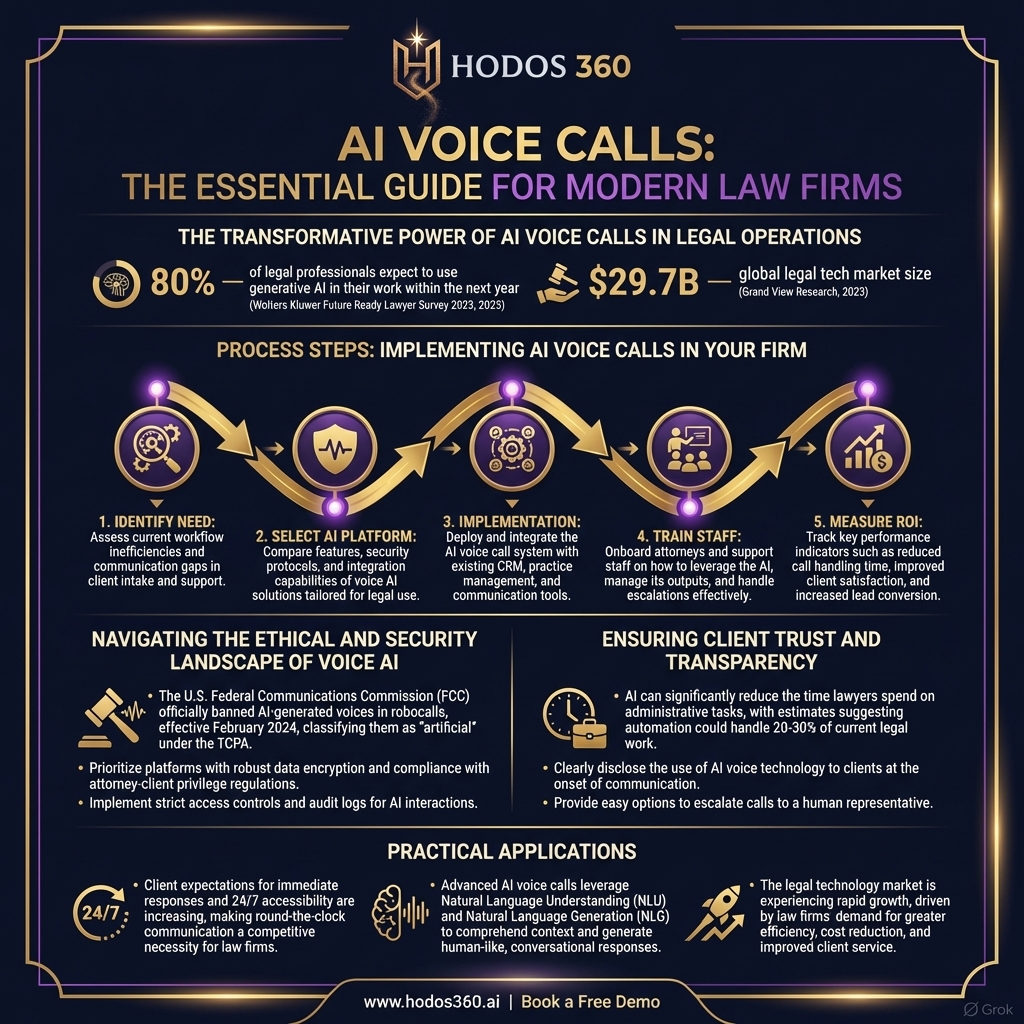
Transparency is the bedrock of ethical AI adoption, preventing any perception of deception and fostering a positive client experience.
Beyond initial disclosures, firms must establish clear protocols for call routing and escalation. Learn more about AI Chatbot Builders: Transform Your Law Firm in 2026. This means ensuring that if an AI encounters a query it cannot handle, or if a client expresses a desire to speak with a human, the transition is seamless and efficient.
Regular audits of AI interactions can also help identify areas where the AI might be causing confusion or failing to meet client expectations, allowing for continuous improvement and refinement of the system. This proactive approach reinforces the firm's commitment to client-centric service, even with advanced technological tools.
Optimize your law firm's client interactions with HODOS 360 AI Voice Assistants. Learn how to implement ethical and efficient voice AI.
Practical Applications: Implementing AI Voice Calls in Your Firm
The transition from theoretical potential to practical implementation of AI voice calls requires a strategic approach tailored to the unique needs of a law firm. Beyond simply answering calls, these advanced systems can perform a myriad of tasks that significantly enhance operational efficiency. This includes automated appointment scheduling, where the AI accesses attorney calendars, identifies availability, and books consultations directly.
It can also provide routine case status updates, answer frequently asked questions about firm services, and even initiate the collection of preliminary client information or document requests, guiding callers through a structured process to gather necessary details before a human intervenes.
Successful implementation hinges on seamless integration with a firm's existing technology stack.
An effective AI voice assistant should integrate with case management software, client relationship management (CRM) systems, and billing platforms to ensure data consistency and eliminate manual data entry. For example, HODOS 360's AI Law Firm Management System offers a holistic platform where AI Voice Assistants can directly feed qualified lead information, client details, and scheduled appointments into a unified dashboard, streamlining workflows from initial contact to case resolution.
This integration ensures that the AI isn't an isolated tool but a fully integrated component of the firm's digital infrastructure.
Customization and continuous training are crucial for an AI voice assistant to truly reflect a firm's brand and meet its specific practice area needs. Firms can train their AI with specific legal terminology, firm-specific policies, and even a particular tone of voice to align with their brand identity.
Learn more about AI Legal Research: The Ultimate Evolution of Legal Analysis. For instance, a family law firm might train its AI to adopt a more empathetic tone, while a corporate law firm might opt for a more formal and direct approach. Data gathered from interactions provides invaluable feedback, allowing firms to refine the AI's responses, improve its understanding of client queries, and enhance its overall performance over time.
This iterative process ensures the AI remains a valuable and evolving asset.
Measuring the return on investment (ROI) for AI voice calls involves tracking key metrics such as reduced call handling times, increased lead conversion rates, improved client satisfaction scores, and the measurable reduction in administrative overhead.
The 2023 Clio Legal Trends Report highlighted that firms leveraging technology effectively reported higher revenue growth and improved client satisfaction. By automating routine calls, firms can reallocate staff to higher-value tasks, leading to better utilization of resources and a significant impact on profitability. This strategic investment in AI voice technology is not just about cost savings; it's about building a more responsive, efficient, and client-centric legal practice that stands out in a crowded market.
- ✓24/7 Client Availability: Ensures no potential client call is missed, regardless of office hours or attorney schedules.
- ✓Automated Lead Qualification: AI screens inbound calls, gathering essential information to pre-qualify leads and route them to the most appropriate attorney.
- ✓Streamlined Client Intake: Guides new clients through initial information gathering, conflict checks, and automated appointment booking.
- ✓Reduced Administrative Burden: Handles routine inquiries (case status, billing, FAQs), freeing up legal staff for complex, high-value tasks.
- ✓Enhanced Client Experience: Provides consistent, rapid, and personalized responses, improving client satisfaction and trust.
- ✓Data-Driven Insights: Collects valuable data from interactions, allowing firms to analyze communication patterns and continuously refine client service strategies.
Streamlining Client Intake and Lead Qualification
The client intake process is often the first and most critical touchpoint for a new client, yet it can be fraught with inefficiencies. AI voice calls fundamentally transform this by automating the initial stages. When a prospective client calls, the AI can immediately engage, introduce itself, and begin a structured conversation to gather crucial information: name, contact details, the nature of their legal issue, and urgency.
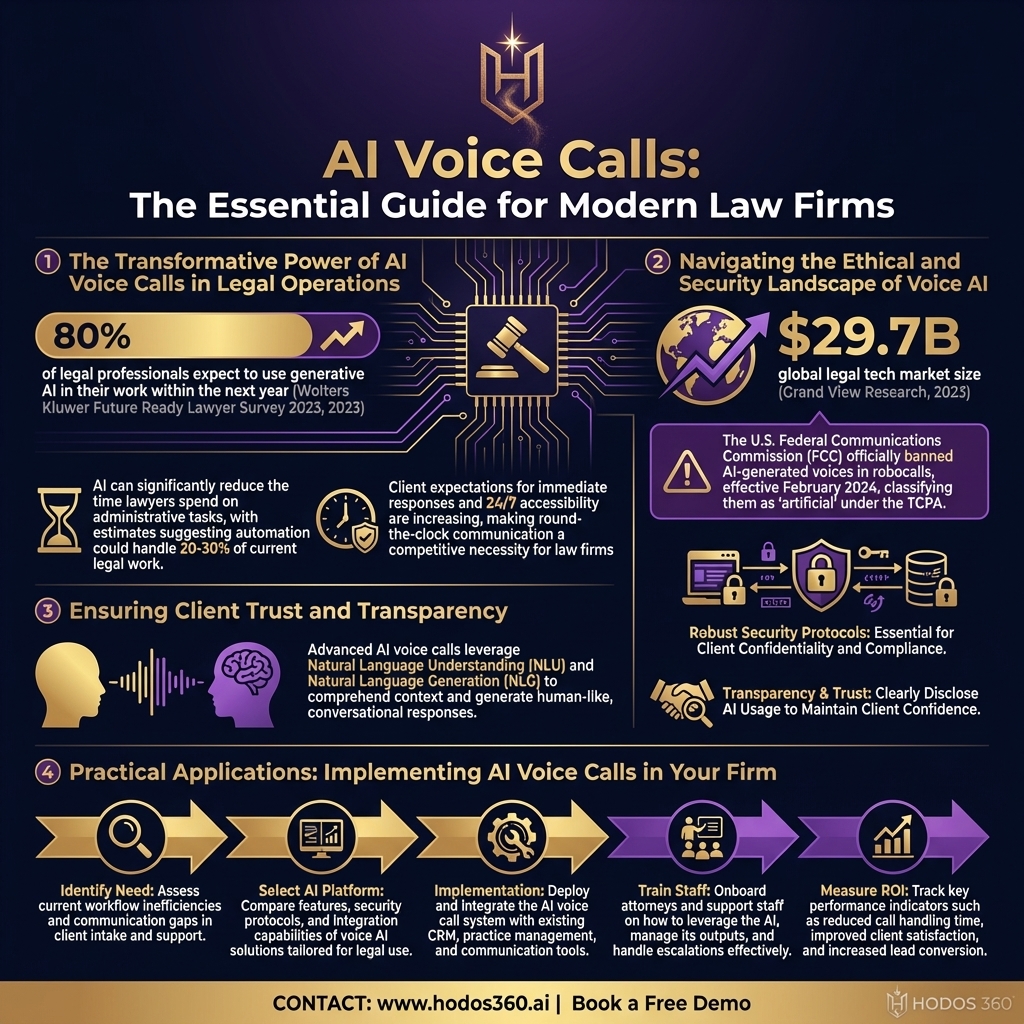
This data is then automatically logged into the firm's CRM or case management system, initiating a digital client file.
Crucially, the AI can perform preliminary lead qualification by asking specific questions tailored to the firm's practice areas and ideal client profile. Learn more about AI Voice Assistant: Essential for Modern Law Firm Success.
For instance, it can determine if the case aligns with the firm's expertise, if the potential client meets certain financial criteria, or if there are immediate conflicts of interest. Only after this initial screening are qualified leads seamlessly routed to the appropriate human attorney or paralegal, often with a pre-populated summary of the interaction, significantly reducing the time spent on unqualified inquiries and accelerating the path to client retention.
The Future of AI Voice in Legal: Beyond Basic Calls
While current AI voice calls offer significant advancements, the trajectory of this technology suggests even more transformative applications for law firms in the near future. Imagine AI not just answering calls, but actively assisting with real-time legal research during a client consultation, pulling up relevant statutes or case precedents based on the conversation's context.
Advanced sentiment analysis capabilities could allow AI to gauge a client's emotional state, adapting its tone and escalating to a human attorney proactively if distress is detected. Furthermore, AI could initiate proactive outreach for follow-ups, contract renewals, or even support in routine negotiation scenarios, guided by predefined legal parameters.
The evolution towards multimodal AI will further enhance client interactions. Combining voice with visual cues in video calls, or integrating seamlessly with text-based communication, will create a richer, more comprehensive client experience. For example, an AI voice assistant might guide a client through filling out a complex form online, providing verbal instructions while simultaneously highlighting fields on their screen.
This convergence of communication channels will allow firms to deliver highly personalized and efficient service, meeting clients wherever they are and however they prefer to communicate, blurring the lines between traditional and digital client engagement.
In this rapidly evolving landscape, firms that proactively embrace advanced AI voice calls and other intelligent automation tools will gain a significant competitive edge.
We've seen early adopters like Allen & Overy partnering with Harvey AI to integrate sophisticated generative AI into their legal research and drafting processes, demonstrating a clear commitment to technological leadership. Learn more about Voice AI: An Essential Leap for Law Firms' Client Engagement. The legal market will increasingly bifurcate between firms leveraging cutting-edge AI to enhance service delivery and efficiency, and those struggling to keep pace with client expectations and operational demands.
This isn't merely about incremental improvements; it's about fundamentally redefining the operational model of a successful law firm.
Ultimately, the future of AI voice in legal is about fostering a powerful human-AI collaboration. As legal tech visionaries like Richard Susskind have long predicted, AI's role is to augment, not replace, the human lawyer.
Attorneys will be liberated from the repetitive, administrative burdens of communication, allowing them to dedicate their expertise to complex problem-solving, strategic counsel, and building deep, empathetic client relationships. The AI handles the high-volume, predictable interactions, while the human focuses on the nuanced, unpredictable, and ethically sensitive aspects of legal practice.
This symbiotic relationship will elevate the legal profession, making it more efficient, accessible, and ultimately, more human.
Preparing Your Firm for Advanced Voice AI Integration
To effectively leverage the next generation of voice AI, law firms must begin preparing today. This involves a comprehensive assessment of current communication workflows to identify bottlenecks and areas ripe for automation. Investing in robust, scalable technological infrastructure that can support advanced AI integrations and handle large volumes of data securely is paramount.
Firms should also prioritize selecting AI partners who understand the unique regulatory and ethical demands of the legal sector, ensuring compliance and data integrity.
Beyond technology, fostering a culture of innovation and continuous learning within the firm is essential. This includes training staff on how to effectively collaborate with AI tools, understanding their capabilities and limitations, and adapting to new workflows.
Embracing pilot programs for specific use cases can provide valuable insights and allow firms to iterate and refine their AI strategies, ensuring a smooth transition into an AI-augmented future. The firms that proactively adapt will be the ones that define the future of legal service.