


AI Adoption: Essential Strategies for Law Firms to Lead
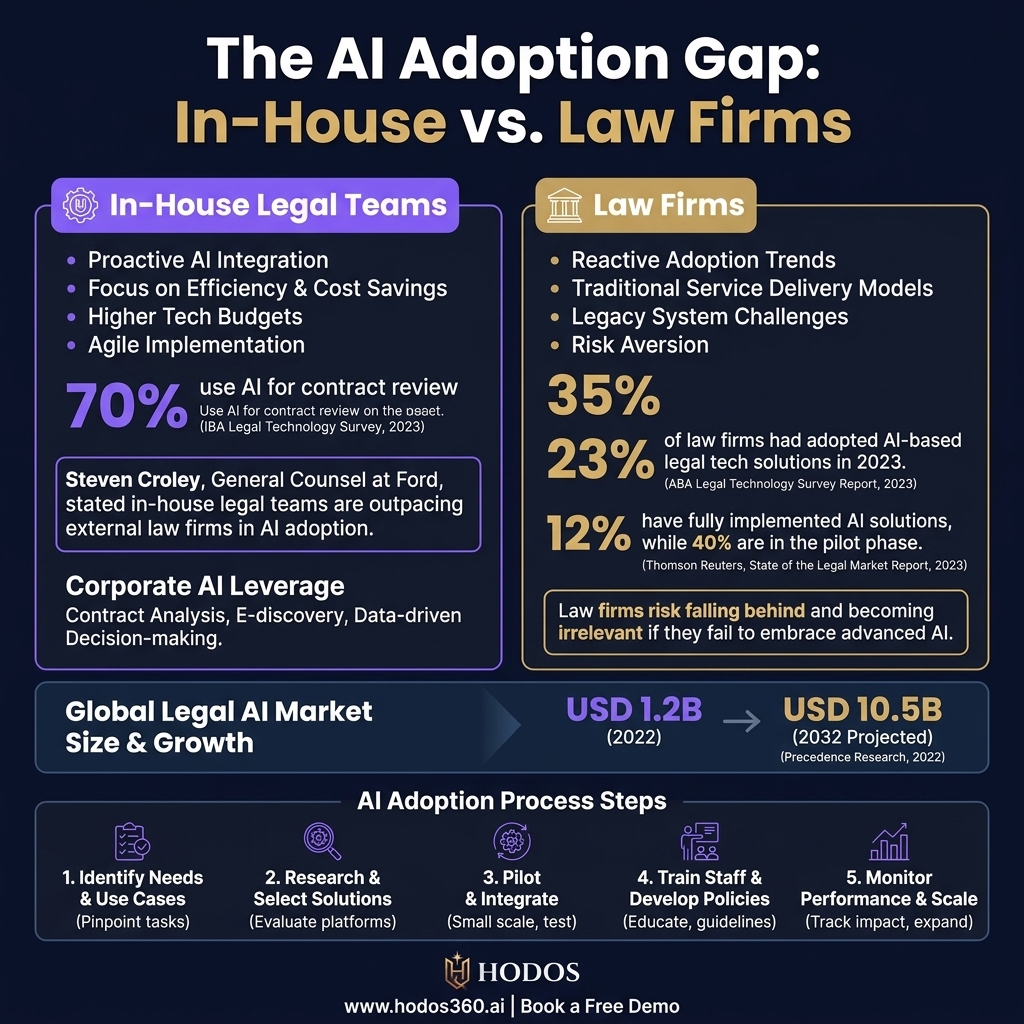
The legal industry is no stranger to disruption, but rarely has a statement reverberated so sharply as the recent pronouncement from Steven Croley, General Counsel and Chief Policy Officer at Ford Motor Company. Croley's candid assertion—that in-house legal teams are now outpacing their external law firms in AI adoption—serves not just as a headline, but as a crucial wake-up call for legal professionals worldwide.
His remarks, prominently featured in Bloomberg Law News, highlight a widening chasm between the technological agility of corporate legal departments and the often-slower pace of traditional law firms. This isn't merely a matter of technological preference; it's a strategic imperative that directly impacts client service, operational efficiency, and ultimately, a firm's long-term viability in an increasingly competitive landscape.
The question is no longer *if* law firms will adopt AI, but *how quickly* they can adapt to meet the evolving expectations of tech-forward client companies like Ford.
This tension between innovation and tradition underscores a pivotal moment for the legal sector. As in-house teams at global giants like Ford and Microsoft leverage sophisticated AI tools for tasks ranging from contract analysis to e-discovery, they are setting new benchmarks for efficiency and data-driven decision-making.
The pressure on external counsel to demonstrate equivalent technological prowess is mounting. Failing to embrace advanced AI adoption risks not just falling behind, but becoming irrelevant in a market that increasingly values speed, precision, and cost-effectiveness. The narrative arc of legal tech is shifting, and law firms must now confront the reality that their clients are not just consumers of legal services, but active participants in the digital transformation that is reshaping the very fabric of legal practice.
It's time for law firms to move forward with purpose and urgency.
The AI Adoption Gap: Why In-House Teams are Leading the Charge
Steven Croley’s observation from Ford Motor Company isn't an isolated incident; it reflects a broader trend observed across the corporate legal landscape. In-house legal departments, driven by relentless pressure to reduce costs, enhance efficiency, and manage ever-increasing volumes of data, have become early and enthusiastic adopters of artificial intelligence.
Companies like Ford, with vast global operations, generate colossal amounts of legal documentation—contracts, regulatory filings, litigation discovery materials. Manually processing this volume is not only cost-prohibitive but increasingly impossible. Learn more about AI Marketing Agents: The Ultimate Law Firm Advantage. As Croley writes, their house legal teams are strategically implementing AI to automate repetitive tasks, identify critical information faster, and provide more accurate, data-backed advice to the business.
This proactive stance allows them to operate with unprecedented agility, directly influencing the company's bottom line and competitive edge. The shift is palpable: corporate legal is moving from a cost center to a strategic enabler, powered by intelligent automation.
The specific AI tools being leveraged by these forward-thinking in-house departments are diverse and sophisticated. For instance, contract lifecycle management (CLM) platforms powered by AI can review thousands of agreements in minutes, identifying anomalies, compliance risks, and key clauses that would take human lawyers weeks to analyze.
E-discovery platforms, now augmented with machine learning, can sift through petabytes of data to pinpoint relevant documents with far greater accuracy and speed than traditional methods. Moreover, AI-powered legal research tools are revolutionizing how corporate counsel access and synthesize legal precedents, enabling faster, more comprehensive legal opinions.
Learn more about Website Design Cost 2026: Strategic Investment for Law Firms. Brad Smith, Vice Chair and President of Microsoft, has often highlighted how AI is integrated into every facet of their operations, including their extensive legal department, optimizing everything from patent analysis to regulatory compliance.
This aggressive AI adoption by major corporations is fundamentally reshaping what client companies expect from their legal service providers, raising the bar for efficiency and technological sophistication.
The drivers behind this rapid AI adoption among in-house teams are clear: financial prudence and strategic advantage. A 2024 report by Thomson Reuters found that 60% of corporate legal departments have increased their investment in legal technology, with AI being a top priority. This contrasts sharply with the often-slower AI adoption rates seen in many law firms.
The report also indicated that 75% of in-house teams believe that legal tech, particularly AI, is crucial for improving operational efficiency and reducing external legal spend. Learn more about AI Web Apps: Ultimate Legal Firms' Guide to Next-Gen Development. By streamlining internal processes, these teams can handle more work in-house, reducing reliance on external counsel for routine or high-volume tasks.
This puts immense pressure on law firms to demonstrate how their services, now, too, are enhanced by cutting-edge technology, ensuring they are not perceived as being behind the curve but rather as strategic partners in innovation.
Corporate Agility vs. Law Firm Inertia
The disparity in AI adoption rates between in-house departments and law firms isn't accidental; it stems from fundamental differences in operational models, risk appetites, and budgetary structures. Corporate legal teams often benefit from direct access to significant technology budgets and internal IT expertise, enabling them to pilot and scale AI solutions with relative ease.
Their focus is squarely on operational efficiency and aligning with the overarching business objectives of the company. Law firms, conversely, often face challenges such as legacy systems, a billable hour model that can disincentivize efficiency gains, and a more cautious approach to adopting unproven technologies.
Learn more about ActiveCampaign 2026: AI Marketing Unleashes Law Firm Growth. The American Bar Association's 2024 TechReport, for instance, showed that while interest in AI is high, actual implementation across firms remains uneven, with many still in exploratory phases rather than full-scale implementing AI tools that demonstrably improve workflows and client outcomes.
This inertia, whether due to perceived risk or internal resistance, directly contributes to firms being perceived as behind their corporate client counterparts.
Essential AI Tools for Modern Law Firm Management
To effectively bridge the AI adoption gap, law firms must strategically identify and integrate AI tools that address their unique operational challenges and enhance client service. A comprehensive AI Law Firm Management System stands as the cornerstone of this transformation. Platforms like HODOS 360 offer an integrated suite of services, from AI-powered case management and automated billing to intelligent client intake and sophisticated document automation.

Imagine a system where routine document drafting, such as initial pleadings or standard contracts, is accelerated by AI, allowing attorneys to focus on complex legal strategy. Learn more about Legal AI: The Ultimate Guide to Transforming Law Firms. This not only boosts internal efficiency but also positions the firm as a forward-thinking entity, capable of delivering services with greater speed and precision.
The integration of AI-powered workflows can streamline the entire lifecycle of a case, from initial consultation to final resolution, ensuring that no detail is overlooked and every process is optimized. This is the kind of robust AI adoption that will enable firms to catch up to their corporate client counterparts who are already implementing these advanced technologies.
Beyond core practice management, AI extends its transformative reach into other critical areas, notably marketing and client communication. An AI Marketing Platform can revolutionize how law firms attract and retain clients. This includes AI-powered video creation for compelling case studies or firm introductions, social media automation for consistent online presence, and intelligent content generation that produces high-quality legal articles and blog posts, ensuring the firm's thought leadership is always current and engaging.
Furthermore, advanced analytics and ROI tracking provide invaluable insights into marketing effectiveness, allowing firms to optimize their spend and focus on strategies that yield the best results. Learn more about Proven Strategy: AI-Built Websites Can Convert for Law Firms. This strategic AI adoption means that firms are not just reactive to their clients' needs but are proactively shaping their market presence and demonstrating technological savviness from the first touchpoint.
This proactive approach to implementing AI in marketing is a clear differentiator for firms aiming to move forward.
Client engagement and accessibility are further enhanced by AI Voice Assistants. These sophisticated tools provide 24/7 phone answering, ensuring no potential client call goes unanswered, even outside business hours. AI-driven lead qualification can efficiently pre-screen inquiries, routing high-value prospects directly to fee-earners and booking appointments automatically.
Multilingual support ensures that a firm's services are accessible to a diverse client base, breaking down language barriers and expanding market reach. For a company like Ford, which operates globally, the ability to communicate seamlessly across languages and time zones is paramount, and law firms must reflect this capability.
Finally, Web & Mobile Development powered by AI offers firms the ability to build responsive, SEO-optimized websites with high-converting templates, ensuring their digital storefront is as professional and efficient as their legal services. This comprehensive AI adoption strategy ensures that firms are not only forward-thinking in their internal operations but also in their external presentation and client interaction, directly addressing the challenge posed by Steven Croley.
Navigating the Legal Tech Landscape: Key Considerations
Successfully implementing AI tools requires careful consideration of several factors beyond mere functionality. Data security and ethical compliance are paramount. Law firms handle highly sensitive client information, making robust cybersecurity protocols and adherence to data privacy regulations (like GDPR or the California Consumer Privacy Act) non-negotiable.
The ABA Model Rules of Professional Conduct, particularly Rule 1.1 on Competence and Rule 1.6 on Confidentiality of Information, impose a duty on attorneys to understand and mitigate the risks associated with technology. Firms must ensure that any AI adoption is conducted with due diligence, choosing vendors with proven security records and transparent data handling policies.
The European Union's AI Act, set to be fully enforced in the coming years, also provides a framework for responsible AI development and deployment, which will influence global best practices and legal tech standards. This regulatory landscape necessitates a cautious yet proactive approach to AI adoption to avoid falling behind on compliance.
The Strategic Imperative: Reimagining Client Service and Competitiveness
The true value of AI adoption for law firms extends far beyond efficiency gains; it lies in the opportunity to fundamentally reimagine client service and enhance market competitiveness. Firms that embrace AI tools can offer predictive analytics for litigation outcomes, providing clients with data-driven insights that were once unimaginable.
This proactive approach to legal strategy differentiates forward-thinking firms from those that remain reactive. For example, firms like Allen & Overy have publicly partnered with legal AI startups like Harvey AI, backed by OpenAI, to develop custom AI solutions for their global practices, demonstrating a commitment to innovation that resonates with sophisticated clients.
This is not just about adopting technology; it’s about signaling to the market that the firm is equipped to handle the complexities of modern business with the most advanced tools available. Steven Croley's statement highlights that this is no longer a luxury but a necessity for firms to avoid being left behind.
The drama of market competition is playing out in real time: firms that invest in AI adoption are gaining a significant edge over those that cling to traditional methods. A 2025 report by McKinsey & Company projected that AI could unlock trillions of dollars in value across various industries, with legal services being a prime beneficiary.
This isn't just about cutting costs; it's about creating new revenue streams through innovative service offerings, attracting top talent who are eager to work with cutting-edge technology, and building a reputation as a leader in legal innovation. The tension between disruption and tradition is palpable, with many firms grappling with the cultural shift required for successful AI adoption.
Those that successfully navigate this transition will be the ones that thrive, securing their position at the forefront of the legal profession and ensuring they are not behind the curve set by industry giants like Ford Motor.
Moreover, AI adoption allows firms to elevate the human element of legal practice. By automating routine, high-volume tasks, attorneys are freed from mundane work to focus on high-value activities: complex problem-solving, strategic client counseling, and building deeper client relationships. This shift not only improves job satisfaction for legal professionals but also enhances the overall quality of service delivered.
Clients aren't just looking for efficiency; they're looking for sophisticated insights and strategic partnership. When a firm can demonstrate that its internal processes are optimized by AI, it builds trust and confidence, reinforcing its position as a trusted advisor. This strategic implementing of AI demonstrates that the firm is genuinely forward-thinking and committed to delivering the best possible outcomes for its clients, a crucial factor in the competitive landscape.
Cultivating an AI-Ready Culture within Your Firm
Successfully implementing AI tools transcends technology; it requires a profound cultural shift within the firm. Leadership buy-in is paramount, as is a commitment to continuous learning and adaptation. Firms must invest in comprehensive training programs to ensure attorneys and staff are proficient in using new AI systems, transforming skepticism into proficiency.
This means fostering an environment where experimentation is encouraged, and learning from failures is embraced. As Dario Amodei, CEO of Anthropic, often emphasizes, the ethical and effective deployment of AI hinges on human oversight and a deep understanding of the technology's capabilities and limitations. Law firms should consider appointing a Chief Innovation Officer or establishing a dedicated legal tech committee to champion AI adoption and ensure its strategic alignment with the firm's goals.
This proactive approach to cultural change is vital for any firm that wishes to avoid being behind in the rapidly evolving legal market.
The Path Forward: Actionable Steps for Law Firms
For law firms to truly embrace AI adoption and avoid being outpaced by in-house legal teams, a structured, actionable approach is essential. The first step involves a comprehensive AI readiness assessment. This entails evaluating existing workflows, identifying pain points where AI can deliver significant value, and assessing the firm's current technological infrastructure.
Understanding where the firm stands allows for targeted investment in AI tools that will yield the highest impact. Firms should then consider starting with pilot projects, focusing on specific practice areas or administrative functions where AI can demonstrate tangible benefits quickly. For example, implementing an AI-powered document review tool for a particular litigation team, or an AI voice assistant for client intake, can provide valuable insights and build internal confidence in the technology's capabilities.
This focused approach minimizes disruption while maximizing learning, enabling the firm to move forward strategically.
Investment in talent and training is another critical component of successful AI adoption. Firms must not only acquire new AI tools but also empower their people to use them effectively. This may involve upskilling existing staff through workshops and certifications, or strategically hiring legal technologists and data scientists who can bridge the gap between legal expertise and technological implementation.
Fostering a culture of collaboration between legal professionals and tech teams is crucial for successful integration. Furthermore, establishing clear ethical guidelines for AI use, in alignment with professional obligations like those outlined in ABA Model Rule 8.4 (Misconduct), ensures responsible deployment. This proactive stance on training and ethics helps to overcome potential resistance and ensures that AI adoption is both effective and compliant, preventing the firm from falling behind on critical ethical considerations.
Finally, strategic partnerships with leading legal tech providers are paramount. Firms don't need to develop AI solutions from scratch; they can leverage the expertise of companies specializing in legal AI. These partnerships can provide access to cutting-edge tools, ongoing support, and insights into future technological advancements.
By collaborating with innovators, law firms can accelerate their AI adoption journey, staying ahead of the curve and continuously enhancing their service offerings. This includes exploring comprehensive platforms that integrate various AI functionalities, from case management to marketing, under one umbrella. The goal is to create a symbiotic relationship where technology empowers legal professionals, allowing them to deliver superior client outcomes and maintain a competitive edge in an increasingly digital legal market, ensuring they are not behind but rather at the forward edge.

Key Takeaways and Next Steps
The message from Ford Motor's GC, Steven Croley, is unequivocal: the era of reactive AI adoption for law firms is over. The competitive landscape demands proactive, strategic integration of AI tools across all facets of legal practice, from case management to client engagement. Firms that continue to lag behind risk not only losing market share but also failing to meet the evolving expectations of sophisticated corporate clients.
The opportunity, however, is immense. By embracing AI, law firms can unlock unprecedented efficiencies, deliver superior client service, and position themselves as forward-thinking leaders in a rapidly transforming industry. This isn't just about technology; it's about the future of legal practice itself.
To navigate this critical juncture, law firms must commit to a clear AI adoption strategy.
This involves assessing current needs, investing in integrated AI tools and platforms, fostering an AI-ready culture, and prioritizing ethical deployment. The time for hesitation is past; the time for decisive action is now. Explore how comprehensive AI platforms, like those offered by HODOS 360, can provide the integrated solutions your firm needs to not just catch up, but to lead the charge in the next generation of legal services.
Don't let your firm be behind; drive forward with AI.
Frequently Asked Questions
Why are in-house legal teams outpacing law firms in AI adoption?+
In-house legal teams are often driven by direct cost-saving mandates and have easier access to corporate tech budgets and IT expertise. They prioritize efficiency to manage high volumes of data and reduce external legal spend, making them agile in implementing AI tools like contract analysis and e-discovery, as highlighted by Ford's GC Steven Croley.
What are the primary benefits of AI adoption for law firms?+
AI adoption offers numerous benefits, including enhanced operational efficiency through automation of routine tasks, improved accuracy in legal research and document review, and better resource allocation. It also enables superior client service through faster response times, data-driven insights, and innovative service offerings, boosting the firm's competitive edge.
What specific AI tools should law firms prioritize for implementation?+
Law firms should prioritize AI tools that streamline core operations and client interactions. This includes AI-powered law firm management systems (case management, billing, document automation), AI marketing platforms (content generation, social media), AI voice assistants for client intake, and AI-enhanced web development for online presence.
How can law firms overcome internal resistance to AI adoption?+
Overcoming resistance requires strong leadership buy-in, clear communication about AI's benefits, and comprehensive training programs for all staff. Fostering a culture that embraces innovation, starting with pilot projects to demonstrate tangible value, and addressing ethical concerns proactively are crucial for successful AI integration and cultural shift.
What ethical considerations should law firms keep in mind when adopting AI?+
Ethical considerations are paramount. Firms must ensure data security and client confidentiality (ABA Model Rule 1.6), maintain attorney competence in using AI (ABA Model Rule 1.1), and avoid bias in AI outputs. Transparency with clients about AI use and adherence to emerging regulations like the EU AI Act are also vital.