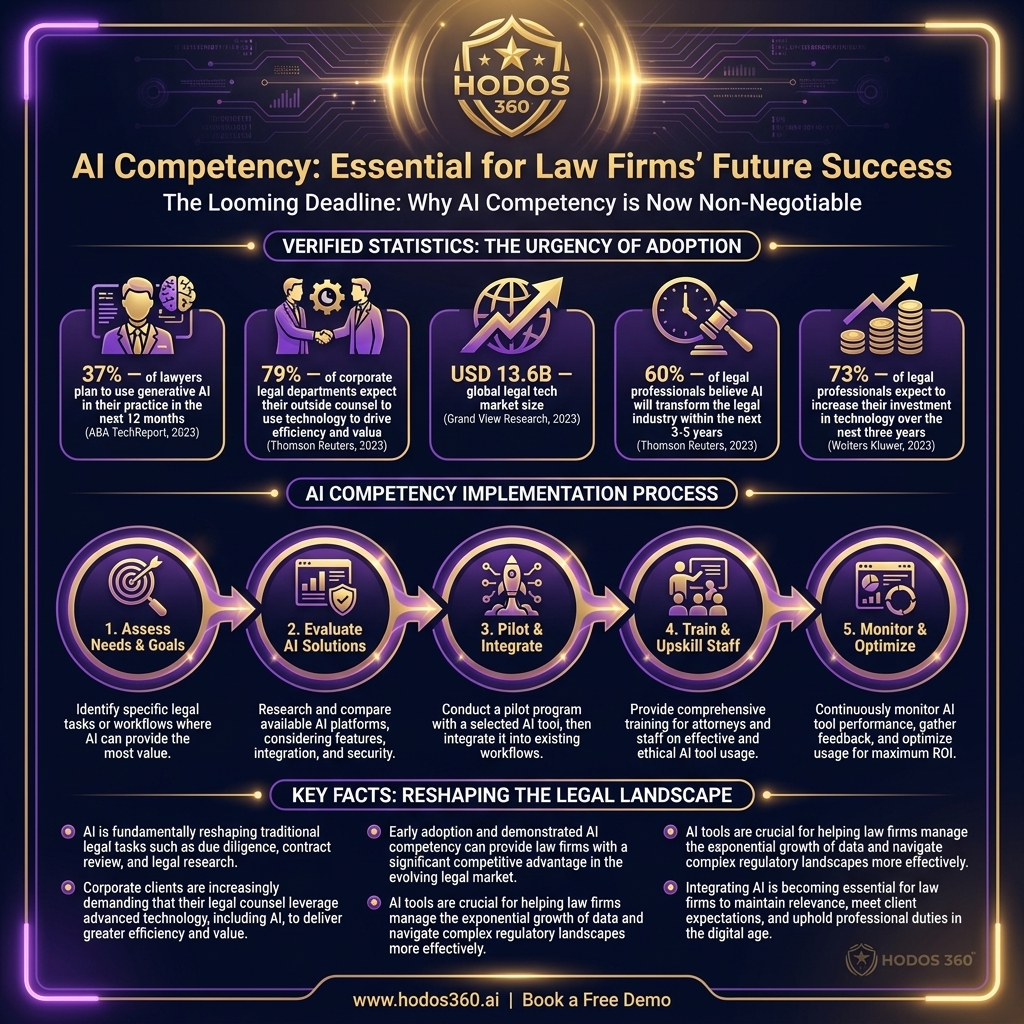


AI Competency: Essential for Law Firms' Future Success
The legal profession, long seen as a bastion of tradition, is now at the precipice of its most profound transformation in decades. A recent and widely discussed report from The Business Journals sends a clear, stark message: law firms have a mere 12-month window to demonstrate "AI competency" or risk alienating and losing major clients. This isn't a speculative future scenario; it’s a present-day ultimatum that underscores the urgency of integrating artificial intelligence into legal practice. The pressure is mounting, not just from the tech-savvy younger generation of lawyers, but from sophisticated corporate clients who are themselves leveraging AI and expect their legal counsel to operate with similar technological proficiency. Firms like Allen & Overy, early adopters through their partnership with Harvey AI, have already signaled a shift, demonstrating how AI competency law firms can enhance due diligence, contract review, and research, setting a new bar for service delivery. This evolving expectation reshapes the very definition of legal excellence and client value.
The implications of this 12-month deadline extend far beyond mere technological adoption; they touch upon the core tenets of legal ethics, client service, and competitive advantage. As attorneys grapple with the sheer volume of data, complex regulatory landscapes, and the demand for faster, more cost-effective solutions, AI emerges not as an optional accessory but as a fundamental tool for maintaining relevance and upholding professional duties. The debate isn't about whether AI will impact the legal sector, but *how* firms will adapt to its undeniable presence. Firms that delay risk falling into an ever-widening chasm, losing ground to agile competitors who have embraced digital transformation. This competitive dynamic is palpable, with figures like Casetext CEO Jake Heller and Harvey AI co-founder Winston Weinberg pushing the boundaries of what legal AI can achieve, igniting a race for innovation that traditional firms can no longer afford to sit out.
The mandate to cultivate AI competency law firms is therefore not merely a recommendation but a strategic imperative. It requires a holistic re-evaluation of firm operations, from client intake and case management to legal research and document generation. The firms that will thrive are those that view this deadline not as a threat, but as an opportunity to redefine their value proposition, enhance efficiency, and deliver superior client outcomes. This article will delve into the specific competencies required, the practical steps firms can take to meet this challenge, and how embracing AI can ultimately lead to unprecedented growth and resilience in a legal market undergoing seismic shifts. Ignoring this call to action is not an option; the future of legal practice is being written now, powered by artificial intelligence.

The legal landscape is undergoing a profound transformation, driven by the relentless march of artificial intelligence. It’s no longer a futuristic concept but a present-day imperative, reshaping how law firms operate, serve clients, and compete. The question is not *if* AI will impact your firm, but *how* you will strategically leverage it to not only survive but thrive. The AI competency challenge is multifaceted, demanding more than just purchasing software; it requires a holistic shift in mindset, operational strategy, and a deep understanding of both its immense potential and inherent limitations.
For too long, the legal industry has been characterized by its reliance on manual processes, billable hours, and a cautious approach to technological adoption. However, this traditional model is increasingly unsustainable. Clients, accustomed to instant gratification and data-driven insights in other sectors, are demanding greater efficiency, transparency, and value from their legal providers. Studies consistently show a growing expectation for law firms to embrace technology. A recent survey by Thomson Reuters found that 81% of corporate legal departments believe that law firms need to increase their use of technology to improve efficiency and reduce costs. Firms that fail to meet this expectation risk losing market share to more agile, tech-forward competitors.
The "AI competency challenge" goes beyond mere adoption; it signifies the ability to strategically integrate, manage, and ethically deploy AI tools across all facets of a law firm's operations. This includes everything from client acquisition and case management to legal research, document review, and even predictive analytics for litigation outcomes. It's about empowering your human talent with intelligent tools, freeing them from repetitive, low-value tasks to focus on complex problem-solving, strategic advice, and client relationship building – the very essence of legal practice.
Consider the staggering amount of time lawyers spend on administrative and non-billable tasks. Reports often indicate that lawyers dedicate upwards of 30-40% of their time to activities like document review, legal research, and data entry. This is where AI offers a revolutionary solution. AI-powered tools can conduct legal research in minutes that would take human lawyers hours, sifting through vast databases of statutes, case law, and regulations to identify relevant precedents and insights. For example, AI-driven legal research platforms can analyze millions of documents to predict judicial behavior or identify patterns in litigation, providing a significant strategic advantage. This isn't just about speed; it's about depth and comprehensiveness that is simply unattainable through manual methods.
In e-discovery and document review, AI has already proven to be a game-changer. Historically, these processes were labor-intensive, costly, and prone to human error, with teams of paralegals and junior associates spending countless hours reviewing documents. Today, AI-powered e-discovery platforms can analyze, categorize, and prioritize millions of documents with remarkable speed and accuracy, identifying privileged information, key themes, and relevant evidence far more efficiently. The American Bar Association has highlighted that technology-assisted review (TAR), a form of AI, can reduce review costs by 50-90% compared to manual review, while often improving accuracy. This translates directly into significant cost savings for clients and a competitive edge for firms that can deliver faster, more precise results.
Beyond research and review, AI is transforming other critical areas. Contract analysis and generation, for instance, are being revolutionized. AI can rapidly review complex contracts, identify anomalies, flag risky clauses, and ensure compliance with regulatory requirements. It can also assist in generating standardized contracts and agreements, drastically reducing drafting time and minimizing errors. For smaller firms, this means access to sophisticated contract management capabilities that were once only available to large corporate legal departments. For larger firms, it means greater consistency, speed, and risk mitigation across their entire contract portfolio.
Predictive analytics, powered by AI, is another burgeoning field. By analyzing historical data from past cases, court decisions, and settlement outcomes, AI can provide insights into the likely success rates of different legal strategies, potential settlement ranges, and even the behavior of specific judges or opposing counsel. This capability empowers lawyers to make more informed decisions, advise clients with greater certainty, and negotiate from a position of strength. Imagine being able to tell a client, based on data, that similar cases have a 70% chance of settling within a certain range, or that a particular judge tends to rule in a specific way on a certain type of motion. This level of insight elevates the value proposition of legal services significantly.
However, embracing AI competency isn't without its challenges. One of the primary hurdles is the initial investment in technology and training. Many law firm owners, particularly in small to mid-sized firms, may perceive AI tools as prohibitively expensive or too complex to implement. This perception often overlooks the substantial long-term ROI in terms of increased efficiency, client satisfaction, and competitive advantage. The market for legal AI solutions is becoming increasingly diverse, with options available for firms of all sizes and budgets, making strategic investment more accessible than ever before.
Another significant challenge is change management. Integrating AI into existing workflows requires a cultural shift within the firm. Lawyers and staff, accustomed to traditional methods, may exhibit resistance to new technologies, fearing job displacement or a steep learning curve. This is where firm leadership plays a crucial role. It's vital to communicate that AI is not designed to replace human lawyers but to augment their capabilities, freeing them to focus on higher-value, more intellectually stimulating work. Comprehensive training programs, pilot projects, and demonstrating tangible benefits are essential for fostering adoption and enthusiasm. Learn more about Essential AI Search for Law Firms: Beyond Hosting Limits. Firms that successfully navigate this cultural shift will find their human capital more engaged and productive.
Ethical considerations are paramount in the deployment of AI in legal practice. Issues such as data privacy, the potential for algorithmic bias, the unauthorized practice of law, and maintaining attorney-client privilege must be meticulously addressed. Law firms must ensure that AI tools are used responsibly, with human oversight, and in compliance with all relevant ethical rules and regulations. This requires not just technical proficiency but also a deep understanding of legal ethics and the ability to critically evaluate AI outputs. For example, ensuring that AI models used for predictive analytics are not biased against certain demographics is a critical ethical imperative. Firms must develop clear policies and protocols for AI usage, emphasizing transparency and accountability.
Building AI competency also necessitates robust data governance and security protocols. AI systems thrive on data, and in the legal context, this data is often highly sensitive and confidential. Firms must implement stringent cybersecurity measures to protect client data, ensure compliance with data protection regulations like GDPR and CCPA, and establish clear policies for how data is collected, stored, processed, and used by AI tools. A data breach stemming from an AI system could have catastrophic consequences for a firm's reputation and client trust.
So, how can law firm owners practically approach building this essential AI competency?
1. Start Small and Iterate: Don't try to overhaul your entire firm at once. Identify a specific pain point or area where AI can deliver immediate, measurable value. Perhaps it's automating client intake, streamlining document review for a particular practice area, or enhancing legal research. Conduct a pilot project, gather feedback, measure results, and then gradually expand. This iterative approach minimizes risk and builds internal confidence. 2. Invest in Training and Upskilling: Your greatest asset is your people. Provide continuous training for your legal professionals and support staff on how to effectively use AI tools. This isn't just about technical skills; it's about developing "AI literacy" – understanding how AI works, its limitations, and its ethical implications. Encourage a culture of continuous learning and experimentation. Consider appointing an "AI champion" or a small committee to lead these efforts. 3. Prioritize Data Strategy: AI is only as good as the data it's fed. Develop a clear strategy for data collection, organization, and cleanliness. Ensure your firm has robust data governance policies in place to maintain data quality, security, and compliance. Clean, well-structured data is the foundation for effective AI implementation. 4. Partner with Experts: You don't have to become an AI expert overnight. Collaborate with technology providers that specialize in legal AI solutions. These partners can offer guidance on selecting the right tools, integrating them with existing systems, and providing ongoing support. Look for partners who understand the unique challenges and ethical considerations of the legal industry. 5. Focus on Augmentation, Not Replacement: Frame AI as a tool that enhances human capabilities, allowing lawyers to focus on the strategic, empathetic, and uniquely human aspects of legal practice. By automating repetitive tasks, AI frees up lawyers to engage in more complex analysis, client counseling, and creative problem-solving, ultimately leading to higher job satisfaction and better client outcomes. 6. Measure ROI and Communicate Success: Clearly define metrics for success before implementing AI. Track improvements in efficiency, cost savings, accuracy, and client satisfaction. Regularly communicate these successes to your team to reinforce the value of AI and encourage broader adoption. Quantify the time saved, the errors avoided, and the new insights gained.
The future of legal practice is inextricably linked to AI. Firms that proactively embrace this technology, cultivating a deep AI competency, will be better positioned to attract top talent, deliver superior client service, operate more efficiently, and maintain a competitive edge in an increasingly dynamic market. Ignoring AI is no longer an option; it's a strategic misstep that could leave your firm behind. The legal industry is projected to see significant growth in AI adoption, with market analyses predicting the legal tech market, heavily influenced by AI, to reach billions in the coming years. This isn't just a trend; it's the new standard for excellence.
Ready to transform your firm and meet the AI competency challenge head-on? Explore HODOS 360 AI Law Firm Management today!