

What a converting law-firm website actually looks like in 2026
I've reviewed a few hundred law-firm websites over the last 18 months — competitor research, partner referrals, prospects we evaluated. The gap between sites that convert and sites that don't is unusually consistent. The high-converters do five things; the low-converters miss most of them. This is what those five things are, why they matter, and how to fix the most common misses.
1. The hero answers 'who are you for' in the first 5 seconds
A visitor lands on your site after clicking a Google ad or organic result. They have a problem (DUI arrest, immigration question, car accident) and a question (can this firm help me?). The hero either answers it or it doesn't. Generic hero copy ('Your trusted partner in legal solutions') tells the visitor nothing. Specific hero copy ('Personal injury and immigration law in NC and FL — bilingual, same-day intake') tells them everything.
The fix: open with practice area + geography + one differentiator. If your differentiators are bilingual, after-hours intake, contingency billing, or a specific caseload type, name it in the hero. Generic hero copy is the single biggest conversion-killer I see across the legal web.
2. Calls to action match the visitor's stage
A visitor researching DUI defense at 2am does not want a 12-field consultation form. They want a phone number that works at 2am. A visitor evaluating estate planning vendors during business hours wants a 'schedule a 30-minute consultation' button with calendar integration. Same site, different visitor stages, different CTAs.
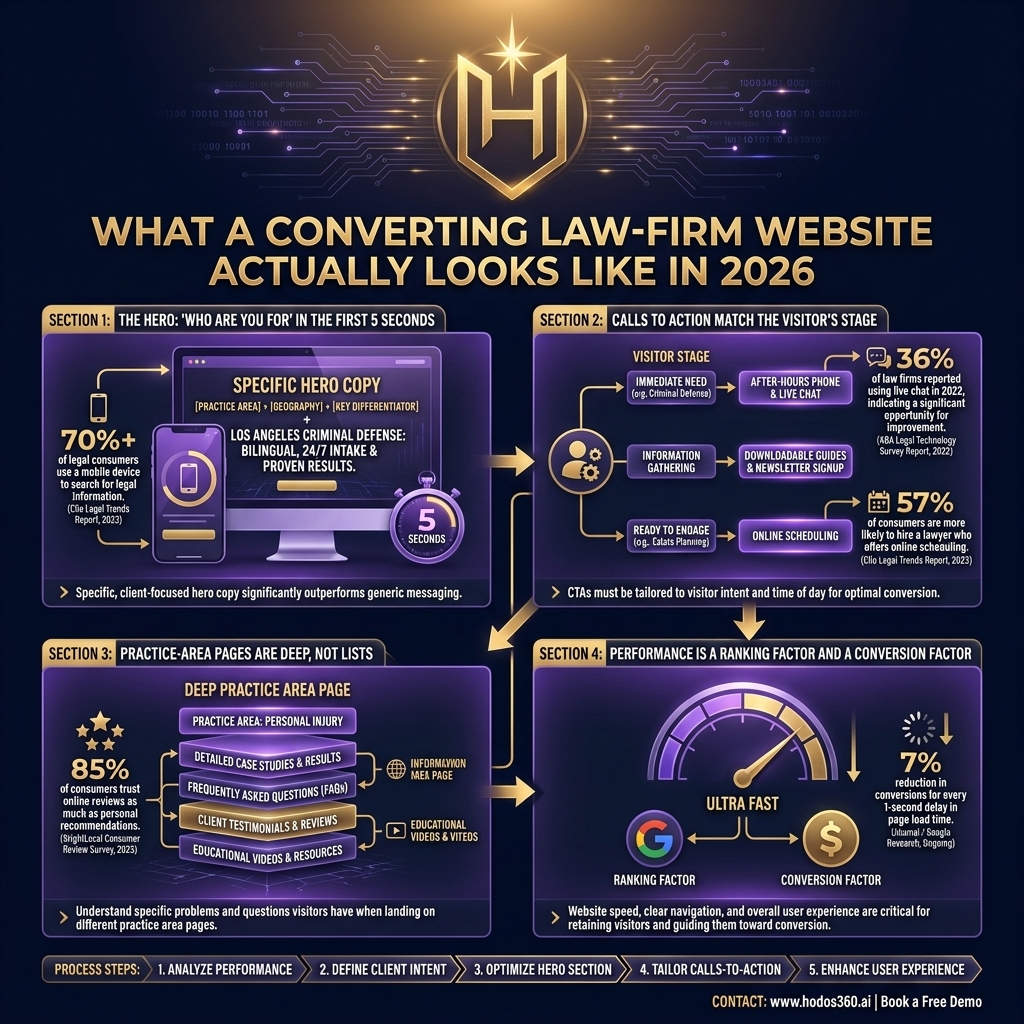
Most law-firm sites ship one CTA pattern (usually 'Contact Us') across the whole site. The fix: one primary CTA per page based on visitor intent. After-hours-relevant practices (criminal defense, PI, immigration emergency) should always show a phone link prominently. Transactional practices (estate, business formation) should lead with calendar booking. Awareness-stage visitors get a content download or newsletter signup. Don't ship a Swiss Army knife of CTAs and hope visitors pick the right one.
3. Practice-area pages are deep, not lists
A 'Practice Areas' page that lists 'Personal Injury · Immigration · Family Law · Criminal Defense' with a sentence each does almost nothing for SEO or conversion. Visitors searching 'workers comp denied claim attorney NC' don't land on the homepage; they land on the workers comp page (if it's deep enough to rank). If your workers comp page is a stub, you don't rank, you don't convert.
The fix: each practice area gets its own substantial page. 800–1500 words. Real qualification questions a potential client should ask. Real pricing transparency where ethics rules allow (contingency vs. flat-fee, retainers, etc). Real next steps. Real case studies where you have them. State-specific procedural notes if you serve a single state. The result is a page that ranks for long-tail queries AND converts the visitor when they get there.
4. Performance is a ranking factor and a conversion factor
Google's Core Web Vitals (LCP, INP, CLS) are real ranking factors and real user-experience factors. A site that takes 6 seconds to render the hero loses ~30% of mobile visitors before they see anything. A page that bumps content around as scripts load creates an immediately untrustworthy feeling — small thing, real conversion impact.
What this means in practice: hero images need to be optimized (AVIF or WebP, properly sized, not loaded from a third-party slow-CDN). Render-blocking JavaScript needs to be lazy-loaded or deferred. Animations have to use transform/opacity, not layout-affecting properties. None of this is exotic — it's basic web performance hygiene. The reason most law-firm websites fail it is that they were built by agencies whose default templates aren't tuned for legal traffic patterns (mobile-heavy, after-hours skewed, intent-driven).
5. The site is wired into the intake stack
This is the one most law-firm websites quietly fail. The website captures a contact form submission, an email goes to the firm's general inbox, and someone responds 'within 24 hours.' Meanwhile the lead has shopped two competitors and signed with one. Studies on time-to-first-response in legal sales show conversion drops by half when response time goes from under 5 minutes to over an hour.
The fix: form submissions go directly into the CRM (GoHighLevel, HubSpot, Clio Grow), trigger an immediate text/email confirmation to the prospect, schedule the consult automatically when calendar availability matches, and notify the on-call attorney via the channel they actually monitor (Slack, SMS, not email). For high-volume practices, voice intake gets the same treatment — calls to the AI agent flow through the same CRM with attribution preserved. The website becomes the entry point of an integrated pipeline instead of a brochure with a sad form on it.
What to skip
- ✓Sliders / carousels in the hero — proven to drop CTA engagement
- ✓Auto-playing video — annoying, slow, rarely watched
- ✓Live chat widgets that no one staffs (a chatbot that goes silent is worse than no chatbot)
- ✓Generic stock-photo lawyers — visitors discount them as templates
- ✓Long award lists in the hero (move them to the about page; visitors care about whether you can help, not your shelf decor)
- ✓Multiple competing CTAs per page