


Gemini AI: The Ultimate Guide for Law Firms
At LegalTech NYC 2026, the buzz wasn't just about incremental improvements; it was a palpable shift toward foundational AI integration. The legal community watched closely as Google, a titan of technological innovation, made a definitive move, announcing the significant expansion of its Gemini AI platform for law firms and individual lawyers, as reported by Reuters. This isn't merely an upgrade; it's a strategic pivot designed to embed sophisticated AI directly into the legal profession's core, promising to redefine everything from routine discovery tasks to complex litigation strategy. The announcement signals a clear intent from Google to become a central player in the fiercely competitive legal technology market, challenging established vendors and emerging AI startups alike. Law firm leaders, from boutique practices to global enterprises, are now grappling with the immediate implications of integrating such a powerful, general-purpose AI into their highly specialized and regulated environments.
This expansion builds on Google's deep expertise in large language models, following the success of its earlier AI initiatives and the broader industry's rapid advancements, spearheaded by companies like OpenAI with its GPT series and Anthropic's Claude. The competitive landscape, marked by significant funding rounds—such as Harvey AI's recent partnership with Allen & Overy and Clio's strategic acquisitions in the practice management space—underscores a market hungry for innovation that delivers tangible ROI. For lawyers and legal professionals, Google's move represents both an immense opportunity and a complex challenge: how to harness Gemini's capabilities to enhance client service, streamline operations, and maintain a competitive edge, all while navigating the ethical and practical considerations inherent in AI adoption. The focus shifts from merely *considering* AI to strategically *implementing* it as a core component of future-proof legal practice.
The promise of Gemini AI for law firms lies in its multimodal capabilities, extending beyond text generation to encompass data analysis, code interpretation, and even image understanding—a versatility that opens new frontiers for legal applications. Firms that embrace this technological wave stand to gain significant advantages in efficiency and insight. As the legal industry continues its digital transformation, platforms like Gemini are not just tools; they are catalysts for a paradigm shift, demanding a proactive approach from legal leaders. This guide delves into the specifics of Google's expanded Gemini platform, exploring its practical applications, strategic implications, and how law firms can effectively integrate this powerful legal AI to optimize their operations and client outcomes. The goal is to provide a roadmap for maximizing the potential of this groundbreaking platform, ensuring firms remain agile and competitive in an increasingly AI-driven legal ecosystem.
Ready to revolutionize your firm's operations with cutting-edge AI? Discover how HODOS 360's integrated solutions can empower your practice. [Book a Free Demo Today]
- ✓The Transformative Power of Gemini AI in Legal Practice
- ✓Practical Applications: How Gemini AI Empowers Lawyers
- ✓Navigating Ethical AI and Data Security in Legal Tech
- ✓Strategic Implementation: Integrating Gemini AI into Your Firm's Workflow
- ✓The Future of Legal Tech: Beyond Gemini AI
- ✓Key Takeaways and Next Steps
The Transformative Power of Gemini AI in Legal Practice
Google's expanded Gemini AI platform for law firms isn't just another software update; it's a fundamental re-imagining of how legal work can be performed. Following its initial rollout, Google's deep investment in AI, spearheaded by DeepMind and its formidable research teams, has culminated in an enterprise-grade offering tailored for the unique demands of the legal sector. This strategic move directly challenges existing legal tech giants and agile startups, creating a vibrant, yet competitive, market. As Sundar Pichai, CEO of Google and Alphabet, articulated during a recent investor call, 'Our commitment is to make AI helpful for everyone, and that extends deeply into professional domains like law, where the potential for efficiency and insight is immense.' This vision aligns with industry reports, such as a 2025 McKinsey study, which projected that generative AI could automate up to 30% of current legal tasks, freeing lawyers to focus on higher-value strategic work. The expansion aims to turn this projection into a tangible reality for law firms of all sizes, from solo practitioners to large enterprise operations.
The core of Gemini's transformative power lies in its advanced multimodal architecture, allowing it to process and understand not just text, but also code, images, and video—a capability that far surpasses many previous legal AI tools. For a law firm, this means the potential to analyze complex evidentiary documents, interpret technical specifications in patent cases, or even review video depositions with unprecedented speed and accuracy. This capability stands in stark contrast to earlier, more rudimentary AI systems that primarily focused on keyword search or basic document review. The competition is fierce, with companies like OpenAI, led by CEO Sam Altman, continually pushing the boundaries of large language models, and Anthropic, under Dario Amodei, emphasizing safety and interpretability. Google’s play with Gemini is to offer a comprehensive, integrated platform that can manage a wide array of legal routine tasks, from initial client intake to final brief drafting, significantly reducing the manual burden on legal professionals. Learn more about Essential AI SMS Marketing: Drive Law Firm Growth. This holistic approach is designed to ensure that law firms can leverage AI not just for isolated tasks, but as a cohesive part of their entire operational framework.
The impact on small firms is particularly noteworthy. Historically, advanced legal tech has been cost-prohibitive for smaller practices, creating a digital divide. However, Google's enterprise offerings, often structured with tiered pricing and integration with existing Workspace tools, aim to democratize access to sophisticated AI. This could level the playing field, allowing smaller company legal teams to compete more effectively with larger firms by leveraging the same powerful tools for research, document generation, and case management. The shift isn't just about efficiency; it's about strategic advantage. Law firms that quickly adapt to integrate Gemini AI for law firms into their daily workflow are poised to attract more clients, deliver faster results, and potentially reduce operational costs, creating a significant competitive edge in a crowded market. The legal industry is witnessing a pivotal moment, where foundational AI is moving from experimental concept to indispensable business asset, reshaping the very definition of legal practice.
Practical Applications: How Gemini AI Empowers Lawyers
The theoretical promise of AI quickly translates into tangible benefits when applied to the day-to-day operations of a law firm. Google's Gemini AI platform offers a suite of applications designed to augment the capabilities of lawyers across various practice areas. Consider the laborious process of legal research; Gemini can rapidly synthesize vast amounts of case law, statutes, and secondary sources, providing concise summaries and identifying relevant precedents in mere seconds—a task that would traditionally consume hours of a paralegal's or associate's time. This isn't just about speed; it's about depth. By quickly identifying nuances and potential counterarguments, lawyers can build more robust cases. Learn more about Essential AI Legal Adoption: Akin's Firmwide Success Blueprint. For instance, in a complex intellectual property dispute, Gemini could analyze thousands of patent documents and technical specifications, identifying infringement patterns or prior art that human reviewers might miss. This allows attorneys to focus on strategic analysis and client counseling, rather than exhaustive manual review. The practical application of Gemini AI for law firms truly transforms how legal tasks are approached, ushering in an era of unprecedented productivity and insight.
Streamlining Case Management and Client Intake
Beyond research, Gemini's capabilities expand into core administrative and client-facing functions. In case management, the AI can automate the categorization and tagging of documents, ensuring that every piece of evidence, correspondence, and pleading is correctly filed and easily retrievable. It can also assist in predicting case outcomes based on historical data and legal precedents, providing lawyers with data-driven insights to better advise clients. For client intake, Gemini-powered virtual assistants can conduct initial screenings, gather essential information, and even draft initial engagement letters, reducing the administrative burden on front-office staff. Learn more about AI Intern for Law Firms: Essential Value Beyond Time. This allows law firms to process new clients more efficiently and provide a seamless, professional experience from the very first interaction. Companies like Clio have demonstrated the immense value of integrated practice management, and Gemini's integration capabilities can further enhance such systems, offering predictive analytics and automated workflow steps that were previously unimaginable. The Google Gemini AI platform is truly a game-changer for modern legal operations.
Enhanced Document Automation and Review
Document automation and review are areas where Gemini AI for law firms truly shines. From drafting contracts and motions to reviewing extensive discovery sets, Gemini can generate high-quality legal documents based on templates and specific case details, significantly reducing drafting time and minimizing errors. In e-discovery, its ability to quickly review and flag relevant documents, identify privileged information, and redact sensitive data can save law firms hundreds of hours and substantial costs. A recent report by Thomson Reuters highlighted that firms leveraging AI for document review saw a 40% reduction in time spent on these tasks. Learn more about AI Patent Tools: Essential Strategies for IP Law Firms. This efficiency gain is not just about cost savings; it's about enabling lawyers to dedicate their expertise to strategic thinking and client advocacy, rather than the tedious, repetitive elements of legal work. The precision and speed offered by these tools are transforming what was once a bottleneck into a streamlined, high-efficiency process, allowing law firms to manage larger caseloads with greater accuracy and deliver superior outcomes.
Boost your firm's efficiency and client satisfaction with intelligent automation. Explore HODOS 360's AI Law Firm Management System designed for the modern legal practice.
Navigating Ethical AI and Data Security in Legal Tech
While the transformative potential of Gemini AI for law firms is undeniable, its implementation necessitates a rigorous consideration of ethical implications and data security. The legal profession operates under stringent rules of professional conduct, including duties of confidentiality, competence, and supervision. Integrating powerful AI tools means ensuring that the AI operates within these boundaries. The American Bar Association (ABA) Model Rules of Professional Conduct, particularly Rule 1.1 (Competence) and Rule 1.6 (Confidentiality of Information), provide a framework for lawyers to use technology responsibly. This includes understanding the AI's limitations, verifying its outputs, and protecting client data from unauthorized access or disclosure. Law firms cannot simply 'set and forget' AI; they must actively manage its use, providing adequate oversight and training for their staff. This human oversight is critical to prevent errors, biases, or misinterpretations that could lead to ethical breaches or malpractice claims.
Data security is another paramount concern. Legal documents often contain highly sensitive and privileged information, making robust cybersecurity measures non-negotiable. Google, as an enterprise-grade provider, invests heavily in security infrastructure, offering encryption, access controls, and compliance certifications. However, the responsibility also rests with the law firm to configure these tools securely, adhere to best practices for data handling, and ensure compliance with relevant data protection regulations like GDPR or CCPA. Learn more about AI Agents Unveiled: Essential Frontend Vision for Law Firms. Firms must implement clear policies for AI usage, including guidelines on what data can be fed into the AI, how outputs are verified, and who has access to AI-generated insights. The inherent risks of 'hallucinations' or biased outputs from generative AI models also underscore the need for human review and critical assessment of any AI-generated content or analysis, especially in areas like legal advice or factual findings. The EU AI Act, expected to be fully enforced by 2026, sets a global precedent for AI regulation, classifying AI systems based on risk and imposing strict requirements for high-risk applications, which will undoubtedly impact legal tech providers and users.
Furthermore, the ethical considerations expand to issues of transparency and explainability. Lawyers have a duty to communicate clearly with clients, which extends to explaining how AI is being used in their cases. Clients deserve to know if AI tools are assisting in document review, research, or drafting, and how those tools impact the overall legal strategy. The black box nature of some advanced AI models poses a challenge, requiring law firms to develop strategies for understanding and explaining AI decisions. This also touches upon the potential for algorithmic bias, where historical data used to train AI models might reflect societal biases, leading to unfair or discriminatory outcomes. Firms must proactively audit their AI systems for such biases and ensure that their use of Gemini AI for law firms upholds principles of justice and fairness, aligning with the core tenets of the legal profession. The ethical framework for AI in law is still evolving, requiring continuous vigilance and adaptation from legal professionals.

Strategic Implementation: Integrating Gemini AI into Your Firm's Workflow
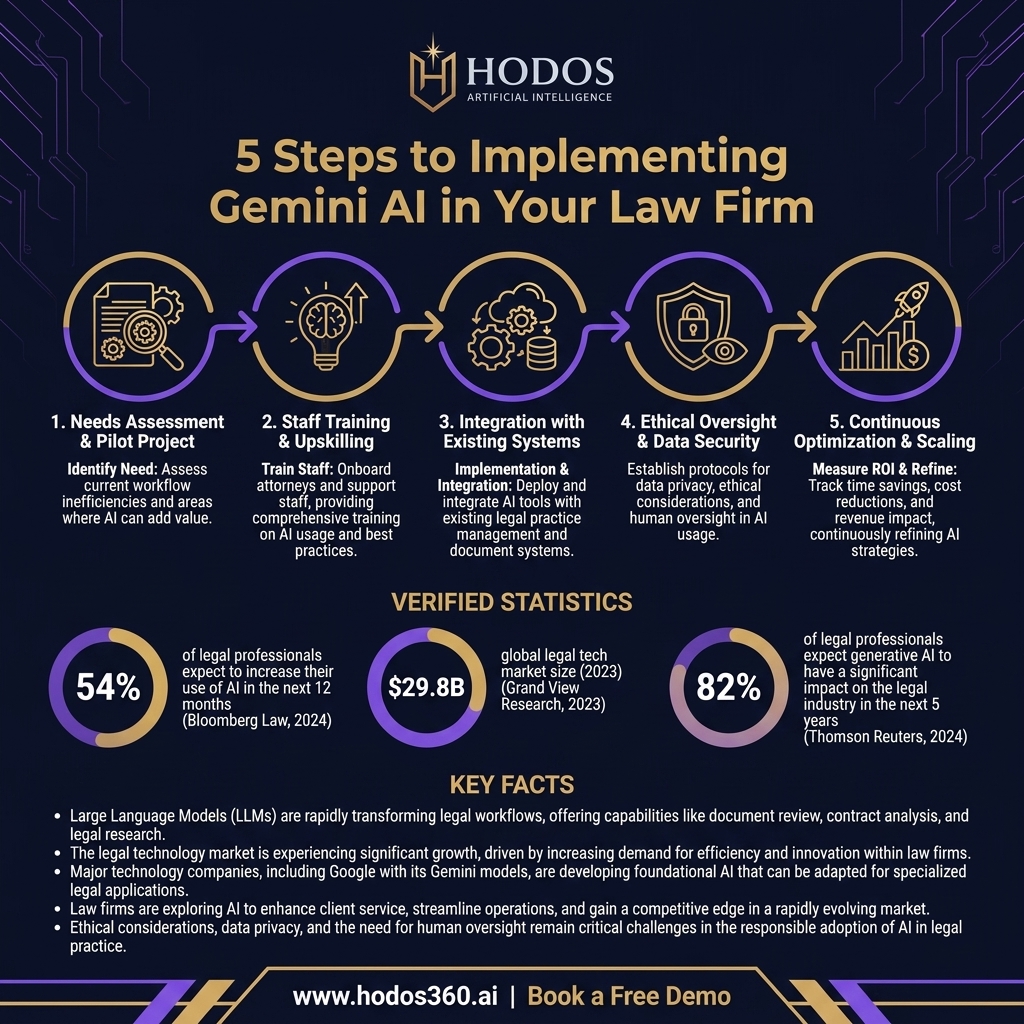
Successfully integrating Google's Gemini AI platform into a law firm's workflow requires more than just subscribing to a service; it demands a strategic, phased approach to change management and technology adoption. The first step involves a comprehensive audit of existing processes to identify pain points and areas where AI can deliver the most significant impact—be it in document review, contract analysis, or client communication. Firms should start with pilot projects, perhaps in a specific practice group or for a particular type of routine task, to test the waters and gather feedback. This iterative approach allows for adjustments and fine-tuning before a broader rollout. Key stakeholders, including senior partners, associates, and administrative staff, must be involved from the outset to foster buy-in and address any resistance to change. As Jack Newton, CEO of Clio, often emphasizes, 'Technology adoption isn't just about the software; it's about the people using it.' This human-centric approach is vital for successful AI integration.
Training and upskilling are paramount. Lawyers and legal staff need to understand not only how to use the Gemini AI tools but also how to critically evaluate their outputs and integrate them seamlessly into their existing tasks. This involves developing new skills in prompt engineering, data interpretation, and AI governance. Many law firms are now designating 'AI champions' within their teams to lead training initiatives and act as internal experts. Furthermore, integrating Gemini effectively means ensuring it can communicate with other essential platforms and systems already in use, such as practice management software, e-discovery platforms, and document management systems. Learn more about AI Voice Assistants: Ultimate Legal Strategy After Apple's Siri Settlement. Google's commitment to API accessibility and compatibility with various enterprise tools facilitates this, but firms must plan for robust integration strategies to avoid creating data silos or disjointed workflows. The goal is a cohesive technological ecosystem where AI enhances, rather than complicates, existing operations.
The financial implications of AI adoption, while initially appearing as an investment, often translate into significant long-term ROI. By automating routine tasks, law firms can reallocate valuable human resources to higher-value, client-facing activities, potentially increasing billable hours and improving client satisfaction. A Gartner report from 2024 indicated that early adopters of generative AI in professional services saw an average 15-20% improvement in operational efficiency within the first year. This tangible benefit makes the case for investment compelling. However, firms must also consider the ongoing costs of AI subscriptions, data storage, and potential customization. A clear business case, outlining anticipated cost savings and revenue growth, is essential for securing leadership buy-in. Ultimately, strategic implementation of Gemini AI for law firms is about building a future-proof practice, one that is agile, efficient, and capable of leveraging cutting-edge technology to deliver superior legal services and manage its resources effectively in a rapidly evolving market.
The Future of Legal Tech: Beyond Gemini AI
While Google's Gemini AI platform marks a significant milestone, the future of legal tech extends far beyond any single platform. The rapid pace of innovation, driven by breakthroughs in quantum computing, advanced robotics, and enhanced human-computer interfaces, promises an even more transformative landscape. The competition among tech giants and specialized legal AI startups will continue to drive rapid development, pushing the boundaries of what AI tools can achieve. We can anticipate even more sophisticated multimodal AI models that can better understand context, nuance, and even emotional cues, potentially revolutionizing client interactions and negotiation strategies. The integration of AI with augmented reality (AR) and virtual reality (VR) platforms could create immersive environments for legal training, courtroom simulations, or complex document visualization, offering lawyers unprecedented ways to prepare and present cases. The legal industry is at the cusp of an era where technology doesn't just assist but fundamentally reshapes the practice of law.
The evolving regulatory environment, exemplified by initiatives like the EU AI Act, will also play a crucial role in shaping the development and deployment of future legal AI. As AI systems become more autonomous and impactful, the need for robust ethical guidelines, transparency requirements, and accountability frameworks will become increasingly critical. This necessitates a proactive dialogue between legal professionals, technologists, and policymakers to ensure that AI serves justice and upholds societal values. Furthermore, the focus will expand beyond just individual AI tools to integrated, end-to-end platforms that offer a holistic solution for law firm management. This is where companies like HODOS 360 are already making significant strides, offering an AI-powered ecosystem that combines AI Law Firm Management Systems with AI Marketing Platforms, AI Voice Assistants, and Web & Mobile Development services. Such comprehensive platforms aim to streamline every aspect of a firm's operations, from client acquisition to case resolution, providing a competitive edge.
The ultimate goal for the legal sector isn't merely to adopt AI, but to strategically integrate it to foster innovation, improve access to justice, and empower lawyers to focus on their most impactful work. The journey initiated by the expansion of Gemini AI for law firms is just one chapter in this ongoing evolution. Firms that embrace continuous learning, invest in adaptable technology infrastructure, and prioritize ethical AI deployment will be best positioned to thrive. The future of legal practice will be characterized by intelligent automation, predictive insights, and hyper-personalized client experiences, all powered by an ever-advancing suite of AI tools. As the legal landscape continues its profound transformation, staying abreast of these developments and proactively adapting will be essential for any law firm aiming to lead in the digital age.

Key Takeaways and Next Steps
The expansion of Google's Gemini AI platform for law firms represents a pivotal moment in the legal industry's technological evolution. It underscores a clear trajectory towards more intelligent, efficient, and data-driven legal practice. For firm owners and legal professionals, the message is clear: AI is no longer an optional add-on but a strategic imperative. From automating routine tasks like document review and client intake to providing sophisticated insights for complex litigation, Gemini offers transformative tools that can significantly enhance operational efficiency and competitive advantage. The ability to manage vast datasets and generate precise legal content allows lawyers to reallocate their valuable time to strategic thinking, client counseling, and developing innovative legal solutions, thereby elevating the overall quality and impact of their work.
However, the journey of AI adoption is not without its complexities. Navigating the ethical landscape, ensuring robust data security, and implementing AI in a manner that aligns with professional responsibilities are paramount. Law firms must invest in continuous training, foster a culture of technological adaptation, and maintain vigilant human oversight over AI-powered workflows. The future of legal tech is an integrated one, where AI seamlessly supports every facet of a law firm's operations. Platforms like HODOS 360 are designed precisely for this integrated future, offering comprehensive AI Law Firm Management, Marketing, Voice Assistants, and Web & Mobile Development services. By embracing such holistic solutions, firms can not only leverage the power of Gemini AI for law firms but also build a resilient, future-ready practice that excels in client service and operational excellence.
The time for passive observation is over. Proactive engagement with AI technologies, starting with understanding and strategically deploying platforms like Google Gemini, is essential. Law firms that commit to this transformation will not only survive but thrive, setting new benchmarks for innovation and client value in the digital age. Focus on strategic integration, continuous learning, and ethical deployment to unlock the full potential of AI in your legal practice.
Frequently Asked Questions
What is Google Gemini AI for law firms?+
Google Gemini AI for law firms is an expanded, enterprise-grade platform leveraging Google's advanced multimodal AI capabilities. It's designed to help legal professionals automate routine tasks, streamline workflows, enhance legal research, and improve case management, thereby increasing efficiency and allowing lawyers to focus on higher-value strategic work. It integrates with existing Google Workspace tools and offers robust security features.
How can Gemini AI improve law firm efficiency?+
Gemini AI can significantly boost efficiency by automating tasks such as document review, legal research summarization, client intake, and initial contract drafting. Its multimodal understanding processes various data types, reducing manual effort and time. This frees up lawyers and staff to concentrate on complex legal strategy, client interaction, and business development, leading to faster case resolution and improved operational throughput.
What are the ethical considerations when using AI in legal practice?+
Ethical considerations include maintaining client confidentiality (ABA Model Rule 1.6), ensuring competence (ABA Model Rule 1.1) by verifying AI outputs, and managing potential algorithmic bias. Firms must provide human oversight, understand AI limitations, and ensure data security. Transparency with clients about AI usage and compliance with regulations like the EU AI Act are also critical for responsible AI deployment in legal practice.
Is Gemini AI suitable for small law firms?+
Yes, Google's enterprise offerings for Gemini AI are designed to be accessible and scalable, making them suitable for small law firms. By democratizing access to powerful AI tools, smaller practices can leverage advanced capabilities for research, document automation, and case management, helping them compete more effectively with larger firms, reduce operational costs, and improve their overall efficiency and client service.
How does Gemini AI compare to other legal AI tools?+
Gemini AI stands out due to its multimodal capabilities, processing text, code, images, and video, offering a broader range of applications than many text-focused AI tools. While specialized legal AI platforms exist, Google's integrated approach with its vast data infrastructure and enterprise security positions Gemini as a comprehensive solution. Its competitive edge lies in its versatility and potential for seamless integration into existing Google Workspace environments.