


Law Firm CRM Automation: Essential Guide to Integration
For years, Sarah Chen, managing partner at Chen & Associates, faced a recurring nightmare: promising leads slipping through the cracks, not due to lack of legal prowess, but a fractured client journey. Her firm's client relationship management (CRM) system housed invaluable client data, yet it remained a silo, disconnected from their marketing efforts.
This meant manual follow-ups, inconsistent communication, and a frustratingly opaque view of their client acquisition funnel. Chen’s frustration mirrors a common challenge for many legal firms today, struggling to bridge the operational chasm between client data management and dynamic client outreach. The competitive legal landscape, where client experience is paramount, demands a more cohesive approach than ever before.
This tension between traditional legal practice and the imperative for modern, integrated client engagement is precisely what the latest HODOS360 Editorial piece, “How to Connect Your Law Firm CRM with Marketing Automation,” seeks to address.
The core problem lies in the disconnect. A robust law firm CRM serves as the repository of client information, case details, and billing history—the very backbone of a legal practice.
However, without seamless integration with marketing automation, this wealth of data remains underutilized for proactive client engagement and lead nurturing. Firms often find themselves grappling with disjointed systems, where marketing campaigns are launched in one platform, client communications happen in another, and case management in yet another.
This fragmentation not only wastes precious billable hours but also creates inconsistent client experiences, eroding trust and potential referrals in an increasingly digital-first world. The cost of this operational inefficiency is not merely financial; it’s measured in missed opportunities and diminished client loyalty.
This comprehensive guide aims to illuminate the path forward, providing a strategic blueprint for integrating your law firm CRM with marketing automation.
We will delve into the tangible benefits, from streamlining client intake to automating personalized follow-ups, and outline practical, step-by-step approaches to achieve this synergy. By embracing this integration, legal firms can transform their client acquisition and retention strategies, ensuring every lead is nurtured, every client feels valued, and every marketing dollar delivers measurable returns.
This isn't just about adopting new tools; it's about fundamentally reshaping how legal services are delivered and perceived in the 21st century.
The Imperative of Integration: Why Law Firms Can't Afford Disjointed Systems
The legal industry, traditionally resistant to rapid technological shifts, is now at an inflection point. A recent Thomson Reuters report revealed that law firms investing more than 3% of their revenue in technology consistently outperform their peers in terms of growth and profitability. Yet, many legal firms continue to operate with fragmented data systems, where client information resides in one database, marketing campaign results in another, and communication logs in a third.
This leads to a critical inefficiency: a lack of a unified client view. Imagine a potential client who interacts with your firm's website, downloads a resource, calls for a consultation, and then sends an email – if these touchpoints aren't seamlessly recorded and connected, the firm loses valuable context, leading to generic responses and missed opportunities for personalized engagement.
The increasing demand for instant gratification from clients, a trend accelerated by experiences with consumer tech giants, highlights the urgency for a cohesive digital strategy in legal services.
The cost of inaction is becoming prohibitively high. The 2023 ABA Legal Technology Survey Report indicated that nearly 40% of small to mid-sized firms still rely on manual processes for client intake and lead management, a stark contrast to the sophisticated systems employed by industry leaders.
This technological lag creates a significant competitive disadvantage. Firms like Linklaters, which made headlines for its early adoption of AI for complex contract review, are setting a new standard for operational excellence and client service. This divergence creates a narrative of human conflict: firms embracing innovation are thriving, while those clinging to outdated methods risk stagnation.
The ability to track a client's journey from initial contact through case resolution and beyond, with every interaction logged and accessible, is no longer a luxury but a foundational requirement for sustained growth and superior client experience in a demanding market.
Furthermore, the digital expectations of today's legal clients are shaped by their everyday interactions with consumer brands.
Learn more about Legal AI Deployment: The Ultimate Firmwide Strategy for Torys. They expect personalized communication, timely updates, and easy access to information. When a law firm fails to deliver this seamless experience, it can lead to client churn. A McKinsey study on customer satisfaction across industries consistently shows that integrated, personalized experiences drive loyalty.
For legal firms, this translates to higher client retention and more robust referral networks. The principles of deep learning tutorials are now being applied to understand and predict client behavior in various sectors, and the legal industry is catching up. By unifying law firm CRM with marketing automation, firms can leverage their data to anticipate client needs and deliver proactive, tailored communications, moving beyond reactive service to truly client-centric practice.
This integration is not merely about adopting technology; it’s about strategically positioning your firm for future success. It allows for the creation of sophisticated, automated workflows that ensure no lead is forgotten, no client feels neglected, and every communication is timely and relevant. Without this unified approach, firms will continue to struggle with fragmented data, inefficient processes, and a diminished capacity to compete effectively for the modern legal client, ultimately hindering their ability to scale and innovate.
The imperative is clear: integrate or risk being left behind in a rapidly evolving legal market.
Unpacking the Power Duo: CRM and Marketing Automation for Legal Practice
At its core, a law firm CRM system, such as industry leaders Clio or MyCase, serves as the central nervous system for managing client relationships. It's designed to organize and track every aspect of a client's journey: contact information, case details, billing history, communication logs, and important documents.
For a busy legal practice, a robust CRM is indispensable for maintaining meticulous records, ensuring compliance, and providing a clear overview of each client's status. As Jack Newton, CEO of Clio, often emphasizes, the future of legal practice is client-centric, and a comprehensive CRM is the primary tool to achieve this, enabling lawyers to spend less time on administrative tasks and more time on high-value legal work.
It’s the foundation upon which efficient and client-focused legal services are built, centralizing critical information that would otherwise be scattered across disparate spreadsheets and email inboxes.
Complementing the CRM is marketing automation, a powerful suite of tools exemplified by platforms like GoHighLevel or HubSpot. These systems are engineered to automate repetitive marketing tasks, including email sequences, social media scheduling, lead nurturing campaigns, and content distribution.
They provide the ability to create sophisticated, multi-touch campaigns that engage potential clients at various stages of their decision-making process, all without constant manual intervention. Think of automated welcome emails to new leads, drip campaigns offering valuable legal insights, or targeted social media posts designed to attract specific demographics.
The rise of AI-powered content generation tools further amplifies the capabilities of these platforms, allowing firms to create personalized and relevant content at scale, ensuring a consistent and professional brand presence across all digital channels.
The true synergy emerges when these two powerful systems are integrated.
Learn more about AI Marketing Intelligence: The Ultimate Guide for Law Firms. The law firm CRM provides the 'who' – the rich client data, lead sources, and interaction history – while marketing automation provides the 'how' and 'when' – the personalized communication, timely follow-ups, and strategic content delivery.
For instance, when a new lead enters the CRM, an automated workflow can immediately trigger a series of personalized welcome emails from the marketing automation platform. If a client’s case status changes within the CRM, an automated notification or update can be sent, ensuring transparency and reducing client anxiety.
This seamless data flow ensures that every interaction is informed by the client’s history and tailored to their current needs, creating a truly integrated client experience.
This integrated approach offers a significant competitive edge for legal firms. It allows for faster lead response times, more effective personalization of client interactions, and precise tracking of marketing campaign ROI.
Firms can move beyond guesswork, understanding exactly which marketing efforts are converting into paying clients and adjusting their strategies accordingly. The principles of devops practices, emphasizing continuous integration and delivery, can be seen as a parallel in how legal marketing automation allows for constant refinement and improvement of client engagement strategies.
This holistic view of client management and marketing empowers firms to optimize their resource allocation, enhance client satisfaction, and ultimately drive sustainable growth in a crowded and competitive market.
Beyond Basic Email: Advanced Automation Workflows
The true power of integrating a law firm CRM with marketing automation extends far beyond simple email blasts. Consider advanced scenarios where the systems work in concert to create highly responsive and personalized client journeys. For example, if a potential client downloads a specific whitepaper on estate planning from your firm's website (tracked by the marketing automation system), their profile in the CRM is immediately updated with this interest.
This action can then trigger a precisely targeted email sequence offering a free consultation related to estate planning, rather than a generic firm overview. Learn more about AI Voice Assistants: Essential for Modern Law Firms. Or, for existing clients, a change in their case status within the CRM – perhaps from 'discovery' to 'settlement negotiations' – could automatically send a personalized, pre-approved update email, enhancing transparency and reducing inbound client queries.
These sophisticated automated workflows ensure that communication is always relevant, timely, and aligned with the client's current stage, fostering trust and improving satisfaction.
- ✓Enhanced Lead Nurturing: Automatically qualify and segment leads based on their interactions, ensuring targeted follow-ups.
- ✓Streamlined Client Onboarding: Automate welcome sequences, document requests, and initial appointment scheduling.
- ✓Personalized Communication: Deliver relevant content and updates based on client data from your law firm CRM.
- ✓Efficient Case Updates: Trigger automated client notifications when case statuses change, improving transparency.
- ✓Boosted Referral Generation: Automate requests for reviews and testimonials from satisfied clients post-case closure.
- ✓Measurable Marketing ROI: Track the entire client journey from lead to conversion, attributing success accurately.
- ✓Reduced Administrative Burden: Free up legal professionals from repetitive marketing and communication tasks.
Strategic Integration: A Step-by-Step Guide for Law Firms
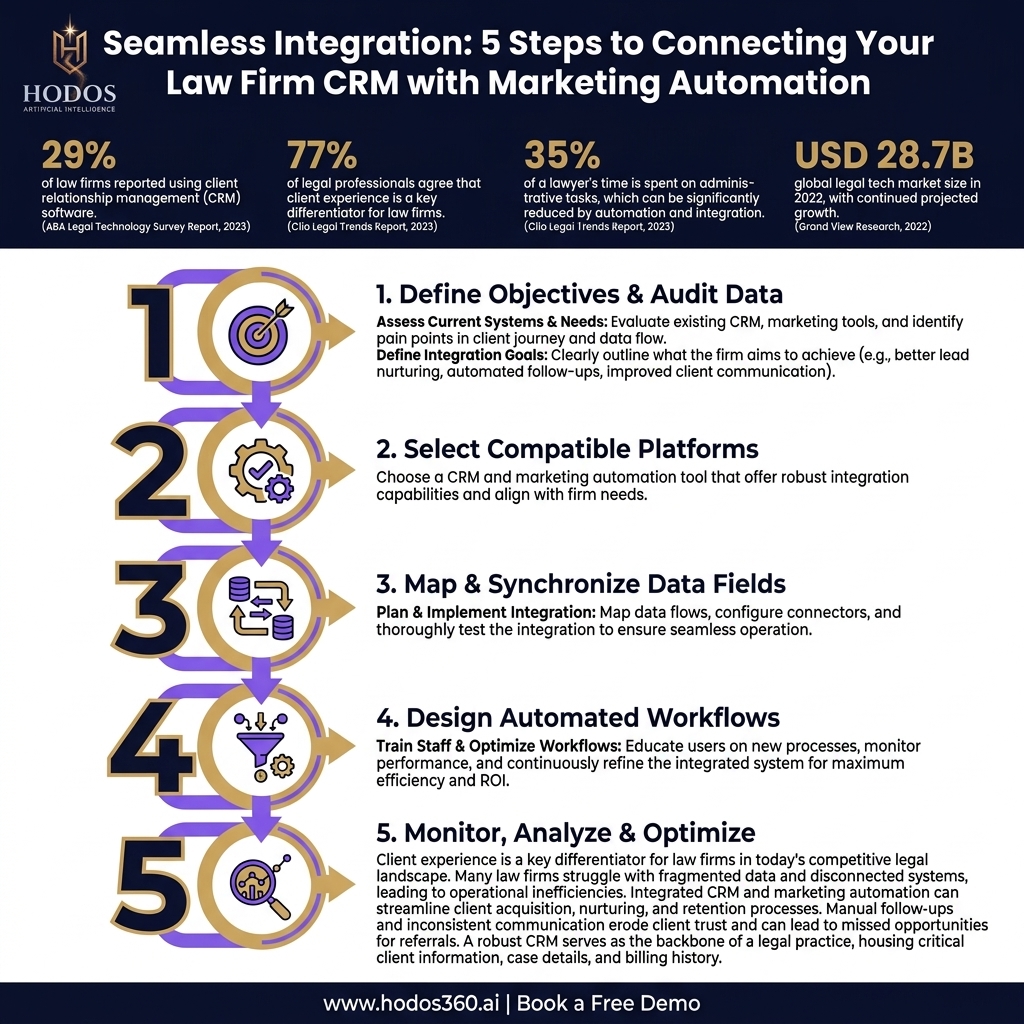
Successfully integrating your law firm CRM with marketing automation requires a methodical approach, starting with clearly defined objectives. Before diving into tools, firms must identify what they aim to achieve: Is it to reduce client acquisition costs by 15%? Improve lead conversion rates by 20%?
Enhance client retention by fostering better communication? As Brenda Smith, founder of LegalTech Consulting, frequently advises, "Firms often get caught up in the 'what' before defining the 'why.' A clear strategy is paramount." Simultaneously, a thorough audit of your existing client data within the CRM is crucial to ensure data hygiene.
Clean, accurate data is the bedrock of any effective automation strategy; garbage in, garbage out, as the adage goes. This initial planning phase, though time-consuming, lays the essential groundwork for a smooth and impactful integration process.
The next critical step involves selecting the right tools that are not only powerful in their own right but, crucially, are designed for seamless integration.
While we've discussed Clio and GoHighLevel, other robust options exist, such as HubSpot for Legal, Salesforce with legal customizations, or specialized legal marketing platforms. When evaluating platforms, prioritize those with strong API capabilities or native connectors to your existing law firm CRM. Compatibility is key to avoiding costly custom development and ensuring smooth data flow.
Consider scalability: will the chosen solution grow with your practice? The goal is to invest in a technology stack that supports your firm's current needs while being adaptable to future growth and evolving client demands, ensuring longevity and maximum return on investment.
Once platforms are chosen, the technical integration process begins.
This often involves leveraging native connectors provided by the software vendors, using middleware solutions like Zapier or Integrately for bespoke connections, or in some complex cases, custom API development. The core of this step is data mapping: meticulously defining how fields in your law firm CRM (e.g., client name, contact information, case type, lead source, status) correspond to fields in your marketing automation platform.
Learn more about Voice AI Unleashed: Essential Innovation for Modern Law Firms. Accurate data mapping ensures that information flows correctly between systems, preventing errors and enabling highly personalized campaigns. It's a precise process that demands attention to detail, ensuring that the integrity of your client data is maintained throughout the synchronization, which is paramount for both operational efficiency and ethical compliance.
With the systems integrated, the focus shifts to designing and implementing automated workflows. This is where the strategic vision comes to life. Develop specific sequences for lead qualification, client onboarding, post-case follow-ups, and even requests for online reviews. These workflows should be dynamic, responding to client actions and data points.
For example, if a client clicks a link about family law, they enter a specific family law nurturing sequence. Crucially, these workflows should be continuously tested and optimized through A/B testing of emails, landing pages, and calls-to-action. Furthermore, always consider compliance with data privacy regulations such as GDPR or CCPA when designing these automated processes, ensuring that automated data handling respects client confidentiality, as mandated by legal ethics like ABA Model Rule 1.6 (Confidentiality of Information).
Data Mapping and Synchronization Best Practices
Effective data mapping and synchronization are the linchpins of successful CRM-marketing automation integration. It's not enough to simply connect the two platforms; you must ensure the accurate, real-time flow of client data. Best practices include creating a comprehensive data dictionary that defines each field in both systems and how they correspond.
Establish clear rules for data conflicts, deciding which system is the 'master' for specific information. Learn more about Wordsmith AI's $100M Valuation: An Essential LegalTech Milestone. For instance, if a client updates their contact details via a web form (marketing automation), this change should automatically overwrite the old information in the law firm CRM.
Implementing robust error logging and regular data audits are also essential to catch and rectify any synchronization issues promptly. This meticulous approach ensures data integrity, prevents communication errors, and enables truly personalized interactions, upholding the highest standards of client service and ethical data management.
Maximizing ROI: Measuring Success and Optimizing Your Automated Workflows
The true measure of any technological investment lies in its return on investment (ROI). For law firm CRM and marketing automation integration, key performance indicators (KPIs) are crucial. These include lead conversion rates, client acquisition cost (CAC), client retention rates, email open and click-through rates, website traffic generated from campaigns, and, ultimately, revenue growth directly attributable to automated efforts.
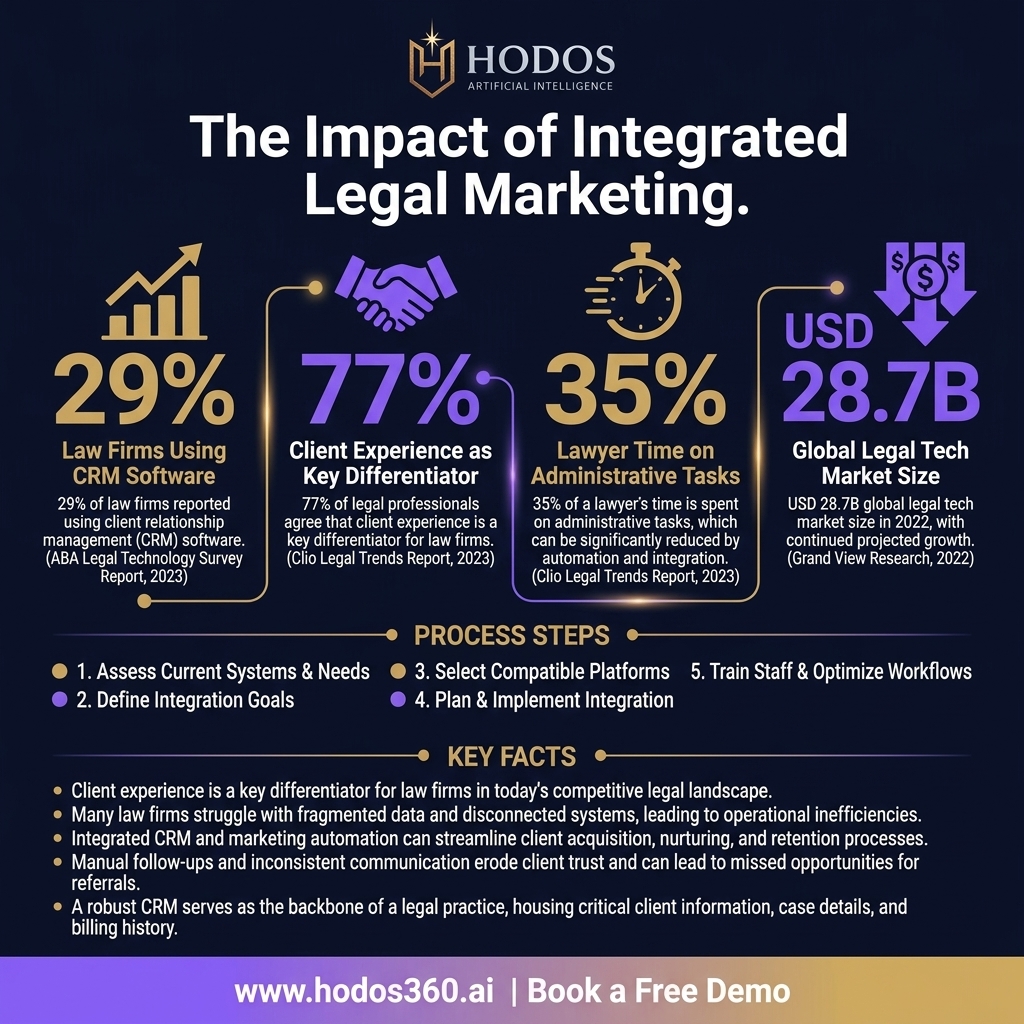
The goal extends beyond mere automation; it’s about driving measurable business growth for legal firms. By meticulously tracking these metrics, firms can move beyond anecdotal evidence and gain a data-driven understanding of what is truly working, allowing for strategic reallocation of resources and continuous improvement of their marketing endeavors.
This analytical rigor is what transforms technology adoption into a tangible competitive advantage.
The power of integrated analytics lies in its ability to provide a holistic view of the client journey. Your law firm CRM offers the ultimate conversion data – new cases opened, specific legal services rendered, and revenue generated.
The marketing automation platform, conversely, tracks engagement metrics such as website visits, content downloads, and email interactions. When these systems are connected, you can stitch together the entire story: from a prospective client’s first touchpoint with a social media ad to their final case resolution and subsequent referral.
This comprehensive insight, much like the sophisticated analytics employed by tech giants like Google and Meta to refine their advertising strategies, empowers legal firms to identify bottlenecks, pinpoint successful campaigns, and understand the true impact of their marketing spend, optimizing every stage of the client lifecycle.
Optimization is not a one-time event but an ongoing, iterative process. Regular review of your data is paramount. Learn more about AI Marketing: Essential Strategies for Law Firm Growth. A/B test different elements of your campaigns: email subject lines, call-to-actions, landing page designs, and even the timing of your communications.
Refine your target audience segmentation based on performance data to ensure your messages resonate with the right prospective client. This iterative approach mirrors agile development methodologies, where continuous feedback and refinement lead to superior outcomes. Feedback loops, both from client responses and internal team observations, are invaluable for fine-tuning your automated workflows.
This commitment to continuous improvement ensures that your integrated system remains a dynamic, high-performing asset, constantly adapting to market changes and client needs.
Real-world examples underscore the transformative ROI. Consider a mid-sized personal injury firm that, after implementing a CRM-marketing automation integration, reduced its lead response time from 48 hours to less than 4 hours.
This dramatic improvement led to a 25% increase in new client intake within six months, directly impacting their bottom line. Another firm leveraged automated post-case follow-ups and review requests, resulting in a 30% increase in positive online reviews and a significant boost in referral business.
These tangible results demonstrate that the investment in integrated systems pays dividends, not just in efficiency but in measurable growth and enhanced client relationships. Furthermore, leveraging insights from deep learning tutorials can allow firms to explore predictive analytics, identifying which leads are most likely to convert based on historical data, further amplifying ROI.
Leveraging AI for Predictive Analytics
The future of law firm CRM and marketing automation is increasingly intertwined with artificial intelligence. With robust, integrated data, firms can move beyond reactive marketing to proactive, predictive engagement. AI, informed by deep learning tutorials and advanced algorithms, can analyze historical client data and interactions to identify patterns.
This allows firms to predict which leads are most likely to convert, enabling highly targeted resource allocation. Furthermore, AI can forecast which existing clients might be at risk of churn, prompting proactive retention strategies. This predictive capability empowers lawyers and marketing teams to make data-driven decisions, optimizing marketing spend and focusing efforts where they will yield the greatest impact, transforming the firm's approach to client engagement from guesswork to strategic foresight, ensuring every interaction is impactful and timely.
Overcoming Challenges and Future-Proofing Your Legal Marketing
While the benefits of integrating law firm CRM with marketing automation are profound, the journey is not without its hurdles. Common challenges include the initial complexity of setup, potential data migration issues from legacy systems, and perhaps most significantly, resistance from staff. Attorneys and paralegals, accustomed to established routines, may view new technology as an added burden rather than an efficiency gain.
As legal tech expert Alex Hamilton, CEO of Radiant Law, once noted, "Technology adoption is 20% tech and 80% change management." Overcoming these challenges requires clear communication, comprehensive training, and visible leadership buy-in. Firms must convey *why* these systems are being implemented—to simplify work, improve client outcomes, and ultimately grow the practice—not just to introduce new tools.
This cultural shift, championed by firm leaders, is crucial for successful legal tech adoption.
Effective staff training and securing buy-in are paramount for successful integration. It’s not enough to simply roll out new software; legal professionals need to understand its value proposition and feel comfortable using it.
Hands-on workshops, clear documentation, and dedicated support channels can significantly ease the transition. Firms should highlight how the new integrated system will automate tedious administrative tasks, freeing up valuable time for more complex legal work and direct client interactions. This empowerment can turn initial resistance into enthusiastic adoption.
Creating internal champions who can advocate for the new system and assist colleagues can further accelerate the adoption curve, fostering a collaborative environment where technology is seen as an enabler, not a hindrance, to providing superior client services.
Future-proofing your legal marketing strategy demands foresight and flexibility.
The legal tech landscape is in constant flux, with new innovations emerging regularly. When selecting your law firm CRM and marketing automation platforms, prioritize solutions that are flexible, scalable, and offer robust integration capabilities with emerging technologies. Consider platforms that are actively developing AI features for legal research, generative AI for content creation, or advanced analytics.
The enforcement of the EU AI Act, for instance, highlights the increasing regulatory scrutiny on automated decision-making, underscoring the need for transparent and compliant systems. Choosing adaptable platforms ensures your investment remains relevant and capable of evolving with future technological advancements and regulatory changes, protecting your firm’s competitive edge.
Ultimately, integrating your law firm CRM with marketing automation is more than a technological upgrade; it's a strategic imperative for building a resilient, client-centric practice ready for the future. It empowers lawyers to focus on their core competency—providing exceptional legal counsel—while the integrated technology expertly manages the intricate dance of client engagement, lead nurturing, and practice growth.
By embracing these integrated systems, firms are not merely keeping pace with the digital age; they are actively shaping their future, ensuring they remain competitive, efficient, and deeply connected with their clients. This foresight and commitment to innovation are what will define the successful legal practices of tomorrow.
Key Takeaways and Next Steps
The journey from fragmented systems to a fully integrated law firm CRM and marketing automation platform marks a pivotal transformation for any legal practice. As we've explored, this synergy is no longer a strategic advantage but an indispensable requirement for modern legal firms seeking sustainable growth and unparalleled efficiency.
The benefits are clear: a significantly improved client experience driven by personalized, timely communications; streamlined internal operations that free up valuable legal professional time; and a measurable return on investment through optimized marketing spend and enhanced client retention. Embracing this integration strategy allows firms to not only meet but exceed the evolving expectations of today’s digitally-savvy clients, ensuring a competitive edge in a demanding market.
For firms ready to embark on this transformative journey, the next steps involve a thorough assessment of current systems, defining clear objectives, and meticulously planning the integration process. Platforms like HODOS 360, with its comprehensive AI Law Firm Management System and AI Marketing Platform, are specifically designed to provide this exact synergy, empowering legal practices to thrive in a digital-first world.
By connecting your law firm CRM with powerful marketing automation, you're not just adopting technology; you're investing in the future success and resilience of your legal practice, ensuring that every client interaction is optimized and every growth opportunity is seized. Don't let your firm be left behind; start planning your integrated future today.
Frequently Asked Questions
What is the primary benefit of integrating a law firm CRM with marketing automation?+
The primary benefit is creating a seamless, personalized client journey from initial lead to case resolution and beyond. This integration ensures that client data from your law firm CRM informs every marketing interaction, leading to more relevant communications, improved lead nurturing, faster follow-ups, and ultimately, higher client conversion and retention rates. It significantly boosts operational efficiency and client satisfaction.
Can small law firms also benefit from CRM and marketing automation integration?+
Absolutely. Small law firms often have limited resources and staff, making automated workflows even more critical. Integrating a law firm CRM with marketing automation allows small firms to compete with larger ones by professionalizing their client outreach, streamlining administrative tasks, and ensuring consistent follow-up without needing to hire additional marketing personnel. It scales their impact without scaling their overhead.
What are common challenges in integrating these systems?+
Common challenges include initial setup complexity, ensuring accurate data migration from existing systems, and securing staff buy-in. Resistance to change from attorneys and administrative staff can hinder adoption. Additionally, maintaining data hygiene and ensuring seamless, real-time synchronization between the law firm CRM and marketing automation platform requires careful planning and ongoing management to avoid errors.
How does AI play a role in law firm marketing automation?+
AI enhances law firm CRM and marketing automation by enabling predictive analytics. It can analyze client data to identify which leads are most likely to convert, personalize content at scale, and even predict client churn. AI-powered tools streamline content generation and optimize campaign performance, allowing legal firms to make more data-driven decisions and achieve higher ROI from their marketing efforts.
Which specific tools are commonly used for this integration?+
Popular law firm CRM systems include Clio, MyCase, and PracticePanther. For marketing automation, common platforms are GoHighLevel, HubSpot, and ActiveCampaign. The integration often occurs through native connectors provided by these tools, or via third-party middleware like Zapier for more customized data flow between the CRM and the marketing automation platform, ensuring seamless client interactions.
How can I measure the ROI of my integrated marketing efforts?+
Measuring ROI involves tracking key metrics like lead conversion rates, client acquisition cost, client retention rates, and revenue directly attributed to marketing campaigns. By linking data from your law firm CRM (new cases, revenue) with marketing automation analytics (email engagement, website traffic), you gain a holistic view. This allows legal firms to understand which automated efforts are most effective and to optimize their strategies for maximum impact.