


Wordsmith AI's $100M Valuation: An Essential LegalTech Milestone
The legal industry is witnessing a seismic shift, driven by rapid advancements in artificial intelligence. This transformation was recently underscored by a headline-grabbing announcement: Scottish legaltech firm Wordsmith AI secured a staggering $100 million valuation, as reported by the Law Society of Scotland. This isn't merely a financial triumph for an Edinburgh-based startup; it's a powerful signal reverberating across the global legal landscape, affirming the immense potential and growing investor confidence in AI-powered legal solutions.
For law firms grappling with efficiency, client demands, and the relentless pace of change, Wordsmith AI's journey from a nascent venture to a 'unicorn in waiting' offers a compelling blueprint for the future of legal practice.
This landmark valuation places Wordsmith AI firmly on the map alongside established players and emerging innovators.
Its success mirrors the broader trend of significant investment flowing into legal AI, exemplified by companies like Harvey AI, which famously partnered with global giant Allen & Overy to embed generative AI into their operations. The question for many law firm owners and attorneys is no longer *if* AI will impact their practice, but *how* quickly it will redefine workflows, client relationships, and competitive advantage.
The $100 million valuation of Wordsmith AI serves as a stark reminder that the future of legal is here, and it's intelligent, integrated, and rapidly evolving. Firms that embrace this evolution are not just adopting new tools; they are strategically repositioning themselves for sustained growth and unparalleled efficiency.
The Wordsmith AI Phenomenon: A Deeper Dive into its Rapid Ascent
The story of Wordsmith AI's meteoric rise is a testament to the power of targeted innovation in a traditionally conservative sector. Founded by visionary CEO Jamie Levy, the Edinburgh-based startup quickly gained traction by addressing critical pain points for legal professionals. Their core offering centers around advanced natural language processing (NLP) and machine learning, designed to automate and enhance complex legal tasks such as document review, contract analysis, and legal research.
This focus on practical, impactful applications, rather than theoretical concepts, has been a key driver of their success. The recent $25 million Series A round, which propelled their valuation to $100 million, attracted significant investor attention, signifying a belief not just in their technology, but in the substantial market opportunity for intelligent legal automation.
This rapid growth, achieved in a relatively short timeframe, highlights the urgent demand within the legal community for solutions that deliver tangible improvements in productivity and accuracy.
What sets Wordsmith AI apart in a crowded legaltech landscape, which includes giants like LexisNexis and Thomson Reuters, as well as agile startups like Casetext and Disco?
It's their nuanced understanding of legal language and context. Jamie Levy's team has meticulously trained their models on vast datasets of legal documents, ensuring a high degree of precision that generic AI tools often lack. This specialized approach allows their platform to not only identify key clauses and anomalies but also to understand the subtle implications within legal text, a capability that dramatically reduces the time and effort required for due diligence and compliance.
The Law Society of Scotland's recognition of their value underscores the firm's credibility and its potential to set new industry standards. This isn't just about speed; it's about augmenting legal expertise with intelligent automation, freeing up attorneys to focus on strategic thinking and client counsel, rather than rote tasks.
The competitive tension in the legal AI market is palpable, with firms vying to offer the most intuitive and powerful tools. Learn more about Website Design Cost 2026: Strategic Investment for Law Firms. Wordsmith AI's success demonstrates that deep specialization and a clear value proposition can carve out a significant niche, even against well-funded incumbents.
Their rapid expansion also reflects a growing willingness among law firms, both large and small, to invest in cutting-edge technology. For years, the legal sector was often perceived as a laggard in tech adoption, but the narrative is changing. The 'death of a unicorn' in other sectors might be a cautionary tale, but in legaltech, the birth of a potential unicorn like Wordsmith AI signifies robust health and an accelerating pace of innovation.
This shift is not without its challenges, as firms must navigate the complexities of integration and change management, but the rewards for early adopters are becoming increasingly clear.
Indeed, the implications of Wordsmith AI's valuation extend beyond financial metrics. It validates the entire legaltech ecosystem, encouraging further investment and development in areas that promise to revolutionize legal service delivery.
For law firms, this means a wider array of sophisticated tools becoming available, offering opportunities to enhance everything from client intake to litigation support. The drive towards greater efficiency and data-driven decision-making is now an undeniable force, and companies like Wordsmith AI are at the vanguard of this movement, demonstrating that legal professionals can leverage advanced AI not just to survive, but to thrive in an increasingly complex and competitive environment.
Their journey serves as a powerful case study for what focused innovation can achieve.
Beyond the Hype: Wordsmith AI's Core Value Proposition
Wordsmith AI's value proposition is rooted in addressing the most time-consuming and labor-intensive aspects of legal work. Their platform excels in automating tasks like contract review, where it can rapidly identify relevant clauses, flag inconsistencies, and highlight potential risks, significantly compressing timelines for M&A due diligence or compliance checks.
This capability moves beyond simple keyword searches, employing contextual understanding to provide truly actionable insights. Learn more about AI Marketing Automation: Law Firms' 2026 Growth Catalyst. Furthermore, its ability to assist with legal research by synthesizing vast amounts of information and identifying pertinent precedents and statutes offers a substantial advantage, reducing the burden on legal teams to manually sift through endless databases.
The platform's intuitive interface also lowers the barrier to entry, making sophisticated AI accessible to a wider range of legal professionals, from seasoned partners to junior associates, thereby democratizing advanced legal technology.
The Broader LegalTech Investment Surge: What $100M Signifies
Wordsmith AI's $100 million valuation is not an isolated incident but rather a prominent indicator of a much larger trend: the accelerating investment in legal technology worldwide. According to a 2024 report by McKinsey & Company, AI is projected to add trillions to the global economy, with professional services, including legal, being a primary beneficiary of efficiency gains.

Gartner's projections for legal tech spending also show a consistent upward trajectory, with firms increasingly allocating significant budgets to digital transformation initiatives. This surge is fueled by several factors: the increasing complexity of legal matters, the demand for greater efficiency from clients, and the growing sophistication of AI tools themselves.
Venture capital firms, seeing the ripe opportunity in a sector historically slow to innovate, are pouring capital into startups that promise to disrupt traditional legal service delivery models. Major players like Sequoia Capital and Andreessen Horowitz have notably increased their portfolios in the broader AI space, recognizing its transformative potential across industries.
This investment boom has created a vibrant ecosystem where companies like Clio, a leader in practice management software, continue to expand through organic growth and strategic acquisitions, integrating more AI capabilities into their comprehensive platforms. Similarly, the partnership between Allen & Overy and Harvey AI, spearheaded by visionaries like Jonathan Brayne, A&O's Global Head of Legal Tech, demonstrates how even the most established global law firms are actively integrating advanced generative AI to enhance legal research, drafting, and client service.
These collaborations and funding rounds signify a collective belief that AI is not a fleeting trend but a fundamental shift in how legal work will be performed. The competition among legaltech providers is fierce, driving innovation at an unprecedented pace, as each firm strives to offer the most robust, secure, and user-friendly solutions to a discerning legal market.
The drama of disruption versus tradition is playing out across the legal sector. Learn more about WordPress AI Unlocked: Legal Websites Mastered 2026. Firms that have been proactive in adopting AI are already reporting significant competitive advantages, from faster case resolution to higher client satisfaction.
For example, the ABA TechReport 2025 indicated that firms leveraging AI for e-discovery or contract analysis reported an average of 30-50% time savings on specific tasks, directly translating into reduced costs and increased profitability. This stark contrast creates a sense of FOMO (Fear Of Missing Out) among those still hesitant to embrace AI, fueling further adoption.
The influx of capital into firms like Wordsmith AI ensures that the pipeline of innovation remains strong, with new tools and enhanced capabilities continually emerging, pushing the boundaries of what is possible in legal practice and challenging firms to adapt or risk being left behind in a rapidly evolving market.
This robust investment also underscores the belief that AI solutions can scale globally, addressing diverse legal systems and languages. The success of a Scottish-based startup like Wordsmith AI, with its potential for international reach, exemplifies this global vision. As AI models become more adept at handling multilingual content and jurisdiction-specific nuances, their applicability expands exponentially.
The legaltech investment surge is fundamentally about empowering legal professionals with tools that enhance their capabilities, reduce administrative burdens, and ultimately improve access to justice by making legal services more efficient and affordable. It's a strategic move to future-proof the legal profession, ensuring it remains relevant and effective in an increasingly data-driven world, while simultaneously creating new opportunities for growth and specialization.
AI's Transformative Impact on Law Firm Management and Operations
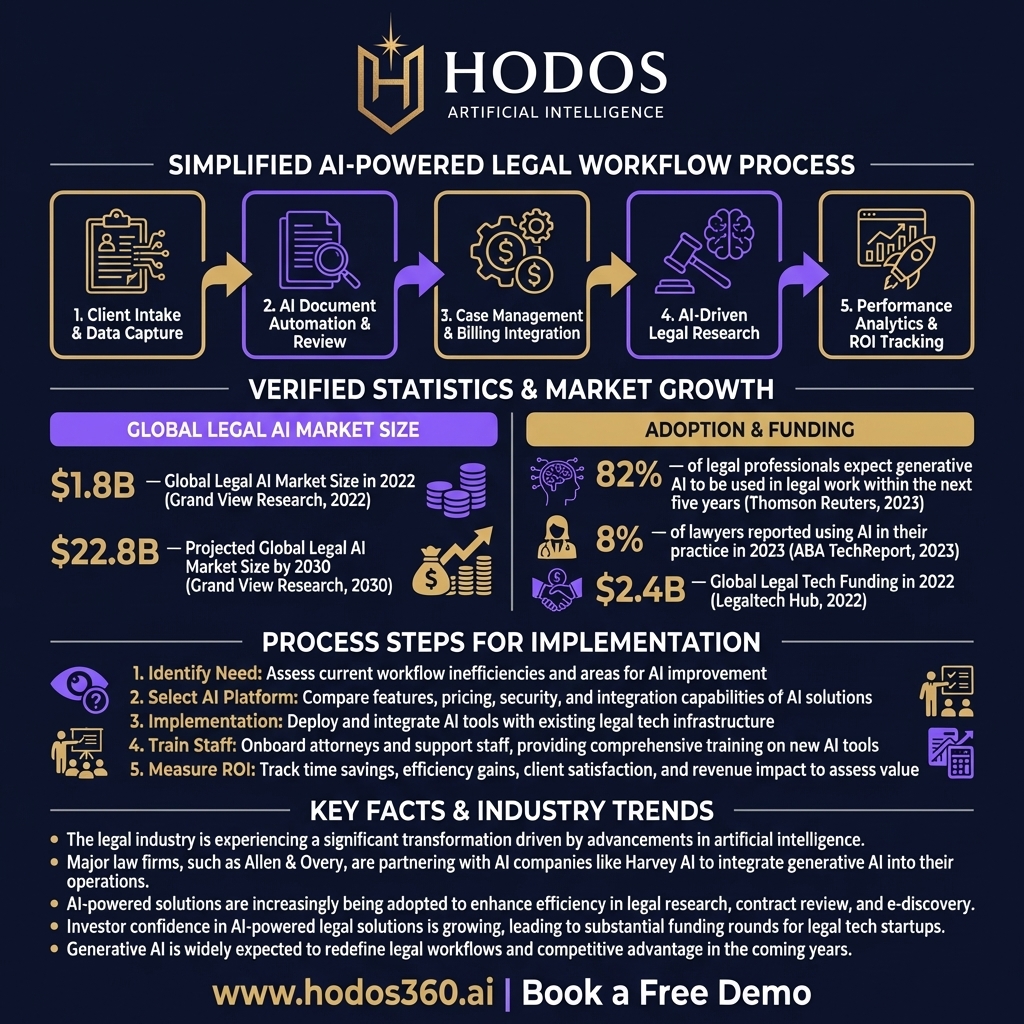
The impact of AI extends far beyond sophisticated legal research; it is fundamentally reshaping the operational backbone of law firms. Comprehensive AI Law Firm Management Systems, such as those offered by HODOS 360, are integrating capabilities that streamline every aspect of practice. From automated client intake processes that capture essential information efficiently, to intelligent case management systems that track deadlines and progress with unparalleled precision, AI is eliminating manual bottlenecks.
Billing and invoicing are becoming more accurate and less time-consuming through AI-powered automation, ensuring that firms can focus on revenue generation rather than administrative overhead. The overarching benefit is a significant boost in operational efficiency, allowing legal teams to reallocate valuable time from mundane tasks to high-value client work and strategic legal analysis.
Document automation, a cornerstone of AI in law firm management, is perhaps one of the most immediately impactful applications. Instead of manually drafting repetitive legal documents, AI-powered platforms can generate customized contracts, pleadings, and agreements based on predefined templates and client-specific data, drastically reducing drafting time and minimizing human error.
This not only accelerates workflows but also ensures consistency and compliance across all documentation. Furthermore, AI-powered legal workflows can guide attorneys through complex processes, suggesting next steps, identifying relevant precedents, and even assisting with strategic planning. This augmentation of human intelligence with machine capabilities ensures a more robust and error-resistant practice, allowing firms to handle a higher volume of cases without compromising on quality or accuracy.
The implementation of such systems is no longer a luxury but a strategic imperative for firms aiming for sustained competitiveness.
Beyond internal operations, AI is also revolutionizing how law firms engage with the outside world. Learn more about Legal AI Adoption: An Essential Guide for Discerning Firms.
An AI Marketing Platform can automate social media content creation, generate targeted campaigns, and provide real-time analytics to track ROI, ensuring marketing efforts are maximally effective. Similarly, AI Voice Assistants are transforming client service, offering 24/7 phone answering, lead qualification, and appointment booking. These multilingual assistants can handle routine inquiries, freeing up human staff for more complex client interactions, and ensuring no potential lead is missed.
The integration of these external-facing AI tools with internal management systems creates a cohesive, intelligent ecosystem that drives both efficiency and growth, providing a holistic approach to modern legal practice.
However, the adoption of AI in legal practice also brings ethical considerations to the forefront.
The American Bar Association (ABA) Model Rules of Professional Conduct, particularly Rule 1.1 (Competence) and Rule 1.6 (Confidentiality of Information), are highly relevant. Lawyers have a duty to understand the technology they use and ensure client data is protected. Firms must implement robust data governance policies and provide adequate training to ensure ethical and responsible AI deployment.
The EU AI Act, for instance, sets a precedent for regulatory oversight, classifying AI systems by risk level and imposing strict transparency and accountability requirements. Navigating these ethical and regulatory landscapes is crucial for successful AI integration, ensuring that technological advancement is balanced with professional responsibility and client trust.
The Ethical Imperative: Navigating AI in Legal Practice
As AI becomes more integrated into legal workflows, the ethical responsibilities of attorneys grow in parallel. Ensuring the competence required by ABA Model Rule 1.1 means understanding the capabilities and limitations of AI tools, and supervising their output to prevent errors or biases. The risk of AI-generated content containing inaccuracies or 'hallucinations' necessitates diligent human review.
Furthermore, safeguarding client confidentiality under Rule 1.6 demands robust data security measures for any AI platform handling sensitive information. Learn more about AI Web Development: Revolutionizing Law Firm Websites in 2026. Firms must also be transparent with clients about the use of AI, particularly in areas like legal research or document drafting, to maintain trust.
The ongoing development of regulatory frameworks, such as the EU AI Act, which categorizes AI systems by risk, underscores the global push for accountable and ethical AI, requiring law firms to remain vigilant and adaptive to evolving legal and ethical standards.
Strategic Advantages for Law Firms Embracing AI Innovation
Law firms that strategically embrace AI innovation are not just improving efficiency; they are fundamentally reshaping their competitive landscape. The ability to process information faster, draft documents more accurately, and manage cases with greater precision translates directly into a superior client experience and a stronger market position.
Consider a firm like Allen & Overy, whose early adoption of Harvey AI not only streamlined their internal processes but also positioned them as a forward-thinking leader capable of delivering cutting-edge legal solutions. This kind of technological prowess becomes a significant differentiator, attracting top-tier clients who increasingly expect modern, efficient service delivery.
Moreover, firms leveraging AI can offer more competitive pricing for certain services due to reduced operational costs, further enhancing their market appeal and expanding their client base beyond traditional boundaries.
Beyond client acquisition, AI plays a crucial role in attracting and retaining top legal talent.
Younger generations of attorneys and legal professionals are entering the workforce with an expectation of modern tools and efficient workflows. Firms that offer state-of-the-art AI platforms, reducing the burden of repetitive tasks and allowing lawyers to focus on more intellectually stimulating work, become significantly more attractive employers.
This focus on empowering legal professionals, rather than replacing them, fosters a more engaging and productive work environment. The ability to automate mundane tasks means attorneys can dedicate more time to complex legal strategy, client interaction, and professional development, leading to higher job satisfaction and lower turnover rates.
This strategic advantage in human capital is invaluable in today's competitive legal market, where talent is a key differentiator.
The strategic benefits also extend to new growth avenues. Learn more about AI Chatbot Builders: Transform Your Law Firm in 2026. With an AI-powered Web & Mobile Development platform, firms can build highly optimized, AI-driven websites that enhance their online presence, improve SEO, and convert visitors into clients more effectively.
These platforms leverage AI to create responsive designs and high-converting templates, ensuring a strong digital footprint. Furthermore, the data generated by AI tools, from client intake metrics to case management analytics, provides invaluable insights for strategic decision-making. Firms can identify trends, forecast workloads, and optimize resource allocation with unprecedented accuracy, moving from reactive problem-solving to proactive, data-informed strategy.
This level of foresight is a game-changer for long-term business planning and sustained growth.
The visionary insights of thought leaders like Richard Susskind, who has long predicted the profound impact of technology on the legal profession, are now manifesting in real-world applications. Firms that are future-proofing their practice are looking beyond basic automation to predictive analytics, using AI to anticipate legal outcomes and inform litigation strategies.
They are also exploring advanced generative AI for crafting complex legal arguments and synthesizing vast legal knowledge into persuasive briefs. This evolution means the role of the human lawyer is shifting, becoming more focused on judgment, empathy, and strategic oversight, while AI handles the heavy lifting of information processing and pattern recognition.
Embracing this shift is not just about adopting technology; it’s about redefining what it means to be a legal professional in the 21st century, ensuring that the practice remains dynamic, innovative, and client-centric.
Future-Proofing Your Practice: Beyond Basic Automation
Future-proofing a legal practice in the AI era means moving beyond simple task automation to strategic integration. This involves leveraging AI for predictive analytics, where algorithms analyze past case data to forecast potential outcomes, aiding in settlement negotiations and litigation strategy. It also includes adopting generative AI for more sophisticated applications, such as drafting complex legal arguments or synthesizing vast quantities of legal research into concise, persuasive briefs.
The shift is towards augmented intelligence, where AI enhances, rather than replaces, human legal reasoning. Firms must invest in platforms that offer deep integration across all operational facets, from client relationship management to financial forecasting, creating a truly intelligent, adaptive, and resilient practice that can anticipate and respond to evolving legal challenges and market demands.

Key Takeaways and Next Steps for Legal Professionals
The $100 million valuation of Wordsmith AI is a resounding affirmation of AI's indispensable role in the modern legal profession. It underscores that investment in legal technology is not merely an expenditure but a strategic imperative for any firm aiming for efficiency, competitiveness, and sustainable growth.
The legal landscape is evolving at an unprecedented pace, driven by innovations that are reshaping everything from client intake and document automation to marketing and client engagement. Firms that delay their AI adoption risk falling behind, losing out on critical efficiency gains, top talent, and market share to more agile competitors.
The time to act is now, not simply to keep pace, but to lead the charge in defining the future of legal services. Embrace the change, and harness the power of AI to transform your practice.
For legal professionals, the next steps are clear and actionable.
Begin by conducting a thorough audit of your current workflows to identify areas ripe for AI-driven automation and enhancement. Research and evaluate integrated AI platforms that offer comprehensive solutions for law firm management, marketing, and client communication—tools that can provide a holistic approach to your firm's digital transformation.
Prioritize solutions that offer robust security, compliance features, and a proven track record of ethical AI deployment. Crucially, invest in continuous training for your team, fostering a culture of technological literacy and encouraging the adoption of new tools. This proactive approach ensures that your firm is not just reactive to change but is actively shaping its future.
Ultimately, the success story of Wordsmith AI serves as both an inspiration and a call to action. It highlights the immense value that targeted AI solutions bring to the legal sector, demonstrating that significant returns are possible for firms willing to innovate. By strategically integrating AI into your operations, you can unlock unparalleled efficiencies, enhance client satisfaction, attract premier talent, and secure a formidable competitive advantage.
Don't get left behind in the AI revolution. [Schedule a free consultation with HODOS 360 to strategize your AI integration.]
Frequently Asked Questions
What is Wordsmith AI and why is its valuation significant?+
Wordsmith AI is a Scottish legaltech startup specializing in AI-powered solutions for legal tasks like document review, contract analysis, and legal research. Its recent $100 million valuation is significant because it signals strong investor confidence in legal AI, highlights the growing market demand for efficient legal technologies, and validates the potential for specialized AI firms to achieve rapid growth and substantial impact within the legal sector, positioning it as a key player in the industry's digital transformation.
How can AI improve law firm management and operations?+
AI can drastically improve law firm management by automating routine tasks such as client intake, billing, and document generation, freeing up attorneys for higher-value work. It enhances case management through intelligent tracking and workflow automation, reduces errors, and provides data-driven insights for better decision-making. AI also powers more efficient legal research and contract analysis, leading to significant time and cost savings. Integrated platforms offer a holistic approach to operational excellence and strategic growth for law firms.
Are there ethical concerns with using AI in legal practice?+
Yes, ethical concerns exist with AI in legal practice. These include ensuring competence (ABA Model Rule 1.1) in using and supervising AI tools, maintaining client confidentiality (Rule 1.6) by securing data, and addressing potential biases in AI algorithms that could lead to unfair outcomes. Transparency with clients about AI usage is also crucial. Firms must implement robust governance, conduct thorough human review of AI outputs, and stay abreast of evolving regulations like the EU AI Act to ensure responsible and ethical deployment.
What should law firms consider when adopting new AI technology?+
When adopting AI, law firms should consider their specific needs and pain points, prioritizing solutions that offer tangible efficiency gains and ROI. Key considerations include the AI's accuracy and reliability, data security and compliance features, ease of integration with existing systems, and the vendor's support and training. Firms must also plan for comprehensive staff training, establish clear ethical guidelines for AI use, and foster a culture that embraces technological change to maximize the benefits and mitigate risks associated with new AI tools.
How does AI contribute to a law firm's competitive advantage?+
AI contributes to a law firm's competitive advantage by enhancing efficiency, allowing faster and more cost-effective service delivery, which attracts more clients. It improves accuracy and consistency in legal work, leading to better outcomes and client satisfaction. AI also frees up attorneys for strategic thinking, fostering innovation and professional development. Furthermore, it helps attract and retain top talent who seek modern tools, and powerful AI marketing platforms can significantly boost client acquisition and brand visibility, positioning firms as industry leaders.
- ✓Automated Client Intake: Streamline the onboarding process, capturing essential client information efficiently and accurately.
- ✓Intelligent Case Management: Track case progress, deadlines, and documents with AI-powered precision, ensuring nothing falls through the cracks.
- ✓AI-Powered Document Automation: Generate legal documents, contracts, and pleadings rapidly, reducing manual drafting time and minimizing errors.
- ✓Enhanced Legal Research: Leverage AI to quickly synthesize vast legal datasets, identifying relevant precedents and statutes with greater accuracy.
- ✓Optimized Billing & Invoicing: Automate billing processes, improve accuracy, and integrate with financial systems for seamless operations.
- ✓Data-Driven Marketing & Client Acquisition: Utilize AI marketing platforms for targeted campaigns, content generation, and ROI tracking to grow your firm.
- ✓24/7 AI Voice Assistants: Provide instant client support, qualify leads, and book appointments, ensuring constant client engagement.