


AI Marketing Intelligence: The Ultimate Guide for Law Firms
Just a few years ago, the marketing department at 'Sterling & Associates,' a mid-sized corporate law firm in Chicago, faced a familiar predicament. Despite significant investments in digital ads, content creation, and networking events, partners struggled to pinpoint which efforts truly yielded new clients and measurable returns.
The firm's marketing director, Sarah Chen, spent countless hours sifting through fragmented data from Google Analytics, social media dashboards, and email campaign reports, often feeling like she was navigating a labyrinth blindfolded. This scenario, far from unique, highlights a fundamental challenge that has long plagued the legal sector: the elusive quest for truly intelligent, data-driven marketing strategies in a world awash with information but starved of insight.
The legal industry, historically cautious about adopting new technologies, is now at an inflection point, driven by client expectations for digital engagement and the sheer volume of competitive noise.
The recent announcement by AiThority, detailing how the TapClicks AI Platform is bringing new AI Marketing Intelligence capabilities to automate performance reporting, serves as a powerful testament to this industry-wide shift.
It's not just about collecting more data; it's about transforming that data into actionable intelligence that directly informs strategy and optimizes resource allocation. For law firms, this means moving beyond guesswork and reactive campaigns to proactive, predictive marketing that identifies high-value leads, nurtures client relationships with precision, and demonstrates clear return on investment.
This evolution is no longer a luxury but a necessity for firms aiming to thrive in an increasingly digital and competitive legal landscape, where every marketing dollar must be justified with tangible results.
The promise of AI Marketing Intelligence lies in its ability to unify disparate data sources, apply sophisticated algorithms to uncover hidden patterns, and automate the laborious tasks of reporting and optimization.
Firms like Sterling & Associates, once overwhelmed by the data deluge, can now leverage AI-powered platforms to gain a holistic view of their marketing ecosystem, understand client journeys with unprecedented clarity, and make strategic decisions with confidence. This paradigm shift offers a clear pathway to not only enhance client acquisition and retention but also to streamline operational efficiencies, freeing up valuable time for legal professionals to focus on what they do best: practicing law.
The question for law firms is no longer *if* to adopt AI in marketing, but *how* to do so effectively and strategically to secure a lasting competitive advantage. Discover how AI Marketing Intelligence can redefine your firm's growth trajectory.
The Evolution of Legal Marketing: Beyond Traditional Outreach
For decades, legal marketing was a relatively straightforward affair, largely relying on word-of-mouth referrals, print advertisements in local bar journals, and partner networking at industry events. This traditional approach, while effective in its time, was inherently limited in reach and notoriously difficult to measure. Firms invested in Yellow Pages ads or golf course memberships with little empirical data to justify the spend, often operating on instinct and established relationships.
However, the dawn of the internet irrevocably altered this landscape, introducing websites, rudimentary search engine optimization, and email newsletters. Early adopters, like Quinn Emanuel Urquhart & Sullivan, recognized the nascent power of digital presence to extend their brand's reach beyond traditional geographic confines, beginning to build online repositories of thought leadership and case successes.
The explosion of social media platforms, content marketing, and sophisticated digital advertising channels further complicated matters. Suddenly, law firms were expected to maintain an active presence across multiple platforms, producing a constant stream of articles, videos, and updates. This shift brought a new set of challenges: managing vast amounts of data from diverse sources, understanding complex client attribution models, and personalizing outreach to a fragmented audience.
According to the ABA's 2023 TechReport, only 37% of law firms actively track their marketing ROI, a figure that underscores the persistent struggle to connect marketing efforts directly to revenue. This stark reality creates a divide between firms that are able to adapt and those that cling to outdated methods, with the latter often seeing a stagnation in client acquisition and market share, unable to compete with the agile, data-savvy strategies of their competitors.
The complexity of modern legal marketing isn't just about the number of channels; it's about the sheer volume and velocity of data generated. Learn more about Voice AI: Ultimate Competitive Landscape for Law Firms. Every website visit, every social media interaction, every email open leaves a digital footprint, offering potential insights into client behavior and preferences.
Yet, without the right tools, this data remains siloed and overwhelming, a "data deluge" rather than a valuable resource. Law firms now face the imperative to move beyond simply *participating* in digital marketing to *mastering* it through intelligent analysis and automation. The competitive pressure from more technologically forward-thinking firms, and even alternative legal service providers, demands a strategic pivot towards solutions that can cut through the noise and deliver clear, actionable intelligence, a void that AI Marketing Intelligence is uniquely positioned to fill.
This evolving landscape has highlighted a critical tension: the desire for personalized client engagement versus the practical limitations of manual processes. Firms are increasingly aware that a one-size-fits-all approach no longer resonates with sophisticated clients who expect tailored communication and relevant content. The challenge has been how to achieve this level of personalization at scale, given the demanding schedules of legal professionals and the inherent complexities of legal services.
The firms that have begun to embrace AI-driven solutions are demonstrating a clear competitive advantage, as evidenced by reports from Thomson Reuters indicating that firms leveraging advanced analytics for business development often report higher year-over-year revenue growth. This data underscores that the future of legal marketing is not just digital, but intelligently digital, where technology acts as a force multiplier for strategic outreach.
Unpacking AI Marketing Intelligence: What Law Firms Need to Know
AI Marketing Intelligence represents a significant leap beyond traditional analytics, transforming raw data into predictive and prescriptive insights that guide strategic decisions. At its core, it's about leveraging artificial intelligence and machine learning algorithms to automate data collection, analysis, and reporting across all marketing touchpoints.
For law firms, this means moving beyond simply knowing *what* happened in a campaign to understanding *why* it happened and *what will likely happen next*, along with *what actions to take*. The key components typically include robust data unification capabilities, advanced analytical engines that uncover subtle patterns, and automation features that streamline workflows, from content generation to ad placement.
The recent news from AiThority regarding TapClicks AI Platform's enhanced capabilities in automating performance reporting is a prime example of this trend. TapClicks, by integrating AI into its platform, allows marketers to view, analyze, and report results from all sources, leveraging deep granular data. For a law firm, this translates into a single dashboard that could consolidate data from their website, LinkedIn campaigns, email outreach, and even client intake forms.
This unified view, powered by AI insights, allows firms to quickly identify which practice areas are generating the most online interest, which content pieces are converting leads, and where marketing spend is most effective. This contrasts sharply with the fragmented reporting common in many firms, where hours are spent manually compiling data from disparate systems.
Furthermore, AI Marketing Intelligence platforms often incorporate specialized "AI agents" or modules designed to perform specific tasks. Learn more about Legal AI ROI: Maximizing Law Firm Value in 2026. These agents can analyze client demographics and psychographics to identify new niche markets, predict which potential clients are most likely to convert based on their online behavior, or even optimize ad bids in real-time for maximum efficiency.
For instance, an AI agent might detect a surge in online searches for "mergers & acquisitions legal advice" in a specific geographic region and automatically adjust a firm's digital ad spend to target that demographic. This level of granular, proactive optimization was previously impossible without dedicated teams of data scientists, making it inaccessible to most law firms.
The true power of these AI-powered platforms for law firms lies in their ability to demystify the client journey. By analyzing millions of data points, AI can map out the typical path a client takes from initial awareness to engagement and retention. This intelligence allows firms to tailor their marketing messages and touchpoints precisely, ensuring that the right message reaches the right potential client at the optimal time.
For example, if AI insights reveal that potential corporate clients often engage with whitepapers on regulatory compliance before contacting a firm, the platform can prioritize the distribution of such content. This strategic application of AI Marketing Intelligence not only enhances client acquisition but also builds stronger, more personalized relationships, which are vital for long-term legal client retention and referrals.
The Data Dilemma: Unifying Disparate Sources
One of the most significant hurdles in modern legal marketing is the proliferation of data silos. Client Relationship Management (CRM) systems hold one set of information, website analytics another, social media platforms a third, and email marketing tools yet another. This fragmentation makes it nearly impossible for law firms to gain a comprehensive, 360-degree view of their marketing performance and client interactions.
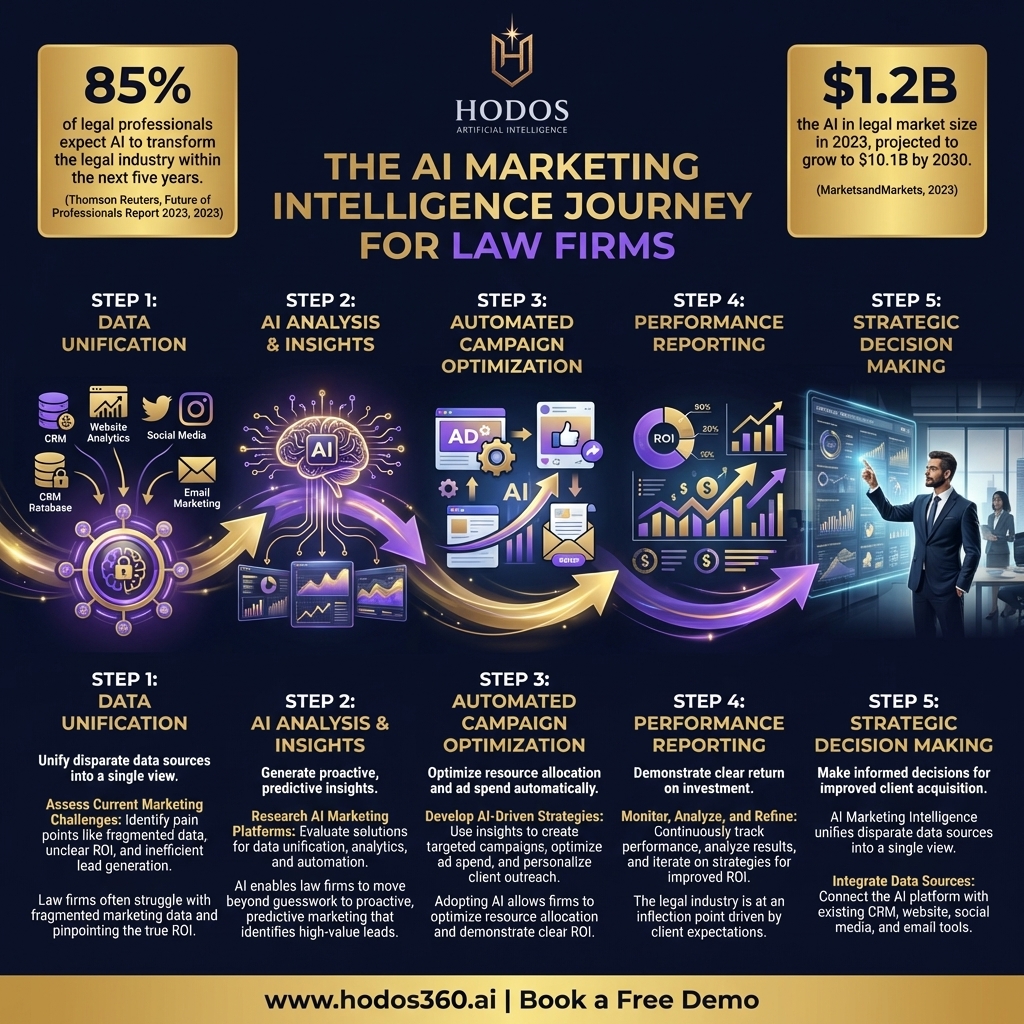
Many firms find themselves with rich data in isolated pockets, unable to connect the dots effectively. AI Marketing Intelligence platforms directly address this "data dilemma" by acting as central hubs, integrating data from all these disparate sources into a unified repository. This unification is not merely about aggregation; it involves sophisticated data cleansing, normalization, and enrichment processes to ensure consistency and accuracy.
By creating a single source of truth, these AI-powered marketing platforms empower legal professionals with an unparalleled understanding of their marketing ecosystem. Learn more about Agentic AI Unleashed: 2026's Power in Legal Work. Instead of toggling between multiple dashboards and manually stitching together reports, attorneys and marketing staff can access a consolidated view that reveals the complete client journey.
This holistic perspective is crucial for effective decision-making, allowing firms to identify which channels are driving the most qualified leads, which content resonates best with specific client segments, and where marketing resources might be misallocated. The ability to see how a potential client interacts with a firm's content on LinkedIn, then visits their website, downloads a whitepaper, and finally schedules a consultation, all within a single interface, transforms strategic planning from guesswork into a data-informed science.
This unified data approach is fundamental to unlocking the true potential of AI Marketing Intelligence within the legal sector.
Leveraging AI for Superior Client Acquisition and Retention
The true measure of any marketing strategy in the legal sector is its impact on client acquisition and retention. Here, AI Marketing Intelligence offers a transformative edge. For client acquisition, AI excels at identifying and targeting high-value leads with unparalleled precision. By analyzing vast datasets of market trends, demographic information, and online behavior, AI algorithms can pinpoint niche markets that are underserved or ripe for specific legal services.
This allows firms to craft hyper-targeted campaigns that resonate deeply with potential clients, avoiding the wasted spend of broad-brush advertising. Imagine an AI system identifying businesses in a specific industry facing new regulatory challenges, then automatically generating personalized outreach, linking them to a firm's relevant expertise.
This level of lead qualification and personalized content delivery significantly boosts conversion rates, making the client acquisition process more efficient and effective.
Beyond initial acquisition, AI plays a crucial role in enhancing client retention, a factor often overlooked but vital for long-term firm profitability. Predictive analytics, a core feature of AI Marketing Intelligence, can identify clients who might be at risk of churning, allowing firms to intervene proactively with tailored communications or service offerings.
For example, if a client's engagement with a firm's online resources or newsletters drops below a certain threshold, the AI can flag this, prompting a personalized follow-up from a legal professional. As Jack Newton, CEO of Clio, often emphasizes, a client-centric approach powered by data is paramount in today's legal market.
AI enables firms to anticipate client needs, deliver personalized value, and foster stronger relationships, turning one-time clients into lifelong advocates. Learn more about Legal AI Adoption: An Essential Roadmap for Law Firms. This proactive approach to retention not only reduces client turnover but also increases opportunities for cross-selling and referrals, critical drivers of sustainable growth.
However, the deployment of such powerful AI tools in legal marketing is not without its ethical considerations, particularly concerning data privacy and confidentiality. Law firms operate under stringent professional obligations, such as ABA Model Rule 1.6 on Confidentiality of Information, which mandates protecting client data.
While AI platforms can personalize marketing, firms must ensure that their use of client data for marketing purposes aligns with these ethical rules and relevant privacy regulations like GDPR or CCPA. This requires careful implementation, transparent data practices, and robust security measures to safeguard sensitive information.
The tension between leveraging data for competitive advantage and upholding professional duties is a critical aspect that firms must navigate with diligence, ensuring that innovation does not come at the expense of ethical compliance.
The integration of AI Marketing Intelligence into a firm's strategy is not merely about adopting a new tool; it's about embedding a data-driven culture that permeates all aspects of client interaction.
From the initial touchpoint where AI identifies a qualified lead, through the personalized content journey, to the proactive retention efforts, AI provides a continuous feedback loop. This iterative process allows firms to constantly refine their marketing strategies, learn from every interaction, and adapt to changing market conditions with agility.
The result is a more resilient, responsive, and ultimately more profitable approach to client management, ensuring that a firm's growth is not only robust but also sustainable in the long run. This holistic view of the client lifecycle, optimized by AI, positions firms to outmaneuver competitors who rely on less sophisticated, reactive methods.
Hyper-Personalization and Predictive Analytics
The era of generic marketing messages is rapidly fading, especially in the sophisticated world of legal services. Clients, whether individuals seeking personal legal counsel or corporations requiring complex litigation support, expect relevance and personalization. AI Marketing Intelligence makes hyper-personalization at scale a reality. By analyzing individual client profiles, past interactions, demographic data, and online behavior, AI algorithms can segment audiences with incredible granularity.
This allows firms to generate highly specific content – from blog posts discussing niche legal precedents to social media updates addressing specific industry regulations – that directly speaks to the unique needs and pain points of each segment. For instance, an AI might identify a segment of small business owners interested in intellectual property protection and automatically push them relevant articles and webinars, increasing engagement and perceived value.
Complementing this, predictive analytics elevates marketing from reactive to proactive. Learn more about AI Legal Practice Management: The Ultimate Firm Advantage. Instead of waiting for a client to express a need, AI can anticipate it. By analyzing historical data and current market trends, AI can forecast which leads are most likely to convert, which services will be in highest demand, and even which existing clients might require additional services in the near future.
This predictive power allows law firms to allocate their marketing resources more efficiently, focusing efforts on the most promising opportunities. Imagine an AI identifying early-stage startups that are rapidly growing and will soon require venture capital legal advice, enabling a firm to reach out with tailored support before they even begin actively searching.
This capability transforms marketing from a cost center into a strategic growth engine, ensuring that every outreach effort is optimized for maximum impact and conversion.
Navigating the Data Deluge: Automated Reporting and Performance Analysis
One of the most time-consuming and often frustrating aspects of legal marketing has traditionally been the manual compilation and analysis of performance reports. Marketing teams, and often attorneys themselves, spend countless hours exporting data from various platforms, wrestling with spreadsheets, and attempting to synthesize disparate metrics into coherent insights.
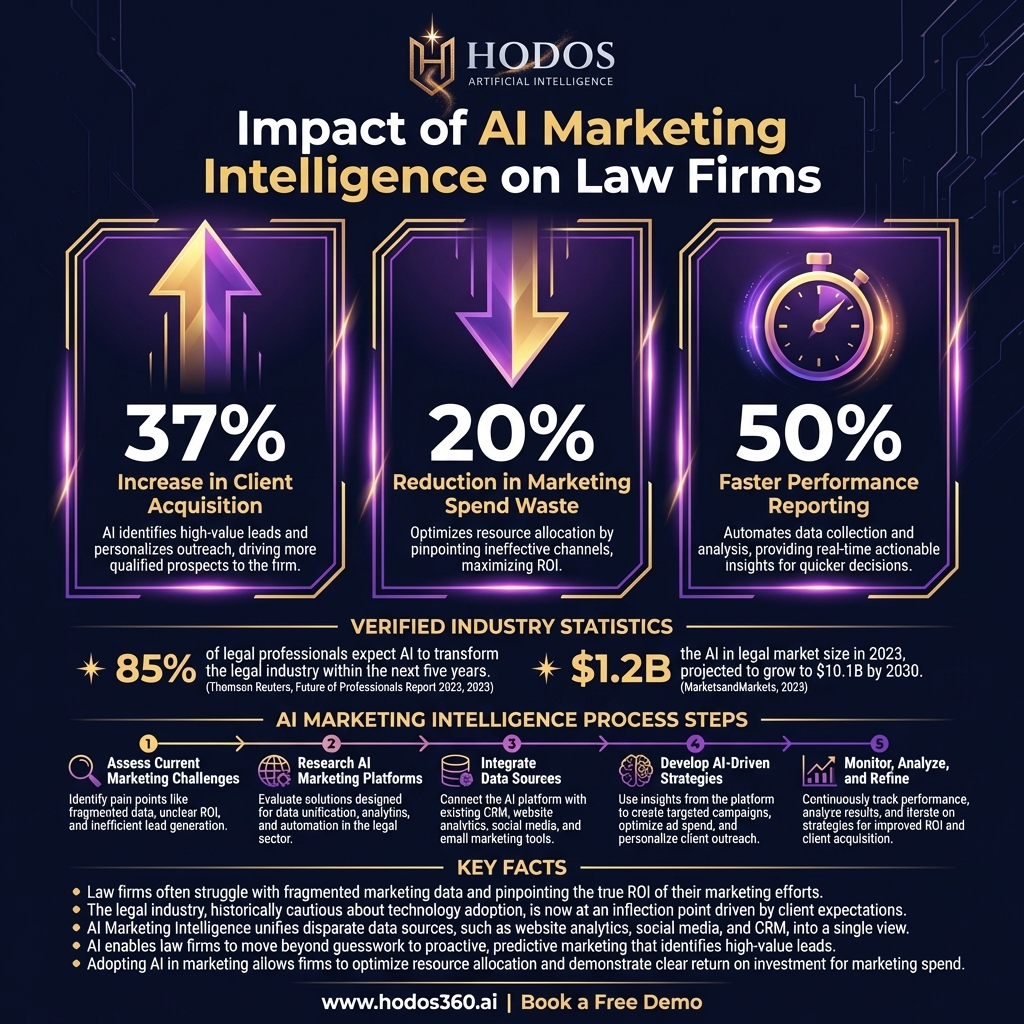
This laborious process is not only inefficient but also prone to human error and often delivers insights that are outdated by the time they are presented. The burden of this data deluge can stifle innovation and prevent firms from making agile, data-driven decisions. This is precisely where AI Marketing Intelligence platforms shine, offering a revolutionary solution to automated reporting and comprehensive performance analysis, liberating legal professionals from administrative overhead.
As highlighted by the recent AiThority article, platforms like TapClicks are at the forefront of this revolution, bringing new AI Marketing Intelligence capabilities specifically designed to automate performance reporting. These platforms automatically collect, clean, and consolidate data from all connected marketing channels, presenting it in real-time, customizable dashboards.
For a law firm, this means partners can instantly view their firm's website traffic, lead generation numbers, social media engagement, and campaign ROI, all in one place. The AI doesn't just display the data; it analyzes it, identifying trends, anomalies, and areas for improvement. For example, an AI might flag that a particular LinkedIn campaign targeting M&A leads is underperforming compared to historical data, or conversely, that a series of blog posts on real estate law is unexpectedly driving significant traffic and conversions.
This level of automated analysis and insight is critical for optimizing marketing spend and strategy. Learn more about Voice AI Revolutionizes Legal: HODOS 360's 2026 Impact. Instead of relying on gut feelings or historical assumptions, firms can make decisions based on empirical evidence provided by the AI.
The AI can identify which keywords are most effective, which ad creatives resonate best with specific audiences, and even predict the optimal times to post content for maximum engagement. This continuous feedback loop allows for agile adjustments to campaigns, ensuring that marketing efforts are always aligned with the firm's strategic objectives and are delivering the best possible return on investment.
The ability to quickly pivot and optimize based on real-time data is a significant competitive advantage in a fast-moving market, allowing firms to react to new opportunities or mitigate underperforming campaigns much more swiftly than traditional methods allow.
Furthermore, the transparency and clarity offered by AI-powered reporting can bridge the communication gap between marketing teams and firm leadership.
When partners can see clear, quantifiable data illustrating the impact of marketing activities on new client intake and revenue, it fosters greater trust and facilitates more informed strategic discussions. This shift from anecdotal evidence to data-backed insights empowers firm leaders to make more confident decisions about where to allocate resources and which growth initiatives to prioritize.
A Gartner report on marketing technology adoption indicates that organizations leveraging AI for performance analysis often achieve a 15-20% improvement in marketing efficiency and ROI, underscoring the tangible benefits for law firms seeking to maximize the value of their marketing investments. This data-driven accountability transforms marketing from a nebulous cost center into a transparent, measurable driver of firm growth and profitability.
From Metrics to Measurable ROI: Proving Marketing Value
One of the perennial challenges in legal marketing has been the difficulty in definitively proving a tangible return on investment (ROI). Traditional marketing often generated soft metrics like brand awareness or website visits, but connecting these directly to new client acquisition and billable hours remained a complex, often elusive task.
This lack of clear accountability frequently led to skepticism from firm partners regarding marketing budgets. AI Marketing Intelligence fundamentally changes this dynamic by providing the tools necessary to track, attribute, and report on marketing performance with unprecedented precision. By unifying data across the entire client journey, from initial impression to signed retainer, AI platforms can calculate the ROI of specific campaigns, channels, or even individual content pieces.
This capability allows law firms to move beyond vanity metrics and focus on what truly matters: new client generation and revenue growth. For example, an AI-powered dashboard can show that a particular series of blog posts on contract law directly led to X number of qualified leads, Y number of consultations, and Z dollars in new client revenue.
This level of granular attribution empowers firms to optimize their marketing spend, reallocating resources from underperforming campaigns to those that demonstrate a clear, positive ROI. The ability to demonstrate concrete financial returns transforms marketing from an overhead cost into a strategic investment, fostering greater confidence and support from firm leadership.
This shift is crucial for sustainable growth, ensuring that marketing efforts are not just visible, but demonstrably valuable to the firm's bottom line.
The Future is Now: Integrating AI for Sustainable Law Firm Growth
The legal industry stands at a pivotal moment, where the adoption of advanced technologies like AI Marketing Intelligence is no longer a competitive advantage but a foundational requirement for sustainable growth. Firms that embrace these AI-powered platforms are not just optimizing their marketing; they are fundamentally transforming their approach to business development, client engagement, and operational efficiency.
The alternative – clinging to outdated, manual processes – risks stagnation and a gradual erosion of market share in an increasingly competitive landscape. As Jensen Huang, CEO of NVIDIA, often remarks about the pervasive nature of AI, its influence will touch every industry, and legal is no exception.
The firms that recognize this early and strategically integrate AI will be the ones that define the future of legal practice.
Integrating AI for marketing extends beyond just the marketing department; it can create synergistic benefits across the entire law firm. For example, insights gained from AI Marketing Intelligence about client needs and market trends can inform the development of new legal services or the expansion into new practice areas.
Data on client preferences for communication can guide the implementation of AI Voice Assistants for 24/7 client support, improving responsiveness and satisfaction. Similarly, understanding the most effective client acquisition channels can inform improvements in the firm's AI Law Firm Management System's client intake and document automation workflows.
This holistic integration of AI across various firm operations, as offered by comprehensive platforms like HODOS 360, ensures that every aspect of the firm is optimized for efficiency and client service, creating a virtuous cycle of growth.
The strategic adoption of AI Marketing Intelligence also democratizes sophisticated marketing capabilities.
Smaller and mid-sized law firms, which historically lacked the resources of larger, international counterparts to invest in extensive marketing departments or data analytics teams, can now access enterprise-grade tools. These platforms level the playing field, enabling smaller firms to compete more effectively for high-value clients by leveraging the same advanced analytics and automation capabilities once exclusive to the largest players.
This accessibility fosters a more dynamic and competitive legal market, where innovation and efficiency, rather than just size, dictate success. The focus shifts from simply having a marketing budget to intelligently deploying that budget for maximum impact, ensuring every dollar is invested strategically and yields measurable results.
Ultimately, the future of law firm growth is inextricably linked to intelligent technology adoption. AI Marketing Intelligence empowers legal professionals to make data-driven decisions, anticipate client needs, and allocate resources with precision. It allows firms to cultivate a deeper understanding of their market, their clients, and their own performance, leading to more effective strategies and a stronger competitive position.
The journey towards an AI-powered future is not about replacing human expertise but augmenting it, providing attorneys with the insights and tools they need to focus on complex legal work while the technology handles the intricate demands of modern marketing. This strategic partnership between human intellect and artificial intelligence is the cornerstone of sustainable growth in the evolving legal profession.

Key Takeaways and Next Steps
The transformative power of AI Marketing Intelligence for law firms is undeniable. From unifying disparate data sources and automating performance reporting to enabling hyper-personalized client acquisition and retention strategies, AI is reshaping how legal services are marketed and delivered. Firms that embrace these AI-powered platforms are not merely keeping pace with technological advancements; they are actively defining their competitive future, ensuring that their marketing efforts are not just visible but measurably impactful.
The insights provided by AI empower legal professionals to make smarter, faster decisions, turning the overwhelming data deluge into a clear roadmap for growth. This is about working smarter, not harder, and focusing valuable human capital on the unique complexities of legal practice.
For law firm owners and managing partners, the immediate next step involves a thorough assessment of current marketing strategies and the identification of areas where AI can deliver the most significant impact.
This isn't about a wholesale overhaul overnight, but a strategic, phased integration that leverages the power of AI Marketing Intelligence to address specific pain points, such as inefficient lead qualification or unclear marketing ROI. Platforms like HODOS 360 offer a comprehensive suite of AI-powered services that can integrate seamlessly into your firm's operations, from case management to marketing automation, ensuring a unified and efficient approach to firm growth.
The time to act is now, to ensure your firm is not just prepared for the future, but actively shaping it. Ready to harness the power of AI Marketing Intelligence? Book a free demo with HODOS 360 today.
Frequently Asked Questions
What is AI Marketing Intelligence for law firms?+
AI Marketing Intelligence for law firms leverages artificial intelligence and machine learning to collect, analyze, and interpret vast amounts of marketing data from various sources. It provides predictive and prescriptive insights, automating reporting, optimizing campaigns, and enabling hyper-personalized client acquisition and retention strategies. This moves firms beyond basic analytics to a more strategic, data-driven approach, ensuring marketing efforts are efficient and yield measurable ROI.
How does AI improve client acquisition in legal practices?+
AI significantly enhances client acquisition by enabling hyper-targeted campaigns. It analyzes market trends and client behavior to identify high-value leads and niche markets with precision. AI can also personalize content delivery, ensuring the right message reaches the right potential client at the optimal time, thereby increasing conversion rates. This reduces wasted marketing spend and focuses resources on the most promising opportunities for new business.
What are the ethical considerations of using AI in legal marketing?+
Ethical considerations primarily revolve around data privacy and client confidentiality. Law firms must ensure their use of AI for marketing complies with professional obligations like ABA Model Rule 1.6 and relevant data protection regulations (e.g., GDPR, CCPA). This means transparent data collection practices, robust security measures, and ensuring that personalization does not infringe upon client privacy or create conflicts of interest. Ethical AI use requires diligent oversight and adherence to legal standards.
Can AI Marketing Intelligence help small law firms?+
Absolutely. AI Marketing Intelligence democratizes sophisticated marketing capabilities, making enterprise-grade tools accessible to small and mid-sized law firms. These platforms level the playing field by providing advanced analytics, automated reporting, and personalized outreach tools that were once exclusive to larger firms. This enables smaller practices to compete more effectively for high-value clients, optimize their limited marketing budgets, and achieve significant growth without extensive in-house marketing teams.
How do I measure the ROI of AI in my firm's marketing efforts?+
AI Marketing Intelligence platforms excel at providing clear, measurable ROI. By unifying data across all marketing touchpoints and client interactions, AI can attribute specific marketing activities directly to lead generation, client consultations, and ultimately, new client revenue. This granular attribution allows firms to see which campaigns are most profitable, enabling data-backed decisions to optimize spend and strategy. This transforms marketing from a nebulous cost into a transparent, accountable investment for firm growth.