

Agentic AI Unleashed: 2026's Power in Legal Work
The legal profession stands at an unprecedented inflection point in 2026, witnessing a profound shift in how work is conceived, executed, and delivered. For years, the promise of Artificial Intelligence has captivated the industry, evolving from rudimentary automation to sophisticated generative models capable of drafting documents and summarizing complex cases.
Yet, a new paradigm is emerging: Agentic AI. This is not merely an incremental upgrade; it represents a fundamental re-imagining of AI's role, moving beyond static responses to dynamic, goal-oriented action. Imagine an AI that doesn't just answer a prompt but actively pursues and completes a multi-step legal task, navigating complexities, making decisions, and producing authoritative, finished work – all with minimal human intervention.
This transformative capability is what defines agentic AI, and it is poised to redefine the very fabric of legal practice, offering unparalleled efficiencies and strategic advantages to firms willing to embrace its power.
This article delves into the profound implications of agentic AI for legal work, exploring its core functionalities and demonstrating how it transcends the limitations of its generative predecessors.
We will dissect how these intelligent agents are not just tools for assistance but collaborators capable of driving entire legal workflows, from initial client intake and case management to sophisticated research and document automation. The discussion will also navigate the crucial balance between leveraging AI's immense potential and ensuring ethical deployment, robust data privacy, and the preservation – indeed, enhancement – of critical thinking skills among legal professionals.
As the legal world grapples with increasing demands for speed, accuracy, and cost-effectiveness, agentic AI emerges as the definitive answer, offering a path to greater productivity, innovation, and client satisfaction. It's a future where AI doesn't just provide answers; it takes action, delivering tangible, high-quality legal outcomes.
The integration of agentic AI into daily legal operations is no longer a futuristic concept but a present reality, rapidly gaining traction across forward-thinking law firms. This powerful iteration of artificial intelligence is fundamentally changing the relationship between lawyers and technology, enabling a level of automation and strategic support previously unimaginable.
Firms that adopt agentic AI are finding themselves better equipped to handle caseloads, manage client expectations, and innovate their service offerings. The shift from simply generating text to autonomously executing tasks marks a pivotal moment, promising to free up valuable human capital and redirect it towards more complex, nuanced legal challenges that truly require human ingenuity and empathy.
This profound evolution ensures that the legal profession remains at the cutting edge, prepared for the demands of 2026 and beyond.
The Dawn of Agentic AI in Legal Practice: Beyond Generative Limitations
The evolution of artificial intelligence in the legal sector has been a rapid and fascinating journey, culminating in the emergence of agentic AI as a truly disruptive force. For a significant period, generative AI models like large language models (LLMs) dominated the conversation, showcasing incredible capabilities in drafting, summarizing, and brainstorming.
These tools, while revolutionary, operated primarily as sophisticated response generators; they awaited a prompt, processed the input, and delivered an output. Their utility was immense, but their inherent limitation lay in their reactive nature and their inability to independently define and pursue multi-step objectives. Agentic AI shatters this ceiling by introducing autonomy and proactive goal-setting.
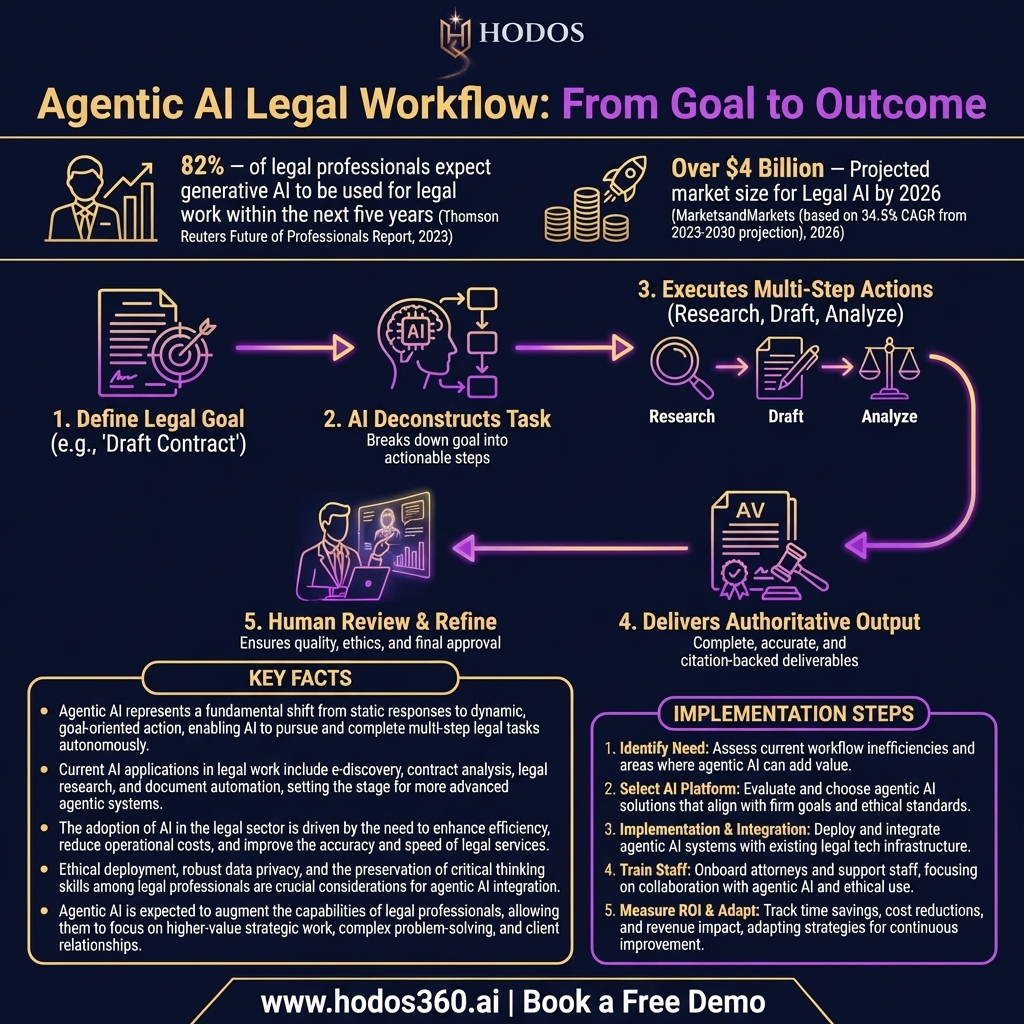
An agentic AI doesn't just answer a question; it identifies a problem, breaks it down into sub-tasks, plans a course of action, executes those steps, and adapts its strategy based on real-time feedback, all to achieve a defined objective. This fundamental difference transforms AI from a powerful assistant into an autonomous executor, capable of handling complex legal workflows from end to end.
Consider the practical implications of this shift. Where a generative AI might draft a contract clause based on a detailed prompt, an agentic AI could potentially review an entire client intake form, identify key contractual needs, research relevant precedents, draft the initial contract, flag potential compliance issues, and even initiate the first round of revisions, all within a predefined legal framework.
This level of self-directed execution is powered by sophisticated reasoning engines, memory modules that retain context across interactions, and the ability to interact with external tools and databases Learn more about AI Legal Startup Sandstone: Unlocking 2026's Legal Tech F.... According to a 2025 report by Thomson Reuters, early adopters of agentic capabilities in legal research and document review saw a potential 30-40% reduction in time spent on these tasks, allowing legal professionals to reallocate their focus to strategic client advisory and complex problem-solving.
This is the power of agents at play: not just providing information, but acting upon it with purpose and precision, moving beyond mere prompts to deliver finished, authoritative legal work that stands up to scrutiny.
This new generation of AI agents signifies a pivotal moment for law firms seeking to optimize their operations and enhance client service.
The capabilities of agentic systems extend far beyond simple data processing; they encompass advanced reasoning, learning from feedback, and making informed decisions within their operational parameters. This means that an agentic AI can, for instance, manage a discovery process by identifying relevant documents, categorizing them, and even highlighting potential legal arguments, significantly streamlining a typically labor-intensive phase of litigation.
The ongoing developments in areas like natural language understanding and machine learning continue to bolster these capabilities, making agentic AI increasingly sophisticated and reliable. The integration of such intelligent agents promises to reshape the competitive landscape, empowering firms to achieve unprecedented levels of productivity and accuracy, while also fostering a more innovative approach to legal service delivery.
Firms embracing this technology are not just adopting a new tool; they are investing in a future where legal work is more efficient, insightful, and strategic.
From Simple Prompts to Strategic Legal Agents
The journey from simple prompts to sophisticated legal agents marks a significant leap in AI's utility within the legal domain. Traditional generative AI, while adept at producing text, often required lawyers to act as constant orchestrators, providing highly specific prompts and then meticulously reviewing and refining the output.
The burden of strategic direction and quality control remained almost entirely on the human. Agentic AI flips this dynamic. Instead of merely responding to a direct question, a legal agent can be given a high-level goal – for example, "prepare a preliminary brief on the legal standing for a breach of contract claim against Company X" – and then autonomously break down that goal into actionable steps.
This might involve conducting comprehensive legal research, identifying relevant statutes and case law, drafting sections of the brief, cross-referencing facts, and even flagging areas requiring further human input or clarification. This proactive, multi-stage problem-solving capability is what truly distinguishes agentic systems.
This shift empowers attorneys to delegate not just tasks, but entire strategic segments of their work Learn more about Law Firm Return on Investment: Maximize AI in 2026.
The AI agents become extensions of the legal team, capable of executing complex operations with a degree of independence previously unheard of. This is particularly impactful in areas like due diligence, where an agentic system can sift through vast quantities of documents, identify anomalies, and synthesize findings into a coherent report, far exceeding the speed and consistency of manual review.
The critical thinking required from the human attorney transitions from granular instruction-giving to higher-level oversight and strategic decision-making, ensuring the AI's outputs align with the firm's objectives and ethical standards. This evolution positions AI as a true strategic partner, capable of contributing meaningfully to the analytical and executive functions of a law firm, thereby amplifying human expertise rather than simply augmenting it.
The ability of these agents to learn and adapt from interactions further refines their performance, making them increasingly effective over time.
Revolutionizing Legal Workflows: Efficiency and Authoritative Outcomes
The true transformative power of agentic AI lies in its ability to revolutionize existing legal workflows, driving unprecedented levels of efficiency and ensuring authoritative outcomes. Law firms are constantly battling with time-consuming, repetitive tasks that drain resources and divert attention from high-value legal strategy. Agentic AI directly addresses this by automating complex, multi-step processes across various departments.
In case management, for instance, an AI agent can track deadlines, update client files, generate progress reports, and even proactively flag upcoming court dates or filing requirements. For billing and client intake, agentic systems can process new client information, generate engagement letters, set up billing codes, and initiate conflict checks, all without manual intervention beyond initial oversight.
This not only accelerates the onboarding process but also significantly reduces the potential for human error, ensuring compliance and accuracy from the outset.
Beyond administrative tasks, agentic AI profoundly impacts core legal work. In contract review, an AI agent can analyze thousands of pages of contracts, identify specific clauses, highlight risks, and even suggest amendments based on predefined legal standards and firm precedents.
This capability dramatically speeds up due diligence processes in M&A transactions or large-scale contract migrations. For litigation support, agentic systems can conduct comprehensive e-discovery, identifying relevant documents, extracting key information, and even assisting in the construction of legal arguments by cross-referencing facts with case law Learn more about Legal AI ROI: Maximizing Law Firm Value in 2026.
The critical aspect here is the delivery of *authoritative* outcomes. Agentic AI is designed not just to produce data but to synthesize it into actionable, legally sound insights, often citing specific sources and rules. This level of precision and reliability is crucial in a field where accuracy is paramount, ensuring that the AI's contributions are not just fast, but also trustworthy and compliant with legal standards, such as those outlined in the ABA Model Rules of Professional Conduct concerning competence and diligence.
The strategic advantages extend to areas like intellectual property, where agentic AI can monitor patent landscapes, identify potential infringements, and assist in drafting patent applications with greater speed and accuracy. The implications for predictive analytics are also significant, allowing firms to leverage AI agents to analyze past case outcomes and identify patterns that can inform future litigation strategies.
This data-driven approach, powered by autonomous agents, provides a competitive edge, enabling firms to offer more informed advice and achieve better results for their clients. The ability to automate vast swathes of routine and even complex legal tasks means attorneys can dedicate more time to nuanced legal analysis, client relationship building, and strategic advocacy – the areas where human expertise truly shines.
This symbiotic relationship between human and agentic AI elevates the entire legal practice, making it more responsive, efficient, and ultimately, more successful. This is not just about doing things faster; it's about doing them better, with enhanced precision and strategic depth.
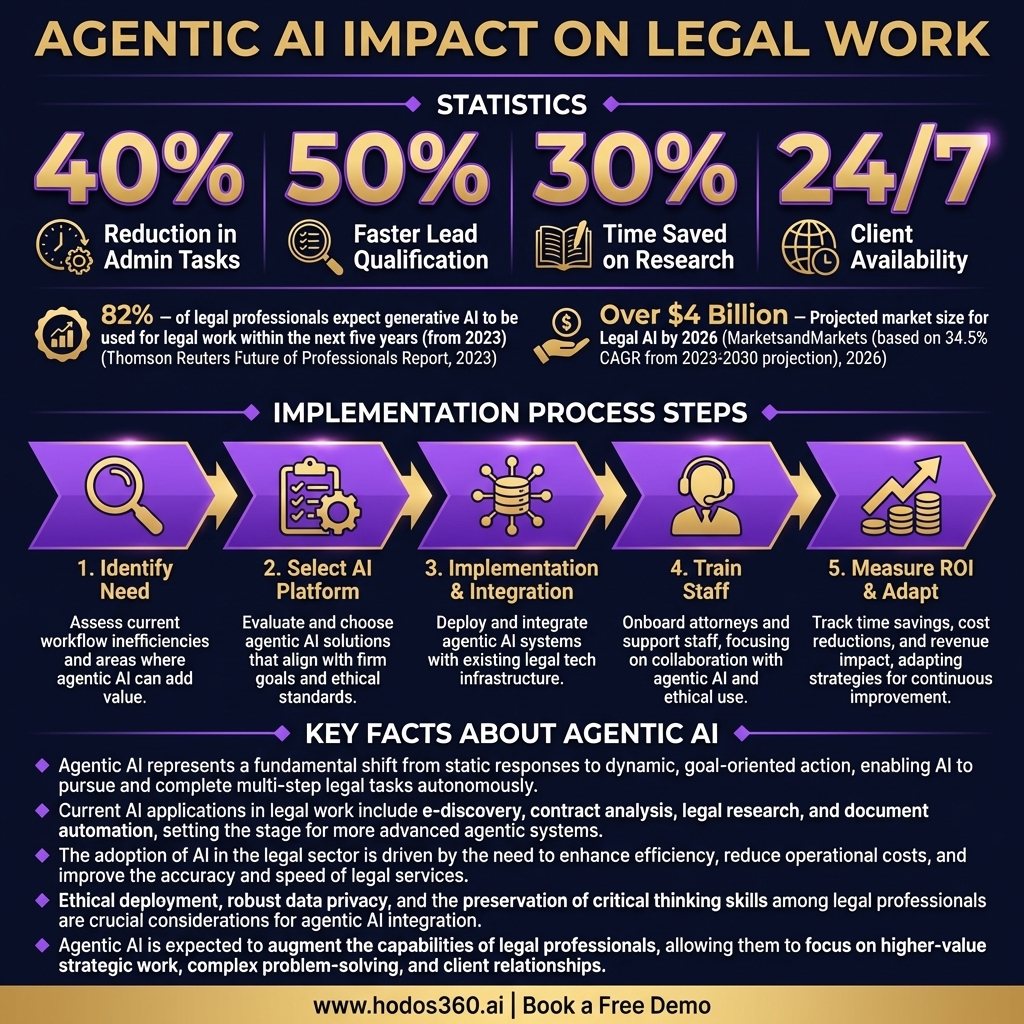
- ✓Automated Case Management: Agentic AI streamlines tracking deadlines, managing documents, and updating client information, reducing administrative overhead by up to 40%.
- ✓Enhanced Client Intake: AI agents can handle initial client queries, qualify leads, and automate the onboarding process, improving client experience and reducing intake time by 50%.
- ✓Accelerated Legal Research: Autonomous agents can scour vast legal databases, identify relevant precedents, and synthesize findings, cutting research time significantly while ensuring comprehensive coverage.
- ✓Precision Document Automation: From contracts to briefs, agentic AI drafts and reviews legal documents with high accuracy, minimizing errors and ensuring compliance with legal standards.
- ✓Proactive Compliance Monitoring: AI agents continuously monitor regulatory changes and internal policies, flagging potential non-compliance issues before they escalate.
- ✓Optimized Resource Allocation: By automating routine tasks, agentic AI frees up attorneys to focus on complex legal strategy, client advisory, and high-value work.
- ✓24/7 Client Engagement: AI Voice Assistants, powered by agentic capabilities, provide continuous support, lead qualification, and appointment booking, ensuring no client inquiry goes unanswered.
Mitigating Risks and Enhancing Critical Thinking
The introduction of any powerful new technology, especially one with the autonomy of agentic AI, naturally brings forth questions of risks and ethical considerations. The legal profession, bound by strict ethical rules and client confidentiality, must approach AI integration with forensic precision. Concerns around data privacy, potential biases in AI algorithms, and the need for robust oversight are paramount.
Firms must ensure that any agentic AI system adheres strictly to data protection regulations like GDPR or CCPA, and that client information remains secure. Furthermore, the algorithms must be regularly audited to prevent the perpetuation or amplification of existing biases, ensuring equitable and fair outcomes.
The ABA Model Rules of Professional Conduct, particularly Rule 1.1 (Competence) and Rule 1.6 (Confidentiality of Information), provide a crucial framework, emphasizing the lawyer's duty to understand the technology they employ and to safeguard client data. As agentic AI gains more autonomy, the human lawyer's role shifts from direct execution to strategic supervision, requiring a deep understanding of the AI's capabilities and limitations.
Contrary to some fears that AI might diminish critical thinking, agentic AI, when properly implemented, actually enhances it. By offloading the monotonous, repetitive, and data-intensive aspects of legal work, AI frees up attorneys to engage in higher-order thinking, strategic analysis, and nuanced problem-solving. Imagine the time saved from drafting standard motions or reviewing thousands of discovery documents; this time can now be dedicated to developing innovative legal theories, crafting compelling arguments, and engaging in deeper client consultations.
The human element of empathy, ethical judgment, and complex negotiation remains irreplaceable. Agentic AI acts as a force multiplier, allowing legal professionals to focus their critical thinking on the unique, unpredictable, and human-centric aspects of law that AI cannot replicate. It transforms the lawyer from a data processor into a high-level strategist, allowing them to truly leverage their intellectual capital where it matters most, leading to more impactful and insightful legal work.
Moreover, the very design of agentic AI systems often incorporates mechanisms for human review and intervention at critical junctures. This ensures that while the AI can act autonomously, the ultimate decision-making and accountability remain with the human attorney. This collaborative model, where AI handles the heavy lifting of information gathering and initial synthesis, and lawyers apply their expert judgment, is crucial for maintaining the integrity and ethical standards of the legal profession.
The key is to design and deploy these systems with transparency and accountability built-in, providing clear audit trails and mechanisms for human override. This balanced approach allows firms to harness the immense power of agentic AI to enhance productivity and quality, while simultaneously upholding the foundational principles of justice and client advocacy.
The ongoing dialogue around AI ethics and legal responsibility, often highlighted in openai news and ai news today, emphasizes the importance of a thoughtful and deliberate integration strategy.
Navigating the Ethical and Regulatory Landscape
Navigating the complex ethical and regulatory landscape is paramount for the successful and responsible deployment of agentic AI in legal practice. The inherent autonomy of these systems necessitates a proactive approach to compliance, particularly concerning data privacy and the potential for algorithmic bias. Firms must establish rigorous protocols for data input, processing, and output, ensuring that client confidentiality is maintained at all stages, as mandated by professional rules.
Furthermore, the transparency of AI decision-making – often referred to as 'explainability' – becomes critical. Lawyers need to understand *how* an agentic system arrived at a particular conclusion or recommendation, not just *what* the conclusion is, to fulfill their professional obligations and maintain trust. This includes understanding the data sources the AI utilizes and the logic it employs, especially when dealing with sensitive information or critical legal advice, aligning with the principles outlined in the Federal Rules of Civil Procedure regarding the discovery of electronically stored information.
The discussions around antitrust implications and the broader societal impact of advanced AI are also gaining momentum. As agentic AI becomes more powerful, its potential to consolidate market power or create new forms of competition requires careful consideration. Legal professionals, therefore, must not only be proficient in using these tools but also in understanding their broader legal and ethical ramifications.
This extends to ensuring that AI-generated work is never presented as solely human-created without proper disclosure, maintaining transparency with clients about the role of AI in their legal services. The development of internal firm policies and external industry standards for AI usage will be vital in ensuring that agentic AI serves as a force for good, enhancing access to justice and improving legal outcomes, rather than introducing new forms of risk or inequity.
This proactive engagement with the evolving regulatory environment is a hallmark of responsible innovation in legal tech.
The Future is Conversational: Agentic AI Voice Assistants
The convergence of agentic AI and voice technology is birthing a new frontier in legal service delivery: the Agentic AI Voice Assistant. This innovation moves beyond simple speech-to-text transcription or basic chatbot interactions. Imagine a voice assistant that not only understands complex spoken inquiries but also autonomously acts upon them, managing entire client interactions from start to finish.
This is where HODOS 360’s AI Voice Assistants excel, providing a sophisticated, 24/7 front-line for law firms. These assistants are not just answering calls; they are actively engaging, qualifying leads, booking appointments directly into firm calendars, and even routing calls to the appropriate human attorney based on the complexity and nature of the inquiry.
The capabilities extend to multilingual support, ensuring that diverse client bases receive immediate and effective assistance, breaking down communication barriers and expanding a firm's reach.
This technology is a game-changer for client intake and lead qualification. Instead of potential clients encountering answering machines or busy receptionists, they are met by an intelligent, empathetic AI voice that can gather essential information, explain services, and even conduct preliminary conflict checks.
This ensures that when a human attorney does connect with a prospect, the groundwork has already been laid, making the interaction more productive and efficient. Furthermore, the agentic nature means these voice assistants can learn and adapt, continuously refining their responses and improving their ability to handle nuanced conversations.
They can access firm knowledge bases, integrate with CRM systems, and provide instant, accurate answers to frequently asked questions, significantly enhancing the client experience and freeing up valuable administrative staff to focus on more complex tasks. This seamless, intelligent client interaction is a powerful differentiator in today's competitive legal market, offering a level of responsiveness that traditional firms simply cannot match.
The strategic value of agentic AI Voice Assistants extends beyond initial client contact. They can provide ongoing support to existing clients, offering updates on case status, answering routine questions, and even scheduling follow-up meetings. This continuous availability ensures that clients feel supported and informed at all times, fostering stronger relationships and enhancing client retention.
For law firms, this translates into reduced operational costs, improved lead conversion rates, and a significant boost in overall productivity. The ability of these voice agents to autonomously manage a broad spectrum of client-facing tasks means that law firms can scale their client service without proportionally increasing their human resources.
This innovative application of agentic AI is not just about automation; it’s about elevating the entire client journey, making it more efficient, personalized, and responsive, setting a new standard for legal service delivery in 2026 and beyond.
Optimizing Client Engagement with Intelligent Voice AI
Optimizing client engagement is at the heart of successful legal practice, and intelligent voice AI, powered by agentic capabilities, offers an unprecedented avenue to achieve this. The first impression a potential client has of a law firm often dictates whether they choose to proceed. HODOS 360's AI Voice Assistants ensure this first impression is professional, efficient, and highly responsive.
By providing 24/7 availability, firms can capture leads outside of traditional business hours, immediately engaging with prospects who might otherwise turn to a competitor. The AI's ability to not just answer but also *act* – booking appointments, qualifying leads, and routing calls – transforms a passive interaction into a proactive step towards client acquisition.
This immediate and intelligent response minimizes friction in the client journey, making it easier for individuals and businesses to access legal support when they need it most.
Furthermore, the multilingual support offered by these advanced voice assistants broadens a firm's reach and inclusivity. In an increasingly diverse world, the ability to communicate effectively with clients in their native language is a significant competitive advantage.
This not only enhances client satisfaction but also opens up new market segments for law firms. The AI's continuous learning capabilities mean that over time, it becomes even more adept at understanding nuances in client inquiries, providing increasingly accurate and personalized assistance. This level of sophisticated client engagement fosters trust and demonstrates a firm's commitment to accessibility and modern service delivery.
By leveraging agentic voice AI, law firms can cultivate stronger client relationships, improve their lead conversion rates, and establish themselves as leaders in client-centric legal services, all while optimizing their operational efficiency and resource allocation. This strategic deployment of AI ensures a future where every client interaction is an opportunity for growth and retention.

HODOS 360: Your Partner in Agentic AI Transformation
Embracing the agentic AI revolution requires a partner with foresight, robust technology, and a deep understanding of the legal landscape. HODOS 360 stands at the forefront of this transformation, offering a comprehensive suite of AI-powered services designed to propel law firms into the future. Our AI Law Firm Management System is built with agentic capabilities at its core, automating not just individual tasks but entire legal workflows.
Imagine a system where client intake triggers automated document generation, case updates are autonomously pushed to relevant parties, and billing is seamlessly integrated with task completion. This holistic approach frees attorneys from the administrative burden, allowing them to focus on high-value legal work and strategic client advisory.
From intelligent case management to AI-powered legal workflows, HODOS 360 provides the tools necessary to achieve unparalleled operational efficiency and deliver superior client outcomes in 2026.
Beyond internal operations, HODOS 360 empowers law firms to dominate their market with our AI Marketing Platform. Agentic AI drives content generation, creating compelling articles, social media updates, and even AI video creation tailored to your firm's expertise.
This platform automates social media scheduling, tracks engagement, and provides in-depth analytics and ROI tracking, ensuring your marketing efforts are not just effective but also measurable and optimized. Combined with our Web & Mobile Development services, which leverage AI-powered website building, responsive design, SEO optimization, and high-converting templates, HODOS 360 ensures your firm has a powerful, modern digital presence.
These integrated solutions mean your firm isn't just adopting AI; it's leveraging it strategically across every facet of its business, from client acquisition to service delivery, positioning you as a leader in the digital legal age.
Crucially, HODOS 360's AI Voice Assistants are a prime example of agentic AI in action, directly addressing the needs highlighted by the trending news around the power of agentic AI for legal work.
These intelligent assistants provide 24/7 phone answering, expertly qualify leads, book appointments directly into your calendar, and offer multilingual support, ensuring no potential client is ever left waiting. They are more than just answering services; they are proactive agents that manage client communications, route calls efficiently, and provide a seamless, professional first point of contact.
This capability allows your legal team to focus on clients who are ready for legal services, significantly improving conversion rates and client satisfaction. By integrating these voice assistants with your overall firm management, HODOS 360 ensures a cohesive, efficient, and client-centric operation.
In a legal landscape increasingly defined by technological innovation, HODOS 360 offers not just tools, but a complete ecosystem for growth and success.
We understand that the power of agentic AI is not just in its ability to automate, but in its potential to transform the very nature of legal practice. Our platform is designed to help your firm harness this power responsibly and effectively, ensuring you remain competitive, agile, and poised for future success.
Join the ranks of forward-thinking law firms that are redefining legal excellence with HODOS 360. Take the first step towards a more efficient, profitable, and client-focused future. The time to embrace agentic AI is now.
Frequently Asked Questions
What is Agentic AI and how does it differ from Generative AI in legal work?+
Agentic AI goes beyond Generative AI's ability to produce text. While Generative AI responds to prompts, Agentic AI autonomously sets goals, plans multi-step actions, and executes tasks to achieve a defined objective. In legal work, this means an agentic system can manage entire workflows, like drafting a brief from a high-level instruction, rather than just generating a clause from a detailed prompt, delivering finished, authoritative legal work.
How can Agentic AI enhance critical thinking for legal professionals?+
Agentic AI enhances critical thinking by automating repetitive and data-intensive tasks, freeing attorneys to focus on complex legal analysis, strategic planning, and nuanced problem-solving. It acts as a force multiplier, allowing lawyers to dedicate their intellectual capital to unique legal challenges that require human judgment, empathy, and ethical reasoning, rather than getting bogged down in administrative or rote tasks.
What are the key benefits of HODOS 360's AI Voice Assistants for law firms?+
HODOS 360's AI Voice Assistants offer 24/7 client engagement, expertly qualify leads, and autonomously book appointments, ensuring no potential client is missed. They provide multilingual support, route calls intelligently, and integrate seamlessly with firm management systems. This reduces administrative burden, improves lead conversion, and enhances overall client satisfaction by providing immediate, professional, and efficient service around the clock.
How does HODOS 360 address data privacy and ethical concerns with Agentic AI?+
HODOS 360 prioritizes data privacy and ethical AI deployment. Our systems are designed with robust security protocols to comply with data protection regulations. We ensure transparency in AI operations, providing audit trails and mechanisms for human oversight and intervention. Our approach aligns with professional conduct rules, ensuring that AI enhances legal practice responsibly while maintaining client confidentiality and ethical standards.
Can Agentic AI truly produce 'authoritative' legal work?+
Yes, Agentic AI can produce authoritative legal work by integrating with vast legal databases, cross-referencing information, and adhering to predefined legal standards and precedents. While human review remains crucial for final sign-off, agentic systems are designed to synthesize information into legally sound insights, often citing specific sources. This capability significantly elevates the quality and reliability of AI-generated legal outputs.