


Legal AI ROI: Maximizing Law Firm Value in 2026
The legal landscape of 2026 is a crucible of innovation, where the promise of Artificial Intelligence consistently dominates discussions, from boutique firm strategy sessions to the grand stages of industry events like Legalweek. Day one of Legalweek 2026 underscored a critical, often elusive, question for law firm leaders: how to definitively identify and quantify the return on investment (ROI) from their burgeoning AI adoptions.
In an era where technological advancements are rapid and competition is fierce, understanding the tangible value derived from AI investments is not merely an academic exercise; it is the bedrock of strategic planning, resource allocation, and ultimately, sustained profitability. The shift from experimental pilots to integrated, revenue-generating AI solutions demands a forensic precision in measurement, transforming abstract potential into concrete financial and operational gains.
Historically, legal technology adoption has often been a leap of faith, driven by a desire for efficiency or a fear of being left behind. However, the sophistication of today's AI tools, coupled with the increasing financial scrutiny within law firms, necessitates a more rigorous approach.
Law firms are no longer just looking to automate tasks; they are seeking transformative change that impacts every facet of their operations – from client intake and case management to sophisticated legal research and predictive analytics. The challenge lies not in finding AI, but in discerning which AI investments truly move the needle, delivering measurable improvements that justify their initial outlay and ongoing maintenance.
This requires a nuanced understanding of both direct cost savings and indirect value creation, such as enhanced client satisfaction, improved data security, and a bolstered competitive posture in the market.
As we delve deeper into this evolving paradigm, HODOS 360 stands at the forefront, empowering law firms to navigate this complexity with clarity and confidence.
Our suite of AI-powered services is meticulously designed to provide not just advanced capabilities but also transparent pathways to demonstrate AI Investment ROI. By integrating AI across critical firm functions – from management and marketing to client communication and web presence – we enable legal professionals to unlock unprecedented levels of efficiency and strategic advantage.
The discussions at Legalweek 2026 serve as a powerful reminder that while the future of legal practice is undoubtedly AI-driven, its success hinges on a clear, data-backed understanding of its financial and operational dividends. This is where strategic foresight meets practical implementation, transforming the potential of AI into a powerful engine for growth.
Decoding AI Investment ROI for Law Firms in 2026
The conversation at Legalweek 2026 highlighted a critical juncture for the legal industry: moving beyond the 'why' of AI adoption to the 'how' of measuring its financial and operational impact. For many law firms, the initial investment in AI tools can seem daunting, yet the competitive landscape of 2026 makes inaction a far greater risk.
Identifying true AI Investment ROI involves a comprehensive audit of both direct and indirect benefits. Direct benefits are often the easiest to quantify: reductions in billable hours spent on repetitive tasks, lower administrative costs, and improved accuracy leading to fewer errors and associated liabilities. For instance, AI-powered document automation can drastically cut down the time attorneys spend drafting standard agreements or pleadings, freeing them to focus on complex, high-value legal work.
This directly translates to increased billable capacity and enhanced attorney productivity, a key driver for law firm growth.
However, the true value of AI extends far beyond simple cost savings. Indirect benefits, while harder to pin down, often represent the most significant strategic advantages. These include enhanced client satisfaction stemming from faster service delivery, more personalized communication, and proactive legal insights.
Firms leveraging AI for predictive analytics can offer clients better foresight into case outcomes or regulatory changes, positioning themselves as indispensable strategic partners Learn more about Law Firm Return on Investment: Maximize AI in 2026. The ability to process vast amounts of legal data quickly and accurately also provides a competitive edge in litigation, due diligence, and transactional work.
Furthermore, a firm's reputation as an innovator, actively embracing cutting-edge legal tech, can attract top talent and high-value clients, fortifying its market position against competitors still relying on outdated methodologies. This holistic view of return is essential for any firm committed to long-term success.
Strategic investment in AI also significantly mitigates operational risks.
Automated compliance checks, for example, reduce the likelihood of regulatory breaches, which can carry severe financial penalties and reputational damage. AI's capacity for continuous learning and adaptation means that its value compounds over time, making early adoption a strategic imperative. As firms integrate AI into their core workflows, they build a robust, data-driven infrastructure that is resilient to market shifts and capable of sustained innovation.
The discussions at Legalweek underscored that firms failing to measure and understand their AI Investment ROI risk not only misallocating resources but also falling behind in a rapidly evolving legal market where efficiency and data intelligence are becoming non-negotiable standards for excellence. It's about building a future-proof practice, not just buying software.
Beyond Simple Cost Savings: The Multifaceted Returns
While cost reduction is a clear metric, the multifaceted returns of AI extend into areas that redefine the very nature of legal service delivery. Consider the impact on client experience. AI voice assistants and chatbots can provide 24/7 client support, answering common queries, scheduling appointments, and providing multilingual assistance, thereby significantly improving responsiveness and client satisfaction.
This isn't just about efficiency; it's about building stronger client relationships and fostering loyalty in a competitive market. Moreover, AI-powered marketing platforms allow firms to analyze market trends, identify high-potential leads, and automate targeted content generation, leading to a more effective client acquisition strategy and a measurable increase in conversion rates.
The ability to track ROI on marketing spend with granular detail transforms marketing from an expense center into a predictable growth engine.
The strategic value also lies in empowering legal professionals. By automating mundane tasks, AI frees attorneys to engage in more complex analytical work, creative problem-solving, and direct client interaction – the core activities that generate significant value and job satisfaction.
This shift not only enhances attorney productivity but also contributes to better work-life balance and reduced burnout, critical factors in talent retention. The ability to leverage AI for predictive insights in litigation or M&A due diligence provides a strategic advantage, allowing firms to advise clients with greater foresight and precision.
These intangible benefits, while challenging to quantify initially, ultimately translate into enhanced reputation, increased market share, and a more resilient, future-ready law firm. It's a comprehensive transformation that impacts the bottom line through multiple, interconnected channels.
The Evolving Metrics: Measuring AI's Impact on Legal Operations
Measuring the true impact of AI on legal operations requires a sophisticated set of metrics that go beyond traditional accounting. Law firms in 2026 are increasingly adopting key performance indicators (KPIs) that directly reflect AI's influence. For instance, in case management, metrics like 'time to case resolution' and 'document review cycle time' show dramatic improvements with AI integration.
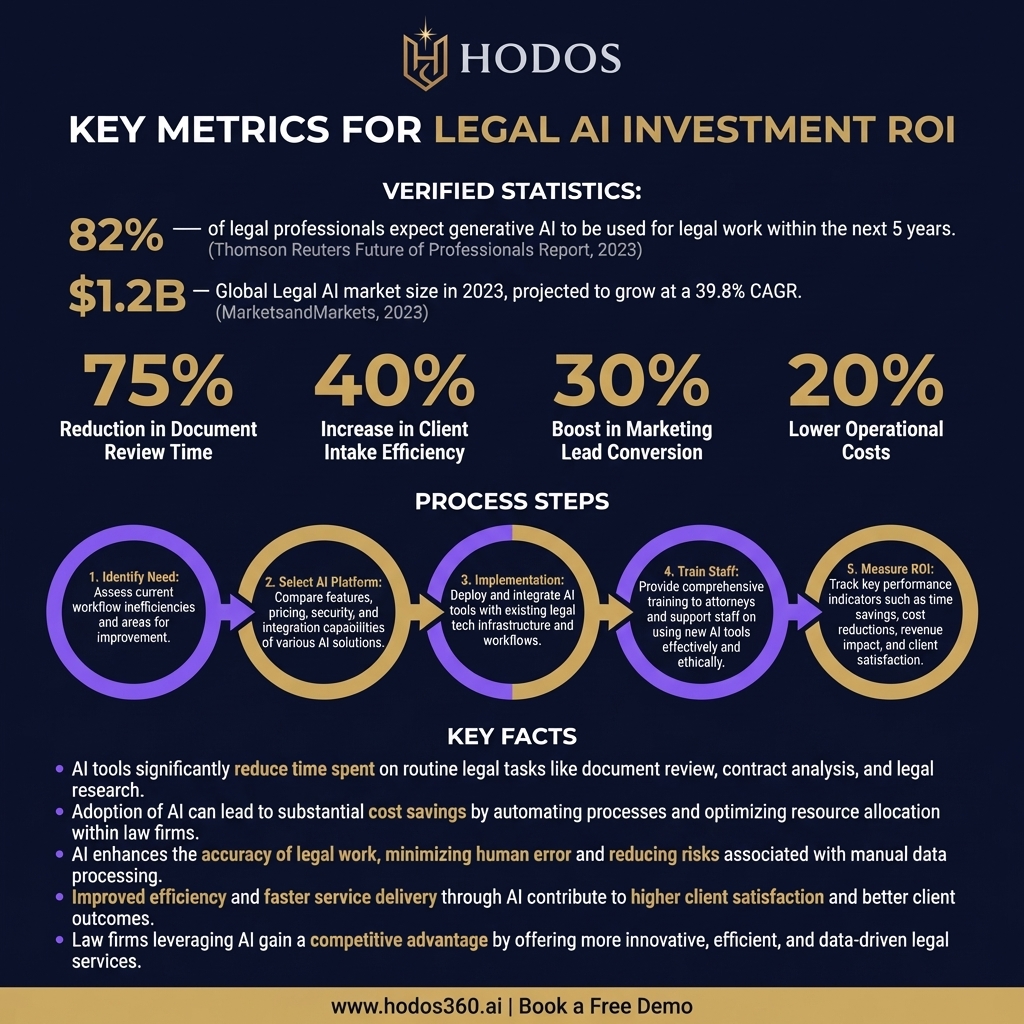
A study by Thomson Reuters in 2024 indicated that firms leveraging AI for document review could reduce review times by up to 75%, translating into significant cost savings for clients and increased capacity for attorneys. Similarly, client intake efficiency, measured by 'time from initial contact to client onboarding' and 'conversion rate of leads,' sees substantial gains through AI-powered client intake systems and AI voice assistants.
These quantifiable improvements demonstrate a clear return on investment, not just in terms of reduced labor costs but in enhanced service delivery.
Beyond efficiency, AI's impact on accuracy and risk mitigation is equally critical. Metrics such as 'error rate in contract drafting' or 'compliance violation incidents' can show marked decreases when AI-powered document automation and legal research tools are employed.
The reduction in human error not only saves time and resources but also protects the firm's reputation and minimizes potential liabilities. Furthermore, tracking 'attorney utilization rates' and 'non-billable administrative hours' can illustrate how AI frees up legal professionals from routine tasks, allowing them to focus on high-value, billable work.
This directly impacts the firm’s revenue generation potential. The strategic adoption of AI also enables firms to track 'client retention rates' and 'net promoter scores' more closely, as improved service quality and responsiveness, often facilitated by AI, directly correlate with client loyalty.
Implementing AI without a clear framework for measuring its impact is akin to sailing without a compass.
The sophisticated AI Law Firm Management Systems available today, such as HODOS 360’s platform, are designed with integrated analytics dashboards that provide real-time insights into these critical KPIs. This allows firms to continuously monitor the performance of their AI tools, identify areas for further optimization, and demonstrate tangible value to stakeholders.
The ability to present data-backed evidence of AI’s positive contributions – from reducing operational costs to increasing client satisfaction and boosting overall profitability – is paramount for securing continued investment and fostering a culture of innovation. Firms that embrace these evolving metrics are not just adopting technology; they are strategically leveraging data to drive their competitive advantage in the legal market.
Data-Driven Decisions: Analytics for Optimal Performance
In the complex ecosystem of modern law firms, data is the new currency, and AI is the engine that extracts its maximum value. Analytics derived from AI-powered systems are no longer a luxury but a fundamental necessity for optimal performance and strategic decision-making. Firms can leverage AI to analyze vast datasets related to billing, case outcomes, attorney performance, and client feedback to identify patterns and predict future trends.
For example, predictive analytics can forecast the likelihood of success in different litigation strategies, allowing attorneys to advise clients with greater confidence and precision. This data-driven approach moves legal practice from reactive to proactive, enabling firms to anticipate challenges and seize opportunities before they fully materialize.
Furthermore, AI-driven analytics provide invaluable insights into resource allocation and operational bottlenecks. By tracking the efficiency of various workflows, firms can pinpoint areas where AI implementation can yield the greatest returns, or where existing AI tools need fine-tuning. This continuous feedback loop ensures that AI investments are not static but evolve with the firm’s needs, maximizing their long-term value.
Data from AI marketing platforms, for instance, can reveal which campaigns are generating the highest ROI, allowing for dynamic adjustments to marketing spend and strategy. This granular visibility, previously unimaginable, empowers law firm leaders to make informed, evidence-based decisions that drive sustainable growth and solidify their position in the competitive legal market of 2026. Book a free demo with HODOS 360 to see how our analytics can transform your firm.
Navigating Implementation Challenges and Maximizing Adoption
The path to maximizing AI Investment ROI is not without its hurdles. One of the most significant challenges for law firms is the seamless integration of new AI technologies with existing legacy systems. Many firms operate with a patchwork of disparate software, making data migration and interoperability a complex endeavor.

This often requires significant IT resources and a clear strategic roadmap to ensure that AI tools communicate effectively across the entire firm ecosystem. Beyond technical integration, cultural resistance to change among attorneys and staff can be a major impediment. Legal professionals, steeped in tradition, may view AI with skepticism or fear, perceiving it as a threat to their roles rather than an enhancement.
Overcoming this requires robust training programs, clear communication about the benefits of AI, and demonstrating how these tools augment, rather than replace, human expertise.
Another critical challenge lies in data quality and privacy. AI systems are only as good as the data they are fed.
Firms must ensure their data is clean, accurate, and structured appropriately for AI processing. This often involves a significant upfront effort in data governance and standardization. Moreover, the ethical implications of AI, particularly concerning client confidentiality and data security, are paramount. Law firms must adhere to stringent professional conduct rules, such as ABA Model Rule 1.6 on Confidentiality of Information, ensuring that AI systems are deployed with robust security measures and privacy protocols.
Failure to address these concerns can lead to significant ethical breaches, regulatory penalties, and a loss of client trust, effectively negating any potential ROI.
Maximizing adoption hinges on a well-executed change management strategy. This includes involving key stakeholders from the outset, identifying internal champions for AI, and providing continuous support and feedback mechanisms.
Firms that prioritize user experience and demonstrate tangible benefits to their attorneys and staff early on are far more likely to achieve widespread adoption. Furthermore, partnering with a technology provider that offers comprehensive support, training, and integration services can significantly smooth the transition. The goal is to create an environment where AI is seen as an invaluable partner, seamlessly integrated into daily workflows, enhancing productivity and enabling attorneys to deliver superior legal services.
This proactive approach transforms potential obstacles into opportunities for growth and innovation, ensuring that the AI investment truly delivers its promised returns.
Fostering a Culture of Innovation and AI Literacy
To truly unlock the potential of AI Investment ROI, law firms must cultivate a culture that embraces innovation and fosters AI literacy among all personnel. This isn't just about technical training; it's about shifting mindsets. Attorneys and legal staff need to understand not only how to use AI tools but also the underlying principles of how AI works, its capabilities, and its limitations.
This empowers them to identify new applications, challenge existing workflows, and contribute to the continuous improvement of the firm's technological infrastructure. Firms can achieve this through regular workshops, internal forums for sharing best practices, and creating dedicated innovation hubs.
Leadership plays a crucial role in championing this cultural shift.
When firm partners actively demonstrate their commitment to AI adoption and articulate its strategic importance, it sends a powerful message throughout the organization. This commitment includes allocating sufficient resources for technology, encouraging experimentation, and rewarding innovative thinking. By fostering an environment where curiosity about legal tech is encouraged and where mistakes are viewed as learning opportunities, firms can build a dynamic workforce that is not just reactive to technological change but actively drives it.
This proactive approach to AI literacy and cultural transformation is the ultimate differentiator, ensuring that the firm's AI investments yield not just short-term gains but a sustainable competitive advantage for years to come.

Strategic AI Adoption: Future-Proofing Your Practice with HODOS 360
In the dynamic legal landscape of 2026, HODOS 360 stands as the quintessential partner for law firms aiming to maximize their AI Investment ROI. Our integrated, AI-powered platform is specifically engineered to address the very challenges and opportunities discussed at Legalweek, providing a comprehensive solution that spans across all critical aspects of modern legal practice.
We understand that a fragmented approach to AI yields fragmented results. That's why HODOS 360 offers a unified ecosystem, ensuring seamless data flow and consistent performance across all firm operations. From streamlining complex case management to revolutionizing client acquisition, our platform acts as the central nervous system for the future-forward law firm, delivering measurable efficiencies and strategic advantages that directly impact the bottom line.
Our AI Law Firm Management System is the cornerstone of operational excellence, integrating case management, billing, client intake, and document automation into intelligent, AI-powered legal workflows. This dramatically reduces administrative overhead, minimizes errors, and frees up valuable attorney time for high-value client work. Imagine documents drafting themselves, bills generating with precision, and cases progressing with AI-driven insights – this is the tangible ROI HODOS 360 delivers.
Simultaneously, our AI Marketing Platform leverages cutting-edge AI for video creation, social media automation, and content generation, ensuring your firm's brand reaches the right audience with compelling messages. With integrated analytics and ROI tracking, you can clearly see the return on every marketing dollar, transforming lead generation into a predictable, scalable process.
Client engagement is redefined with our AI Voice Assistants, offering 24/7 phone answering, intelligent lead qualification, and seamless appointment booking. Multilingual support ensures your firm can connect with a diverse client base, while smart call routing guarantees every inquiry reaches the right professional, optimizing responsiveness and client satisfaction.
This not only enhances client experience but also significantly reduces the burden on administrative staff, allowing them to focus on more complex tasks. Finally, our Web & Mobile Development services ensure your firm has a cutting-edge digital presence. From AI-powered website building to responsive design and SEO optimization, we craft high-converting templates that attract and retain clients, ensuring your firm stands out in a crowded digital marketplace.
Each of these services is designed not just for efficiency, but for measurable impact on your firm’s growth and profitability.
HODOS 360 is more than just a technology provider; we are a strategic partner committed to your firm's success in the AI era. We provide the tools, the insights, and the support necessary to navigate the complexities of AI adoption, ensuring that every investment translates into a clear, demonstrable return.
By centralizing your AI strategy with HODOS 360, you empower your firm to operate with unparalleled efficiency, attract and retain top-tier clients, and cultivate a reputation for innovation that sets you apart. The future of legal practice is here, and with HODOS 360, your firm is not just participating in it, but leading the charge towards a more profitable and productive tomorrow.
Don't just adapt to the future; define it with HODOS 360. Try free or book a demo today to discover your firm's full AI potential.
Frequently Asked Questions
What is AI Investment ROI in the legal sector?+
AI Investment ROI in the legal sector refers to the measurable financial and operational benefits a law firm gains from implementing artificial intelligence tools. This includes quantifiable improvements in efficiency, cost reduction, increased revenue, enhanced client satisfaction, and strategic advantages like better data insights and risk mitigation. It's about ensuring AI investments deliver tangible value.
How can law firms measure the ROI of AI tools?+
Law firms can measure AI ROI by tracking key performance indicators (KPIs) such as reduced document review times, improved client intake efficiency, lower administrative costs, increased attorney utilization, higher client satisfaction scores, and enhanced lead conversion rates. Utilizing analytics dashboards provided by platforms like HODOS 360 allows for real-time monitoring of these metrics.
What are the common challenges in implementing AI in law firms?+
Common challenges include integrating new AI systems with existing legacy software, overcoming cultural resistance among legal professionals, ensuring high-quality data input for AI, and addressing ethical concerns related to data privacy and client confidentiality. Effective change management, comprehensive training, and robust security protocols are crucial for success.
How does AI enhance client satisfaction for law firms?+
AI enhances client satisfaction through 24/7 responsiveness via AI voice assistants, personalized communication, faster service delivery, and proactive legal insights from predictive analytics. By automating routine tasks, attorneys can dedicate more time to client relationships and complex problem-solving, leading to a more engaged and satisfied clientele.
Can AI help law firms with marketing and business development?+
Absolutely. AI marketing platforms can automate content generation, manage social media, identify high-potential leads, and track campaign ROI with precision. This allows law firms to execute more targeted and effective marketing strategies, increasing client acquisition and firm visibility, turning marketing spend into a measurable growth driver.
What ethical considerations should law firms keep in mind when using AI?+
Law firms must prioritize client confidentiality (ABA Model Rule 1.6), ensure competence in using AI (ABA Model Rule 1.1), and maintain oversight of AI-assisted tasks (ABA Model Rule 5.3). Transparency with clients about AI use, robust data security, and avoiding bias in AI algorithms are also critical ethical considerations for responsible AI adoption.