


Legal Tech Strategy: Essential Build vs. Buy Insights
The legal industry is in the midst of a profound technological re-evaluation, driven primarily by the rapid advancements in Artificial Intelligence. A recent article, "The Inside View: Addleshaw Goddard’s AGPT learnings and the future of build vs buy," from Legal IT Insider, casts a spotlight on a critical strategic crossroads for law firms: whether to develop bespoke AI solutions internally or to integrate commercially available platforms. This dilemma, exemplified by Addleshaw Goddard's pioneering work with their internal generative AI tool, AGPT, is not merely a technical decision but a fundamental element of a firm's overarching legal tech strategy, impacting everything from operational efficiency to competitive differentiation.
Addleshaw Goddard's journey with AGPT, as highlighted by Elliot White, the firm's Head of Legal Tech & Innovation, offers invaluable learnings for other legal professionals grappling with this choice. Their decision to invest heavily in building an in-house solution underscores a significant trend: the pursuit of hyper-customized tools that precisely fit a firm's unique workflows and client demands. This contrasts sharply with the broader market's increasing reliance on sophisticated, off-the-shelf AI offerings from vendors like Harvey AI, which recently secured a significant partnership with Allen & Overy. The tension between these two approaches—the bespoke and the standardized—defines the current landscape of legal innovation, challenging traditional notions of technology adoption.
The stakes for making an informed decision are exceptionally high. A 2023 ABA TechReport indicated that over 50% of law firms are actively exploring or implementing AI, a substantial jump from previous years, reflecting the urgent need for competitive advantage. Firms that strategically navigate the build vs buy question stand to gain significant benefits, including enhanced client service, optimized resource allocation, and improved profitability. Conversely, missteps can lead to wasted investment, integration headaches, and a lagging position in an increasingly tech-driven legal market. Understanding the nuances of these choices is paramount for any firm aiming to thrive in the coming decade.
Addleshaw Goddard's AGPT Learnings: A Pioneering Approach
Addleshaw Goddard's internal generative AI solution, AGPT, represents a bold foray into the 'build' paradigm, offering critical learnings for the entire legal sector. Their motivation was clear: to develop a tool precisely aligned with their specific internal processes and client engagement models, going beyond the capabilities of existing vendor offerings. Elliot White, a key architect of this initiative, has frequently emphasized the strategic imperative behind AGPT, viewing it as a means to achieve a unique competitive differentiator rather than merely adopting industry-standard tools. This commitment to internal development is a testament to the firm's belief in the power of bespoke innovation to drive future success and shape their legal tech strategy.
However, the path to building AGPT was not without its significant challenges. Developing a proprietary large language model (LLM) solution necessitated substantial investment in both financial capital and human resources. The firm had to navigate complex issues related to data privacy and security, ensuring that client data handled by AGPT met stringent regulatory and ethical standards. Furthermore, integrating a custom-built AI with existing legacy systems proved to be a formidable technical hurdle, requiring a deep understanding of their current infrastructure and meticulous planning. The scarcity of specialized AI talent in the legal sector also presented recruitment difficulties, underscoring the high barriers to entry for firms considering a similar 'build' approach.
Despite these hurdles, the perceived benefits of AGPT are considerable. Learn more about Essential AI Marketing Automation for Law Firms: Boost Growth. A custom solution offers unparalleled control over functionality, allowing Addleshaw Goddard to tailor the AI's capabilities to specific legal tasks, such as document review, legal research, and internal knowledge management. This deep customization fosters a unique competitive advantage, distinguishing the firm in a crowded market. Moreover, the process of building AGPT has provided the firm with invaluable AI insights and a deeper understanding of generative AI's potential and limitations, empowering them to innovate further. This contrasts with firms like Allen & Overy, which opted for a strategic partnership with Harvey AI, demonstrating a 'buy' approach to leverage external expertise.
The learnings from AGPT extend beyond its immediate functionalities, influencing Addleshaw Goddard's broader approach to legal innovation. Their experience highlights the intensive commitment required for in-house development, from initial conceptualization to ongoing maintenance and refinement. This pioneering effort serves as a case study for other firms contemplating whether the significant investment in building bespoke AI tools can truly deliver a superior return compared to leveraging the rapidly evolving landscape of commercial AI platforms, a central question in shaping the future of legal tech strategy.
The Genesis of AGPT: Internal Development & Customization
The development of AGPT at Addleshaw Goddard was a multi-faceted project, driven by a desire for precise functional control and integration. The firm focused on leveraging its vast internal data repositories, carefully curated and anonymized, to train and fine-tune its LLM. This allowed AGPT to understand and process legal documents and queries within the specific context of the firm’s practice areas, leading to highly relevant and accurate outputs. Specific functionalities prioritized included automated contract analysis, preliminary legal research synthesis, and intelligent document drafting assistance, all designed to augment their existing legal workflows rather than replace them entirely.
Assembling the right talent was a critical component of AGPT's genesis. Learn more about Conversational AI: Ultimate Guide for Legal Teams. This involved not only legal technologists but also data scientists, machine learning engineers, and prompt engineers, all collaborating to bridge the gap between legal expertise and AI development. The cost of attracting and retaining such specialized talent in a highly competitive market, often competing with tech giants like Google and Microsoft, represented a substantial portion of the project's overall budget. This investment underscores the high resource intensity of an in-house build strategy, where firms must effectively become mini-tech companies to achieve their desired level of customization and control.
Navigating the Build vs. Buy Dilemma in Legal AI
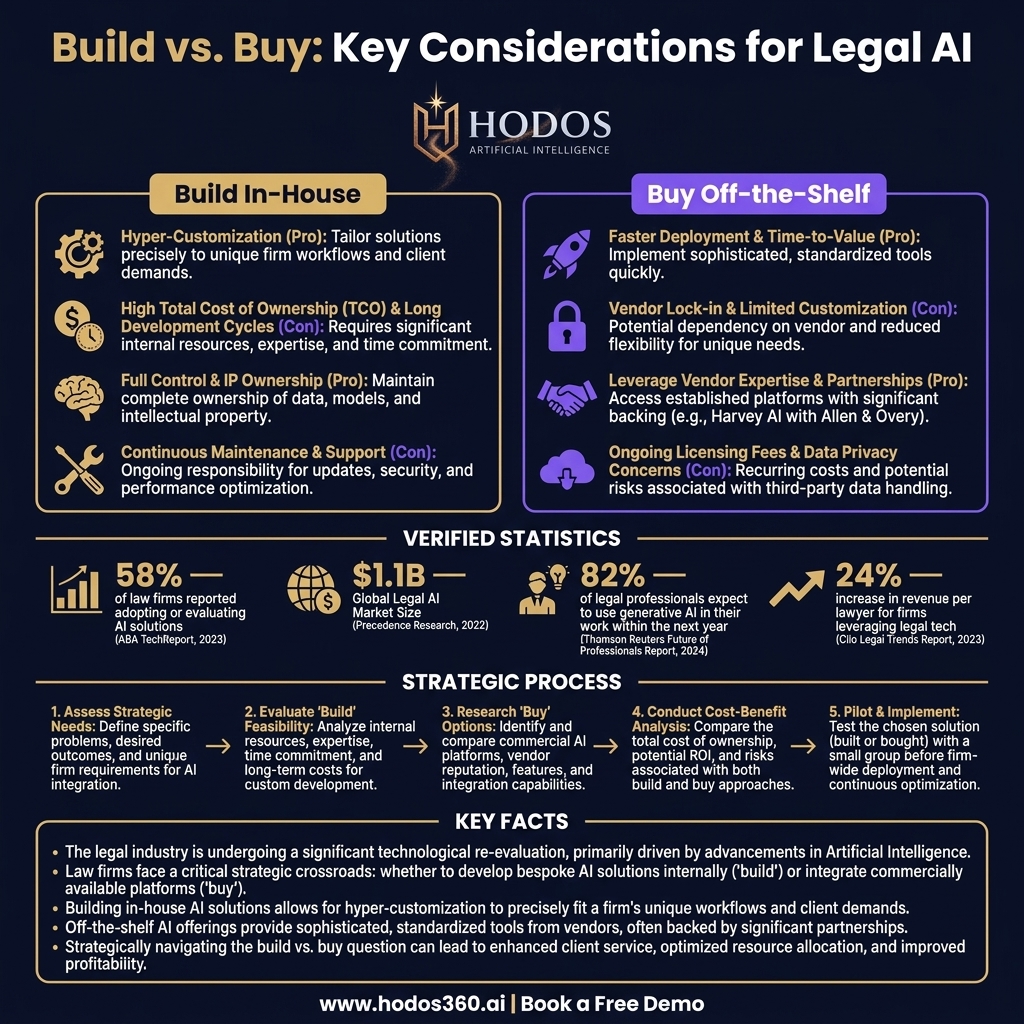
The build vs buy dilemma is a foundational decision in modern legal tech strategy, particularly with the advent of sophisticated generative AI. 'Building' refers to the in-house development of custom AI solutions, offering complete control and tailored functionality, as seen with Addleshaw Goddard's AGPT. 'Buying,' conversely, involves subscribing to or integrating off-the-shelf SaaS platforms provided by third-party vendors, which often offer faster deployment and lower upfront costs. This strategic choice is influenced by a myriad of factors, including a firm's budget, timeline, desired level of customization, internal technical expertise, and long-term strategic vision for legal innovation.
The advantages of building an in-house solution are compelling for firms seeking a distinct competitive edge. It provides absolute control over the AI's design, features, and data security protocols, ensuring a perfect fit with existing legal workflows and ethical guidelines. Ownership of the intellectual property generated can also be a significant long-term asset. However, the 'build' route comes with considerable drawbacks: high upfront investment, prolonged development cycles, the need for specialized technical talent, and ongoing maintenance costs. A McKinsey report from 2023 indicated that custom software development projects have a significant failure rate, with only about 30% successfully meeting all objectives, highlighting the inherent risks.
Conversely, the 'buy' approach offers several clear benefits. Learn more about AI Voice Assistants: Ultimate Competitive Edge for Law Firms. It typically entails faster deployment, allowing firms to leverage AI capabilities almost immediately. Vendors handle the complexities of maintenance, updates, and security, reducing the operational burden on the firm. Furthermore, purchasing solutions often provides access to a broader range of features and proven expertise, benefiting from the vendor's continuous investment in AI research and development. However, 'buying' also presents its own set of challenges, including potential vendor lock-in, limited customization options, and reliance on the vendor's product roadmap, which may not always align perfectly with the firm's evolving firm strategy.
Many firms are exploring hybrid models, combining the strengths of both approaches. This might involve purchasing a robust foundational AI platform and then building custom integrations or specialized modules on top using APIs or low-code/no-code tools. For instance, firms like Clifford Chance have been known to adopt leading legal tech platforms while simultaneously developing specific internal applications for niche requirements. This blended legal tech strategy allows firms to achieve a balance between rapid implementation and tailored functionality, mitigating the extreme risks associated with an exclusively 'build' or 'buy' approach and adapting their firm strategy to the dynamic legal landscape.
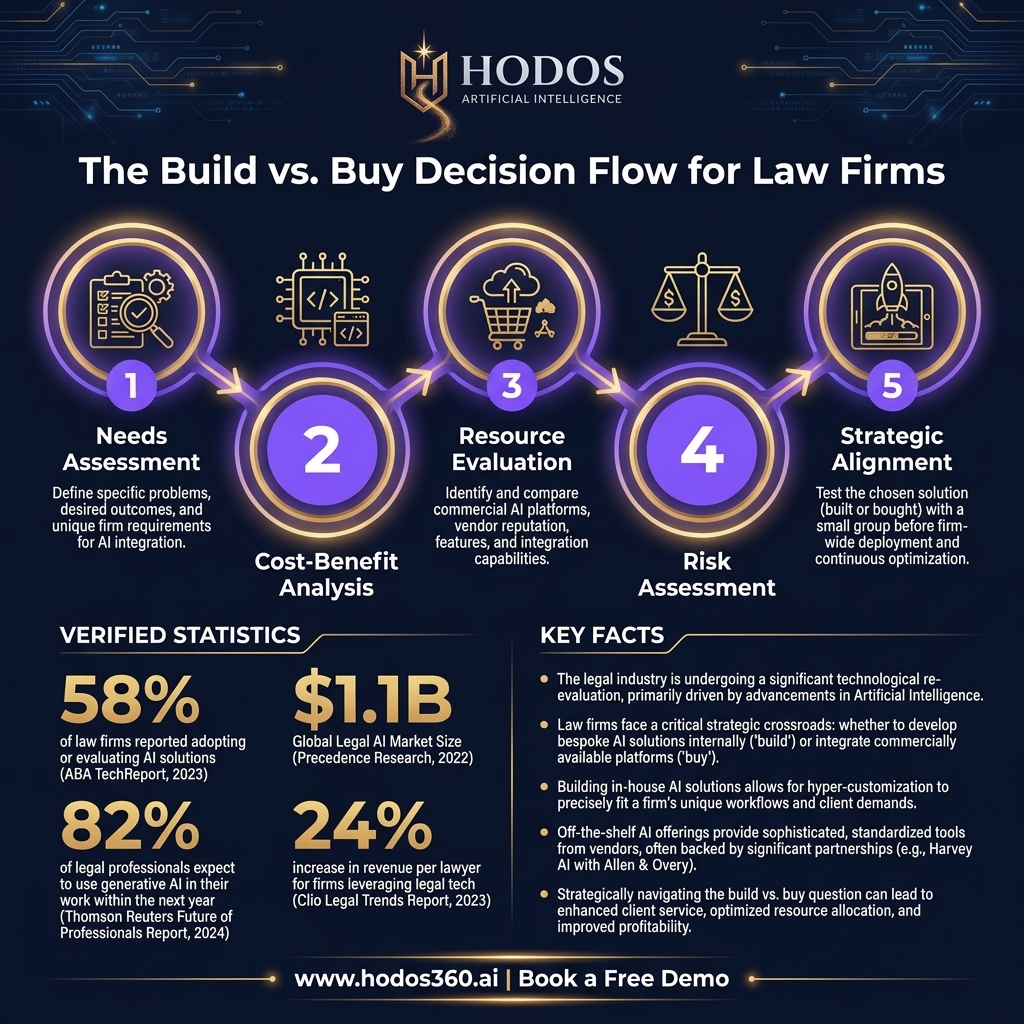
Evaluating Vendor Solutions vs. In-House Builds: A Strategic Framework
To navigate the build vs buy decision effectively, law firms need a robust strategic framework for evaluation. Key criteria must include functionality (does it meet specific legal workflows?), scalability (can it grow with the firm?), security (data protection and compliance), total cost of ownership (TCO, beyond just upfront price), integration capabilities with existing systems, vendor reputation, and future roadmap alignment. A thorough needs assessment is the crucial first step, identifying specific pain points and desired outcomes that AI is intended to address. Without a clear understanding of what problems the AI will solve, any investment risks becoming a speculative endeavor rather than a strategic one.
Firms must also consider their internal risk appetite and technical maturity. Learn more about Essential Marketing Automation: Law Firm Growth Strategies. Those with significant in-house development capabilities and a high tolerance for risk might lean towards building, as Addleshaw Goddard did. Firms with limited technical resources or a preference for proven, supported solutions will likely find the 'buy' option more appealing. The decision should not be made in isolation but as part of a holistic firm strategy, ensuring that the chosen legal tech strategy aligns with the firm's overall business objectives, client service model, and long-term vision for legal innovation.
The Economic Imperative: ROI and Scalability in Legal Tech
Regardless of whether a firm chooses to build vs buy, the ultimate justification for any significant investment in legal tech strategy hinges on demonstrating a clear return on investment (ROI) and ensuring scalability. Law firms operate on tight margins, and every dollar spent on technology must contribute tangibly to efficiency, profitability, or client satisfaction. Gartner's 2024 tech spending outlook consistently emphasizes that successful technology adoption is inextricably linked to measurable business outcomes. For AI in legal, ROI can be quantified through metrics like reduced administrative hours, increased billable capacity, improved accuracy in legal research, faster client intake processes, and enhanced client retention rates due to superior service.
Scalability is another critical economic consideration, particularly for firms with multiple offices or diverse practice groups. A bespoke AI solution, while perfectly tailored, might be challenging and costly to scale across an entire organization without significant additional development and infrastructure investment. This can lead to fragmented adoption or the creation of 'shadow IT' systems if departments develop their own workarounds. In contrast, purchased AI solutions often come with built-in scalability, designed to accommodate growth and varied user needs, allowing for consistent deployment and centralized management across the firm. This inherent scalability of commercial offerings can significantly reduce the long-term total cost of ownership (TCO) compared to a custom-built system that requires continuous, resource-intensive scaling efforts.
The total cost of ownership (TCO) for both 'build' and 'buy' options extends far beyond the initial purchase or development price. Learn more about AI Lead Generation: The Ultimate Guide to Smarter Law Firm Growth. For custom builds, TCO includes ongoing maintenance, bug fixes, security patches, infrastructure upgrades, and the continuous need for specialized development talent. For purchased solutions, TCO encompasses subscription fees, integration costs, and potential customization fees. A Thomson Reuters 2024 State of the Legal Market report highlighted that firms effectively leveraging generative AI in their operations are reporting higher profit margins and improved client satisfaction, underscoring the direct economic impact of a well-executed legal tech strategy.
The economic imperative also extends to the opportunity cost. The time and resources diverted to building a complex AI solution in-house could potentially be used for other strategic initiatives, such as business development, talent acquisition, or expanding into new practice areas. Conversely, a poorly chosen off-the-shelf solution might fail to deliver the promised efficiencies, leading to frustration and the need for further investment in alternative tools. Therefore, a comprehensive TCO analysis, coupled with a realistic assessment of potential ROI, is indispensable for making a financially sound build vs buy decision that aligns with the firm's overall firm strategy and ensures sustainable legal innovation.
Integrating AI: Challenges, Best Practices, and Ethical Considerations
Integrating new AI tools into existing legal workflows, whether built or bought, presents a unique set of operational and cultural challenges. The most common hurdles include data migration from legacy systems, potential disruption to established processes, and, crucially, user adoption. Legal professionals, often accustomed to traditional methods, may exhibit resistance to change, viewing new technology with skepticism or fear. A 2023 survey by Legal Tech News indicated that 'user resistance' remains one of the top three barriers to successful technology implementation in law firms, underscoring the human element in legal tech strategy.
Best practices for successful AI integration emphasize a phased rollout, robust training programs, and transparent communication. Firms should start with pilot projects in specific practice groups, allowing for iterative feedback and adjustments. Comprehensive training, tailored to different user groups (e.g., paralegals, associates, partners), is essential to build competency and confidence. Crucially, leadership buy-in and active championing of the new technology are vital. When partners visibly adopt and advocate for AI tools, it significantly boosts firm-wide acceptance and reinforces the strategic importance of legal innovation.
Beyond technical and operational challenges, ethical considerations are paramount in AI adoption. Learn more about Event Marketing: Essential Strategies for Live Events in the AI Era. The use of generative AI in legal practice raises serious questions about client confidentiality, data privacy, and the potential for algorithmic bias. ABA Model Rule 1.6 on Confidentiality of Information mandates that lawyers must make reasonable efforts to prevent the inadvertent or unauthorized disclosure of, or unauthorized access to, information relating to the representation of a client. This rule extends to the use of AI tools, requiring firms to vet solutions for data security and ensure that client-sensitive information is not compromised or inadvertently used for AI training.
Furthermore, the potential for AI 'hallucinations' or inaccurate outputs necessitates rigorous human oversight. Lawyers remain professionally responsible for the advice they provide, regardless of whether AI contributed to its formulation. The evolving regulatory landscape, exemplified by the EU AI Act, is beginning to impose strict requirements on high-risk AI applications, including those in legal services. These regulations demand transparency, human oversight, and robust risk management frameworks, influencing how firms develop, deploy, and govern their legal tech strategy and use of AI insights.
Data Security and Ethical AI Adoption: A Core Responsibility
The integrity of client data and the ethical deployment of AI are non-negotiable aspects of a responsible legal tech strategy. For custom-built AI like AGPT, firms must design and implement stringent data security protocols from inception, including end-to-end encryption, strict access controls, and regular security audits. Compliance with data protection regulations such as GDPR, CCPA, and other jurisdictional requirements is not merely a legal obligation but a cornerstone of client trust. For vendor-provided solutions, thorough due diligence on the vendor's security infrastructure, data handling policies, and compliance certifications is essential to mitigate risks.
Ethical guidelines for using generative AI in legal practice are rapidly developing. The American Bar Association (ABA) and various state bar associations are issuing guidance emphasizing the need for lawyers to understand the limitations of AI, verify AI-generated content, and ensure that client privilege is always maintained. This necessitates a culture of critical evaluation and human-in-the-loop validation for all AI outputs. The focus must remain on AI as an assistive tool that augments human expertise, rather than replacing the lawyer's professional judgment and ethical responsibility, ensuring that AI insights are leveraged responsibly within the firm strategy.

Key Takeaways and The Future of Legal Tech Adoption
The build vs buy decision in legal tech strategy is far from simple, as evidenced by the contrasting approaches of firms like Addleshaw Goddard and Allen & Overy. Addleshaw Goddard's learnings from AGPT underscore the profound commitment required for in-house development, offering unparalleled customization but demanding significant resources. Conversely, the 'buy' approach provides faster access to advanced capabilities and reduced operational burden, albeit with less control. The future of legal innovation will likely see a nuanced blend of both, where firms strategically purchase robust foundational platforms and then selectively build proprietary solutions for truly unique competitive differentiators.
Success in this evolving landscape hinges on a proactive and adaptive firm strategy. Law firm leaders must engage in continuous evaluation of their technological needs, market offerings, and internal capabilities. The actionable advice remains consistent: conduct a thorough needs analysis to define problems precisely, prioritize ROI and TCO in all investment decisions, and rigorously assess scalability and integration potential. Crucially, never compromise on data security, client confidentiality, and ethical AI deployment, as these are the bedrock of professional responsibility and client trust.
The legal industry is undergoing a fundamental transformation, and the firms that thrive will be those that embrace this change with strategic foresight. The debate between building and buying AI solutions is not merely about technology; it's about shaping the future of legal service delivery, enhancing client value, and securing a sustainable competitive advantage. By making informed, deliberate decisions about their legal tech strategy, firms can unlock the immense potential of AI to revolutionize their operations and client engagement.
Ultimately, leveraging powerful platforms to enhance services is a strategic imperative. The ability to integrate advanced AI tools for case management, client intake, document automation, and AI-powered legal workflows will be a defining characteristic of leading law firms. Whether through bespoke development or strategic procurement, the goal remains the same: to empower legal professionals with the tools they need to deliver exceptional results in an increasingly complex and competitive world.
Frequently Asked Questions
What is the "build vs. buy" dilemma in legal tech?+
The "build vs. buy" dilemma refers to the strategic decision law firms face: either developing custom AI software and tools in-house (build) or licensing and integrating existing commercial AI platforms and solutions from third-party vendors (buy). This choice impacts cost, time-to-market, customization, and long-term control over the technology.
What are the key advantages of building an AI solution in-house?+
Building an AI solution in-house offers complete control over design, functionality, and data security, ensuring a perfect fit for specific legal workflows and unique firm needs. It can provide a distinct competitive advantage and intellectual property ownership. This approach is ideal for firms seeking highly specialized capabilities not available commercially.
What are the primary benefits of purchasing an off-the-shelf legal AI platform?+
Purchasing an off-the-shelf legal AI platform typically offers faster deployment, lower upfront costs, and reduced maintenance burdens as vendors handle updates and security. Firms gain immediate access to proven expertise, a broader feature set, and ongoing innovation from the vendor, allowing for quicker adoption and scalability.
How can law firms measure the ROI of their AI investments?+
Measuring ROI for AI investments involves tracking metrics such as reduced administrative time, increased billable hours, improved accuracy in tasks like legal research or document review, faster client intake, and enhanced client satisfaction. Firms should establish clear benchmarks before implementation and continuously monitor performance against these objectives to demonstrate value.
What ethical considerations are paramount when adopting AI in legal practice?+
Ethical considerations include ensuring client confidentiality and data privacy (per ABA Model Rule 1.6), mitigating algorithmic bias, preventing AI 'hallucinations' or inaccuracies, and maintaining human oversight. Lawyers remain professionally responsible for all advice, requiring critical verification of AI-generated content to uphold ethical duties and professional judgment.
How does the EU AI Act impact legal tech development and adoption?+
The EU AI Act, when fully enforced, will impose strict regulations on high-risk AI systems, including some used in legal services. It mandates requirements for transparency, human oversight, risk management, and data governance. This impacts both firms building AI and vendors selling solutions, requiring careful compliance and potentially influencing design choices for legal AI applications.