


Essential Marketing Automation: Law Firm Growth Strategies
Just last year, Eleanor Vance, managing partner at Sterling & Associates, a respected mid-sized litigation firm in Washington D.C., faced a daunting challenge. Despite a stellar reputation, the firm's client acquisition had plateaued. Their marketing efforts felt like a Sisyphean task: endless hours spent drafting bespoke emails, manually posting on LinkedIn, and struggling to track which campaigns actually yielded new clients.
Eleanor knew they needed a paradigm shift, observing how competitors, even smaller ones, seemed to be effortlessly expanding their reach. This struggle isn't unique to Sterling & Associates; it’s a common narrative across the legal industry, where firms often grapple with the inherent tension between maintaining professional decorum and aggressively competing for market share in a rapidly evolving digital world.
The traditional reliance on referrals, while valuable, is no longer enough to sustain robust growth in a market saturated with options and increasingly sophisticated client expectations. The question facing Eleanor, and countless other legal leaders, was not *if* to embrace digital transformation, but *how* to do so effectively and strategically.
The answer, increasingly, lies in the intelligent deployment of marketing automation. As highlighted by the recent "How to Automate Small Business Marketing" discussion among Washington D.C. experts, the legal sector, much like other professional services, is realizing that automating repetitive marketing tasks isn't just about efficiency; it's about strategic advantage.
It frees up valuable attorney time, ensures consistent brand messaging, and, most critically, provides actionable data to refine outreach efforts. The American Bar Association's 2023 TechReport indicated that while AI adoption in legal marketing was still nascent, firms leveraging even basic automation reported significant improvements in lead qualification and client engagement.
This trend underscores a critical inflection point: law firms that master the art and science of automated marketing are not just surviving, but actively shaping the future of legal services delivery.
This isn't merely about scheduling social media posts; it's about building intelligent client journeys, from initial lead capture to long-term retention.
It involves AI-powered content generation, sophisticated analytics, and personalized communication at scale. Firms like Sterling & Associates are discovering that the true power of automation is in its ability to transform disparate marketing activities into a cohesive, measurable, and highly effective engine for growth. The legal industry, often cautious to adopt new technologies, is now witnessing firsthand the undeniable competitive edge that comprehensive marketing automation provides, moving beyond manual tasks to truly strategic client engagement.
The Shifting Legal Landscape: Why Marketing Automation is Non-Negotiable
The legal market has undergone a seismic shift, driven by digital transformation and heightened client expectations. Clients today, whether individuals or corporations, begin their legal journey online, researching firms, comparing services, and seeking transparency. A 2024 Thomson Reuters report on the 'Future of Legal' revealed that over 70% of potential clients use online search engines to find legal representation, with an increasing emphasis on a firm's digital presence and responsiveness.
This statistic alone underscores the obsolescence of purely traditional, referral-based marketing strategies. Firms that fail to engage effectively in the digital realm risk becoming invisible in a crowded marketplace. The pressure to innovate is immense, as new legal tech startups continuously emerge, offering agile, client-centric solutions that challenge established firms to adapt or be left behind.
This evolving dynamic creates a compelling argument for embracing modern marketing methodologies that can keep pace with client demands and market competition.
Moreover, the competitive intensity among law firms, particularly mid-sized and boutique practices, has never been higher. Firms are not just competing against peers but also against alternative legal service providers (ALSPs) and in-house legal departments that are increasingly adopting advanced technologies.
Managing partner Eleanor Vance’s observation about competitors effortlessly expanding their reach points to a broader trend: successful firms are those that have streamlined their client acquisition funnels and are leveraging data to make informed marketing decisions. According to a McKinsey Global Institute study, businesses that effectively implement marketing automation see a 14.5% increase in sales productivity and a 12.2% reduction in marketing overheads.
For law firms, where billable hours are paramount, these efficiency gains translate directly into increased profitability and the capacity to focus on high-value legal work, rather than administrative marketing tasks.
Regulations, too, are playing a role in shaping how firms approach marketing. Learn more about Marketing AI: Essential Tools to 10x Law Firm Growth.
While the ABA Model Rules of Professional Conduct, Rule 7.1 (Communications Concerning a Lawyer's Services), emphasizes truthful and non-misleading advertising, it does not preclude the use of advanced technological tools. In fact, comment [1] to Rule 7.1 notes that "any communication about a lawyer's services should be accurate and not misleading."
Marketing automation, when implemented ethically and transparently, can help firms ensure consistent adherence to these rules by standardizing communication and review processes. The challenge is to integrate these tools while maintaining professional standards and ethical obligations. This requires careful consideration of data privacy, client consent, and the accuracy of automated messaging, ensuring that technology serves to enhance, not compromise, the firm's reputation and compliance.
Finally, the sheer volume of marketing tasks—from content creation and email campaigns to social media management and lead nurturing—can overwhelm even dedicated marketing teams within law firms. Without automation, these repetitive tasks consume significant resources, diverting attention from strategic initiatives. Firms often find themselves in a reactive mode, struggling to keep up, rather than proactively engaging potential clients.
This is where the power of AI-driven marketing automation becomes indispensable. By automating the mundane, it allows legal professionals to dedicate their expertise to crafting compelling legal arguments and delivering exceptional client service, knowing that their marketing engine is running efficiently and effectively in the background.
It's about working smarter, not just harder, in the pursuit of sustainable growth.
The Ethical Imperative: Balancing Innovation with Professional Responsibility
As law firms embrace advanced marketing automation tools, a crucial consideration remains the ethical implications. The ABA Model Rules of Professional Conduct, Rule 1.6 (Confidentiality of Information), for instance, dictates that lawyers must protect client information. When using AI platforms for client intake or communication, firms must ensure that vendor agreements and system architecture comply with stringent data security and privacy standards.
This means vetting third-party tools for robust encryption, data localization, and strict access controls. The rise of sophisticated AI tools necessitates a heightened vigilance regarding data governance, especially when handling sensitive client data, to prevent breaches and maintain the attorney-client privilege. Learn more about AI Marketing: Proven Strategies for Legal Growth Beyond Efficiency.
Firms must also consider the implications of AI-generated content for accuracy and potential misrepresentation, ensuring all automated communications are reviewed for compliance with Rule 7.1. This delicate balance between technological innovation and professional responsibility is a cornerstone of responsible AI adoption in the legal sector.
Firms must actively engage in due diligence, not only from a functional perspective but, more importantly, from an ethical and compliance standpoint, ensuring that the technology serves the firm's best interests without compromising client trust or regulatory obligations.
Beyond Repetitive Tasks: AI's Role in Strategic Legal Marketing
The evolution of AI has propelled marketing automation far beyond simple task scheduling. Today, AI empowers law firms to engage in genuinely strategic marketing, anticipating client needs and personalizing interactions at scale. Think of Harvey AI's partnership with Allen & Overy, which demonstrated the potential for AI to augment legal work.
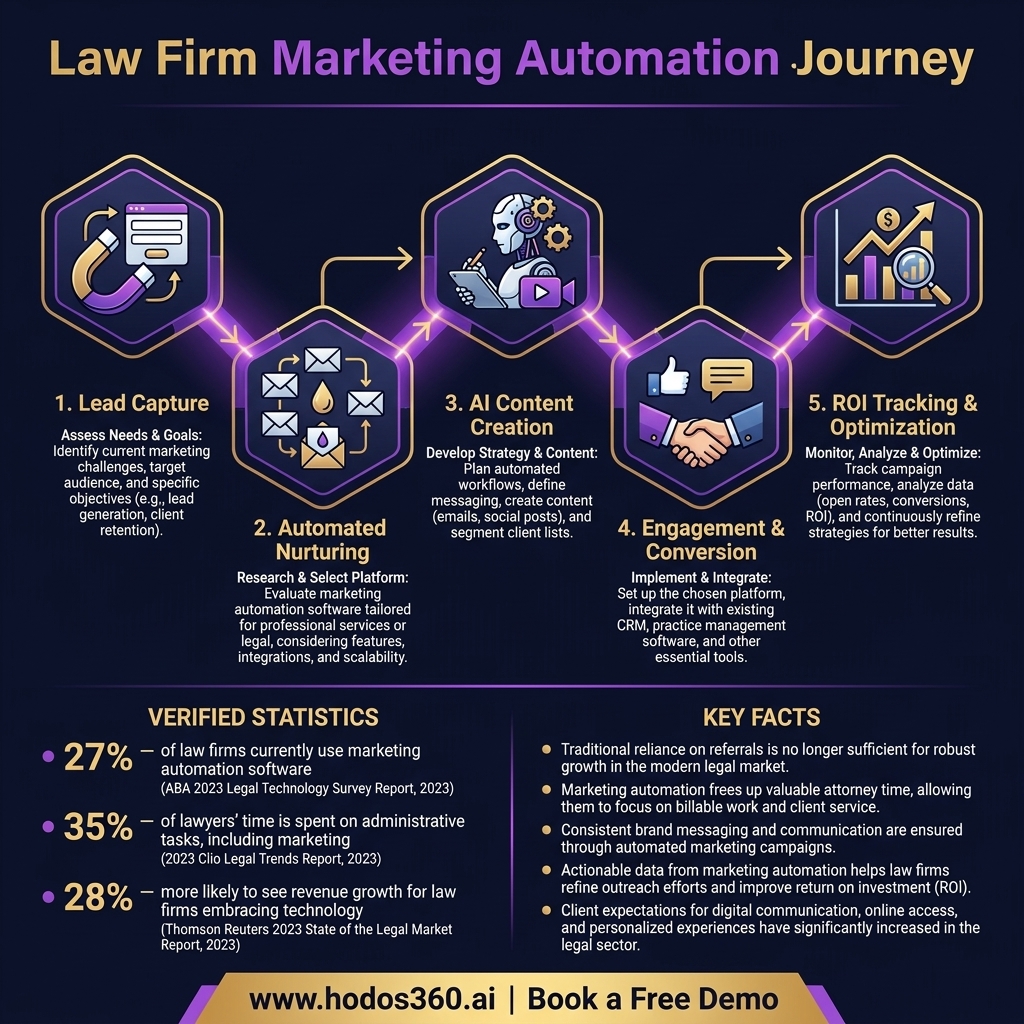
Similarly, in marketing, AI can analyze vast datasets of past client interactions, market trends, and competitor activities to identify optimal target audiences and predict future client demands. This predictive analytics capability allows firms to proactively tailor their messaging and service offerings, rather than reacting to market shifts.
For instance, an AI-powered platform could identify a surge in demand for specific intellectual property services in a certain industry sector, prompting the firm to launch a targeted content campaign or webinar series. This level of foresight transforms marketing from a cost center into a strategic growth driver, enabling firms to allocate resources more effectively and achieve a higher return on investment from their marketing spend.
One of the most impactful applications of AI in legal marketing automation is in AI video creation and content generation. Imagine a law firm needing to explain complex legal concepts or highlight recent case successes. Traditionally, this involved significant time and expense for scriptwriting, filming, and editing.
AI tools can now rapidly generate professional-quality video snippets or draft blog posts, articles, and social media updates based on specific keywords, firm expertise, and target audience profiles. While human oversight remains crucial for accuracy and tone, AI significantly accelerates the content creation pipeline. This capability allows firms to maintain a consistent, high-quality digital presence across multiple platforms, from LinkedIn to YouTube, without overwhelming internal resources.
The ability to quickly adapt and publish relevant content is a game-changer in capturing attention and establishing thought leadership in niche legal areas, ensuring that the firm remains top-of-mind for potential clients seeking specialized counsel.
Another critical area where AI excels is social media automation and engagement.
Learn more about Voice AI: Essential Strategic Growth for Law Firms. Platforms can analyze social media trends, identify relevant conversations, and even suggest optimal posting times for maximum visibility. Beyond mere scheduling, advanced AI can monitor sentiment around legal topics, identify potential leads engaging with competitors, and even draft personalized responses to inquiries, all while maintaining the firm's brand voice.
This proactive engagement transforms social media from a passive presence into an active lead-generation and client-nurturing channel. The efficiency gained allows firms to manage multiple social media accounts effectively, ensuring a consistent and professional online image, which is vital for building trust and credibility with a new generation of legal consumers.
The goal is not just to be present, but to be an active, responsive, and authoritative voice in the digital legal community.
Finally, AI-driven analytics and ROI tracking provide unprecedented insights into marketing performance. Gone are the days of guessing which campaigns are effective. AI platforms can meticulously track every touchpoint, from initial website visit to client conversion, attributing revenue to specific marketing efforts.
This granular data allows firms to optimize their marketing spend, reallocating resources to channels and campaigns that deliver the highest return. For example, if data shows that LinkedIn ads targeting in-house counsel yield a 3x higher conversion rate than traditional email newsletters, the firm can adjust its strategy accordingly.
This data-driven approach fosters a culture of continuous improvement, ensuring that marketing budgets are invested wisely and contribute demonstrably to the firm's bottom line. The ability to quantify the impact of marketing activities is not just an operational benefit; it's a strategic imperative for sustainable growth and accountability.
AI-Powered Content Generation and Social Media for Legal Firms
The marriage of AI and content creation is particularly transformative for legal firms. Tools powered by large language models can draft initial versions of blog posts, client alerts, and social media captions, significantly reducing the time human marketers or attorneys spend on drafting. For instance, a firm specializing in corporate law could use AI to generate a summary of a new SEC regulation, which an attorney then reviews and refines for accuracy and nuance.
This dramatically accelerates the firm’s ability to publish timely and relevant content, positioning them as thought leaders. Learn more about Legal AI Content: Essential for Modern Contract Workflows. Similarly, social media automation platforms can schedule posts across various channels, curate industry news, and even suggest optimal hashtags to maximize reach.
This ensures a consistent online presence, crucial for maintaining visibility and engaging with potential clients in the fast-paced digital environment. The key is to leverage AI as an augmentation tool, empowering legal professionals to focus on strategic insights and client relationships, rather than the mechanics of content production.
Crafting a Client Journey: Automation in Action for Law Firms
The true power of marketing automation for law firms lies in its ability to orchestrate a seamless and personalized client journey, from initial interest to long-term loyalty. Consider the initial touchpoint: a potential client visits a firm's website after searching for "employment lawyer near me."
An automated system can immediately capture their information through a smart intake form, categorize their inquiry (e.g., wrongful termination, contract dispute), and trigger a personalized welcome email. This email might include a relevant case study, a link to an attorney's bio specializing in that area, and an invitation to schedule a consultation through an automated calendar booking system.
This immediate, tailored response not only demonstrates professionalism but also significantly increases the likelihood of converting a lead into a client, as responsiveness is a critical factor in client selection. This is a far cry from a generic contact form submission that might sit in an inbox for hours.
Furthermore, automation excels in client nurturing. For leads not immediately ready to commit, the system can enroll them in a drip campaign, delivering a series of educational emails, newsletters, and firm updates relevant to their initial inquiry. For example, a lead interested in estate planning might receive weekly emails on topics like "Understanding Probate," "Benefits of a Living Trust," or "Updating Your Will."
Each email is designed to provide value, build trust, and keep the firm top-of-mind without being overtly promotional. As the lead interacts with this content—opening emails, clicking links, downloading resources—the automation platform tracks these engagements, scoring the lead based on their level of interest. This lead scoring allows the firm to identify "hot" leads that are ripe for direct attorney follow-up, ensuring that valuable attorney time is spent on prospects most likely to convert, optimizing the entire sales funnel.
Beyond initial acquisition, marketing automation plays a vital role in client retention and fostering referrals. After a case concludes, automated follow-up sequences can be initiated: a satisfaction survey, a request for a testimonial or review, and periodic check-ins to offer continued legal support or updates on relevant legal changes.
Learn more about AI Agents Unveiled: Essential Frontend Vision for Law Firms. For instance, a real estate client might receive an automated email about new property tax laws a year after their transaction. This proactive engagement demonstrates a firm's commitment to long-term client relationships, transforming one-off clients into loyal advocates.
According to Clio’s 2023 Legal Trends Report, client satisfaction is directly linked to communication frequency and personalization, areas where automation provides immense leverage. By consistently providing value and staying connected, firms can significantly increase client lifetime value and generate a steady stream of high-quality referrals.
Finally, the integration of AI voice assistants and web development with marketing automation creates a truly holistic client experience. Imagine a potential client calling after hours; an AI voice assistant can qualify the lead, answer basic FAQs, and even book an appointment directly into an attorney's calendar.
This 24/7 availability ensures no lead is missed due to timing constraints. Simultaneously, AI-powered website building tools can optimize landing pages for specific campaigns, ensuring a seamless user experience from ad click to conversion. Responsive design and SEO optimization, managed through automation, ensure the firm's digital assets are always performing at their peak.
This comprehensive approach, where every client touchpoint is optimized and automated, allows law firms to operate with unparalleled efficiency and effectiveness, delivering a superior experience that sets them apart in a competitive market.
Personalized Client Nurturing Through Automation
Personalization is the cornerstone of effective client nurturing, and marketing automation makes it scalable. Instead of generic mass emails, automation platforms segment audiences based on specific criteria: practice area interest, geographic location, stage in the client journey, or past interactions. This allows for hyper-targeted communication that resonates deeply with the recipient.
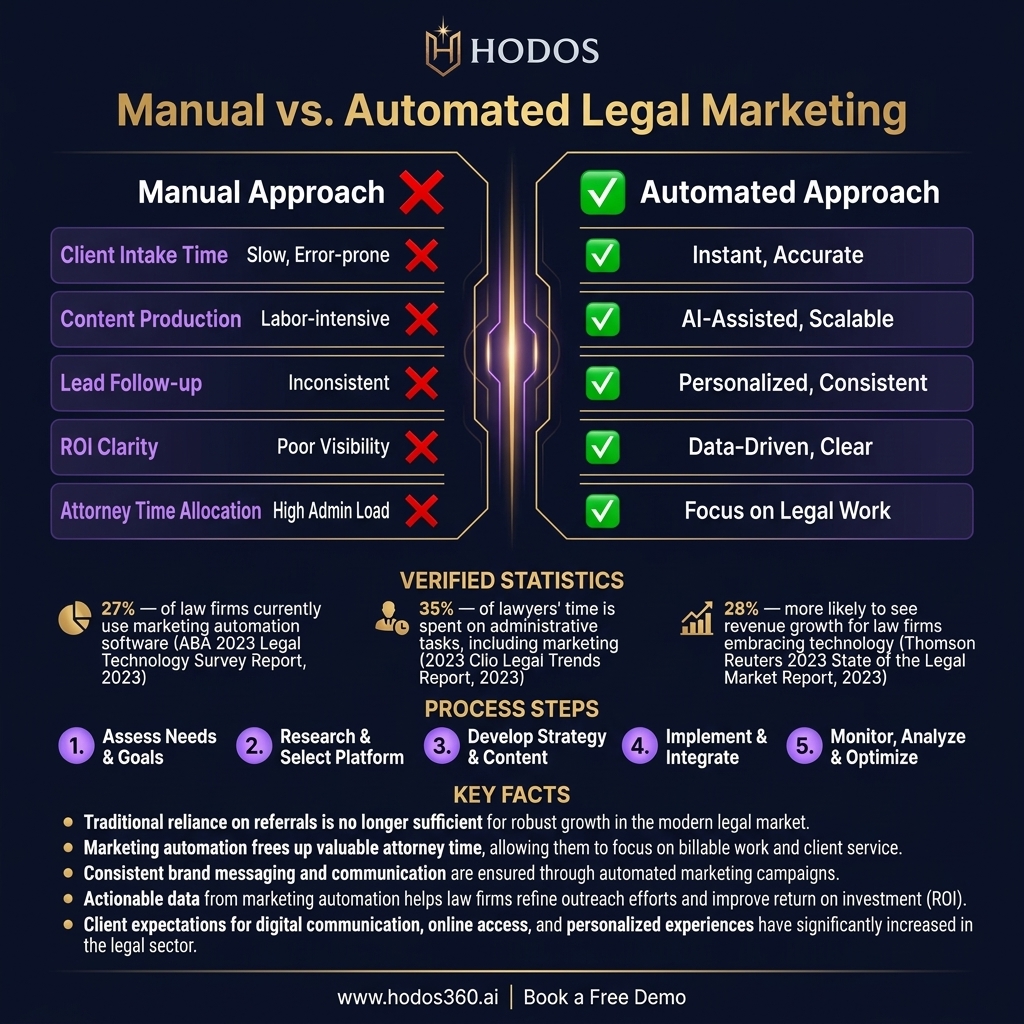
For example, a prospective client who downloaded a whitepaper on M&A due diligence might receive an invitation to a webinar hosted by the firm's corporate law team, whereas a family law prospect might get an article on co-parenting tips. Learn more about Essential AI Website Builder Guide for Law Firms.
This level of tailored content builds trust and demonstrates the firm's understanding of individual needs, significantly increasing engagement and conversion rates. The ability to deliver the right message to the right person at the right time is a potent differentiator in a service-oriented industry like law.
Measuring Success: Analytics, ROI, and Continuous Optimization
In the world of legal marketing, proving return on investment (ROI) has historically been a challenge. Traditional methods often involved anecdotal evidence or broad assumptions. However, with advanced marketing automation platforms, firms can now meticulously track, analyze, and optimize every aspect of their marketing efforts.
These platforms integrate sophisticated analytics tools that provide real-time data on campaign performance, website traffic, lead conversion rates, client acquisition costs, and ultimately, the revenue generated from specific marketing initiatives. For instance, a firm can precisely determine that a series of blog posts on 'commercial lease disputes' led to five qualified leads, three consultations, and ultimately, one new client engagement valued at $X.
This level of granular insight empowers managing partners and marketing directors to make data-driven decisions, eliminating guesswork and ensuring that marketing budgets are allocated to the most effective channels and strategies. The transparency offered by these analytics transforms marketing from a nebulous expense into a quantifiable investment.
The ability to track ROI tracking extends beyond simple lead counting. Modern marketing automation systems can integrate with billing and case management systems, allowing firms to follow a client's journey from initial marketing touchpoint all the way through the revenue cycle. This means understanding not just *how many* clients a campaign generated, but *how profitable* those clients ultimately became.
This deep integration is crucial for long-term strategic planning. For example, a campaign might generate a high volume of leads, but if those leads consistently result in low-value cases or high client churn, the firm can identify this inefficiency and adjust its targeting or messaging.
Conversely, a campaign with fewer leads but higher-value, more loyal clients can be prioritized. This comprehensive view of the client lifecycle enables firms to optimize for profitability and sustainable growth, not just vanity metrics.
Continuous optimization is a hallmark of successful marketing automation. The insights gained from analytics are not static; they inform ongoing adjustments and improvements to campaigns.
A/B testing of email subject lines, landing page layouts, and ad copy becomes effortless, allowing firms to incrementally refine their messaging for maximum impact. If an email sequence targeting corporate clients shows a low open rate, the firm can quickly test new subject lines or adjust the content based on data-driven hypotheses.
This iterative process ensures that marketing efforts are always evolving and improving, adapting to market changes and client feedback. This agile approach is a stark contrast to traditional, static marketing plans that often become outdated before they are fully executed, providing firms with a dynamic edge in a competitive environment.
Moreover, the data collected by marketing automation platforms can be leveraged for more than just marketing adjustments. It provides valuable intelligence about client needs, emerging legal trends, and market demand, which can inform strategic business decisions for the entire firm. For example, a consistent increase in inquiries for a niche practice area might signal an opportunity to invest further in that specialty, perhaps by hiring new attorneys or developing new service lines.
This holistic view, enabled by powerful analytics, transforms marketing data into a strategic asset for the firm’s overall growth and development. It moves beyond just client acquisition to genuine business intelligence, empowering firms to anticipate future challenges and seize new opportunities with confidence.
Leveraging Data for Predictive Insights
The true frontier of marketing automation lies in its capacity for predictive analytics. By analyzing historical data on client behavior, market shifts, and competitor strategies, AI can forecast future trends and client needs. For a law firm, this means being able to anticipate which legal services will be in high demand, identify which potential clients are most likely to convert, or even predict potential client churn before it happens.
This proactive intelligence allows firms to tailor their marketing efforts with unparalleled precision, allocating resources to the most promising opportunities. For instance, if data predicts an increase in regulatory compliance issues for a specific industry, the firm can preemptively launch a targeted campaign for businesses in that sector.
This foresight transforms marketing from a reactive expense to a strategic investment, enabling firms to stay several steps ahead of the curve and consistently capture new market share.

The Future is Automated: Embracing Smart Growth with HODOS 360
The journey of Eleanor Vance at Sterling & Associates, from marketing stagnation to strategic growth, is a testament to the transformative power of marketing automation. Her firm, like many others, realized that the future of legal practice demands a proactive, data-driven approach to client engagement.
The Washington D.C. experts referenced in the Carroll County Mirror-Democrat article echoed this sentiment: automation is no longer a luxury but a fundamental requirement for small businesses, and by extension, for law firms seeking to compete effectively. The firms that embrace this shift are not just seeing incremental improvements; they are experiencing exponential growth in client acquisition, engagement, and profitability.
This isn't about replacing human ingenuity, but about augmenting it with intelligent tools that handle the repetitive, time-consuming tasks, allowing legal professionals to focus on what they do best: providing exceptional legal counsel.
From the initial lead capture to the final client testimonial, every step of the client journey can be optimized and enhanced through intelligent automation.
The ability to generate AI-powered video content, automate social media engagement, and precisely track ROI means that law firms can present a polished, professional, and highly responsive front to the world, even with limited internal resources. This comprehensive approach ensures that firms are not just attracting clients but building lasting relationships based on consistent communication and personalized service.
The narrative of competition and disruption in the legal tech space, often highlighted by figures like Jack Newton of Clio, underscores that innovation is not an option but a necessity. Firms that hesitate risk falling behind those who are leveraging these advanced capabilities to redefine their market presence.
For law firms ready to embrace this future, platforms like HODOS 360 offer a comprehensive suite of AI-powered services designed specifically for the legal sector. Our AI Marketing Platform streamlines every aspect of your firm's outreach, from AI video creation and social media automation to content generation and robust ROI tracking.
Imagine having a system that ensures your firm's message is consistently heard, that your leads are nurtured efficiently, and that every marketing dollar is accounted for. This integrated approach allows firms to move beyond piecemeal solutions and adopt a unified strategy that drives measurable results.
The investment in such a platform is not just in technology; it's an investment in the sustainable growth and future resilience of your practice, ensuring you remain competitive and profitable in an ever-evolving legal landscape.
Ultimately, the choice facing law firms today is clear: continue with fragmented, labor-intensive marketing efforts, or embrace the efficiency and strategic advantages offered by advanced marketing automation.
The firms that choose the latter are positioning themselves for unparalleled success, building stronger client relationships, expanding their reach, and securing their place at the forefront of the legal industry. The journey to smart growth begins with a commitment to innovation and the strategic adoption of tools that empower your firm to thrive in the digital age.
It’s about leveraging technology to foster deeper connections, demonstrate expertise more broadly, and ultimately, serve clients more effectively than ever before. This is the path to a future where your firm’s marketing efforts are as sophisticated and strategic as your legal services.
- ✓Streamlined Client Intake: Automate initial client information gathering, reducing administrative burden and accelerating the onboarding process for new clients.
- ✓Personalized Client Nurturing: Deliver tailored content and communications to leads based on their specific legal needs and interests, building trust and increasing conversion rates.
- ✓Efficient Content Generation: Utilize AI to assist with drafting blog posts, social media updates, and legal articles, ensuring a consistent and authoritative online presence.
- ✓Automated Social Media Management: Schedule and optimize social media posts across multiple platforms, saving time and maximizing engagement with your target audience.
- ✓Robust ROI Tracking & Analytics: Gain clear insights into which marketing campaigns are most effective, allowing for data-driven allocation of marketing budgets and continuous optimization.
- ✓24/7 Lead Qualification: Deploy AI Voice Assistants to handle after-hours calls, qualify leads, and book appointments, ensuring no potential client is missed.
- ✓Enhanced Online Presence: Leverage AI-powered web development for optimized, high-converting websites that attract more prospective clients and reflect your firm's expertise.
Frequently Asked Questions
What is marketing automation for law firms?+
Marketing automation for law firms involves using software and AI tools to automate repetitive marketing tasks such as email campaigns, social media posting, lead nurturing, and analytics. It streamlines client acquisition, communication, and retention processes, allowing attorneys and staff to focus on high-value legal work. The goal is to create a more efficient, personalized, and data-driven marketing strategy that drives measurable growth and enhances client relationships.
How can AI marketing platforms help with client acquisition?+
AI marketing platforms enhance client acquisition by automating lead generation, qualification, and nurturing. They can identify ideal client profiles, personalize outreach messages, create targeted ad campaigns, and even use AI voice assistants for 24/7 lead qualification and appointment booking. This ensures a consistent, high-touch approach to potential clients, converting more leads into actual cases while reducing manual effort and improving responsiveness.
Is marketing automation ethical for legal services?+
Yes, marketing automation can be ethical for legal services when implemented carefully and compliantly. Firms must ensure that automated communications adhere to ethical rules like ABA Model Rule 7.1 (truthful advertising) and Rule 1.6 (client confidentiality). Data privacy, informed consent for communication, and human oversight for AI-generated content are crucial. When used responsibly, automation enhances client communication and firm efficiency without compromising professional standards.
What kind of content can AI generate for law firm marketing?+
AI can generate a wide range of content for law firm marketing, including initial drafts of blog posts, social media updates, client alerts, email newsletters, and even video scripts. While human review is essential for legal accuracy, nuance, and firm voice, AI significantly accelerates the content creation process. This allows firms to maintain a consistent flow of high-quality, relevant content, establishing thought leadership and engaging potential clients across various digital channels.
How does marketing automation help track ROI for law firms?+
Marketing automation platforms provide robust analytics and ROI tracking capabilities by monitoring every client touchpoint from initial interaction to conversion. They can attribute leads and revenue directly to specific marketing campaigns, track client acquisition costs, and measure the effectiveness of different channels. This data-driven approach allows law firms to optimize their marketing spend, identify high-performing strategies, and demonstrate a clear return on investment for their marketing efforts, moving beyond guesswork.