


Legal AI Content: Essential for Modern Contract Workflows
The legal landscape is experiencing a seismic shift, propelled by the relentless march of artificial intelligence. On April 16, 2026, the legal tech world buzzed with news of a pivotal strategic alliance: LexisNexis, a titan in legal information and technology, announced a partnership with Luminance, a leader in AI-powered contract analysis.
This collaboration, highlighted by HRTech Series, isn't just another industry handshake; it represents a profound convergence of authoritative legal content with cutting-edge AI technology, poised to redefine enterprise contract workflows for law firms and corporate legal departments globally. For legal professionals navigating an increasingly complex and data-rich environment, this alliance signals a critical juncture, underscoring the imperative of integrating intelligent solutions to maintain efficiency, accuracy, and a competitive edge.
It’s a move that recognizes the growing demand for AI systems fed by trusted, verifiable legal data, a direct response to the risks associated with unverified generative AI outputs.
This strategic alliance is more than just a business deal; it's a testament to the evolving dynamics of the legal tech market, where collaboration between established giants and nimble innovators is becoming the norm.
The pressure to deliver faster, more accurate, and cost-effective legal services has never been higher, pushing firms to seek out advanced tools. As Winston Weinberg, co-founder of Harvey AI, often emphasizes, the true value of AI in law lies in its ability to augment human expertise, not replace it, by handling the voluminous, repetitive tasks that consume valuable attorney time.
The LexisNexis-Luminance pact aims to precisely address this by embedding LexisNexis's unparalleled legal research and content directly into Luminance's sophisticated AI platform. This integration promises to empower legal teams to accelerate contract review, enhance due diligence, and ensure compliance with a level of precision previously unattainable, thereby setting a new benchmark for efficiency and reliability in legal operations.
The implications extend far beyond simple document processing; they touch upon the very core of how legal work is performed, managed, and delivered in the digital age.
The implications of such a high-profile strategic alliance resonate throughout the entire legal ecosystem. Law firm partners and legal tech enthusiasts alike are keenly observing how this partnership will influence product development, market share, and the broader adoption of AI in legal practice.
It forces firms to critically evaluate their current technology stacks and consider whether their existing AI solutions are sufficient to meet future demands. The move by LexisNexis, a company with over 200 years of history, to align with an AI-native company like Luminance, founded in 2015, speaks volumes about the urgency and significance of AI integration.
It’s a clear signal that even the most established players recognize the need to evolve rapidly, combining their deep domain expertise with the agility and innovation of AI startups. This convergence is not merely about incremental improvements; it's about fundamentally rethinking legal processes, from client intake to litigation, leveraging legal AI content to drive unprecedented operational efficiencies and strategic insights.
This is where platforms like HODOS 360, with its comprehensive suite of AI-powered services, are becoming indispensable for firms looking to thrive in this new era. Book a free demo today to see how HODOS 360 can transform your law firm operations.
The Strategic Alliance: LexisNexis and Luminance Forging New Paths
The announcement of the strategic alliance between LexisNexis and Luminance has sent ripples across the legal technology sector, signaling a pivotal moment for enterprise contract workflows. LexisNexis, a global leader in legal research and content, brings its vast repository of authoritative legal AI content—case law, statutes, regulations, and expert analysis—to the table.
Luminance, on the other hand, contributes its award-winning AI platform, renowned for its ability to rapidly analyze and understand legal documents with remarkable accuracy. This partnership is designed to embed LexisNexis’s deep legal intelligence directly into Luminance’s AI-driven contract review process, creating a synergy that promises to drastically improve the speed and reliability of legal work.
Nicola Shaver, General Manager of LexisNexis’s Legal & Professional U.S. Business, emphasized in a recent statement that the collaboration is about empowering legal professionals with the most comprehensive and intelligent tools available, ensuring they can navigate complex contractual landscapes with greater confidence and efficiency. This isn't just about integrating two software systems; it's about fusing unparalleled legal knowledge with state-of-the-art machine learning capabilities to create a truly next-generation solution.
This move by LexisNexis and Luminance comes at a time of intense competition and innovation within the legal AI content space. Firms like Thomson Reuters, with its Westlaw Edge and HighQ platforms, and startups like Harvey AI, which recently secured a significant partnership with Allen & Overy, are all vying for dominance.
The LexisNexis-Luminance alliance is a direct response to this competitive environment, aiming to create a robust offering that combines the best of both worlds: established legal authority and cutting-edge AI technology. For many years, the challenge in legal AI has been the 'garbage in, garbage out' problem; AI models are only as good as the data they are trained on.
By leveraging LexisNexis’s meticulously curated and authoritative legal AI content, Luminance’s AI can operate with an unprecedented level of precision and contextual understanding. Learn more about Essential AI Website Builder Guide for Law Firms. This significantly reduces the risk of AI 'hallucinations' or misinterpretations that could lead to costly errors in legal practice, a concern frequently raised by legal ethicists and practitioners alike.
The alliance thus positions itself as a benchmark for reliable, trustworthy AI solutions in the legal domain, addressing a critical pain point for attorneys concerned about the veracity of AI-generated insights.
The genesis of this alliance can be traced back to the growing recognition that raw generative AI, while powerful, often lacks the contextual legal accuracy required for high-stakes legal work.
Emily Foges, former CEO of Luminance, had long championed the idea of augmenting human lawyers with AI, not replacing them, a vision that aligns perfectly with LexisNexis’s mission to support legal professionals. The partnership effectively creates a closed-loop system where Luminance’s AI learns from and applies insights from the most trusted legal sources.
This extends the utility of authoritative legal AI content beyond simple research, embedding it into the very fabric of transactional workflows. For law firms, this means a tangible reduction in the time spent on mundane tasks like contract review and due diligence, freeing up lawyers to focus on higher-value strategic advice.
The 2024 ABA TechReport indicated that over 60% of law firms are experimenting with or planning to adopt AI, but a significant portion still express concerns about accuracy and reliability. This alliance directly addresses those concerns, offering a solution built on a foundation of verifiable legal truth.
It is a bold statement in the race to define the future of legal practice, emphasizing quality and reliability over mere speed or novelty, and will undoubtedly influence future collaborations and product developments across the industry.
The Evolution of Legal Tech Partnerships
The LexisNexis-Luminance alliance is emblematic of a broader trend in legal tech: the shift from siloed innovation to integrated ecosystems. Historically, legal software often operated independently, requiring manual data transfer or complex integrations. However, as the demands for seamless workflows and comprehensive AI solutions have grown, so too has the need for collaborative platforms.
This mirrors developments seen in other industries, such as fintech or HR tech, where strategic partnerships enable a fuller, more integrated service offering. Think of Clio's strategic acquisition of Lawyaw in 2021 to bolster its document automation capabilities, or the ongoing integrations between various e-discovery platforms and practice management systems.
Learn more about Law Firm Mobile App Development: An Essential Blueprint for Growth. These collaborations are driven by a singular goal: to provide a unified, efficient experience for legal professionals. The market is increasingly demanding platforms that can handle everything from client intake and case management to document automation and advanced analytics, all underpinned by intelligent AI.
This means that firms are no longer just looking for a point solution; they are seeking a holistic legal technology partner capable of delivering end-to-end efficiency. The LexisNexis-Luminance partnership is a prime example of this evolution, demonstrating how combining specialized strengths can create a more powerful and compelling value proposition for the legal market, particularly in the critical area of enterprise contract workflows.
Unpacking the Power of Authoritative Legal AI Content
At the heart of the LexisNexis-Luminance alliance lies the concept of authoritative legal AI content. This term refers to AI models that are trained on, and can directly reference, verified, high-quality legal data sources—not just general internet content. In the legal profession, accuracy is paramount; a single error in a contract or legal brief can have catastrophic consequences.
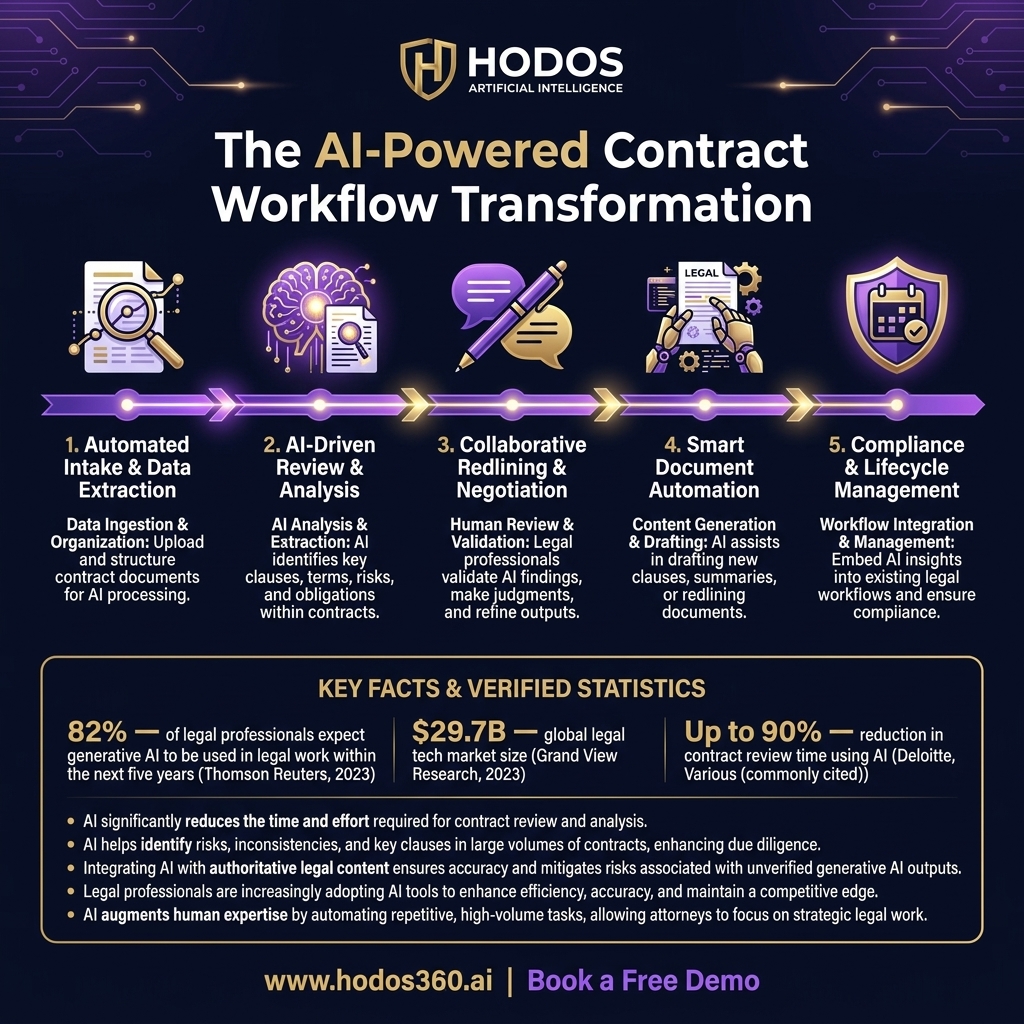
Generative AI, while impressive in its ability to produce text, has faced scrutiny for its propensity to 'hallucinate' or invent facts, citations, or even entire cases. This is where the depth and reliability of LexisNexis’s databases become invaluable. Their content, meticulously curated and updated by legal experts for decades, provides the foundational truth necessary for AI to operate reliably in a legal context.
Imagine an AI reviewing a contract clause and, instead of just flagging potential issues, it can instantly cross-reference that clause with relevant statutes, case law, and regulatory guidance from a trusted source. This level of verification is what transforms a powerful AI tool into an indispensable legal assistant.
The ethical implications of using AI in legal practice are profound, and the reliance on authoritative legal AI content directly addresses many of these concerns. ABA Model Rule 1.1 on Competence mandates that lawyers provide competent representation, which, as Comment [8] notes, includes understanding the benefits and risks associated with relevant technology.
Using AI trained on unverified data could easily lead to incompetent representation. Furthermore, ABA Model Rule 1.6 on Confidentiality of Information, specifically Comment [18], requires lawyers to make reasonable efforts to prevent inadvertent disclosure of client information. While not directly tied to content authority, it underscores the need for secure and reliable AI solutions that don't compromise sensitive data.
The integration of LexisNexis’s vetted content ensures that the AI’s output is not only efficient but also ethically sound and legally defensible. This provides a crucial layer of trust and accountability for attorneys who are increasingly incorporating AI into their daily workflows, from initial client intake to final document production.
The emphasis on authoritative content is not just a technical feature; it's a professional obligation.
The impact of authoritative legal AI content on the quality of AI solutions cannot be overstated. Learn more about Voice AI: Essential Transformation for Modern Legal Workflows. Consider the due diligence process for mergers and acquisitions, where thousands of contracts must be reviewed under tight deadlines.
Without an AI trained on accurate legal definitions, precedents, and regulatory frameworks, the risk of missing critical clauses or liabilities is substantial. A recent report by McKinsey & Company estimated that AI could automate up to 23% of lawyers' tasks, but this automation is only beneficial if the output is reliable.
Firms that adopt AI platforms like Luminance, supercharged with LexisNexis’s data, gain a significant advantage. They can perform comprehensive reviews in a fraction of the time, with greater accuracy than manual processes alone. This directly translates to better client outcomes, reduced risk, and enhanced firm profitability.
The future of legal practice hinges not just on having AI, but on having AI that is intelligently informed and ethically grounded, making authoritative legal AI content the gold standard for any firm serious about its AI strategy. This is a key differentiator that firms must consider when evaluating their legal technology investments and seeking to optimize their enterprise contract workflows.
Moreover, the concept extends beyond mere accuracy to the depth of insight. Authoritative legal AI content allows AI to perform sophisticated comparative analysis, identify nuanced legal trends, and even predict potential litigation risks based on historical data. For instance, an AI reviewing a lease agreement can not only flag unusual clauses but can also cite relevant state statutes or recent appellate court decisions that might impact enforceability, all drawn from LexisNexis’s vast library.
This proactive insight is invaluable for strategic legal advice, moving lawyers beyond reactive problem-solving to anticipatory risk management. The data from Thomson Reuters Institute’s 2023 State of the Legal Market report highlighted that law firms are increasingly seeking ways to leverage data for predictive analytics.
By feeding AI with authoritative legal AI content, firms can unlock these advanced capabilities, transforming their approach to everything from contract review to regulatory compliance. This empowers attorneys to offer more strategic, data-driven counsel, reinforcing their role as trusted advisors in a rapidly evolving legal and business landscape.
Transforming Enterprise Contract Workflows with AI Solutions
The true impact of AI solutions like those offered by the LexisNexis-Luminance alliance is most evident in the radical transformation of enterprise contract workflows. Traditionally, contract management has been a laborious, time-consuming, and error-prone process. From drafting and negotiation to execution and compliance, each stage is fraught with manual tasks that drain valuable resources.
AI changes this paradigm entirely. Imagine a scenario where a corporate legal department needs to review thousands of vendor contracts for a new data privacy regulation. Manually, this could take months, requiring a large team of paralegals and junior attorneys. With an AI-powered platform leveraging authoritative legal AI content, the system can ingest these contracts, identify relevant clauses, flag non-compliant terms, and even suggest revised language within hours or days.
This dramatically reduces the time to completion, mitigates risk, and ensures a higher degree of accuracy than human review alone, freeing up legal professionals for more strategic tasks. This efficiency gain is not theoretical; Gartner predicts that by 2027, generative AI will automate 30% of legal departments’ tasks, a significant portion of which will be in contract analysis.
One of the most significant advancements is in contract review and due diligence. In M&A deals, the speed and accuracy of reviewing target company contracts can make or break a transaction. AI solutions accelerate this process by intelligently identifying key provisions, anomalies, and potential liabilities across vast volumes of documents.
For example, during the acquisition of Twitter by Elon Musk, the legal teams faced an immense challenge of reviewing countless agreements under intense public scrutiny and tight deadlines. While not explicitly using this specific alliance, the need for sophisticated AI tools for such large-scale contract analysis was undeniable.
AI can quickly highlight clauses related to change of control, indemnification, intellectual property, and data privacy, allowing lawyers to focus on the most critical issues. This isn't just about speed; it's about depth. Learn more about AI Voice Assistants: Essential for Modern Law Firm Growth.
The AI can be trained to recognize specific risk factors unique to a particular industry or transaction, providing a level of granular analysis that would be impossible for human teams to achieve within similar timeframes. This strategic application of legal AI content enhances the firm’s capacity to handle larger, more complex deals, giving them a distinct competitive advantage in the market.
The benefits extend to ongoing contract lifecycle management (CLM) and compliance. Post-execution, contracts require continuous monitoring for obligations, renewals, and regulatory changes. AI-powered CLM systems can automatically track key dates, alert teams to upcoming deadlines, and even analyze new legislation to assess its impact on existing agreements.
For instance, following the enforcement of the EU AI Act in 2025, firms with robust AI-driven CLM systems could rapidly identify all contracts with AI-related clauses that needed review or amendment, ensuring proactive compliance rather than reactive damage control. This proactive approach significantly reduces exposure to legal and financial penalties, safeguarding client interests.
Furthermore, document automation tools integrated within these AI solutions can generate new contracts, amendments, and legal documents based on pre-approved templates and client-specific data, drastically cutting down drafting time and minimizing human error. These integrated AI-powered legal workflows are not just about efficiency; they are about embedding intelligence into every stage of the contract lifecycle, transforming it from a static repository of agreements into a dynamic, intelligent asset that supports strategic business decisions.
For law firms, this translates to improved client service, reduced operational costs, and the ability to take on more work with existing resources.
This transformation is precisely what platforms like HODOS 360 aim to deliver through their AI Law Firm Management System. By offering comprehensive features like case management, billing, client intake, and document automation, all powered by AI, HODOS 360 provides a holistic solution for firms seeking to modernize their operations.
Our AI-powered legal workflows are designed to streamline everything from initial client engagement to complex contract review, enabling firms to leverage the same principles of authoritative legal AI content integration that major players like LexisNexis and Luminance are championing. The goal is to democratize access to advanced AI capabilities, allowing even small to mid-sized law firms to achieve efficiencies and insights previously reserved for large enterprises.
By centralizing operations and infusing them with intelligent automation, HODOS 360 empowers legal professionals to focus on high-value legal work, enhance client satisfaction, and drive sustainable growth in a competitive market. Our platform ensures that firms are not just adopting AI, but are doing so strategically and effectively, making the most of the transformative power of legal AI content.
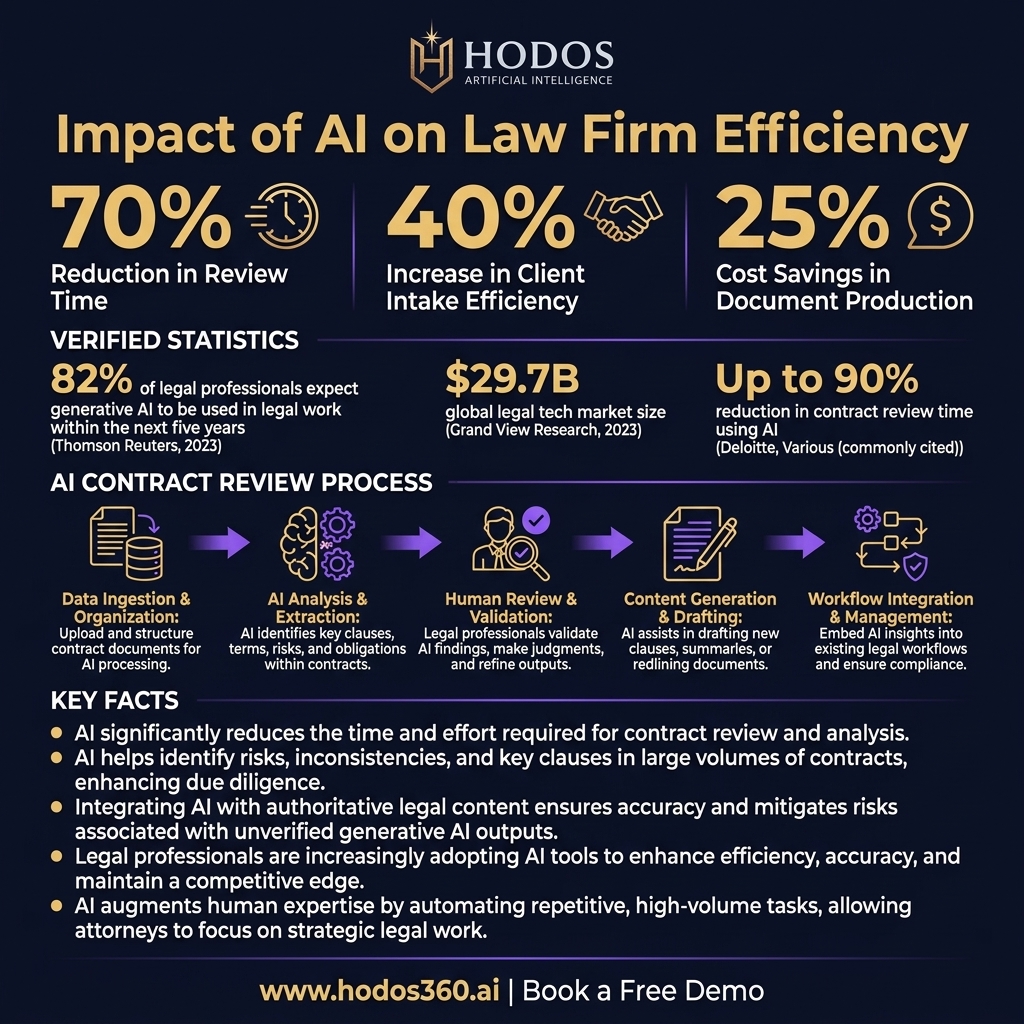
- ✓Automated Contract Review: AI rapidly identifies key clauses, anomalies, and risks in vast document volumes, reducing review time by up to 70% according to some industry estimates.
- ✓Enhanced Due Diligence: Accelerates M&A processes by quickly pinpointing critical contractual provisions and potential liabilities, ensuring comprehensive analysis under tight deadlines.
- ✓Proactive Compliance Management: AI-powered systems monitor contracts for regulatory changes and obligations, alerting firms to necessary amendments and ensuring ongoing adherence to new laws like the EU AI Act.
- ✓Smart Document Automation: Generates accurate and consistent legal documents, such as new contracts or amendments, from templates and data, minimizing manual drafting errors and improving turnaround times.
- ✓Risk Mitigation & Predictive Analytics: Identifies potential litigation risks and provides comparative analysis based on historical data and authoritative legal AI content, enabling strategic advice and proactive risk management.
- ✓Improved Client Intake & Case Management: Streamlines initial client engagement and integrates contract data into broader case management, ensuring a seamless flow of information and better client service.
- ✓Cost Efficiency: Reduces operational costs associated with manual review, drafting, and compliance monitoring, allowing firms to allocate resources to higher-value legal work and improve profitability.
Navigating the Legal Tech Landscape: Competition and Collaboration
The legal tech landscape is a dynamic arena characterized by intense competition and strategic collaborations, where firms are constantly vying for market share and technological superiority. The LexisNexis-Luminance strategic alliance is but one prominent example in a broader narrative of innovation and disruption. We've seen significant moves from other industry giants, such as Thomson Reuters, which continues to invest heavily in its AI capabilities, integrating generative AI into Westlaw Edge and expanding its HighQ platform for enterprise legal management.
Meanwhile, startups like Harvey AI, backed by OpenAI’s investment and led by CEO Winston Weinberg, have rapidly ascended, forming high-profile partnerships with prestigious firms like Allen & Overy to develop custom AI solutions for litigation and transactional work. This competitive tension creates a fertile ground for innovation, pushing every player to enhance their legal AI content offerings and AI solutions.
The market is also witnessing a surge in venture capital funding for legal tech startups, signaling strong investor confidence in the sector’s growth potential. In 2023, legal tech funding reached over $1 billion globally, with a significant portion directed towards AI-driven platforms. For example, Clio, a leader in cloud-based legal practice management, has continued its aggressive growth strategy, including strategic acquisitions like Lawyaw to bolster its document automation capabilities.
These investments and acquisitions highlight the urgency with which the industry is embracing digital transformation. The 'human conflict/drama' plays out as established legal tech providers adapt to the rapid pace of AI development, often by acquiring smaller, innovative companies or forming alliances, rather than building everything in-house.
This strategy allows them to quickly integrate cutting-edge AI technology and authoritative legal AI content into their existing ecosystems, responding to the evolving needs of legal professionals who demand more sophisticated and integrated tools.
Conferences like LegalTech NYC 2026 serve as critical barometers for these trends, showcasing the latest product launches, strategic partnerships, and thought leadership in the sector.
This year, much of the discussion revolved around the practical implementation of generative AI in legal practice, moving beyond hype to tangible applications in enterprise contract workflows and beyond. Learn more about AI Legal Research: The Ultimate Evolution of Legal Analysis. The EU AI Act, which began enforcement in 2025, has also spurred a new wave of innovation focused on AI governance, ethics, and compliance, creating a distinct market segment for AI solutions that prioritize transparency and accountability.
Firms that adopted AI early, like those leveraging platforms for AI-powered legal workflows, are already demonstrating measurable gains in efficiency and client satisfaction, creating a stark contrast with more traditional firms that are still hesitant. This growing gap underscores the competitive pressure for all legal entities, regardless of size, to strategically engage with legal technology and authoritative legal AI content.
The race for market dominance is not just about features; it’s about ecosystem and trust. The LexisNexis-Luminance alliance leverages the decades-long trust LexisNexis has built with the legal community, combining it with Luminance’s reputation for robust AI. This contrasts with some newer players who are still building that foundational trust.
The challenge for all AI solutions providers is to demonstrate not just capabilities, but also reliability and ethical adherence. Law firms are increasingly sophisticated buyers, demanding proof of ROI and rigorous security protocols, especially when dealing with sensitive client data. The market is maturing, and generic AI offerings are no longer sufficient.
The demand is for specialized, legally-informed AI that can handle the nuances of legal language and practice. This intense competition and collaborative spirit are ultimately beneficial for law firms, leading to more powerful, reliable, and integrated legal technology tools that can truly transform their operations and client service delivery.
The Rise of Specialized Legal AI Platforms
In this competitive landscape, the emergence of specialized legal AI platforms is a defining characteristic. No longer is a generic AI tool sufficient for the complex demands of legal practice. Instead, platforms are now tailored to specific legal functions, such as contract review, e-discovery, litigation analytics, or intellectual property management.
This specialization allows for deeper integration of authoritative legal AI content and more nuanced understanding of legal context. For example, a platform designed for enterprise contract workflows can incorporate specific industry standards, regulatory frameworks, and even a firm's unique precedents, leading to highly accurate and actionable insights.
Learn more about AI Websites: Essential Digital Growth for Law Firms. This trend is a direct response to the legal profession's demand for precision and reliability, moving beyond broad-stroke AI to highly targeted AI solutions. The partnership between LexisNexis and Luminance exemplifies this, creating a specialized tool focused on contracts, enriched by the most reliable legal data.
This strategic focus ensures that the AI's capabilities are not diluted across various domains but are instead concentrated to deliver maximum value in a specific, critical area of legal practice, providing a template for future developments in legal technology.
The Future-Forward Law Firm: Embracing AI for Growth
For law firm owners and legal professionals, the message from the LexisNexis-Luminance alliance and the broader legal tech landscape is clear: embracing AI is no longer optional; it is essential for growth and survival. The future-forward law firm is one that strategically integrates AI solutions across its operations, leveraging authoritative legal AI content to enhance efficiency, reduce costs, and deliver superior client outcomes.
This doesn't mean replacing lawyers with machines, but rather empowering attorneys with intelligent tools that augment their capabilities, freeing them from mundane, repetitive tasks to focus on complex problem-solving, strategic advice, and client relationship building. Firms that hesitate risk being outmaneuvered by more agile competitors who are already reaping the benefits of AI-powered legal workflows, from accelerated contract review to optimized client intake solutions.
The question is no longer *if* to adopt AI, but *how* to implement it effectively and ethically.
Strategic AI implementation involves more than just purchasing software; it requires a cultural shift within the firm. It necessitates training legal teams to work alongside AI, understanding its strengths and limitations, and establishing robust data governance policies.
Firms must ensure that the legal AI content they use is authoritative and secure, adhering to ethical guidelines like those outlined in ABA Model Rules. Moreover, successful implementation means integrating AI into existing systems, creating seamless enterprise contract workflows and other operational processes. The goal is to build an intelligent ecosystem that supports every facet of legal practice, from document automation to advanced litigation analytics.
This holistic approach ensures that AI is not just a siloed tool but a core component of the firm's strategic advantage, driving innovation and fostering a culture of continuous improvement. Firms that invest in comprehensive legal technology platforms are better positioned to attract top talent, offer competitive pricing, and provide unparalleled service to their clients.
The benefits of becoming a future-forward law firm extend beyond internal efficiencies. Clients are increasingly sophisticated and demand transparency, speed, and value. Firms that can demonstrate their commitment to innovation through the adoption of AI solutions like those leveraging authoritative legal AI content will gain a significant competitive edge.
Imagine a client receiving a contract review in days instead of weeks, or a complex due diligence report generated with unprecedented accuracy. These tangible benefits translate directly into enhanced client satisfaction and stronger relationships. Furthermore, by optimizing internal processes, firms can reallocate resources to invest in growth areas, such as expanding practice areas or enhancing their AI marketing platform capabilities.
The adoption of AI is not merely a cost-saving measure; it is a strategic investment in the firm's long-term viability and success in an increasingly tech-driven legal market.
In conclusion, the strategic alliance between LexisNexis and Luminance is a powerful indicator of the direction of legal technology.
It underscores the critical importance of integrating authoritative legal AI content into AI solutions to transform enterprise contract workflows. For law firms looking to navigate this evolving landscape, platforms like HODOS 360 offer a comprehensive suite of AI-powered services designed to meet these exact needs.
From AI Law Firm Management System with AI-powered legal workflows to AI Marketing Platform and AI Voice Assistants, HODOS 360 provides the tools necessary to embrace this transformation. By adopting sophisticated AI solutions, firms can secure their competitive position, enhance client service, and ensure sustainable growth in the era of intelligent law.
The time to act is now; the future of legal practice is here, and it is powered by AI. Discover how HODOS 360 can empower your firm to lead the charge.

Embracing a Culture of Innovation
Cultivating a culture of innovation is paramount for firms aiming to thrive with AI solutions. This involves not only adopting new legal technology but also fostering an environment where attorneys and staff are encouraged to experiment, learn, and adapt. Firms that embrace this mindset will find it easier to integrate authoritative legal AI content into their daily routines and extract maximum value from their investments.
It’s about more than just tools; it’s about a mindset that views technology as an enabler of better legal service, not a threat. This forward-thinking approach is what differentiates leading firms from their competitors, allowing them to remain agile and responsive to the rapid changes in the legal profession.
By fostering innovation, firms can continuously refine their enterprise contract workflows and other processes, ensuring they remain at the forefront of legal AI content application.
Frequently Asked Questions
What is 'authoritative legal AI content' and why is it important?+
'Authoritative legal AI content' refers to AI models trained on and able to reference verified, high-quality legal data from trusted sources like LexisNexis. It's crucial because it ensures accuracy and reliability in AI outputs, minimizing errors and 'hallucinations' that could have severe consequences in legal practice. This foundational truth is essential for ethical and competent legal representation.
How do AI solutions transform enterprise contract workflows?+
AI solutions revolutionize contract workflows by automating repetitive tasks like review, due diligence, and compliance monitoring. They accelerate processes, enhance accuracy, and reduce costs. For example, AI can analyze thousands of contracts in hours, identify risks, and suggest amendments, freeing legal professionals to focus on strategic advice. This leads to faster transactions and proactive risk management.
What are the ethical considerations of using AI in legal practice?+
Ethical considerations include ensuring AI competence (ABA Model Rule 1.1), maintaining client confidentiality (ABA Model Rule 1.6), and avoiding 'hallucinations' or biased outputs. Lawyers must understand AI's limitations, verify its results, and ensure data security. Relying on authoritative legal AI content and transparent AI solutions is crucial for ethical and responsible AI adoption in law.
How can small to mid-sized law firms adopt AI effectively?+
Small to mid-sized firms can adopt AI effectively by choosing integrated platforms that offer comprehensive AI-powered solutions, like HODOS 360. Start with key areas like client intake, document automation, and contract review to see immediate benefits. Focus on solutions with authoritative legal content. Training staff and fostering a culture of innovation are also vital for successful, scalable AI integration.
What is the future outlook for legal AI and legal technology?+
The future outlook for legal AI and technology is one of rapid integration and specialization. We will see more strategic alliances between content providers and AI developers, leading to highly specialized, reliable AI solutions. AI will increasingly automate routine tasks, augment lawyer capabilities for strategic work, and drive predictive analytics, making legal services faster, more accessible, and more accurate across the board.