


Voice AI: Essential Transformation for Modern Legal Workflows
In the rapidly evolving landscape of artificial intelligence, the concept of "vibe coding"—the intuitive, conversational generation of code—has captured the imagination of developers and tech enthusiasts alike, as highlighted by recent discussions on platforms like Forbes. While the initial buzz might focus on its creative potential for rapid application development, the deeper, more profound impact of conversational AI, particularly Voice AI, is already extending far beyond the realm of pure coding.
For the legal industry, this shift isn't just about efficiency; it's about fundamentally transforming every aspect of legal practice, from client engagement to case management, promising an era of unprecedented productivity and accessibility.
Indeed, the journey from rudimentary speech recognition to sophisticated Voice AI capable of understanding nuance, context, and intent represents one of the most significant technological leaps for professional services.
Legal professionals, often burdened by administrative tasks and stringent communication requirements, stand to gain immensely. Imagine a world where a lawyer's voice can initiate complex document automation, schedule client consultations, or even provide preliminary lead qualification, all while maintaining the highest standards of confidentiality and accuracy.
This vision is no longer futuristic speculation but an emerging reality, powered by platforms designed specifically for the rigorous demands of the legal sector.
The competitive tension in the legal market has never been higher, pushing firms to seek out every advantage. While some firms may still be debating the merits of initial AI adoption, others are already leveraging advanced Voice AI to redefine their operational blueprints.
As Sam Altman, CEO of OpenAI, frequently emphasizes, the rapid advancement of large language models (LLMs) is creating entirely new paradigms for human-computer interaction. This isn't merely about automating repetitive tasks; it’s about augmenting human intelligence, freeing legal experts to focus on complex legal strategy and client advocacy, rather than getting bogged down in the minutiae of daily operations.
The question is no longer *if* Voice AI will transform legal workflows, but *how quickly* firms will adapt to harness its essential power.
Voice AI: Beyond Vibe Coding in Legal Workflows
The concept of "vibe coding," as explored by tech thought leaders like Shashi Bellamkonda and discussed across various forums including Medium, underscores a fascinating trend: the ability to intuitively generate digital assets through natural language. While this paradigm is exciting for quick prototyping, its direct application in the highly structured, compliance-driven legal field requires a more robust and specialized interpretation.
For law firms, Voice AI isn't about casually "vibing" code; it's about deploying sophisticated algorithms to handle mission-critical legal workflows with precision, security, and unwavering adherence to professional standards. This involves moving from simple command recognition to deep semantic understanding, allowing AI to interpret legal jargon, client intent, and complex procedural requirements.
The real transformation lies in the advanced capabilities of Natural Language Processing (NLP) that underpin modern Voice AI. Unlike earlier iterations, today's AI can process vast amounts of unstructured data, identify key entities, and even infer emotional states, all crucial in client interactions. For instance, a client calling a firm might express frustration or urgency; an advanced Voice AI assistant can detect these cues, prioritize the call, and route it appropriately, or provide empathetic responses.
This level of nuanced interaction ensures that even automated processes maintain a human-centric approach, a critical factor for client satisfaction in the legal sector. Firms that embrace this level of sophistication are not just automating; they are engineering a superior client experience.
Consider the operational shifts this enables.
Learn more about AI Chatbot Builders: Transform Your Law Firm in 2026. Firms that have historically relied on human receptionists for initial client screening can now deploy Voice AI assistants that operate 24/7, handling routine inquiries, providing directions, and even pre-qualifying leads based on predefined criteria.
This significantly reduces overhead, ensures no potential client call is missed, and allows human staff to focus on high-value tasks. This is not about replacing human interaction but optimizing it, ensuring that when a human intervenes, they are equipped with all necessary preliminary information, leading to more productive and focused engagements.
The competitive edge this offers is substantial, allowing firms to expand their reach and responsiveness without proportional increases in staffing.
Furthermore, the advancements in AI, such as those seen in Claude AI and its Claude code generation capabilities, illustrate the potential for AI to not just understand but to *act* on complex instructions.
In a legal context, this translates to Voice AI that can initiate case file creation, update client contact information in a CRM, or even trigger document assembly processes based on a verbal summary of a new case. This is a far cry from basic voice commands; it's about a symbiotic relationship where legal professionals can articulate their needs naturally, and the AI system intelligently executes multi-step legal workflows, paving the way for unprecedented efficiency and freeing up valuable attorney time.
The shift is from reactive to proactive, from manual to intelligent automation.
Revolutionizing Client Engagement with AI Voice Assistants
The front lines of client interaction are where Voice AI assistants are making some of their most significant inroads, fundamentally reshaping how law firms engage with prospective and existing clients. Historically, client intake has been a bottleneck, often relying on manual processes, phone tag, and limited office hours.
This creates friction for clients seeking legal assistance and lost opportunities for firms. Firms that have been slow to adopt modern client intake automation often face a stark reality: potential clients, accustomed to instant gratification in other sectors, will simply move on if their initial outreach is met with delays or unresponsiveness.
This human conflict—the tension between traditional methods and modern client expectations—is precisely where Voice AI offers a powerful resolution.
With AI Voice Assistants, law firms can offer 24/7 client support, ensuring that every call is answered, every inquiry acknowledged. These assistants are not just answering machines; they are intelligent agents capable of lead qualification, gathering essential information, identifying the nature of the legal issue, and even performing initial conflict checks.
This pre-screening process ensures that when a human attorney or paralegal follows up, they are engaging with a genuinely qualified lead, armed with relevant preliminary data. For example, a recent report by Thomson Reuters' *State of the Legal Market* highlighted that firms leveraging advanced client communication tools saw a significant increase in lead conversion rates, directly impacting their bottom line.
Learn more about Agentic Marketing: The Ultimate Guide for Law Firms. The ability to provide instant, accurate information, even in multiple languages through multilingual support, positions a firm as modern, client-centric, and highly responsive.
Beyond initial intake, Voice AI streamlines the entire client journey. Imagine a client needing to schedule an appointment.
Instead of navigating complex phone trees or waiting for a callback, they can simply speak their request to an AI assistant, which then accesses the firm's calendar, suggests available slots, and books the appointment—all in natural conversation. For existing clients, these assistants can provide updates on case status, answer frequently asked questions about billing or court procedures, and even route urgent calls directly to the appropriate attorney.
This sophisticated call routing ensures that critical communications are never delayed, enhancing both efficiency and client satisfaction, solidifying client trust and loyalty. This paradigm shift means less administrative burden for staff and a vastly improved experience for clients.
From Call Centers to Virtual Legal Receptionists
The evolution of Voice AI mirrors the transformation seen in traditional call centers, but with a specialized legal twist. Firms are moving beyond outsourcing generic call answering to deploying dedicated virtual legal receptionists powered by AI. These systems are trained on legal terminology, firm-specific protocols, and jurisdictional nuances, making them far more effective than generalist virtual assistants.
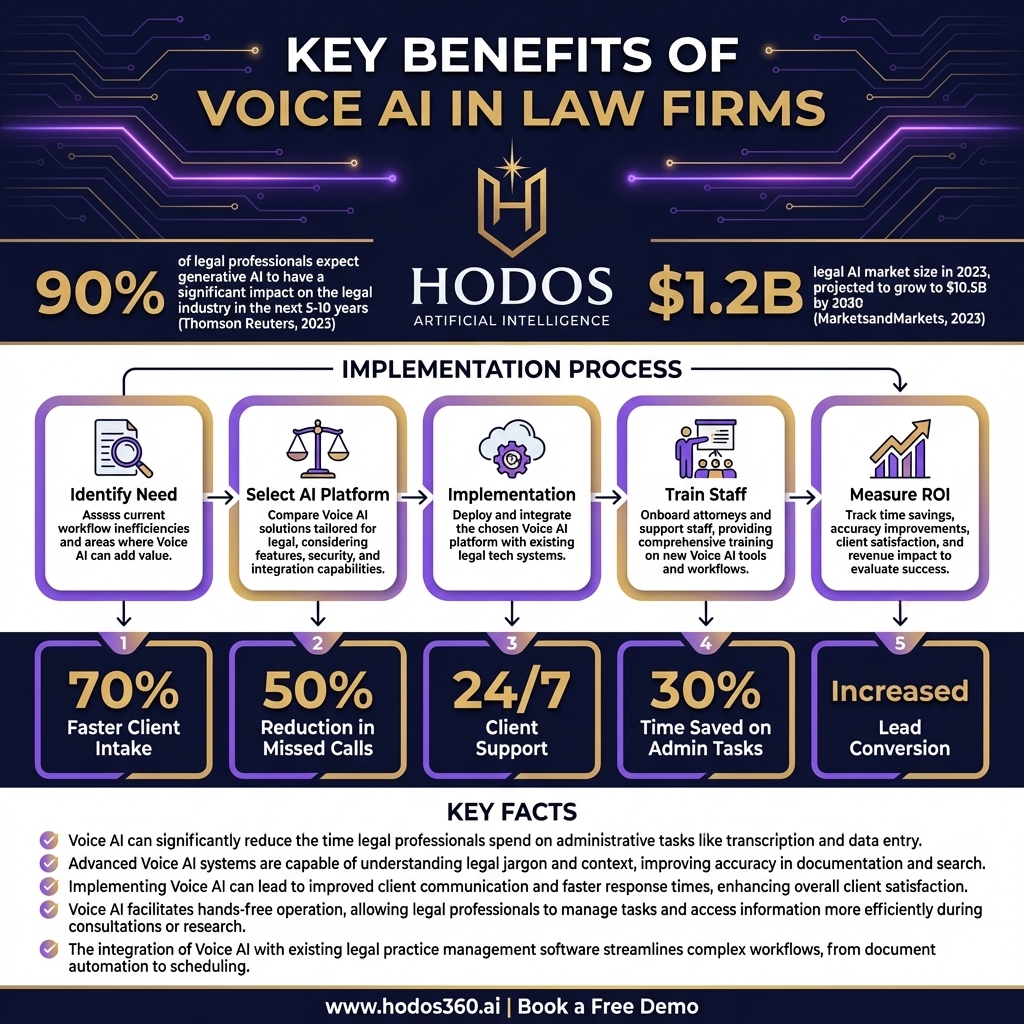
For instance, a solo practitioner or small firm, traditionally unable to afford 24/7 human staff, can now compete with larger firms by offering round-the-clock availability, ensuring every potential client feels valued and heard. Learn more about Future Ready Lawyer: Essential AI Confidence for Legal Professionals.
This levels the playing field, allowing smaller firms to scale their client service capabilities dramatically, ensuring no opportunity is lost due to limited resources. The impact on client perception and firm reputation is immediate and positive.
Streamlining Legal Operations: The Power of Conversational AI
The impact of Voice AI extends deep into the internal legal operations of a firm, fundamentally reshaping how daily tasks are managed and executed. Beyond client-facing roles, conversational AI is becoming an indispensable tool for attorneys and support staff, automating tedious administrative processes that consume valuable billable hours.
Consider the routine tasks of updating case management systems, entering billing codes, or initiating document retrieval. Traditionally, these tasks require manual data entry or navigation through complex software interfaces. With Voice AI, a lawyer can simply vocalize a command: "Update client Smith's case status to 'Discovery Phase,'" or "Log 1.5 hours to Project Alpha for legal research."
The AI interprets the command, interacts with the relevant AI Law Firm Management System, and executes the task, freeing the legal professional to focus on substantive legal work.
The integration of Voice AI with existing legal tech stacks is a critical development. Platforms like HODOS 360 are designed to seamlessly connect with popular practice management software, billing systems, and document automation tools.
This interoperability ensures that Voice AI doesn't create new data silos but rather acts as an intelligent layer, unifying disparate systems through a natural language interface. For instance, a partner at a large firm, like those at Allen & Overy who are pioneering AI tools for internal knowledge management, could verbally request a summary of recent court rulings on a specific topic, and the Voice AI could pull data from their internal knowledge base and external legal research platforms, presenting a concise verbal or written summary.
Learn more about Voice AI Revolutionizes Legal: HODOS 360's 2026 Impact. This capability significantly reduces research time and improves decision-making speed, offering a tangible competitive advantage in a fast-paced legal environment.
Data from the ABA TechReport consistently highlights that attorneys spend a significant portion of their day on non-billable administrative tasks.
Voice AI offers a direct solution to this inefficiency. By automating data entry, calendar management, and initial document drafting based on verbal inputs, firms can unlock substantial productivity gains. Jensen Huang, CEO of Nvidia, often speaks about the accelerating pace of AI innovation, and its application in legal is no exception.
Firms that leverage Voice AI for internal operations report not just time savings but also improved data accuracy, as the AI can cross-reference information and flag inconsistencies. This ensures that the foundation of legal work—accurate data and efficient processes—is robust, allowing for better strategic outcomes.
Integrating Voice AI into Existing Legal Tech Stacks
The true power of Voice AI for law firms is realized through its seamless integration into existing technological infrastructures. This isn't about ripping and replacing current systems but enhancing them. Advanced Voice AI platforms utilize robust APIs (Application Programming Interfaces) to connect with a firm's CRM, case management, billing software, and communication tools.
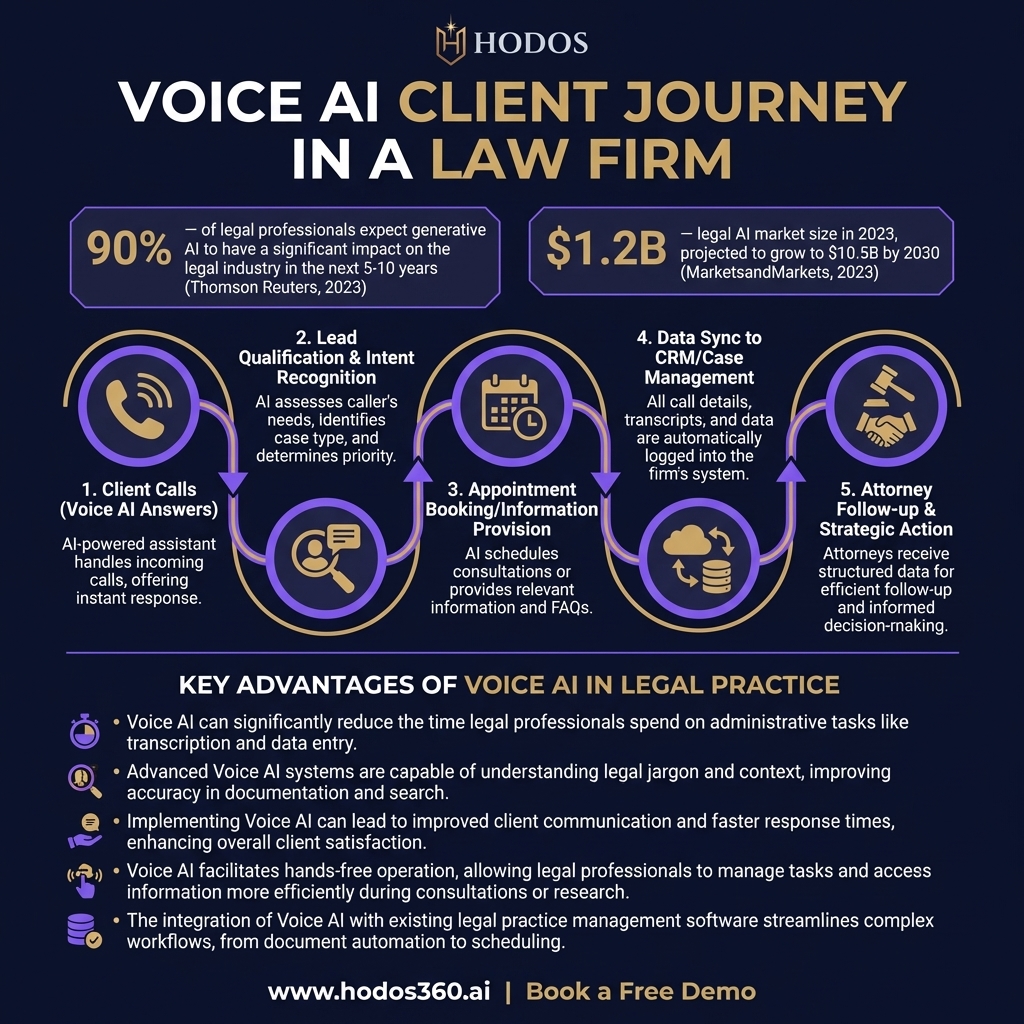
This creates a unified ecosystem where voice commands act as a universal interface, allowing attorneys to control various aspects of their practice simply by speaking. Learn more about AI Marketing: The Ultimate Playbook for Law Firms. The result is a more intuitive, efficient, and interconnected digital workspace, reducing the learning curve for new technologies and maximizing the return on investment for existing software licenses.
Firms like Clio have demonstrated the value of integrated legal tech, and Voice AI takes this integration to the next level of conversational interaction.
Navigating Ethical & Practical Considerations of Voice AI in Law
While the benefits of Voice AI in legal workflows are undeniable, its implementation necessitates careful consideration of ethical and practical challenges unique to the legal profession. Foremost among these is client confidentiality, a cornerstone of legal practice enshrined in ABA Model Rule 1.6 (Confidentiality of Information).
Law firms must ensure that any Voice AI system deployed adheres to the strictest data privacy and security protocols, including robust encryption, secure data storage, and compliance with regulations like GDPR or CCPA. The potential for inadvertent disclosure of sensitive client information, even through a sophisticated AI, demands rigorous testing and continuous monitoring.
Firms must clearly communicate to clients how Voice AI is used, ensuring informed consent, particularly when recording or processing voice data.
Another critical area involves the rules of professional responsibility, specifically ABA Model Rule 1.1 (Competence). Attorneys have a duty to understand the technology they employ, including its limitations and potential for error.
Voice AI, while powerful, is not infallible. Issues such as bias in AI algorithms, misinterpretation of complex legal terminology, or errors in data entry can have significant consequences. Therefore, human oversight remains paramount. Learn more about Legal AI Gap: Bridging the Divide for Law Firms in 2026.
As Dario Amodei, CEO of Anthropic, often emphasizes, AI systems should be designed with safety and interpretability in mind. Attorneys must review AI-generated outputs, verify facts, and make ultimate decisions, using AI as an assistive tool rather than a replacement for professional judgment. This ensures that the ethical obligations of competence and diligence are always met.
Furthermore, the legal landscape for AI is still evolving. The enforcement of legislation like the EU AI Act highlights a global push towards greater accountability and transparency in AI systems. Law firms implementing Voice AI must stay abreast of these regulatory developments and ensure their systems are compliant.
This includes understanding the provenance of training data, the potential for algorithmic bias, and the mechanisms for auditing AI decisions. Proactive engagement with these legal and ethical frameworks is not just a matter of compliance but a strategic imperative, demonstrating a firm's commitment to responsible innovation.
Ignorance of these evolving rules could lead to significant reputational and legal risks.
Training and Customization for Legal Nuances
The effectiveness of Voice AI in a legal setting hinges on its ability to understand and process the unique nuances of legal language and procedures. Generic AI models, while capable, often lack the specialized training required for legal contexts. Therefore, customization is key. Law firms must invest in training their Voice AI assistants with firm-specific terminology, client names, local court procedures, and common legal phrases.
This bespoke training ensures higher accuracy, reduces misinterpretations, and allows the AI to become a truly invaluable asset. Without this crucial step, the point of implementing such advanced technology could be lost, as the AI might still struggle with the intricacies that make legal communication so distinct.
This tailored approach is what separates truly transformative Voice AI from mere technological novelties.

Key Takeaways and Next Steps: Embracing Conversational Intelligence
The narrative emerging from the discussion around "vibe coding" and its broader implications for Voice AI in the professional sphere underscores a clear imperative for law firms: adapt or risk being left behind. Voice AI is no longer a nascent technology; it is a mature, powerful tool capable of transforming nearly every facet of legal practice.
From supercharging client intake and engagement through 24/7 AI Voice Assistants to streamlining complex internal legal operations and workflows, the benefits are tangible and immediate. Firms that are proactive in exploring and implementing these solutions are not just gaining efficiency; they are fundamentally reshaping their competitive posture and enhancing their ability to serve clients in an increasingly demanding legal market.
However, embracing conversational intelligence requires more than just purchasing software. It demands a strategic vision, a commitment to ethical deployment, and a willingness to learn and adapt. The most successful implementations will be those that prioritize customization, ensuring the Voice AI is trained on specific legal contexts and integrated seamlessly into existing tech stacks.
This is about augmenting human capabilities, empowering legal professionals to focus on the high-value, strategic work that truly differentiates their practice. As the "AI news today" continuously highlights rapid advancements, staying informed and agile is crucial for any forward-thinking firm.
For law firm owners and legal professionals looking to harness this transformative power, the next step is clear.
Explore comprehensive, AI-powered platforms designed specifically for the legal industry. HODOS 360 offers a suite of integrated services, including advanced AI Voice Assistants that are built from the ground up to meet the unique demands of legal workflows. By leveraging such specialized solutions, firms can ensure they are not just keeping pace with technological change but leading the charge, building a more efficient, responsive, and future-proof legal practice.
This is the start of a new era for legal excellence.
- ✓Enhanced Client Intake: AI Voice Assistants provide 24/7 availability, ensuring no client call is missed and initial inquiries are handled promptly and professionally.
- ✓Streamlined Lead Qualification: Intelligent AI screens potential clients, gathers critical information, and identifies qualified leads, saving valuable attorney time.
- ✓Automated Appointment Booking: Clients can schedule consultations effortlessly through natural conversation with a Voice AI assistant, integrating directly with firm calendars.
- ✓Improved Internal Operations: Attorneys can verbally command case management updates, billing entries, and document automation, significantly reducing administrative burden.
- ✓Multilingual Support: Reach a broader client base with AI Voice Assistants capable of communicating in multiple languages, improving accessibility and client satisfaction.
- ✓Data-Driven Insights: Voice AI systems collect and analyze interaction data, providing valuable insights into client needs, call patterns, and operational efficiencies.
- ✓Reduced Overhead Costs: Automating routine communication tasks frees up human staff, allowing firms to optimize resource allocation and reduce operational expenses.
Frequently Asked Questions
What is Voice AI in a legal context?+
In a legal context, Voice AI refers to artificial intelligence systems capable of understanding, processing, and responding to spoken language, specifically tailored for law firm operations. These systems go beyond simple voice commands, leveraging advanced Natural Language Processing (NLP) to handle client intake, schedule appointments, update case files, and provide information, all while adhering to legal terminology and ethical guidelines.
How can Voice AI improve client intake for law firms?+
Voice AI dramatically improves client intake by providing 24/7 availability, ensuring every call is answered. It can qualify leads by gathering essential information, identify the nature of a legal issue, and perform initial conflict checks. This pre-screening process routes qualified leads efficiently to attorneys, reduces missed opportunities, and provides a faster, more professional first impression for potential clients.
Is Voice AI secure for sensitive legal data?+
When implemented correctly with robust security measures, Voice AI can be secure for legal data. Leading platforms employ advanced encryption, secure data storage, and strict access controls. However, firms must ensure their chosen solution complies with data privacy regulations (e.g., GDPR, CCPA) and ethical obligations, such as ABA Model Rule 1.6 on client confidentiality. Human oversight and clear client consent are crucial.
What are the ethical considerations for using Voice AI in law?+
Ethical considerations include maintaining client confidentiality (ABA Model Rule 1.6), ensuring attorney competence (ABA Model Rule 1.1) by understanding AI's limitations, and mitigating algorithmic bias. Firms must provide clear disclosure to clients about AI use, ensure human oversight for critical decisions, and comply with evolving AI governance laws. Responsible implementation requires continuous vigilance and adherence to professional standards.
How do law firms integrate Voice AI into existing systems?+
Law firms integrate Voice AI through robust APIs that connect with their current legal tech stack, including case management software, CRM systems, billing platforms, and document automation tools. This allows Voice AI to act as a conversational interface, enabling attorneys to verbally command tasks across different systems, ensuring seamless data flow and enhancing overall operational efficiency without requiring a complete overhaul of existing infrastructure.