


AI Lead Generation: The Ultimate Guide to Smarter Law Firm Growth
The pursuit of new clients has always been the lifeblood of any successful law firm. Yet, for years, the legal industry has grappled with lead generation methods that often feel like throwing darts in the dark—costly, time-consuming, and notoriously inefficient. This challenge was acutely felt by Sarah Chen, Managing Partner at Sterling & Associates, a mid-sized litigation firm in Chicago.
For years, Sarah oversaw marketing efforts that relied heavily on traditional advertising and networking, yielding inconsistent results. She observed a stark decline in the effectiveness of generic campaigns, a sentiment echoed by the ABA Legal Technology Survey Report 2025, which indicated only 15% of firms found traditional advertising 'very effective' for new client acquisition.
The firm’s growth plateaued, creating internal tension between partners who favored familiar approaches and the urgent need for a new strategy.
The narrative shifted dramatically in late 2025, when a trending MSN article, "AI lead generation: The strategic 2026 guide to smarter pipeline growth," caught Sarah’s attention.
It highlighted how artificial intelligence was not just a futuristic concept but a tangible, strategic imperative for businesses, including law firms, seeking smarter pipeline growth. This article underscored a fundamental truth: the modern legal client is digitally native, expecting personalized experiences and immediate responses. Traditional methods, from cold calls to generic mailers, were simply failing to resonate, creating a widening gap between law firms and their potential clients.
The market was ripe for disruption, and AI presented the most compelling answer.
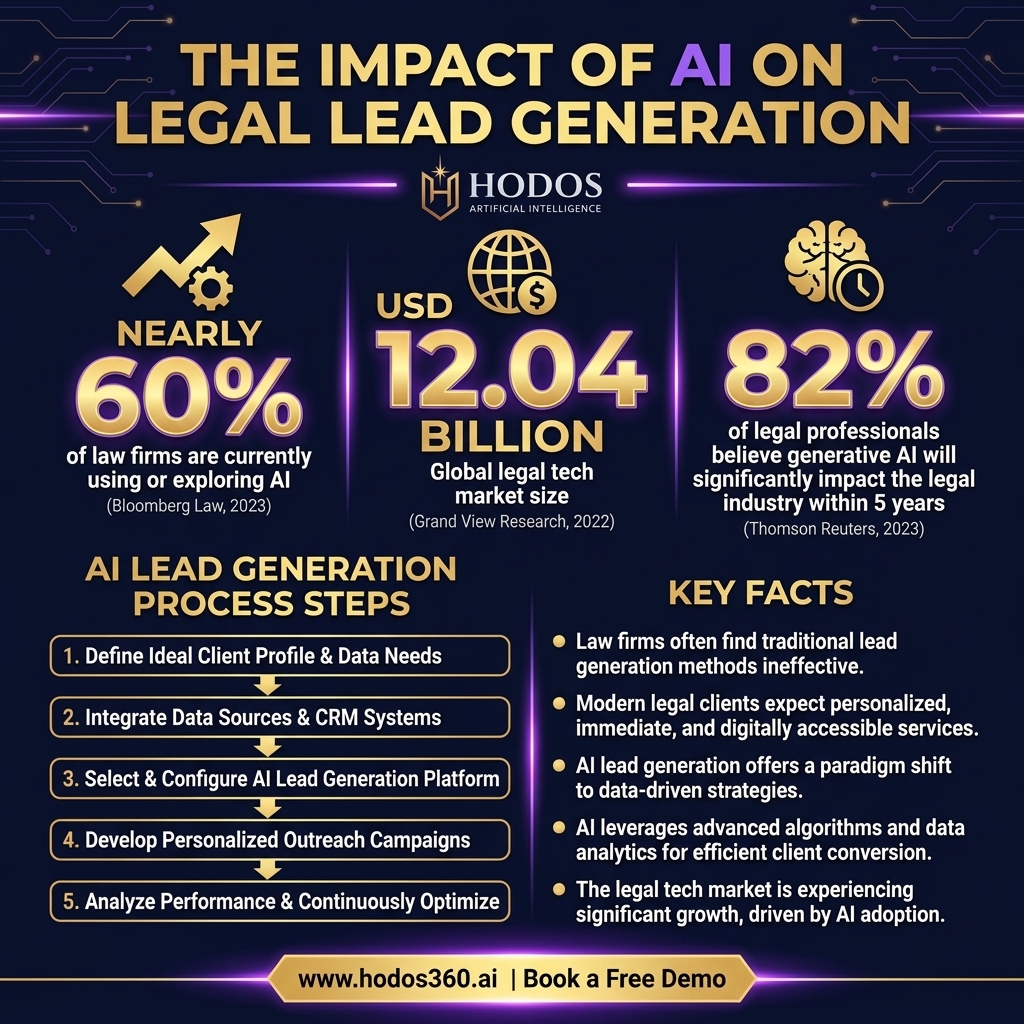
AI lead generation, therefore, isn't merely an incremental upgrade; it represents a paradigm shift in how law firms identify, engage, and convert prospective clients. By leveraging advanced algorithms and data analytics, AI transforms the laborious, often speculative processes of client acquisition into a streamlined, highly precise operation.
It promises not just more leads, but higher-quality leads, allowing legal teams to focus on what they do best: practicing law. As we delve into this ultimate guide, we will discover the transformative power of AI, exploring the tools and strategies that are reshaping legal marketing and client generation in 2026 and beyond.
The Shifting Sands of Legal Client Acquisition: Why Traditional Methods Fail
For decades, legal client acquisition largely hinged on referrals, local advertising, and direct mail. While these methods once formed the bedrock of growth, their efficacy has dwindled significantly in the digital age. The modern client begins their legal journey online, often through search engines or social media, long before they ever consider picking up a phone or visiting an office.
This fundamental shift in client behavior has rendered many traditional strategies obsolete, or at best, incredibly inefficient. Firms like Sterling & Associates, as exemplified by Sarah Chen's experience, found themselves pouring resources into campaigns with diminishing returns, leading to budget overruns and stagnant growth. The conflict between maintaining established practices and adapting to new realities became a critical challenge for many mid-sized firms.
Furthermore, the legal market itself has become intensely competitive. Learn more about AI Marketing: Essential Strategies for Law Firm Growth. With an increasing number of lawyers and firms, merely having a presence is no longer enough. Standing out requires a nuanced understanding of client needs, proactive engagement, and hyper-targeted communication.
Traditional methods, by their very nature, are broad-stroke and lack the precision required to capture the attention of a specific niche or an individual facing a unique legal challenge. This broad approach often results in low-quality leads, wasting valuable time for legal professionals who end up sifting through unqualified inquiries.
The inability to effectively segment and target potential clients meant that many firms were missing out on truly lucrative opportunities, instead focusing on a volume game that rarely paid off.
AI Lead Generation: Unpacking the Core Technologies for Law Firms
At the heart of modern AI lead generation are sophisticated technologies like predictive analytics, natural language processing (NLP), and machine learning. These aren't just buzzwords; they are powerful tools that allow law firms to move beyond guesswork and into data-driven decision-making. Predictive analytics, for instance, can analyze vast datasets—including past client behavior, market trends, and demographic information—to identify patterns and forecast which potential clients are most likely to require legal services and, crucially, which specific services.
This capability transforms raw data into actionable insights, allowing firms to anticipate demand rather than react to it. Companies like LexisNexis, through their evolving platforms, are increasingly integrating such predictive capabilities, moving beyond traditional legal research into proactive business development.
Moreover, NLP plays a pivotal role in understanding and generating human-like text, which is essential for content generation and client communication.
From drafting personalized email campaigns to creating targeted social media posts, NLP-powered AI can craft compelling messages that resonate with specific client segments. Learn more about Voice AI: Essential Strategic Growth for Law Firms. Machine learning algorithms continuously refine these processes, learning from every interaction to improve targeting accuracy and message effectiveness.
This constant learning loop ensures that a firm’s lead generation efforts become progressively more efficient and effective over time. A McKinsey report on AI adoption in professional services from late 2025 highlighted that early adopters of AI in marketing operations achieved a 25-30% efficiency gain, significantly boosting their pipeline performance and reducing client acquisition costs.
These core AI advancements, often inspired by foundational work in large language models by entities like OpenAI and Anthropic, are now directly applicable to the nuanced needs of legal marketing, providing unprecedented power to legal teams.
Crafting a Winning AI Lead Generation Strategy: From Outreach to Conversions
Implementing AI effectively requires more than just acquiring the tools; it demands a well-defined strategy that integrates these technologies into every stage of the client journey. Firms must move beyond generic marketing and embrace hyper-personalization. Consider David Miller, Head of Marketing at Innovate Legal Group, a firm specializing in intellectual property.
David’s team partnered with a legal tech solution to overhaul their outreach efforts. Instead of mass emails, their AI system analyzed patent application databases, industry news, and competitor activity to identify startups likely to need IP protection. The AI then crafted personalized messages, referencing specific company milestones or market shifts, delivered at optimal times.
This approach led to a remarkable 3x increase in qualified leads and a significant boost in conversions within 18 months.
The success of Innovate Legal Group underscores the critical components of a winning AI lead generation strategy. Learn more about Voice Assist: Essential AI Scheduling for Law Firms.
It involves AI-powered content generation that dynamically adapts to audience segments, social media automation that ensures consistent brand presence and engagement, and targeted ad campaigns optimized for specific demographics and legal needs. Furthermore, AI can predict the best time to engage a prospect, improving open rates and response times for sales teams.
The goal is not just to generate leads but to nurture them through a personalized journey, converting initial interest into retained clients. This systematic approach, informed by continuous data analysis, ensures that every marketing dollar spent contributes directly to the firm’s pipeline growth and profitability.
The Gartner Marketing Data & Analytics Survey 2025 reported that organizations leveraging AI for personalization saw an average increase of 15-20% in customer engagement and conversion rates.
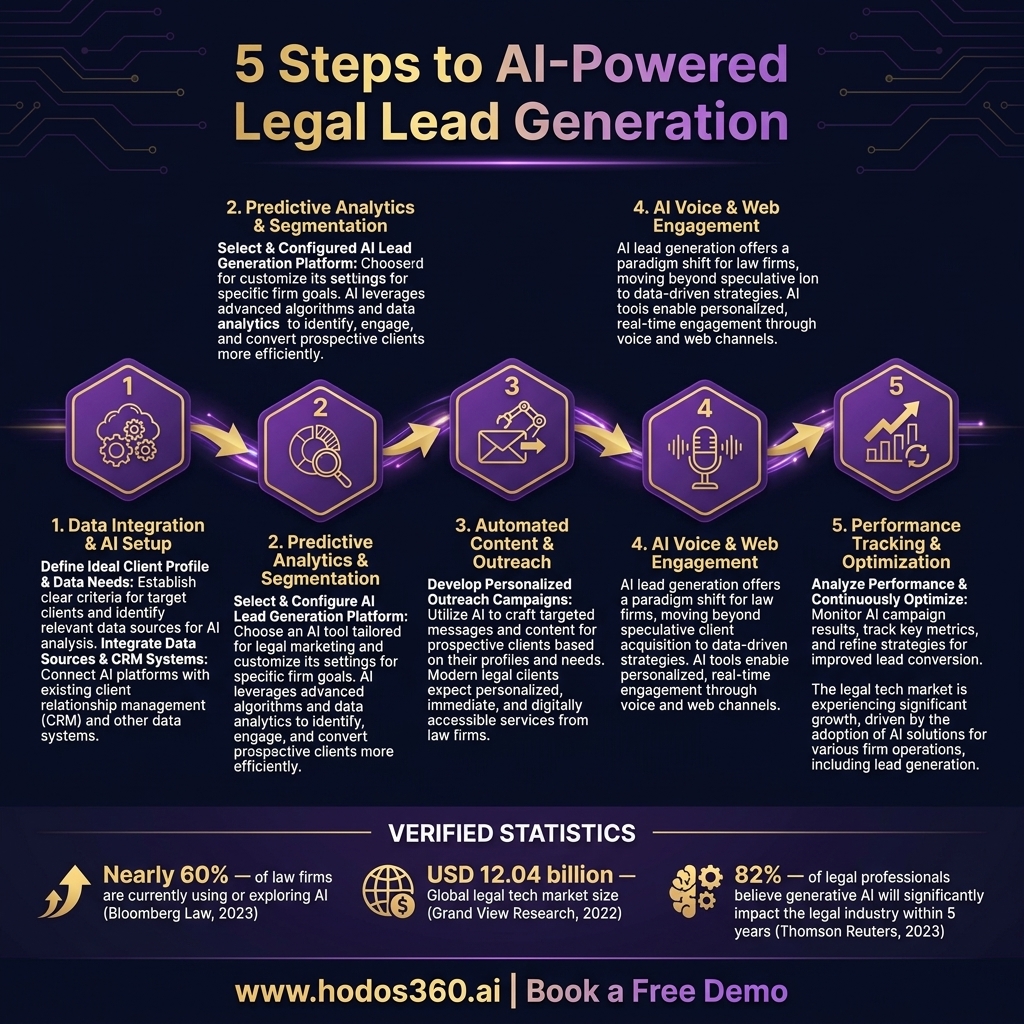
- ✓Data Integration & AI Setup: Consolidate client data, website analytics, and market intelligence into a unified platform for AI analysis.
- ✓Predictive Analytics & Segmentation: Utilize AI to identify high-value client segments and predict future legal needs based on historical data.
- ✓Automated Content & Outreach: Deploy AI to generate personalized marketing content and automate targeted communication across multiple channels.
- ✓AI Voice & Web Engagement: Implement AI voice assistants for 24/7 client intake and optimize websites with AI for seamless lead capture.
- ✓Performance Tracking & Optimization: Continuously monitor AI campaign performance, analyze key metrics, and use insights to refine strategies.
- ✓Ethical & Compliance Review: Regularly audit AI processes to ensure adherence to data privacy regulations and legal advertising ethics.
Leveraging AI for Enhanced Legal Marketing Content
Beyond lead identification, AI revolutionizes the creation and distribution of legal marketing content. Modern AI models can assist in drafting blog posts, social media updates, and even video scripts, ensuring that content is not only relevant but also optimized for search engine visibility and audience engagement.
For law firms, this means a consistent stream of high-quality, informative content that positions them as thought leaders in their respective practice areas. AI can analyze popular legal queries, trending topics, and competitor content to identify gaps and opportunities, allowing firms to create content that directly addresses the needs of potential clients.
Learn more about Law Firm Return on Investment: Maximize AI in 2026. This strategic content generation is crucial for attracting inbound leads and establishing credibility, significantly improving the initial touchpoints in the client journey. The ability to produce personalized content at scale is a game-changer for firms looking to boost their online presence and attract a diverse client base.
Implementing AI Voice Assistants and Web Development for Seamless Lead Capture
The initial point of contact with a potential client is often the most critical, yet many law firms struggle with 24/7 availability and efficient lead qualification. This is where HODOS 360's AI Voice Assistants and Web & Mobile Development services prove transformative. Our AI Voice Assistants are designed for the legal sector, providing 24/7 phone answering, multilingual support, and intelligent lead qualification.
Imagine a potential client calling at 2 AM with an urgent query; instead of reaching voicemail, they are greeted by an AI assistant that can understand their needs, qualify their urgency, and even book an appointment directly into a lawyer's calendar. This dramatically reduces missed opportunities, as studies show that 40% of potential legal clients hang up if not answered within 30 seconds, and significantly improves the client experience from the very first interaction.
At LegalTech NYC 2026, Eleanor Vance, founding partner of Vance & Co., highlighted how integrating an AI voice assistant reduced their lead response time by 80%, directly impacting their sales pipeline.
Complementing AI Voice Assistants, HODOS 360’s Web & Mobile Development services leverage AI for building high-converting, responsive websites.
Learn more about Voice AI Revolutionizes Legal: HODOS 360's 2026 Impact. An AI-powered website goes beyond aesthetics; it learns from user behavior to optimize conversion paths, personalize content, and ensure seamless navigation. This means landing pages are designed not just to look good, but to effectively capture lead information, integrate with CRM systems, and guide visitors through the pipeline.
Features like AI-driven chatbots on the website can provide instant answers to common questions, further qualifying leads and directing them to the appropriate legal teams. By combining intelligent lead capture through websites with the immediate, round-the-clock support of AI Voice Assistants, law firms can create a truly seamless and efficient client acquisition funnel, ensuring no potential client is left unheard or unaddressed.
This integrated approach is crucial for firms aiming to maximize their generation efforts.
Optimizing Client Intake with AI-Powered Workflows
Beyond initial capture, AI extends its benefits to streamlining the entire client intake process. Once a lead is qualified, HODOS 360’s AI Law Firm Management System integrates these leads directly into case management, initiating AI-powered legal workflows. This means automated document generation for intake forms, pre-populated client profiles, and automated scheduling of initial consultations.
The time saved from manual data entry and administrative tasks is substantial, allowing legal teams to onboard new clients faster and more efficiently. Learn more about Legal AI Gap: Bridging the Divide for Law Firms in 2026. This not only improves operational efficiency but also enhances the client experience, as new clients perceive a modern, organized, and responsive firm.
The seamless transition from a generated lead to an active case is a testament to the power of integrated AI tools in legal practice, significantly reducing friction points that often deter potential clients.
The Ethical Imperative and Future of AI in Legal Marketing
As AI becomes more pervasive in legal marketing, ethical considerations move to the forefront. The legal profession, bound by strict rules of conduct, must navigate issues of data privacy, algorithmic bias, and transparency. The EU AI Act, which came into full force in late 2025/early 2026, sets a global precedent for regulating AI systems, particularly those deemed 'high-risk.'
While primarily focused on public safety and fundamental rights, its principles of transparency and data governance have implications for any firm using AI to profile potential clients, even outside the EU. Firms must ensure their AI lead generation tools comply with regulations like GDPR and CCPA, respecting client data and privacy.
ABA Model Rule 7.1 (Communications Concerning a Lawyer's Services), specifically Comment 3, emphasizes that any communication must be truthful and not misleading. This rule extends to AI-generated content and the underlying algorithms that target specific demographics, ensuring fairness and preventing discriminatory practices.
The challenge lies in balancing the immense potential of AI with the legal profession's ethical obligations.
Dr. Anya Sharma, Director of AI Ethics at the LegalTech Institute, frequently speaks on the critical importance of 'explainable AI' in legal applications. She argues that law firms must understand not just what their AI tools predict, but *why* they predict it, to avoid perpetuating biases or making unfair assumptions about potential clients.
The future of AI in legal marketing will likely involve greater regulatory scrutiny and the development of industry-specific ethical guidelines. Firms that proactively embed ethical considerations into their AI strategies will build greater trust and credibility. This human conflict—the tension between technological advancement and ethical responsibility—will define the next era of legal tech, pushing firms to adopt AI responsibly while maximizing its benefits for pipeline growth and client acquisition.

Key Takeaways and Next Steps
The strategic deployment of AI in lead generation is no longer a luxury but a necessity for law firms aiming for sustainable growth in 2026 and beyond. From enhancing the quality of leads through predictive analytics to automating personalized outreach and ensuring seamless client intake with AI Voice Assistants, the tools and technologies are available to revolutionize your firm's pipeline.
By embracing a data-driven strategy, firms can significantly boost their conversions, reduce client acquisition costs, and free up valuable legal teams to focus on their core competencies. The example of firms like Innovate Legal Group demonstrates that thoughtful AI integration yields tangible, measurable results. However, this transformation demands a commitment to ethical AI practices, ensuring transparency and compliance in every step of the process.
The legal landscape is evolving rapidly, and those who proactively adopt and adapt to AI will not only survive but thrive. Don't let your firm be left behind; discover how these advanced strategies can redefine your future.
Frequently Asked Questions
What is AI lead generation for law firms?+
AI lead generation for law firms involves using artificial intelligence technologies like predictive analytics, NLP, and machine learning to identify, qualify, and engage potential clients more efficiently. It automates tasks, personalizes outreach, and optimizes marketing efforts to generate higher-quality leads, significantly improving the firm's client acquisition pipeline.
How can AI improve the quality of leads?+
AI improves lead quality by analyzing vast datasets to identify individuals or businesses most likely to need specific legal services. It segments potential clients based on behaviors, demographics, and expressed needs, allowing for hyper-targeted outreach. This precision ensures that legal teams spend their time engaging with prospects who have a genuine and immediate need, leading to higher conversion rates.
Is AI lead generation ethical for legal practices?+
Yes, when implemented responsibly. Ethical AI lead generation adheres to data privacy laws (e.g., GDPR, CCPA) and legal advertising rules like ABA Model Rule 7.1. Firms must ensure transparency, avoid algorithmic bias, and maintain client confidentiality. Proactive ethical reviews and adherence to industry best practices are crucial for responsible AI deployment in legal marketing.
What are some common AI tools used in legal lead generation?+
Common AI tools include predictive analytics platforms for identifying prospects, natural language processing (NLP) for content generation and personalized messaging, AI-powered chatbots for website engagement, and AI Voice Assistants for 24/7 client intake and qualification. These technologies work in concert to streamline the entire lead generation process.
How quickly can law firms see ROI from AI lead generation?+
The timeframe for ROI varies, but many firms report significant improvements within 6-12 months of strategic AI implementation. Early benefits include reduced manual effort, improved lead quality, and higher conversion rates. Long-term, AI leads to substantial cost savings in client acquisition and sustained pipeline growth, as seen in the experiences of early adopters.