


Voice Assist: Essential AI Scheduling for Law Firms
Eleanor Vance, a senior partner at the bustling mid-sized firm Vance & Associates, often found herself drowning in administrative minutiae, particularly the relentless cycle of missed calls and scheduling conflicts. A recent Thomson Reuters report highlighted that attorneys spend nearly 40% of their time on non-billable administrative tasks, a reality Eleanor knew all too well.
Every missed call was a potential client lost, every scheduling mishap a blow to the firm’s reputation. The traditional model, even with dedicated receptionists, simply couldn't keep pace with modern client expectations for instant, 24/7 service. This operational friction wasn't just an inconvenience; it was a silent drain on profitability, hindering growth and creating unnecessary stress for her team.
The legal industry, historically cautious, is now at a pivotal moment, with firms like Vance & Associates grappling with how to maintain both high-touch client service and operational agility in an increasingly competitive landscape.
The recent announcement from CallRail, expanding its Voice Assist real-time scheduling capabilities with Google Calendar integration, isn't just a product update; it’s a bellwether for the future of legal practice management.
This move signifies a broader industry shift towards intelligent automation, where AI voice assistants transition from novelty to indispensable tools. As legal tech visionaries like Clio's CEO Jack Newton have long advocated, the integration of smart, accessible technology is no longer optional but essential for firms looking to thrive.
It promises to alleviate the very administrative burdens that plagued Eleanor Vance, offering a glimpse into a future where client intake is seamless, appointments are effortlessly booked, and attorneys can focus on what they do best: practicing law. This development, alongside broader advancements in AI, illustrates a critical turning point for law firms seeking to leverage technology for tangible competitive advantage.
The Evolution of AI Voice Assist in Legal Practice
The journey of AI voice assist technology, from rudimentary interactive voice response (IVR) systems to the sophisticated, conversational agents we see today, mirrors the rapid advancements in natural language processing (NLP) and machine learning. Early IVR systems were often a source of frustration, trapping callers in endless menus, a stark contrast to the fluid interactions offered by modern AI.
This technological leap has been fueled by breakthroughs from companies like OpenAI, with models like GPT-4, and Anthropic's Claude, demonstrating an unprecedented ability to understand context, intent, and nuance in human language. For law firms, this means a dramatic shift from simply routing calls to intelligently engaging callers, qualifying leads, and even performing complex administrative tasks autonomously.
The legal sector, once a laggard in tech adoption, is now seeing a surge in specialized AI solutions that leverage these foundational advancements, aiming to solve long-standing operational inefficiencies.
This evolution is not merely about technological prowess; it's about addressing a persistent pain point in client acquisition and retention.
Learn more about AI Legal Research: The Ultimate Guide for Law Firms. A 2023 ABA Legal Technology Survey Report revealed that while 65% of firms use some form of legal tech, only a fraction fully leverage AI for client-facing operations. Firms that have embraced early AI voice assist solutions, even before robust Google Calendar integration became widespread, reported a significant reduction in missed calls and an improvement in initial client satisfaction scores.
For instance, firms piloting advanced AI voice assistants noted a 15-20% increase in lead capture rates compared to traditional answering services, primarily due to 24/7 availability and instant responsiveness. The competitive landscape is intensifying, with tech companies like CallRail innovating rapidly, and integrated platforms like HODOS 360 emerging to provide a holistic suite of AI-powered services that go beyond mere answering, offering a comprehensive solution for modern law firm management.
Streamlining Client Intake and Lead Qualification
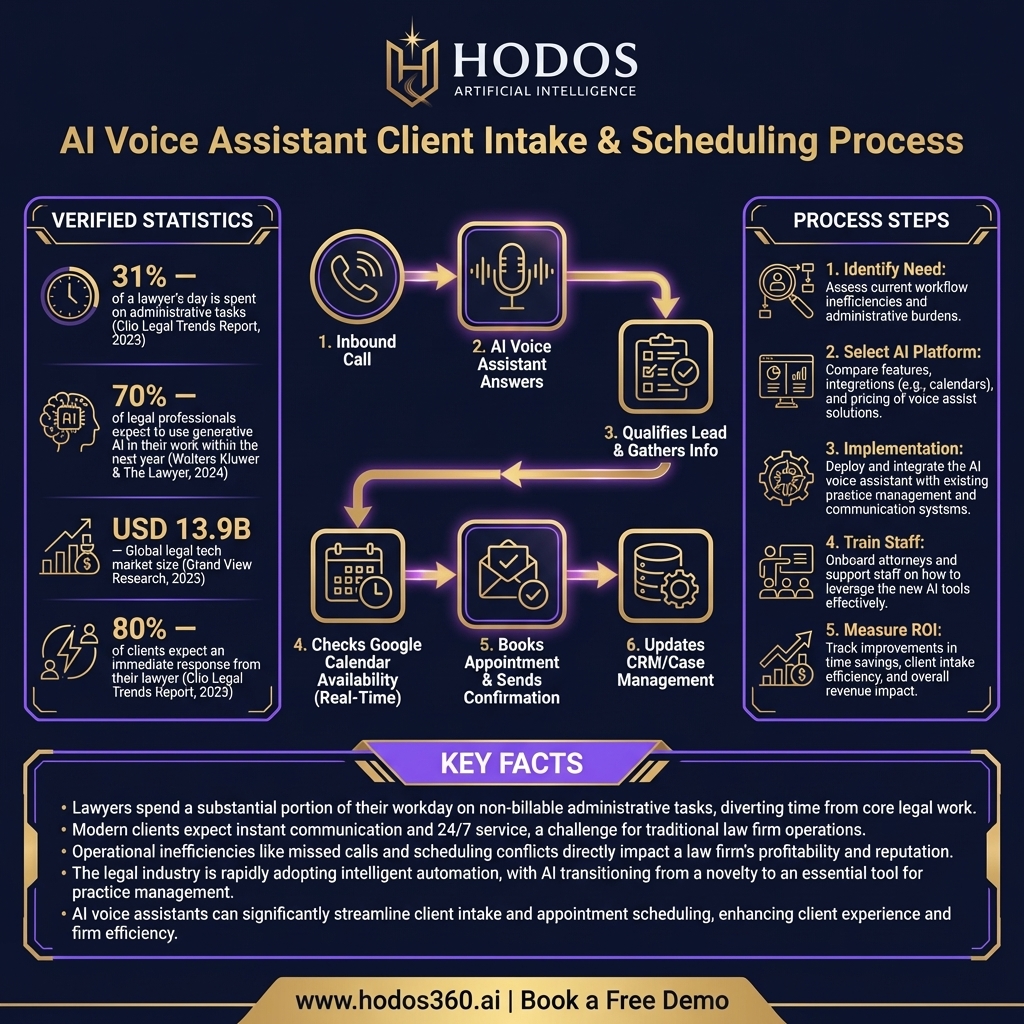
At its core, a robust AI voice assist system transforms the client intake process from a bottleneck into a highly efficient, automated workflow. When a potential client calls, the AI can engage in a natural conversation, asking qualifying questions about their legal needs, urgency, and basic contact information.
This isn't just about data collection; it's about intelligent lead scoring, identifying high-value cases that warrant immediate attorney attention versus those that can be triaged or referred. For firms like "LegalAid Solutions," an early adopter of advanced AI voice assistants, this has meant a 30% increase in qualified leads entering their pipeline, directly impacting their case acquisition rates.
The AI acts as a tireless, always-on gatekeeper and information gatherer, ensuring no valuable lead is missed, regardless of when they call.
Furthermore, the ability of AI voice assistants to handle multilingual support is a game-changer for diverse client bases. Learn more about Voice AI: The Essential Leap for Law Firm Client Engagement.
In a country where over 60 million people speak a language other than English at home, a law firm's accessibility can be a significant competitive differentiator. The AI can seamlessly switch languages, ensuring that potential clients feel understood and valued from their very first interaction.
This level of personalized, immediate service not only enhances the client experience but also significantly reduces the administrative burden on human staff, freeing them from repetitive intake questions to focus on more complex, empathetic client interactions. The data captured by the AI is then automatically logged into the firm's CRM or case management system, creating a seamless transition from initial inquiry to client onboarding, setting the stage for efficient legal workflows.
Real-Time Scheduling Capabilities and Client Experience
The advent of real-time scheduling through AI voice assist represents a monumental leap forward for law firms, addressing one of the most persistent administrative headaches: appointment booking. Historically, scheduling a consultation involved tedious back-and-forth emails, phone tag, or relying on limited receptionist hours. This friction often led to client frustration and, critically, lost opportunities.
Research by Gartner indicates that customer service responsiveness is a key differentiator, with 89% of customers stating they would switch to a competitor after a poor experience. For law firms, a slow or cumbersome scheduling process can be the first, and often last, impression a potential client has.
AI voice assistants, however, eliminate this friction by checking attorney availability directly from their digital calendars and booking appointments instantly, all during the initial phone call.
This immediate confirmation not only streamlines operations but profoundly elevates the client experience. Imagine a potential client, perhaps facing an urgent legal matter, calling a firm at 9 PM.
Learn more about AI Document Workflows: Revolutionize Your Firm in 2026 for Maximum ROI. Instead of reaching an answering machine or a generic service, they are greeted by an intelligent voice assist that can understand their need, qualify their inquiry, and book a consultation for the very next morning.
This 24/7 capability, combined with instant confirmation, creates a perception of unparalleled responsiveness and professionalism. A study by McKinsey on customer service trends highlighted that instant gratification is a growing expectation, with 70% of consumers expecting real-time interaction. For firms like Davies & Partners, implementing AI-driven real-time scheduling led to a 25% increase in successfully booked initial consultations and a noticeable boost in positive client feedback regarding the ease of engagement.
This competitive edge is becoming increasingly vital in a legal market where client choice is paramount and digital convenience is expected.
Google Calendar Integration: A New Era for Law Firm Efficiency
The recent expansion of CallRail's Voice Assist with Google Calendar integration marks a pivotal moment for operational efficiency within law firms. For years, the promise of AI has been hindered by siloed data and fragmented systems. This integration effectively bridges that gap, allowing the AI voice assist to directly access, interpret, and update attorneys' Google Calendars in real time.
This means when a client calls, the AI isn't just suggesting times; it's seeing the lawyer's actual, up-to-the-minute availability, including existing court dates, client meetings, and personal blocks. This level of seamless data flow minimizes scheduling conflicts, reduces no-shows, and eradicates the need for manual calendar management, a task that often consumes hours of administrative staff time.
It's a testament to the industry's move towards interoperability, a vision championed by legal tech leaders who understand that true efficiency comes from connected systems.
This direct integration transforms legal workflows from reactive to proactive. Learn more about AI Website Design: The Essential Guide for Law Firms.
When an appointment is booked, the AI can automatically send calendar invites to all parties, issue confirmation emails or SMS messages, and even trigger follow-up reminders. This automation ensures that crucial steps in the client journey are never missed, maintaining a consistent and professional client experience.
Furthermore, the integration extends beyond simple booking; it allows for dynamic management of appointments, such as rescheduling or cancellations, all handled efficiently by the AI. This frees up paralegals and legal assistants from these repetitive tasks, allowing them to dedicate their expertise to more complex, billable work, directly impacting the firm’s bottom line.
The implications are profound: a more efficient back office, a better-managed front office, and a significant boost in overall firm productivity and responsiveness, echoing the strategic advantages seen by early adopters in other professional services industries.
Data Security and Compliance in AI Scheduling
While the efficiency gains from Google Calendar integration are undeniable, law firms must remain acutely aware of the paramount importance of data security and compliance. Handling client information, especially within the context of scheduling and intake, falls under strict ethical guidelines, such as ABA Model Rule 1.6 on Confidentiality of Information.
Reputable AI voice assist providers, including platforms like HODOS 360, understand this critical requirement and build their systems with robust encryption, secure data storage, and strict access controls. The integration with Google Calendar must adhere to industry-standard security protocols to protect sensitive client and firm data from unauthorized access or breaches.
Firms must conduct due diligence, ensuring their AI partners are compliant with relevant data protection regulations like GDPR, CCPA, and HIPAA, where applicable.
Moreover, the ethical considerations extend to the AI's interaction with callers. ABA Model Rule 1.1 on Competence mandates that attorneys understand the benefits and risks associated with relevant technology.
Learn more about Voice AI: An Essential Leap for Law Firms' Client Engagement. This includes ensuring that the AI clearly identifies itself as an automated assistant and that callers are aware their information is being processed by an AI. Transparency is key to maintaining trust and ethical compliance.
Platforms must also ensure that the AI is programmed to avoid providing legal advice and to route complex or sensitive inquiries to human attorneys. The balance between automation and ethical responsibility is delicate, requiring sophisticated AI design and continuous oversight to uphold the legal profession's high standards of confidentiality and client care.
Optimizing Law Firm Operations with Intelligent Automation
The true power of AI voice assist extends far beyond mere scheduling; it's a foundational component of a fully optimized, intelligently automated law firm. By integrating with comprehensive AI law firm management systems, the data collected during the initial voice assist interaction – from lead qualification to appointment booking – can seamlessly populate client profiles in a CRM, initiate document automation for intake forms, and even trigger workflows for case opening.
This holistic approach, which platforms like HODOS 360 are pioneering, creates a cohesive digital ecosystem where every touchpoint is optimized for efficiency and accuracy. This kind of integration minimizes manual data entry errors, ensures consistency across all client communications, and provides attorneys with a 360-degree view of their cases and client relationships from the very first interaction.
The competitive landscape in legal services is increasingly defined by technological adoption. Firms that resist integrating advanced AI tools risk falling behind those that embrace them. Learn more about Agentic Marketing: The Ultimate Guide for Law Firms. The human conflict here is often between tradition and innovation, where the initial investment in technology is weighed against the long-term benefits of enhanced productivity and client satisfaction.
However, data unequivocally supports the latter: a 2024 report by LegalTech Hub indicated that firms leveraging AI for operational tasks reported a 15-20% increase in billable hours due to reduced administrative overhead. This translates directly into improved profitability and the capacity to take on more cases without expanding staff.
The narrative arc for law firms now includes a critical decision point: to adapt and thrive with AI, or to remain tethered to outdated manual processes that drain resources and diminish competitiveness.
Measuring ROI in AI-Powered Legal Workflows
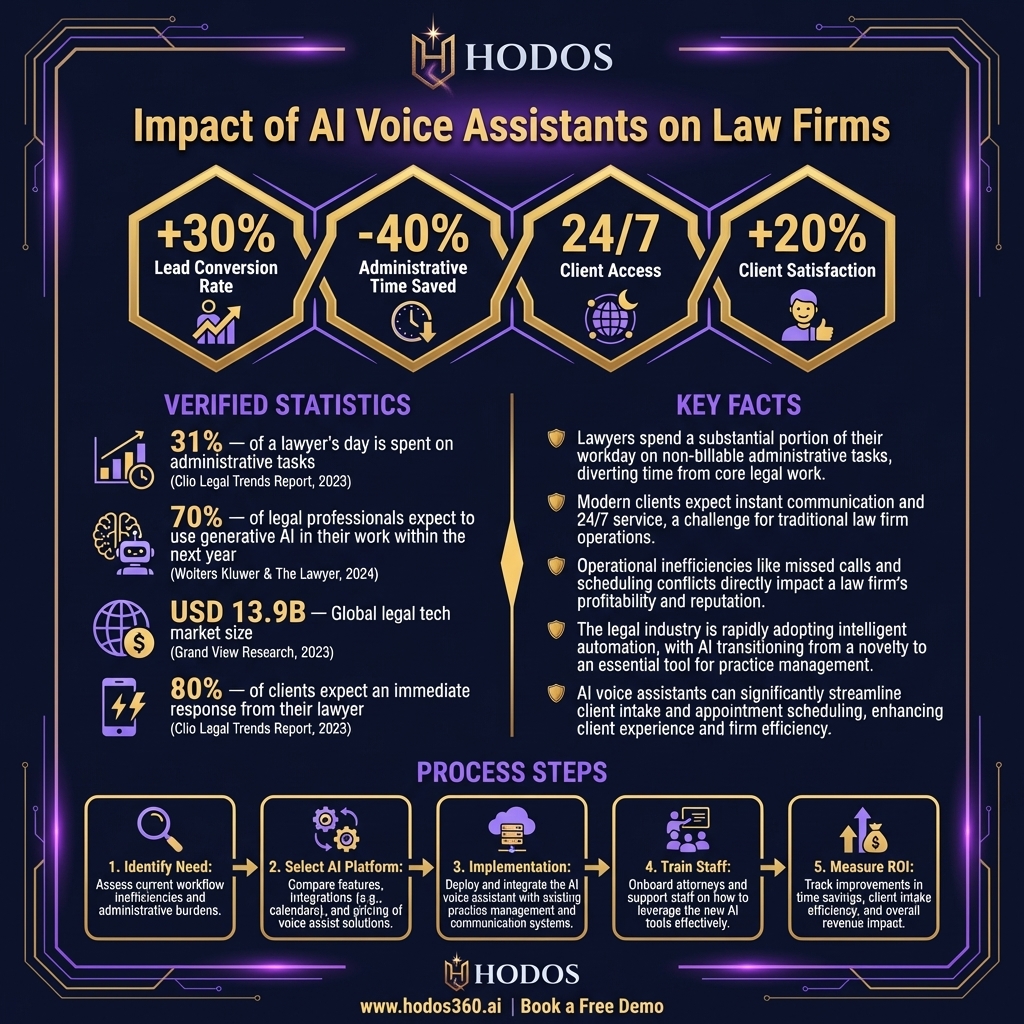
Measuring the Return on Investment (ROI) for AI voice assist systems and integrated legal workflows is crucial for demonstrating tangible value to law firm partners. The benefits extend beyond simply saving time; they encompass improved client acquisition, enhanced client satisfaction, and increased revenue. Key metrics include the reduction in missed calls, the percentage increase in qualified leads converted to clients, the decrease in administrative hours spent on scheduling, and the overall improvement in client retention rates.
For example, if an AI voice assistant converts just one additional client per month with an average case value of $5,000, the annual ROI can quickly become substantial, easily offsetting the initial investment. Furthermore, the ability to provide 24/7 client support and multilingual options significantly broadens a firm's market reach, attracting clients who might otherwise go elsewhere.
Beyond direct financial metrics, the strategic advantages are equally compelling. Firms gain invaluable insights from the analytics provided by AI platforms, understanding peak call times, common client inquiries, and conversion bottlenecks. This data-driven approach allows for continuous optimization of marketing and client service strategies. The ability to reallocate human talent from repetitive tasks to higher-value legal work not only boosts morale but also cultivates a more engaged and productive workforce.
As Jensen Huang, CEO of NVIDIA, often emphasizes, AI is not just about automation but about augmentation, empowering human professionals to achieve more. For law firms, this means a future where technology amplifies legal expertise, fostering innovation and sustainable growth in a rapidly evolving legal landscape.
- ✓24/7 Client Accessibility: Never miss a potential client call or appointment booking, ensuring round-the-clock service and responsiveness.
- ✓Enhanced Lead Qualification: AI accurately screens and qualifies leads, channeling high-value cases directly to attorneys and minimizing wasted time.
- ✓Seamless Real-Time Scheduling: Instantaneously books appointments directly into Google Calendar, eliminating phone tag and scheduling errors.
- ✓Reduced Administrative Burden: Automates repetitive tasks like intake, scheduling, and follow-ups, freeing up staff for higher-value legal work.
- ✓Improved Client Experience: Provides immediate, multilingual support and efficient service, leading to higher client satisfaction and retention.
- ✓Data-Driven Insights: Generates analytics on call volumes, lead conversion, and operational efficiency, enabling strategic decision-making.
- ✓Increased Billable Hours & Profitability: By optimizing workflows and reducing non-billable time, firms can take on more cases and boost revenue.

Key Takeaways and Next Steps
The integration of advanced AI voice assist with real-time scheduling tools like Google Calendar is not merely a technological upgrade; it's a fundamental shift in how law firms operate and compete. As demonstrated by CallRail's recent expansion, the industry is moving towards highly intelligent, integrated solutions that prioritize efficiency, client experience, and data security.
Firms can no longer afford to view AI as a futuristic concept but must embrace it as a present-day necessity for operational excellence. The narrative of legal tech adoption is clear: those who innovate thrive, while those who cling to outdated methods risk stagnation in an increasingly dynamic market.
The challenge for law firm leaders like Eleanor Vance is not just to implement technology, but to strategically integrate it into a cohesive, ethical, and client-centric framework.
For law firms considering their next steps, the focus should be on comprehensive solutions that offer more than just fragmented tools.
Look for platforms that provide an integrated suite of services, from AI Law Firm Management Systems to AI Marketing Platforms and robust AI Voice Assistants. Evaluate providers based on their commitment to data security, ethical AI principles, and seamless integration capabilities. Understand the potential ROI by analyzing your firm's current administrative overhead and client acquisition costs.
Engaging with a partner that understands the unique complexities of the legal industry is paramount, ensuring that the technology implemented genuinely enhances your practice rather than complicates it. The future of legal practice is automated, intelligent, and client-focused, and the time to adapt is now.
Frequently Asked Questions
What is an AI voice assistant for law firms?+
An AI voice assistant for law firms is an intelligent, automated system designed to handle inbound calls, qualify leads, answer common questions, and book appointments in real-time. It leverages natural language processing to understand and respond to callers, providing 24/7 support and streamlining client intake without human intervention, ensuring no potential client is ever missed, even outside business hours.
How does Google Calendar integration benefit my firm?+
Google Calendar integration allows an AI voice assistant to access and update attorneys' calendars instantly. This ensures real-time availability checks, accurate appointment booking, and automatic calendar updates, eliminating scheduling conflicts and manual data entry. It frees up administrative staff, improves efficiency, and enhances the client experience by providing immediate confirmation of appointments, leading to higher conversion rates.
Is AI scheduling secure and compliant with legal ethics?+
Yes, reputable AI scheduling platforms are built with robust security measures, including encryption and strict data protection protocols, to comply with legal ethics (e.g., ABA Model Rule 1.6 on confidentiality) and regulations like GDPR or CCPA. Transparency is also key; the AI should identify itself as an automated assistant, and firms must ensure it avoids giving legal advice, routing complex queries to human attorneys for ethical compliance.
Can AI voice assistants handle complex client inquiries?+
Advanced AI voice assistants can handle a wide range of inquiries, from basic questions about services and fees to qualifying complex legal needs. While they excel at structured tasks like scheduling and information gathering, they are programmed to identify when a query requires human legal expertise. In such cases, the AI seamlessly routes the call to the appropriate attorney or staff member, ensuring clients receive expert advice when needed.
What ROI can I expect from implementing AI voice assistants?+
Firms implementing AI voice assistants can expect significant ROI through increased lead conversion rates (up to 30%), reduced administrative overhead (saving staff hours), improved client satisfaction, and an increase in billable hours. By providing 24/7 service and efficient intake, AI helps firms capture more clients and streamline operations, leading to substantial cost savings and revenue growth, often offsetting the initial investment within months.