
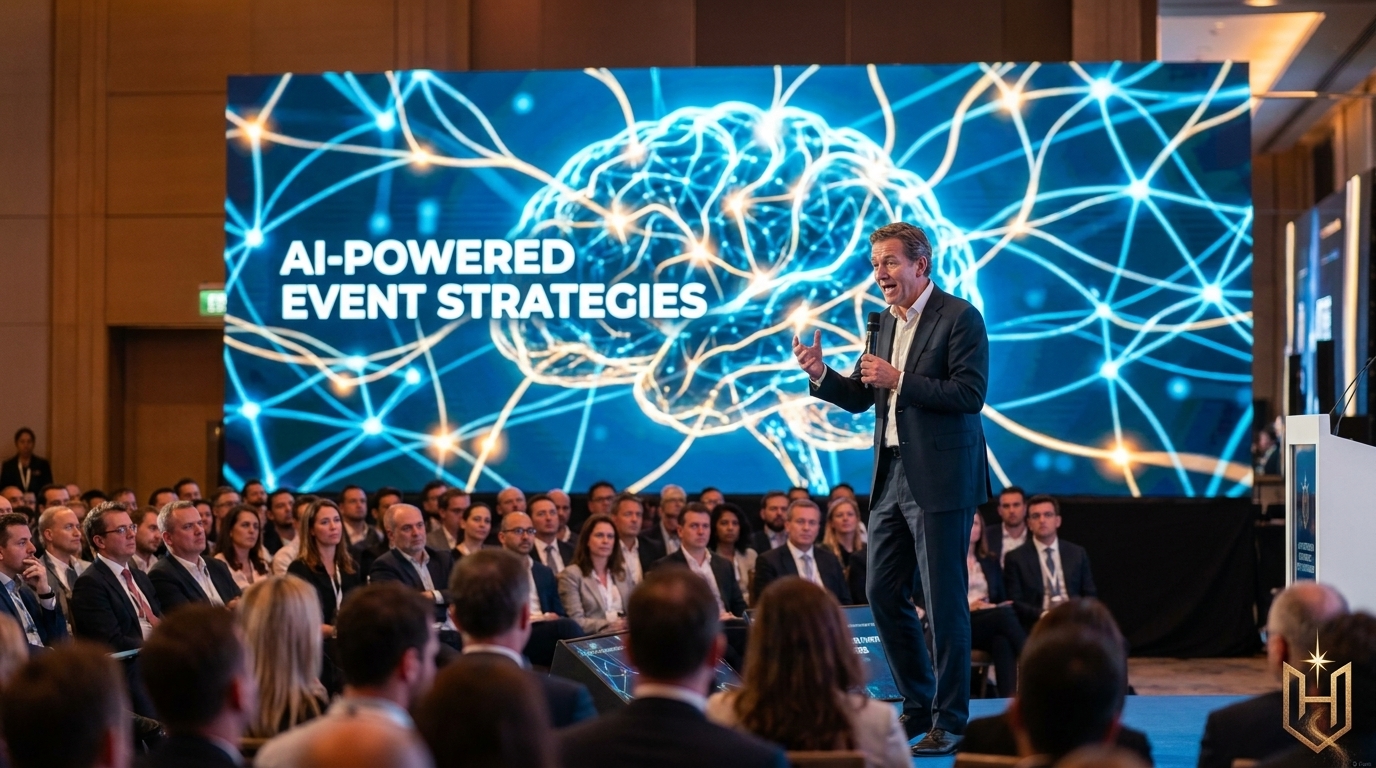
Event Marketing: Essential Strategies for Live Events in the AI Era
In early 2026, Sarah Chen, a senior partner at LexBridge LLP, found herself in a familiar predicament. Despite significant investments in targeted digital campaigns and AI-driven content generation, her firm's online engagement for their quarterly thought leadership webinars had plateaued. "It felt like we were shouting into a digital void," Chen remarked at a recent LegalTech NYC 2026 panel.
This sentiment echoes a growing trend identified by eMarketer, which recently highlighted how "AI-driven traffic declines are fueling a return to live events." The irony is palpable: while AI has made digital content ubiquitous, it has simultaneously amplified the human craving for authentic, in-person connection, particularly in high-stakes industries like law.
This shift isn't a rejection of AI, but rather a re-evaluation of its role – from a purely digital driver to a powerful enhancer of real-world interactions.
This emerging dynamic presents a critical juncture for law firms. For years, the industry has wrestled with how to balance traditional relationship-building with the efficiencies of technology.
The rise of sophisticated AI tools initially pushed many firms, including innovators like Gunderson Dettmer, to heavily invest in digital-first strategies for client acquisition and branding. However, as the digital landscape became saturated with AI-generated content and hyper-targeted ads, a new form of 'digital fatigue' set in.
Clients and prospects, overwhelmed by the sheer volume of online noise, began to seek out more curated, tangible experiences. The challenge now is not whether to use AI, but *how* to strategically deploy it to amplify the impact of live event marketing, transforming it from a logistical headache into a highly personalized and measurable client engagement powerhouse.
For law firms striving to cut through the digital clutter and forge deeper client relationships, the return to live events, powered by intelligent AI integration, offers a compelling pathway. This approach acknowledges that while AI can automate and optimize, the essence of legal practice remains deeply human.
By leveraging AI to refine event planning, personalize attendee experience, and meticulously track event ROI, firms can elevate their event marketing strategies beyond mere attendance numbers. It’s about creating memorable moments that translate into lasting client loyalty and tangible business growth, ensuring every handshake and conversation is backed by data-driven insight.
Discover how this strategic blend can revolutionize your firm's outreach.
The Resurgence of Live Events: Beyond Digital Overload
The legal industry, traditionally built on personal relationships and trust, has always valued face-to-face interactions. Yet, the past decade saw a significant pivot towards digital engagement, driven by the promise of scale and efficiency. Firms like Allen & Overy, early adopters of legal tech, invested heavily in digital content and virtual events.
However, the very tools designed to connect us remotely have, in some ways, inadvertently created a distance. McKinsey & Company's recent reports on B2B customer engagement highlight a growing preference for hybrid or in-person interactions for complex decisions, noting that 70-80% of B2B decision-makers prefer in-person sales interactions for new purchases, a sentiment that resonates deeply within the legal sector where trust and nuance are paramount.
This isn't a failure of digital event marketing, but a natural evolution in how clients wish to engage.
The current landscape is marked by a paradox: AI has made it easier than ever to reach vast audiences online, yet this very ease has diluted the impact of individual digital touchpoints.
eMarketer's finding regarding AI-driven traffic declines underscores this. When every firm uses similar AI-powered tools for content creation and social media automation, the 'signal-to-noise' ratio online becomes overwhelming. Clients become desensitized to generic digital outreach, craving experiences that feel authentic, exclusive, and tailored. This 'digital fatigue' is precisely what is fueling the renewed appetite for live events, from intimate client appreciation dinners to large-scale industry conferences.
The value of a direct conversation, a shared meal, or a spontaneous networking moment at an ABA Techshow or a local bar association event is increasingly seen as irreplaceable.
For law firms, this trend presents an opportunity to differentiate themselves. Learn more about AI Officer: The Essential Role for Modern Law Firms.
While competitors might still be over-indexing on purely digital campaigns, forward-thinking firms are strategically reallocating resources to curate exceptional live event marketing experiences. This doesn't mean abandoning digital; rather, it means using digital tools more intelligently to support and amplify in-person interactions. Clio's acquisition of platforms that enhance client communication further emphasizes the industry's drive for more integrated, client-centric engagement.
The goal is to create a seamless journey where digital touchpoints lead to meaningful in-person engagements, fostering deeper trust and stronger professional bonds that are the bedrock of successful legal practices. The focus shifts from merely reaching clients to genuinely connecting with them, making every interaction count.
This strategic pivot is not merely a nostalgic return to old ways but a sophisticated evolution. Firms are recognizing that the human element, once considered a given, is now a premium commodity in an AI-saturated world. The shift reflects a deeper understanding of client psychology and the unique dynamics of legal service delivery.
As David Lat, founder of *Above the Law* and a keen observer of the legal industry, often points out, reputation and relationships are paramount. Live events provide an unparalleled platform for lawyers to showcase their expertise, build rapport, and demonstrate their firm's culture in a way that digital mediums simply cannot replicate.
The investment in live event management is an investment in the human capital and relational equity that truly drives legal business.
AI's Dual Role: Fueling & Streamlining Event Marketing
The resurgence of live events does not diminish AI's importance; rather, it reframes it. AI is no longer just a tool for generating online traffic, but a powerful engine for optimizing every facet of event marketing and event management. Its dual role involves both *fueling* the right attendee engagement and *streamlining* the complex logistics.
For instance, before an event, AI can analyze vast datasets from CRM systems, public records, and industry reports to identify high-value prospects most likely to convert. This precision targeting, far beyond traditional demographic segmentation, ensures that invitation lists are curated for maximum impact. Firms can leverage AI to predict which topics will resonate most with a specific audience, allowing for hyper-relevant content and speaker selection, transforming a generic seminar into a must-attend thought leadership event.
This capability shifts the focus from broad outreach to intelligent, impactful engagement.
During the event, AI continues to play a pivotal role in enhancing the attendee experience. Imagine an AI-powered networking tool that suggests connections based on professional interests and practice areas, facilitating more meaningful interactions among lawyers and potential clients.
Chatbots or AI voice assistants can provide real-time support, answering logistical questions, guiding attendees to sessions, or even scheduling follow-up meetings, freeing up human staff to focus on high-touch engagement. This level of personalized interaction, from a custom agenda delivered to an attendee's device to instant feedback mechanisms, elevates the entire experience.
Firms like Kirkland & Ellis, known for their extensive client events, are exploring these technologies to ensure every guest feels uniquely valued and supported throughout their participation, reinforcing their brand as forward-thinking and client-centric.
Post-event, AI truly shines in demonstrating event ROI tracking. Learn more about AI Website Coding: An Essential Guide for Law Firms.
It can analyze attendee engagement data—from session attendance to networking interactions and content downloads—to quantify the impact of the event. This data can then be cross-referenced with CRM data to track lead progression, client acquisition, and even long-term client retention directly attributable to the event.
This analytical rigor moves event marketing beyond anecdotal success stories, providing concrete metrics that justify investment and inform future strategies. Furthermore, AI can automate personalized follow-up communications, ensuring that leads are nurtured effectively and promptly. This comprehensive data loop, from initial targeting to post-event analysis, ensures that every event is not just an expense, but a strategic investment with measurable returns.
Integrating AI into event management also addresses the perennial challenge of resource allocation. Many law firms, particularly mid-sized ones, struggle with the labor-intensive nature of event planning. AI-powered platforms can automate tasks such as venue sourcing, vendor contract drafting, budget management, and compliance checks, significantly reducing the administrative burden.
This frees up marketing teams and administrative staff to focus on the creative and strategic aspects of event execution, rather than getting bogged down in minutiae. The efficiency gained allows firms to host more events, or more complex events, without expanding their internal teams, making sophisticated event marketing accessible to a wider range of legal practices.
It’s about working smarter, not just harder, to deliver exceptional client experiences.
Leveraging AI for Superior Attendee Personalization
One of AI's most profound contributions to event marketing is its ability to deliver hyper-personalized attendee experience. Gone are the days of generic mass invitations and one-size-fits-all agendas. With AI, law firms can craft bespoke journeys for each potential client. This begins with sophisticated segmentation, where AI analyzes past interactions, expressed interests, and professional backgrounds to create highly targeted invitation lists.
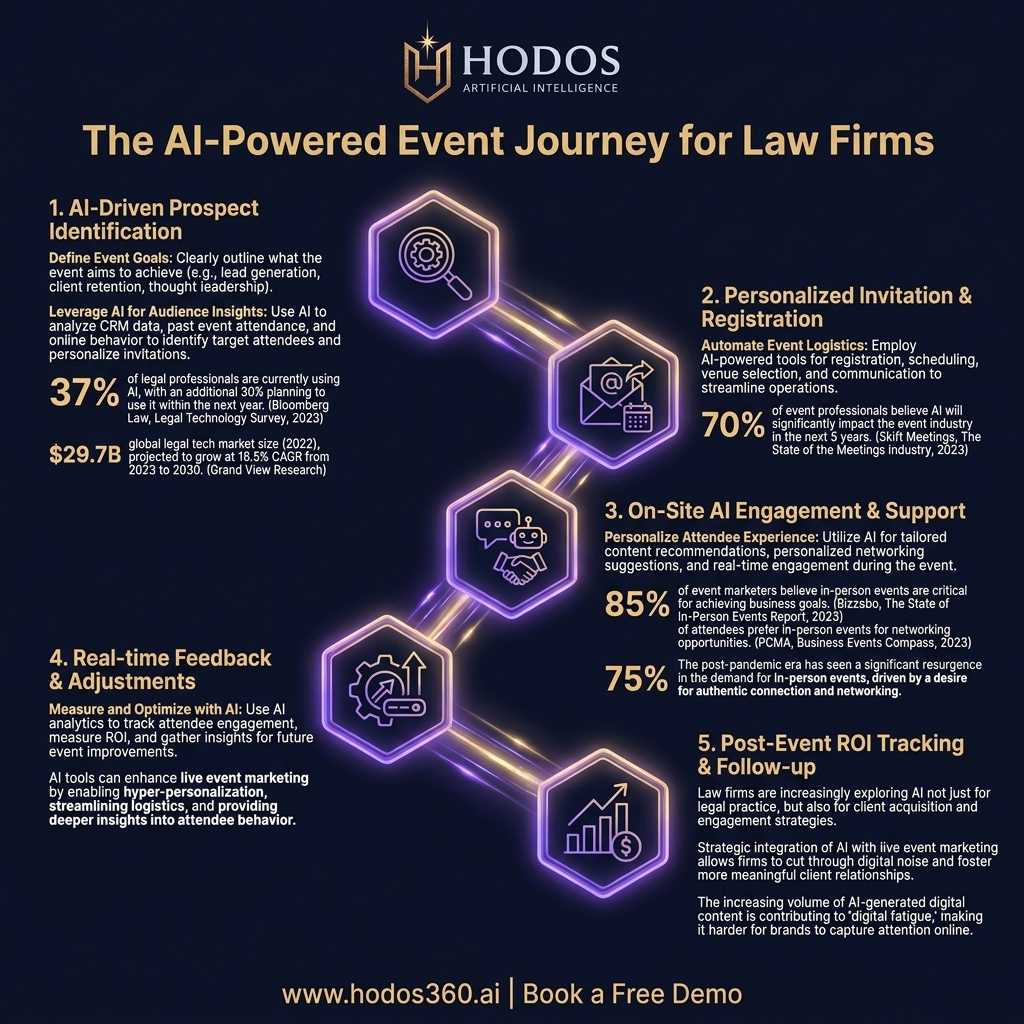
For example, a firm specializing in intellectual property law might use AI to identify in-house counsel from tech startups who have recently filed patents, tailoring event content specifically to their challenges. This level of precision significantly increases engagement rates and ensures that every invite feels like a direct, relevant communication, not just another piece of marketing collateral.
During the event itself, personalization extends to every touchpoint. Learn more about AI Legal Research: The Ultimate Guide to legalgain & Beyond. AI-powered mobile apps can offer customized schedules, recommending sessions and networking opportunities based on an individual's profile and stated preferences. Imagine a system that suggests a specific partner for a one-on-one meeting based on shared industry expertise, or directs an attendee to a panel discussion directly relevant to a recent legal challenge they've faced.
This is where platforms like HODOS 360's AI Marketing Platform, with its robust analytics and content generation capabilities, becomes invaluable. By leveraging AI to understand and anticipate attendee needs, law firms can create an environment where every participant feels understood, valued, and empowered to make the most of their time, fostering deeper connections and maximizing the value proposition of the live event.
- ✓Targeted Outreach: Utilize AI to analyze CRM data and identify high-value prospects for event invitations, ensuring relevance and maximizing attendance.
- ✓Personalized Content Delivery: Employ AI to tailor pre-event communications, on-site materials, and post-event follow-ups based on individual attendee interests and roles.
- ✓Automated Event Logistics: Implement AI-powered tools for tasks like venue booking, vendor management, and scheduling, reducing administrative burden and human error.
- ✓Real-time Attendee Support: Deploy AI Voice Assistants or chatbots to handle FAQs, provide directions, and facilitate networking during the event, enhancing the attendee experience.
- ✓Robust ROI Tracking: Leverage AI analytics to measure the true impact of events, linking attendance and engagement directly to lead generation and client acquisition.
- ✓Dynamic Content Generation: Use AI to quickly create engaging social media posts, email campaigns, and event summaries, keeping the marketing momentum high.
- ✓Feedback & Iteration: Implement AI for sentiment analysis of attendee feedback, allowing for continuous improvement of future event strategies.
Crafting Engaging Experiences: Personalization & Analytics
Beyond mere logistics, AI is revolutionizing the very fabric of the attendee experience by enabling unprecedented levels of personalization and deep analytical insights. Imagine a law firm hosting a seminar on emerging tech regulations. Instead of a generic invitation, AI analyzes a prospect's LinkedIn profile, recent company news, and even their browsing history on the firm's website to craft a personalized invite highlighting specific sessions or speakers most relevant to their professional challenges.
This level of foresight not only boosts attendance but ensures the right people are in the room. Platforms like Bizzabo and Cvent have been integrating AI for years to enhance these capabilities, allowing legal marketers to move beyond guesswork and into data-driven precision for their event marketing.
During the event, AI's role shifts to real-time engagement and feedback. Consider an interactive event app powered by AI that offers personalized content recommendations, suggests networking connections based on shared interests, and even facilitates real-time Q&A sessions. HODOS 360's AI Marketing Platform can further amplify this by generating compelling social media content from live event snippets, ensuring the firm's thought leadership is broadcasted widely and immediately.
This dynamic content strategy keeps the event vibrant and extends its reach far beyond the physical venue. Moreover, AI can analyze sentiment from live polls and social media mentions, providing organizers with instant feedback to make on-the-fly adjustments, ensuring the event remains engaging and relevant to its audience, a critical component for successful event management.
Perhaps one of the most transformative aspects of AI in event marketing is its capacity for meticulous ROI tracking. Traditional event metrics often stop at attendance numbers or rudimentary lead counts. AI, however, can connect the dots from initial invitation to post-event client conversion. Learn more about Legal AI Gap Widens: Strategic Imperative for Law Firms 2026.
It can track which attendees engaged with specific content, who networked with firm lawyers, and ultimately, which of those interactions led to new client engagements or expanded mandates. This granular data allows firms to precisely quantify the return on their event investment, identifying successful strategies and areas for improvement.
For instance, a firm might discover that events focused on specific regulatory updates yield a 15% higher conversion rate for new clients compared to general industry outlook seminars, enabling more strategic allocation of future event planning budgets. This data-driven approach is essential for demonstrating the tangible value of event marketing efforts.
Ethical considerations are paramount when leveraging AI for personalization and data analytics in legal event marketing. Law firms must adhere strictly to data privacy regulations such as the General Data Protection Regulation (GDPR) and the California Consumer Privacy Act (CCPA), as well as professional obligations like ABA Model Rule 1.6 (Confidentiality of Information).
When collecting and analyzing attendee data, transparency about data usage and obtaining informed consent are not just legal requirements but ethical imperatives. Firm leaders like Brad Smith at Microsoft, a proponent of responsible AI, emphasize that trust is foundational. Lawyers, by their very nature, are custodians of sensitive information, and this ethos must extend to how they handle attendee data gathered through AI tools.
Ensuring robust data security and clear privacy policies will build trust with prospects and clients, safeguarding the firm's reputation while maximizing the benefits of AI-powered personalization.
Data-Driven Strategies for Maximizing Event ROI
For law firms, the ultimate measure of any event marketing initiative is its return on investment. Historically, quantifying this has been challenging, often relying on anecdotal evidence or broad estimations. AI, however, introduces a new era of precision. By integrating event management platforms with CRM systems and marketing automation tools, firms can create a comprehensive data pipeline.
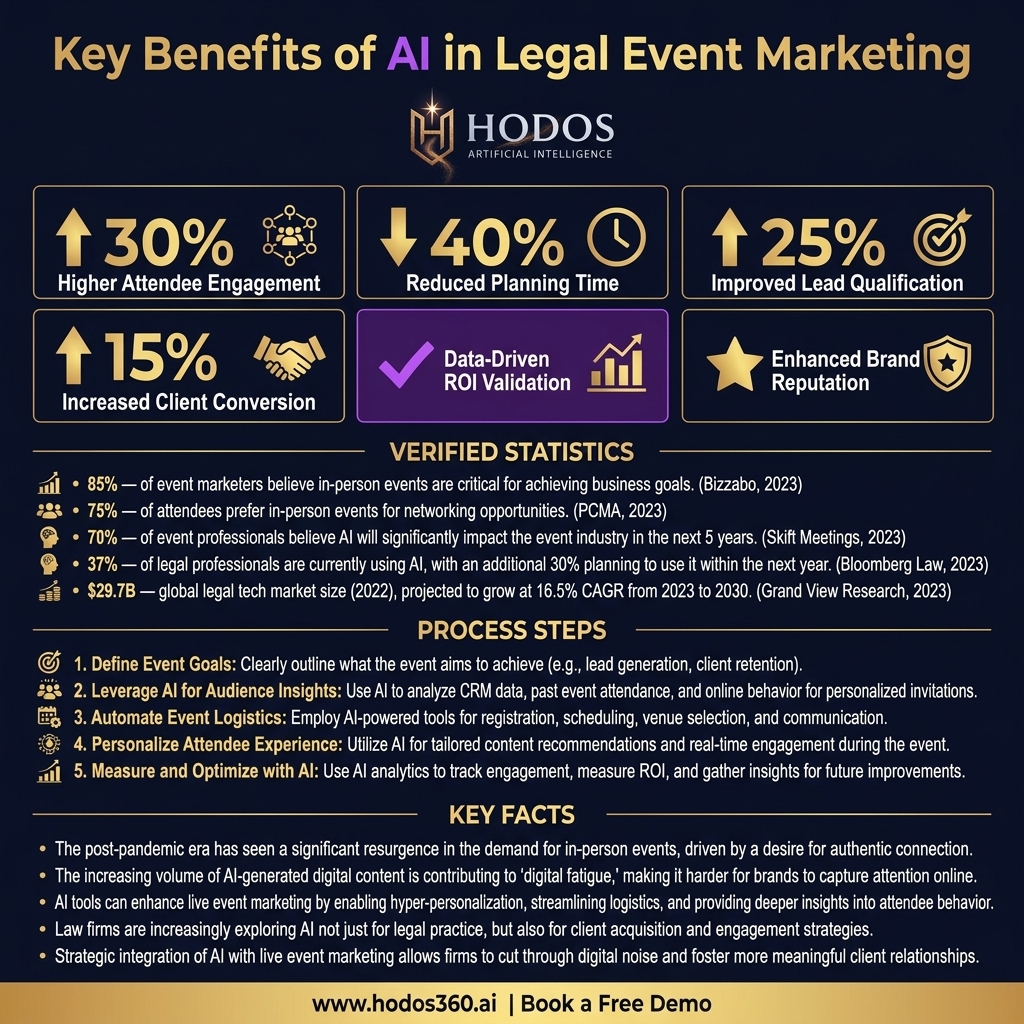
AI algorithms can then analyze this data to attribute specific client acquisitions or expanded engagements directly to an event. For example, if LexCorp Legal hosts a seminar, AI can track attendees who later schedule consultations, sign engagement letters, and ultimately generate revenue, providing a clear dollar-for-dollar ROI.
Learn more about AI Document Workflows: Revolutionize Your Firm in 2026 for Maximum ROI. This granular insight allows firms to optimize their event planning for maximum financial impact, moving beyond simple lead counts to tangible revenue generation.
Beyond direct revenue, AI helps in measuring softer, yet equally crucial, metrics like brand sentiment and thought leadership impact.
Through social media listening and sentiment analysis, AI can gauge public perception of an event and the firm's presence, providing valuable qualitative data. This holistic view of event ROI tracking empowers legal marketers to make smarter, more strategic decisions. Firms can identify which event formats, topics, or even specific speakers are most effective in achieving their marketing objectives, ensuring that future event marketing efforts are not only efficient but also highly effective in building the firm's reputation and client base.
Operational Excellence: AI Tools for Seamless Event Management
The logistical complexities of event management can be daunting, often consuming significant resources and time. From venue scouting and contract negotiations to catering and audiovisual setup, the sheer volume of tasks can overwhelm even the most organized teams. This is where AI truly shines in delivering operational excellence.
AI-powered platforms can automate mundane yet critical tasks, such as generating vendor contracts based on pre-approved templates, managing guest lists with dynamic updates, and even optimizing seating arrangements for networking opportunities. This automation significantly reduces the potential for human error and frees up legal marketing professionals to focus on the strategic, relationship-building aspects of the event, rather than getting mired in administrative details.
The efficiency gains are not just about cost savings; they're about elevating the quality and impact of the entire event planning process.
Consider the power of AI Voice Assistants in transforming event logistics. Imagine a prospective client calling the firm with questions about an upcoming seminar.
Instead of tying up a human receptionist, an AI Voice Assistant, like those offered by HODOS 360, can provide instant, accurate answers to FAQs, confirm registration details, offer directions, and even book follow-up appointments. These assistants operate 24/7, provide multilingual support, and can seamlessly route complex queries to the appropriate human staff member.
This ensures that every inquiry is handled promptly and professionally, enhancing the attendee experience from the very first touchpoint. For events with hundreds or thousands of attendees, this level of automated support is not just convenient; it's a game-changer for efficient lead qualification and client service.
Beyond direct communication, AI assists in more subtle but equally vital aspects of event planning. Learn more about Legal AI Problem: Mastering Ethical Tech in Law Firms 2026. For instance, predictive analytics can help forecast attendance numbers more accurately, allowing for better resource allocation and cost control.
AI can also assist in identifying potential logistical bottlenecks or compliance issues well in advance, minimizing last-minute crises. For law firms, where reputation and meticulousness are paramount, ensuring every detail of an event runs smoothly is crucial. AI's ability to process and analyze vast amounts of data quickly makes it an indispensable partner in risk management and quality control for event marketing.
This proactive approach ensures that events are not only successful but also flawlessly executed, reflecting positively on the firm's professionalism.
The integration of AI into event management is not just about automation; it's about creating a smarter, more responsive event ecosystem. From the initial concept to post-event breakdown, AI tools are transforming how law firms approach every stage of event planning.
This technological advancement allows firms to host more sophisticated, impactful events without proportionally increasing their operational overhead. It represents a strategic advantage, enabling firms to allocate their most valuable human capital—their lawyers and marketing strategists—to what they do best: building relationships and delivering exceptional legal services.
The future of legal event marketing is one where human ingenuity is amplified by the precision and efficiency of artificial intelligence.
The Future of Legal Event Planning with AI
Looking ahead, the synergy between AI and live event marketing promises even more transformative possibilities for law firms. We are moving towards a future of 'phygital' events, where the lines between physical and digital experiences blur seamlessly. Imagine a live conference where attendees can interact with holographic presentations, participate in virtual breakout rooms with remote colleagues, or receive real-time, AI-generated summaries of discussions directly to their devices.
Firms that embrace these innovations will not only enhance the attendee experience but also expand their reach to a global audience, overcoming geographical limitations. This evolution will require flexible and integrated platforms capable of managing both physical and digital components with equal sophistication.
The competitive landscape in legal services demands continuous innovation, and AI-powered event management offers a distinct edge.
Firms that proactively adopt these advanced tools will be better positioned to attract top talent, secure high-value clients, and solidify their reputation as industry leaders. This isn't just about efficiency; it's about pioneering new ways to connect, engage, and build lasting relationships in a rapidly evolving world.
The future of legal event marketing is not just about hosting events, but about curating intelligent, immersive experiences that leave a lasting impact, proving that the human touch, when amplified by AI, is more powerful than ever.

Key Takeaways and Next Steps
The narrative of event marketing for law firms in the AI era is one of sophisticated evolution, not revolution. The eMarketer report's observation about AI-driven traffic declines fueling a return to live events underscores a fundamental truth: human connection remains paramount, especially in the trust-based legal profession.
However, this return is not a step backward; it's a leap forward, powered by intelligent AI integration. Firms that master this balance—using AI to enhance personalization, streamline operations, and precisely measure ROI for their live events—will forge deeper client relationships and gain a significant competitive advantage.
The goal is to create compelling, memorable experiences that resonate long after the event concludes, transforming attendees into loyal clients.
For law firms ready to embrace this future, the journey involves strategic adoption of integrated AI solutions. Platforms like HODOS 360 offer a comprehensive suite of services designed for this very purpose, from an AI Marketing Platform that streamlines content generation and social media automation for pre- and post-event engagement, to AI Voice Assistants that handle lead qualification and 24/7 client support during events.
Our AI Law Firm Management System further ensures that client intake, billing, and document automation are seamlessly integrated with your event follow-up processes, providing a holistic approach to growth. The time to reimagine your firm's event marketing strategy is now, leveraging AI to amplify your human touch and achieve unparalleled success.
Frequently Asked Questions
Why are live events making a comeback in the AI era?+
Despite AI's advancements in digital marketing, a phenomenon known as 'digital fatigue' has emerged. Clients and prospects are overwhelmed by the sheer volume of online content, leading to diminishing returns from purely digital campaigns. Live events offer an invaluable opportunity for authentic, in-person human connection, trust-building, and curated experiences that digital mediums struggle to replicate, especially in the relationship-driven legal sector.
How can AI personalize the attendee experience for legal events?+
AI can analyze vast datasets from CRM, public records, and online behavior to create hyper-targeted invitation lists and tailor event content to individual attendee interests. During the event, AI-powered apps can offer personalized schedules, networking suggestions, and real-time support, ensuring each participant feels uniquely valued and engaged, leading to more meaningful interactions and a stronger brand impression.
What specific AI tools are most useful for event marketing?+
Key AI tools include predictive analytics for audience segmentation, AI-powered content generation for pre- and post-event communications, AI voice assistants for 24/7 attendee support and lead qualification, and advanced analytics platforms for granular ROI tracking. These tools streamline logistics, enhance personalization, and provide data-driven insights for continuous improvement of event strategies.
How does AI help with measuring event ROI?+
AI integrates event data with CRM and marketing automation systems to track the entire client journey, from initial invitation to post-event client acquisition and revenue generation. It can attribute specific client wins directly to event participation, analyze engagement metrics, and quantify the financial impact of events, moving beyond simple attendance numbers to demonstrate tangible returns on investment.
Can AI voice assistants genuinely enhance event logistics?+
Yes, AI voice assistants significantly enhance event logistics by handling routine inquiries such as FAQs, registration details, directions, and appointment booking 24/7. This frees up human staff to focus on high-value interactions, improves responsiveness for attendees, offers multilingual support, and can even pre-qualify leads, making the event experience smoother and more efficient for everyone involved.