


Essential AI Accountability: Bridging the Legal Tech Gap
The legal landscape is undergoing an unprecedented transformation, driven by the rapid AI adoption across all facets of practice. Yet, as innovation accelerates, a critical challenge emerges: the widening AI accountability gap. A recent report by the Interactive Advertising Bureau (IAB), highlighted by MediaPost on July 20, 2026, underscored this growing disparity, finding that despite mass adoption, the frameworks for ensuring responsible AI use are lagging. This isn't merely an abstract concern; it presents tangible risks for law firms, from ethical dilemmas to potential regulatory penalties. Consider the case of Sterling & Hayes, a mid-sized firm that, in its zeal to leverage AI for client intake and conflict checks, faced a significant challenge when a newly deployed system inadvertently flagged a long-standing client due to a data bias in its training model, nearly jeopardizing a lucrative merger deal. Senior Partner Eleanor Vance recounted the frantic efforts required to manually override the system and reassure the client, a stark reminder that efficiency alone cannot be the sole metric of AI success. This incident, while hypothetical, mirrors the real-world anxieties legal professionals face as they integrate powerful, yet often opaque, AI tools into their daily operations.
The IAB's findings resonate deeply within the legal industry, where the stakes of AI missteps are exceptionally high. Law firms are not just adopting technology; they are entrusting AI with sensitive client data, critical legal analysis, and foundational aspects of their client relationships. The promise of AI—streamlined workflows, enhanced research capabilities, and predictive insights—is undeniable, driving firms to invest heavily in solutions ranging from sophisticated document automation to AI-powered legal research platforms. However, this swift AI transformation has often been characterized by a 'move fast and break things' mentality, a paradigm ill-suited for a profession built on precision, trust, and unwavering ethical standards. The core issue, as the IAB report implies, is that while the legal sector has achieved significant strides in leveraging AI, the development of robust, sustainable accountability mechanisms has not kept pace.
This gap is not just about technical failures; it extends to the very principles of fairness, transparency, and human oversight. As AI systems become more autonomous and their decision-making processes more complex, the ability to trace, explain, and take responsibility for their outputs becomes paramount. For law firms, this isn't just a matter of best practice; it's a professional obligation rooted in ethical duties of competence and supervision. The imperative to bridge this AI accountability gap is not merely a reactive response to potential problems but a proactive strategy for building trust, ensuring compliance, and future-proofing legal services in an increasingly AI-driven world. Firms must move beyond mere AI adoption to strategic, responsible integration, embedding governance and ethical considerations at every stage of their AI journey. Discover how to build a resilient, ethical AI framework for your firm.
The Widening AI Accountability Gap in Legal Tech
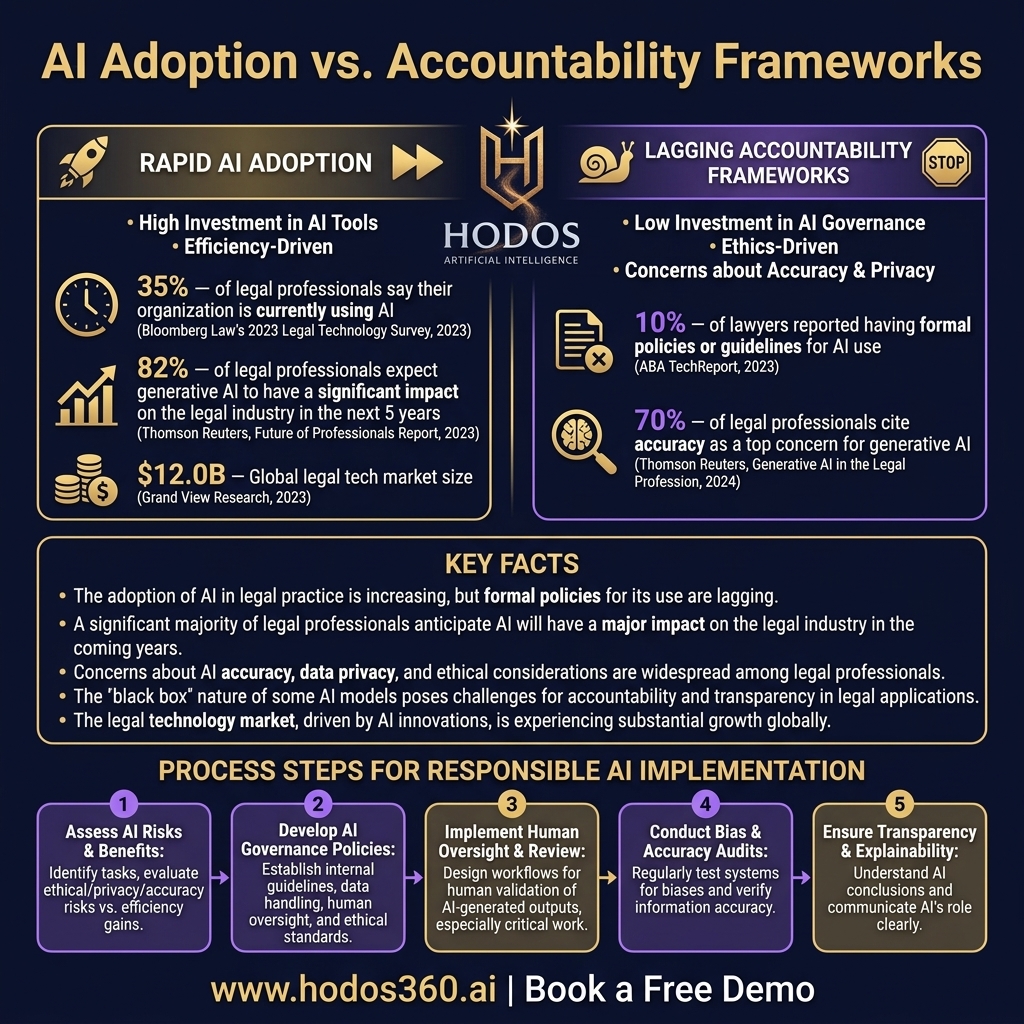
The recent IAB report serves as a potent reminder that the legal industry's enthusiasm for AI, while understandable given its transformative potential, has created a significant chasm between technological prowess and ethical governance. This accountability deficit is not unique to legal tech but is particularly pronounced here due to the profession's inherent responsibilities. Data from the 2023 ABA TechReport indicates that over 50% of law firms are already using AI tools, a figure projected to rise dramatically. Yet, when asked about formal AI governance policies, less than 15% reported having comprehensive frameworks in place. This disparity highlights a dangerous trend: firms are deploying powerful AI without fully understanding or addressing the inherent risks of bias, lack of transparency, and potential for unintended consequences. The IAB finds that this gap widens as AI becomes more embedded, making it harder to retroactively impose accountability.
The implications of this widening gap are far-reaching. Beyond the ethical considerations, there are tangible business and legal risks. In a highly regulated environment, an AI system that produces biased legal research, generates discriminatory client communications, or mismanages sensitive data can lead to severe reputational damage, malpractice claims, and regulatory fines. Learn more about AI Legal Revolution: Corporate Use Jumps 87% by 2026. Consider the recent debates surrounding the EU AI Act, which, despite its phased enforcement, signals a global trend towards stricter oversight. While the Act focuses on high-risk AI systems, its principles of transparency, human oversight, and robustness offer a blueprint for responsible AI adoption across all sectors, including legal. Firms that ignore these burgeoning regulatory landscapes do so at their peril, risking not only financial penalties but also a significant erosion of client trust, which is the bedrock of any successful legal practice.
Moreover, the competitive landscape itself is shaping the urgency of addressing AI accountability. Firms like Allen & Overy, through its partnership with Harvey AI, are not just adopting AI; they are actively shaping its responsible deployment, emphasizing explainability and human-in-the-loop processes. This proactive stance distinguishes them from competitors who might view AI merely as a cost-cutting measure. As Microsoft President Brad Smith frequently emphasizes, the future of AI hinges on trust, and trust is built on accountability. Firms that fail to prioritize this will find themselves at a disadvantage, not only in terms of compliance but also in attracting and retaining top talent and discerning clients who increasingly scrutinize the ethical posture of their legal partners.
Navigating the Regulatory Labyrinth: EU AI Act and Beyond
The regulatory environment surrounding AI is evolving rapidly, creating a complex labyrinth for law firms to navigate. The EU AI Act, set to be fully enforced in the coming years, is arguably the most comprehensive piece of AI legislation globally, categorizing AI systems based on their risk level and imposing stringent requirements for high-risk applications. While legal tech tools might not always fall into the 'high-risk' category, the Act's emphasis on data governance, human oversight, and transparency sets a precedent that will undoubtedly influence future regulations in other jurisdictions, including the US. States like California are already exploring their own AI governance frameworks, and federal discussions are ongoing. For law firms, this means that waiting for explicit legal-specific AI regulations is a precarious strategy. Learn more about AI Marketing Agents: The Ultimate Guide for Law Firms. Instead, they must proactively align their AI adoption strategies with these emerging global standards, ensuring their tools and processes are designed for inherent accountability and compliance. This proactive approach is not just about avoiding penalties; it's about establishing a foundation for sustainable and ethical growth in the AI transformation era.
Legal Citation: ABA Model Rule 1.1 (Competence) and ABA Model Rule 5.3 (Responsibilities Regarding Nonlawyer Assistants), which can be extended to encompass AI tools, require lawyers to provide competent representation and adequately supervise nonlawyer assistance to ensure ethical compliance. These rules implicitly demand that lawyers understand the risks and benefits of technologies they employ and ensure their proper use.
Ethical AI Development and Deployment for Law Firms
Beyond regulatory compliance, the core of bridging the AI accountability gap lies in embedding ethical principles into the very fabric of AI development and deployment within law firms. This means moving beyond a purely functional view of AI to consider its broader societal and professional impact. Leaders in the AI space, such as OpenAI's CEO Sam Altman and Anthropic's CEO Dario Amodei, have consistently stressed the importance of building AI responsibly, emphasizing safety, fairness, and transparency. For law firms, this translates into a commitment to ethical AI principles: ensuring that AI systems are developed and used in a way that avoids bias, promotes fairness, and maintains client confidentiality. The infamous incident where an AI-powered legal research tool hallucinated case law serves as a stark warning; while the technology is powerful, it is not infallible, and its outputs must always be critically evaluated.
Developing ethical AI requires a multi-faceted approach. First, firms must prioritize data governance, ensuring that the data used to train and operate AI systems is diverse, unbiased, and compliant with privacy regulations like GDPR and CCPA. Biased training data can lead to discriminatory outcomes, directly violating a lawyer's ethical duties. Second, transparency and explainability are crucial. Lawyers must be able to understand *how* an AI system arrived at a particular conclusion, especially when it impacts client advice or case strategy. This isn't always easy with complex 'black box' AI models, but firms must demand explainable AI (XAI) capabilities from their vendors or integrate internal processes to interpret AI outputs. Learn more about Fine-Tuning LLMs: Ultimate Guide for Legal Innovation. Third, robust human oversight is non-negotiable. AI should augment, not replace, human legal judgment. Partners at firms like Latham & Watkins have openly discussed their internal guidelines for AI use, emphasizing that every AI-generated output must be reviewed and validated by a qualified attorney, embedding a crucial layer of accountability.
Furthermore, the selection and integration of AI tools must be guided by these ethical considerations. Firms should conduct thorough due diligence on AI vendors, scrutinizing their data privacy practices, bias mitigation strategies, and commitment to responsible AI development. The legal tech market is booming, with startups like Casetext (acquired by Thomson Reuters) and Clio continually innovating, but not all solutions are created equal. Firms must choose partners who align with their ethical standards. The partnership between Harvey AI and Allen & Overy exemplifies this, focusing on developing generative AI tools that enhance legal work while maintaining strict ethical guardrails and ensuring human oversight. This proactive approach to ethical AI is not just about risk management; it's about upholding the foundational values of the legal profession in the digital age, ensuring that the AI transformation serves justice rather than undermining it.
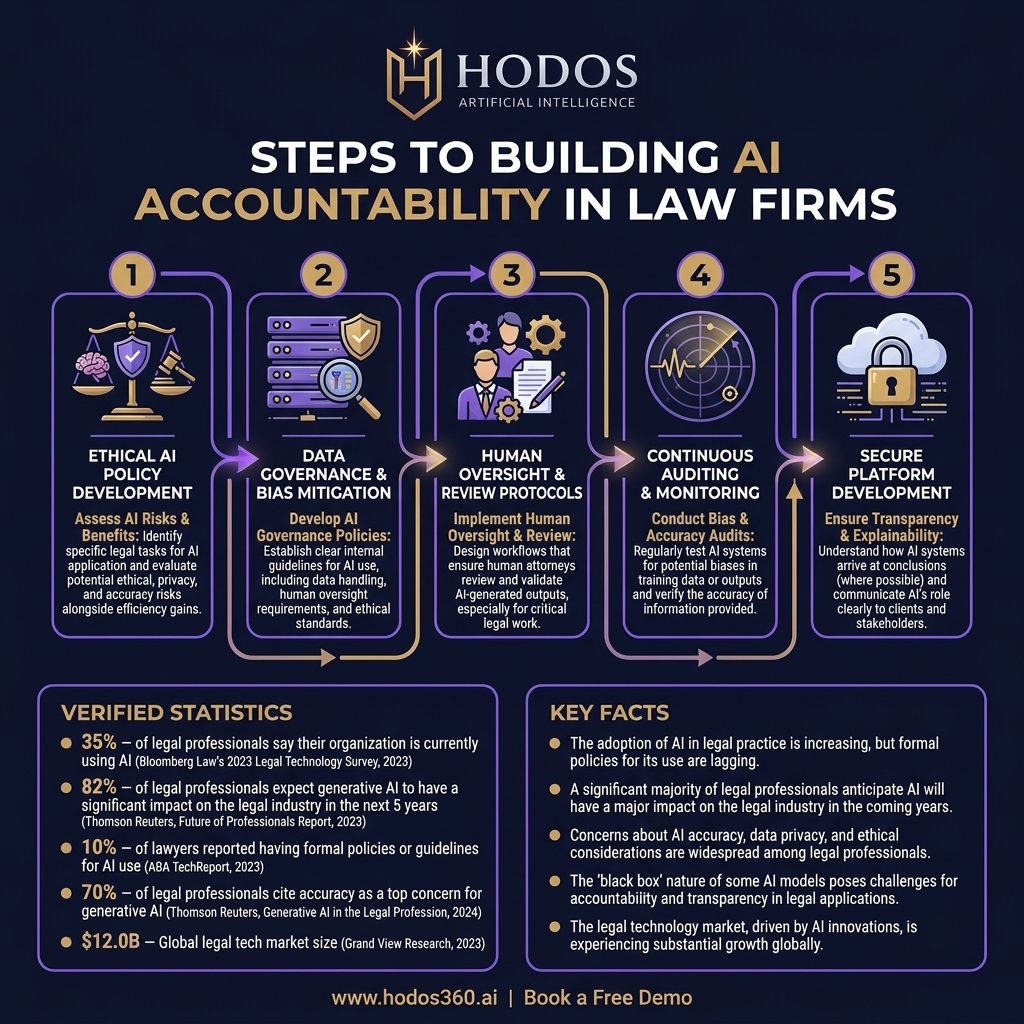
- ✓Prioritize Data Governance: Ensure training data is diverse, unbiased, and compliant with privacy regulations (e.g., GDPR, CCPA) to prevent discriminatory AI outcomes.
- ✓Demand Transparency & Explainability: Seek AI tools with Explainable AI (XAI) capabilities, allowing attorneys to understand how conclusions are reached, especially for critical legal advice.
- ✓Implement Robust Human Oversight: Mandate attorney review and validation for all AI-generated outputs, ensuring AI augments, rather than replaces, human legal judgment.
- ✓Conduct Vendor Due Diligence: Thoroughly vet AI vendors for their data privacy, bias mitigation strategies, and commitment to responsible AI development.
- ✓Establish Internal AI Use Policies: Develop clear guidelines for AI tool usage, ethical boundaries, and accountability protocols within the firm.
- ✓Foster Continuous Education: Keep legal teams updated on AI advancements, ethical considerations, and evolving regulatory landscapes to maintain competence.
- ✓Integrate Feedback Loops: Create mechanisms for continuous monitoring and feedback on AI system performance, allowing for adaptive improvements and bias correction.
Building Robust AI Governance and Compliance Frameworks
To effectively bridge the AI accountability gap, law firms must move beyond ad-hoc solutions and implement robust, institutionalized AI governance and compliance frameworks. This involves creating a structured approach to how AI tools are selected, deployed, monitored, and retired within the firm. A comprehensive governance framework begins with clear policies defining acceptable use, data handling protocols, and ethical guidelines, much like the internal policies large tech companies like Google DeepMind develop for their own AI applications. These policies should address issues such as client confidentiality, data anonymization, intellectual property rights when using generative AI, and the clear delineation of responsibility when AI outputs are used in legal advice or court filings. Firms should consider establishing an internal AI oversight committee, potentially comprising partners, IT specialists, and ethics counsel, to continuously review and update these policies in light of new technological advancements and evolving legal standards.
Crucial to any AI governance framework is the concept of continuous auditing and monitoring. It’s not enough to simply deploy an AI tool; its performance, accuracy, and adherence to ethical guidelines must be constantly evaluated. This includes regular checks for algorithmic bias, data drift, and potential security vulnerabilities. Firms should implement audit trails for AI-driven decisions, allowing for forensic analysis in case of errors or disputes. For instance, if an AI-powered document review system misses a critical clause, the firm must be able to trace *why* it was missed, whether it was a model limitation, data input error, or human oversight failure. Learn more about AI Voice Assistants: Ultimate Guide for Law Firm Efficiency. This level of granular accountability is essential for demonstrating due diligence and mitigating risk. Companies like Relativity have been at the forefront of providing tools for legal teams to manage vast datasets, and their emphasis on auditable processes offers a model for AI governance.
The integration of web development expertise is also paramount in building these compliance and governance frameworks. Secure, custom-built web and mobile platforms can embed accountability by design. This means developing user interfaces that clearly indicate when AI is being used, providing options for human review, and incorporating robust data encryption and access controls. An AI-powered client intake system, for example, can be designed with clear consent mechanisms for data usage, transparent explanations of how AI will process information, and secure portals for document exchange. This proactive approach to web development ensures that AI accountability is not an afterthought but an intrinsic part of the firm's digital infrastructure, fostering trust and mitigating the risks associated with rapid AI adoption. The focus should be on creating systems that are not only efficient but also inherently trustworthy and auditable, contributing to a sustainable and responsible AI transformation.
The Imperative of Human Oversight and Continuous Auditing
The notion that AI can fully automate complex legal tasks without human intervention is a dangerous fallacy. The imperative of human oversight remains the cornerstone of AI accountability in the legal profession. As articulated by the ABA Standing Committee on Ethics and Professional Responsibility, lawyers retain ultimate responsibility for legal work, regardless of the tools used. This means that every AI-generated legal brief, contract draft, or research memo must undergo rigorous review by a qualified attorney. Firms must establish clear protocols for this human-in-the-loop process, defining checkpoints where human judgment is explicitly required to validate, correct, or contextualize AI outputs. This isn't just about preventing errors; it's about ensuring that the nuanced ethical and strategic considerations inherent in legal practice are always prioritized over algorithmic efficiency. The tension between achieving speed and maintaining accuracy is real, but in law, accuracy and accountability must always prevail.
Complementing human oversight is the necessity of continuous auditing. Learn more about AI Website Design: Essential Strategies for Law Firms. AI models are not static; they can drift over time, their performance degrading or biases emerging as they interact with new data. Regular, systematic audits are crucial to monitor AI system performance, identify potential biases, and ensure ongoing compliance with internal policies and external regulations. These audits should encompass data quality checks, model validation, and impact assessments. Firms should also invest in tools that provide explainability for AI decisions, allowing experts to delve into the 'why' behind an AI's output. This continuous feedback loop ensures that AI systems evolve responsibly, contributing to a more sustainable and trustworthy AI transformation. Without this vigilance, the initial benefits of AI adoption can quickly be overshadowed by unforeseen risks, widening the accountability gap rather than narrowing it, and undermining the very purpose of leveraging advanced technology in legal practice.
Leveraging Web & Mobile Development for Accountable AI
The path to robust AI accountability for law firms is inextricably linked to sophisticated web and mobile development. It’s not enough to simply integrate off-the-shelf AI solutions; firms must consider how these tools are accessed, how they interact with existing systems, and how their outputs are presented to both attorneys and clients. This is where custom web development plays a pivotal role in embedding accountability by design. Imagine a proprietary client portal, built with cutting-edge web development, that integrates AI-powered document review. This portal could be designed to clearly flag AI-generated summaries for human review, provide direct links to source documents for verification, and offer transparent explanations of the AI’s methodology. Such a platform ensures that the firm maintains full control over the AI's application, mitigating risks associated with opaque black-box systems and bolstering client trust through enhanced transparency. Firms like Baker McKenzie have invested heavily in custom digital platforms to manage their global operations, recognizing that bespoke solutions offer unparalleled governance and security.
Furthermore, web and mobile development can facilitate the creation of secure, auditable environments for AI operations. This includes building custom dashboards for monitoring AI performance, tracking data lineage, and managing access controls. For example, an AI-powered legal research platform developed internally or customized by a third party can incorporate features that log every query, every AI-generated response, and every human interaction, creating a comprehensive audit trail essential for compliance and internal governance. This level of granular tracking is crucial for demonstrating due diligence, especially in areas like intellectual property or regulatory compliance, where precision is paramount. Learn more about AI Website Builder: Strategic Insights for Law Firms. The expertise in responsive design and SEO optimization inherent in modern web development also means these accountability features can be seamlessly integrated into user-friendly interfaces, encouraging adoption while upholding strict governance standards. This approach ensures that the firm's digital ecosystem is not just efficient but also intrinsically trustworthy and resilient against the challenges of the widening AI accountability gap.
The strategic application of web and mobile development also extends to internal training and compliance tools. Firms can develop interactive web applications that educate attorneys on ethical AI use, provide simulations for identifying AI bias, and offer quick access to the firm’s AI governance policies. These platforms become central hubs for fostering an AI-literate workforce, ensuring that every member of the firm understands their role in maintaining AI accountability. By leveraging advanced web development, firms can create a proactive learning environment that adapts to new AI developments and regulatory changes, promoting a culture of continuous compliance and ethical stewardship. This investment in custom digital infrastructure is not just a technological upgrade; it's a fundamental commitment to responsible innovation and a sustainable future for legal services.
Ultimately, the synergy between web and mobile development and AI accountability represents a significant opportunity for law firms to differentiate themselves. In an era where the IAB finds the accountability gap widening, firms that prioritize building transparent, secure, and ethically governed AI systems through sophisticated custom development will emerge as leaders. This proactive stance not only mitigates risk but also enhances client confidence and positions the firm at the forefront of the AI transformation. HODOS 360’s Web & Mobile Development services are specifically designed to empower law firms to build these bespoke, AI-powered digital infrastructures, ensuring that accountability is engineered into every layer of their technological stack, from client-facing portals to internal governance dashboards.
Designing for Transparency and Trust in Legal AI Platforms
In the context of the widening AI accountability gap, designing legal AI platforms with an emphasis on transparency and trust is no longer optional—it's a strategic imperative. This means that every element of a firm's digital presence, from its public-facing website to its internal AI-powered tools, must be crafted to foster confidence and clarity. Through meticulous web development, firms can create user experiences that clearly articulate how AI is being utilized, what data is being processed, and the extent of human oversight involved. Features like clear disclaimers, interactive explanations of AI models, and easy-to-access audit logs can transform potentially opaque AI operations into transparent, understandable processes. This approach not only addresses ethical concerns but also builds a stronger foundation of trust with clients, who are increasingly aware of the implications of AI on their legal matters.
For example, an AI-powered document automation system can be developed with a user interface that allows attorneys to view the underlying logic or templates used by the AI, providing a "glass box" rather than a "black box" experience. Similarly, client portals built via custom web development can offer dashboards showing the progress of AI-assisted tasks, with clear indications of human review points. This level of transparency in design is crucial for demonstrating compliance with ethical obligations and regulatory expectations, particularly as discussions around AI accountability intensify globally. By prioritizing design for transparency, law firms can proactively manage the risk associated with AI adoption, turning a potential liability into a competitive advantage and ensuring their AI transformation is truly sustainable and trustworthy.

Charting a Sustainable Path Forward for Legal AI
The IAB's report on the widening AI accountability gap serves as a critical inflection point for the legal industry. It's a call to action for law firms to move beyond mere AI adoption and commit to a proactive, sustainable strategy for AI governance. The future of legal tech isn't just about faster document review or more efficient research; it's about building an ethical, resilient, and trustworthy ecosystem where technology augments human judgment without compromising the core values of the profession. This means prioritizing ethical AI principles, investing in robust governance frameworks, and leveraging sophisticated web and mobile development to embed accountability into every digital touchpoint. Firms that take these steps will not only mitigate risks but will also solidify their reputation as forward-thinking, responsible leaders in the AI transformation era.
As law firms navigate this complex landscape, the imperative is clear: embrace innovation with a profound commitment to accountability. This involves continuous learning, adaptive policy-making, and strategic partnerships with technology providers who understand the unique ethical and regulatory demands of the legal profession. By proactively addressing the AI accountability gap, firms can ensure that their AI adoption journey is not just efficient but also ethical, compliant, and ultimately, more successful for their clients and their practice. The opportunity to shape a sustainable and trustworthy future for legal AI is now, and those who seize it will define the next generation of legal service delivery.
Frequently Asked Questions
What is the 'AI Accountability Gap' and why is it widening in legal tech?+
The AI Accountability Gap refers to the disparity between the rapid AI adoption in various sectors, including legal tech, and the slower development of robust frameworks for ethical oversight, governance, and responsibility. It's widening because technological innovation often outpaces regulatory and ethical considerations, leaving firms exposed to risks like bias, data privacy issues, and lack of transparency, as highlighted by recent industry research.
How can law firms ensure ethical AI adoption?+
Law firms can ensure ethical AI adoption by prioritizing data governance (unbiased, compliant data), demanding transparency and explainability from AI tools, implementing robust human oversight for all AI-generated outputs, conducting thorough due diligence on AI vendors, and establishing clear internal policies for AI use to promote compliance and mitigate risk within their AI transformation.
What role does web and mobile development play in AI accountability?+
Web and mobile development are crucial for embedding AI accountability by design. Custom platforms can offer transparent user interfaces that flag AI use, provide audit trails for AI decisions, ensure secure data handling, and integrate compliance features. This proactive approach ensures governance is built into the firm's digital infrastructure, fostering trust and mitigating risks associated with rapid AI adoption.
What are the key components of an effective AI governance framework for law firms?+
An effective AI governance framework for law firms includes clear policies on AI use, data handling, and ethical guidelines. It also requires continuous auditing and monitoring of AI performance for bias and accuracy, establishing human-in-the-loop protocols, and creating an internal oversight committee. This comprehensive approach ensures compliance and promotes sustainable AI adoption.
How do legal citations like ABA Model Rules apply to AI accountability?+
Legal citations such as ABA Model Rule 1.1 (Competence) and 5.3 (Responsibilities Regarding Nonlawyer Assistants) implicitly extend to AI tools. They require lawyers to understand and competently use technology, and adequately supervise its outputs. This means lawyers are ultimately responsible for AI's use, necessitating strong AI accountability and governance to ensure compliance and ethical practice, even with advanced AI adoption.