

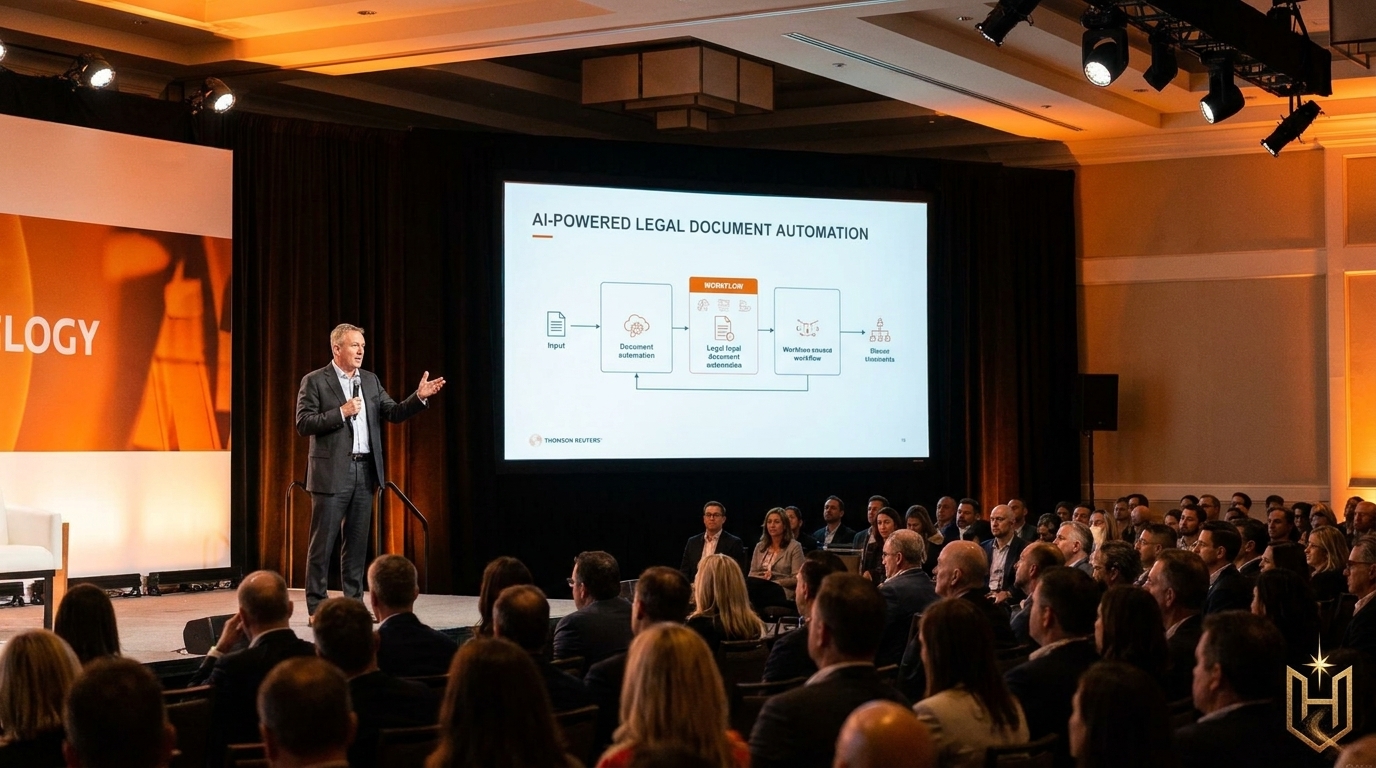
AI Legal Page Generators: The Ultimate Guide for Firms
Just a few years ago, the meticulous drafting of every legal page—from website terms and conditions to intricate privacy policies—was a time-consuming cornerstone of legal practice. Partners like Sarah Chen, a senior attorney at a mid-sized corporate law firm in Silicon Valley, recall spending countless hours annually on these foundational documents, often duplicating efforts across clients with similar needs.
The process was not only resource-intensive but also a significant bottleneck for firms striving for agility in a fast-paced digital economy. This challenge is precisely why a recent article from Trend Hunter, titled "AI Legal Pages Generators," has resonated so deeply across the legal community, highlighting a transformative shift.
Today, the landscape is dramatically different. The emergence of AI Legal Page Generators is fundamentally reshaping how law firms approach these essential tasks, moving beyond mere templates to truly intelligent automation. This isn't just about speed; it's about embedding jurisdictional nuances, ensuring compliance with evolving regulations like GDPR or the CCPA, and freeing up highly skilled legal professionals to focus on complex, high-value strategic work.
As technology continues to advance at an unprecedented pace, driven by giants like OpenAI and Anthropic, law firms are finding themselves at a critical juncture, needing to embrace these innovations to maintain competitive advantage and deliver superior client service. The question is no longer *if* AI will transform legal documentation, but *how* rapidly firms can integrate these powerful tools into their daily operations.
The legal industry, historically cautious about technological adoption, is now experiencing an undeniable acceleration in embracing AI. Data from the American Bar Association's (ABA) 2023 Legal Technology Survey Report indicated a significant uptick in law firms exploring or implementing AI solutions, with a particular interest in automation tools that reduce repetitive tasks.
This trend is further amplified by the competitive pressures exerted by legal tech startups and the growing demands from clients for more efficient and cost-effective services. Firms that once relied solely on traditional keyword search methods for document analysis are now finding AI-powered search to be often superior, capable of identifying subtle patterns and relationships within vast datasets that human review might miss.
This shift is not merely about convenience; it is a strategic imperative for modern legal business.
Companies like LexisNexis and Thomson Reuters have long provided document automation features, but the new wave of AI Legal Page Generators goes far beyond static forms. Learn more about Legal AI: The Ultimate Guide for Small Firms' Smart Decisions.
These advanced platforms leverage large language models (LLMs) to understand context, generate dynamic content, and adapt to specific client requirements with remarkable accuracy. Consider the example of LexisNexis's Lexis+ AI or Thomson Reuters' CoCounsel, which, while not solely legal page generators, demonstrate the underlying AI capabilities that are now being specialized.
These tools enable firms to quickly draft compliant privacy policies, terms of service, disclaimers, and other foundational documents that are critical for any business, significantly reducing the manual drafting time. The era of generic, one-size-fits-all legal pages is rapidly fading, replaced by AI-driven, context-aware generation.
Beyond Simple Forms: Advanced Capabilities of AI Document Generation
The initial perception of AI Legal Page Generators might be limited to basic templating, but the reality is far more sophisticated. Modern AI platforms are equipped with advanced natural language processing (NLP) capabilities that allow them to interpret complex inputs, cross-reference legal databases, and generate highly nuanced legal text.
For instance, a firm drafting a privacy policy for a startup operating across multiple jurisdictions would traditionally need to manually research and incorporate clauses for CCPA, GDPR, and other regional regulations. An AI generator, however, can ingest these jurisdictional requirements and dynamically weave them into a single, cohesive document, ensuring comprehensive compliance without manual oversight.
This level of dynamic adaptation represents a monumental leap from the static document generators of the past, offering a powerful tool for business lawyers.
The real power of these advanced legal document generators lies in their ability to learn and refine. Learn more about AI Website Coding: An Essential Guide for Law Firms.
Platforms are often powered by machine learning algorithms that improve with every document generated and reviewed by human attorneys. This continuous feedback loop enhances the AI's understanding of legal precedents, client preferences, and emerging regulatory language. Firms can, for example, feed their own preferred boilerplate clauses and stylistic guidelines into the system, allowing the AI to generate documents that not only adhere to legal standards but also reflect the firm's unique brand and client approach.
This capability transforms the AI from a mere tool into a collaborative partner in legal drafting, significantly boosting efficiency and consistency across all legal documents.
Enhancing Client Intake and Compliance
One of the most immediate and impactful applications of AI Legal Page Generators is in optimizing client intake and ensuring compliance. When a new client engages a law firm, a host of initial documents are required: engagement letters, privacy consents, terms of service, and various disclaimers.
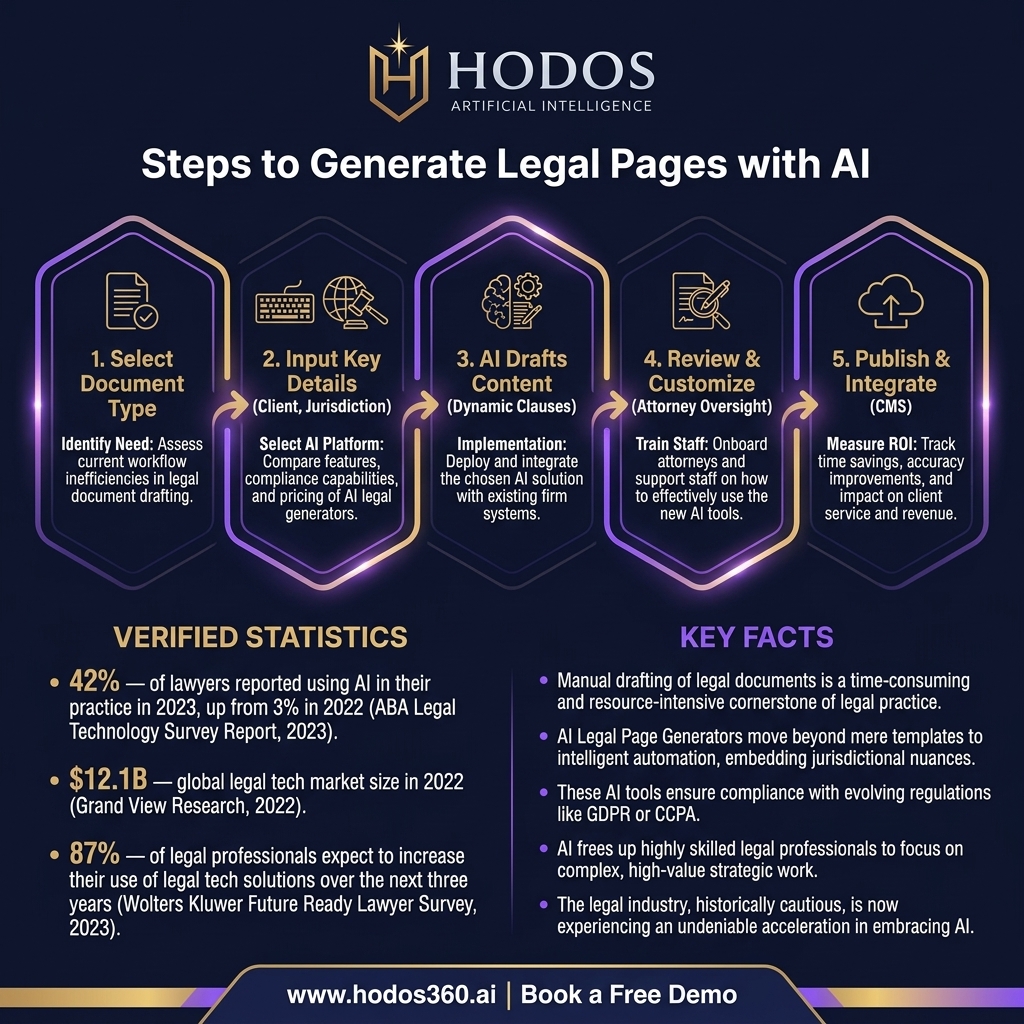
Manually preparing these for each client is repetitive and prone to error. AI streamlines this by generating personalized, compliant documents based on specific client data gathered during the intake process. For example, HODOS 360’s AI Law Firm Management System integrates document automation directly into client intake, ensuring that all necessary legal pages are generated accurately and promptly, tailored to the client's industry and operational scope.
This not only accelerates the onboarding process but also significantly reduces the risk of non-compliance, a critical concern highlighted by numerous regulatory bodies.
Furthermore, the dynamic nature of legal compliance means that legal pages need constant updating. Learn more about AI Web Development: Essential Collaboration for Law Firms.
Consider the impact of the EU AI Act or evolving data privacy laws. Manually reviewing and updating hundreds of client documents for new regulatory requirements is a daunting task. AI-powered tools can monitor regulatory changes and flag documents that require revision, or even suggest the necessary amendments, ensuring that a firm's clients remain compliant without incurring massive legal fees for continuous manual review.
This proactive approach to compliance, driven by intelligent automation, is a game-changer for risk management and client service, transforming what was once a laborious chore into an automated safeguard.
- ✓Accelerated Drafting: Generate standard legal pages (e.g., privacy policies, terms of service, disclaimers) in minutes, not hours.
- ✓Enhanced Accuracy: Minimize human error by leveraging AI to cross-reference legal standards and client-specific data.
- ✓Jurisdictional Adaptability: Automatically incorporate specific legal requirements for different regions or countries (e.g., CCPA, GDPR).
- ✓Customization at Scale: Tailor documents to individual client needs while maintaining consistency and firm-specific clauses.
- ✓Regulatory Compliance: Stay updated with evolving laws and automatically update documents to ensure continuous adherence.
- ✓Cost Reduction: Significantly lower the overhead associated with manual document drafting and review.
- ✓Improved Client Experience: Deliver essential legal documents faster, demonstrating efficiency and responsiveness.
Ready to transform your firm's document generation? Discover how HODOS 360's AI Law Firm Management System can revolutionize your practice.
Strategic Implementation: Integrating AI into Law Firm Workflows
Successfully integrating AI Legal Page Generators into a law firm’s workflow requires more than just purchasing software; it demands a strategic, phased approach. Firms must first identify which types of legal documents are most suitable for AI automation – typically those that are repetitive, standardized, or require frequent updates.
A pilot program, perhaps with a small team or a specific practice area, can help iron out kinks and build internal champions. This was the approach taken by Allen & Overy when they partnered with Harvey AI, demonstrating how even large, traditional firms are carefully rolling out AI solutions.
The initial investment in training attorneys and support staff is crucial; understanding how to effectively prompt AI, review its output, and integrate it into existing case management systems will determine the success of adoption. The goal is to augment human capabilities, not replace them, fostering a collaborative environment where AI tools enhance legal expertise rather than diminish it.
Law firm leaders, such as Clio CEO Jack Newton, have consistently emphasized the importance of a 'client-centered' approach to legal tech adoption. Learn more about AI Web Design: Essential Agentic Workflows for Law Firms. For AI legal document generators, this means ensuring that the efficiency gains translate into tangible benefits for clients, whether through faster service delivery, more transparent billing, or higher-quality legal documents.
It also involves selecting platforms that offer robust integration capabilities with existing practice management software, calendaring systems, and client intake processes. A fragmented tech stack can quickly negate the benefits of automation. Firms should look for solutions that provide seamless data flow, ensuring that information entered once can be leveraged across multiple legal documents and systems, minimizing data entry errors and maximizing overall operational efficiency.
Measuring ROI and Firm Adoption
The return on investment (ROI) for AI Legal Page Generators can be substantial, though it requires careful measurement. Key metrics include reduced drafting time, decreased error rates, improved client satisfaction scores, and the reallocation of attorney hours to higher-value tasks. According to a 2024 report by Gartner, organizations that strategically invest in AI-powered automation can see productivity gains of up to 30% in specific task areas.
For law firms, this translates into partners and associates spending less time on routine document generation and more time on legal strategy, client counseling, and business development. Firms that embraced early AI solutions, like several boutique practices in New York specializing in startup law, reported significant improvements in their ability to scale services without proportional increases in headcount, directly impacting their bottom line.
Successful adoption is also heavily influenced by firm culture and leadership buy-in. Learn more about AI Website Design: The Essential Guide for Law Firms. When senior partners champion the use of AI legal tools, it creates a ripple effect, encouraging wider acceptance and integration. Conversely, resistance to change or a lack of proper training can hinder even the most advanced technology.
Firms should track adoption rates, gather user feedback, and continuously refine their implementation strategy to ensure that the AI tools are genuinely empowering their legal professionals. This iterative process of deployment, feedback, and refinement is critical for maximizing the long-term benefits and ensuring the technology becomes an indispensable part of the firm's operational backbone.
Navigating Ethical Considerations and Data Security with AI
While the benefits of AI Legal Page Generators are undeniable, law firms must navigate a complex landscape of ethical considerations and data security challenges. The paramount concern is maintaining professional responsibility, as enshrined in rules like ABA Model Rule 1.1 (Competence) and 1.6 (Confidentiality of Information).
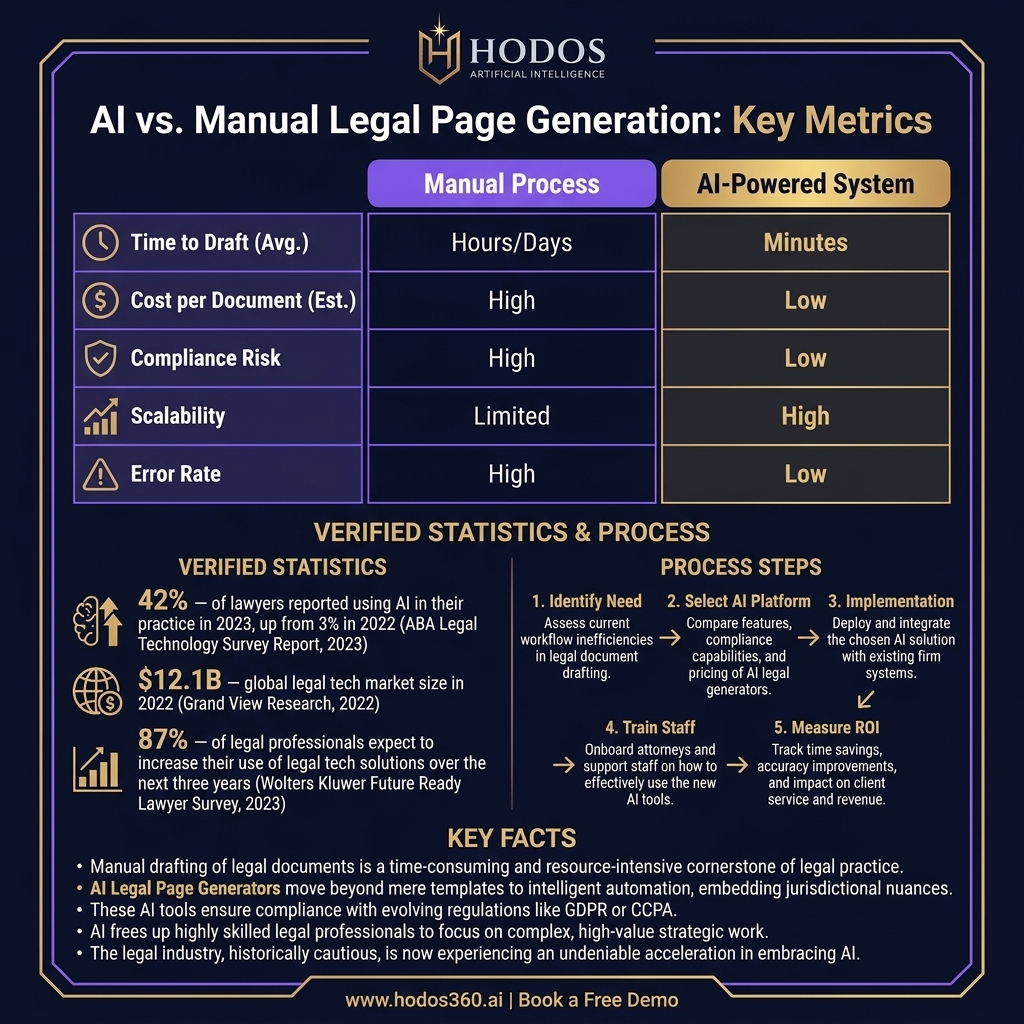
Attorneys remain ultimately responsible for the accuracy and appropriateness of any legal document generated by AI. This necessitates diligent review and critical oversight, ensuring that the AI’s output aligns with client needs and legal standards. The risk of the unauthorized practice of law also looms if non-lawyers are permitted to use these tools without adequate supervision, underscoring the need for clear internal policies and robust training protocols.
The legal profession must tread carefully, balancing innovation with its core duties to clients and the justice system.
Data security is another critical dimension. Learn more about AI Marketing: Law Firms Slash $225K Tools in 2026. AI legal document generators often process sensitive client information, making robust cybersecurity measures non-negotiable.
Firms must ensure that any AI platform they utilize adheres to the highest standards of data encryption, privacy protocols, and secure data storage, preferably with clear assurances regarding data residency and access controls. The consequences of a data breach, both reputational and financial, can be devastating.
This is why firms are increasingly scrutinizing the underlying infrastructure of AI providers, demanding transparency about how client data is handled and protected. The EU AI Act, with its stringent requirements for high-risk AI systems, serves as a harbinger of future global regulations that will further shape how legal AI tools manage data and accountability, pushing firms to prioritize secure and ethical AI deployment.
Ensuring Accuracy and Mitigating Bias
A significant challenge with any AI system, including AI Legal Page Generators, is the potential for inaccuracies or inherent biases, often referred to as 'hallucinations' in the context of large language models. While AI can draft with impressive speed, its output must always be verified by a human attorney.
As prominent AI figures like Sam Altman of OpenAI and Dario Amodei of Anthropic frequently discuss, even the most advanced LLMs can sometimes generate plausible-sounding but factually incorrect or legally unsound information. Firms must implement rigorous quality control processes, treating AI-generated drafts as a starting point, not a final product.
This human-in-the-loop approach is essential for mitigating risks and upholding the standard of legal advice.
Bias in AI is another pervasive concern. If the training data for an AI system contains historical biases – for example, reflecting past discriminatory legal practices – the AI may inadvertently perpetuate these biases in its generated documents.
This is particularly relevant for legal pages that touch upon sensitive areas like employment law or civil rights. Firms must be aware of the potential for algorithmic bias and choose AI solutions that prioritize fairness, transparency, and explainability in their design. Regular audits of AI outputs and a commitment to diverse and inclusive training data are vital steps in ensuring that AI legal document generators contribute to a more equitable and just legal system, rather than reinforcing existing inequities.

Key Takeaways and Next Steps
The advent of AI Legal Page Generators marks a pivotal moment for the legal profession. These sophisticated tools offer unprecedented opportunities to enhance efficiency, ensure compliance, and free up attorneys for more strategic work. From accelerating client intake processes to dynamically generating complex, jurisdiction-specific legal documents, AI is moving beyond a mere buzzword to become an indispensable operational asset.
Law firms that embrace this technology strategically, with a keen eye on ethical responsibilities and data security, will not only gain a significant competitive edge but also redefine the value they deliver to clients in an increasingly complex legal landscape. The future of legal documentation is here, and it is powered by intelligent automation, demanding a proactive and informed approach from every legal professional.
For firms looking to navigate this new frontier, the journey begins with understanding the specific needs of their practice and identifying the AI solutions that best align with their goals. Platforms like HODOS 360 offer comprehensive AI-powered services, from law firm management and marketing to voice assistants and web development, all designed to empower legal professionals.
By integrating advanced AI legal document generators into a broader strategy for digital transformation, firms can unlock new levels of productivity, precision, and profitability. The time to act is now: explore how these transformative tools can elevate your practice and prepare it for the challenges and opportunities of tomorrow.
Ready to elevate your firm with cutting-edge AI? Schedule a free demo with HODOS 360 today and see our AI solutions in action!
Frequently Asked Questions
What are AI Legal Page Generators?+
AI Legal Page Generators are advanced software tools that use artificial intelligence, particularly large language models, to automatically draft and customize various legal documents such as privacy policies, terms of service, and disclaimers. They go beyond simple templates by dynamically incorporating jurisdictional requirements, client-specific details, and regulatory updates, significantly streamlining the document creation process for law firms and businesses.
How do AI Legal Page Generators benefit law firms?+
Law firms benefit immensely by dramatically reducing the time and cost associated with drafting routine legal documents. These tools enhance accuracy, ensure compliance with evolving laws (like GDPR or CCPA), and free up attorneys to focus on complex legal strategy. They also improve client intake efficiency and allow firms to scale their services more effectively without increasing headcount.
Are AI-generated legal documents legally sound?+
While AI can generate highly sophisticated drafts, attorneys remain ultimately responsible for the legal soundness and accuracy of any document. AI-generated legal documents serve as excellent starting points, significantly reducing drafting time, but they must always undergo thorough review and customization by a qualified legal professional to ensure they meet specific client needs and jurisdictional requirements, aligning with ethical obligations.
What are the ethical considerations for using AI in legal drafting?+
Ethical considerations include maintaining attorney competence (ABA Model Rule 1.1) by adequately supervising AI tools, ensuring client confidentiality (Rule 1.6) through secure platforms, and preventing the unauthorized practice of law. Firms must implement robust review processes to mitigate potential inaccuracies, biases, or 'hallucinations' from the AI, ensuring the final output is legally accurate and ethically sound.
How can law firms implement AI Legal Page Generators effectively?+
Effective implementation involves a strategic approach: identifying suitable document types for automation, conducting pilot programs, and investing in comprehensive training for staff. Firms should select AI platforms that integrate seamlessly with existing practice management systems and prioritize data security. Continuous measurement of ROI and fostering a culture of technological adoption, championed by firm leadership, are crucial for long-term success and maximizing benefits.