

Legal AI: The Ultimate Guide for Small Firms' Smart Decisions
The legal industry stands at a pivotal crossroads, grappling with the rapid ascent of artificial intelligence. For Sarah Chen, managing partner at Chen & Associates, a bustling five-attorney firm in Seattle, the question wasn't *if* to adopt AI, but *which* AI. After seeing a headline from The National Law Review – "General-Purpose AI or Legal AI?
How Small Firms Decide" – Sarah felt a familiar tension. Her firm had initially experimented with a popular general-purpose generative AI, hoping to streamline basic administrative tasks. While it offered some novelty, the inherent risks of factual inaccuracies and a lack of legal context quickly became apparent, leading to more headaches than efficiencies.
This experience mirrors a broader struggle faced by countless small firms across the nation: the allure of readily available, often free, general-purpose AI versus the perceived complexity and cost of specialized legal AI solutions. It's a critical decision that can either propel a firm into a new era of productivity or entangle it in unforeseen ethical and operational challenges.
The choice between a versatile, all-encompassing AI and a purpose-built legal AI is far from trivial for small firms. The legal business demands precision, confidentiality, and an unwavering adherence to professional standards. General-purpose models, while impressive in their linguistic capabilities, are not trained on curated legal datasets, nor are they designed with the intricate regulatory frameworks of the legal profession in mind.
This fundamental difference creates a chasm between potential benefits and profound risks. Firms like Chen & Associates quickly learned that drafting client communications or performing preliminary legal research with a general AI could introduce "hallucinations" – confident but fabricated information – jeopardizing client trust and professional reputation.
The true impact of AI on small businesses, particularly in the legal sector, hinges on understanding these distinctions and making informed, strategic investments. The right AI tools can level the playing field, enabling small firms to compete with larger entities by enhancing efficiency and client service, but the wrong choice can lead to significant setbacks.
It's an issue of understanding which AI is right for their specific workflows and ethical obligations. Discover how to navigate this complex landscape and harness the power of legal AI to transform your practice.
The Evolving Landscape: General-Purpose vs. Specialized Legal AI
The past few years have witnessed an explosion in the capabilities of general-purpose artificial intelligence, primarily driven by the advancements in large language models (LLMs). Companies like OpenAI, led by CEO Sam Altman, and Anthropic, co-founded by Dario Amodei, have pushed the boundaries of what AI can achieve, from generating coherent text to summarizing complex documents.
These powerful generative AI tools are designed for broad application across various industries, offering impressive versatility in tasks like content creation, coding assistance, and general information retrieval. Their accessibility, often through freemium models or low-cost subscriptions, makes them incredibly attractive to small businesses looking to dip their toes into AI without significant upfront investment.
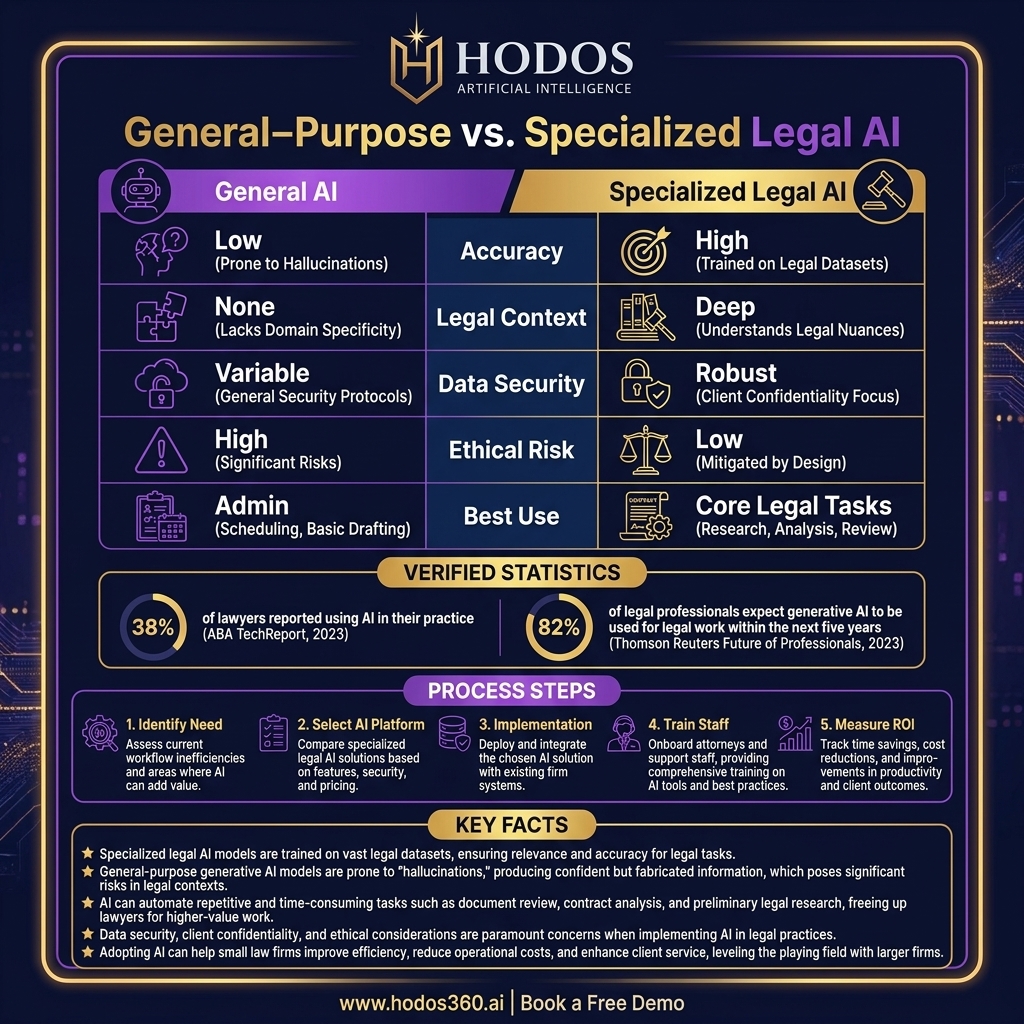
However, this broad utility comes with inherent limitations when applied to the highly specialized and regulated domain of law. Learn more about Legal AI Gap: Bridging the Divide for Law Firms in 2026. The models, while sophisticated, are trained on vast, uncurated internet datasets, making them prone to factual errors, biases, and the infamous "hallucinations" that can be catastrophic in a legal context.
This lack of domain-specific training means they don't inherently understand legal nuances, precedents, or ethical obligations, making their output unreliable for core legal work. The legal business, unlike many others, simply cannot afford such inaccuracies.
In stark contrast, specialized legal AI platforms are purpose-built systems meticulously designed and trained on vast, proprietary legal datasets, including statutes, case law, regulations, and legal briefs. These platforms integrate advanced natural language processing with deep legal expertise, ensuring accuracy, contextual understanding, and compliance. Companies like Harvey AI, which famously partnered with global giant Allen & Overy, exemplify this shift, offering sophisticated tools for contract review, due diligence, and legal research that are grounded in legal principles.
Similarly, established players like Thomson Reuters (with CoCounsel) and LexisNexis have heavily invested in developing their own specialized AI solutions, leveraging decades of curated legal content. Learn more about Legal AI: Ultimate Guide to Implementation for Law Firms. These tools are engineered to understand legal jargon, identify relevant precedents, and even flag potential risks or inconsistencies within legal documents with a level of precision general-purpose AI cannot match.
The core difference lies in their 'purpose' – general AI aims for broad utility, while legal AI targets specific, high-stakes legal challenges, prioritizing accuracy and ethical compliance above all else. For small firms, understanding the impact of these specialized tools is crucial for making the right investment.
The dilemma for small firms often boils down to perceived cost versus tangible value and risk mitigation. A general-purpose AI might seem like a cost-effective entry point, offering quick solutions for non-legal administrative tasks or generating initial ideas. However, the hidden costs associated with fact-checking, correcting errors, and potential ethical breaches can quickly outweigh any initial savings.
Imagine a scenario where a firm uses a general AI to draft a client email regarding a complex legal matter; a single factual inaccuracy or misstatement of law could lead to professional negligence claims or disciplinary action. In contrast, specialized legal AI, while requiring a more significant investment, offers a higher degree of reliability and ethical safeguards, often incorporating features like explainability and audit trails.
Learn more about AI Voice Clone: The Ultimate Guide for Law Firms. The decision isn't merely about technology; it's about aligning technological adoption with professional responsibility and strategic growth. Small firms must weigh the immediate convenience against the long-term implications for their reputation, client trust, and compliance.
The future of legal practice, especially for small firms, will be defined by their understanding and strategic adoption of these sophisticated, purpose-built AI solutions.
The Allure and Limitations of General-Purpose AI
The appeal of general-purpose AI for small firms is undeniable. Tools like ChatGPT can quickly generate marketing copy, summarize internal memos, or even assist with basic data organization. For solo practitioners or small legal businesses with limited resources, these applications present an opportunity to automate non-core tasks and free up valuable time.
For instance, a firm might use an LLM to draft a social media post announcing a new service, or to create an initial outline for a blog article on a non-legal topic. This can be particularly helpful in areas like basic content generation for a website or internal communication, where the risk of factual error is low and the need for legal precision is minimal.
However, the moment these tools touch anything client-facing or legally substantive, the risks escalate dramatically. The underlying models are not designed to understand the nuances of legal precedent, the specificities of jurisdictional law, or the ethical imperative of attorney-client privilege. Learn more about AI Voice Assistants: Ultimate Guide for Law Firms.
Their responses, while grammatically correct and fluent, are probabilistic and can easily fabricate details, known as 'hallucinations,' which are unacceptable in legal practice. Relying on such tools for legal research or drafting could lead to malpractice claims, as famously highlighted in the *Mata v. Avianca* case, where an attorney submitted a brief citing non-existent cases generated by ChatGPT.
This incident served as a stark reminder across the legal community of the critical difference between general linguistic competence and specialized legal accuracy. Understanding their limitations is paramount for any firm considering these powerful, yet unpredictable, tools.
Navigating the AI Toolset: What Small Firms Need
For small firms, the operational challenges extend far beyond legal research. They encompass everything from efficient case management and meticulous billing to seamless client intake and robust document automation. These are the lifeblood of a thriving legal practice, and where specialized legal AI solutions truly shine.
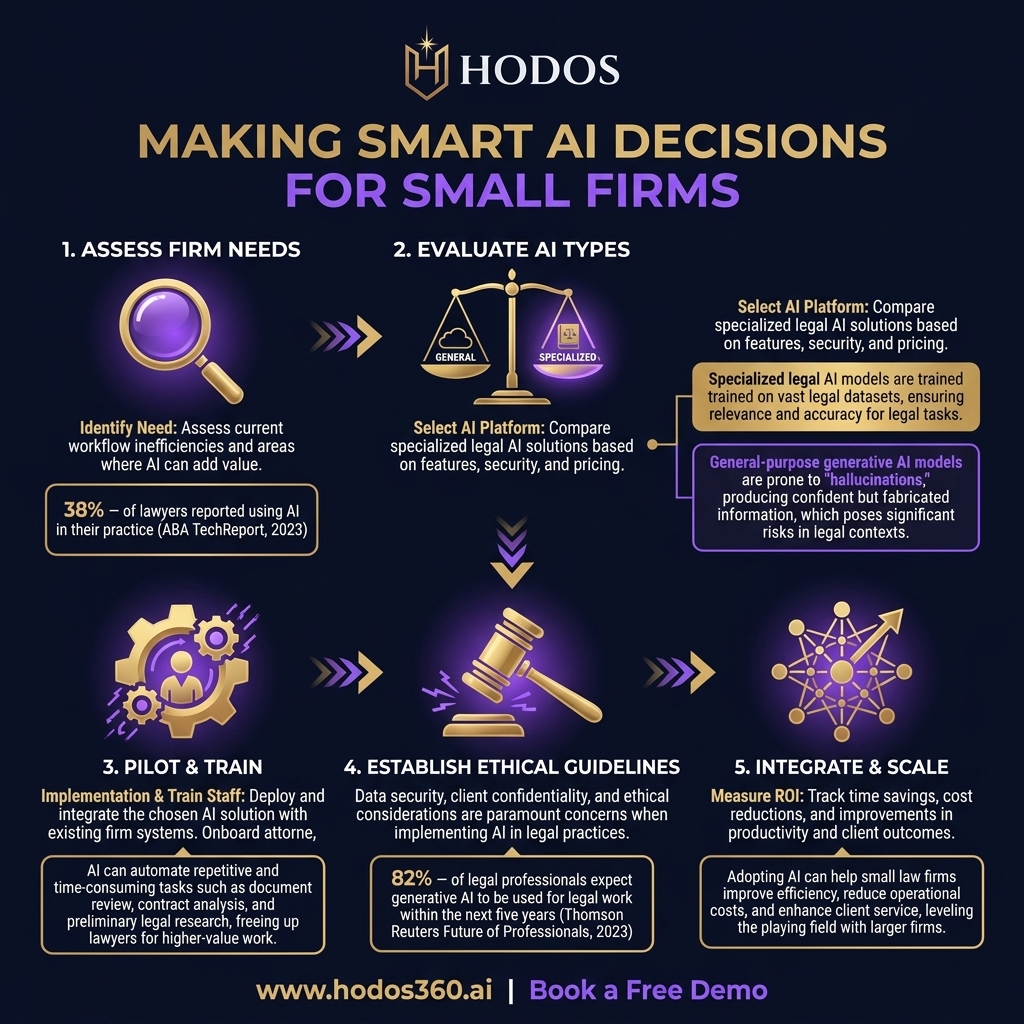
While a general-purpose AI might assist in drafting a generic client onboarding email, it lacks the integrated capabilities to automatically populate client data into a case file, trigger a conflict check, or generate a retainer agreement using pre-approved templates. Specialized platforms, however, are built with these intricate legal workflows in mind.
Learn more about AI Marketing Automation: The Ultimate Guide for Law Firms. They can streamline case management by automating task assignments, tracking deadlines, and providing a centralized repository for all case-related documents. This holistic approach ensures that every aspect of a client's journey, from initial contact to case resolution, is managed with precision and efficiency, reducing administrative burden and allowing attorneys to focus on high-value legal work.
The ABA TechReport consistently shows that small firms are increasingly seeking integrated solutions that cover multiple facets of their operations, moving beyond standalone tools. Their understanding of the impact of these tools is growing.
When it comes to core legal tasks, the distinction becomes even sharper. Legal research, contract analysis, and e-discovery demand an unparalleled level of accuracy and contextual understanding that only specialized legal AI can provide. Platforms from Thomson Reuters and LexisNexis, for example, integrate generative AI capabilities into their vast legal databases, allowing attorneys to ask complex legal questions and receive answers backed by verifiable case law and statutes.
This contrasts sharply with general-purpose AI, which, lacking access to proprietary legal databases and trained on broad internet content, cannot guarantee the veracity or relevance of its legal output. Moreover, specialized legal AI often includes features for identifying specific clauses in contracts, redlining documents based on firm-specific guidelines, and even predicting litigation outcomes based on historical data.
Learn more about AI Voice Assistants: Essential for Modern Law Firm Growth. These are not merely efficiency gains; they are fundamental shifts in how legal work is performed, offering a competitive edge to small firms. The ability to quickly and accurately review hundreds of pages of discovery, for instance, can be a game-changer for a small firm competing against a larger one with more human resources.
This allows small businesses to leverage advanced capabilities previously exclusive to large firms.
Beyond the purely legal functions, specialized AI also plays a crucial role in enhancing the client experience and firm's growth. For instance, enhance client intake processes through AI-powered chatbots that can answer frequently asked questions, qualify leads, and even schedule initial consultations, all while capturing essential client data in a structured, secure manner.
This not only improves responsiveness but also ensures that potential clients receive consistent, accurate information 24/7. Similarly, AI-driven marketing platforms can automate social media posting, generate targeted content, and analyze campaign performance, helping small firms expand their reach and attract new clients more effectively. These are integrated solutions that understand the legal context, ensuring that marketing efforts comply with ethical advertising rules and accurately represent the firm's services.
The adoption of such AI tools transforms not just internal operations but also external client engagement, fostering growth and ensuring that the firm remains competitive in a rapidly evolving market. It's about leveraging technology to build a more resilient and client-centric legal business.
The decision to adopt AI is not just about choosing a tool; it's about choosing a strategic partner that aligns with the firm's values, ethical obligations, and growth aspirations. For small firms, this means prioritizing solutions that offer reliability, security, and a deep understanding of the legal domain.
While general-purpose AI can serve as a supplementary tool for non-sensitive, administrative tasks, the core of a modern legal practice must be built upon specialized legal AI. These platforms provide the necessary precision for legal research, the automation for complex document workflows, and the ethical safeguards required in a profession where accuracy and confidentiality are paramount.
Investing in the right AI solution is an investment in the firm's future, enabling it to deliver superior client service, operate more efficiently, and maintain its competitive edge against both larger firms and other small legal businesses. The right tools are essential for their continued success and professional standing, ensuring they can confidently adopt new technologies.
Real-World Impact: Success Stories and Cautionary Tales
The impact of AI in small law firms isn't just theoretical; it's playing out in real-time, creating clear distinctions between those who adopt strategically and those who stumble. Consider the case of Justice & Co., a boutique litigation firm in Austin, Texas. Managing Partner Elena Rodriguez, initially skeptical, decided to invest in a specialized legal AI platform for e-discovery and document review in late 2025. Her firm was drowning in discovery for a complex commercial litigation case, facing hundreds of thousands of documents.
"We were spending countless hours on manual review," Rodriguez recounted at LegalTech NYC 2026. "Our team was exhausted, and costs were skyrocketing." After implementing a specialized AI, the firm saw a 40% reduction in document review time and a significant decrease in human error. The AI quickly identified key documents, flagged privileged information, and categorized relevant evidence, allowing her team to focus on strategic analysis rather than tedious review.
"It wasn't just about speed; it was about precision. The AI understood the legal context, which a general tool simply couldn't have done," Rodriguez emphasized. This success story illustrates how purpose-built legal AI can dramatically enhance efficiency and accuracy, directly impacting a small firm's profitability and ability to handle larger, more complex cases, leveling the playing field against larger competitors.
Their adoption of these tools provided a clear competitive advantage.
However, the landscape is also littered with cautionary tales, underscoring the dangers of misapplying general-purpose AI in legal contexts. The infamous *Mata v. Avianca* case from 2023 serves as a stark reminder. Attorney Steven Schwartz used ChatGPT for legal research, which confidently generated citations to six non-existent court cases.
Schwartz, failing to verify the AI's output, submitted a brief riddled with fabricated precedents, leading to judicial sanctions and widespread condemnation. This incident highlighted a critical ethical pitfall: while general generative AI can mimic legal language, it lacks the foundational understanding and access to verified legal databases required for accurate legal research.
The problem isn't the AI's intent, but its design – it's optimized for plausible language generation, not factual accuracy in a specialized domain. This scenario directly implicates ABA Model Rule 1.1 on Competence, which requires lawyers to possess the legal knowledge, skill, thoroughness, and preparation reasonably necessary for the representation.
Relying on unverified AI output can be a direct violation of this fundamental ethical duty. Small firms, particularly, must be acutely aware that the convenience of general AI comes with a heavy burden of independent verification, a burden that often negates any efficiency gains for core legal tasks.
Understanding the impact of these tools is crucial for ethical practice.
Another common pitfall for small firms is the uncritical use of general-purpose AI for client communications or drafting sensitive documents without proper oversight. While such AI can generate fluent text, it may inadvertently disclose confidential information if prompts are not carefully constructed, or it may produce language that is legally imprecise or culturally inappropriate for a specific client.
This touches upon ABA Model Rule 1.6 on Confidentiality of Information, which mandates that lawyers shall not reveal information relating to the representation of a client unless the client gives informed consent. Feeding client details into a public or general AI model, especially one without robust data security protocols and legal-specific compliance, poses a significant risk of breaching confidentiality.
Moreover, the lack of explainability in many general LLMs means that attorneys cannot fully understand *why* a particular output was generated, making it difficult to vouch for its accuracy or ethical implications. This "black box" nature presents a challenge for professional accountability. The lesson from these real-world examples is clear: while AI offers immense potential, its application in law demands a discerning approach, prioritizing specialized, verifiable, and ethically compliant solutions for core legal functions, reserving general AI for non-sensitive, administrative support with strict human oversight.
The right AI tools require careful consideration.
The contrast between these narratives underscores the critical importance of a "human in the loop" approach, regardless of the AI type. Even with specialized legal AI, human oversight remains indispensable for final review, contextual interpretation, and ethical judgment. However, specialized tools are designed to augment human intelligence, reducing the burden of verification by providing traceable sources and legal context.
For example, Thomson Reuters' CoCounsel allows attorneys to see the specific legal documents and passages the AI used to generate its answers, facilitating quick verification. This level of transparency is largely absent in general-purpose LLMs, making the human oversight task far more onerous and error-prone.
The drama unfolds in real-time within law firms globally: those who embrace specialized, integrated legal AI are seeing tangible benefits in efficiency, accuracy, and client satisfaction, while those who misapply general tools risk their professional reputation and face disciplinary actions. The choice isn't just about technology; it's about responsible innovation and maintaining the highest standards of legal practice in the AI era.
Firms must understand which tools provide the necessary safeguards.
Strategic Adoption: Integrating AI into Your Firm's Workflow
For small firms poised to harness the power of AI, strategic adoption is paramount. It begins with a comprehensive needs assessment: what are the firm's biggest pain points? Is it inefficient client intake, time-consuming document review, or a lack of robust marketing? Identifying these specific challenges will guide the selection of the most appropriate AI tools.
A pilot program, starting with a single practice area or a specific workflow, can then allow the firm to test the AI's efficacy, measure its impact, and refine its implementation strategy without disrupting the entire operation. For instance, a firm might pilot an AI-powered contract analysis tool for its real estate practice before rolling it out firm-wide.
This phased approach minimizes risk and allows for iterative improvements. Crucially, successful AI integration requires significant investment in training. Attorneys and support staff must understand not only how to use the tools but also their underlying mechanisms, limitations, and ethical implications. Suffolk Law's Professor Andrew Perlman, a leading voice in legal innovation, consistently emphasizes that technology adoption is as much about human adaptation as it is about software implementation.
Without proper training, even the most sophisticated AI will fail to deliver its full potential, becoming an underutilized asset rather than a transformative tool. This thoughtful approach ensures the right AI solutions are implemented effectively.
Beyond technical implementation, establishing clear ethical guidelines for AI use is non-negotiable. The legal profession, bound by stringent rules of professional conduct, must ensure that AI tools enhance, rather than compromise, these standards. This involves developing internal policies on data privacy, client confidentiality, and attorney oversight.
For instance, firms should have explicit rules prohibiting the input of confidential client information into general-purpose AI models that lack adequate security and privacy safeguards. Furthermore, attorneys must be educated on the duty of technological competence, as reinforced by ABA Model Rule 1.1, which implies an understanding of the benefits and risks associated with relevant technology.
The EU AI Act, with its focus on high-risk AI systems and transparency requirements, offers a glimpse into future regulatory landscapes that legal professionals must proactively prepare for. Firms need to ensure that their chosen AI solutions offer audit trails, explainable outputs, and robust data encryption to meet these evolving compliance demands.
Secure client data must always be the top priority, making specialized, legally compliant AI solutions the preferred choice. These considerations are vital for the responsible adoption of AI tools within their legal business.
Ethical Considerations and Best Practices
The ethical landscape of AI in law is complex and rapidly evolving. Best practices dictate that attorneys maintain ultimate responsibility for all work product, regardless of AI assistance. This means every document, every piece of research, and every client communication generated or assisted by AI must undergo thorough human review and verification.
Firms should implement robust quality control protocols to catch potential AI errors or biases before they reach clients or courts. Furthermore, transparency with clients about the use of AI, particularly in sensitive areas, is becoming an increasingly important consideration, aligning with ABA Model Rule 1.4 on Communication.
While not yet universally mandated, informing clients about AI usage can build trust and manage expectations. The legal community is actively grappling with these issues; state bar associations are beginning to issue guidance on responsible AI use, emphasizing the attorney's duty of supervision and competence.
For example, some states explicitly require lawyers to understand the risks of using generative AI and to take reasonable steps to ensure accuracy. These proactive measures are essential for navigating the ethical complexities and harnessing AI's power responsibly. The right AI tools are those that facilitate, rather than hinder, ethical practice.
Ultimately, strategic AI adoption is about leveraging technology to create a sustainable competitive advantage. For small firms, this means utilizing AI-powered legal workflows to automate repetitive tasks, freeing up attorneys to focus on complex legal strategy and client relationships. It means employing AI voice assistants to handle initial client inquiries, ensuring no lead is missed and clients receive prompt attention 24/7. It means using AI marketing platforms to intelligently target potential clients and measure ROI, allowing for more effective and efficient growth.
According to a 2024 report by Gartner, the legal tech market is projected to grow significantly, with AI-driven solutions being a primary driver. Firms that strategically integrate these specialized AI capabilities will be better positioned to attract and retain clients, improve profitability, and offer a level of service that rivals much larger firms.
The goal is not to replace human legal expertise but to augment it, making legal professionals more efficient, informed, and capable. This forward-thinking approach to AI adoption is what will define the leading small law firms of tomorrow, ensuring their businesses thrive in an increasingly digital world.
Future-Proofing Your Practice: The HODOS 360 Advantage
The journey for small firms navigating the AI landscape often leads to the realization that a piecemeal approach—cobbling together various general-purpose tools—is unsustainable and fraught with risk. The true power of AI for small firms lies in integrated, purpose-built solutions that understand the unique demands of legal practice.
This is where platforms like HODOS 360 offer a transformative advantage. Instead of choosing between a general-purpose AI that risks factual inaccuracies and a single-function specialized tool that addresses only one part of the problem, HODOS 360 provides a comprehensive ecosystem designed specifically for law firms.
Its AI Law Firm Management System integrates case management, billing, client intake, and document automation with AI-powered legal workflows. This means the AI isn't just generating text; it's intelligently automating processes, ensuring data integrity, and adhering to legal protocols across the entire firm's operations. This integrated approach mitigates the ethical and operational risks associated with general AI, providing a secure, reliable, and legally compliant framework for all core legal activities.
It's about providing the right AI tools for their business.
Beyond internal operations, HODOS 360 extends its AI capabilities to critical external functions. The AI Marketing Platform leverages generative AI for video creation, social media automation, and content generation, but critically, it does so within the context of legal ethics and professional advertising rules. This ensures that a firm's online presence is not only dynamic and engaging but also compliant and professional.
Furthermore, the AI Voice Assistants provide 24/7 phone answering, lead qualification, and appointment booking, all with multilingual support and intelligent call routing. This dramatically improves client responsiveness and ensures that potential leads are captured and nurtured around the clock, enhancing the firm's ability to compete with larger firms that have dedicated reception teams.
These are not general-purpose chatbots; they are sophisticated AI assistants trained to understand legal inquiries and manage client interactions professionally and securely. The impact on client satisfaction and lead conversion is immediate and measurable, offering substantial growth opportunities for small legal businesses. Understanding these comprehensive offerings is key to their success.
The Integrated Approach for Holistic Growth
The underlying philosophy of HODOS 360 is to empower small firms with a holistic suite of AI-powered services that address every facet of their business. From the foundational Web & Mobile Development services, which include AI-powered website building and SEO optimization designed for high conversion, to the advanced AI-driven management and marketing tools, the platform ensures seamless integration and data flow.
This eliminates the need for disparate systems that often lead to data silos and operational inefficiencies. For instance, client data captured by an AI Voice Assistant can automatically populate into the AI Law Firm Management System, triggering document automation workflows and client-specific marketing campaigns. This synergy ensures that every AI component works in concert, maximizing efficiency and minimizing manual intervention.
It’s about creating a truly future-proof practice where AI is not just a tool, but an intelligent partner that drives growth, enhances client satisfaction, and ensures ethical compliance. For small legal businesses, this integrated approach provides a robust framework for sustained success and competitive resilience in the AI era.
It's about making the right AI decisions for their long-term viability.
By consolidating these essential services under one intelligent, AI-powered umbrella, HODOS 360 enables small firms to overcome the complexities of AI adoption. It removes the guesswork from choosing between general and specialized AI by offering a suite of purpose-built, legally compliant tools. This allows attorneys to focus on what they do best – practicing law – while the AI handles the heavy lifting of management, marketing, client engagement, and operational efficiency.
The platform is designed to scale with the firm, providing the flexibility and power needed to adapt to future challenges and opportunities. For small firms looking to not just survive but thrive in the rapidly evolving legal landscape, an integrated AI solution like HODOS 360 represents a strategic investment in their future.
It empowers them to deliver exceptional client service, optimize their operations, and achieve sustainable growth, all while adhering to the highest professional and ethical standards. This comprehensive approach is what truly differentiates leading firms in the age of artificial intelligence, providing them with the right tools for transformative impact.

Key Takeaways and Next Steps
The debate between general-purpose AI and specialized legal AI is no longer academic for small law firms; it's a critical strategic decision with significant implications for efficiency, ethics, and growth. While general AI offers intriguing possibilities for non-sensitive tasks, its inherent limitations and risks make it unsuitable for core legal work.
The path forward for small firms lies in the judicious adoption of specialized legal AI – tools designed with the precision, confidentiality, and legal context required by the profession. These purpose-built solutions not only streamline operations and enhance productivity but also ensure compliance with ethical obligations, safeguarding client trust and professional reputation.
The impact of these tools is undeniable, shaping the future of legal business.
To truly future-proof your practice, consider an integrated approach that harmonizes various AI functionalities into a cohesive system. Platforms that offer comprehensive AI law firm management, marketing, voice assistance, and web development empower small firms to achieve holistic growth and maintain a competitive edge. The right AI tools are those that augment human expertise, ensure accuracy, and secure client data, allowing attorneys to focus on providing exceptional legal counsel.
Evaluate your firm's specific needs, understand the nuances between AI types, and invest in solutions that align with your strategic vision for a more efficient, ethical, and profitable future. The decision regarding which AI to adopt will profoundly shape the trajectory of your legal business.
Discover how an integrated AI solution can transform your firm today.
Frequently Asked Questions
What's the main difference between general-purpose and specialized legal AI?+
General-purpose AI, like ChatGPT, is trained on broad internet data and excels at versatile language tasks but lacks legal context and can 'hallucinate' facts. Specialized legal AI is trained on curated legal datasets (case law, statutes) and is purpose-built for legal tasks like research and document review, prioritizing accuracy, compliance, and ethical safeguards. It provides the right tools for legal professionals.
Is general-purpose AI safe for legal drafting or research?+
No, general-purpose AI is generally not safe for core legal drafting or research without extensive human verification. Its propensity for factual errors and lack of legal understanding poses significant risks of malpractice and ethical breaches, as demonstrated by cases where fabricated legal citations were produced. Specialized legal AI is designed to mitigate these risks.
How can small firms afford specialized legal AI platforms?+
Many specialized legal AI platforms now offer tiered pricing tailored for small firms, and the long-term cost savings from increased efficiency, reduced errors, and enhanced client acquisition often justify the investment. Integrated solutions can also provide more value by consolidating multiple tools into one system, making them more accessible for small legal businesses.
What ethical concerns should I consider when using AI in my practice?+
Key ethical concerns include maintaining competence (ABA Model Rule 1.1), protecting client confidentiality (Rule 1.6), and ensuring accuracy. Attorneys must always verify AI-generated content, understand the AI's limitations, and avoid inputting sensitive client data into insecure general-purpose platforms. Transparency with clients about AI use is also crucial. These are vital considerations for their legal business.
How does AI help with client intake and marketing for small firms?+
AI can significantly enhance client intake by providing 24/7 AI voice assistants for lead qualification and appointment booking, ensuring no potential client is missed. For marketing, AI platforms can automate content generation, social media posting, and perform analytics to optimize campaigns, helping small firms attract and convert more clients effectively and ethically. These AI tools are transformative for their business.