
AI Voice Clone: The Ultimate Guide for Law Firms
The legal industry, often characterized by its reliance on tradition and meticulous human oversight, is now at the precipice of an unprecedented technological shift. The recent announcement by the wireless carrier REALLY, unveiling "Clone" – an AI capable of making and answering calls in a user’s voice – isn't just a consumer novelty; it signals a seismic wave approaching professional services, particularly law firms.
This isn't about replacing the nuanced expertise of an attorney, but rather augmenting their capacity, streamlining client interactions, and fundamentally reshaping how legal practices manage their most time-consuming administrative burdens. For firm owners and legal professionals grappling with increasing client demands and the imperative for greater efficiency, understanding this nascent technology and its implications for AI voice clone applications is no longer optional, but essential.
This development arrives amidst a broader surge in AI adoption across the legal sector. Firms like Allen & Overy, partnering with generative AI startup Harvey AI, are already demonstrating the immediate impact of AI on research and document drafting. However, the realm of voice AI, particularly with the advent of voice cloning, introduces a new frontier: direct, personalized, and scalable communication.
Imagine an AI voice assistant, indistinguishable from a human, handling routine inquiries, scheduling consultations, or even navigating complex IVR systems for administrative tasks. The implications for client satisfaction, lead qualification, and overall operational fluidity are immense, but they also bring a unique set of ethical and practical considerations that demand careful scrutiny from the legal community.
Ready to explore how advanced AI voice assistants can transform your firm's operations and client engagement? Discover the HODOS 360 AI Voice Assistants difference today.
The Dawn of AI Voice Clone Technology in Legal Practice
The announcement of REALLY's "Clone" AI has ignited conversations across industries, but its potential impact on legal operations is particularly profound. This technology, which can replicate a user's voice and autonomously handle phone calls – from screening inbound inquiries to making outbound calls and even navigating complex interactive voice response (IVR) menus – represents a paradigm shift.
For law firms, where effective communication is paramount and administrative burdens often consume valuable billable hours, the prospect of an AI voice clone offers both immense opportunity and significant challenges. This isn't merely about automated answering services; it’s about deploying a sophisticated digital twin capable of intelligent, context-aware dialogue that mimics human interaction.
Historically, law firms have struggled with the sheer volume of calls: prospective clients seeking initial consultations, existing clients needing updates, vendors, and a myriad of administrative calls. According to a 2023 ABA Legal Technology Survey Report, attorneys spend an average of 15-20% of their day on non-billable administrative tasks, a significant portion of which involves phone communication.
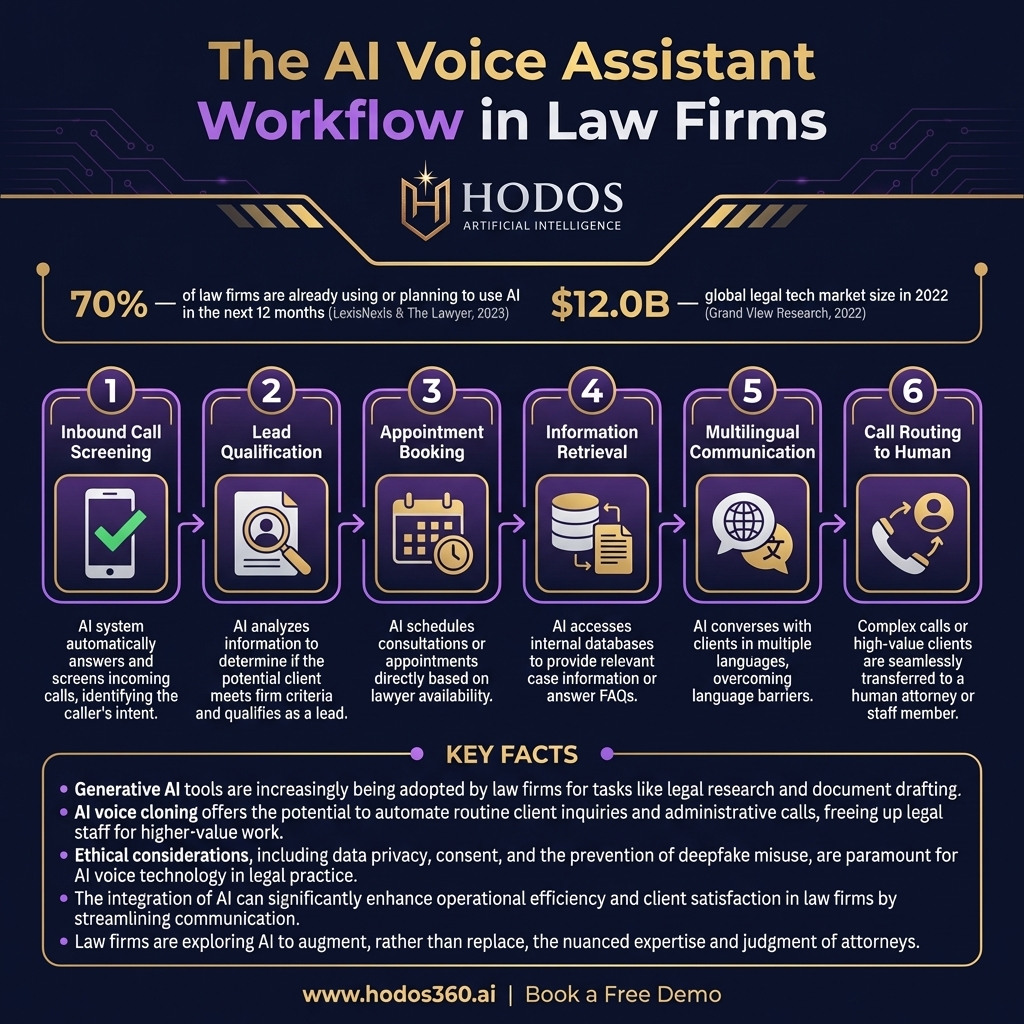
Learn more about WordPress AI Unlocked: Legal Websites Mastered 2026. The introduction of AI voice clone technology, as exemplified by REALLY, promises to alleviate this burden. Firms can deploy AI voice assistants that sound like a familiar receptionist or even a junior associate, capable of screening calls, performing initial lead qualification based on predefined criteria, and booking appointments directly into case management systems.
This frees up human staff to focus on complex legal work, thereby enhancing overall productivity and client service.
Enhancing Client Intake and Lead Qualification with AI Calls
One of the most immediate benefits of AI voice clone technology for law firms lies in its capacity to revolutionize client intake and lead qualification. Imagine a prospective client calling your firm at 2 AM with an urgent legal query. Instead of reaching an answering machine or an outsourced service with limited capabilities, they are greeted by an AI voice assistant that sounds like a member of your team.
Learn more about Essential AI Website Builder Guide for Law Firms. This AI can engage in a dynamic conversation, asking key qualifying questions – practice area, urgency, jurisdiction, conflict checks – and then, based on the responses, either schedule an immediate consultation with an available attorney or collect detailed information for follow-up.
This capability dramatically expands a firm’s availability and responsiveness, crucial factors in today’s competitive legal market.
Navigating the Ethical and Regulatory Landscape of AI Voice
While the operational benefits of AI voice clone technology are compelling, its deployment in the legal sector is fraught with complex ethical and regulatory considerations. The core principle of "authenticity" in communication, particularly in the attorney-client relationship, is paramount. When an AI is answering calls in a voice indistinguishable from a human, questions of transparency and informed consent immediately arise.
The American Bar Association's Model Rules of Professional Conduct, particularly Rule 1.4 (Communication) and Rule 1.6 (Confidentiality of Information), underscore the attorney's duty to keep clients reasonably informed and to protect client information. Deploying an AI voice assistant without clear disclosure could potentially violate these duties, eroding client trust and raising concerns about deception.
Leading legal ethicists, such as Professor Andrew Perlman of Suffolk University Law School, have consistently emphasized the importance of transparency when using AI in legal practice. Firms must clearly disclose when a client is interacting with an AI, even if the voice is cloned. Learn more about AI Marketing Transforms Legal Web: Webflow's Vidoso Acquisition 2026.
This disclosure can be subtle, such as a brief introductory statement, but it must be present. Furthermore, the handling of sensitive client information by an AI system, especially one that processes and stores voice data, necessitates robust data security protocols. A breach involving voice recordings or AI-generated transcripts could have devastating consequences for client confidentiality, potentially leading to professional disciplinary actions and severe reputational damage.
The FTC has also been increasingly active in addressing the potential for AI voice cloning to be used in scams, as highlighted by their "Voice Cloning Challenge," emphasizing the need for robust safeguards against misuse.
Ensuring Transparency and Data Security in AI Calls
Transparency is the bedrock of trust in the legal profession. When implementing AI voice clone technology, law firms must establish clear guidelines for disclosing AI interaction to clients. This could involve an initial voice prompt, a clear statement on the firm's website, or specific language in client engagement letters.
Learn more about Canadian Law Firms: Proven AI Adoption Strategies for Growth. Beyond transparency, the security of voice data and related client information is paramount. Firms must ensure that any AI voice assistant vendor employs end-to-end encryption, adheres to industry-standard security certifications (e.g., ISO 27001, SOC 2), and has robust data retention and deletion policies that align with legal obligations.
Operational Efficiency: How AI Voice Assistants Transform Law Firms
Beyond ethical considerations, the tangible benefits of AI voice assistants in driving operational efficiency for law firms are undeniable. The ability to automate routine communication tasks frees up significant human capital, allowing attorneys and paralegals to dedicate more time to complex legal analysis, client advocacy, and strategic case development.
This shift is critical in an industry where profitability is often tied directly to billable hours and the efficient allocation of resources. AI-powered voice assistants can handle a vast array of tasks that traditionally consume valuable staff time, from managing a high volume of incoming calls to proactive client outreach for appointment reminders or document requests.
Consider the typical workflow of a busy law firm. Calls come in throughout the day, often interrupting focused work. A 2024 report by Thomson Reuters found that legal professionals spend approximately 30% of their day on administrative tasks, a figure largely unchanged for years. Learn more about Legal AI Problem: Mastering Ethical Tech in Law Firms 2026.
AI voice assistants directly address this inefficiency. They can intelligently screen calls, distinguishing between genuine client inquiries, sales calls, and spam. For legitimate inquiries, they can gather essential details, perform initial conflict checks against a firm's database, and even provide basic information about the firm's services or general legal processes, all without human intervention.
This not only improves response times but also ensures that when a human does engage, they are already equipped with crucial context.
Streamlining Communication Workflows with AI Voice
The true power of AI voice assistants lies in their ability to streamline entire communication workflows. Instead of a linear process where calls are answered, notes taken, and tasks assigned manually, AI can create a dynamic, interconnected system. For instance, an AI can answer a call, qualify the lead, book an appointment, send a confirmation email, and create a new matter in the case management system – all in one seamless interaction.
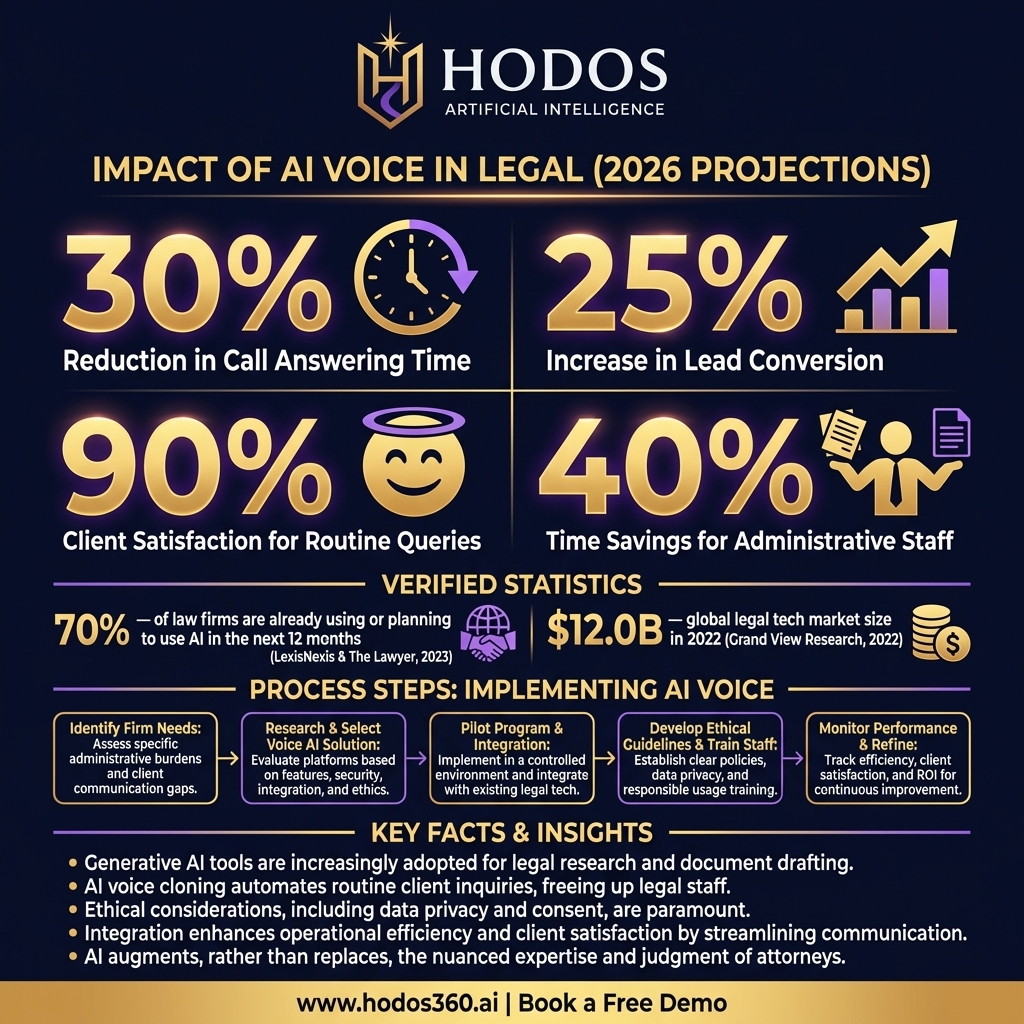
Learn more about Voice AI Revolutionizes Legal: HODOS 360's 2026 Impact. This reduces handoffs, minimizes errors, and ensures that no potential client falls through the cracks, optimizing the firm's pipeline from initial contact to client retention.
Are you ready to elevate your firm's client experience and operational efficiency with cutting-edge AI? Explore the full capabilities of HODOS 360's AI solutions and schedule a personalized demo.
Mitigating Risks: Security and Client Trust with AI Voice
The integration of AI voice clone technology into legal practice, while promising, necessitates a robust framework for risk mitigation, particularly concerning data security and maintaining client trust. The very realism that makes AI voice cloning so appealing also presents its greatest vulnerabilities. As discussed, the threat of voice spoofing and sophisticated phishing attempts, known as "wangiri" scams or deepfake voice fraud, is a growing concern.
If a malicious actor can mimic an attorney's voice to extract sensitive information or authorize fraudulent transactions, the consequences for clients and the firm could be catastrophic. This demands that law firms adopting such technology prioritize security measures that go far beyond standard protocols.
Firstly, firms must conduct thorough due diligence on any AI voice assistant vendor.
This includes scrutinizing their data encryption standards, access controls, incident response plans, and compliance with privacy regulations like HIPAA (for healthcare-related legal practices) or GDPR/CCPA. Vendors like HODOS 360 are building their AI voice assistants with security at the forefront, incorporating multi-factor authentication for internal access and advanced anomaly detection to flag suspicious voice patterns or interactions.
Furthermore, firms should consider implementing internal policies that clearly define the scope of AI voice assistant capabilities, especially regarding sensitive information. For example, an AI might be authorized to schedule appointments but explicitly prohibited from discussing case specifics or financial details without human verification.
Building Client Confidence in AI-Augmented Services
Building client confidence in AI-augmented legal services requires a multi-pronged approach. It starts with unequivocal transparency about AI interaction, followed by robust security protocols that protect client data. Firms should also emphasize the *benefits* to the client – faster response times, 24/7 availability, and more focused human attention when it truly matters. By framing AI voice assistants as powerful tools that enhance the client experience and legal outcomes, rather than impersonal replacements, firms can foster trust and demonstrate their commitment to leveraging technology responsibly for client benefit.
- ✓Mandatory Disclosure: Implement clear, concise disclosures to clients that they are interacting with an AI voice assistant, maintaining transparency and ethical obligations.
- ✓Robust Data Encryption: Ensure all voice data and associated client information handled by the AI system is protected with state-of-the-art encryption, both in transit and at rest.
- ✓Strict Access Controls: Limit access to AI system configurations and client interaction logs to authorized personnel only, utilizing multi-factor authentication.
- ✓Vendor Due Diligence: Thoroughly vet AI voice assistant providers for their security certifications (e.g., SOC 2, ISO 27001), incident response plans, and compliance with legal privacy frameworks.
- ✓Defined AI Scope: Clearly delineate tasks and types of information an AI voice assistant is authorized to handle, prohibiting it from discussing highly sensitive legal details without human oversight.
- ✓Continuous Monitoring & Auditing: Implement systems to continuously monitor AI interactions for anomalies, potential security threats, or deviations from ethical guidelines, with regular audits.
- ✓Client Education: Proactively educate clients on how the firm uses AI, its benefits, and how to verify authenticity of communications, building trust and safeguarding against scams.

Key Takeaways and Next Steps: The Future of Legal Communication
The emergence of sophisticated AI voice clone technology, exemplified by REALLY's "Clone" and the broader advancements in voice AI, is not merely an incremental improvement; it signals a fundamental shift in the future of legal communication. Law firms that strategically adopt these technologies stand to gain a significant competitive advantage, not just in efficiency but also in client acquisition and retention.
The future legal landscape will likely be bifurcated: firms that harness AI to scale their expertise and personalize client interactions, and those that struggle to keep pace with evolving client expectations and operational demands. This isn't about replacing the lawyer's voice, but amplifying it, extending its reach, and optimizing its impact.
The strategic adoption of AI voice assistants goes beyond simply turning on a new feature; it requires a holistic integration into the firm's overall digital transformation strategy. This means evaluating how AI voice interacts with existing case management systems, document automation platforms, and marketing efforts.
For instance, HODOS 360's comprehensive suite, which includes an AI Law Firm Management System and an AI Marketing Platform alongside AI Voice Assistants, offers a unified approach. An AI voice assistant can qualify a lead, and that data instantly feeds into the management system to create a new matter, while simultaneously triggering targeted marketing campaigns based on the client's needs.
This synergistic approach maximizes the value of each AI component.
Frequently Asked Questions
How does AI voice clone technology differ from traditional answering services?+
Traditional answering services rely on human operators following scripts, often lacking deep integration with firm-specific data. AI voice clone technology, conversely, utilizes advanced AI to mimic a human voice, engage in dynamic, context-aware conversations, and integrate directly with your firm's case management and client intake systems. This allows for more intelligent lead qualification, automated appointment booking, and a personalized client experience, 24/7, without human intervention for routine tasks.
What are the primary ethical concerns for law firms using AI voice assistants?+
The main ethical concerns revolve around transparency and confidentiality. Law firms must ensure clients are aware they are interacting with an AI, even if the voice is cloned, to uphold the duty of communication (ABA Model Rule 1.4). Additionally, safeguarding sensitive client information processed by AI voice clone systems is critical to comply with confidentiality duties (ABA Model Rule 1.6) and prevent data breaches or misuse, requiring robust security measures.
Can AI voice assistants handle complex legal inquiries or give legal advice?+
Currently, AI voice assistants are best suited for routine inquiries, lead qualification, appointment booking, and information gathering. While they can provide general legal information, they are not designed to offer legal advice or handle complex, nuanced legal queries that require human judgment, empathy, and strategic thinking. Their role is to augment, not replace, human legal professionals, freeing them to focus on high-value client work.
How can law firms ensure data security when deploying AI voice technology?+
Ensuring data security involves several steps: conducting thorough vendor due diligence to verify encryption, access controls, and compliance with privacy regulations; implementing clear internal policies on AI usage and data handling; and continuously monitoring AI voice clone interactions for anomalies. Firms should also educate clients on how their data is protected and how to identify potential scams, building trust through transparency and robust security protocols.
What impact will AI voice assistants have on law firm staffing?+
AI voice assistants are unlikely to replace human staff entirely but will redefine roles. They automate mundane, repetitive tasks, allowing paralegals and administrative staff to focus on more complex, fulfilling work that requires human judgment. This can lead to increased job satisfaction, greater efficiency, and the ability for firms to scale operations without proportionally increasing headcount, ultimately optimizing resource allocation and enhancing overall firm productivity.
Is multilingual support available with AI voice assistants for law firms?+
Yes, advanced AI voice assistants, like those offered by HODOS 360, increasingly feature robust multilingual support. This capability allows law firms to serve a diverse client base by communicating effectively in multiple languages for initial screenings, appointment bookings, and general inquiries. This enhances accessibility for non-English-speaking clients and expands a firm's market reach without requiring dedicated human translators for every initial point of contact.
Embrace the future of legal communication with HODOS 360's AI Voice Assistants. Contact us today for a free consultation and see how we can empower your firm.