


Canadian Law Firms: Proven AI Adoption Strategies for Growth
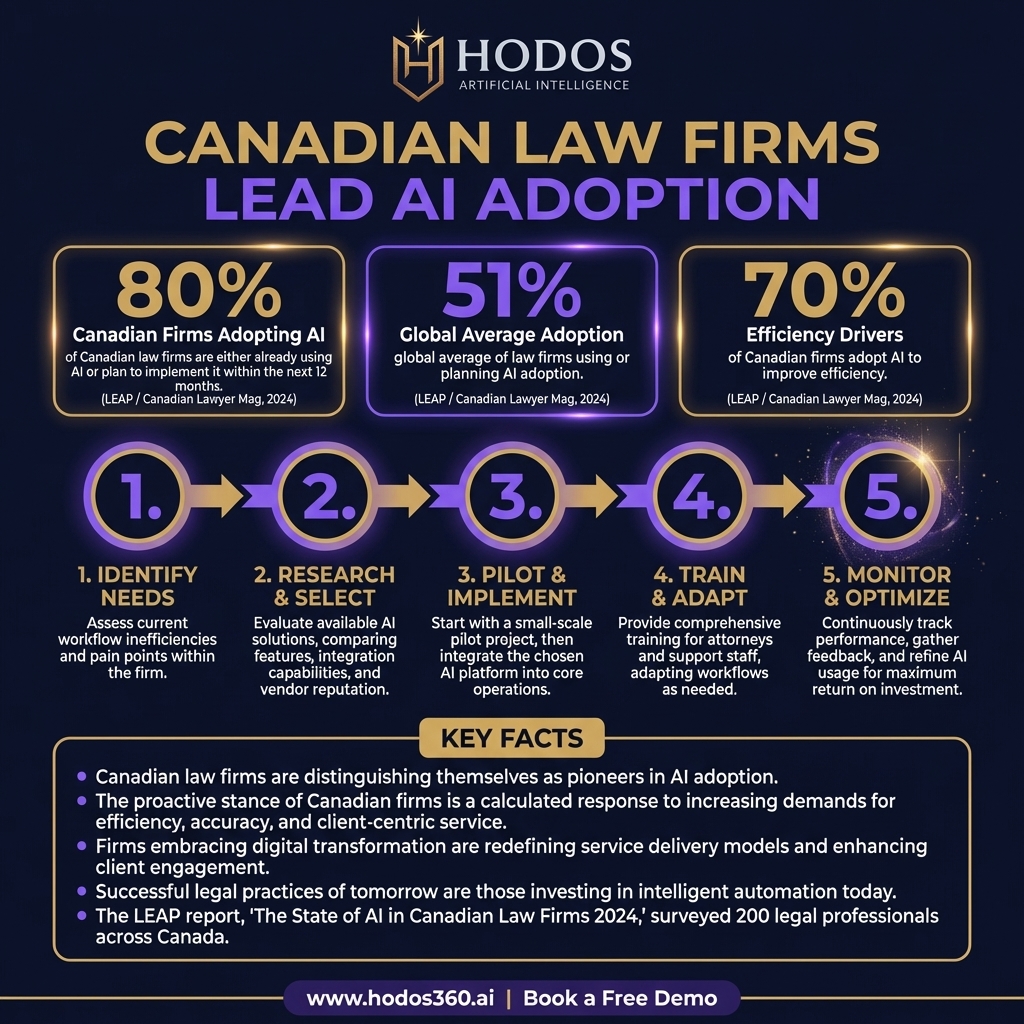
In the rapidly evolving legal industry, a significant narrative is emerging from north of the border. Canadian law firms are distinguishing themselves as pioneers in AI adoption, a trend underscored by recent LEAP research prominently featured in Canadian Lawyer Mag. This report illuminates how firms across Canada, from the bustling financial districts of Toronto to the innovative hubs of Vancouver and Montreal, are proactively integrating emerging technologies, especially legal-specific AI, into their core operations.
This decisive move positions Canadian legal businesses not merely as early adopters but as strategic innovators, setting a compelling benchmark for global legal markets. The findings suggest a cultural readiness and a strategic foresight among these firms that is less prevalent in other jurisdictions, marking a pivotal moment for the industry.
This proactive stance is not accidental; it’s a calculated response to the increasing demands for efficiency, accuracy, and client-centric service. For years, the legal profession has grappled with the tension between tradition and technological advancement. Now, the Canadian experience offers a compelling blueprint for how to bridge that gap effectively.
Firms that have embraced this digital transformation are not just streamlining their internal processes; they are fundamentally redefining their service delivery models, enhancing client engagement, and unlocking new avenues for growth. The narrative is clear: successful legal practices of tomorrow are those that are investing in intelligent automation today, transforming legal workflows and client interactions in profound ways.
This article delves into the specific strategies and underlying factors driving this impressive wave of AI adoption among Canadian legal entities. Ready to see how AI can transform your firm? Discover how HODOS 360's integrated AI solutions empower legal professionals. Learn more about our comprehensive platform.
The Canadian Edge in Legal AI Adoption
The LEAP research, as reported by Canadian Lawyer Mag, provides a definitive snapshot: Canadian law firms are leading the charge in the adoption of emerging technologies, particularly legal-specific AI. This isn't just about experimenting with new tools; it's about strategic integration that's reshaping how legal services are delivered.
While many global counterparts, including some in the U.S. and Europe, are still grappling with the initial stages of AI implementation, Canadian firms are moving from pilot programs to full-scale deployment. This leadership isn't confined to major metropolitan areas; even small and medium-sized firms in provinces like Alberta are showing significant interest, with a recent report indicating that nearly nine in 10 Alberta companies, and 84 percent of Canadian firms overall, anticipate AI will transform their sector by 2030. This forward-thinking mindset is a critical differentiator, fostering an environment where innovation is seen as a competitive advantage rather than a daunting challenge.
What fuels this distinctive Canadian leadership in AI adoption? A confluence of factors contributes to this phenomenon. Learn more about Strategic AI Tools Adoption: Essential Guide for Law Firms. Canada has invested heavily in its AI ecosystem, with government initiatives and a robust talent pool stemming from world-class universities, creating a fertile ground for legal tech innovation.
Firms are increasingly recognizing that leveraging technologies like AI is not merely about cost reduction but about enhancing the quality and accessibility of legal services. Industry giants like Thomson Reuters, with a significant presence in Canada, have also played a role by providing localized solutions and insights, further accelerating the pace of digital transformation.
This environment has fostered a willingness among Canadian law firms to explore and implement sophisticated AI tools, from predictive analytics in litigation to intelligent document automation in corporate transactions, positioning them at the vanguard of the global legal tech movement.
Navigating the AI Landscape: Challenges and Opportunities
Despite the clear advantages, the path to successful AI adoption is not without its complexities. Law firms, particularly those in Canada, must navigate a labyrinth of ethical considerations, regulatory frameworks, and practical implementation hurdles. The ethical implications of AI, such as potential biases in algorithms, data privacy concerns, and the preservation of client confidentiality, are paramount.
For instance, the use of AI in e-discovery or predictive analytics must strictly adhere to principles of fairness and accuracy, as outlined by professional conduct rules. The Canadian legal landscape is also evolving, with new legislation potentially impacting how AI is developed and deployed. The proposed Artificial Intelligence and Data Act (AIDA) under Bill C-27 aims to regulate high-impact AI systems, requiring firms to be vigilant about compliance and accountability.
Beyond ethics, firms face significant technical challenges. Integrating new legal-specific AI tools with existing legacy systems can be complex and resource-intensive, often requiring substantial investment in infrastructure and IT expertise. Learn more about Legal AI Gap Widens: Strategic Imperative for Law Firms 2026. Data governance—ensuring data quality, security, and accessibility—is another critical hurdle.
However, these challenges are overshadowed by the immense opportunities AI presents. For firms that successfully overcome these obstacles, the rewards are substantial: dramatically improved operational efficiency, enhanced client satisfaction through faster and more accurate service delivery, and the ability to offer innovative new service lines.
AI can free up lawyers from routine tasks, allowing them to focus on complex legal strategy and client relationship building, ultimately transforming the very nature of legal practice. This strategic shift is crucial for firms aiming to maintain competitiveness and relevance in a rapidly changing market.
Ethical Imperatives and Regulatory Hurdles
The ethical compass must guide every step of AI adoption in the legal sector. As AI systems become more sophisticated, the potential for unintended consequences, such as algorithmic bias impacting case outcomes or privacy breaches, escalates. Canadian law firms must ensure that their use of AI aligns with fundamental legal principles and professional obligations.
For example, ABA Model Rule 1.1 (Competence) mandates that lawyers stay abreast of changes in the law and its practice, including the benefits and risks associated with relevant technology. Learn more about AI Studio Update: Essential Web App Creation for Law Firms. Similarly, ABA Model Rule 1.4 (Client Communication) requires lawyers to keep clients reasonably informed about their case, which extends to explaining how AI tools might be used and their potential implications.
Firms must implement robust data governance policies, conduct regular audits of AI systems for fairness, and provide comprehensive training to ensure lawyers understand the limitations and capabilities of these tools. The evolving regulatory landscape, including Canada's own privacy laws like PIPEDA and the upcoming AIDA, further emphasizes the need for a proactive and ethical approach to AI integration, ensuring that innovation does not come at the expense of justice or client trust.
Strategic AI Integration: Beyond Basic Tools
True strategic AI adoption in legal practice extends far beyond simple automation. It involves a holistic reimagining of workflows, leveraging AI to generate deeper insights, predict outcomes, and optimize decision-making. Consider the transformative impact of platforms like Harvey AI, which, through partnerships with global firms like Allen & Overy and Winston & Strawn, has demonstrated the power of generative AI in complex legal research, due diligence, and contract analysis.
These advanced tools move beyond keyword searches to understand legal concepts, synthesize information, and even draft preliminary legal documents, dramatically reducing the time and resources traditionally required. Similarly, companies like Clio and LexisNexis are continuously enhancing their offerings with AI-powered features that streamline firm management, from client intake and billing to sophisticated analytics that identify practice area trends and revenue opportunities.
The focus is shifting from merely doing tasks faster to doing them smarter and more strategically.
For Canadian law firms, the opportunity lies in integrating these advanced AI capabilities into a coherent digital strategy. Learn more about Website Design Cost 2026: Strategic Investment for Law Firms.
This means moving beyond siloed tools to a unified platform approach that ensures seamless data flow and maximizes the value of AI insights across all firm functions. A key aspect of this integration is fostering an internal culture that embraces technological change. Firms must empower their legal professionals with the knowledge and skills to effectively utilize AI, transforming them from skeptics into 'AI champions.'
This involves ongoing training, encouraging experimentation with new tools, and creating clear pathways for feedback and continuous improvement. As AI adoption matures, the competitive advantage will increasingly go to firms that not only acquire cutting-edge technology but also successfully integrate it into their people, processes, and overall strategic vision, ultimately delivering superior client outcomes and operational excellence.
Cultivating an Innovation Culture
- ✓Leadership Buy-in: Firm leaders must champion AI initiatives, articulating a clear vision for how technology supports strategic goals.
- ✓Cross-Functional Teams: Establish teams comprising lawyers, paralegals, IT specialists, and business development professionals to explore and implement AI solutions.
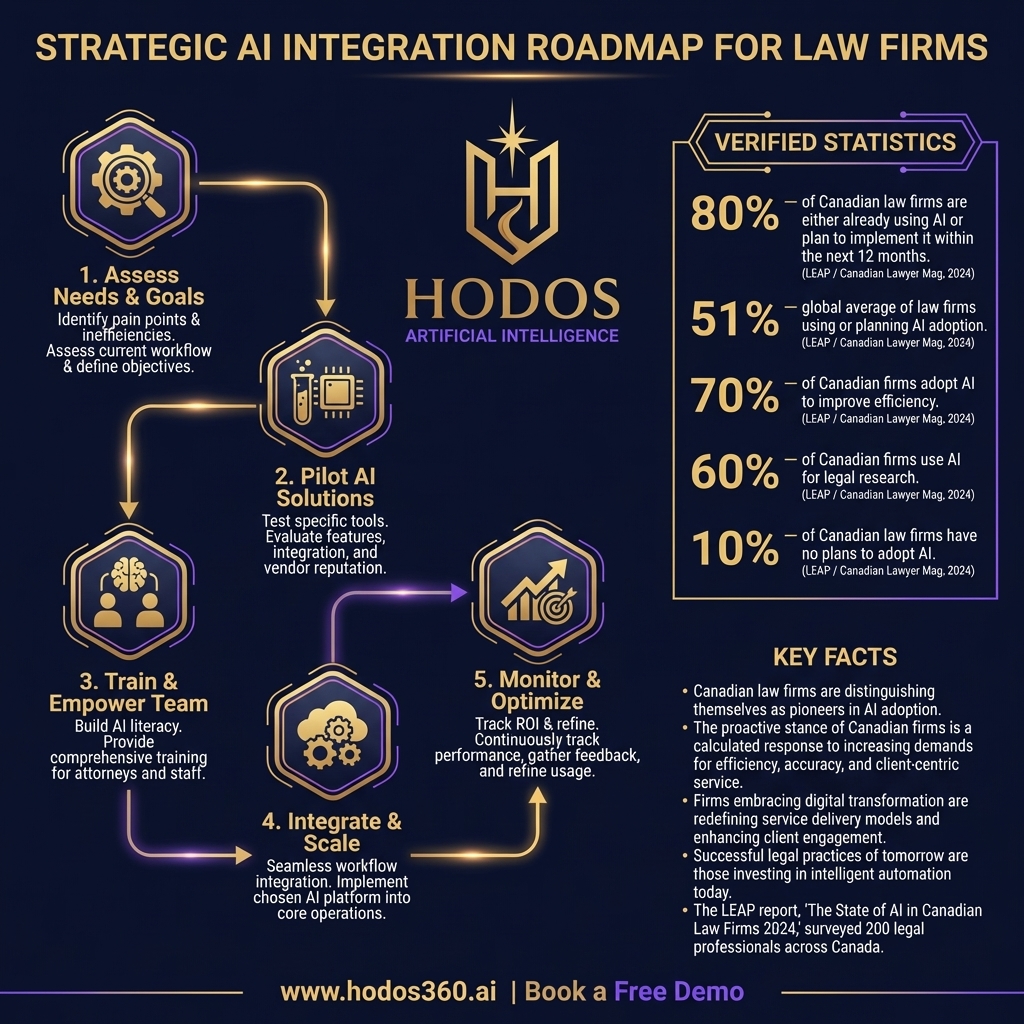
- ✓Pilot Programs & Feedback Loops: Start with small, manageable pilot projects to test AI tools, gather feedback, and iterate before wider deployment.
- ✓Continuous Learning & Training: Invest in ongoing education for all staff, from basic AI literacy to advanced tool-specific training, fostering a growth mindset.
- ✓Data Governance & Ethics: Develop clear policies for data security, privacy, and ethical AI use, ensuring compliance and building trust.
- ✓Measure & Optimize: Track key performance indicators (KPIs) related to AI implementation, such as efficiency gains, cost savings, and client satisfaction, to demonstrate ROI and inform future investments.
- ✓Celebrate Successes: Recognize and reward individuals and teams that successfully adopt and leverage AI, reinforcing the firm's commitment to innovation.
HODOS 360: Empowering Canadian Law Firms with Comprehensive AI
For Canadian law firms eager to accelerate their AI adoption and digital transformation, HODOS 360 offers a comprehensive, integrated suite of AI-powered services designed to address every facet of modern legal practice. Recognizing the fragmented nature of many legal tech stacks, HODOS 360 provides a unified platform that streamlines operations, enhances client engagement, and drives growth.
Our AI Law Firm Management System integrates case management, billing, client intake, document automation, and calendar functions, all powered by intelligent workflows that adapt to your firm's unique needs. This means lawyers spend less time on administrative burdens and more time on high-value legal work, directly impacting profitability and client satisfaction.
Imagine AI-powered tools that predict case outcomes or automate the drafting of complex legal documents, drastically cutting down on manual effort and potential errors.
Beyond internal operations, HODOS 360’s AI Marketing Platform empowers firms to effectively reach and convert new clients. In an increasingly competitive market, AI-driven video creation, social media automation, content generation, and sophisticated analytics provide the tools to build a strong online presence and track marketing ROI with precision.
This allows firms to target specific demographics, personalize client outreach, and optimize their marketing spend, ensuring a continuous pipeline of qualified leads. Learn more about AI Web Apps: Ultimate Legal Firms' Guide to Next-Gen Development. Complementing this, our AI Voice Assistants offer 24/7 phone answering, lead qualification, and appointment booking, providing multilingual support and intelligent call routing.
This ensures that potential clients receive immediate, professional assistance, capturing leads that might otherwise be lost outside of business hours and significantly enhancing the overall client experience.
Furthermore, HODOS 360's Web & Mobile Development services ensure that Canadian law firms present a cutting-edge digital storefront.
With AI-powered website building, responsive design, SEO optimization, and high-converting templates, firms can create a powerful online presence that attracts and engages clients. This holistic approach means that from the moment a potential client interacts with your website or calls your firm, to the efficient management of their case and ongoing communication, AI is intelligently woven into every touchpoint.
This integrated strategy is critical for firms looking to not only adopt AI but to truly leverage its full potential across their entire business, cementing their position as leaders in the legal industry.
Realizing ROI with Integrated AI Solutions
The ultimate measure of successful AI adoption is tangible Return on Investment (ROI). For Canadian law firms, integrating comprehensive AI solutions like those offered by HODOS 360 translates directly into measurable benefits. By automating routine tasks and optimizing workflows, firms can significantly reduce operational costs, freeing up valuable resources.
The enhanced efficiency in case management, document generation, and billing cycles directly contributes to increased billable hours and improved cash flow. Learn more about Legal AI Divide: Bridge the Gap, Thrive in 2026's Digital Era. Moreover, the AI Marketing Platform drives client acquisition with greater precision and lower cost per lead, while AI Voice Assistants ensure no potential client is missed, leading to higher conversion rates and expanded client bases.
The improved client experience, from seamless intake to proactive communication, fosters loyalty and generates positive referrals, further boosting revenue. This strategic investment in AI is not merely an expense; it is a catalyst for sustainable growth, enabling firms to scale operations without proportional increases in overhead, ultimately securing a robust and profitable future in the competitive legal market.

The Future-Proof Law Firm: Embracing Continuous Innovation
The narrative of AI adoption among Canadian law firms is a testament to the transformative power of emerging technology. It underscores a fundamental truth about the modern legal profession: complacency is no longer an option. Firms that proactively embrace AI, not as a threat but as a strategic partner, are the ones poised for sustained success.
The insights from the LEAP research and the real-world applications of sophisticated platforms demonstrate that AI is not just enhancing existing legal practices; it is creating entirely new possibilities for service delivery, client engagement, and operational excellence. The competitive tension is real: firms that invest in intelligent automation are rapidly outpacing those clinging to traditional methodologies, creating a clear divide in market leadership and client perception.
To future-proof a law firm in this dynamic environment requires more than just acquiring new tools; it demands a commitment to continuous innovation, ethical stewardship, and strategic foresight. As technologies like generative AI continue to evolve at an unprecedented pace, legal professionals must remain agile, adaptable, and perpetually curious.
The journey of AI adoption is ongoing, characterized by iterative learning and refinement. By leveraging comprehensive solutions and fostering a culture of technological proficiency, Canadian law firms can not only maintain their leading edge but also define the very future of legal service, ensuring relevance, profitability, and an unparalleled client experience for decades to come.
Explore integrated AI solutions to position your firm for future success.
Frequently Asked Questions
Why are Canadian law firms leading in AI adoption?+
Canadian law firms are leading due to a combination of factors, including a strong national AI strategy, a robust ecosystem of legal tech startups, and a cultural readiness to embrace innovation. Government support for AI research and development, coupled with a pragmatic approach to integrating new technologies, has positioned firms across Canada to proactively leverage AI for competitive advantage and enhanced service delivery, as highlighted by recent LEAP research.
What are the primary benefits of AI adoption for law firms?+
The primary benefits include significant improvements in operational efficiency, reduced administrative burdens, and enhanced accuracy in tasks like legal research, document review, and case management. AI also improves client satisfaction through faster, more responsive services and enables firms to offer innovative new service lines. Ultimately, AI frees up legal professionals to focus on higher-value strategic work, driving profitability and growth.
What ethical considerations should law firms address when using AI?+
Law firms must address ethical considerations such as potential algorithmic bias, data privacy, client confidentiality, and ensuring transparency in AI's use. Adherence to professional conduct rules, like ABA Model Rules 1.1 (Competence) and 1.4 (Client Communication), is crucial. Firms should implement robust data governance, conduct fairness audits, and provide comprehensive training to ensure ethical and responsible AI deployment.
How can small and medium-sized Canadian firms implement AI?+
Small and medium-sized Canadian firms can implement AI by starting with targeted solutions that address specific pain points, such as AI-powered document automation, client intake systems, or virtual assistants. Leveraging integrated platforms like HODOS 360, which offer comprehensive services tailored to various firm sizes, can provide a cost-effective entry point. Phased implementation, starting with pilot programs, can help manage resources and ensure successful integration.
What role does continuous innovation play in AI adoption?+
Continuous innovation is vital because AI technology is rapidly evolving. Law firms must commit to ongoing learning, adapting to new tools, and refining their AI strategies to stay competitive. Fostering an internal culture that embraces technological change, investing in regular training, and maintaining an agile approach to technology integration ensures that firms can continuously leverage the latest advancements, securing long-term relevance and growth in the dynamic legal market.