


AI in Legal Practice: Ultimate Guide to What Comes Next
Just two years ago, Sarah Chen, managing partner at Sterling & Finch LLP, a prominent mid-sized firm specializing in commercial litigation in Chicago, viewed artificial intelligence with a healthy dose of skepticism. Her firm, like many traditional practices, prided itself on meticulous human-driven processes and deep client relationships. Yet, the relentless drumbeat of innovation, amplified by major announcements like OpenAI's continued advancements and the meteoric rise of specialized legal AI startups like Harvey AI, began to shift the ground beneath her. Competitors who embraced early AI adoption reported significant gains in efficiency, client satisfaction, and even new revenue streams, leaving Sarah and her partners to question if their cautious approach was actually a strategic misstep in the rapidly evolving landscape of AI in legal practice.
The trending Lexology article, "AI in Legal Practice: What It Can Replace, What It Can’t, and What Comes Next," perfectly encapsulates the central tension facing legal professionals today. It's a debate that extends beyond mere technological adoption; it touches the very core of what it means to be a lawyer in the 21st century. The question isn't whether AI will impact the legal profession—that ship has sailed. The real challenge lies in discerning which tasks AI can effectively automate or augment, which areas will forever demand indispensable human judgment, and crucially, how firms can strategically position themselves for the next wave of innovation. This deep dive will explore these nuances, offering a comprehensive perspective on the current capabilities and future trajectory of AI, ensuring law firms like Sterling & Finch are not just surviving, but thriving in this new era.
The conversation around AI often veers into extremes: either a utopian vision of effortless automation or a dystopian fear of widespread job displacement. The reality, as always, is far more complex and nuanced. AI is not a monolith; it’s a diverse set of technologies, each with specific strengths and limitations. Understanding these distinctions is paramount for law firm owners and attorneys seeking to integrate AI responsibly and effectively. We'll delve into concrete examples, drawing on real-world implementations and expert insights, to demystify the hype and provide actionable strategies. Ready to explore the transformative power of AI in legal practice? [Learn more about HODOS 360's solutions today.]
The Evolving Landscape: Where AI Excels in Legal Practice
The most immediate and demonstrable impact of AI in legal practice has been its capacity to revolutionize data-intensive, repetitive tasks, thereby significantly boosting efficiency and accuracy. This isn't merely about incremental improvements; it’s about fundamentally reshaping workflows that have historically consumed vast amounts of attorney time and firm resources. According to the 2023 ABA TechReport, a significant majority of firms (over 70% of large firms) reported using AI-powered tools for legal research and document review, a stark increase from previous years, underscoring AI's proven utility in these domains. This adoption rate reflects a growing recognition that AI tools are no longer experimental but essential for competitive advantage, allowing legal professionals to reallocate their expertise to higher-value activities.
One of the prime examples of AI’s transformative power is in e-discovery and contract analysis. Traditional document review, notorious for its time-consuming nature and susceptibility to human error, is now being dramatically streamlined by AI. Platforms like Thomson Reuters’ CoCounsel and LexisNexis’s Lexis+ AI leverage advanced natural language processing (NLP) to rapidly sort, categorize, and extract relevant information from millions of documents, identifying key clauses, anomalies, and potential risks in a fraction of the time it would take human reviewers. A groundbreaking example is Harvey AI’s partnership with Allen & Overy, where the generative AI platform is used to support the firm’s lawyers across various practice areas, enhancing everything from due diligence to litigation strategy. This collaboration demonstrates how leading global firms are not just experimenting with AI but integrating it deeply into their core operational structures, realizing substantial gains in both speed and precision.
Beyond document analysis, AI is also making significant strides in legal research and predictive analytics. Modern AI legal research tools go far beyond keyword searches, understanding context and legal concepts to surface highly relevant precedents, statutes, and secondary sources. This capability allows lawyers to conduct more comprehensive research in less time, uncovering insights that might otherwise be missed. Learn more about AI Document Workflows: Unleash Efficiency & ROI in 2026. Furthermore, predictive analytics, utilizing machine learning algorithms, can analyze historical case data to forecast potential litigation outcomes, assess risks, and inform negotiation strategies. While these predictions are not infallible, they provide invaluable data-driven insights that augment a lawyer’s strategic planning. As Casey Flaherty, founder of Legal Tech Audit, frequently emphasizes, "AI isn't about replacing the lawyer's brain, it's about giving them a much more powerful telescope and microscope for their work."
Administrative automation represents another critical area where AI excels, freeing up legal professionals from mundane, yet essential, operational tasks. This includes everything from client intake and billing to scheduling and document generation. AI-powered systems can automate the initial screening of potential clients, gather essential information, and even draft initial engagement letters and standard contracts based on predefined templates and client inputs. The integration of AI into law firm management systems means that tasks like expense tracking, invoice generation, and calendar management can be handled with minimal human intervention, significantly reducing administrative overhead. This efficiency gain is particularly impactful for small to mid-sized firms, allowing them to scale operations without proportionally increasing their administrative staff, thus improving their bottom line and enhancing overall service delivery to clients. This is precisely where platforms offering AI-powered legal workflows provide a competitive edge, ensuring consistency and accuracy across all operational aspects.
Automating Routine Legal Workflows with Precision
The strategic implementation of AI in automating routine legal workflows is perhaps one of the most impactful applications for modern law firms. By offloading repetitive, rules-based tasks to intelligent systems, lawyers are freed from the drudgery of administrative work, allowing them to dedicate their valuable time and cognitive energy to complex legal analysis, client strategy, and courtroom advocacy—the very core of their professional expertise. This shift not only enhances job satisfaction for attorneys but also significantly improves the overall quality and efficiency of legal service delivery.
Consider the process of automated document generation. Instead of manually drafting standard agreements, pleadings, or client communications from scratch, AI-powered document automation tools can generate these documents in minutes, populated with specific client data and tailored to particular case requirements. This drastically reduces the time spent on drafting and proofreading, minimizing errors and ensuring consistency across all firm outputs. Learn more about AI Legal Research: The Ultimate Guide for Law Firms. Similarly, in case management, AI can automate the categorization of documents, track deadlines, assign tasks, and even flag potential conflicts of interest, providing a centralized, intelligent hub for all case-related activities. This level of automation ensures that no critical detail is overlooked and that every team member is aligned on case progress and priorities. Furthermore, AI's ability to streamline client intake processes, from initial inquiry to conflict checks and onboarding, creates a seamless and professional first impression, setting the stage for stronger client relationships and operational excellence. This foundational efficiency is a game-changer for firms aiming to maximize productivity and elevate their service offerings.
The Indispensable Human Element: What AI Cannot Replace
While AI’s capabilities are expanding at an astonishing pace, there remain fundamental aspects of the legal profession that are inherently human and, by their very nature, irreplaceable by technology. These are the domains where human judgment, nuanced ethical reasoning, empathy, and the art of persuasion reign supreme. The core of legal practice, particularly in its most complex and impactful forms, relies on an intricate blend of intellectual acumen and emotional intelligence that no algorithm, however sophisticated, can fully replicate. This distinction is crucial for understanding the symbiotic relationship between human lawyers and AI tools.
Central to this indispensable human element is the lawyer’s role in navigating complex ethical dilemmas and exercising independent legal reasoning. The ABA Model Rules of Professional Conduct, particularly Rule 1.1 (Competence) and its Comment 8, which explicitly acknowledges the duty to keep abreast of changes in technology, underscore the lawyer's ultimate responsibility for their actions and advice. AI can provide data, identify patterns, and even suggest courses of action, but it cannot weigh competing moral imperatives, understand the subjective values of a client, or make a decision that aligns with the spirit, rather than just the letter, of the law. As Professor David B. Wilkins of Harvard Law School often articulates, "Lawyers are not just problem-solvers; they are trusted advisors, counselors, and guardians of justice. These roles demand an understanding of human nature, societal norms, and ethical frameworks that go far beyond data processing." This human capacity for wisdom, integrity, and discretion forms the bedrock of legal professionalism.
Furthermore, the bedrock of successful legal practice rests significantly on building and maintaining robust client relationships. Learn more about AI Voice Assistants: Essential Balance for Law Firms. Empathy, active listening, and the ability to understand and respond to a client's emotional state are critical for trust and effective representation. A client facing a life-altering legal challenge needs more than just legal analysis; they need reassurance, understanding, and a human connection. AI can automate communication, but it cannot offer genuine compassion or provide the psychological support that often accompanies legal counsel. The subtleties of human interaction—reading body language, interpreting tone, and building rapport—are essential for effective negotiation, client counseling, and jury persuasion, none of which can be truly replicated by an algorithm.
Finally, the dynamic and often unpredictable environment of courtroom advocacy and high-stakes negotiation remains firmly within the human domain. While AI can assist in preparing arguments, predicting judicial behavior, or analyzing opposing counsel's past strategies, it cannot replicate the spontaneous brilliance of an attorney cross-examining a witness, the persuasive power of a well-crafted opening statement delivered with conviction, or the adaptability required to pivot in real-time during a complex negotiation. These are performances, requiring not just intellect but emotional intelligence, charisma, and an innate understanding of human psychology—qualities that AI cannot replace. The strategic application of legal knowledge in a fluid, adversarial context demands a level of creative thinking and adaptive problem-solving that remains uniquely human, ensuring that the trial lawyer's role will endure.

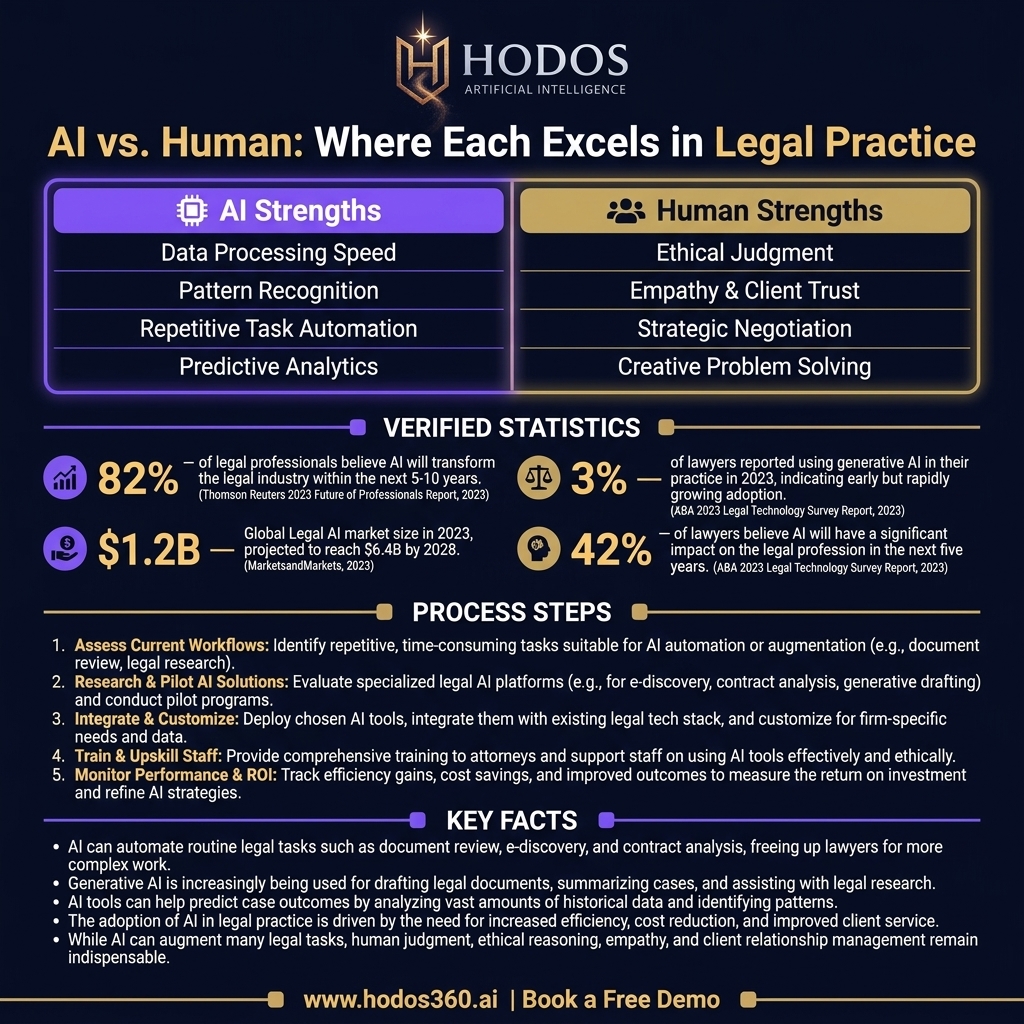
- ✓Ethical Reasoning & Moral Judgment: AI lacks consciousness and the capacity for moral deliberation, making human oversight essential for ethical legal advice.
- ✓Client Empathy & Relationship Building: The nuanced understanding of human emotions and the ability to build trust are critical for effective client representation and cannot be automated.
- ✓Strategic Litigation & Courtroom Advocacy: The dynamic, unpredictable nature of trials and the art of persuasion require human adaptability, charisma, and real-time strategic thinking.
- ✓Creative Problem Solving & Novel Legal Argumentation: Developing innovative legal theories or navigating unprecedented situations demands human creativity and intuitive leaps beyond algorithmic pattern recognition.
- ✓Negotiation & Persuasion: The subtle dance of human negotiation, involving reading non-verbal cues and understanding underlying motivations, is beyond AI's current capabilities.
- ✓Accountability & Liability: Lawyers bear the ultimate ethical and professional responsibility for legal advice, a burden AI cannot assume.
- ✓Nuanced Interpretation of Law: While AI can identify rules, applying them to complex, fact-specific scenarios often requires a human understanding of societal context and legislative intent.
Navigating Ethical Considerations and AI Governance
The integration of AI in legal practice is not without its significant challenges, particularly concerning ethical considerations and the imperative for robust governance frameworks. As law firms increasingly rely on AI tools for everything from document review to predictive analytics, new ethical minefields emerge, demanding careful navigation by legal professionals. One of the most pressing concerns revolves around the potential for bias embedded within AI algorithms. If an AI system is trained on historical data that reflects societal biases, it can perpetuate or even amplify those biases in its outputs, leading to discriminatory outcomes in areas like bail recommendations, sentencing predictions, or even the identification of relevant evidence. This raises profound questions about fairness and justice, directly impacting a lawyer's duty to uphold the rule of law and protect client rights. The ongoing discussions surrounding the EU AI Act and similar legislative efforts globally highlight the urgency of addressing these biases through careful data curation, algorithm design, and continuous auditing.
Another critical ethical consideration is client confidentiality and data security, enshrined in ABA Model Rule 1.6 (Confidentiality of Information). Feeding sensitive client information into third-party AI systems, whether cloud-based or locally hosted, introduces new vectors for data breaches and unauthorized access. Firms must exercise extreme due diligence in selecting AI vendors, ensuring robust encryption, secure data storage, and clear policies on data usage and retention. The potential for AI systems to inadvertently reveal privileged information or create new vulnerabilities is a risk that cannot be overstated. Figures like Dario Amodei, CEO of Anthropic, have consistently warned about the inherent safety and security challenges in deploying advanced AI, urging developers and users alike to prioritize responsible deployment and continuous risk assessment. Law firms, as custodians of highly sensitive data, bear a heightened responsibility to implement ironclad cybersecurity protocols when adopting AI technologies.
Accountability and liability also present a complex ethical puzzle. When an AI system makes an error—whether it's a missed deadline, an incorrect legal interpretation, or a biased recommendation—who bears the ultimate responsibility? While AI tools are designed to assist, the legal profession dictates that the lawyer remains ultimately accountable for the advice given and the work performed. Learn more about AI Marketing Automation: Law Firms' 2026 Growth Catalyst. This necessitates a clear understanding of the AI's limitations, continuous human oversight, and the ability to critically evaluate and validate AI-generated outputs. Firms cannot simply outsource their professional obligations to an algorithm. This legal and ethical imperative means that lawyers must be sufficiently educated about the AI tools they use, understanding their mechanisms, potential pitfalls, and how to effectively supervise their operation. This vigilance ensures that AI serves as a powerful assistant, not an unsupervised decision-maker, preserving the lawyer's professional integrity and client protection.
The ethical integration of AI also demands transparency and explainability. Lawyers need to understand *how* an AI system arrived at a particular conclusion, especially when dealing with client matters. Black-box AI models, which offer little insight into their decision-making processes, pose significant challenges to a lawyer's duty of competence and transparency with clients. Furthermore, the rapid pace of AI development requires continuous ethical recalibration. What might be considered acceptable use today could raise new ethical questions tomorrow. This necessitates ongoing engagement with legal ethics committees, industry best practices, and a commitment to proactive policy development within firms. The goal is not to stifle innovation but to ensure that AI adoption aligns with the core values of justice, fairness, and client advocacy that define the legal profession.
The Imperative for Robust AI Policies in Law Firms
Given the multifaceted ethical and practical challenges posed by AI in legal practice, the development and implementation of robust internal AI policies are no longer optional but an absolute imperative for every law firm. These policies serve as a guiding framework, ensuring that AI tools are utilized responsibly, ethically, and in a manner that enhances, rather than compromises, professional standards. A comprehensive AI policy should clearly define acceptable use cases for different AI technologies, outline data governance protocols, and establish clear guidelines for human oversight and review of AI-generated work product.
Crucially, these policies must also address attorney training and education. Lawyers and legal staff need to be proficient not only in using AI tools but also in understanding their underlying mechanisms, their potential for bias, and the limitations of their outputs. This includes training on prompt engineering for generative AI, critical evaluation of AI-generated research, and awareness of data privacy implications. Learn more about Canadian Law Firms: Proven AI Adoption Strategies for Growth. Regular updates to these policies are essential, reflecting the rapid evolution of AI technology and emerging legal and ethical standards. By establishing clear guardrails and fostering a culture of informed AI usage, law firms can mitigate risks, uphold their ethical obligations, and confidently leverage AI to drive innovation and efficiency, ultimately protecting both the firm and its clients in an increasingly AI-driven legal landscape. Explore how HODOS 360 empowers your firm to focus on irreplaceable human value. [Discover our AI-powered solutions.]
The Future Trajectory: What Comes Next for the Legal Profession
Looking ahead, the future of AI in legal practice is not one of replacement but of profound transformation, characterized by the rise of the "augmented lawyer" and the emergence of entirely new service models. This vision, frequently articulated in reports from institutions like McKinsey & Company on the impact of AI on professional services, posits that AI will serve as a powerful co-pilot, expanding human capabilities rather than diminishing them. Instead of spending hours on routine tasks, lawyers will leverage AI to synthesize vast amounts of information, identify critical patterns, and generate first drafts, allowing them to dedicate more time to strategic thinking, client counseling, and complex problem-solving. This shift will require a redefinition of traditional legal roles, emphasizing skills such as critical thinking, emotional intelligence, and interdisciplinary collaboration, all augmented by technological fluency. The lawyer of tomorrow will be a master of both legal doctrine and intelligent tools, harnessing technology to deliver superior client outcomes.
This augmented paradigm will also pave the way for new and more accessible legal service models. By significantly reducing the cost and time associated with many legal tasks, AI can help bridge the access-to-justice gap, making legal services more affordable and widely available to individuals and small businesses that previously found them out of reach. We're already seeing startups leveraging AI to offer streamlined, cost-effective solutions for common legal needs, disrupting traditional models and forcing established firms to innovate. Clio’s continued growth and strategic acquisitions, for instance, demonstrate the market's appetite for integrated, efficient law firm management solutions that cater to a broader spectrum of legal needs. This competitive pressure will drive innovation, pushing firms to rethink their service delivery, pricing structures, and client engagement strategies, ultimately benefiting consumers by fostering a more efficient and responsive legal market.
Furthermore, the evolution of AI in legal practice will necessitate a significant overhaul of legal education and professional development. Learn more about Legal Tech Adoption: Mastering AI for Law Firms in 2026. Law schools are increasingly incorporating AI literacy, data analytics, and prompt engineering into their curricula, preparing future lawyers for a tech-driven landscape. This isn't just about learning how to use specific software; it's about developing a foundational understanding of AI principles, its ethical implications, and how to effectively collaborate with intelligent systems. Continuing legal education (CLE) programs will also need to adapt rapidly, offering attorneys the opportunity to upskill and reskill in AI-related competencies. The demand for lawyers specializing in AI law—addressing issues such as AI regulation, intellectual property for AI-generated content, and AI liability—is already growing, creating entirely new practice areas and career paths within the legal profession. This specialization underscores the dynamic nature of the field and the continuous learning required for success.
Ultimately, the trajectory of AI suggests a future where the legal ecosystem is more efficient, more analytical, and potentially more equitable. The firms that will thrive are those that strategically embrace AI, not as a threat, but as an opportunity to enhance their capabilities, innovate their service offerings, and deepen their impact. This requires visionary leadership, investment in appropriate technologies, and a commitment to continuous learning and adaptation. The legal industry is on the cusp of a profound transformation, and those who proactively engage with AI will be the ones to shape its future, ensuring that the essence of justice is preserved and advanced through intelligent innovation.
HODOS 360's Role in Shaping the Next Era of Legal Tech
As the legal profession navigates this transformative era, platforms like HODOS 360 are emerging as crucial enablers for firms seeking to strategically integrate AI. HODOS 360 offers a comprehensive suite of AI-powered services designed to empower law firms, allowing them to embrace the future with confidence. Its AI Law Firm Management System, for instance, streamlines everything from case management and billing to client intake and document automation, leveraging AI-powered legal workflows to enhance efficiency and accuracy across the board. This holistic approach ensures that firms can centralize their operations, reduce administrative burdens, and free up attorneys to focus on high-value legal work.
Beyond internal operations, HODOS 360 also addresses the critical need for modern law firms to effectively market their services in a competitive digital landscape. Its AI Marketing Platform automates content generation, facilitates AI video creation, manages social media engagement, and provides robust analytics to track ROI, ensuring firms can attract and retain clients more effectively. Coupled with AI Voice Assistants offering 24/7 phone answering, lead qualification, and appointment booking, HODOS 360 provides a truly integrated solution that not only enhances internal productivity but also revolutionizes client acquisition and service delivery. By offering cutting-edge web and mobile development, including AI-powered website building and SEO optimization, HODOS 360 positions firms at the forefront of digital innovation, ensuring they are well-equipped to thrive in the next era of legal tech.

Key Takeaways and Next Steps for Law Firms
The journey through the evolving landscape of AI in legal practice reveals a clear truth: AI is not here to replace lawyers, but to redefine the very nature of legal work. It is a powerful tool for augmentation, capable of automating repetitive tasks, enhancing research capabilities, and streamlining firm operations. However, the core essence of the legal profession—the exercise of human judgment, ethical reasoning, empathetic client relationships, and strategic counsel—remains firmly in the hands of human attorneys. Firms that recognize and embrace this symbiotic relationship will be best positioned for future success.
The path forward for law firms involves a strategic, rather than reactive, approach to AI adoption. This means investing in the right technologies that align with firm goals, prioritizing ethical deployment, and, critically, investing in the continuous education and training of legal professionals. The goal should be to empower lawyers with AI, turning them into augmented legal practitioners who can deliver higher-quality, more efficient, and more accessible services. By doing so, firms can not only improve their bottom line but also reinforce their commitment to justice and client advocacy in an increasingly complex world.
Embracing AI isn't just about technological upgrade; it's about a cultural shift within the firm—one that values innovation, continuous learning, and adaptability. The firms that proactively integrate AI into their workflows, while steadfastly upholding the irreplaceable human elements of the law, will be the ones that lead the legal profession into its next, most exciting chapter. Ready to harness the full potential of AI for your firm? [Book a free demo with HODOS 360 today and transform your legal practice.]
Frequently Asked Questions
Will AI truly replace lawyers in the future?+
No, AI is highly unlikely to fully replace lawyers. While AI can automate many routine and data-intensive tasks like document review and legal research, it cannot replicate essential human qualities such as ethical reasoning, empathy, strategic judgment, and the nuanced art of persuasion in court. AI will augment lawyers, allowing them to focus on complex, high-value work and client relationships, rather than replacing their fundamental role.
What specific tasks can AI automate in a law firm?+
AI can automate numerous tasks, including first-pass document review, e-discovery, contract analysis, legal research, client intake processes, billing, scheduling, and generating standard legal documents. These automations free up lawyers from repetitive administrative burdens, allowing them to dedicate more time to strategic thinking, client counseling, and complex legal analysis. This leads to increased efficiency and accuracy across firm operations.
How can small and mid-sized firms afford AI legal tech?+
Many AI legal tech solutions are now offered on a subscription basis, making them accessible even for smaller firms. Platforms like HODOS 360 provide integrated, scalable solutions that consolidate multiple services, often proving more cost-effective than managing disparate systems. The efficiency gains from AI can also lead to significant cost savings and increased profitability, making the investment quickly justifiable for firms of all sizes.
What are the main ethical concerns with AI in law?+
Primary ethical concerns include potential biases in AI algorithms leading to discriminatory outcomes, risks to client confidentiality and data security when using third-party AI tools, and the question of accountability and liability when AI makes errors. Lawyers must maintain ultimate responsibility, ensure human oversight, understand AI limitations, and establish robust internal AI policies to mitigate these ethical challenges effectively.
How does AI improve client service and relationships?+
AI improves client service by streamlining communication, automating appointment booking, providing 24/7 support through AI voice assistants, and generating personalized legal content. By freeing lawyers from administrative tasks, AI allows them to dedicate more focused time to client counseling, fostering deeper relationships. Efficient processes also lead to faster service delivery and more transparent communication, enhancing overall client satisfaction and loyalty.
What skills should lawyers develop for an AI-driven future?+
Lawyers should develop skills in critical thinking, ethical reasoning, emotional intelligence, and complex problem-solving. Additionally, technical literacy, including understanding AI's capabilities and limitations, prompt engineering, data analysis, and cybersecurity awareness, will be crucial. The ability to effectively collaborate with AI tools and adapt to new technologies will define success in the evolving legal landscape, ensuring lawyers remain indispensable.