
Privilege & AI: The Ultimate Guide After US v. Heppner
In early 2026, the legal community watched intently as the case of *United States v. Heppner* unfolded, delivering a jolt to the burgeoning integration of artificial intelligence in legal practice. The ruling, which questioned the privileged status of communications involving AI, ignited a critical conversation about the boundaries of attorney-client privilege in an era of advanced legal technology.
For law firm owners, managing partners, and legal professionals, this decision is not merely a footnote in AI news today; it's a clarion call to re-evaluate how AI tools are deployed, governed, and secured within their firms. The tension between leveraging AI for unparalleled efficiency and upholding the bedrock principles of client confidentiality has never been more pronounced.
Historically, the attorney-client privilege has served as a cornerstone of the legal system, fostering open and honest communication between clients and their counsel. However, the rise of sophisticated AI tools, capable of drafting documents, conducting research, and even interacting with clients, introduces complex questions about who (or what) constitutes an 'attorney' or 'client' for the purpose of privilege, and whether an AI's output can truly be considered a confidential communication.
The *Heppner* decision, while specific in its context, has cast a long shadow, threatening to undermine the very access to legal services that AI tools are designed to enhance, particularly if not handled with meticulous care.
This comprehensive guide delves into the *Heppner* ruling's implications, exploring the challenges and offering actionable strategies for law firms to navigate the evolving landscape of AI privilege.
We’ll examine how firms can responsibly integrate AI, ensuring compliance with ethical obligations while harnessing the transformative power of technologies like HODOS 360’s AI Law Firm Management System. By understanding the nuances of this recent legal development, firms can safeguard client interests, mitigate risks, and confidently stride into the future of legal practice.
Learn more about protecting your firm's privilege in the AI era.
The Heppner Ruling: A Pivotal Moment for AI Privilege
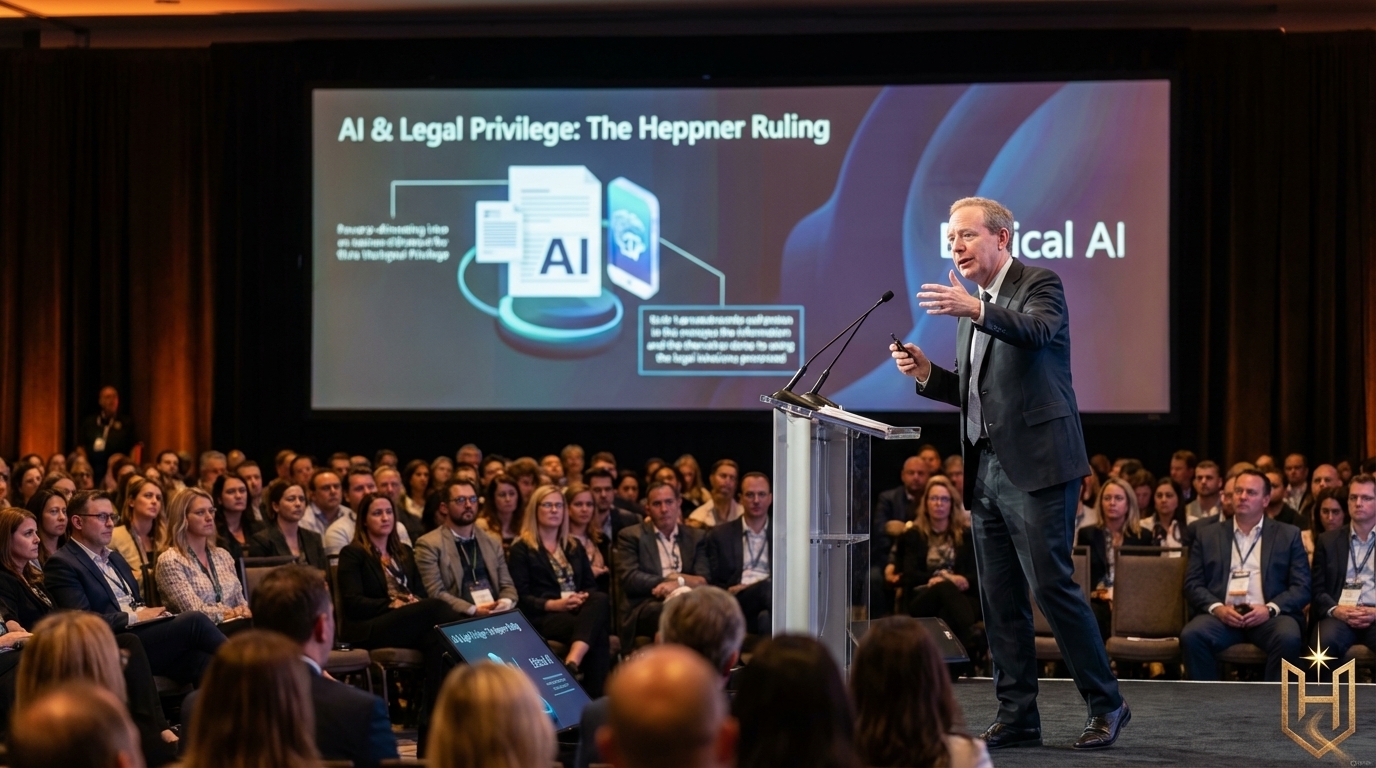
The *United States v. Heppner* case, decided by Judge Jed Rakoff in the Southern District of New York on February 6, 2026, centered on a defendant's communications with an AI chatbot. The core issue was whether these interactions, which included the AI's generation of legal-adjacent content, were protected by attorney-client privilege or the work product doctrine.
Judge Rakoff ultimately ruled that they were not, citing the absence of a genuine attorney-client relationship between the defendant and the AI, and the lack of a reasonable expectation of confidentiality given the nature of the AI's operation. This first federal AI privilege ruling, as highlighted by legal scholars like Mihir Kshirsagar on Lawfare, underscored a critical distinction: AI, in its current form, is a tool, not a legal professional capable of forming privileged relationships.
This ruling immediately prompted a re-evaluation of how legal professionals interact with AI. Learn more about Essential AI Website Builder Guide for Law Firms. While many firms, including those leveraging advanced platforms, have been carefully integrating AI for tasks ranging from document review to case management, *Heppner* serves as a stark reminder that the fundamental principles of legal ethics, particularly confidentiality, remain paramount.
The decision emphasizes that simply using an AI tool for legal tasks does not automatically extend privilege to the AI's outputs or interactions. It compels firms to consider the "human element" in privilege assertions and the potential for inadvertent waivers when AI is not properly managed or understood.
Understanding the Nuances: Attorney-Client Privilege vs. AI Interaction
Attorney-client privilege protects confidential communications between a client and their attorney made for the purpose of obtaining or providing legal assistance. Key elements include a client, a licensed attorney, a confidential communication, and the purpose of legal advice. The *Heppner* ruling exposed a crucial gap in applying these elements to AI interactions.
An AI chatbot, regardless of its sophistication, does not possess a bar license, nor can it truly form a confidential relationship with a client in the traditional sense. Its responses are generated based on algorithms and vast datasets, not independent legal judgment or a fiduciary duty.
Furthermore, the expectation of confidentiality with general-purpose AI tools can be tenuous. Learn more about AI Marketing: The Ultimate Playbook for Law Firms. Many public-facing AI models explicitly state that user inputs may be used to train their systems, thus compromising the confidentiality essential for privilege.
This contrasts sharply with the strictures of ABA Model Rule 1.6, which mandates that lawyers keep client information confidential. For firms, this means a clear distinction must be drawn between using AI as a sophisticated research or drafting assistant under an attorney's direct supervision and allowing it to engage in interactions that could be construed as legal advice, thereby risking privilege waiver.
The ruling necessitates a deeper dive into the terms of service and data handling practices of all AI tools employed.
Navigating the Ethical Minefield: Protecting Confidentiality with AI
The *Heppner* decision underscores the urgent need for law firms to establish robust protocols for ethical AI use to prevent inadvertent waivers of privilege. The risks extend beyond direct client-AI interactions to include the input of sensitive case information into AI tools for tasks like document review, legal research, or drafting.

Without proper safeguards, such inputs could be deemed non-confidential or even publicly accessible, especially if the AI vendor's data practices are not rigorously vetted. Firms must also contend with the "hallucination" problem, where AI generates plausible but false information, potentially leading to flawed legal advice if not meticulously fact-checked by human attorneys.
Moreover, the evolving landscape of AI regulation news, including the enforcement of the EU AI Act, highlights a global movement towards greater accountability and transparency in AI systems. While these regulations often focus on data privacy and algorithmic bias, they implicitly impact how legal professionals must manage sensitive client data when interacting with AI.
Learn more about AI Marketing: Essential Strategies for Law Firm Growth. Firms that fail to adopt clear guidelines risk not only privilege waivers but also potential ethical violations and professional liability. The key lies in treating AI as a powerful, yet ethically neutral, tool that requires human oversight and strict adherence to established legal principles.
Discover how HODOS 360 helps firms integrate AI securely and ethically.
- ✓Implement Strict Data Governance Policies: Define clear rules for what data can be input into AI tools, ensuring sensitive client information is appropriately anonymized or restricted to secure, enterprise-grade platforms.
- ✓Vet AI Vendors Thoroughly: Understand the data security, privacy policies, and terms of service of all AI providers. Prioritize vendors with robust encryption, data minimization, and explicit non-training clauses for client data.
- ✓Establish Clear Human Oversight: Mandate that all AI-generated content or analysis pertaining to client matters undergoes rigorous review and validation by a qualified attorney before being relied upon or communicated to clients.
- ✓Educate and Train Staff: Provide comprehensive training to all legal professionals on the ethical implications of AI use, focusing on privilege, confidentiality, and the limitations of AI tools.
- ✓Develop Internal AI Use Guidelines: Create explicit firm-wide policies outlining permissible and prohibited uses of AI, particularly concerning client communications and the handling of privileged information.
- ✓Monitor AI Updates and Legal Developments: Stay abreast of new AI technologies, vendor updates, and evolving legal interpretations, like those following *Heppner*, to adapt firm policies accordingly.
- ✓Utilize Secure, Purpose-Built Legal AI Platforms: Opt for AI solutions designed specifically for the legal industry, which often incorporate legal-specific security and compliance features, rather than general-purpose AI.
Strategic AI Adoption: Building Trustworthy Legal AI Workflows
Despite the challenges highlighted by *Heppner*, the strategic adoption of AI remains critical for law firms seeking to maintain competitiveness and enhance service delivery. The path forward involves not shying away from AI, but rather integrating it thoughtfully within secure, well-defined workflows. Firms are increasingly turning to specialized legal AI platforms that offer enterprise-grade security and compliance features.
For instance, companies like Harvey AI have partnered with global firms like Allen & Overy to develop custom, secure large language models that are trained on firm-specific data, maintaining strict confidentiality protocols. This approach ensures that client data remains within a controlled environment, significantly mitigating the risks of privilege waiver.
Implementing AI effectively means embedding it into existing processes in a way that augments human capabilities, rather than replacing them. Learn more about AI Legal Assistant 2026: Revolutionizing Law Firm Efficiency. This includes leveraging AI for tasks such as e-discovery, contract analysis, and legal research, where its ability to process vast amounts of data quickly can dramatically reduce time and cost.
The key is to design workflows where AI acts as a sophisticated assistant, with human attorneys always retaining ultimate control and responsibility. This balanced approach not only respects ethical obligations but also unlocks significant operational efficiencies, allowing attorneys to focus on high-value, strategic work.
Implementing Robust AI Governance and Training Protocols
Effective AI governance is paramount for any firm looking to responsibly adopt these technologies. This involves developing a comprehensive internal framework that addresses everything from data input and output to ethical use and continuous monitoring. Firms should consider forming an internal AI ethics committee or task force composed of partners, associates, and IT professionals to regularly review AI tools, policies, and industry best practices.
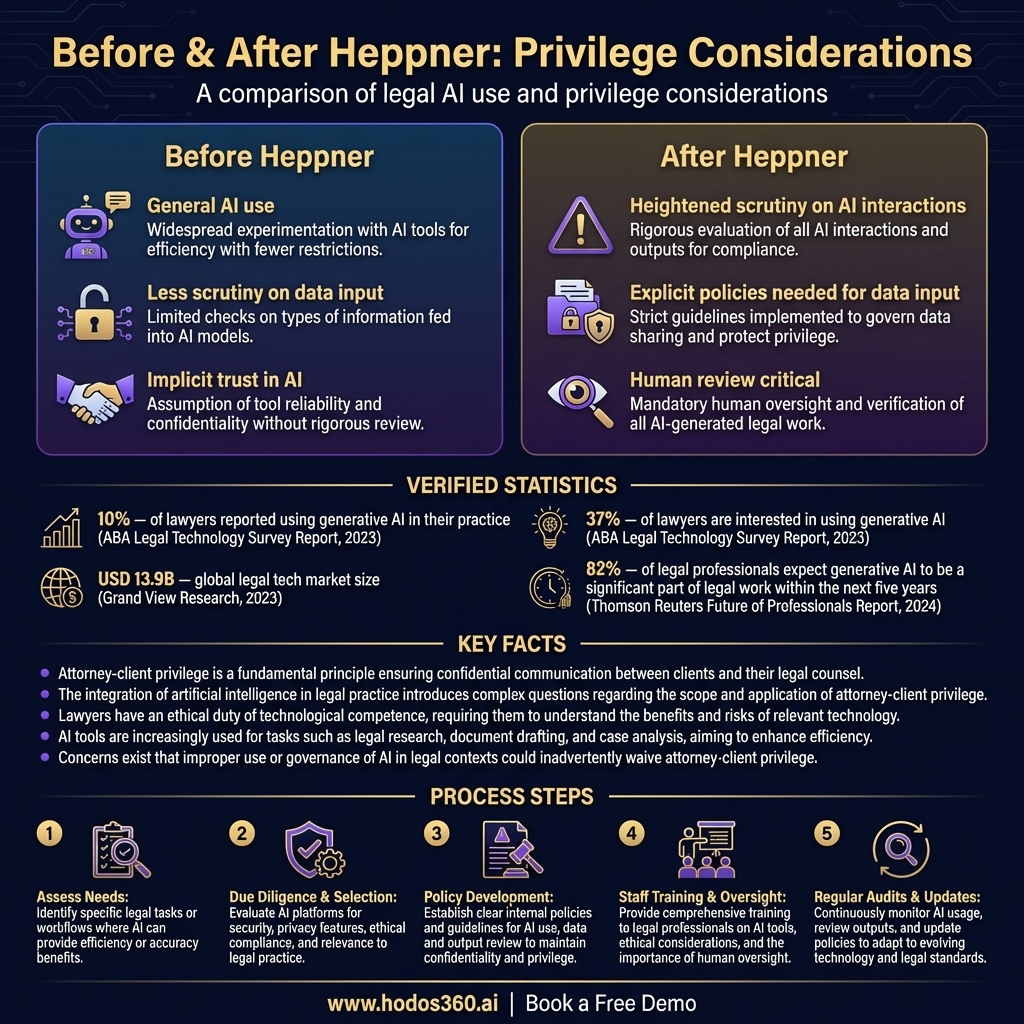
This committee can assess new AI software, ensure compliance with evolving AI regulation news, and develop training modules tailored to the firm's specific needs.
Training is not a one-time event; it's an ongoing process. Learn more about Legal AI Adoption: An Essential Roadmap for Law Firms.
As AI technologies advance and legal interpretations shift, attorneys and staff need continuous education on the latest ethical guidelines, software updates, and potential pitfalls. This includes practical workshops on how to properly prompt AI, how to verify AI-generated content, and how to identify situations where AI use might inadvertently compromise privilege.
Firms that invest in robust governance and comprehensive training will be better positioned to leverage AI's benefits while diligently upholding their professional and ethical duties, especially in light of rulings like *Heppner*.
The Future of Legal Practice: AI as an Enabler, Not a Replacer
The narrative emerging from *Heppner* is not one of AI being a threat to legal practice, but rather a reminder that its integration demands careful, ethical consideration. The future of legal practice is undeniably intertwined with AI, with projections from industry leaders like Gartner suggesting that by 2027, generative AI will be embedded in over 80% of legal tech solutions.
Firms that embrace this reality, while meticulously managing the risks, stand to gain significant competitive advantages. AI-powered platforms are transforming everything from client intake and document automation to legal research and predictive analytics, streamlining operations and freeing up attorneys for more complex, client-facing tasks.
This shift is already evident in the legal market.
The ABA TechReport indicates a steady increase in AI adoption among law firms, with those leveraging AI reporting improved efficiency and better client outcomes. Learn more about AI Legal Tech Boom 2026: Unlocking Billions in Valuation. For example, AI can rapidly analyze vast quantities of data to identify patterns, predict litigation outcomes, or automate routine document generation, allowing attorneys to deliver faster, more cost-effective services.
The challenge, as highlighted by *Heppner*, is to ensure that these efficiencies are achieved without compromising the fundamental ethical obligations, particularly attorney-client privilege. It’s about leveraging AI as an intelligent assistant that enhances human legal expertise, rather than a black box that operates outside ethical scrutiny.
Leveraging AI for Enhanced Client Service and Efficiency
In a competitive legal landscape, firms are constantly seeking ways to enhance client service and operational efficiency. AI offers powerful avenues to achieve this, provided it's implemented with an acute awareness of ethical boundaries. For instance, AI-driven document automation can significantly reduce the time and cost associated with drafting standard legal documents, freeing attorneys to focus on strategic advice.
Similarly, AI-powered legal research tools can sift through immense databases of case law and statutes in seconds, providing attorneys with comprehensive insights far more quickly than traditional methods. These advancements directly translate into faster, more responsive service for clients and more efficient use of firm resources.
However, the lessons from *Heppner* dictate that such efficiencies must be pursued within a framework of strict ethical compliance. This means ensuring that AI tools used for client-facing or internal confidential tasks are secure, transparent, and operate under the direct supervision of a licensed attorney.
When deployed thoughtfully, AI becomes a force multiplier for legal professionals, enabling them to deliver superior client outcomes, manage their practices more effectively, and stay ahead in a rapidly evolving legal market. The goal is to maximize the benefits of AI without inadvertently threatening the foundational trust and confidentiality that define the legal profession.

Key Takeaways and Next Steps
The *United States v. Heppner* ruling serves as a crucial inflection point for the legal industry, underscoring the imperative for law firms to critically examine their use of AI in relation to attorney-client privilege. It’s a stark reminder that while AI offers unprecedented opportunities for efficiency and innovation, these advancements must always be balanced against the profession’s core ethical duties.
The decision reinforces that AI is a tool, not a substitute for human legal judgment or the confidential attorney-client relationship. Firms must prioritize secure, transparent, and ethically compliant AI adoption, backed by robust governance and continuous attorney education.
For forward-thinking law firms, this moment presents an opportunity to refine their AI strategies, ensuring that technology serves to strengthen, not jeopardize, client trust and confidentiality.
Platforms like HODOS 360 are designed to empower law firms with AI-powered solutions for management, marketing, and client engagement, all while providing the necessary infrastructure for secure and compliant operations. By proactively addressing the challenges illuminated by *Heppner* and embracing responsible AI innovation, firms can not only mitigate risks but also build a more efficient, ethical, and future-ready legal practice.
Ready to secure your firm's future with ethical AI? Contact HODOS 360 for a consultation today.
Frequently Asked Questions
What was the significance of the *United States v. Heppner* ruling?+
The *United States v. Heppner* ruling, decided in February 2026, determined that communications between a defendant and an AI chatbot were not protected by attorney-client privilege or the work product doctrine. This was the first federal ruling of its kind, establishing a precedent that AI interactions, in themselves, do not create a privileged relationship, thus prompting law firms to re-evaluate their AI usage and confidentiality protocols to avoid inadvertent waivers.
How does *Heppner* impact attorney-client privilege for law firms using AI?+
*Heppner* clarifies that AI tools are not attorneys, and direct client-AI interactions without human attorney oversight are unlikely to be privileged. For law firms, this means meticulous attention must be paid to how client data is input into AI, the terms of service of AI vendors, and ensuring human attorneys always supervise and validate AI-generated work to maintain confidentiality and privilege. It heightens the need for robust AI governance.
What steps can law firms take to protect privilege when using AI?+
Law firms should implement strict data governance policies, thoroughly vet AI vendors for data security, ensure robust human oversight of all AI-generated content, provide continuous staff training on ethical AI use, and develop clear internal AI use guidelines. Prioritizing secure, purpose-built legal AI platforms designed with compliance in mind is also crucial to safeguard client confidentiality.
Can AI tools ever be used in a privileged context?+
Yes, AI tools can be used in a privileged context when they function as an extension of the attorney's work, under strict supervision. For example, an attorney using AI for legal research or document review to assist in providing legal advice to a client. The key is that the AI acts as a tool for the attorney, and the confidential communication remains between the client and the human attorney, with the attorney maintaining ultimate responsibility and control.
How does HODOS 360 address AI privilege concerns?+
HODOS 360's AI-powered platform is designed with security and compliance at its core, understanding the critical importance of attorney-client privilege. Our AI Law Firm Management System and other services provide secure environments for data processing, integrate AI workflows under human control, and empower firms to implement robust governance. We focus on enabling efficient AI adoption while supporting firms in upholding their ethical obligations and safeguarding client confidentiality.