
AI Receptionist: Essential for Modern Law Firm Success
The legal industry, often characterized by its deliberate pace, is currently experiencing a seismic shift driven by artificial intelligence. A recent headline from inc.com, "This Startup Is Now Offering an AI Receptionist for Just $29 a Month," sent ripples through the professional services sector, igniting conversations about accessibility and affordability in legal tech. This startling proposition, spearheaded by companies like ElevenLabs, co-founded by Mati Staniszewski and Piotr Dąbkowski, whose advanced voice AI technology has garnered significant attention, presents a tantalizing vision: a 24/7 virtual gatekeeper for an unprecedentedly low monthly fee. While a $29 AI receptionist may sound like a silver bullet for small law firms grappling with rising overheads and overwhelming call volumes, it also prompts a crucial inquiry: is a generic, low-cost solution truly adequate for the nuanced, high-stakes environment of legal client interaction? The tension between bare-bones automation and intelligent, compliant support is now at the forefront of legal innovation discussions.
This market disruption, amplified by the rapid advancements in large language models and speech synthesis, forces legal professionals to re-evaluate their operational strategies. Firms that once relied solely on human receptionists are now presented with a spectrum of AI-driven alternatives, from basic call routing to comprehensive client intake and multilingual support. The challenge isn't merely adopting AI, but strategically integrating solutions that align with the specific demands of legal practice – managing sensitive information, maintaining professional decorum, and providing a superior client experience. As Thomson Reuters noted in its 2024 State of the Legal Market Report, client expectations for responsiveness and digital convenience are at an all-time high, making the front line of communication more critical than ever.
The emergence of such affordable AI tools also highlights a growing divide: firms that proactively embrace intelligent automation versus those that hesitate, risking stagnation in a hyper-competitive market. While the $29 AI receptionist offers a glimpse into a future of ubiquitous AI, the legal sector requires a tailored approach, one that understands the intricacies of client confidentiality, ethical obligations under rules like ABA Model Rule 1.6 (Confidentiality of Information), and the precise workflows necessary for lead qualification and appointment scheduling. This article will delve into what law firms truly need from an AI voice assistant, distinguishing between generic offerings and the robust, specialized platforms that can genuinely elevate legal practices, exploring the journey from initial inquiry to seamless client integration.
Interested in transforming your firm's client communication and operational efficiency? Discover how HODOS 360's AI Voice Assistants can help your practice thrive.
Beyond the $29 Price Tag: What Law Firms Truly Need from an AI Receptionist
The inc.com headline, while attention-grabbing, underscores a critical distinction in the burgeoning AI landscape: the difference between a general-purpose AI receptionist and a specialized voice AI assistant designed for the intricate demands of the legal industry. While a $29-a-month plan, often offered by startups like ElevenLabs for their "Reception" agent, might cover basic call answering and routing, it rarely encompasses the depth of functionality, security, and compliance required by law firms. Legal professionals aren't just looking for someone (or something) to pick up the phone; they need an intelligent agent capable of nuanced lead qualification, sensitive information handling, multilingual support for diverse client bases, and seamless integration with existing legal practice management systems. The value proposition for law firms extends far beyond minutes of calls or simultaneous call handling; it's about safeguarding client data, maintaining professional integrity, and optimizing every touchpoint in the client journey.
Consider the operational friction points that a truly effective AI voice assistant must address. For many firms, managing a high volume of inbound calls, especially after hours or during peak times, is a significant drain on resources. Learn more about Voice Search Growth: Essential Legal Firm Strategies. A generic AI might answer, but can it accurately discern a potential client seeking a consultation from a telemarketer? Can it understand the urgency of a new arrest warrant versus a routine inquiry about office hours? More importantly, can it provide preliminary information about legal services without crossing ethical lines of providing legal advice, a clear violation of ABA Model Rule 1.1 (Competence) if not properly configured?
Furthermore, the legal industry is bound by stringent regulatory requirements regarding data privacy and client confidentiality. A basic AI service may not offer the enterprise-grade security protocols, data encryption, and robust compliance frameworks essential for handling sensitive legal information. Firms need assurance that their AI voice assistant adheres to industry standards, protecting client communications from unauthorized access or breaches. The long-term cost of a data breach or ethical violation far outweighs any initial savings offered by a budget-friendly solution, making due diligence paramount in selecting an AI voice assistant.
Cost vs. Value Proposition for Legal Practices
The "$29 a month" offer for an AI receptionist is certainly disruptive, but it often represents a bare-bones service that may create more problems than it solves for a law firm. While the immediate cost savings are attractive, especially for solo practitioners or small firms, the true value proposition for legal practices extends far beyond the monthly subscription fee. A generic AI might handle basic queries, but it won't understand the intricate differences between a tort claim and a contract dispute. Learn more about Voice AI Unleashed: Essential Innovation for Modern Law Firms. Investing in a specialized voice AI system, even if it costs more than $29 per month, can yield significant ROI through improved lead conversion rates, reduced administrative burden, and enhanced client satisfaction, which are invaluable assets for any growing law firm.
Integrating Voice AI: A Strategic Advantage for Legal Practices
The strategic integration of voice AI into a law firm's operations goes beyond simply answering calls; it represents a fundamental shift in how legal services are delivered and managed. For firms looking to gain a competitive edge in an increasingly crowded market, a robust AI voice assistant can be a game-changer. Consider the scenario where a potential client calls after hours or on a weekend. A sophisticated AI voice assistant can immediately engage, qualify the lead, provide preliminary information about the firm's services, and even book an appointment directly into the attorney's calendar. This always-on availability not only enhances the client experience but also ensures that no valuable lead is missed, a critical factor in client acquisition. According to a 2023 ABA Legal Technology Survey Report, firms using AI tools reported a significant increase in efficiency and client satisfaction.
Furthermore, the operational benefits extend deeply into the firm's internal workflows. By automating routine inquiries, appointment scheduling, and basic information dissemination, an AI voice assistant frees up human staff—receptionists, paralegals, and even attorneys—to focus on higher-value tasks that require human judgment and empathy. Learn more about AI Voice Clones: The Ultimate Legal Battle for Control. This reallocation of resources optimizes productivity, reduces overhead costs associated with staffing, and allows firms to scale their operations without proportionally increasing their administrative burden. A well-integrated AI voice assistant acts as a force multiplier, enabling firms to handle a larger volume of clients and cases more efficiently, a critical advantage in a legal market where efficiency often translates directly into profitability.
The capabilities of advanced voice AI extend to crucial aspects of client service, such as multilingual support and accessibility. In today's diverse society, law firms often serve clients from various linguistic backgrounds. A human receptionist might be limited to one or two languages, but an AI voice assistant can offer support in multiple languages, ensuring that every caller feels understood and valued, removing significant communication barriers. This not only broadens a firm's potential client base but also demonstrates a commitment to inclusivity, enhancing its reputation within the community.
Enhancing Client Experience and Operational Efficiency
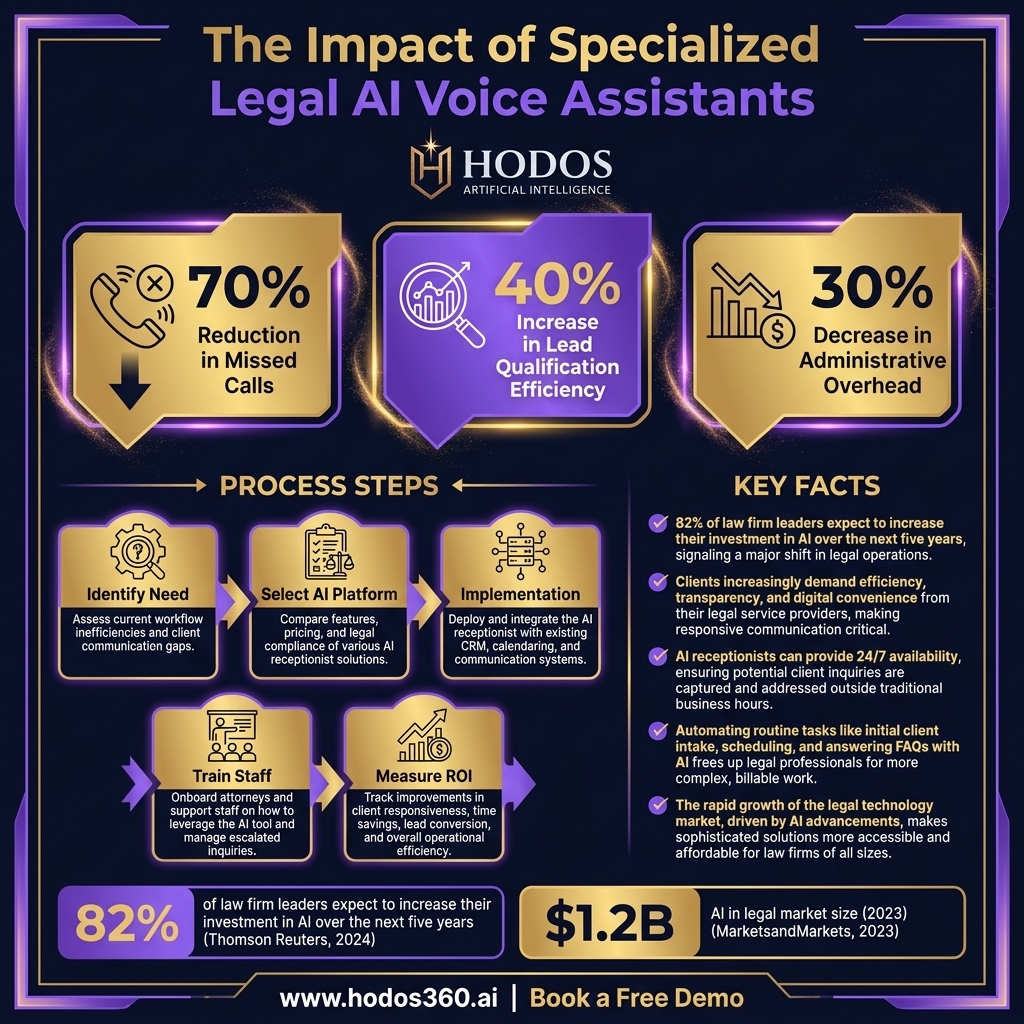
The modern client expects immediate, personalized, and efficient service, and an AI voice assistant is uniquely positioned to deliver this. By providing 24/7 availability, multilingual support, and rapid response times, an AI receptionist significantly enhances the client experience from the very first interaction. From an operational standpoint, this means a dramatic reduction in missed calls and voicemails, ensuring that every potential lead is captured and processed promptly. Learn more about Essential AI SMS Marketing: Drive Law Firm Growth. The efficiency gains are not just theoretical; they translate into tangible benefits like reduced administrative costs, optimized staff workload, and a streamlined client intake process that can cut down the time from initial contact to retainer agreement.
Ready to empower your legal team and elevate client satisfaction? Explore HODOS 360's comprehensive AI solutions for law firms.
Navigating Ethical AI in Client Communications
The deployment of an AI receptionist in a legal context introduces a complex layer of ethical considerations that extend far beyond mere technological implementation. Law firms operate under strict professional conduct rules, such as those promulgated by the American Bar Association (ABA), which govern client confidentiality, competence, and supervision of non-lawyer personnel. When an AI system becomes the primary point of contact for potential and existing clients, firms must ensure that the technology complies with these exacting standards. For instance, how is client data handled and stored? Is it encrypted? Who has access? These questions directly relate to ABA Model Rule 1.6 (Confidentiality of Information), which mandates that lawyers take reasonable measures to protect sensitive client data.
Beyond data security, the competence of the AI in handling legal inquiries is paramount. While an AI can answer factual questions, it must never cross the line into providing legal advice. This distinction is critical and directly impacts a firm's adherence to ABA Model Rule 1.1 (Competence) and unauthorized practice of law statutes. Learn more about AI Websites: Essential for Law Firm Growth & Control. A sophisticated legal AI voice assistant is programmed with guardrails, designed to identify queries that require human legal judgment and to route those calls appropriately, rather than attempting to answer them.
Furthermore, the transparency with which an AI is used is an emerging ethical concern. Should clients be explicitly informed they are speaking with an AI? While there isn't yet explicit ABA guidance on this specific point, the principle of honesty and candor in client communications suggests that transparency is advisable. Clients have a right to know if they are interacting with a human or an automated system, especially when discussing sensitive legal matters. This proactive approach to transparency not only aligns with ethical best practices but also contributes to a positive client experience.
Security, Compliance, and Data Privacy in AI Voice Solutions
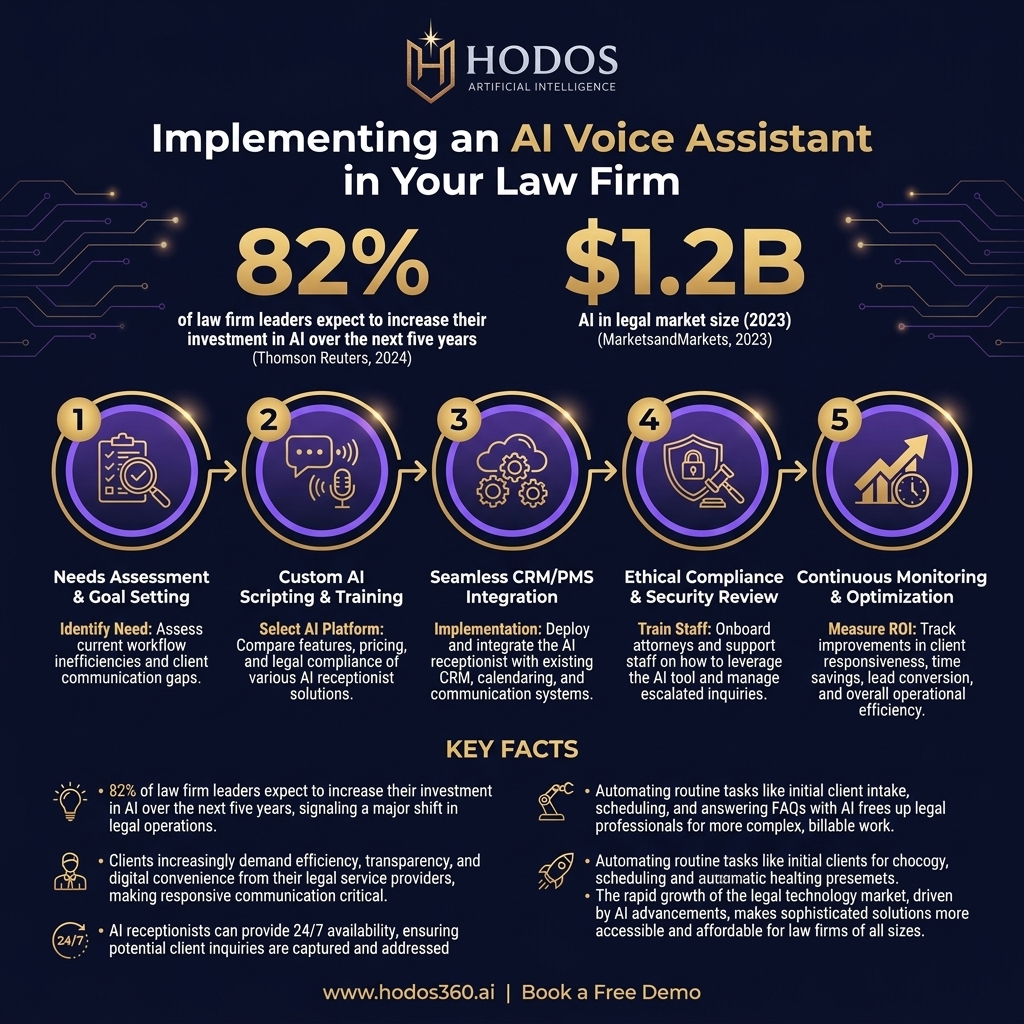
For law firms, the security and privacy implications of an AI voice assistant are paramount. Client confidentiality is not just an ethical obligation but a legal one, enforced by state bar associations and privacy regulations. Any AI solution must provide robust data encryption, secure cloud infrastructure, and strict access controls to protect sensitive client communications. Learn more about AI Legal Startup Sandstone: Unlocking 2026's Legal Tech Future. Firms must scrutinize the provider's data handling policies, understanding where data is stored, how long it is retained, and whether it is used for further AI model training without explicit consent. Compliance with regulations like HIPAA (for healthcare law), GDPR, or CCPA, depending on the firm's jurisdiction and client base, is non-negotiable.
The Future is Calling: Embracing AI for Sustainable Growth
The narrative around AI in legal is shifting from skepticism to strategic adoption, driven by market pressures, client expectations, and the undeniable efficiency gains offered by tools like the AI receptionist. Firms that embrace this technological evolution are not just surviving; they are positioning themselves for sustainable growth in an increasingly competitive landscape. The integration of AI voice assistants signifies a commitment to operational excellence and a forward-thinking approach to client service. This isn't about replacing the human element of law, but rather about augmenting it, allowing legal professionals to focus on the intricate, empathetic, and strategic aspects of their work that truly require their expertise.
The transformation extends beyond mere cost savings. It's about building a more responsive, accessible, and scalable law firm. Imagine a firm that can handle an exponential increase in client inquiries without adding a single administrative hire, simply by leveraging the power of AI to manage initial contact and qualification. This scalability is crucial for firms aiming to expand their market reach or enter new practice areas. Moreover, the data analytics provided by advanced AI systems offer unprecedented insights into client behavior, common pain points, and lead conversion metrics.
As Jensen Huang, CEO of Nvidia, often emphasizes, AI is not just a tool; it's a new industrial revolution that will reshape every industry. For law firms, this means recognizing that AI is no longer a futuristic concept but a present-day imperative. The firms that proactively invest in and strategically deploy AI solutions, from AI Law Firm Management Systems to AI Voice Assistants, will be the ones that thrive in the coming decades. This requires a cultural shift within firms, an openness to innovation, and a willingness to adapt traditional practices to leverage the full potential of artificial intelligence.
Ultimately, the choice facing law firms is not whether to adopt AI, but how to adopt it intelligently and ethically. While the allure of a low-cost AI receptionist is strong, the discerning law firm will look beyond the price tag to evaluate the comprehensive capabilities, security features, and ethical compliance of any voice AI solution. The future of legal practice is one where technology and human expertise converge to deliver superior client outcomes and operational efficiency.

Key Takeaways and Next Steps
The rise of the affordable AI receptionist marks a pivotal moment for law firms, presenting both immense opportunities and complex challenges. While headlines boast of low-cost solutions, the discerning legal professional understands that the unique demands of legal practice necessitate a more robust, secure, and ethically compliant AI voice assistant. The true value lies not in the cheapest option, but in a system that can intelligently qualify leads, manage sensitive information securely, provide multilingual support, and seamlessly integrate with existing legal tech infrastructure.
For law firms considering an AI voice assistant, the next steps are clear:
- ✓Assess Your Needs: Identify specific pain points in client intake, call management, and administrative workflows, considering how a specialized AI can address them.
- ✓Prioritize Security & Compliance: Vet potential AI solutions for enterprise-grade security, robust data privacy protocols, and strict adherence to legal ethical guidelines.
- ✓Seek Specialization: Opt for AI platforms designed specifically for the legal industry, understanding its nuances and regulatory environment, avoiding generic solutions.
- ✓Evaluate Integration Capabilities: Ensure the AI voice assistant can integrate smoothly with your existing AI-powered legal workflows, document automation, and client intake solutions.
- ✓Plan for Training & Oversight: Recognize that AI deployment is an ongoing process requiring continuous monitoring, adaptation, and human oversight to maintain efficacy and compliance.
- ✓Consider Comprehensive Platforms: Explore how integrated solutions like HODOS 360's offerings, including AI Marketing Platform and Web & Mobile Development, can provide a holistic digital strategy.
By approaching AI adoption strategically, law firms can transform their client communication, enhance operational efficiency, and build a more resilient and future-ready practice. HODOS 360 offers a comprehensive suite of AI-powered services, including specialized AI Voice Assistants, designed to meet the exacting standards of the legal profession, ensuring your firm not only keeps pace with innovation but leads it. Book a Free Demo to see HODOS 360 in action.
Frequently Asked Questions
What is an AI receptionist for law firms?+
An AI receptionist for law firms is an intelligent virtual assistant powered by artificial intelligence, specifically designed to handle inbound and outbound calls, qualify leads, schedule appointments, and provide general information. Unlike generic solutions, it's trained on legal terminology, adheres to ethical guidelines, and integrates with legal practice management systems to streamline operations and enhance client communication.
How does a specialized AI voice assistant differ from a generic $29 offering?+
A specialized AI voice assistant for law firms offers enterprise-grade security, compliance with legal ethics (e.g., client confidentiality), advanced lead qualification, multilingual support, and seamless integration with legal tech. A generic $29 offering typically provides basic call answering and routing without the legal-specific training, security, or customization necessary for a law firm's complex needs.
Can an AI receptionist provide legal advice?+
No, a properly configured AI receptionist for law firms should never provide legal advice. Its function is to gather information, answer factual questions about the firm, qualify leads, and schedule consultations. Ethical AI solutions are programmed with guardrails to recognize when a query requires human legal judgment and to route such calls to a qualified attorney or legal professional.
What are the ethical considerations for using AI in client communications?+
Key ethical considerations include client confidentiality (ABA Model Rule 1.6), ensuring the AI does not engage in the unauthorized practice of law (ABA Model Rule 1.1), and transparency with clients about AI interaction. Firms must ensure robust data security, continuous oversight of the AI's performance, and clear disclosures to clients that they are interacting with an automated system.
How can an AI voice assistant improve a law firm's client intake process?+
An AI voice assistant can dramatically improve client intake by providing 24/7 availability, ensuring no calls are missed. It can pre-qualify leads by asking relevant questions, gather essential client information securely, and automatically schedule appointments directly into attorneys' calendars. This streamlines the process, reduces administrative burden, and leads to higher lead conversion rates and client satisfaction.