


AI Website Redesign: Essential for Modern Law Firms
The legal landscape is undergoing a profound digital transformation, and nowhere is this more evident than in the strategic importance of a law firm's online presence. For too long, legal websites have been static, digital brochures – often aesthetically pleasing but functionally inert. However, as DSC Web Services recently highlighted, the conversation around website redesign has shifted dramatically. It's no longer just about looks; it's about embedding artificial intelligence into the very fabric of your digital front door. This paradigm shift, driven by rapid advancements in AI, compels law firms to re-evaluate their online strategies, moving from passive information repositories to active, intelligent client engagement platforms. The firms that embrace this evolution are not just staying competitive; they are redefining what it means to connect with clients in the 21st century legal market.
Consider the journey of a prospective client today: they don't just browse; they search, they ask, they expect immediate, personalized relevance. The digital experience a law firm provides can be the decisive factor in converting a lead into a loyal client. This isn't theoretical; the ABA's 2023 Legal Technology Report revealed a significant uptick in law firms leveraging technology for client intake and communication, a trend only accelerating. Firms that have invested in rudimentary digital marketing often see limited returns because their underlying web infrastructure isn't designed for intelligent interaction. The challenge lies in building a website that not only looks professional but actively learns from visitor behavior, anticipates their needs, and guides them through a seamless, personalized journey. This is where AI website redesign becomes not just an advantage, but an essential component of a future-proof legal practice.
This transformation isn't an overnight phenomenon but a culmination of years of AI development, now reaching maturity in practical applications. We've seen titans like OpenAI's Sam Altman and Anthropic's Dario Amodei push the boundaries of large language models, making sophisticated AI accessible for bespoke applications. For law firms, this means leveraging AI to automate mundane tasks, personalize content at scale, and provide an unparalleled user experience. The implications are vast, impacting everything from initial client intake to ongoing case management. The question is no longer if AI will reshape legal web development, but how quickly law firms will adapt to harness its full potential for growth and client satisfaction. Ignoring this trend is akin to ignoring the internet itself in the early 2000s – a perilous choice for any ambitious legal practice.
The Evolution of Legal Websites: Beyond Static Brochures
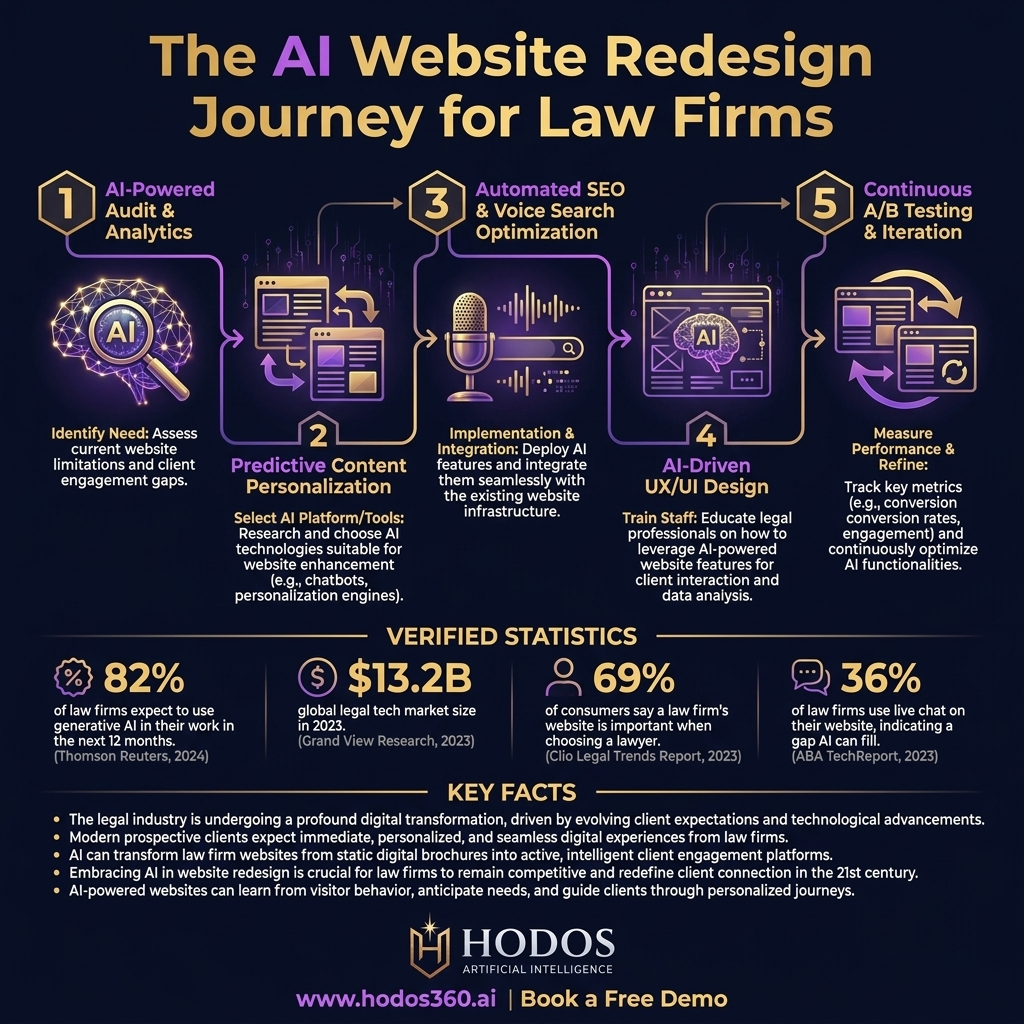
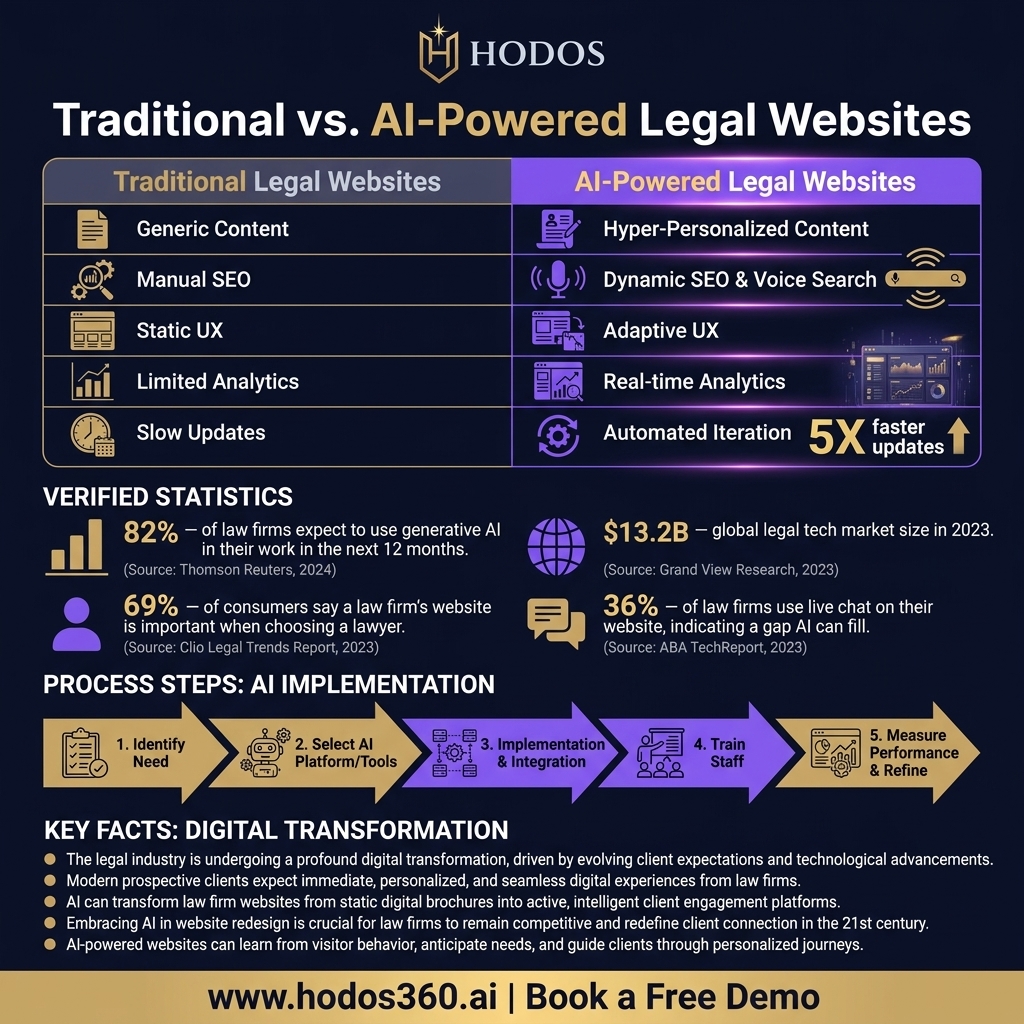
For decades, a law firm's website design was primarily about visual appeal and providing basic contact information. These digital storefronts often mirrored their physical counterparts: respectable, perhaps a bit conservative, but largely static. The focus was on displaying attorney bios, practice areas, and a contact form. While foundational, this approach is now woefully inadequate for the modern digital consumer, who expects dynamic, interactive, and highly personalized experiences across all online services. The shift isn't just about adding a chatbot; it's about embedding intelligence that understands user intent, predicts their needs, and delivers relevant content proactively. This is the core of an AI website redesign strategy, moving beyond mere aesthetics to deep functional intelligence.
Leading the charge in this evolution are platforms that integrate AI at every layer of web development. Take, for instance, the broader trend observed by Gartner, which predicts that by 2027, generative AI will be embedded in 80% of enterprise applications, up from less than 5% in 2023. This isn't just for tech giants; it's permeating every sector, including legal. Learn more about AI Website Redesign: Essential for Modern Legal Firms. Law firms that once relied on generic templates and manual updates are now exploring AI-powered platforms that can dynamically adapt content based on user location, search history, and specific legal queries. This kind of adaptive design ensures that a visitor seeking, for example, 'estate planning lawyer in Austin' receives not just a generic page, but tailored articles, relevant attorney profiles, and even personalized scheduling options, all optimized for their specific context. The 'looks' are still important, but they are now subservient to intelligent functionality.
This radical rethinking of website functionality is also influenced by the competitive landscape. Legal tech startups, often backed by significant funding – such as Harvey AI's substantial backing that led to its partnership with Allen & Overy – are demonstrating the immense potential of AI in legal operations. While Harvey AI focuses on legal research and drafting, the underlying principle of leveraging advanced AI to enhance professional services is directly applicable to web presence. Firms that delay their redesign to incorporate AI risk being overshadowed by competitors who are already offering superior, more engaging digital experiences. The cost of inaction, in terms of lost leads and diminished brand perception, is becoming significantly longer than the investment in a truly modern, AI-driven website.
From Generic to Hyper-Personalized Experiences
The hallmark of an effective AI website redesign is its ability to deliver hyper-personalization. Traditional websites offer a one-size-fits-all experience, assuming every visitor has the same needs. AI, however, allows for a granular understanding of individual user intent. By analyzing browsing patterns, time spent on pages, referral sources, and even implied sentiment from search queries, AI algorithms can dynamically adjust content, calls-to-action, and even visual elements in real-time. Learn more about Ultimate AI Search SEO Guide for Law Firms: Essential Strategies. Imagine a divorce attorney's site where a visitor from a 'child custody' search sees immediate prominence given to relevant articles and attorney profiles, while a visitor from a 'spousal support' search sees different, equally relevant content. This level of tailored interaction significantly boosts engagement and conversion rates, making the client feel understood and valued from their very first digital interaction. This shift is critical for firms seeking to optimize their digital footprint and ensure their online presence is genuinely helpful and effective.
AI-Powered Personalization and Client Engagement
The true power of AI website redesign for law firms lies in its capacity to transform client engagement from a passive interaction to an active, personalized dialogue. Beyond basic personalization, AI can power sophisticated recommendation engines that suggest relevant legal articles, FAQs, or even specific legal services based on a user's inferred needs. For instance, a visitor browsing 'business litigation' content might be prompted with information about preventative legal audits, demonstrating foresight and value beyond immediate problem-solving. This proactive engagement builds trust and positions the firm as a knowledgeable, client-centric resource. The goal is not just to answer questions, but to anticipate them, fostering a deeper connection with potential clients and enhancing the overall user experience. This level of intelligent interaction is what sets an AI-driven website apart, making it a powerful tool for lead nurturing and conversion.
Furthermore, AI-powered chatbots and virtual assistants, seamlessly integrated into the design of the website, can provide 24/7 support, answering common queries, qualifying leads, and even scheduling initial consultations. This automation frees up valuable human resources within the firm, allowing attorneys and staff to focus on complex legal work rather than routine inquiries. These AI assistants are becoming increasingly sophisticated, capable of understanding nuanced legal questions and providing accurate, pre-approved responses, often in multiple languages. Learn more about AI Marketing Transforms Legal Web: Webflow's Vidoso Acquisition 2026. This immediate responsiveness is crucial in today's fast-paced digital world, where potential clients expect instant gratification. Firms like Clio, with its history of strategic acquisitions to broaden its legal tech ecosystem, understand that seamless client experience, from intake to billing, is paramount, and the website is the first touchpoint in this integrated journey.
The data generated by these AI interactions is invaluable. Every click, every question, every path a user takes provides rich information that AI algorithms can analyze to continuously optimize the website's performance. This continuous learning loop ensures that the site is always improving, adapting to changing user behaviors and market trends. Firms can gain insights into which practice areas are generating the most interest, what specific legal terms users are searching for, and where potential clients might be dropping off in the conversion funnel. This level of analytics, far beyond what traditional web analytics tools offer, empowers law firms to make data-driven decisions about their marketing strategies, content creation, and even practice area development. This robust feedback mechanism ensures that the AI website redesign is an ongoing, evolving asset, not a static project.
Voice Search and Semantic SEO for Law Firms
With the proliferation of smart speakers and mobile assistants, voice search has become an increasingly significant channel for prospective clients seeking legal help. An effective AI website redesign must integrate advanced semantic SEO strategies to capture this growing segment. Unlike traditional keyword-based search, voice queries are often longer, more conversational, and intent-driven. AI algorithms can analyze these complex queries to understand the underlying meaning and context, ensuring that a law firm's website content is optimized for natural language processing. Learn more about Future Ready Lawyer: Essential AI Confidence for Legal Professionals. This means focusing on answering specific questions directly and providing comprehensive, authoritative information that aligns with how people naturally speak. Firms that fail to adapt their design for voice search will find their online visibility diminishing in a landscape increasingly dominated by conversational AI. This proactive approach to SEO is no longer optional; it's a necessity for digital discoverability.
The Operational Advantage: Streamlining with AI Web Development
Beyond client-facing enhancements, an AI website redesign offers significant operational advantages for law firms. AI-powered content generation tools can assist in drafting blog posts, FAQs, and even initial responses for inquiry forms, ensuring consistent messaging and freeing up attorney time. While human oversight remains crucial for legal accuracy and tone, AI can provide a robust first draft, significantly accelerating content creation workflows. Furthermore, AI can automate website maintenance tasks, such as broken link detection, image optimization, and even A/B testing variations of page layouts or calls-to-action, ensuring the website is always performing at its peak without constant manual intervention. This efficiency extends to lead qualification, where AI tools can filter and prioritize incoming inquiries, ensuring that attorneys engage with the most promising prospects. This backend automation is a game-changer for resource-constrained law firms.
Consider the burden of managing extensive legal libraries and ensuring all information is current and compliant. An AI website redesign can integrate systems that automatically flag outdated content or suggest updates based on changes in legislation or case law, drawing on vast legal databases. This proactive content management is invaluable for maintaining credibility and avoiding potential ethical pitfalls related to providing inaccurate or stale legal information. For instance, a firm specializing in regulatory compliance needs its website to reflect the latest statutes, such as those enforced by the EU AI Act or evolving data privacy laws like CCPA. Learn more about Voice AI: The Essential Shift to Personal Legal Assistants. AI can monitor these changes and prompt content reviews, or even suggest automatic updates to relevant sections of the site, ensuring the firm's online presence is always authoritative and up-to-date. This level of automated diligence minimizes risk and enhances the firm's reputation as a reliable legal resource.
Moreover, AI-powered analytics provide granular insights into website performance, far surpassing traditional metrics. Firms can track not just page views, but engagement with specific legal topics, the effectiveness of different calls-to-action, and even the sentiment expressed in user interactions with chatbots. This data allows for continuous optimization of the website's design and content, ensuring it aligns perfectly with client needs and firm objectives. For example, if data reveals that a particular services page has a high bounce rate, AI can suggest specific content or UX improvements to address the issue. This data-driven approach transforms the website from a static asset into a dynamic, intelligent system that continuously learns and improves, driving demonstrable ROI for the firm. This strategic use of AI ensures that every aspect of the online experience is purposeful and effective.
Automating Content and Intake Workflows
One of the most immediate benefits of an AI website redesign for law firms is the automation of content creation and client intake workflows. AI can assist in generating tailored content for different client segments, ensuring that marketing messages resonate more deeply. For intake, AI-driven forms can intelligently adapt based on user responses, gathering precise information needed for initial qualification. For example, if a prospective client indicates a personal injury case, the form can automatically expand to ask about accident details, medical treatment, and insurance information. Learn more about Essential AI Web Development: Build Legal Apps with Ease. This not only streamlines the intake process but also provides attorneys with comprehensive data before the first consultation, making the initial client interaction more productive and efficient. This focus on automation is crucial for scalability and ensuring no promising lead falls through the cracks, optimizing the firm's operational efficiency. This is where comprehensive platforms like HODOS 360, with its AI Law Firm Management System and AI-powered website building, truly shine, integrating these capabilities into a cohesive platform.
Securing Your Digital Frontier: Ethical AI and Data Privacy in Web Design
As law firms increasingly integrate AI into their website redesign, paramount importance must be placed on ethical AI use and robust data privacy. The collection and analysis of client information through AI tools must comply with stringent legal and ethical standards, including regulations like the General Data Protection Regulation (GDPR) and the California Consumer Privacy Act (CCPA). Law firms, as custodians of sensitive client data, have a heightened responsibility to ensure that their AI-powered website services are transparent about data collection practices, provide clear consent mechanisms, and implement state-of-the-art security protocols. The ethical implications of AI in legal marketing are a frequent topic at conferences like LegalTech NYC, where industry leaders debate best practices for responsible AI deployment. A firm's commitment to data privacy can be a significant differentiator, building trust with clients who are increasingly wary of how their personal data is used online. This focus on ethical design is non-negotiable.
Furthermore, the ethical considerations extend to the content generated by AI. While AI can draft initial content, human attorneys must review and approve all client-facing materials to ensure accuracy, compliance with ABA Model Rule 7.1 (Communications Concerning a Lawyer’s Services) regarding truthful and non-misleading communications, and adherence to the firm's brand voice. The potential for AI to generate biased or inaccurate information is a real concern, necessitating rigorous oversight. Firms must implement clear guidelines and workflows for AI-assisted content creation, ensuring that the technology serves as an assistant, not a replacement for legal expertise and ethical judgment. This dual approach – leveraging AI's power while maintaining human ethical control – is essential for responsible AI website redesign.
Finally, the security infrastructure supporting an AI-driven website must be impenetrable. With AI processing vast amounts of personal and potentially confidential information, the risk of cyberattacks or data breaches increases. Law firms must invest in advanced cybersecurity measures, including encryption, multi-factor authentication, and regular security audits, to protect client data. The reputation of a law firm can be severely damaged by a data breach, making proactive security a critical component of any AI website redesign project. Partnering with web development services providers that specialize in secure, compliant AI solutions is crucial. This proactive stance on security is not just about compliance; it's about safeguarding the trust that is fundamental to the attorney-client relationship. The complexities of ensuring compliance and security are no longer simple checkboxes but require continuous vigilance and expert partnership.

Key Takeaways and Next Steps for Your Law Firm
The message from the rapidly evolving digital landscape is clear: website redesign is fundamentally about AI. It's no longer sufficient for a law firm's online presence to be merely visually appealing. The modern legal consumer demands intelligence, personalization, and seamless interaction. Firms that embrace AI website redesign are positioning themselves for unparalleled growth, enhanced client satisfaction, and operational efficiency. From hyper-personalized content delivery and advanced SEO to automated client intake and robust data analytics, AI is transforming every facet of legal web development. The firms that hesitate risk falling behind in a competitive market where digital innovation is now a primary driver of success. The time to act is now, to ensure your firm's digital front door is not just open, but intelligently welcoming and effective.
For law firms ready to embark on this transformative journey, the next step is to partner with a legal tech expert that understands both the nuances of legal practice and the cutting edge of AI web development. Look for services that offer comprehensive solutions, from AI-powered website building and responsive design to SEO optimization and high-converting templates. Platforms like HODOS 360 are specifically engineered to provide these integrated capabilities, ensuring your firm's AI website redesign is not just a project, but a strategic investment in your future. Don't just update your website; intelligently evolve it to meet the demands of tomorrow's legal market. The future of legal client acquisition is here, and it's powered by AI.
Frequently Asked Questions
What is AI website redesign for law firms?+
AI website redesign for law firms involves integrating artificial intelligence into every aspect of a firm's online presence. This goes beyond mere aesthetics, focusing on AI-powered personalization, automated content generation, intelligent lead qualification, advanced SEO for voice search, and continuous performance optimization. The goal is to create a dynamic, learning website that anticipates client needs and delivers a highly engaging, efficient user experience, ultimately driving client acquisition and operational efficiency.
Why is AI integration essential for a law firm's website?+
AI integration is essential because it transforms a static website into a powerful, intelligent client engagement tool. It enables hyper-personalization, delivering tailored content to individual visitors, enhancing user experience, and improving conversion rates. AI also streamlines operations through automated lead qualification, content management, and advanced analytics, freeing up attorney time. In a competitive digital landscape, AI-powered websites offer a significant advantage in discoverability, client trust, and overall firm growth.
How does AI enhance SEO and client discoverability for law firms?+
AI enhances SEO by optimizing content for semantic search and voice queries, which are increasingly conversational and intent-driven. AI algorithms analyze complex queries to understand underlying meaning, ensuring a firm's website ranks higher for natural language searches. It also provides dynamic SEO adjustments, continuously learning from search trends and user behavior to keep the site highly discoverable. This proactive approach ensures law firms are found by prospective clients across diverse search platforms, including smart assistants.
What are the ethical considerations for AI in law firm website development?+
Ethical considerations include ensuring robust data privacy (compliance with GDPR, CCPA), transparency in data collection, and safeguarding client confidentiality. AI-generated content requires human oversight to ensure accuracy, avoid bias, and comply with legal advertising ethics (e.g., ABA Model Rule 7.1). Firms must implement strong cybersecurity measures to protect sensitive client information processed by AI. Prioritizing ethical AI use builds trust and upholds the legal profession's high standards of responsibility and client care.
How can HODOS 360 assist with AI website redesign for law firms?+
HODOS 360 offers a comprehensive Web & Mobile Development service specifically designed for law firms, featuring AI-powered website building. This includes responsive design, SEO optimization, and high-converting templates integrated with AI capabilities. Beyond just the website, HODOS 360's broader platform provides AI Law Firm Management, AI Marketing, and AI Voice Assistants, creating a holistic AI ecosystem. This ensures your AI website redesign is part of a larger, integrated strategy for client acquisition, management, and firm growth.