
Legal Intake: The Essential Guide for Modern Law Firms
The scene at the 2026 LegalTech NYC conference was electric, especially during the keynote address by Jack Newton, CEO of Clio. He presented compelling data from Clio's latest Legal Trends Report, highlighting a critical chasm in the legal industry: while client demand remains high, many law firms struggle with inefficient client acquisition, losing valuable leads before they even become clients.
Newton emphasized that the 'front door' of a law firm – the legal intake process – is often its weakest link, costing firms millions in missed opportunities. This isn't just about answering a phone; it's about a sophisticated, multi-stage interaction that sets the tone for the entire client relationship, impacting everything from revenue generation to client satisfaction and retention.
The traditional, often manual, approach to legal intake is no longer sustainable in a market that demands speed, transparency, and personalized service.
This critical juncture has propelled legal intake to the forefront of strategic discussions among managing partners and legal tech innovators alike. The question is no longer *if* technology will transform intake, but *how quickly* firms can adapt and leverage it to gain a competitive edge.
The stakes are incredibly high: a poorly managed intake process can lead to significant client churn and reputational damage. Conversely, a streamlined, client-centric intake system can dramatically improve conversion rates, enhance operational efficiency, and free up valuable attorney time for billable work. According to a recent Thomson Reuters report, firms that have invested in modern client intake solutions report a 25% increase in client satisfaction and a 15% improvement in lead conversion within the first year.
This demands a holistic approach that integrates technology, refined processes, and a deep understanding of prospective clients' needs and expectations.
Ready to revolutionize your firm's growth? Discover how HODOS 360 can transform your legal intake process today!
Understanding the Core of Legal Intake in Modern Practice
Legal intake is far more than just gathering contact details; it is the comprehensive process by which a law firm evaluates, qualifies, and ultimately onboards a prospective client. This initial engagement is the bedrock upon which all future client relationships are built, encompassing everything from the initial inquiry to the signing of an engagement letter.
In today’s competitive legal market, the efficiency and professionalism of this process are paramount. Firms must not only collect essential information but also conduct thorough conflict checks, assess the viability and profitability of a potential case, communicate clearly and empathetically with prospective clients, and manage expectations from the outset.
A recent study by the American Bar Association (ABA) highlighted that nearly 70% of potential clients decide whether to retain a law firm within the first 24 hours of initial contact, underscoring the urgency and criticality of a responsive and well-structured intake system.
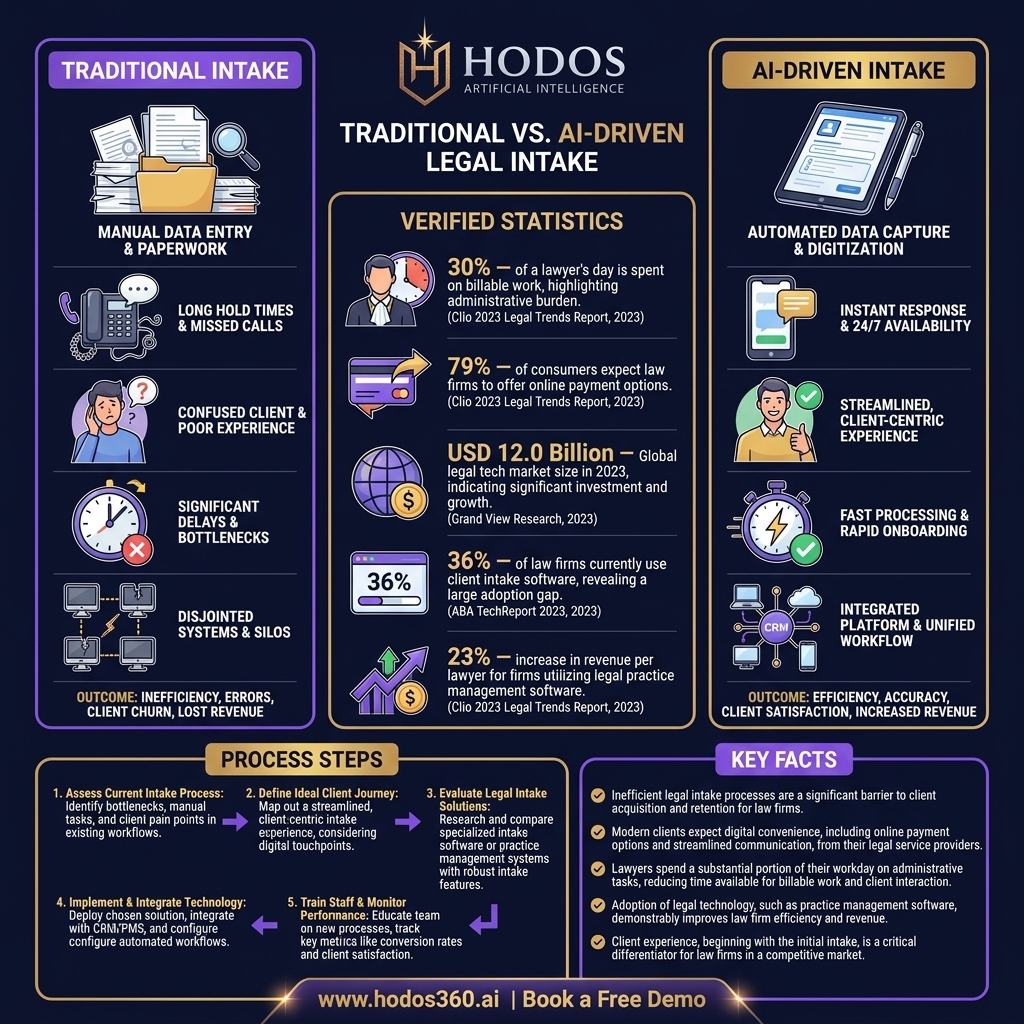
The traditional approach to legal intake often involves a series of manual, disjointed steps that can lead to significant inefficiencies and a poor client experience.
Learn more about AI Legal Research: The Ultimate Guide to legalgain & Beyond. This typically includes phone calls, email exchanges, paper forms, and multiple internal hand-offs, each introducing potential delays and opportunities for errors. This fragmented approach not only wastes valuable time for both the firm and the client but also creates a perception of disorganization.
As Sarah Chen, managing partner at LexNova Legal, remarked at a recent panel on legal innovation, "Our biggest revelation wasn't just *what* we were doing in intake, but *how* we were doing it. The manual steps were killing our conversion rates and exhausting our team, forcing us to rethink our entire approach to client engagement."
The Traditional Legal Intake Process: Challenges and Bottlenecks
Historically, the legal intake process has been characterized by its reliance on manual effort, fragmented systems, and a lack of standardized protocols, leading to a host of operational inefficiencies and missed opportunities. Picture the scenario: a prospective client calls a law firm, often during a stressful life event.
They might be directed to voicemail, wait on hold, or be asked to fill out lengthy paper forms that require repetitive data entry – a significant deterrent. Beyond the client experience, the internal process is often equally convoluted, with intake specialists manually transcribing information, conducting conflict checks by cross-referencing multiple databases, and physically routing documents for attorney review.
This series of manual hand-offs is prone to human error, delays, and a lack of real-time visibility into the status of a lead.
One of the most significant challenges in traditional client intake is the inconsistent application of best practices and the absence of a centralized system for data management.
Learn more about AI Search Optimization: An Essential Guide for Law Firms. Without a unified platform, client information might be stored in a CRM, a separate case management system, and even in attorneys' personal notes. This data fragmentation makes it incredibly difficult to obtain a holistic view of a prospective client or conduct comprehensive conflict checks efficiently.
Furthermore, the lack of standardization means that different intake specialists might follow varying protocols, leading to inconsistencies in client screening and communication. This not only creates an uneven client experience but also poses significant compliance risks, particularly concerning client confidentiality and ethical obligations under rules like ABA Model Rule 1.6 (Confidentiality of Information).
Navigating Ethical Considerations in AI-Enhanced Intake
While AI offers transformative potential for legal intake, it also introduces complex ethical considerations that law firms must proactively address. The use of AI in collecting and processing sensitive client information, performing initial conflict checks, and even providing preliminary case assessments raises questions about data privacy, security, and the unauthorized practice of law.
Firms must ensure that any AI system used complies strictly with regulations like the General Data Protection Regulation (GDPR) or state-specific privacy laws in the U.S., such as the California Consumer Privacy Act (CCPA), particularly when handling personally identifiable information (PII). Learn more about Voice AI: Essential Evolution of the Legal User Interface.
The ethical duty of confidentiality (ABA Model Rule 1.6) requires robust security protocols and clearly defined data governance policies. The line between providing helpful information and offering legal advice must be carefully managed by the AI, typically by designing it to gather facts and present options rather than render judgments.
Ready to empower your firm with cutting-edge AI for seamless operations and enhanced client engagement? Request a personalized demo of HODOS 360's AI-powered solutions today!
AI-Powered Transformation: Revolutionizing Legal Intake with HODOS 360
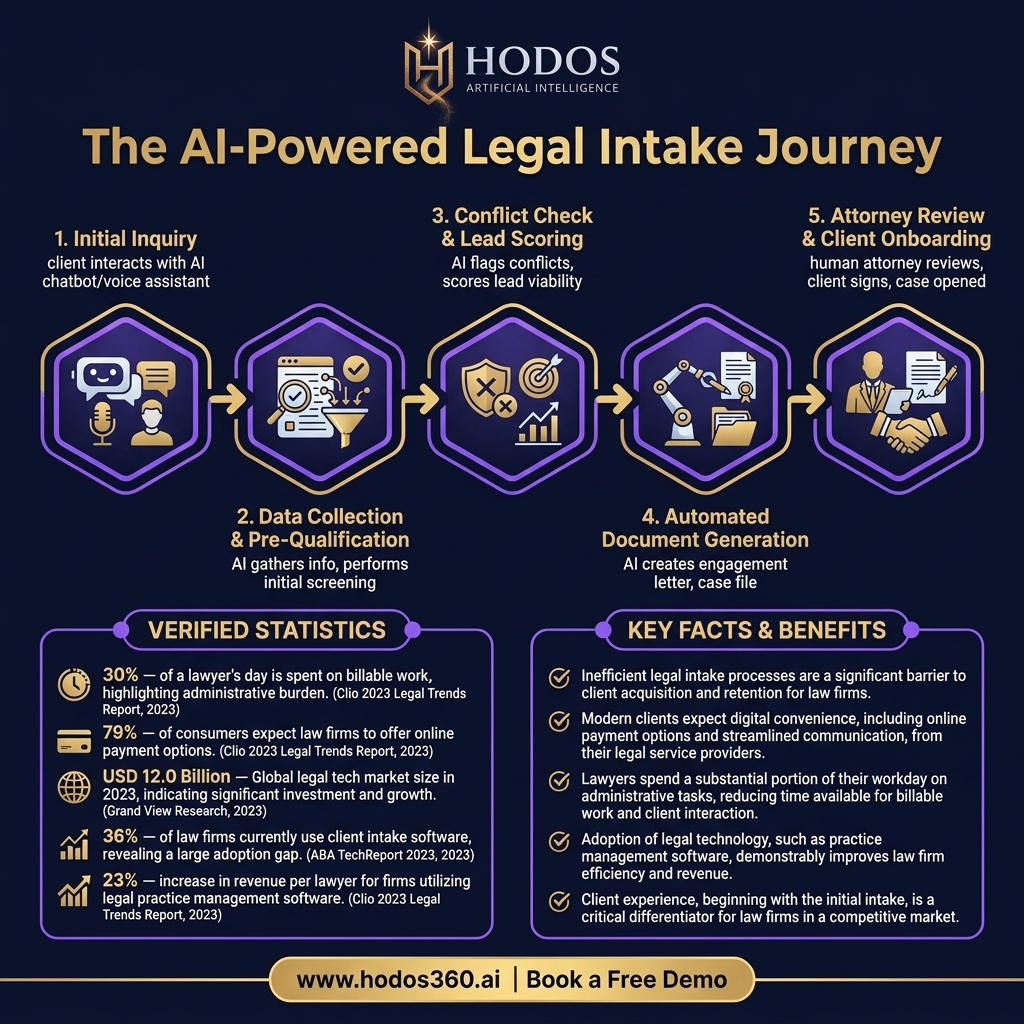
The advent of artificial intelligence has ushered in a new era for legal intake, transforming it from a cumbersome bottleneck into a strategic advantage. AI-powered platforms, like the HODOS 360 AI Law Firm Management System, are fundamentally reshaping how law firms interact with prospective clients, automating repetitive tasks, enhancing data accuracy, and providing invaluable insights.
Imagine a prospective client initiating contact through a firm's website. Instead of a static form, they encounter an AI-powered chatbot or virtual assistant that intelligently guides them through an interactive intake questionnaire. This system can dynamically adapt questions based on previous answers, ensuring all necessary information is collected efficiently and comprehensively.
Learn more about AI Websites: Essential for Law Firm Growth & Control. This immediate, guided interaction not only improves the client experience but also ensures that the firm gathers all pertinent details upfront, significantly reducing follow-up calls and emails.
One of the most compelling aspects of AI in legal intake is its ability to provide real-time lead qualification and triage.
After a prospective client submits their information, AI algorithms can analyze the data against predefined criteria – such as practice area fit, potential case value, and likelihood of success – to score and prioritize leads. This intelligent triage ensures that attorneys and intake specialists focus their valuable time on the most promising cases, maximizing conversion rates and optimizing resource allocation.
As Maya Gupta, CTO of a rapidly growing mid-sized firm that recently implemented AI intake, noted, "The AI isn't replacing our human judgment; it's augmenting it, allowing our attorneys to spend less time sifting through unqualified leads and more time building relationships with clients who truly need our help."
This capability extends to creating initial case files within the firm's case management system, setting up billing profiles, and scheduling initial consultations, all with minimal human oversight.
Measuring Success: KPIs for Optimized Intake Workflows
To truly leverage the power of AI in legal intake, firms must establish clear Key Performance Indicators (KPIs) to monitor and optimize their workflows. Critical KPIs include lead-to-client conversion rate, average time to conversion, cost per acquisition (CPA), and client satisfaction scores for the intake process.
For example, a firm might track how many initial inquiries convert into signed engagement letters, aiming for a target conversion rate of 20-30%. The average time to conversion, from first contact to retainer, should ideally be minimized. Learn more about AI Legal Platform: The Ultimate Guide to Unified Firm Operations.
CPA helps assess the ROI of marketing efforts combined with intake efficiency. By consistently tracking these metrics, firms can identify areas for further optimization, demonstrate the tangible benefits of their AI investments, and make data-driven decisions to refine their intake strategies.
- ✓Automated Lead Qualification: AI algorithms instantly assess lead viability, prioritizing high-potential prospective clients.
- ✓Enhanced Data Accuracy: AI-driven forms and data extraction minimize human error, ensuring precise client information.
- ✓Accelerated Conflict Checks: AI rapidly cross-references client databases for conflicts of interest, reducing ethical risks.
- ✓Personalized Client Experience: Dynamic, AI-powered interactions provide a tailored intake journey, improving client engagement.
- ✓Streamlined Document Generation: Automated creation of engagement letters and initial case documents saves significant time.
- ✓24/7 Availability and Responsiveness: AI voice assistants or chatbots offer round-the-clock support, ensuring no lead is missed.
- ✓Actionable Analytics and Reporting: AI platforms provide deep insights into intake performance, identifying bottlenecks and opportunities.
Implementing Best Practices for Superior Client Intake
Beyond technology, successful legal intake hinges on implementing a set of best practices that prioritize both efficiency and the client experience. One foundational best practice is to adopt a client-centric approach, viewing the intake process not as a series of administrative hurdles but as the client's first interaction with your firm's brand and values.
This means designing intuitive, user-friendly intake forms, providing clear communication at every step, and ensuring that prospective clients feel heard and understood. Firms should also standardize their intake protocols across all touchpoints – phone, email, website, and in-person – to ensure a consistent and professional experience.
As David Lat, founder of Original Jurisdiction, often emphasizes, "The firms that win today are those that treat every interaction as an opportunity to build trust, starting with intake."
Another critical best practice involves rapid and consistent follow-up. In the digital age, prospective clients expect immediate responses.
Studies show that firms that respond to inquiries within minutes, rather than hours or days, have significantly higher conversion rates. Learn more about AI Alliances Reshuffle: Essential Legal Tech Strategy for Firms. This is where AI-powered voice assistants and automated email sequences can play a pivotal role, ensuring that initial inquiries are acknowledged and triaged instantly, even outside of business hours.
However, automation must be coupled with human oversight. A prompt automated response should quickly be followed by a personalized outreach from an intake specialist or attorney. Firms should also prioritize transparency throughout the process, clearly explaining the next steps and what information is required from the client.
This proactive communication helps manage client expectations and reduces anxiety, fostering a sense of trust and reliability.
Building a Client-Centric Intake Culture
Cultivating a client-centric intake culture goes beyond implementing technology; it requires a fundamental shift in mindset across the entire firm. This involves training all staff, from receptionists to senior partners, on the importance of the intake process and their role in delivering an exceptional client experience.
Emphasis should be placed on empathy, active listening, and clear communication. Regular workshops and role-playing exercises can help staff develop the skills needed to handle diverse client inquiries, address concerns, and guide prospective clients smoothly through the initial stages. By fostering a culture where every team member understands that the client's journey begins with intake, and that their actions directly impact the firm's success, firms can transform their intake from a mere procedure into a powerful client acquisition and retention engine.
Key Takeaways and Next Steps
The imperative for modern law firms is clear: a strategically optimized legal intake process is no longer a luxury but a necessity for sustainable growth and competitive advantage. The days of manual, disjointed intake are rapidly fading, replaced by sophisticated, AI-driven systems that promise unparalleled efficiency, accuracy, and client satisfaction.
Firms that embrace this transformation are not just streamlining operations; they are fundamentally reshaping their client relationships, building trust from the very first interaction, and positioning themselves as leaders in a rapidly evolving legal landscape. The data from industry reports, the insights from prominent legal tech leaders, and the tangible results from early adopters all point to one undeniable conclusion: investing in intelligent intake solutions yields significant returns, both in terms of profitability and reputation.
For law firm owners and legal professionals looking to navigate this new frontier, the path forward involves a critical assessment of current intake processes, an openness to technological innovation, and a commitment to continuous improvement. Platforms like the HODOS 360 AI Law Firm Management System offer a comprehensive suite of tools designed precisely for this purpose, integrating AI-powered workflows, document automation, and intelligent lead qualification to create a seamless, efficient, and client-centric intake experience.
By leveraging such advanced solutions, firms can reduce administrative burdens, increase conversion rates, and free up attorneys to focus on what they do best: delivering exceptional legal services. The future of legal practice is here, and it begins with a smarter, more strategic approach to client intake.
Frequently Asked Questions
What is legal intake and why is it so important for law firms?+
Legal intake is the initial process where a law firm collects information from prospective clients, evaluates their case, conducts conflict checks, and determines if it's a good fit for representation. It's crucial because it's the first impression a firm makes, directly impacting client conversion rates, operational efficiency, and overall client satisfaction. A smooth intake process sets a professional tone, builds trust, and ensures the firm is selecting cases that align with its expertise and business goals.
How does AI specifically improve the legal intake process?+
AI significantly enhances legal intake by automating repetitive tasks like data entry and initial conflict checks, ensuring 24/7 responsiveness, and providing intelligent lead qualification. AI-powered chatbots guide prospective clients through dynamic questionnaires, ensuring comprehensive data collection. It can also automatically generate initial documents and integrate client information seamlessly into case management systems, drastically reducing manual effort, errors, and conversion time.
What are the biggest challenges law firms face with traditional intake methods?+
Traditional intake methods often suffer from manual processes, fragmented data storage, and inconsistent protocols. This leads to slow response times, repetitive data entry, high potential for human error, and difficulty in tracking lead status. Prospective clients can become frustrated by cumbersome forms and delays, often abandoning the process and seeking more agile firms, resulting in significant lost revenue and operational inefficiencies.
Are there ethical concerns when using AI for legal intake?+
Yes, ethical concerns primarily revolve around data privacy, client confidentiality (ABA Model Rule 1.6), and the unauthorized practice of law. Firms must ensure AI systems comply with data protection regulations (e.g., GDPR, CCPA), maintain robust security, and avoid premature attorney-client relationship formation. AI should be designed to gather facts and present options, not to provide legal advice, with clear disclaimers to manage client expectations.
What key metrics should law firms track to measure the success of their intake process?+
Law firms should track key performance indicators (KPIs) such as lead-to-client conversion rate, average time to conversion (from inquiry to retainer), cost per acquisition (CPA), and client satisfaction scores specific to the intake experience. Monitoring the percentage of qualified leads and identifying bottlenecks in the workflow are also crucial. These metrics provide actionable insights to continuously refine and optimize the intake process for maximum effectiveness.