
AI Legal Platform: The Ultimate Guide to Unified Firm Operations
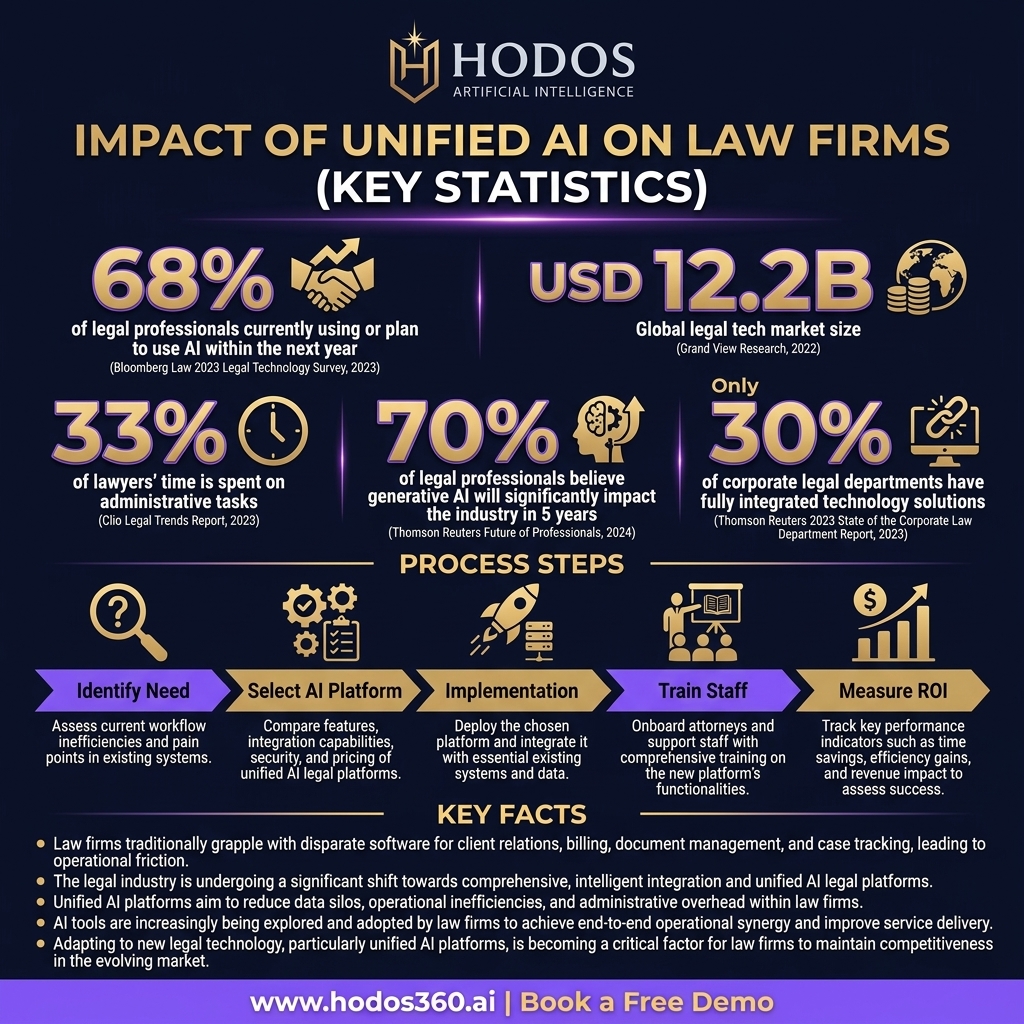
The legal landscape is in the midst of a technological renaissance, where the fragmented toolkits of yesterday are rapidly giving way to sophisticated, unified AI legal platforms. For years, law firms, from burgeoning solos to multinational powerhouses, grappled with a patchwork of disparate software solutions—CRM for client relations, separate systems for billing, document management, and case tracking.
This operational friction, often leading to data silos, inefficiencies, and increased administrative overhead, became an undeniable impediment to growth and client satisfaction. The recent announcement of MyLegal 4, a unified AI platform poised to redefine corporate legal operations, is not just a product launch; it's a resounding affirmation of an industry-wide shift towards comprehensive, intelligent integration.
This trend signals a critical juncture for law firm owners and attorneys: adapt or risk being outmaneuvered in an increasingly competitive market.
This shift isn't merely about adopting new software; it's a fundamental re-evaluation of how legal services are delivered and managed. According to the ABA's 2023 Legal Technology Survey Report, adoption rates for AI tools in law firms have steadily climbed, with a notable increase in firms exploring solutions that promise end-to-end operational synergy.
Managing Partner Olivia Thorne of 'Veritas Legal Group,' a mid-sized firm specializing in IP law, recently shared her firm's journey: 'Before embracing a unified platform, our team spent countless hours reconciling data across five different systems. It was a constant drain on resources and a source of perpetual frustration.
The concept of a single source of truth, powered by AI, felt like a distant dream, but now it's a reality transforming our daily workflow.' Her experience underscores a widespread industry challenge and the profound impact of moving beyond piecemeal solutions to a truly integrated AI legal platform.
The Evolution of Legal Tech: From Fragmented Tools to Unified AI Platforms
For decades, legal technology evolved in a siloed fashion. We saw the rise of specialized tools: document management systems (DMS) like iManage, practice management software like Clio, and e-discovery platforms such as Relativity. While each offered significant improvements over manual processes, their lack of interoperability created a new set of challenges.
Attorneys and support staff often found themselves duplicating data entry, switching between multiple interfaces, and struggling to gain a holistic view of a case or client relationship. This fragmentation led to inefficiencies that, according to a recent Thomson Reuters report, could account for up to 30% of a legal professional's time being spent on administrative tasks rather than billable work.
The promise of automation remained partially realized as data flow bottlenecks persisted, hindering true legal workflow optimization. Learn more about AI Legal Marketing: Proven Strategies for Law Firm Growth. This era, characterized by powerful but disconnected tools, set the stage for the demand for a more cohesive approach.
The market began to respond with integrations, but these often amounted to superficial links rather than deep, native unification. The vision of a truly unified platform emerged from the recognition that legal operations are inherently interconnected. A client intake process, for example, feeds directly into case management, which then informs billing, document generation, and client communication.
Without a seamless flow of information across these functions, the benefits of individual tools are severely limited. Industry leaders like Brad Blickstein, founder of the Blickstein Group, have long advocated for a shift towards integrated solutions, emphasizing that 'the future of legal operations isn't about more tools, but smarter, more connected tools.'
This philosophical shift paved the way for the current generation of AI-powered platforms designed to act as a single source of truth for all firm activities, from initial client contact to case resolution and beyond.
Unpacking MyLegal 4: A Benchmark for Integrated Legal Operations
The recent announces of MyLegal 4 by AiThority highlights the growing momentum towards fully integrated AI solutions in the legal sector. While focused on corporate legal operations, the principles behind its design resonate deeply with the needs of law firms across the spectrum. MyLegal 4 is touted as a unified AI platform that aims to eliminate fragmented legal tech stacks by bringing AI, automation, CLM (Contract Lifecycle Management), and DMS into a single system designed for the future.
This move by MyLegal is a significant market indicator, demonstrating that the industry's demand for comprehensive solutions is being met with increasingly sophisticated offerings. The platform's emphasis on a 'Legal Front Door' concept, where all legal requests and data flow through one centralized portal, mirrors the optimal structure for any modern law firm seeking to enhance efficiency and client experience.
MyLegal 4’s strategy underscores a critical trend: the move beyond mere task automation to intelligent workflow orchestration. By integrating various functionalities—from intake and matter management to advanced analytics—it aims to provide a holistic view and control over legal processes. Learn more about Legal AI ROI: Maximizing Law Firm Value in 2026.
This approach is a direct answer to the inefficiencies caused by legacy systems. For instance, the software claims to leverage generative AI for document drafting and review, reducing the manual burden on legal teams. This kind of deep integration, where AI assists across multiple stages of a legal workflow, represents a paradigm shift.
Firms that embrace such solutions can expect not only cost savings but also a significant boost in productivity, allowing attorneys to focus on high-value strategic work rather than repetitive administrative tasks. This competitive move by MyLegal sets a new benchmark for what law firms should expect from their technology partners.
The Core Pillars of a Modern AI Legal Platform: Efficiency and Intelligence
A truly effective AI legal platform is built upon several foundational pillars that collectively drive efficiency and infuse intelligence into every aspect of a law firm's operations. The first is comprehensive case management, moving beyond basic calendaring to include intricate task management, deadline tracking, and document version control, all integrated with communication logs.

The second is intelligent client intake, which leverages AI to automate data collection, perform initial conflict checks, and even qualify leads, ensuring that valuable attorney time is only spent on viable prospects. This automation reduces the administrative burden significantly, allowing firms to onboard clients faster and more accurately.
The third pillar involves advanced document automation, where AI generates drafts of common legal documents, contracts, and filings based on predefined templates and case data, drastically cutting down drafting time and minimizing human error. These functionalities, when seamlessly integrated, represent a quantum leap from traditional, manual processes, redefining operational benchmarks for law firms.
Beyond these core functional areas, a modern unified platform must also deliver on critical strategic fronts. Learn more about AI Legal Research: The Ultimate Guide for Law Firms. AI-powered legal workflows are essential, using machine learning to predict next steps, suggest relevant precedents, and optimize task assignments, ensuring that cases progress efficiently and consistently.
Robust billing and financial management, integrated directly with case activities, eliminate discrepancies and accelerate the billing cycle. Furthermore, the platform must offer sophisticated analytics and ROI tracking, providing law firm leaders with actionable insights into performance, profitability, and resource allocation. This data-driven approach empowers firms to make informed strategic decisions, identify areas for improvement, and demonstrate the tangible benefits of their technology investments.
Ultimately, the goal is to transform the firm into a lean, intelligent, and highly responsive legal service provider, ready to meet the demands of the 21st-century legal market with unparalleled agility.
Enhancing Client Experience Through AI
The impact of a unified AI legal platform extends far beyond internal efficiencies; it fundamentally transforms the client experience. With features like 24/7 AI voice assistants and client portals, firms can offer immediate responses to inquiries, provide real-time case updates, and streamline communication. This level of responsiveness and transparency builds trust and significantly enhances client satisfaction.
Clients today expect immediate access to information and seamless interactions, mirroring their experiences with other service providers. Learn more about Essential AI Website Builder Guide for Law Firms. Firms like 'Global Legal Advisors' have seen client retention rates improve by 15% after implementing an AI-driven client communication system, according to Managing Partner David Lee.
By reducing the friction points in client interactions and providing proactive updates, AI platforms ensure that clients feel valued and well-informed throughout their legal journey, fostering stronger, long-lasting relationships.
Strategic Advantages: Why Law Firms Need Unified AI Solutions
The adoption of a unified AI legal platform is no longer a luxury but a strategic imperative for law firms seeking to thrive in a rapidly evolving legal market. Firms that continue to rely on fragmented systems face significant disadvantages, including higher operational costs, increased risk of data errors, and slower response times.
In contrast, firms embracing integrated AI solutions gain a substantial competitive edge. They can allocate attorney time more effectively to complex legal analysis and client strategy, rather than administrative tasks. This not only boosts profitability but also improves attorney morale and reduces burnout, a critical factor in talent retention.
The ability to leverage AI for predictive analytics, identifying trends in litigation or client needs, provides a foresight that traditional methods simply cannot match, enabling proactive rather than reactive legal counsel.
Furthermore, a single platform ensures data consistency and security, which is paramount in the legal profession.
Learn more about Legal AI Adoption: An Essential Roadmap for Law Firms. With data breaches and cyber threats on the rise, maintaining client confidentiality and adhering to regulatory compliance (e.g., ABA Model Rule 1.6 on Confidentiality of Information) is more challenging than ever. A unified system reduces the number of vulnerable access points and simplifies data governance, offering a more robust security posture.
This enhanced security, combined with the efficiency gains, translates directly into a stronger market position. As Daniel Katz, a leading scholar in legal AI at Illinois Tech Chicago-Kent College of Law, often emphasizes, 'The firms that embrace technological innovation strategically are not just surviving; they are fundamentally reshaping the delivery of legal services, creating new value propositions for their clients.'
This foresight is what separates market leaders from those struggling to keep pace, making the investment in a comprehensive AI legal platform a clear differentiator.
Data Security and Compliance in the AI Era
In an era of increasing cyber threats, the integrity and confidentiality of client data are paramount. A unified AI legal platform offers a centralized, secure environment for all sensitive information, mitigating the risks associated with data spread across multiple, unlinked systems. This consolidation simplifies compliance with stringent data protection regulations, such as GDPR or CCPA, and aligns with ethical obligations like ABA Model Rule 1.1 on Competence, which implies a duty to stay abreast of technology’s benefits and risks.
Learn more about AI Website Coding: An Essential Guide for Law Firms. Advanced encryption, access controls, and audit trails inherent in modern platforms provide a robust defense against breaches, ensuring that client trust remains inviolate. Law firms can confidently assure clients that their sensitive information is protected by state-of-the-art security measures, a significant competitive advantage in today's digital world.
Navigating the Future: Selecting the Right AI Legal Platform for Your Firm
As the market for AI legal platforms continues to expand, selecting the right software for your firm requires careful consideration. It's not just about features; it's about finding a partner whose solutions align with your firm's specific needs, growth trajectory, and ethical obligations. Begin by assessing your firm's most pressing pain points: Is it inefficient client intake?
Disjointed workflow management? Lack of actionable data? A platform that directly addresses these challenges will offer the most immediate and tangible ROI. Consider the scalability of the platform – can it grow with your firm, adapting to new practice areas or an expanding team? The user experience is also paramount; a powerful system is ineffective if it's not intuitive for attorneys and staff to use.
Look for platforms that offer comprehensive training and robust customer support, ensuring a smooth transition and ongoing optimization.
Furthermore, scrutinize the platform's AI capabilities. Does it genuinely enhance automation and intelligence across critical processes, or is AI merely a buzzword? Evaluate its ability to integrate with existing essential tools, such as court e-filing systems or specialized research databases, if full migration isn't immediately feasible.
Data security, as previously mentioned, should be a non-negotiable priority. Request detailed information on encryption protocols, compliance certifications, and disaster recovery plans. Finally, consider the vendor's long-term vision and commitment to innovation. The legal tech landscape is dynamic, and you need a partner who is continuously evolving their platform to meet future demands.
Platforms like HODOS 360, for example, offer a comprehensive suite of services including AI Law Firm Management and AI Marketing, demonstrating a holistic approach to supporting modern law firms. A thorough due diligence process will ensure that your investment yields maximum returns, positioning your firm at the forefront of legal innovation and operational excellence.
Implementing AI: Best Practices for Seamless Integration
Successful integration of an AI legal platform hinges on a strategic implementation plan. Begin with a pilot program involving a small, enthusiastic team to identify potential challenges and refine workflows before a firm-wide rollout. Invest in comprehensive training for all users, emphasizing the 'why' behind the change and the long-term benefits to their daily work.
Foster a culture of continuous feedback, allowing for iterative improvements and user adoption. Remember that technology is a tool; its effectiveness is amplified by the people who use it. By approaching implementation as a collaborative, ongoing process, law firms can maximize their investment and ensure a seamless transition to a more efficient, AI-powered future, fully leveraging the robust capabilities designed to transform their practice.

Key Takeaways and Next Steps
The emergence of unified AI legal platforms, exemplified by market announcements like MyLegal 4, signifies a pivotal moment for the legal industry. The era of fragmented legal tech is drawing to a close, replaced by integrated solutions that promise unprecedented levels of efficiency, intelligence, and competitive advantage.
For law firm owners and attorneys, the message is clear: embracing these technologies is no longer optional but essential for sustained growth and client satisfaction. By streamlining processes from client intake and case management to document automation and billing, these platforms enable legal professionals to reclaim valuable time, reduce operational costs, and elevate the quality of their services.
Firms that strategically invest in a comprehensive AI legal platform will not only enhance their internal operations but also significantly improve the client experience, build stronger relationships, and ensure robust data security. The choice of platform is critical, demanding thorough due diligence to find a solution that aligns with your firm's unique needs and future aspirations.
As the legal landscape continues to evolve, leveraging advanced AI will be the differentiator for firms that lead the way, setting new standards for legal service delivery in the digital age. This is your opportunity to not just adapt, but to redefine your firm's potential.
- ✓Consolidate Operations: Move beyond disparate tools to a single, unified AI platform for all firm management needs.
- ✓Boost Efficiency: Leverage AI for automated client intake, document generation, and intelligent workflow management.
- ✓Enhance Client Experience: Utilize AI voice assistants and client portals for 24/7 responsiveness and transparent communication.
- ✓Improve Data Security: Centralize data management to reduce vulnerabilities and ensure compliance with legal ethics and regulations.
- ✓Gain Strategic Insights: Access robust analytics for informed decision-making and tracking ROI on technology investments.
- ✓Stay Competitive: Position your firm at the forefront of legal innovation, attracting top talent and high-value clients.
- ✓Invest Wisely: Choose a platform that offers scalability, intuitive user experience, and strong vendor support.
Frequently Asked Questions
What is a unified AI legal platform?+
A unified AI legal platform integrates various law firm operations—like case management, client intake, billing, and document automation—into a single, intelligent system. It uses artificial intelligence to streamline workflows, automate repetitive tasks, and provide comprehensive insights, eliminating the need for multiple, disconnected software solutions. This holistic approach enhances efficiency, reduces errors, and improves overall firm performance.
How do AI legal platforms improve efficiency?+
AI legal platforms boost efficiency by automating time-consuming administrative tasks such as data entry, document drafting, and appointment scheduling. They streamline workflows, provide intelligent insights for case strategy, and centralize information, drastically reducing the time attorneys and staff spend on non-billable work. This allows legal professionals to focus on high-value tasks, legal analysis, and client-facing activities.
What are the benefits of AI in client intake?+
AI in client intake automates the initial data collection, performs conflict checks, and can even qualify leads, ensuring only viable prospects reach attorneys. This significantly reduces manual effort, accelerates the onboarding process, and minimizes human error. It also allows firms to offer 24/7 responsiveness, improving the client's first impression and overall satisfaction with the firm's efficiency and modernity.
Is data security a concern with AI legal platforms?+
Data security is a paramount concern, and reputable AI legal platforms are designed with robust security measures. They offer centralized, encrypted data storage, stringent access controls, and compliance with legal data protection regulations. Consolidating data into a single, secure platform actually reduces the number of vulnerable points compared to fragmented systems, enhancing overall data integrity and client confidentiality.
How can my firm choose the right AI legal platform?+
Selecting the right platform involves assessing your firm's specific pain points, considering the platform's scalability, user-friendliness, and integration capabilities. Evaluate its true AI functionalities, data security protocols, and the vendor's support and long-term vision. A thorough due diligence process, potentially involving pilot programs, will help ensure the chosen platform aligns with your firm's strategic goals and delivers maximum ROI.