


AI Alliances Reshuffle: Essential Legal Tech Strategy for Firms
The digital landscape is in constant flux, and few developments have sent as many ripples through the technology world as the recent reshuffling of Big Tech AI alliances. The news, highlighted by reports like "Big Tech AI alliances reshuffle as agent payments evolve" from 디지털투데이, points to a profound shift in how artificial intelligence capabilities are developed, distributed, and monetized.
This isn't merely a corporate boardroom drama; it's a strategic realignment that will fundamentally impact every sector, including the legal industry, necessitating a proactive evolution of legal tech strategy for law firms. The implications stretch from the underlying cloud infrastructure supporting AI models to the very nature of digital payments and automated legal workflows.
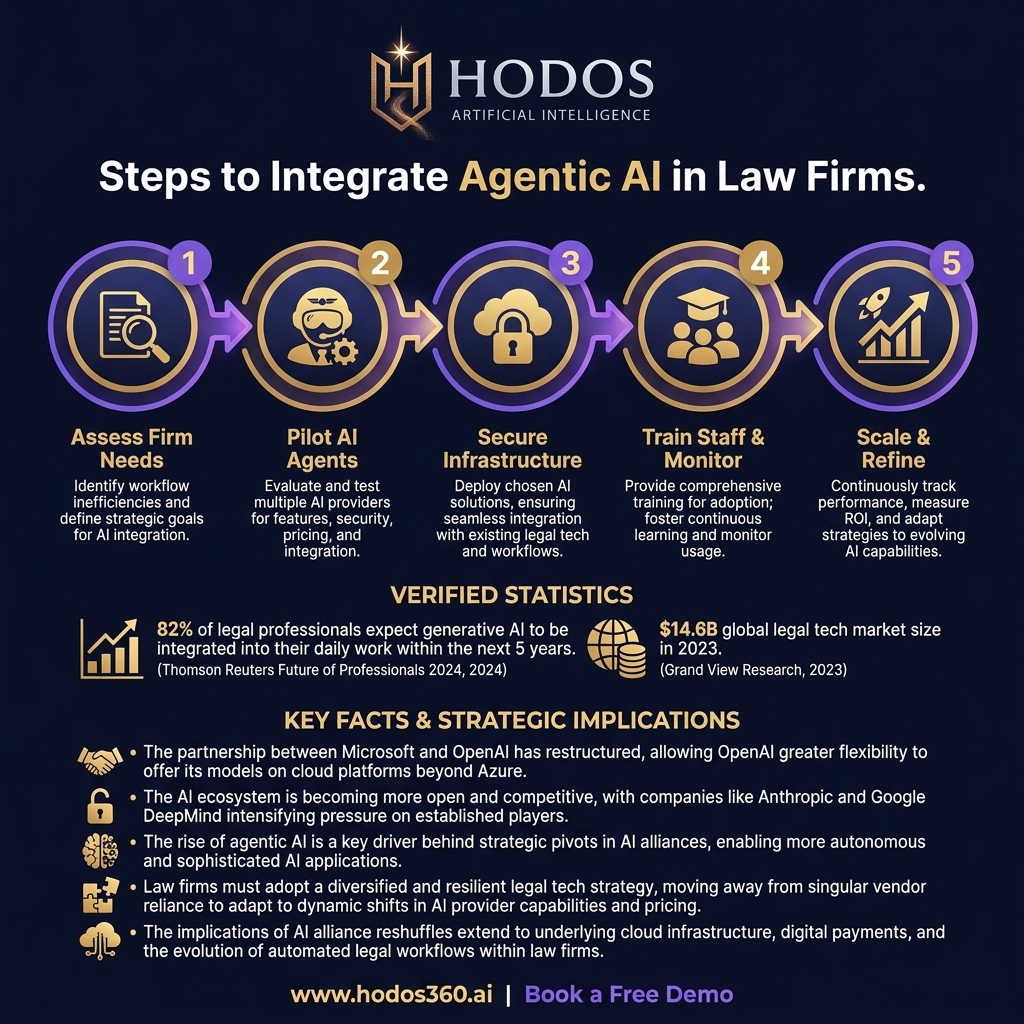
At the heart of this transformation is the evolving relationship between industry giants, exemplified by the restructured partnership between Microsoft and OpenAI. Initially, Microsoft's substantial investment granted it exclusive rights to integrate OpenAI's groundbreaking models like GPT into its Azure cloud services. However, recent adjustments now permit OpenAI greater flexibility to offer its models on other cloud platforms, signaling a move towards a more open and competitive AI ecosystem.
This strategic pivot, driven by the rapid maturation of AI and the burgeoning potential of agentic AI, means that law firms can no longer rely on singular vendor relationships but must instead build a diversified and resilient legal tech strategy that anticipates dynamic shifts in AI provider capabilities and pricing models.
The competitive pressures are immense, with companies like Anthropic, led by CEO Dario Amodei, and Google DeepMind constantly pushing the boundaries, compelling even established players like OpenAI and Microsoft to continually reassess their market positioning and offerings.
The Great AI Alliances Reshuffle and Its Legal Fallout
The recent adjustments in AI alliances among tech giants are not just about corporate strategy; they represent a fundamental recalibration of the AI market itself, with significant repercussions for law firms. The initial exclusive partnership between Microsoft and OpenAI, which saw Microsoft inject billions into the AI startup, was a defining moment in the AI race.
This arrangement provided OpenAI with critical resources while giving Microsoft a significant edge in integrating cutting-edge AI into its enterprise offerings. However, as AI models became more commoditized and the demand for diverse deployment options grew, the exclusivity became less tenable. Reports indicate that OpenAI sought greater flexibility, leading to a revised agreement that allows them to license their models more broadly, beyond just Microsoft Azure.
This shift was partly influenced by the intense competition from other major players like Google DeepMind and Anthropic, which have also secured substantial funding and strategic partnerships, such as Anthropic's multi-billion-dollar deals with Google and Amazon, as detailed in various tech financial reports.
This evolving landscape means that law firms, which increasingly rely on AI-powered legal tech, must reassess their vendor relationships and technology stack.
Firms that have heavily invested in a Microsoft-centric AI ecosystem, for instance, might now find themselves with more options, but also greater complexity in managing multiple AI service providers. The move towards a more open AI market, while offering greater choice and potentially lower costs due to increased competition, also demands a more sophisticated approach to due diligence and integration.
As Sam Altman, CEO of OpenAI, has often emphasized, the goal is to make AI broadly accessible and beneficial, a vision that naturally pushes against strict exclusivity. This strategic flexibility is crucial for the rapid innovation cycles characteristic of the AI sector, driving a need for adaptive legal tech strategy.
The implications extend to the very infrastructure underpinning legal operations. Learn more about AI Voice: Legal's 2026 Paradigm Shift & Innovation Catalyst. Law firms utilize AI across various functions, from document review and contract analysis to client intake and billing. If the foundational AI models they depend on are suddenly available across different cloud providers, it opens up opportunities for greater resilience and cost optimization.
Firms can potentially diversify their AI infrastructure, reducing reliance on a single vendor and mitigating risks associated with service outages or price hikes. This also encourages greater interoperability between different legal tech solutions, as they can tap into a wider pool of AI services. Legal tech companies, in turn, are adapting their platforms to be more modular and agnostic to the underlying AI model, recognizing that the future of AI will be defined by flexibility rather than rigid alliances.
Ultimately, the reshuffling of AI alliances underscores a broader trend: the democratization of advanced AI capabilities. What was once the exclusive domain of a few tech giants is now becoming more accessible, albeit with new complexities. Law firms must view this not as a challenge but as an opportunity to build a more robust and future-proof legal tech strategy.
By understanding the dynamics of these alliances and the trajectory of AI development, legal professionals can make informed decisions about their technology investments, ensuring they remain at the forefront of legal innovation. This requires a keen eye on industry news and a willingness to adapt, much like the tech giants themselves are doing in this rapidly evolving environment.
Agentic AI and the Future of Legal Payments & Workflows
A pivotal driver behind the evolving AI alliances is the rapid emergence of agentic AI, a paradigm shift that will profoundly reshape payment infrastructure and legal workflows. Unlike traditional AI, which typically executes predefined tasks, agentic AI systems are designed to autonomously plan, execute, and monitor complex goals, often interacting with other agents and systems to achieve desired outcomes.
For law firms, this translates into a future where AI agents can manage intricate processes like client intake, billing, and even aspects of case management with minimal human intervention. Imagine an AI agent not just generating an invoice, but proactively monitoring payment terms, sending automated reminders, and even initiating dispute resolution processes based on predefined rules and client agreements.
This evolution is already being discussed at major industry events like LegalTech NYC 2026, where experts are highlighting the potential for agentic AI to transform the financial aspects of legal practice. For instance, an AI agent could qualify leads by interacting with potential clients, book appointments, and even process initial retainer payments, all while adhering to specific firm policies and ethical guidelines.
This level of autonomy requires a robust and secure payment infrastructure that can handle agent-initiated transactions, verify identities, and ensure compliance with anti-money laundering (AML) regulations. Companies like PayPal and Stripe are already exploring how their platforms can adapt to this new reality, recognizing the potential for agent-mediated payments to become a multi-trillion-dollar market, as projected by various fintech analyses.
Within a law firm, agentic AI can streamline myriad administrative and operational tasks. For example, an AI agent integrated with a firm's case management system could automatically track billable hours, generate detailed expense reports, and reconcile accounts, significantly reducing the manual effort and potential for human error.
This automation extends beyond simple data entry; an agent could analyze spending patterns, identify opportunities for cost savings, and even predict future cash flow based on ongoing cases and projected client payments. Learn more about AI for Small Law Firms: The Essential Hub for Growth.
The ability of these AI agents to learn and adapt based on new data means they will continually optimize these processes, leading to unprecedented levels of efficiency and accuracy in legal operations. This allows legal professionals to focus on high-value legal work, rather than getting bogged down in administrative overhead.
The partnership between companies like Harvey AI and Allen & Overy already demonstrates the power of advanced AI in legal reasoning, and agentic AI will take this a step further by automating the *execution* of legal and administrative tasks.
The strategic adoption of agentic AI is not merely about efficiency; it's about competitive advantage and enhanced client experience.
Firms that successfully integrate these intelligent agents will be able to offer faster, more transparent, and more cost-effective services. Clients will benefit from quicker responses, more accurate billing, and a seamless digital journey from initial contact to case resolution. However, the implementation of agentic AI also presents challenges, particularly concerning oversight, accountability, and the ethical implications of autonomous decision-making.
Law firms must establish clear protocols and safeguards to ensure that AI agents operate within legal and ethical boundaries, a critical aspect that will be further explored in regulatory discussions surrounding AI governance. The shift in AI alliances fuels this innovation, making such powerful tools more accessible but also demanding greater strategic oversight from firms.
Impact on Client Intake and Billing Automation
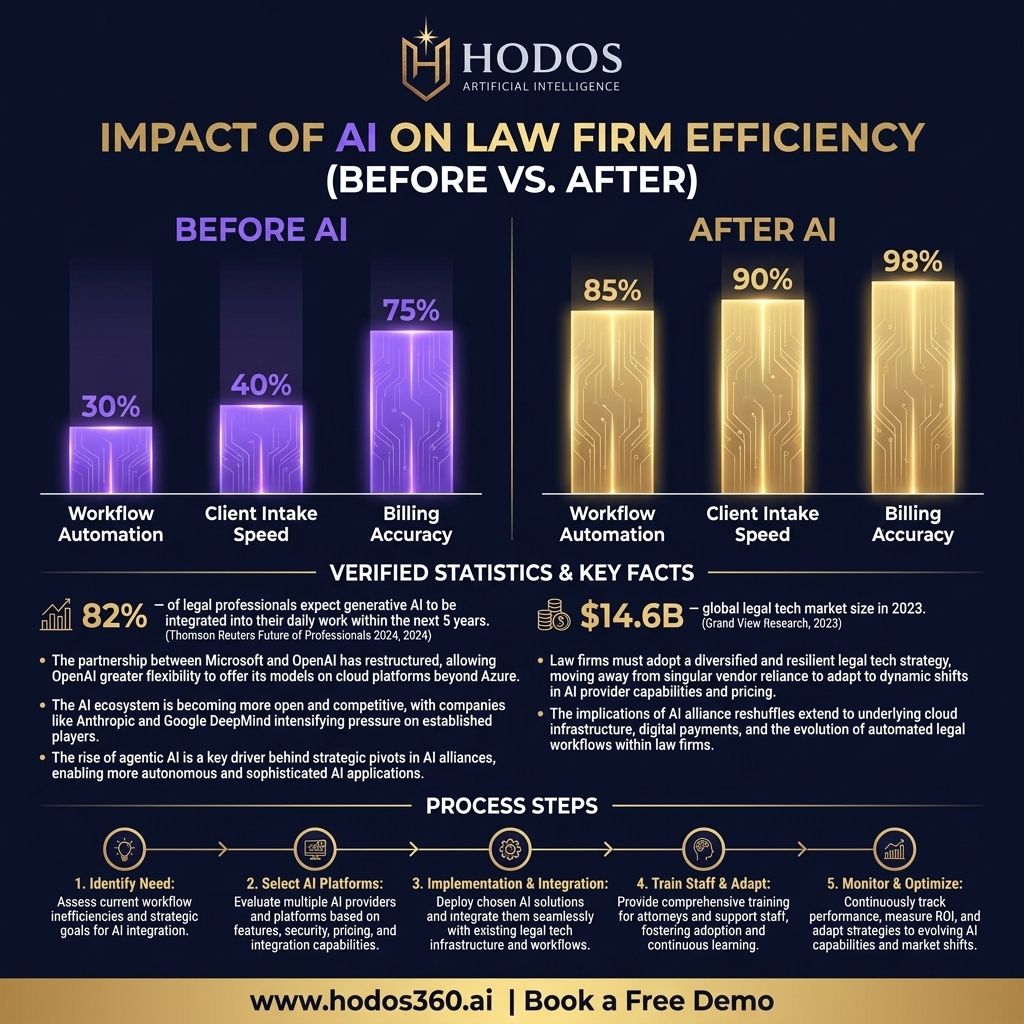
The direct impact of agentic AI on client intake and billing automation is transformative. Imagine an AI voice assistant powered by agentic capabilities, capable of not just answering calls but intelligently qualifying leads, understanding legal needs, and even initiating the client onboarding process by collecting necessary information and scheduling consultations.
This level of automation can dramatically reduce response times and improve the initial client experience. For billing, agentic AI can track every minute of billable work, cross-reference it with engagement letters, and generate highly accurate invoices, minimizing disputes and improving cash flow. Learn more about Strategic AI Tools Adoption: Essential Guide for Law Firms.
Furthermore, these agents can learn from past billing cycles to predict payment behaviors and proactively manage collections, a significant benefit for firms looking to optimize their financial health. According to the ABA TechReport, firms leveraging automation in billing reported up to a 20% reduction in administrative overhead, a figure poised to grow with agentic AI.
Building Resilient Digital Infrastructure for Law Firms
In an era defined by dynamic AI alliances and the rise of agentic systems, building a resilient digital transformation infrastructure is paramount for law firms. This extends beyond simply adopting new software; it involves creating a robust ecosystem that can adapt to technological shifts, ensure data security, and support seamless operations.
The foundation of this resilience lies in a well-architected web and mobile presence, acting as the digital storefront and operational hub for the firm. As the core AI models become more distributed across various cloud providers, firms need their internal systems, including their websites and client portals, to be equally flexible and interoperable.
This means investing in platforms that can integrate with diverse AI services, allowing firms to switch providers or leverage multiple AI models without disrupting their core operations. The focus shifts from vendor lock-in to a more open, API-driven approach, ensuring that a firm's digital infrastructure can evolve as rapidly as the AI landscape itself.
Moreover, the concept of AI-powered website building and responsive design becomes critical. A firm's website is often the first point of contact for potential clients, and its ability to integrate with AI-driven lead qualification, client intake, and scheduling tools is essential. HODOS 360, for instance, offers web and mobile development services that focus on creating AI-powered websites designed for high conversion and seamless integration with advanced legal workflows.
This ensures that a firm's online presence is not just aesthetically pleasing but also a powerful operational asset, capable of handling automated interactions and data collection securely. Such platforms need to be built with SEO optimization in mind, ensuring that the firm remains visible in an increasingly crowded digital marketplace.
Learn more about Claude AI for Legal: The Ultimate Guide to Contract Review. The goal is to create a digital ecosystem that is not only robust but also intelligent, leveraging AI to enhance every aspect of client engagement and internal management.
Data security and privacy are non-negotiable pillars of a resilient digital infrastructure, especially as AI agents handle sensitive client information and financial transactions.
The evolving regulatory landscape, including the enforcement of the EU AI Act and ongoing discussions in the US, places significant obligations on firms to protect data. This means implementing robust cybersecurity measures, ensuring compliance with data protection regulations, and regularly auditing AI systems for biases and vulnerabilities.
Firms must also consider the ethical implications of using AI, particularly in areas like client selection and case strategy, adhering to professional responsibility guidelines such as ABA Model Rule 1.1 on Competence, which implies a duty to stay abreast of technology. The ability to demonstrate transparent and accountable AI usage will become a key differentiator for law firms in the coming years, building client trust and mitigating legal risks.
Finally, the strategic integration of AI into all aspects of firm management—from case management and billing to document automation and calendar management—is vital. An AI law firm management system that can harness the power of agentic AI to automate routine tasks, provide predictive insights, and streamline workflows will significantly enhance operational efficiency.
This holistic approach ensures that AI is not just a siloed tool but an integrated component of the firm’s entire operational fabric. The agility to adapt to new AI models and leverage evolving AI alliances hinges on having a flexible, secure, and intelligently designed digital infrastructure.
Firms that embrace this comprehensive approach will be better positioned to navigate the complexities of the modern legal market and harness the full potential of AI for sustained growth.
Data Security and Compliance Challenges with AI Agents
The deployment of AI agents introduces new dimensions to data security and compliance for law firms. With agents autonomously handling client data, payments, and confidential case information, the attack surface expands. Firms must implement advanced encryption, multi-factor authentication, and continuous monitoring to protect against breaches.
Furthermore, ensuring that AI agents comply with privacy regulations like GDPR, CCPA, and upcoming AI-specific legislation is critical. Learn more about ActiveCampaign 2026: AI Marketing Unleashes Law Firm Growth. This necessitates rigorous data governance frameworks, regular audits of AI agent behavior, and clear accountability mechanisms to address potential data incidents, aligning with principles often discussed in contexts related to ABA Formal Opinion 483 regarding data breaches.
The complexity of these challenges underscores the need for expert guidance in building and maintaining secure AI-powered digital infrastructure.
Navigating Regulatory Compliance in an Evolving AI Landscape
As AI alliances shift and agentic AI becomes more prevalent, the regulatory landscape for artificial intelligence is rapidly evolving, posing significant regulatory compliance challenges for law firms. The European Union's AI Act, set to be fully enforced in the coming years, represents a landmark piece of legislation that categorizes AI systems by risk level and imposes stringent requirements on high-risk applications.
While the U.S. has yet to pass comprehensive federal AI legislation, various states and federal agencies are exploring guidelines, and existing laws, such as those governing data privacy and consumer protection, are being reinterpreted through an AI lens. This patchwork of regulations means law firms must develop a sophisticated understanding of AI governance, not just from a technological standpoint but from a legal and ethical one as well.
The duty of competence (ABA Model Rule 1.1) requires lawyers to understand the risks and benefits of technology, including AI, they use in their practice.
One of the primary concerns for law firms is ensuring that their use of AI, particularly agentic systems, does not inadvertently violate ethical rules or legal statutes.
For instance, if an AI agent is used for client intake, how does the firm ensure it avoids bias in client selection or provides accurate information that doesn't constitute unauthorized practice of law? The potential for AI to generate biased outcomes, especially if trained on non-representative data, is a well-documented issue.
Firms must implement robust testing and auditing mechanisms to detect and mitigate bias in their AI tools. Furthermore, the transparency and explainability of AI decisions, often referred to as 'black box' issues, are becoming key regulatory demands. Firms may need to demonstrate how their AI systems arrive at certain conclusions, particularly in sensitive areas like legal research or predictive analytics, to comply with future disclosure requirements.
Another critical area is the intersection of AI with existing legal frameworks, particularly those related to discovery and evidence. Learn more about Legal AI Gap: Bridging the Divide for Law Firms in 2026. The Federal Rules of Civil Procedure (e.g., Rule 26) already place significant burdens on parties to produce relevant electronic information.
As AI systems generate more data—from automated communications to workflow logs—law firms must be prepared to manage and produce this information in litigation. This includes understanding how AI systems store data, how to forensically retrieve it, and how to authenticate its provenance. The complexity of e-discovery will only increase with the widespread adoption of AI agents, requiring firms to invest in advanced data management and e-discovery solutions that are AI-aware.
This presents a complex challenge, but also an opportunity for firms to lead in developing best practices for AI-driven litigation.
Ultimately, navigating the evolving AI regulatory landscape requires a proactive and multidisciplinary approach. Law firms need to engage legal tech experts, cybersecurity professionals, and ethicists to develop comprehensive AI governance strategies.
This includes establishing internal policies for AI use, conducting regular risk assessments, and staying informed about new legislation and judicial interpretations. Firms that anticipate these regulatory shifts and build compliance into their AI adoption strategy will not only mitigate risks but also build a reputation for responsible innovation, a significant competitive advantage in the modern legal market.
The dynamic nature of AI alliances means firms must always be ready to adapt their compliance strategies to new tools and service providers.
Maximizing ROI with AI-Powered Web Development
To maximize ROI in this AI-driven era, law firms must leverage AI-powered website building and robust web and mobile development. A firm's website is no longer just a brochure; it's a dynamic, interactive platform that can utilize AI for lead generation, client engagement, and even initial legal information dissemination.
By integrating AI-driven analytics, firms can track user behavior, optimize content for SEO, and personalize the client journey. This ensures marketing efforts are not only effective but also measurable, providing clear ROI tracking. Responsive design and high-converting templates, combined with AI-driven content generation for blogs and social media, create a powerful digital marketing engine.
Firms like HODOS 360 offer comprehensive solutions that blend AI marketing with web development, ensuring a cohesive and high-performing digital presence that directly contributes to business growth and profitability.
Strategic Imperatives for Law Firm Innovation and Growth
The shifting landscape of AI alliances and the rise of agentic AI present a clear mandate for law firm innovation and strategic growth. Firms can no longer afford to be passive observers; proactive engagement with emerging technologies is essential for competitive survival and expansion. One key imperative is to cultivate a culture of continuous learning and experimentation within the firm.
This means encouraging attorneys and staff to explore new AI tools, participate in legal tech training, and provide feedback on how these technologies can be best integrated into daily practice. Firms that invest in their human capital's technological literacy will be better equipped to identify and implement impactful AI solutions, moving beyond superficial adoption to true digital transformation.
Another strategic imperative is to embrace a modular and adaptable approach to technology adoption. Given the fluidity of AI alliances and the rapid pace of innovation, firms should prioritize legal tech solutions that offer flexibility and interoperability. This means favoring platforms with open APIs, cloud-agnostic capabilities, and robust integration options, allowing the firm to mix and match the best AI services from various providers without being locked into a single ecosystem.
This strategy not only mitigates vendor risk but also positions the firm to quickly pivot and adopt new, superior AI models as they emerge. As Jensen Huang, CEO of NVIDIA, has repeatedly emphasized, the future of computing is accelerated and distributed, a principle that applies equally to the legal tech stack.
Furthermore, law firms must leverage AI not just for internal efficiency but as a core component of their client service and business development strategies. This involves using AI-powered analytics to identify market trends, understand client needs, and tailor legal services more effectively. AI marketing platforms can generate targeted content, automate social media campaigns, and track ROI, ensuring that business development efforts are data-driven and highly effective.
By demonstrating a forward-thinking approach to technology, firms can differentiate themselves, attract new clients seeking innovative legal solutions, and retain existing ones by offering enhanced value and efficiency. This client-centric application of AI transforms technology from a cost center into a powerful revenue generator.
Finally, the most successful law firms will be those that view AI as an opportunity to redefine the practice of law itself.
This isn't about replacing lawyers with machines, but about augmenting human capabilities, freeing up legal professionals to focus on complex problem-solving, strategic advice, and empathetic client relationships. By automating routine tasks, providing instant access to legal insights, and streamlining operations, AI empowers lawyers to deliver higher quality services more efficiently.
This transformative potential, fueled by the evolving AI alliances and the march of agentic AI, offers a compelling pathway for law firms to achieve sustained innovation and robust growth in the 21st century. The firms that embrace this vision will not just survive; they will thrive, shaping the future of legal practice.

Key Takeaways and Next Steps
The ongoing reshuffling of Big Tech AI alliances and the rise of agentic AI signal a new era for the legal industry. Law firms must recognize that this isn't just a tech trend but a fundamental shift requiring a proactive and adaptive legal tech strategy.
The ability to leverage diverse AI models, integrate agentic systems into workflows, and maintain robust digital infrastructure will be critical for operational efficiency, regulatory compliance, and competitive advantage. Firms that embrace this dynamic environment by fostering innovation, prioritizing data security, and adopting flexible technology solutions will be best positioned for future growth and success.
Engaging with comprehensive legal tech providers, such as HODOS 360, which offers AI-powered law firm management, marketing, voice assistants, and web development, can provide the integrated solutions necessary to navigate this complex landscape effectively. The future belongs to firms that are not only technologically adept but also strategically agile.
- ✓Reassess AI Vendor Strategies: Evaluate current AI tool providers in light of evolving AI alliances. Diversify where possible to avoid vendor lock-in and leverage competitive offerings.
- ✓Invest in Agentic AI Adoption: Explore how agentic AI can automate client intake, billing, and routine legal workflows to boost efficiency and enhance client experience.
- ✓Fortify Digital Infrastructure: Ensure your firm's web and mobile presence, alongside internal systems, is robust, secure, and capable of integrating with diverse AI services.
- ✓Prioritize Regulatory Compliance: Stay abreast of global and local AI regulations (e.g., EU AI Act) and implement governance frameworks to ensure ethical and compliant AI usage.
- ✓Cultivate an Innovation Mindset: Foster a culture of continuous learning and experimentation with new legal tech, empowering your team to drive law firm innovation.
- ✓Leverage AI for Growth: Utilize AI-powered marketing and analytics to identify new business opportunities, optimize client acquisition, and demonstrate clear ROI for tech investments.
Frequently Asked Questions
How do shifting AI alliances impact my law firm's existing legal tech?+
Shifting AI alliances can lead to changes in pricing, features, and availability of AI models your firm currently uses. This necessitates a review of your current tech stack. It may open opportunities for better pricing or more advanced features from new providers, but also requires vigilance to ensure continuity and compatibility with your existing systems and workflows. Firms should assess contracts and consider diversifying AI dependencies.
What is agentic AI and how will it change legal payments?+
Agentic AI refers to AI systems that can autonomously plan and execute complex tasks. In legal payments, this means AI agents could manage entire billing cycles, from generating invoices and sending reminders to processing transactions and reconciling accounts, with minimal human oversight. This will significantly streamline operations, enhance accuracy, and potentially reduce payment delays, requiring robust and secure payment infrastructure.
What are the key cybersecurity concerns for law firms adopting AI agents?+
With AI agents handling sensitive client data, cybersecurity concerns include protecting against unauthorized access, data breaches, and ensuring data integrity. Firms must implement advanced encryption, multi-factor authentication, and continuous monitoring of AI systems. Regular security audits and compliance with data protection regulations are paramount to mitigate risks associated with autonomous AI operations.
How can law firms ensure regulatory compliance with new AI technologies?+
Ensuring regulatory compliance requires a proactive approach. Firms should stay informed about emerging AI legislation (like the EU AI Act), conduct ethical risk assessments for AI tools, and establish clear internal policies for AI use. Adhering to professional responsibility rules, such as ABA Model Rule 1.1 on competence, and ensuring transparency and explainability in AI decision-making are also crucial for maintaining compliance.
What role does web and mobile development play in a law firm's AI strategy?+
Robust web and mobile development provides the essential digital infrastructure for a law firm's AI strategy. AI-powered websites can integrate with AI agents for client intake, lead qualification, and document automation. A responsive, SEO-optimized digital presence ensures visibility, attracts clients, and serves as a seamless interface for AI-driven services, maximizing efficiency and enhancing the overall client experience. It's the digital face of your AI-powered firm.