
AI Search Optimization: An Essential Guide for Law Firms
The digital frontier for law firms has never been more dynamic, yet simultaneously more challenging. Consider the predicament of Sterling & Associates, a mid-sized corporate law firm in downtown Toronto. Despite a stellar reputation for complex litigation and a roster of highly qualified partners, their online visibility plateaued.
Traditional search engine optimization (SEO) efforts, once reliable, seemed to yield diminishing returns. "We're doing everything by the book – quality content, keyword research, local listings – but our organic traffic isn't reflecting our expertise," lamented Eleanor Vance, a senior partner at the firm, during a recent internal strategy meeting.
This sentiment echoes across the legal industry as Google's algorithms, powered by sophisticated artificial intelligence, continue to evolve at an unprecedented pace, rendering yesterday's best practices obsolete.
This shift isn't just theoretical; it's a tangible force reshaping market leadership. A recent blogTO article, "5 of the best SEO companies in Toronto leading in AI search optimization," underscores this critical transition.
It highlights how forward-thinking digital marketing agencies are already leveraging AI to help businesses, including law firms, adapt to an era dominated by semantic understanding, user intent, and conversational search. Firms that fail to embrace this transformation risk being relegated to the digital shadows, missing out on crucial client acquisition opportunities in a fiercely competitive market.
The gap between firms adopting AI for discovery and those clinging to outdated methods is widening, creating both tension and immense opportunity.
This comprehensive guide aims to demystify AI search optimization for law firms, providing actionable strategies to not only survive but thrive in this new digital landscape.
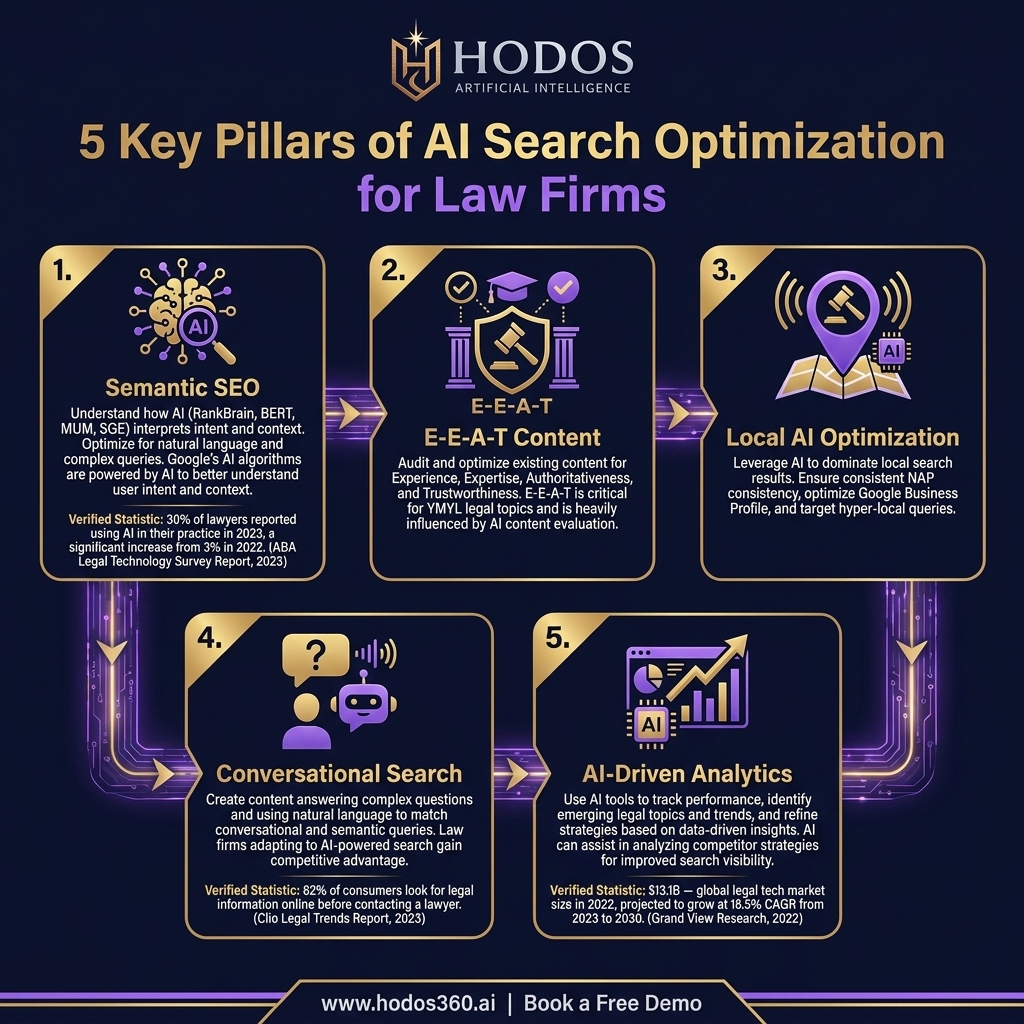
We'll explore the intricacies of AI-powered algorithms, delve into strategic content generation that satisfies Google's E-E-A-T (Experience, Expertise, Authoritativeness, Trustworthiness) guidelines, and outline how to leverage AI for unparalleled local search dominance and client acquisition. This isn't just about finding an agency; it's about empowering your firm with the knowledge and tools to command your digital presence.
For law firms ready to lead, understanding and implementing AI search optimization is no longer an option, but an essential imperative. Discover how to revolutionize your firm's online strategy today.
The Evolving Landscape of Legal SEO: Why AI Search Optimization Matters
The past decade has seen a seismic shift in how search engines, particularly Google, interpret and deliver information. Gone are the days when keyword stuffing and rudimentary link building guaranteed top rankings. Major algorithm updates like RankBrain (2015), BERT (Bidirectional Encoder Representations from Transformers, 2019), and MUM (Multitask Unified Model, 2021) have fundamentally transformed search from simple keyword matching to a sophisticated understanding of context, intent, and natural language.
As Google's Search Liaison, Danny Sullivan, frequently articulates, the goal is to provide the most relevant and helpful information, often anticipating user needs. This evolution necessitates a complete rethinking of legal SEO, pushing firms towards genuine AI search optimization that aligns with these advanced interpretative capabilities.
For the legal industry, this evolution is particularly pronounced. Law firms deal with highly complex, nuanced queries that demand precise and authoritative answers. A generic approach to SEO often falls short, failing to capture the specific intent behind queries like "intellectual property dispute lawyer Toronto" or "Ontario commercial lease agreement review."
Firms like Allen & Overy, for example, have not only embraced AI for internal efficiency through partnerships with entities like Harvey AI but have also implicitly understood how this deep linguistic processing impacts their external content strategy. Their ability to articulate complex legal concepts in a manner comprehensible to both human clients and AI algorithms gives them a significant edge, illustrating the critical need for a specialized approach to digital presence.
The competitive pressure on law firms to excel digitally is mounting. Learn more about AI Virtual Assistant: Essential for Modern Law Firms. According to Thomson Reuters' latest "State of the Legal Market" report, client acquisition remains a top challenge, with digital channels playing an increasingly dominant role.
Firms that are leading in competitive markets like Toronto, as evidenced by the blogTO article spotlighting top AI SEO agencies, are those that have adapted their strategies to leverage AI for discovery and visibility. This isn't merely about being found; it's about being found by the *right* clients for high-value, complex cases, which requires a nuanced understanding of how AI interprets legal expertise and client needs.
The firms that embrace AI search optimization are the ones carving out market share.
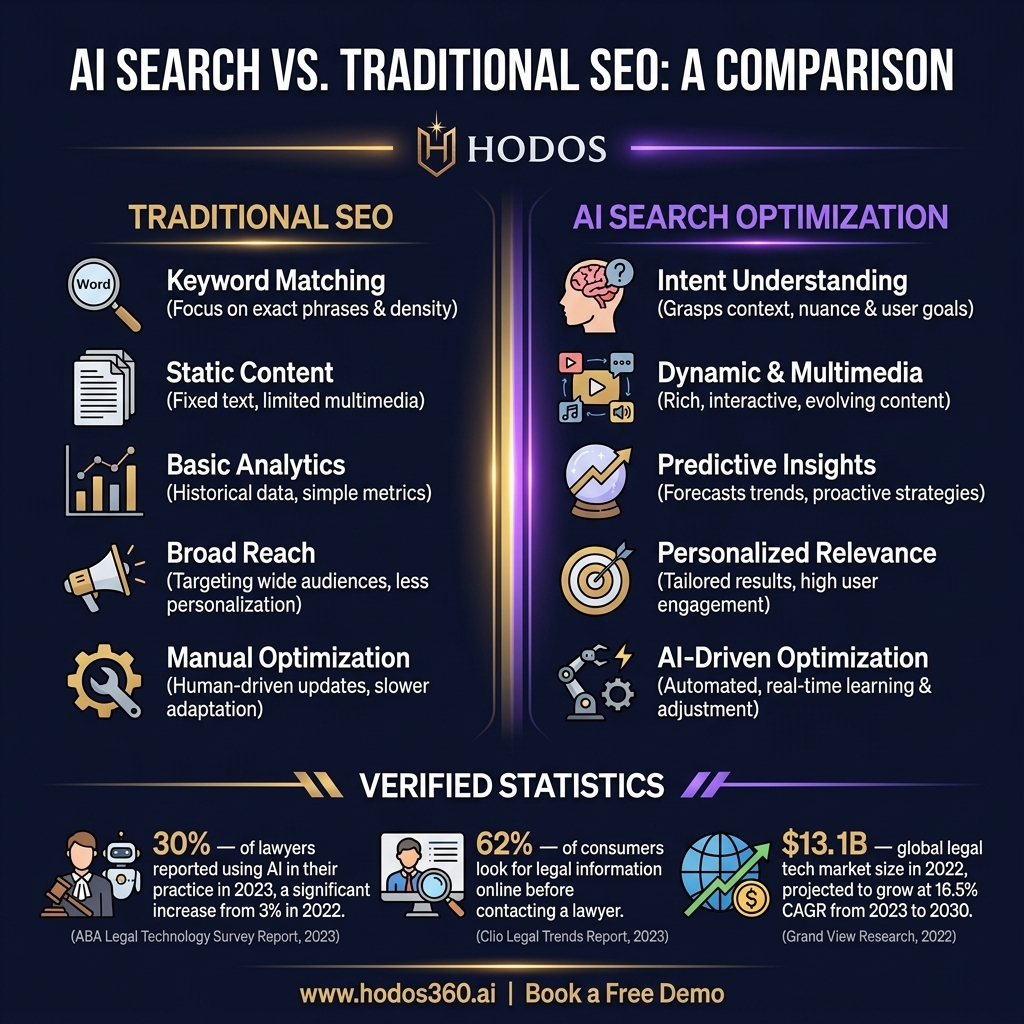
Therefore, AI search optimization for law firms is not just a collection of tactics; it represents a fundamental paradigm shift in how legal professionals approach their online presence. It involves utilizing AI-powered tools and methodologies to predict user intent, optimize for an increasingly conversational search environment, and create hyper-relevant, authoritative content that resonates with both potential clients and sophisticated algorithms.
This holistic approach ensures that a firm's digital strategy is not only current but future-proof. Platforms like HODOS 360's AI Marketing Platform are designed precisely to offer law firms the integrated tools necessary to navigate these complexities, from content generation to social media automation, ensuring they stay ahead in the race for digital visibility.
Understanding AI-Powered Search Algorithms: Beyond Keywords
Modern AI algorithms, such as Google's experimental Search Generative Experience (SGE), are revolutionizing how search results are presented. These models synthesize information from various sources, often providing direct, conversational answers rather than just a list of links. This fundamental change impacts how law firms must structure their content; it's no longer enough to have a page with keywords if the content doesn't comprehensively address the user's underlying question.
A recent report by Gartner highlighted that by 2028, 60% of search queries will involve generative AI, emphasizing the urgency for professional services firms to adapt their digital strategies. The shift demands a focus on semantic SEO, where content is optimized for meaning and context, not just individual terms.
Semantic SEO requires an understanding of entities and their relationships. For instance, instead of merely optimizing for "personal injury lawyer," a firm must consider related entities like "motor vehicle accident claims Ontario," "slip and fall liability," or "brain injury compensation." AI algorithms excel at understanding these complex relationships, linking seemingly disparate pieces of information to form a holistic view of a topic.
This means content must demonstrate deep knowledge, connecting various legal concepts and offering comprehensive insights. Learn more about Privilege & AI: The Ultimate Guide After US v. Heppner. Law firms that structure their websites and content around these semantic networks will find themselves favored by AI-driven search engines, as their content will naturally align with the interconnected knowledge graphs that these algorithms build.
The user experience (UX) and engagement signals are increasingly critical factors for AI algorithms. Metrics such as dwell time, bounce rate, and click-through rates provide AI with insights into the quality and relevance of content. A study by Moz indicated that pages with higher engagement metrics often correlate with improved search rankings, as these signals tell Google that users found the content valuable.
Therefore, law firms need fast-loading, mobile-responsive websites that are intuitive and easy to navigate. A seamless user experience ensures visitors stay longer, consume more content, and engage more deeply, all of which are positive signals to AI algorithms. This foundational aspect of digital presence is a core offering of HODOS 360’s Web & Mobile Development service, ensuring firms have a robust and user-friendly online platform.
Ethical Considerations in AI Search Optimization
As law firms increasingly leverage AI for content generation and AI search optimization, the ethical implications become paramount. The legal profession is bound by strict rules regarding truthfulness and non-misleading communications, as enshrined in the ABA Model Rules of Professional Conduct, specifically Rule 7.1, which prohibits false or misleading communications about a lawyer’s services.
AI-generated content, while efficient, carries the risk of "hallucinations" or inaccuracies, which could severely compromise a firm's reputation and lead to ethical violations. Firms must implement rigorous human oversight, ensuring that all AI-assisted content is thoroughly reviewed, fact-checked, and compliant with legal and ethical standards before publication.
The responsible use of AI is not just a best practice but a professional obligation. Learn more about AI Adoption: The Ultimate Guide for Law Firm Growth. Moreover, data privacy regulations, such as the California Consumer Privacy Act (CCPA), also come into play when using AI to analyze user data for optimization purposes, requiring careful handling of personal information.
Beyond accuracy, the rise of conversational search and voice assistants like Google Home, Amazon Alexa, and professional AI Voice Assistants means search queries are becoming more natural and question-based. Law firms must optimize for long-tail, conversational keywords that mimic how a potential client might phrase a question aloud.
This involves understanding the nuances of spoken language and structuring content to directly answer these questions. For example, instead of just "divorce lawyer," optimizing for "what are my rights in a divorce in Ontario?" or "how much does a divorce cost in Toronto?" This proactive approach to conversational AI search optimization ensures that firms are discoverable across all modern search modalities, capturing a wider spectrum of client inquiries.
Strategic Content Generation for AI Search: Expertise, Authority, Trust (E-A-T)
Google’s E-E-A-T (Experience, Expertise, Authoritativeness, Trustworthiness) guidelines are exceptionally critical for "Your Money, Your Life" (YMYL) topics, a category that legal advice squarely falls into. For law firms, demonstrating genuine legal expertise and authority is not just a ranking factor; it's a foundational requirement for building client trust and credibility.
This means going beyond superficial content to showcase the profound knowledge and experience of your legal professionals. Firms can achieve this by featuring detailed lawyer bios that highlight specific case successes, academic citations, thought leadership articles published in reputable legal journals, and public speaking engagements at industry conferences like LegalTech NYC.
Each piece of content should reinforce the firm's deep understanding and practical experience in its practice areas, signaling to AI algorithms that the content originates from a highly credible source.
While AI cannot replace human legal expertise, it can significantly enhance and scale the creation of high-quality content.
AI-powered tools can assist in comprehensive legal research, outline complex articles, and draft initial content pieces, freeing up attorneys to focus on strategic insights and critical review. Platforms offering AI-powered content generation can help law firms produce a consistent stream of articles, blog posts, and legal guides that are both SEO-optimized and legally sound, provided they undergo rigorous human attorney review.
Learn more about Voice AI: Essential for Law Firms, Touting Twilio's Success. This synergistic approach allows firms to maintain a robust online presence with fresh, relevant content without overburdening their legal teams. The collaboration between human expertise and AI efficiency is the hallmark of effective AI search optimization.
Beyond traditional text, multimedia content is increasingly vital for engaging audiences and satisfying AI-driven search. Engaging videos, informative podcasts, and compelling infographics can break down complex legal concepts into digestible formats. AI video creation tools and social media automation, often part of integrated marketing platforms, empower firms to produce diverse content efficiently.
Companies like OpenAI and Google DeepMind are continually pushing the boundaries of multimodal AI, making it easier for even mid-sized firms to leverage sophisticated content formats. This rich media not only improves user engagement but also provides more signals for AI algorithms to understand the depth and breadth of a firm's expertise, boosting its overall digital authority.
Personalizing Legal Content with AI
AI offers powerful capabilities for personalizing legal content, moving beyond generic advice to hyper-relevant information tailored to specific client segments. By analyzing anonymized and privacy-compliant client data, AI can identify common pain points, frequently asked questions, and specific legal needs within a firm's target demographic.
This allows firms to create targeted educational content, customized service descriptions, and even personalized email campaigns that directly address the individual concerns of potential clients. For instance, an AI might identify a surge in queries related to "startup legal advice Toronto" and prompt the creation of a series of articles specifically for tech entrepreneurs, rather than broad corporate law content.
This level of personalization significantly enhances the client journey and conversion rates, fostering deeper engagement and trust.
Crucially, AI search optimization is an ongoing, iterative process. Learn more about AI Legal Platform: Essential Security for Law Firms. AI search models continually reward fresh, accurate, and comprehensive content.
Law firms must implement a strategy for regular content audits, reviewing existing articles and guides to update outdated information, incorporate new legal developments, and add fresh insights. This continuous refinement ensures that content remains relevant and authoritative, signaling to AI algorithms that the firm is a reliable and current source of legal information.
Firms that neglect this aspect risk having their content fall behind, losing ground to competitors who are actively maintaining and improving their digital assets in response to evolving search trends and legal precedents.
Leveraging AI for Local Search and Client Acquisition in Competitive Markets
For law firms operating in densely populated, competitive urban centers like Toronto, local SEO is an indispensable component of AI search optimization. Google's local pack and map results are heavily influenced by a triumvirate of factors: proximity, relevance, and prominence. AI algorithms are increasingly sophisticated at interpreting location-based queries and matching them with the most relevant local businesses.
This means a firm's physical presence and its digital representation in local search results are intrinsically linked. Optimizing for local search ensures that when a potential client in Toronto searches for "family lawyer near me" or "estate planning services downtown," your firm appears prominently, capturing immediate, high-intent leads that are geographically relevant.
Optimizing your Google Business Profile (GBP) with an AI-informed mindset is paramount. This involves more than just basic information; it requires meticulous attention to accurate category selection, detailed service descriptions, consistent NAP (Name, Address, Phone) information across all online directories, and proactive management of client reviews.
AI can analyze sentiment within client reviews, identifying common themes, strengths, and areas for improvement. Learn more about Essential Legal AI Access: NELLCO's Broad Impact. This feedback loop can inform not only service enhancements but also guide content strategy, allowing firms to create FAQs or blog posts directly addressing common client queries.
A well-maintained and active GBP is a powerful signal to AI algorithms, enhancing a firm's local prominence and trustworthiness, especially in competitive markets like Toronto where agencies and professional services vie for top local rankings.
The power of local citations and strategic link building continues to hold sway in an AI-driven environment.
While the quantity of links is less important than it once was, the *quality* and *relevance* of backlinks are more crucial than ever. AI algorithms are adept at discerning authoritative and contextually relevant links. For law firms, this means actively seeking citations from reputable local legal directories, bar associations (e.g., the Law Society of Ontario), and community organizations.
Building relationships with local businesses and participating in community events can also generate valuable local links and mentions, which signal to AI that your firm is an active and respected part of the local ecosystem, thereby boosting its local search authority.
AI-Powered Lead Qualification and Appointment Booking
The journey from a local search query to a converted client needs to be seamless, and this is where AI truly shines in optimizing the client acquisition funnel. Once a potential client discovers a firm through local search, the next critical step is engagement and qualification.
AI Voice Assistants, such as those offered by HODOS 360, provide 24/7 phone answering, ensuring no potential lead is missed, regardless of time zones or office hours. These assistants can intelligently qualify leads based on predefined criteria, gather essential information, answer common questions, and even book appointments directly into the firm's calendar.
This automation not only enhances efficiency but also provides an exceptional client experience, ensuring that high-intent leads are captured and processed swiftly, giving firms a significant competitive advantage over those relying solely on traditional call answering services.
Finally, a geo-targeted content strategy is indispensable for local AI search optimization.
Creating content that specifically addresses legal issues pertinent to residents of a particular city or region signals immense relevance to AI algorithms for local search queries. For example, articles titled "Ontario family law changes impacting Toronto residents" or "Commercial real estate regulations in the Greater Toronto Area" demonstrate a deep understanding of local nuances and legal specificities.
This hyper-local content strategy not only attracts local clients but also reinforces the firm's authority within its geographic service area, making it a go-to resource for local legal information and services.
Implementing AI-Driven Analytics and Performance Tracking
The adage "what gets measured, gets managed" is more pertinent than ever in the realm of AI search optimization. Without robust, AI-driven analytics and performance tracking, law firms operate in the dark, unable to discern which strategies are yielding results and which require refinement. Traditional metrics like website traffic and keyword rankings remain important, but AI-powered analytics delve significantly deeper, providing granular insights into user behavior, conversion paths, and the true return on investment (ROI) of digital marketing efforts.
Platforms like Google Analytics 4 (GA4), with its AI-powered insights and predictive capabilities, allow firms to move beyond surface-level data to understand the intricacies of client engagement and digital performance, providing a clear roadmap for continuous improvement.
Beyond simple clicks and impressions, law firms must track advanced metrics that reflect user intent fulfillment and deeper engagement.
This includes analyzing the time-on-page for critical legal topics, the progression through a client's journey from initial search query to client intake, and engagement with specific content sections. AI can identify subtle patterns in this vast dataset that human analysis might miss, revealing unexpected insights into client preferences and pain points.
For instance, AI might uncover that articles featuring specific case studies have significantly higher conversion rates, prompting the firm to create more such content. These advanced metrics empower firms to make data-driven decisions that directly impact their bottom line, optimizing every facet of their online presence for maximum effectiveness.
Accurate ROI tracking and sophisticated attribution modeling are crucial for law firms, where understanding the direct link between a marketing expenditure and a new client acquisition is paramount. AI-powered platforms offer more sophisticated, multi-touch attribution models that can assign credit to various touchpoints in the client journey—be it an initial blog post, a targeted social media ad, or an interaction with an AI Voice Assistant—that contributed to a conversion.
This allows firms to allocate their marketing budget more effectively, investing in channels and strategies that demonstrate the highest impact. The precision of AI-driven attribution ensures that every marketing dollar is working efficiently, maximizing the firm's return on its digital investments.
AI search optimization is not a static endeavor; it is an ongoing, adaptive process that requires continuous optimization through AI feedback loops.
AI tools can monitor real-time changes in search trends, analyze competitor strategies, and track algorithm updates, providing proactive recommendations for content adjustments, technical SEO improvements, and campaign optimizations. This adaptive approach ensures that a firm's digital strategy remains agile and responsive to the ever-evolving search landscape.
By embracing continuous optimization, law firms can maintain their competitive edge, consistently ranking higher and attracting more qualified leads, thereby securing their long-term growth and market leadership in a dynamic digital world.

Key Takeaways and Next Steps
The digital world for law firms is undergoing a profound transformation, making AI search optimization an undeniable imperative for sustained growth and market leadership. The era of simple keyword matching is over; success now hinges on understanding AI-powered algorithms, demonstrating unparalleled E-E-A-T through strategic content, dominating local search with precision, and leveraging AI-driven analytics for continuous improvement.
Firms that proactively embrace these strategies will not only elevate their online visibility but also attract a higher caliber of clients, cementing their authority in an increasingly crowded legal market.
For law firms ready to embrace this future, the time to act is now. Start with a comprehensive digital audit, invest in continuous learning for your team, and consider integrated platforms that provide a holistic solution.
Platforms like HODOS 360 offer a comprehensive suite of AI-powered services—from an AI Marketing Platform that streamlines content and social media to AI Voice Assistants that capture and qualify leads 24/7—providing the tools necessary to compete and thrive in this evolving digital landscape. The legal profession is at an inflection point; those who leverage AI will define the future of practice.
Embrace AI, optimize your search presence, and secure your firm's future.
Frequently Asked Questions
What is AI search optimization for law firms?+
AI search optimization for law firms involves leveraging artificial intelligence tools and strategies to enhance a firm's online visibility and authority in search engine results. It moves beyond traditional keyword-focused SEO to optimize for semantic understanding, user intent, conversational queries, and Google's E-E-A-T guidelines, ensuring content is highly relevant and authoritative for AI-driven algorithms and potential clients.
How do Google's AI algorithms impact legal SEO?+
Google's AI algorithms, like BERT, MUM, and SGE, impact legal SEO by prioritizing content that demonstrates deep semantic understanding, answers complex queries comprehensively, and provides exceptional user experience. They assess content for expertise, authority, and trustworthiness (E-E-A-T), making it crucial for law firms to produce high-quality, legally accurate information that satisfies both human users and sophisticated AI models.
Can AI replace human lawyers in content creation?+
No, AI cannot replace human lawyers in content creation, especially for legal advice. While AI can assist significantly in research, outlining, and drafting content, human legal expertise is indispensable for ensuring accuracy, ethical compliance (per ABA Model Rule 7.1), and strategic nuance. AI serves as a powerful tool to scale and optimize content production, but human oversight and review by qualified attorneys remain critical.
What role does local SEO play in AI search optimization for law firms?+
Local SEO plays a crucial role in AI search optimization for law firms, particularly in competitive markets like Toronto. AI algorithms prioritize local relevance for geographically specific queries. Optimizing Google Business Profile, securing local citations, and creating geo-targeted content signal local authority and prominence to AI, ensuring firms appear in local pack results and attract high-intent clients in their service area.
How can law firms measure the ROI of AI search optimization efforts?+
Law firms can measure the ROI of AI search optimization efforts through AI-driven analytics platforms like Google Analytics 4. These tools track advanced metrics beyond basic traffic, including user engagement, conversion paths, and multi-touch attribution. By analyzing which AI-optimized content and channels contribute directly to qualified leads and client intake, firms can accurately assess the financial return on their digital marketing investments.